Most secondary classrooms now do the majority of their reading on a screen. The article is a link, the novel is a PDF, the primary source is a scan, and the class set of paperbacks is three years out of date and eleven copies short. That shift happened for practical reasons, not instructional ones, and it happened faster than anyone built a plan for it.
The research on screen reading is genuinely unflattering in places. It is also narrower than the headlines suggest, and the conditions where the gap shows up are conditions a teacher can change. That is the useful part.
What follows is what the evidence supports, what a Lexile measure does and does not tell you, how to run one text at three levels without writing three lessons, and which of the free platforms are actually free.
Key Takeaways
- The print advantage is real but small and conditional. The largest meta-analysis found an effect of roughly g = −0.21 favoring paper — and no advantage at all for narrative text.
- Time pressure is where the gap opens. Under a clock the paper advantage roughly triples compared with self-paced reading.
- Students overestimate how much they understood on screen. That miscalibration is the finding with the clearest classroom fix.
- Lexile bands describe texts, not students. They overlap on purpose, and they say nothing about background knowledge, motivation, or content maturity.
- Three pathways, one question. Differentiating the text is not the same as differentiating the thinking.
- "Free" varies. ReadWorks and Project Gutenberg are free outright. CommonLit has a real free tier. Newsela’s free account is a rotating sample, not the library.
Free Download · 2-page PDF
Digital Reading Setup Planner
The 20-minute routine with space to write your own version, a five-question check for the text before you assign it, a three-pathway planner, and a blank comprehension tracker.
Free. No email address required. Designed for grades 6–12. Browse every printable in Your Free Library.
What Actually Changed When the Books Went Away
Three things changed at once, and they are worth separating because only one of them is about screens.
The text became infinitely available. A teacher can now put a 1914 telegram, a modern historian’s argument, and a plain-language summary of the same event in front of thirty students in about four minutes. That is a genuine gain and it is the reason nobody is going back.
The text lost its edges. A paperback tells you how far in you are by feel. A scroll bar tells you almost nothing, and an article with three embedded videos and a comment section tells you less than that. Physical location in a text turns out to be part of how people remember it.
The reading moved onto a device built for skimming. This is the part that matters most, and it is also the part a classroom can control. The device is not the problem so much as the habit the device was trained into.
What the Research Says About Print and Digital Comprehension
The most cited study here is Delgado and colleagues’ 2018 meta-analysis in Educational Research Review, published under the blunt title "Don’t throw away your printed books." It pooled 54 studies and more than 171,000 participants, and it found a small advantage for paper: Hedges’ g of about −0.21.
Read the moderators and the picture gets more useful than the title suggests:
- Time pressure. Under a time limit the paper advantage was about g = −0.26. When readers set their own pace it fell to roughly −0.09.
- Text type. The advantage appeared for informational text (about −0.27) and mixed text (−0.30). For narrative text alone it was essentially zero.
- Not the device. The type of digital device did not explain the difference, and neither did educational level.
- The gap grew over time. Effect sizes favoring paper increased across the publication years studied, which is the opposite of what "digital natives will adapt" predicted.
Clinton’s 2019 systematic review in the Journal of Research in Reading reached the same direction across 33 studies and added the finding that is most actionable in a classroom: across eleven studies of metacognition, readers were more overconfident after reading from screens. They thought they had understood more than they had.
Be careful what you do with this. It is not evidence that technology harms achievement, and it is not a case for banning devices. It is evidence that a particular combination — dense informational text, a clock, and a screen — produces worse comprehension and more confidence in it than the reader has earned. Every one of those three is under a teacher’s control.
What a Lexile Measure Is — and What It Does Not Tell You
A Lexile measure is a number produced by an algorithm that looks at two things: sentence length and word frequency. Longer sentences and rarer words produce a higher number. That is the whole mechanism.
It is genuinely useful for the thing it does. It is a fast, consistent way to sort a pile of texts by surface difficulty, which is a real problem when you are choosing among forty search results at 9 p.m.
Here is what it cannot see:
- Background knowledge. A 900L article about the Dust Bowl is harder for a student who has never heard of it than an 1100L article about a sport they play.
- Conceptual difficulty. Short sentences and common words can carry a genuinely hard idea. Some philosophy scores low and reads hard.
- Content maturity. Lexile has nothing to say about whether a text is appropriate for a fourteen-year-old. Of Mice and Men scores around 630L.
- Structure and layout. Headings, images, and paragraph length change how readable a text is and are not part of the measure.
- Accessibility. Contrast, font, line length, and whether the text works with a screen reader do not register at all.
The most important distinction, and the one most often collapsed: a Lexile text measure and a Lexile reader measure are two different numbers. A student is not "a 1000L reader" in any fixed sense, and a grade band is not a requirement anyone has to hit.
The Lexile Text-Complexity Bands by Grade
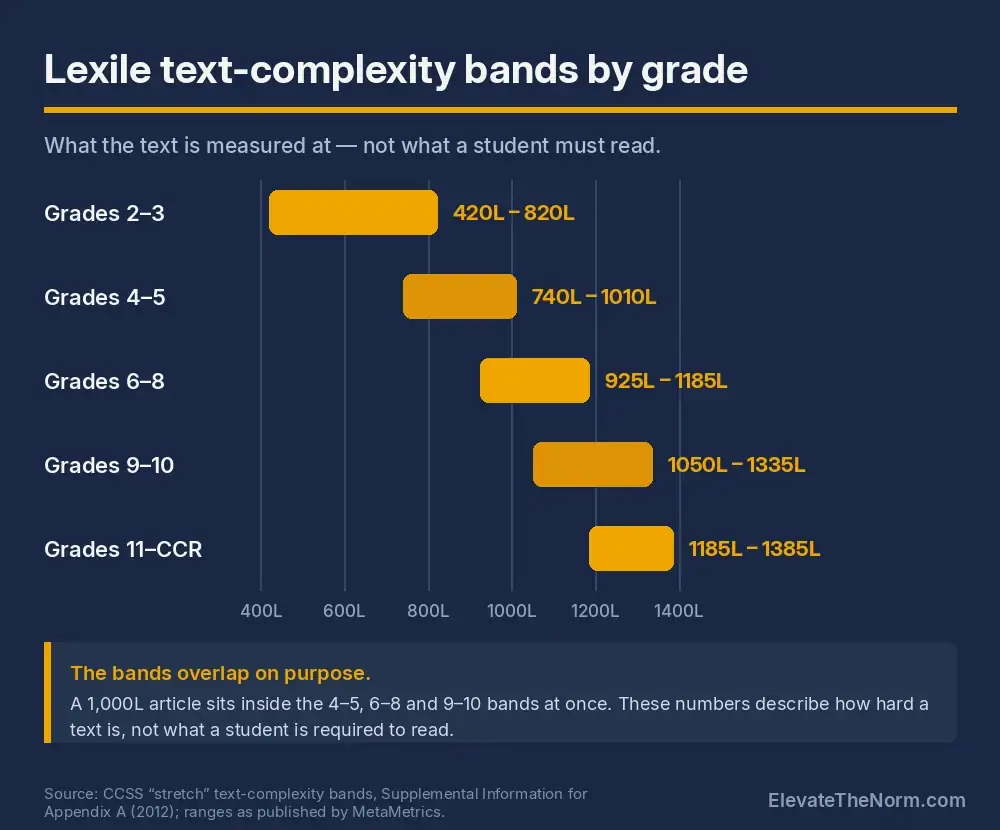
The bands below are the ones most state documents and platform filters use. They are the "stretch" text-complexity bands published in the 2012 Supplemental Information for Appendix A of the Common Core State Standards, which revised the original 2010 ranges upward to close the gap between high school text and college and career text. The figures match those published by MetaMetrics, the organization that develops the Lexile Framework.
| Grade band | Lexile text range |
|---|---|
| Grades 2–3 | 420L – 820L |
| Grades 4–5 | 740L – 1010L |
| Grades 6–8 | 925L – 1185L |
| Grades 9–10 | 1050L – 1335L |
| Grades 11–CCR | 1185L – 1385L |
Notice the overlap. A 1,000L article sits inside the 4–5, 6–8, and 9–10 bands simultaneously. That is not sloppiness; it is an admission that a single number cannot place a text in one grade. Treat the bands as a sorting aid and nothing more.
Differentiating Without Writing Three Lessons
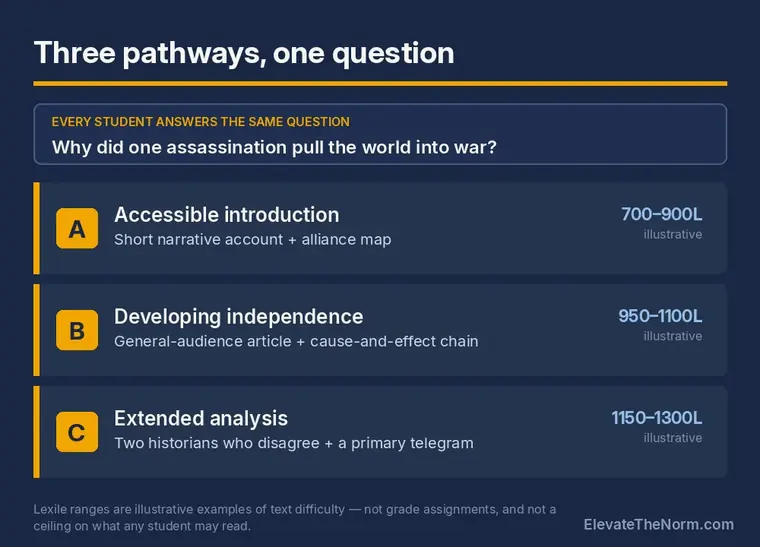
The mistake most differentiation makes is differentiating the thinking along with the text. The student on the easier reading gets the easier question, and by March everyone knows which group they are in and what it means.
The alternative is to hold the question fixed and vary the road to it. Take a World War I unit and the question Why did the assassination of one archduke pull the world into war?
- Pathway A — a short narrative account of June 1914 with a labeled alliance map. Students mark who was bound to defend whom, then answer the question in four sentences using two pieces of evidence.
- Pathway B — a general-audience history article covering alliances, mobilization timetables, and imperial rivalry. Students build a cause-and-effect chain and rank the causes they can defend.
- Pathway C — two historians who disagree about German responsibility, plus a primary telegram. Students weigh the interpretations and argue which cause carries the most weight.
All three students answer the same question, and all three can be part of the same discussion, because the discussion is about the question and not about the article. If you want more worked versions of this in a history context, the history project ideas collection has units built the same way.
Two rules keep this from becoming tracking. First, students move between pathways within a unit, and they know it. Second, nobody is prevented from taking a harder pathway because a number said so — the expectation stays where it was and the support changes.
Seven Strategies That Make Digital Reading Work
Each of these targets something the research actually identified, rather than being a general good idea about technology.
- Take the clock off, or move it. The paper advantage roughly triples under time pressure. If a reading has to be timed, time the task after the reading rather than the reading itself.
- Require a mark on every paragraph. A question, an underline, a two-word summary — the form matters less than that it makes passive scrolling impossible. This is the single cheapest fix on the list.
- Restore the edges. Tell students how long the text is, how many sections it has, and where they should be at the halfway point. Give a screen text the boundaries a book has for free.
- Break the overconfidence before it sets. Ask for a prediction of their own score, then check. One round of being wrong about how much they understood is worth more than a lecture about careful reading.
- Pre-teach three or four words, not fifteen. Vocabulary load is half of what a Lexile measure is actually detecting. Clearing the four words that carry the argument changes the reading more than a long list does.
- Put discussion between reading and assessment. Talk repairs a surprising amount of what a first read missed, and it does it before the misunderstanding gets written down.
- Move the final answer to paper. Not because paper is sacred, but because it removes the copy-paste path and forces retrieval from memory. There are other engagement moves worth pairing with this, but this one is the least negotiable.
Four Free Digital Reading Tools, Described Honestly
"Free" means four different things across these platforms, and the difference matters if you are planning a unit around one. The details below were checked on September 17, 2026.
| Tool | What is free | What is not |
|---|---|---|
| ReadWorks | Everything. The nonprofit states it is free and will always be free for all teachers and students: 6,000+ K–12 texts, question sets, vocabulary tools, paired texts, automated grading, Google Classroom and Clever integration. | No paid tier is offered. It runs on donations. |
| CommonLit | A real free tier — the full text library, the CommonLit 360 curriculum, on-demand training, and kickoff webinars, with no contract. | School-wide paid plans (School Essentials PRO and PRO Plus, priced per school per year) add administrator data dashboards, LMS integrations, a dedicated account manager, and implementation support. |
| Newsela Lite | A rotating, staff-selected sample of articles at five reading levels, with assignments, due dates, level locking, quiz scores, annotations, and Google Classroom. | The full library. Free articles expire after about four weeks. Text Sets, Collections, Power Words, printing and data download, admin console, LMS auto-rostering and auto-rostered accounts are paid. |
| Project Gutenberg | Everything, with no registration — 79,000+ ebooks whose U.S. copyright has expired, readable in a browser or on an e-reader. | No leveling, no questions, no teacher tools. It is a library, not a platform. Nothing published recently enough to still be in copyright. |
One practical note on leveled versions: when a platform rewrites an article down a level, it usually shortens sentences and swaps vocabulary, which is exactly what the Lexile algorithm measures. It does not always preserve the argument’s structure. Read the lower version before you assign it, particularly if the lesson turns on how the author reasons rather than what the author concludes. The same caution applies to the free templates and planning tools that come bundled with these platforms: useful, but not a substitute for looking at the thing.
The 20-Minute Digital Reading Routine
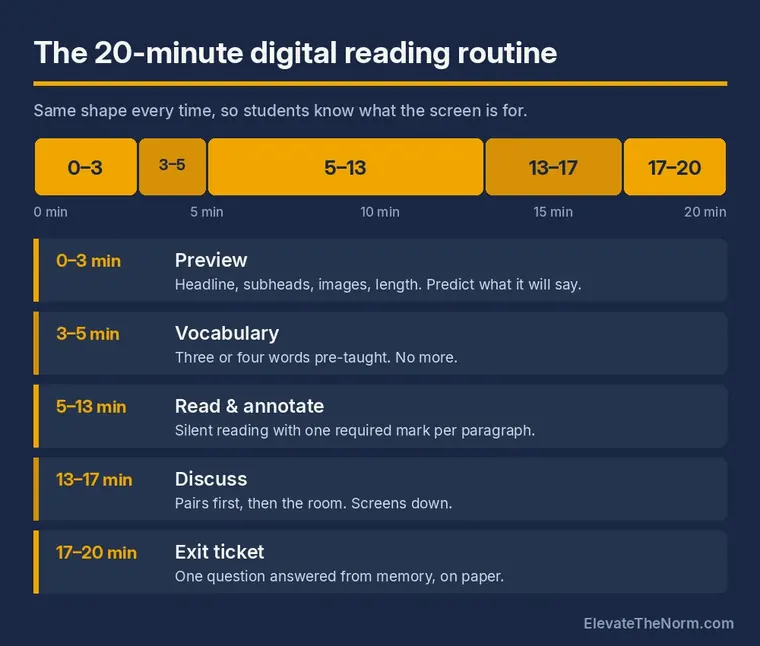
The shape matters more than the minutes. Students who know what a reading block is going to look like stop treating the tab as an invitation to open another one.
- 0–3 — Preview. Headline, subheads, images, length. Predict what it will say. This is the step that restores the edges a printed page gives for free.
- 3–5 — Vocabulary. Three or four words, pre-taught. No more.
- 5–13 — Read and annotate. Silent, self-paced, with one required mark per paragraph. Self-paced is the condition where the research gap nearly closes.
- 13–17 — Discuss. Pairs first, then the room. Screens down.
- 17–20 — Exit ticket. One question, answered from memory, on paper.
Like any other classroom procedure, this has to be taught and practised rather than announced. The first three or four times it will run long. After that it runs itself, and the eight minutes of actual reading are worth more than twenty unstructured ones.
How to Tell Whether Comprehension Actually Improved
This is where most articles about digital reading show you a chart of rising scores. There is no such chart here, because any numbers on it would be invented. What is worth tracking, and what the research suggests you should track, is the gap between what students think they understood and what they did.
Ask for a predicted score before the exit ticket, record both, and watch the difference. That difference is the overconfidence effect made visible, and it is the number most likely to move first. The template below is empty on purpose — fill it with your own class.
| Week | Text and Lexile | Avg. predicted score | Avg. actual score | Gap | What changed |
|---|---|---|---|---|---|
| 1 | |||||
| 2 | |||||
| 3 | |||||
| 4 | |||||
| 5 |
Two cautions. Five weeks of one class is not evidence of anything beyond that class, so resist writing it up as a finding. And if scores rise, the reading routine is one of a dozen things that changed — including the students getting better at your exit tickets. The point of the table is to notice, not to prove. Wider habits for checking what students actually know apply here without modification.
Accessibility Is Not Lowering the Bar
Digital text is the first format in the history of schooling that a student can adjust without asking permission, and that is the strongest argument for it. Font size, contrast, line spacing, text-to-speech, translation and dictionary lookup all happen without a conversation, a form, or a visible accommodation.
Make those adjustments available to everyone by default. A student who needs larger text and has to request it in front of the class has been handed a choice between reading and dignity, and plenty of fourteen-year-olds will pick dignity.
Two limits worth being straight about. Text-to-speech is a route into the content, but listening and reading are not the same skill, and a student who only ever listens is not practising the one they are graded on. And scanned PDFs of book pages are images: they cannot be resized usefully, searched, or read aloud by assistive software. If the only version you have is a scan, that is an accessibility problem before it is a comprehension one.
Before you go: grab the free Digital Reading Setup Planner (PDF) — ElevateTheNorm.com branded, printable, no email required.
Frequently Asked Questions
Is reading on a screen actually worse for comprehension?
Slightly, and only under certain conditions. The largest meta-analysis found a small advantage for paper — about g = -0.21 across 54 studies — but that advantage was concentrated in informational text read under time pressure. For narrative text it was essentially zero, and for self-paced reading it shrank to about -0.09. So the honest answer is that a screen is not inherently worse; a screen plus a clock plus dense informational text is worse, and a teacher controls two of those three.
What Lexile level should my students be reading at?
That question has a false premise built into it. Lexile bands describe text difficulty, not students, and they overlap heavily — a 1,000L article sits inside the grades 4-5, 6-8 and 9-10 bands at once. The published grades 6-8 band is 925L-1185L and the grades 9-10 band is 1050L-1335L, but those are ranges for choosing texts, not targets a student has to hit. A student reading below the band with strong support and real interest is in a better position than one placed in the band and left alone.
Are Newsela, CommonLit, ReadWorks and Project Gutenberg really free?
Two of them are free outright. ReadWorks states it is free and always will be for all teachers and students, and Project Gutenberg is free with no registration. CommonLit has a genuine free tier that includes the text library and the 360 curriculum; the paid school plans add admin dashboards, LMS integration and support. Newsela is the one to watch: the free Lite account gives you a rotating, staff-selected sample of articles at five reading levels, and those articles expire after about four weeks. The full library, Text Sets, Power Words, printing and data download are paid.
Should I print everything out instead?
No, and the research does not support that conclusion either. Printing throws away the adjustable text, the instant availability, the text-to-speech and the ability to put three versions of the same source in front of three students. Print the things where the evidence is strongest — long, dense informational text that has to be read under time pressure, such as a test passage — and keep the rest digital with the reading routine around it.
How do I know a leveled version has not gutted the text?
Read it before you assign it, specifically looking for the argument rather than the facts. Automated and editorial leveling works mainly by shortening sentences and swapping vocabulary, which is what the Lexile algorithm measures. Nuance, qualification and the author’s reasoning are what tend to go. If the lesson turns on how the author argues rather than what the author concludes, the lower version may not carry the lesson, and you are better off keeping the original and adding support around it.
Does giving students text-to-speech mean they are not really reading?
It means they are getting the content, which is usually the point of the lesson. Listening and reading are not identical skills, though, so the honest position is that text-to-speech is a route into material a student could not otherwise reach, not a replacement for decoding practice. Make it available to the whole class by default rather than as a named accommodation, and keep separate time for the reading skill itself.
What is the single change with the biggest return?
Requiring one mark per paragraph. It costs nothing, needs no platform, and it makes passive scrolling structurally impossible. The second-best is asking students to predict their own exit-ticket score before they take it: the research consistently finds that readers overestimate their comprehension after reading on screen, and being visibly wrong about it once does more than any amount of reminding to read carefully.
Sources
- Delgado, P., Vargas, C., Ackerman, R., & Salmerón, L. (2018). Don’t throw away your printed books: A meta-analysis on the effects of reading media on reading comprehension. Educational Research Review, 25, 23–38. Full text (PDF) — 54 studies, 171,055 participants; overall g ≈ −0.21 favoring paper, moderated by time pressure and text genre, with no effect for narrative text.
- Clinton, V. (2019). Reading from paper compared to screens: A systematic review and meta-analysis. Journal of Research in Reading, 42(2), 288–325. ERIC record — 33 studies; small negative effect for screens, and readers more overconfident about their comprehension after screen reading across 11 calibration studies.
- Council of Chief State School Officers & NGA Center. Supplemental Information for Appendix A of the Common Core State Standards: New Research on Text Complexity (2012). Document — the source of the revised "stretch" text-complexity bands used above.
- MetaMetrics. Lexile Measures and Grade Levels (FAQ). PDF — per-grade and grade-band Lexile ranges aligned to the 2012 CCSS measures.
- ReadWorks. About ReadWorks — statement that the platform is free and always will be for all teachers and students; 6,000+ texts.
- CommonLit. Pricing — free Classroom Basics tier and the paid School Essentials PRO tiers.
- Newsela. Newsela Lite (free account) — five reading levels on a rotating selection, four-week article expiry, and the list of paid-only features.
- Project Gutenberg. Home — 79,000+ free ebooks, public domain in the United States, no registration.
Every link above was checked on September 17, 2026. Where a figure comes with limits on how far it travels, those limits are stated in the text rather than left in a footnote. No classroom results, student work, or research findings on this page are invented; the tracking table is deliberately empty for that reason.