By Clay Shumate
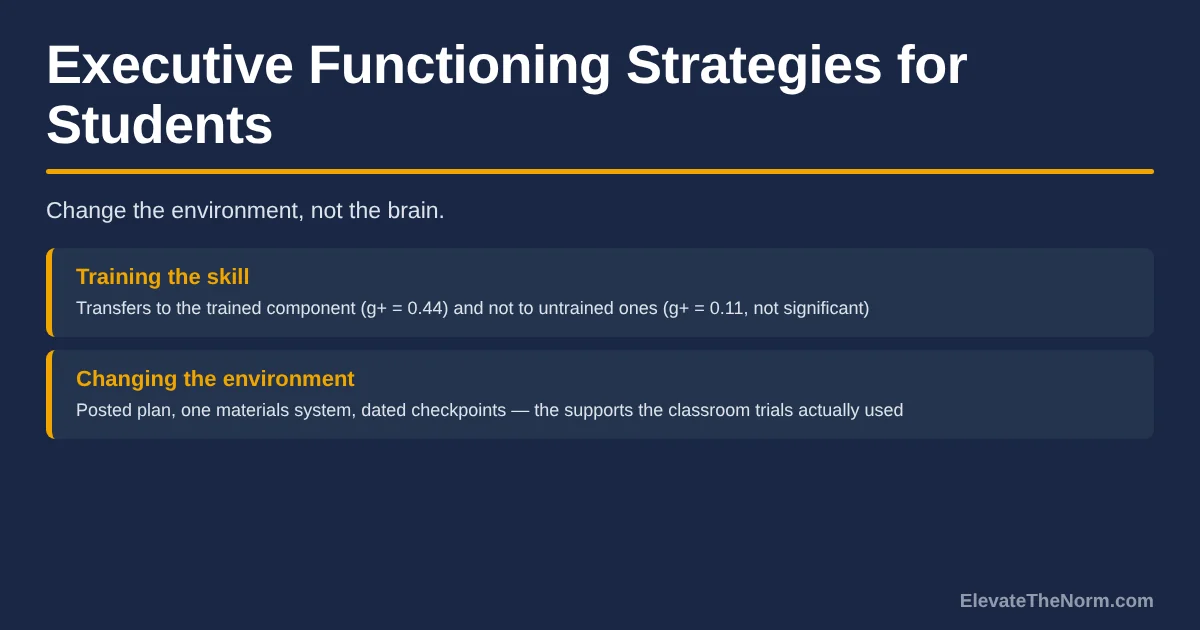
The executive functioning strategies for students with the best evidence change the environment rather than training the brain. A meta-analysis found training one executive function transfers to that skill (g = 0.44) but not to untrained ones (g = 0.11, not significant). What works in grades 6–12 is externalizing the plan and building in checkpoints.
Key Takeaways
- Executive function training mostly trains itself. Across 43 studies of near transfer and 17 of far transfer, training working memory, inhibition or cognitive flexibility produced g+ = 0.44 on the trained component and g+ = 0.11 (p = .11) on untrained ones.
- Even the gains that appear may not stay. A separate meta-analysis of 90 studies and 8,925 children found executive function can be fostered, but reported no convincing evidence that benefits remained at follow-up.
- The strongest classroom result here is organizational, not cognitive. In 280 middle schoolers with ADHD, two brief interventions delivered by school staff in under 20 minutes a session beat a waitlist on parent-rated homework problems and organization with large effect sizes.
- Teaching students to plan and monitor their own work does have real secondary-school numbers. Self-regulated learning training at secondary level averaged 0.54 on academic performance and 0.88 on strategy use, with metacognitive reflection the strongest single component.
- The same evidence carries a warning for teachers: researcher-delivered versions of these programs outperformed teacher-delivered ones. The gap is implementation and training, which means a half-taught system is a predictable way to get nothing.
A student who has not started an assignment by minute twelve is not refusing. Usually they cannot find the first move. The gap between knowing what to do and beginning to do it is the single most common thing I see go wrong in grades 6 through 12, and almost nothing in a teacher’s training addresses it directly.
The industry built around this problem sells brain training — games, apps, working-memory programs, cognitive exercises. The research on that is unusually clear and unusually disappointing. What it supports instead is less exciting and considerably cheaper: stop asking the student to hold the plan in their head. Below: what these skills are, what the transfer research found, the strategies with classroom evidence behind them, how to run this for 150 students, and where the evidence runs out.
What are executive functioning strategies?
Executive functioning strategies are the supports that help a student plan, start, organize, hold information, resist distraction and switch tasks — either by teaching a routine or by moving the demand out of the student’s head and into the room.
The research usually splits executive function into three components: working memory, inhibitory control and cognitive flexibility. In a classroom those show up as holding multi-step directions, not responding to the first distraction, and changing approach when the first one fails.
The practical taxonomy matters less than the split between two kinds of strategy, because the evidence treats them completely differently. Training strategies try to make the underlying skill stronger — working-memory games, cognitive exercises, apps. Scaffolding strategies reduce how much of the skill the task requires — a written plan, a visible checklist, a checkpoint, a materials system. Most of what gets marketed to schools is the first kind. Nearly all of the evidence favors the second.
Can executive functioning skills be taught?
They can be improved on the thing you train, and that improvement mostly does not spread. Training one executive function produced g+ = 0.44 on the trained component and g+ = 0.11 on untrained components, which was not statistically significant.
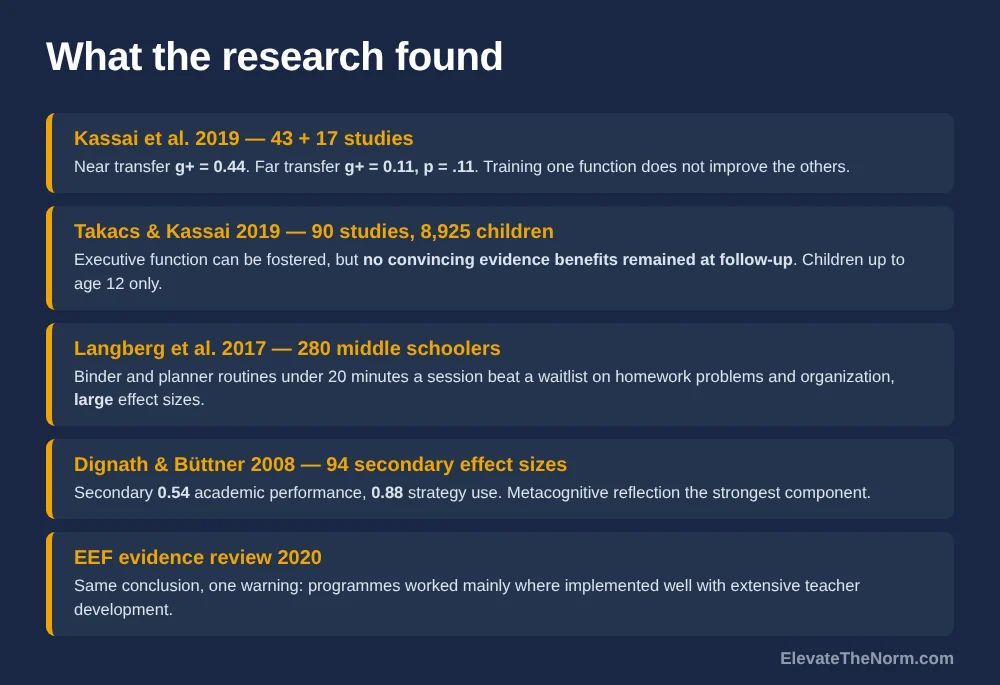
Kassai, Futo, Demetrovics and Takacs (2019), in Psychological Bulletin, pooled 43 studies for near transfer and 17 for far transfer across working memory, inhibitory control and cognitive flexibility. Near transfer was clear: interventions did train the component they targeted, g+ = 0.44, p < .001. Far transfer was not: g+ = 0.11, p = .11. Their conclusion is worth quoting in substance — the absence of benefit beyond the trained component calls into question the practical value of training executive functions in isolation.
The companion paper is gentler and still sobering. Takacs and Kassai (2019) synthesized 100 effect sizes from 90 studies covering 8,925 children and concluded executive function can be fostered in childhood. But they also reported that they did not find convincing evidence for the benefits remaining at follow-up assessment. For typically developing children, mindfulness practices showed moderate effects; for children with neurodevelopmental disorders or behavior problems, learning new self-regulation strategies worked best. Explicit practice on executive-function tasks — computerized or not — produced small to moderate effects, and those effects were consistently weaker for the non-typically-developing children who are usually the reason the program was purchased.
Both of those studies capped at age 12. That is a real limitation on a grades 6–12 site and it cuts both ways: the discouraging transfer findings are drawn from children younger than most of this audience, and so is the encouraging part. Nobody should be quoting these numbers as high school results, including me.
Why don’t executive functioning games and apps work?
Because getting better at a working-memory game makes you better at that game. The skill does not generalize to the untrained skills, and the transfer meta-analysis is explicit that this is why working-memory training has not produced academic gains.
Kassai and colleagues point directly at that connection, citing the working-memory training literature as the obvious case. If training working memory does not reliably improve inhibitory control — a close cousin measured in the same lab in the same session — there is no reason to expect it to improve a student’s ability to write a document-based essay three weeks later.
This is not an argument that executive function does not matter. It matters enormously. It is an argument about where the leverage is. A student with weak task initiation does not need a stronger brain; they need the first step written down where they can see it. The second is achievable in a Tuesday lesson and the first is not achievable by any method anyone has demonstrated.
Which executive functioning strategies actually work in grades 6-12?
The ones that move the load into the environment: a written first step, a visible plan with times, one materials system taught to mastery, dated checkpoints instead of a single deadline, and a short reflection before submission. Each substitutes a structure for a skill the student does not have yet.
The strongest school-based evidence here is organizational. Langberg and colleagues (2017), in the Journal of Consulting and Clinical Psychology, randomized 280 middle school students with ADHD in Virginia to one of two brief interventions or a waitlist. Both were delivered by school mental health providers during the school day, pulling students from electives, in sessions averaging under 20 minutes. Both beat the waitlist on parent-rated homework problems and organizational skills with large effect sizes. The Homework, Organization and Planning Skills program also produced moderate-effect improvements on teacher-rated materials management and organized action behaviors, and outperformed the comparison program on organized actions specifically.
Note what that intervention consists of. Not cognitive exercises. A binder system, a planner routine, and someone checking it. Students with more severe behavioral dysregulation responded better to the more structured of the two programs, which is the opposite of the usual assumption that struggling students need looser expectations.
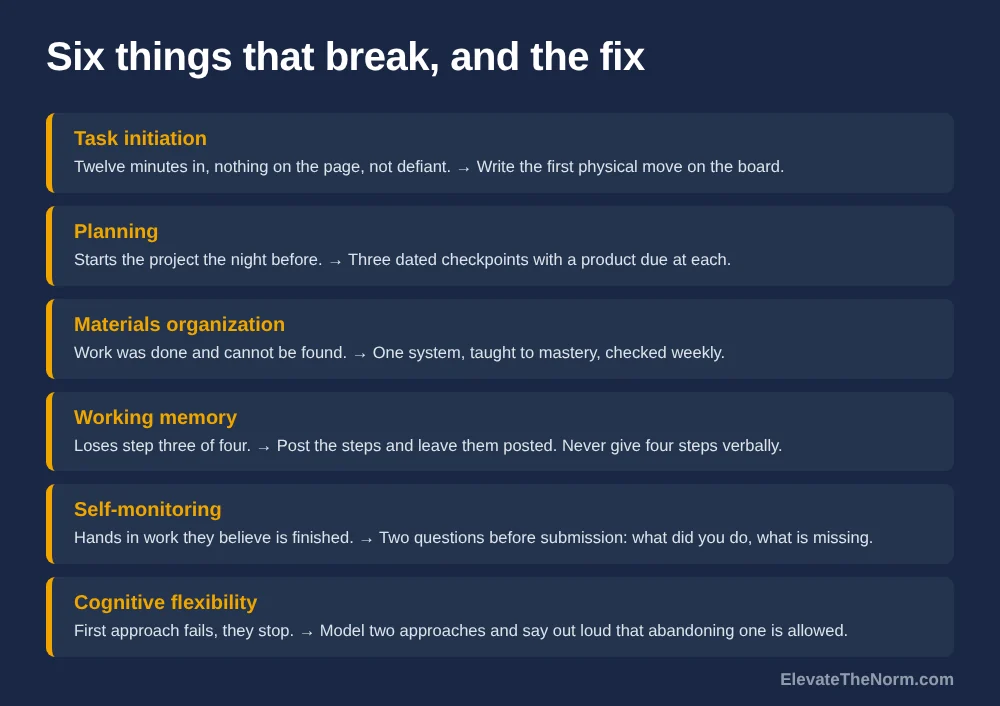
| What is breaking | What it looks like in grades 6–12 | The environmental fix | What the evidence says |
|---|---|---|---|
| Task initiation | Twelve minutes in, nothing on the page, not defiant | The first physical move written on the board: “title and date, then read the first question aloud to your partner” | No direct trial. Strongest inference from organizational interventions and from strategy instruction |
| Planning | Starts the project the night before it is due | Three dated checkpoints with a product due at each, not one deadline | Checkpoint structure is standard in the organizational programs that worked |
| Materials organization | The assignment was done and cannot be found | One system, taught to mastery, checked weekly — not three competing systems | Directly supported: teacher-rated materials management improved with moderate effect sizes |
| Working memory | Loses step three of a four-step direction | Steps posted and left posted; never deliver four steps verbally | Training working memory does not transfer (g+ = 0.11, ns). Reduce the demand instead |
| Self-monitoring | Hands in work they believe is finished and is not | A two-question reflection before submission: what did you do, what is still missing | Metacognitive reflection was the strongest component at secondary level (B = 0.82 on performance) |
| Cognitive flexibility | First approach fails and they stop rather than switch | Two worked approaches modeled, and permission to abandon one named out loud | Weakest evidence of the six. Treat as reasonable practice, not a result |
How do you help a student who cannot start?
Make the first move smaller than the task and physical rather than cognitive. “Start your essay” is a planning problem. “Write the date and copy the question at the top of the page” is not a problem at all, and it ends the frozen state.
Task initiation is where teachers most often misread the behavior, because a student sitting still with a blank page looks like refusal and is usually paralysis. The two call for opposite responses. A consequence applied to paralysis adds a second problem to the first.
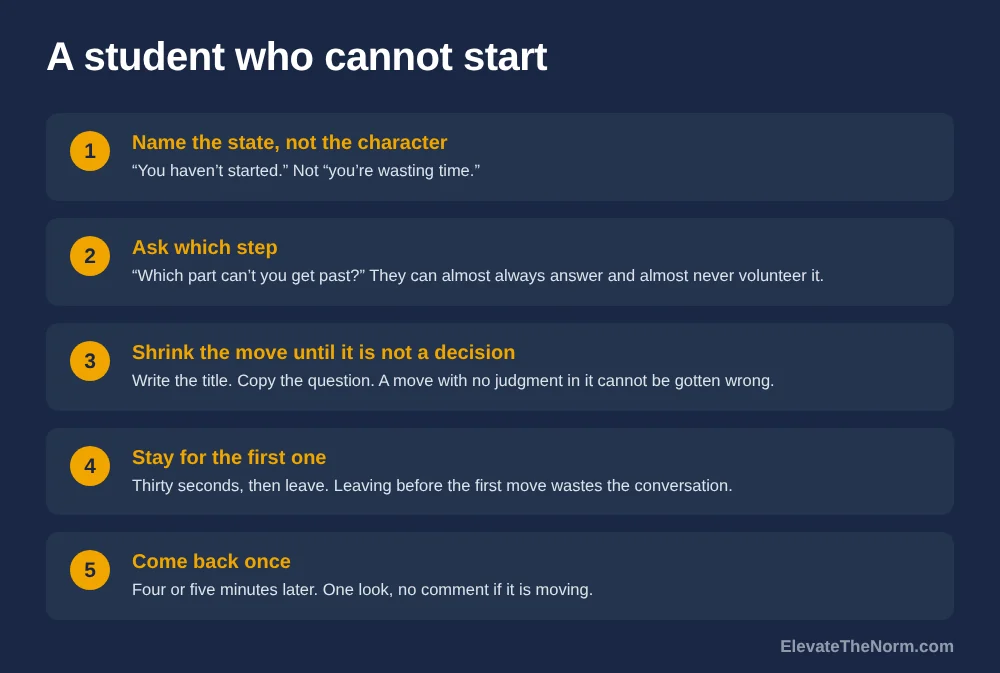
The sequence that works in my room, and it is three minutes:
- Name the state, not the character. “You haven’t started.” Not “you’re wasting time.” One is a fact you can both work from.
- Ask which step, not whether they understand. “Which part is the one you can’t get past?” Students can almost always answer this and almost never volunteer it.
- Shrink the first move until it is not a decision. Write the title. Copy the question. Read the first source aloud. A move with no judgment in it cannot be gotten wrong, which is what makes it startable.
- Stay for the first one. Thirty seconds standing there while they do it, then leave. Leaving before the first move happens wastes the whole conversation.
- Come back once. Four or five minutes later, one look, no comment if it is moving. The check is what makes the next one faster.
The reason this is written as a teacher routine rather than a student skill is the transfer evidence. A student who gets unstuck fifteen times with help has had fifteen models of how to get unstuck. A student who is told to work on their executive function has had none.
Does teaching students to plan and self-monitor actually work?
Yes, and this is where the secondary-school numbers finally appear. Self-regulated learning training at secondary level averaged 0.71 across all outcomes, 0.54 on academic performance and 0.88 on strategy use, with metacognitive reflection the strongest single component.
Dignath and Büttner (2008), in Metacognition and Learning, pooled 357 effect sizes, 94 of them from secondary school. The secondary results were not weaker than primary — strategy use was actually higher (0.88 against 0.72). In their meta-regression at secondary level, metacognitive reflection carried the strongest effects on academic performance (B = 0.82) and on strategy use (B = 1.45), with motivation strategy instruction next.
Two findings in that paper deserve to be uncomfortable. First, researcher-directed training outperformed teacher-directed training on both academic performance (B = −0.80) and strategy use (B = −0.64). Second, group work was positive overall at secondary level but negative for secondary mathematics performance (B = −0.65). The motivation figure for secondary rests on a single study and should not be quoted at all.
The Education Endowment Foundation’s evidence review of metacognition and self-regulation reaches the same general conclusion and adds the same caveat from another direction: most of the underlying research is cross-sectional, so causal claims are hard, and one study it cites suggests higher attainment may drive better strategy use rather than the reverse. It also notes a secondary science intervention that showed no impact alongside poor implementation in many schools, and that programs were effective mainly where they were implemented well with extensive teacher development.
Which is the honest headline for a teacher reading this. The effect is real and it is contingent on doing the thing properly for long enough. A reflection sheet handed out twice and abandoned is not a small dose of a 0.54 effect. It is zero.
That researcher-versus-teacher gap is worth reading as an instruction rather than an insult. The difference between the two conditions is training, feedback and somebody watching the implementation — which is the job description of an instructional coach. If your building has one, this is exactly the kind of work to bring them, and the honest ask is not “observe me” but “watch whether my version of this is actually the thing the studies ran.” Nearly every system in this article is easy to half-implement in a way that looks right.
And on the reflection itself: it is a gate, not a graded item. Two questions on an index card or a form before submission, read in the thirty seconds before you accept the work, not scored. Turn it into a graded assignment and you have added a hundred and fifty things to grade in order to support students who are already behind on grading, which is how this dies.


How do you do this for 150 students?
By building the supports into the lesson structure rather than into individual plans. A posted plan, one materials system, dated checkpoints and a closing reflection are classwide and cost no additional minutes once they are routine.
The individualized version of this work is real and it belongs to special education and school mental health teams. The Langberg interventions were delivered one-to-one by trained providers to students with a diagnosis. A general-education teacher with five sections cannot replicate that and should not pretend to.
What a classroom teacher can do is remove the executive-function tax from the whole room. If the plan is on the board with times on it, nobody has to hold it. If there is one place assignments live, nobody has to remember which of three places. If a project has three dated checkpoints, no student has to plan backward from a single date, which is the hardest planning task there is and the one we assign most casually.
One hard line, and it is the most important sentence in this article for anyone with a caseload. A classwide scaffold is not a substitute for a service a student is legally entitled to. Posting the plan does not discharge an accommodation on an IEP or a 504 plan, and “we do checkpoints for everybody” is not an answer to extended time, a separate setting, chunked assignments or organizational support written into a document. Build the classwide version because it helps everyone; deliver the individual services because they are owed. If the two ever get presented as alternatives in a meeting, they are being confused.
This also reframes who benefits. A posted plan is usually described as an accommodation. It is not — it helps the organized students too, and it means the student who needed it never had to identify themselves to get it. The same logic runs through differentiation that does not require five lesson plans and through the routines worth teaching explicitly.
One caution on the late-work side. Executive function explains why work arrives late; it does not settle what should happen next. That is a separate argument with its own retracted-study problem, and the evidence on late-work policy is worth reading before you decide a deadline is a scaffold.
Where does the evidence run out?
Early, and in four specific places: the transfer research stops at age 12, the classroom trials are clinical samples, nobody has tested the classwide version, and the one measured teacher-versus-researcher comparison went against teachers.
- Age ceiling. Both Psychological Bulletin meta-analyses covered children up to 12. Everything said here about transfer is extrapolated upward into grades 6–12, and that extrapolation is an assumption.
- Clinical samples. The 280-student trial was students with ADHD, delivered by trained mental health providers. Whether the same binder-and-planner routine helps a general-education student with ordinary disorganization is untested, though it is hard to see the harm.
- No test of the classwide version. Nobody has randomized classrooms to “post the plan with times and run three checkpoints” versus business as usual. The table above is assembled from adjacent evidence, not drawn from a trial of itself.
- Delivery is a measured weakness. Self-regulated learning training worked better in researchers’ hands than in teachers’. That is the most relevant single finding in this article for anyone planning to run it alone with no training and no coach.
- Durability is unestablished. One meta-analysis explicitly found no convincing evidence of benefits persisting to follow-up. Nothing here should be sold as building a skill a student keeps for life.
- Nobody has studied how to take the scaffold off. This is the gap that matters most on a site about student responsibility, and there is no honest research answer to give.
That last one deserves more than a bullet, because a reasonable student will ask it. If the plan is always posted and the deadline is always broken into three, when does anyone learn to do it themselves? I do not have a study to point at. What I can say is that the alternative — withholding the support so students build the skill under pressure — has no evidence behind it either, and the transfer research gives no reason to think struggling through an unsupported task builds a transferable capacity.
The defensible position is that the scaffold should narrow rather than vanish. Three checkpoints in the first project, two in the second, one in the third, and name out loud what you are doing and why, so the student is tracking their own progress rather than noticing that the help disappeared. That is a judgment, not a finding, and it is labeled as one. It is also the version that is consistent with how this site thinks about what responsibility actually means — a standard that stays while the support thins out, not a cliff.
Clay’s take: the room does the remembering
My classroom runs on lamps. I do not turn the overhead fluorescents on — the light comes from torchiere lamps around the perimeter and a few desk lamps, and the effect is warm and low instead of institutional. I did it because the room is meant to be enjoyed. What I did not expect was how much it changed the start of class.
The point generalizes, and it is the whole argument of this article. I did not make anyone better at ignoring distraction. I lowered the amount of distraction there was to ignore. That is a worse-sounding intervention and a better-working one, and almost everything in the table above has the same shape.
The other thing I would say is about the posted plan, because I came to it from a different direction. My method is organization to the minute, and then you pause — the plan goes on the framed whiteboard at the front with times attached, and then you stop talking and let the room settle instead of filling the silence. I started posting times to control pacing. The unintended result is that no student has to carry the sequence in their head, and the ones who cannot carry it stopped being visible as the ones who cannot.
I will also say what the posted times are not, since this is where it goes wrong. They are a budget and a promise, not a script. When I miss them I say so out loud and give the reason. A schedule nobody acknowledges missing teaches students that the posted plan is decoration, and then it stops working as a support for the kids who were actually using it.
And one honest admission. Everything above is cheap to start and easy to quit. The posted plan survives in my room because it is tied to how I run pacing, not because I decided to support executive function. The supports that stick are the ones that make your own teaching easier. That is not a research finding. It is the reason most of these systems die in November.
What to do next week
Pick one: post the plan with times every day for two weeks, or convert the next project from one deadline into three dated checkpoints with something due at each. Do not do both. Then add the two-question reflection before submission — what did you do, what is still missing — because metacognitive reflection is the component with the strongest secondary-level numbers behind it.
Skip the brain-training app. If someone is proposing to buy one, the transfer meta-analysis above is the document to put in front of them, and it is one page of abstract. And if you are a parent who already bought one, that is not a parenting failure — the marketing for these products is genuinely persuasive and cites real neuroscience, just not neuroscience that says the product works. The planner routine and the one place assignments live are free, and they are the parts with the evidence.
Related reading: note taking strategies that survive the research is the working-memory half of this problem, what student responsibility looks like in practice covers the part where the scaffold comes back off, and holding teenagers to a standard without treating them like children is the line this whole topic has to walk. Everything on this site is free and nothing asks for your email address.
Frequently Asked Questions
What are executive functioning strategies for students?
They are supports that help a student plan, start, organize, hold information, resist distraction and switch tasks. They split into two kinds: training strategies that try to strengthen the underlying skill, and scaffolding strategies that reduce how much of the skill a task demands. The evidence strongly favours the second kind, which includes posted plans, one materials system, and dated checkpoints.
Can executive functioning skills be improved?
On the specific thing you train, yes. Beyond it, the evidence is weak. A meta-analysis of 43 near-transfer and 17 far-transfer studies found g+ = 0.44 on the trained component but only g+ = 0.11 on untrained components, which was not statistically significant. A companion review also found no convincing evidence that gains remained at follow-up.
Do executive function games and apps work?
They improve performance on tasks resembling the game and do not reliably improve anything else. The far-transfer meta-analysis points to this directly as the reason working-memory training has not produced academic gains. Before a school buys a program, ask what untrained outcome it has improved in a randomized trial, and read the answer carefully.
How do you help a student who cannot start an assignment?
Shrink the first move until it contains no decision. “Start your essay” is a planning task; “write the date and copy the question at the top” is not. Name the state rather than the character, ask which specific step they cannot get past, stay the thirty seconds it takes for the first move to happen, and come back once a few minutes later.
Which executive functioning strategies have the best classroom evidence?
Organizational ones. A randomized trial of 280 middle schoolers with ADHD found two brief school-based programs — binder systems, planner routines and regular checks, under 20 minutes a session — beat a waitlist on parent-rated homework problems and organization with large effect sizes, and improved teacher-rated materials management with moderate effects.
Is teaching metacognition worth the class time?
At secondary level it has the better numbers in this whole topic. A meta-analysis of self-regulated learning training reported an average of 0.54 on academic performance and 0.88 on strategy use at secondary level, with metacognitive reflection the strongest component. The caveat is that researcher-delivered versions outperformed teacher-delivered ones, so a half-run version should not be expected to pay.
Are these strategies only for students with ADHD or an IEP?
The individualized versions belong to special education and school mental health teams, and the strongest trials used diagnosed samples. But the classwide supports — a posted plan with times, one place assignments live, three checkpoints instead of one deadline — cost nothing extra and help the organized students too. They also mean a student who needs the support never has to identify themselves to get it.
Do classwide supports replace an IEP or 504 accommodation?
No, and treating them as alternatives is a mistake. A posted plan helps everyone and discharges nothing. Extended time, chunked assignments, a separate setting or organizational support written into a document are services a student is entitled to, and “we do checkpoints for the whole class” is not an answer to any of them. Build the classwide version anyway, because it helps.
Sources
- Kassai, R., Futo, J., Demetrovics, Z., & Takacs, Z. K. (2019). A meta-analysis of the experimental evidence on the near- and far-transfer effects among children’s executive function skills. Psychological Bulletin, 145(2), 165–188. 43 studies for near transfer, 17 for far transfer. Near transfer g+ = 0.44 (p < .001); far transfer g+ = 0.11 (p = .11), no convincing evidence. Authors conclude the lack of benefit beyond trained components questions the practical value of training executive functions in isolation. Children only; not a secondary-school sample.
- Takacs, Z. K., & Kassai, R. (2019). The efficacy of different interventions to foster children’s executive function skills: A series of meta-analyses. Psychological Bulletin, 145(7), 653–697. 100 independent effect sizes from 90 studies, 8,925 children up to age 12. Executive function can be fostered, but “we did not find convincing evidence … for the benefits to remain on follow-up assessment.” Mindfulness moderate for typically developing children; strategy-teaching best for non-typically-developing children; explicit task practice small to moderate and weaker for non-typically-developing children.
- Langberg, J. M., Dvorsky, M. R., Molitor, S. J., Bourchtein, E., Eddy, L. D., Smith, Z. R., Oddo, L. E., & Eadeh, H.-M. (2017). Overcoming the research-to-practice gap: A randomized trial with two brief homework and organization interventions for students with ADHD as implemented by school mental health providers. Journal of Consulting and Clinical Psychology. 280 middle school students with ADHD in Virginia; HOPS and CHIEF versus waitlist; sessions averaging under 20 minutes. Both beat waitlist on parent-rated homework problems and organizational skills, large effect sizes; HOPS improved teacher-rated materials management and organized action behaviors at moderate effect sizes. Numeric effect sizes are reported as magnitude labels in the record read; the published article carries the values.
- Dignath, C., & Büttner, G. (2008). Components of fostering self-regulated learning among students: A meta-analysis on intervention studies at primary and secondary school level. Metacognition and Learning, 3, 231–264. 357 effect sizes (263 primary, 94 secondary). Secondary: 0.71 across all outcomes, 0.54 academic performance (n = 34), 0.88 strategy use (n = 54). Metacognitive reflection strongest at secondary level (B = 0.82 performance, B = 1.45 strategy use). Researcher-directed training outperformed teacher-directed (B = −0.80 performance). Group work negative for secondary mathematics (B = −0.65). The secondary motivation figure (0.17) rests on one study and is not quoted here as a finding.
- Muijs, D., & Bokhove, C. (2020). Metacognition and Self-Regulation: Evidence Review. London: Education Endowment Foundation. Concludes improving self-regulated learning and metacognition can raise attainment, particularly where multiple elements are included. Caveats recorded here: most studies are cross-sectional so causal claims are hard; one study suggests higher attainment may drive strategy use rather than the reverse; a secondary science intervention showed no impact with poor implementation; programs were effective mainly where implemented well with extensive teacher development.