By Clay Shumate
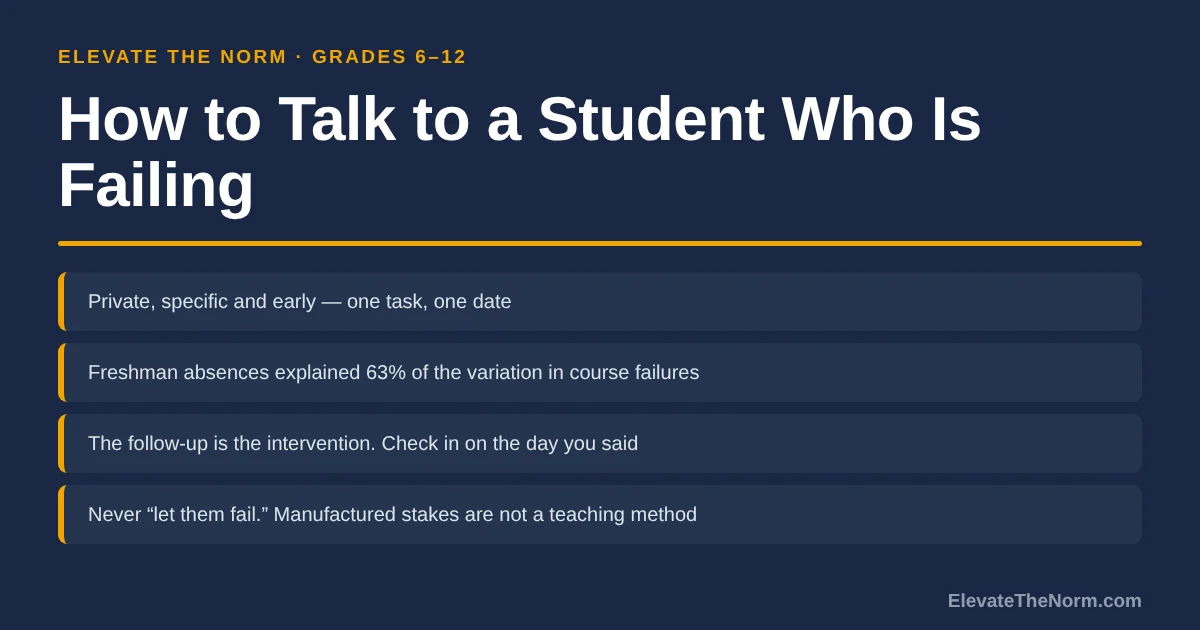
Talk to a student who is failing privately, early, and about one specific thing rather than the whole grade. Name what is missing, ask what is getting in the way, say plainly that you expect them to reach the standard, and leave with one task and one date. Then check back when you said you would.
Key Takeaways
- A failing grade is usually the last signal, not the first. In Chicago Public Schools, freshman absences alone explained 63 percent of the variation in course failures, against 8 percent for eighth-grade test scores.
- Private, specific and early beats comprehensive. One behaviour, one question, one task, one date. A conversation that covers nine problems gives the student nothing to do tonight.
- In a randomized study of 44 seventh graders, attaching one sentence to critical feedback — high expectations, and I know you can reach them — raised essay revision among African American students from 17 to 71 percent. A 44-student study is promising, not settled.
- Ask what is getting in the way, not what is wrong at home. The American School Counselor Association states that even school counselors do not diagnose; a teacher notices and routes.
- Structured follow-up has the clearest evidence and the clearest limit: in the two randomized trials the What Works Clearinghouse accepted on Check & Connect, the programme had positive effects on staying in school and no discernible effects on completing school.
Most of these conversations go wrong in the first thirty seconds, and almost never because the teacher was unkind. It is because the teacher opened with the grade. A 41 on a progress report is an aggregate of a dozen decisions a student has already made and mostly cannot undo, so leading with it hands a teenager a number they cannot act on and a feeling they will act on instead.
What follows is the structure that holds up: when to have the conversation, the six things it needs, the four very different situations a failing grade can mean, the sentences to leave out, and the honest research on all of it — including the part that found no effect on graduation.
What should you say to a student who is failing?
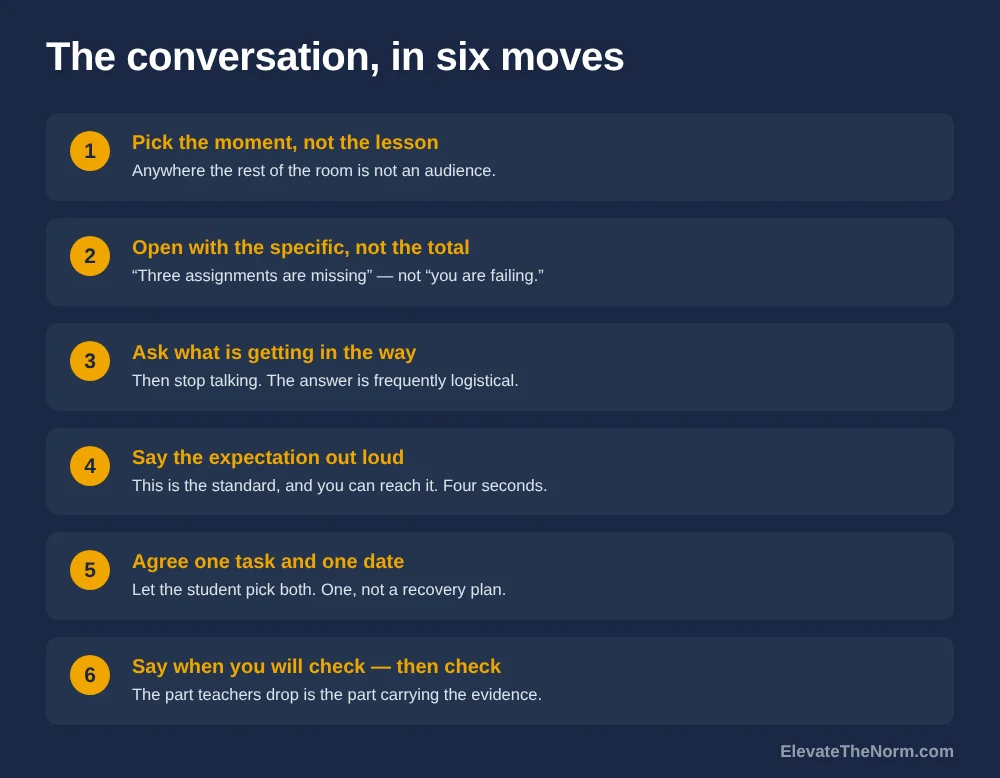
Say one specific thing that is missing, ask one open question about what is getting in the way, state that you expect them to reach the standard, and agree one task with a date on it. Six moves, in order, and the whole thing fits in four minutes.
- Pick the moment, not the lesson. After class, at your table, during independent work — anywhere the rest of the room is not an audience. A conversation about a failing grade held within earshot of twenty-eight people is a performance, and the student will play their part in it.
- Open with the specific, not the total. “You have three missing assignments and two of them are the ones the unit test is built on.” Not “you are failing my class.” The first sentence is a problem with an edge on it. The second is a verdict.
- Ask what is getting in the way, then stop talking. This is the question most teachers skip because they already have a theory. Ask it anyway. The answer is frequently logistical — a shared laptop, a shift that ends at eleven, a folder lost in a locker change — and logistical problems have fixes.
- Say the expectation out loud. Not a pep talk. One sentence: this standard is the standard, and you can reach it. The research below suggests that sentence does real work, particularly with students who have reason to wonder whether the adult in front of them has already written them off.
- Agree one task and one date — and let the student pick them. Ask which one they want to start with and when it will be done. A teenager who names the date is holding their own deadline; one who is handed it is complying with yours. The student who owes eleven assignments needs the first one back, not a recovery plan.
- Say when you will check, and then check. A follow-up that does not happen teaches the student that the conversation was for your records. That is the part teachers drop, and it is the part that carries the evidence.
When is the right time to have this conversation?
Before the grade is failing. The warning signs that predict a failed course are attendance and missing work, and both are visible weeks earlier than the average on a progress report.
The clearest evidence on this is still Elaine Allensworth and John Easton’s on-track study of Chicago Public Schools freshmen, and the numbers are blunt. Fifty-three percent of CPS freshmen failed at least one semester course. Students who ended ninth grade on-track graduated in four years at about 82 percent; students who were off-track graduated at about 22 percent. And freshman absences alone explained 63 percent of the variation in course failures, against 8 percent for eighth-grade test scores.
Their sentence on absence is the one worth pinning above a gradebook: “Just one week of absence per semester indicates problems with students’ grades.” Not two weeks. One. Students with the lowest eighth-grade test scores who missed one week averaged fewer Fs (1.3) than top-scoring students who missed two (2.1).
That is one large urban district and a cohort that entered high school in 2000–01, so the percentages are not national facts. The ordering has held up well enough that most early-warning systems use the same signals, and the lesson for a teacher is simple: check the attendance column before building a theory about motivation. The reasons behind a pattern of absence are mostly outside your room, which is a separate problem with its own evidence base.
Does telling a student you believe in them actually help?
One sentence of it, attached to critical feedback, has measurable support. Open-ended encouragement that is not attached to anything does not. The distinction matters more than the sentiment.
David Yeager and colleagues ran a set of field experiments on what they called wise feedback. Seventh graders handed back a marked-up essay received one of two notes. The control note read: “I’m giving you these comments so that you’ll have feedback on your paper.” The other read: “I’m giving you these comments because I have very high expectations and I know that you can reach them.”
Seventy-one percent of African American students who got the second note revised their essay, against 17 percent who got the first. For White students the difference — 87 against 62 percent — was not statistically significant. Among African American students who had reported low trust in the school, none of the control group revised and 82 percent of the treated group did. A second study the following year found treated students incorporated 5.54 of the teacher’s edits against 2.19.
The caveats are large. Each study had 44 students, and only students carrying B or C averages were eligible — which the authors say limits how far this travels to the students a teacher would call failing. The race-by-condition interaction was not significant, and the authors call the trust findings tentative. It is a reason to say the sentence, not proof that saying it fixes a grade.
What it does explain is why the sentence is not flattery. The mechanism is attribution: a student handed hard criticism has to decide whether it means the teacher thinks they can do better or thinks they cannot. Most teachers mean the first and say neither.
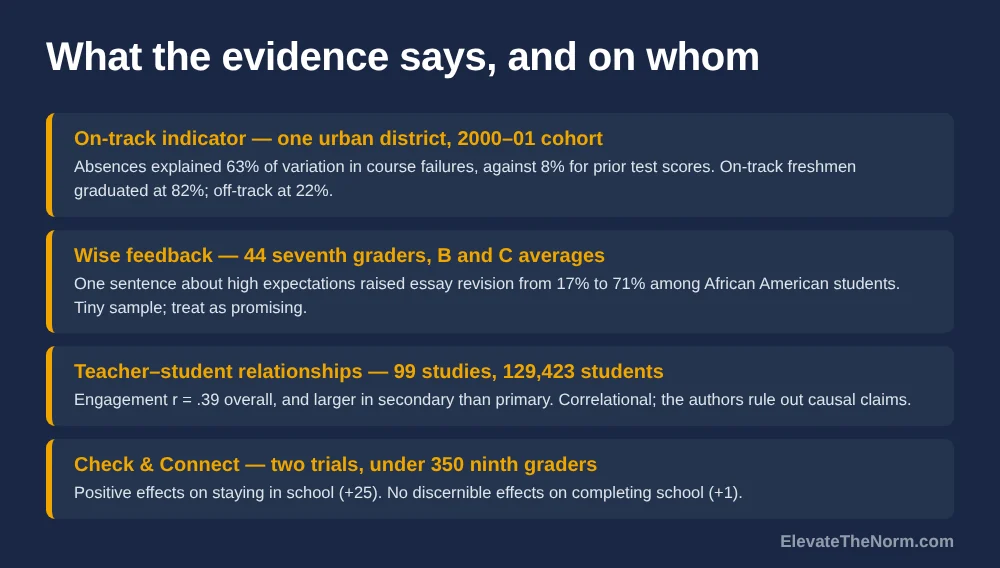
It is also worth knowing that the relationship itself matters more in high school than most people assume, not less. Debora Roorda and colleagues’ meta-analysis of 99 studies and 129,423 students found positive teacher–student relationships associated with engagement at r = .39 overall, and the secondary-school estimates were larger than the primary ones — r = .30 to .40 for engagement across 23 studies. The authors flag that as unexpected, and they state plainly that the design “does not permit conclusions about causality,” since most of the underlying studies are cross-sectional. The modest, useful read: a student rarely takes hard feedback from an adult they have decided is not on their side. That does not mean being liked. It means being predictable.
Which conversation does this student actually need?
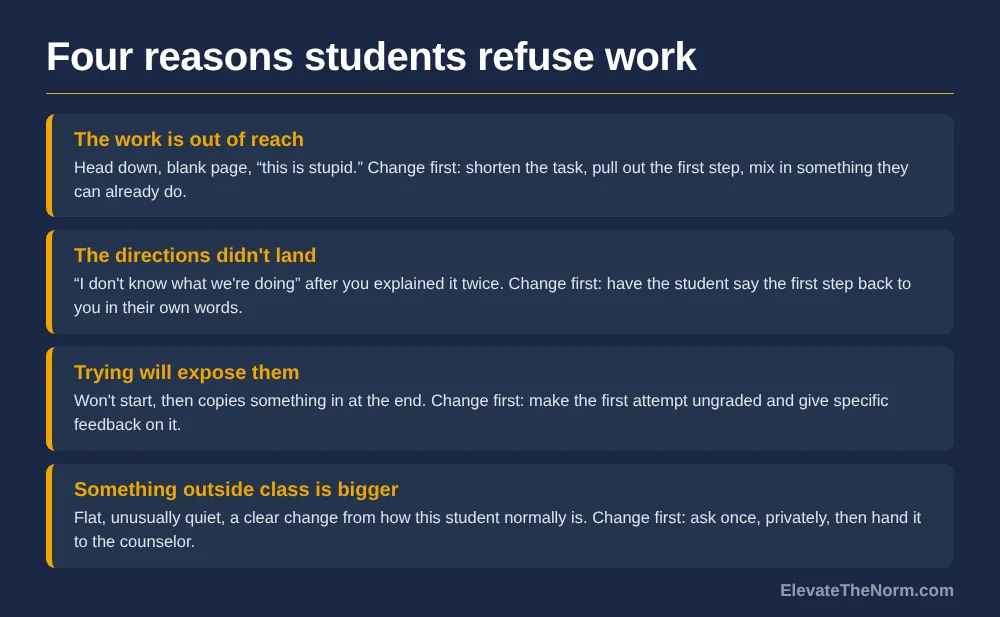
Four different problems produce the same failing grade, and each needs a different opening line. Working out which one you have in front of you takes about ninety seconds in the gradebook and saves the entire conversation.
The categories are for your diagnosis, not for the student’s ears — say the question out loud, never the label, and be ready to be wrong when they answer. One caution on the third row: “I’ve missed you” only works if it is true, and a teenager can tell.
| What the grade actually is | How you can tell | How to open | What success looks like in two weeks |
|---|---|---|---|
| Missing work, not failed work | Scores are mostly zeros; the attempts that exist are passing | “You can do this — three of these were never turned in. Let’s pick one.” | One assignment in, and the student knows the window for the rest |
| Attempted and not learned | Work is submitted and scoring low; quiz and test scores agree | “You’re doing the work. Something in the middle isn’t landing. Show me where it stops making sense.” | Reteaching or a reassessment scheduled, not more of the same practice |
| Not in the room | Absences or tardies cluster; grade drop tracks them | “I’ve missed you. What’s making it hard to get here?” | An attendance plan with someone other than you in it |
| Something outside the class | A sudden change in a student who was fine; across several subjects | “Something’s changed. I’m not going to pry. Who in the building do you trust?” | The student has talked to a counsellor; you have adjusted one deadline |
Most teachers’ default script is written for the second row while most failing grades belong to the first. Missing work is a logistics problem in a motivation costume, and it responds to a clear window and a short list better than to a conversation about caring — which is the same argument behind a late work policy with a floor instead of a zero.
For the second row, “show me where it stops making sense” is not a figure of speech. Have the student work one problem out loud, or read you their notes from the lesson in question. The breakdown is usually three steps earlier than either of you assumed, and you cannot scaffold a gap you have not located. Check the student’s accommodations or IEP before you design any of it — the case manager may already know the answer, and an agreement that cuts across a plan on file is worse than no agreement.
What should you never say to a student who is failing?
Anything that asks the student to account for their character rather than their work. The four sentences below are all well-intentioned and all of them end the useful part of the conversation.
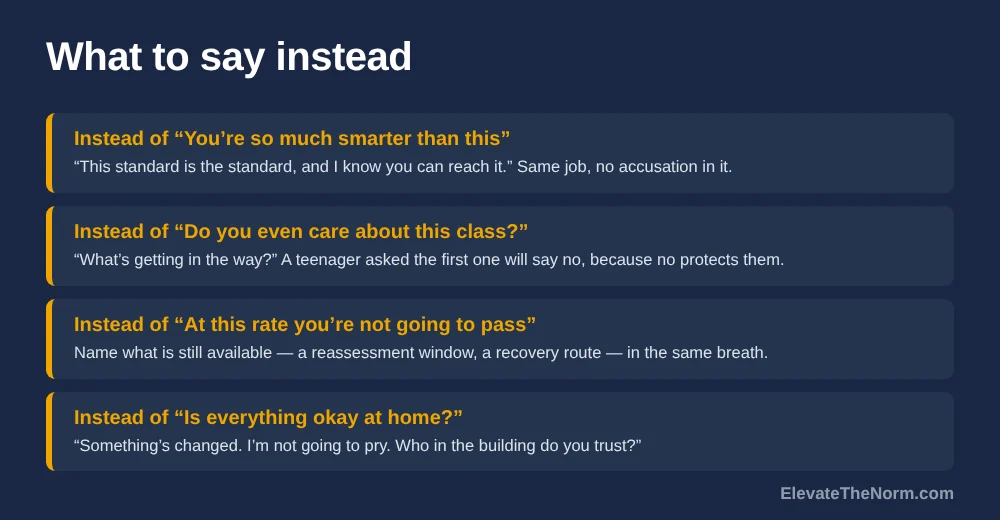
- “You’re so much smarter than this.” It sounds like a compliment and lands as a charge: the student now has to explain why they are a disappointment. Replace it with the expectation sentence, which does the same job without the accusation.
- “Do you even care about this class?” A teenager asked this in front of a grade they are ashamed of will say no, because no is the only answer that protects them. Then both of you are stuck with it. What not caring usually turns out to mean is a different problem entirely.
- “At this rate you’re not going to pass.” Probably true and entirely useless. A student who already knows the number needs the next step, not the forecast. If the mathematics genuinely no longer works, say what is still available — credit recovery, a summer option, a reassessment window — in the same breath.
- “Is everything okay at home?” Well meant, and not yours to ask cold. It invites a disclosure you are not trained or authorised to handle and it can read as an assumption about the student’s family. “What’s getting in the way?” gets you the same information and leaves the student in charge of how much they say.
One more guardrail, and it is an administrator’s point: only offer what your school actually permits. A reassessment window, a late-work floor or a credit-recovery route is school policy before it is your policy, and a promise you cannot keep does more damage than the original grade. If you are not certain what is allowed, ask before the conversation rather than walking it back afterward.
And one structural rule: do not make this conversation the consequence. A failing grade is already a consequence. Layering a lecture on top of it teaches the student that coming to you with a problem costs them something, which is the opposite of what the next six weeks require. The distinction between a consequence and a punishment is worth being precise about.
What if the problem is clearly bigger than your class?
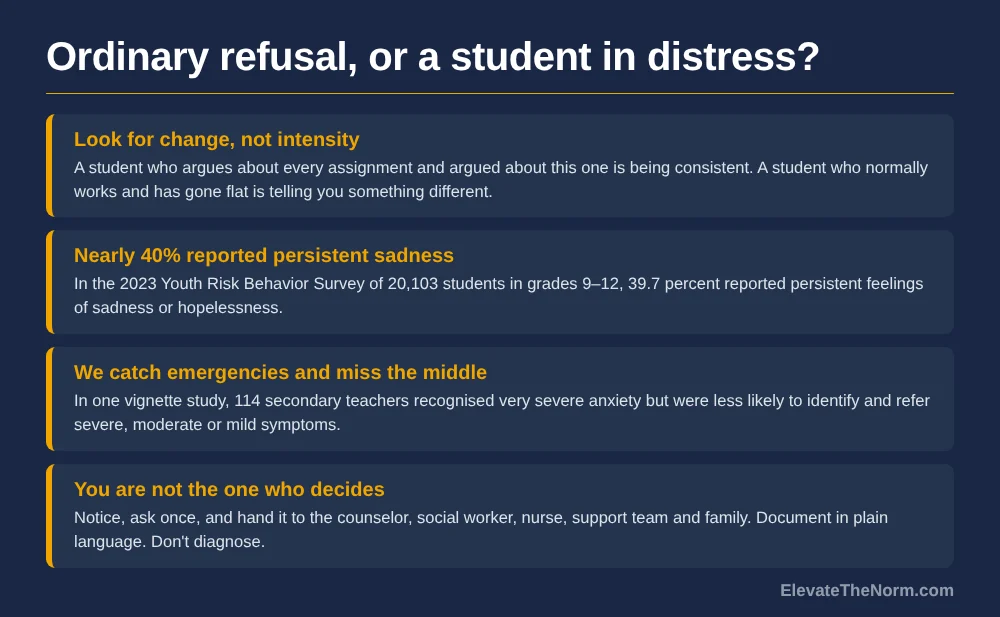
Route it, immediately, and do not try to handle it yourself. Notice, name that you have noticed, hand the student to someone whose job this is, and follow the referral path your school already has.
The boundary here is not a matter of taste. The American School Counselor Association’s position statement on student mental health states that “school counselors do not diagnose” and that providing long-term therapeutic counselling in school is inappropriate even for a counsellor who holds a therapy licence; their role is brief counselling, crisis intervention, and referral to school and community providers. If that is the limit on a licensed counsellor, a social studies teacher’s limit is considerably tighter.
What ASCA does list as warning signs is squarely in a teacher’s field of view: changes in grades or attendance, shifts in mood, school avoidance. You are well placed to see those and badly placed to interpret them. So the move is three sentences long — something has changed, I am not going to pry, here is who I think you should talk to — followed by a walk to the counsellor’s office or an email to them the same day.
That assumes a counsellor who is reachable, and in a lot of schools the counselling caseload makes that optimistic. If yours is carrying hundreds of students, find out now — not in the moment — who the route actually is: a school social worker, a nurse, an administrator, a named point of contact for a district programme. The referral path existing on paper is not the same as you knowing it.
If a student says something that makes you worry about their immediate safety, that is not a conversation to finish alone or to leave until tomorrow. Follow your school’s reporting procedure that day and tell your administrator.
What happens after the conversation?
The follow-up is the intervention. Structured, repeated contact with one named adult has the strongest evidence in this area — and a clear ceiling.
Check & Connect is the tested version: a named monitor who tracks attendance, behaviour and grades, intervenes when a signal trips, and coordinates with the family. The What Works Clearinghouse intervention report accepted two randomized trials without reservations and rated it positive effects on staying in school (improvement index +25), potentially positive effects on progressing in school (+30), and no discernible effects on completing school (+1).
That last row is the honest headline: the programme kept students enrolled and did not demonstrably get them to a diploma. Both trials ran in Minneapolis with fewer than 350 students in total, all ninth graders receiving special education services for learning, emotional or behavioural disabilities, and the WWC rates the extent of evidence small in every domain.
The scaled-down version a teacher can actually run is one adult, one signal, and a check-in that happens on the day it was promised. Not a case plan — a thirty-second question on Thursday because Thursday is when you said. It is the same reason test corrections only work when the student has to produce thinking rather than the right answer: the structure does the work, not the sentiment.
Contacting home belongs in this stage rather than the first one, and it belongs after you have told the student. To be clear about what that means for a family: telling the student first is a matter of hours, not weeks, and it is not a reason to delay contact. It is so the student hears it from you rather than at the dinner table. Send it in a language the family reads, say how they can reach you, and keep every other student out of it — including the one whose grade the parent asks to compare. If the next step is a conference instead of a message, these are the questions actually worth the fifteen minutes.
Where does the evidence run out?
Sooner than any of the above implies. There is no randomized trial of the teacher–student conversation itself, and every study cited here was run on a population that is not quite yours.
- Nobody has tested the conversation. What has been tested is a written note on feedback, a monitoring programme, and a correlation. The four-minute talk is assembled from those, not validated as a unit.
- The wise-feedback studies had 44 participants each, were limited to students with B and C averages, and the authors call the trust moderation tentative. Treat the sentence as low-cost and promising, not as an established lever.
- The on-track figures are one district, one era — Chicago Public Schools in the early 2000s. The ordering of the signals has replicated widely; the numbers are not national facts.
- Check & Connect’s trials were ninth graders with disabilities in one city, and the completing-school result was no discernible effect. Anyone selling monitoring as a graduation strategy is quoting the first row and skipping the third.
Clay’s take: the grade is information about the plan too
My position here is unfashionable and I will defend it: if a student in my room could fail badly enough for it to matter, that is mostly a planning problem.
If a kid can screw up that badly in a classroom, what was the teacher doing the entire time? I am moving between tables most of the period. A grade that collapses without my noticing is a grade I stopped looking at.
So I read a failing grade as two pieces of information. One is about the student, and it is usually attendance or a stack of untouched work rather than anything about character. The other is about me — where the scaffolding was thin, which day the class lost the thread, what I posted and then quietly let slide. The second half is what I can fix this week.
Where I will not go is “let them fail so they learn.” Manufactured stakes are not a teaching method. Students can struggle, do a thing badly, need help and still be held to the standard afterward; what they should not be able to do is walk off a cliff an adult built and then watched them approach.
So I keep the conversation small and keep my word about it. A teenager who has been failing for a month has usually had plenty of adults be disappointed at them and very few be specific with them. Specific, and then back on Thursday like you said, is most of the job.
What to do tomorrow
- Sort your gradebook by missing assignments rather than by average. The list you get is the list of conversations worth having, in order.
- Pick the top three students. With 120 or 150 on a roster you are not having thirty of these this week, and three conversations you finish beat ten you start. Sorting by missing work rather than by who worries you keeps the choice honest.
- For each one, work out which of the four rows above you are looking at before you say a word.
- Hold it somewhere private, in four minutes, with one task and one date out of it. Private rarely means an empty room — the doorway as the bell goes, your table during independent work, and the two minutes while everyone else packs up all count.
- Write the check-in date where you will see it, and set the due dates on a schedule you can actually mark — twelve recovery assignments landing the same Friday helps nobody. Then check in on the day, even if nothing has changed, because that is the part the student is actually measuring.
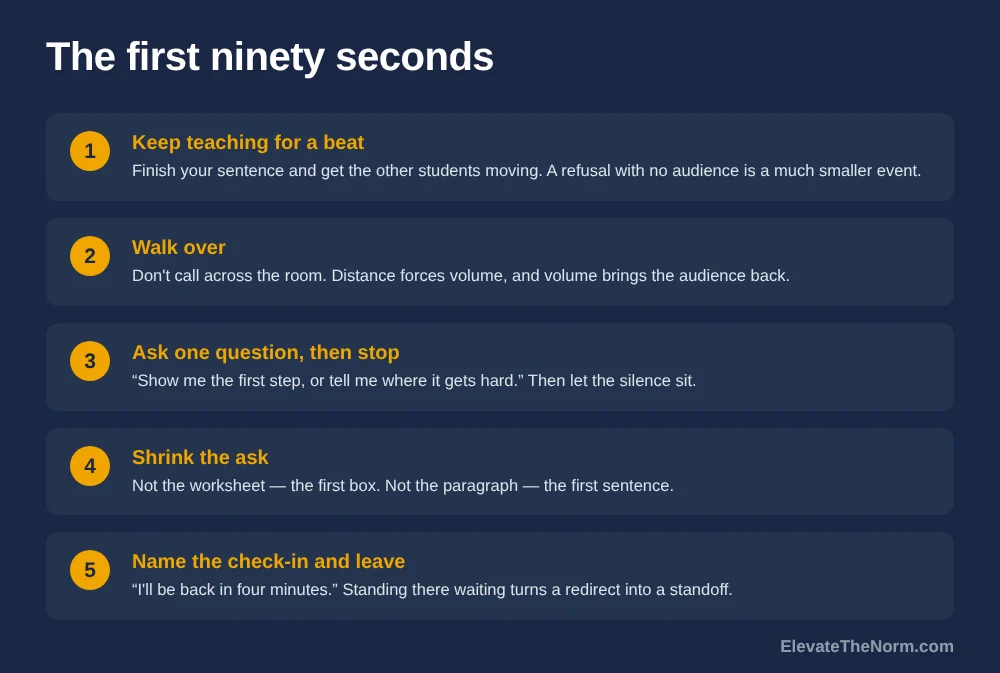
If the student’s problem turns out to be refusal in the moment rather than a quiet backlog, that is a different ninety seconds and it comes first. Everything on this site is free and nothing asks for your email address.
Frequently Asked Questions
How do you start a conversation with a student who is failing?
Start with one specific missing piece of work rather than the grade, and start somewhere private. “You have three missing assignments and two of them are what the test is built on” gives a student something to do. “You are failing my class” gives them a verdict to react to. Then ask what is getting in the way and let them answer.
Should you tell a student they are failing?
Yes, and earlier than most teachers do. A student who learns it from a report card has lost the weeks when it was fixable. Say it plainly, say it in private, and pair it with the one task that starts the recovery. Attendance and missing work show the problem coming long before the average does.
Does telling a student you have high expectations actually work?
There is real but small-scale evidence for it. In a randomized study of 44 seventh graders, a note saying the teacher had high expectations and believed the student could reach them raised essay revision among African American students from 17 to 71 percent. The sample was tiny and limited to B and C students, so treat the sentence as low-cost and promising rather than proven.
What should you not say to a failing student?
Avoid “you’re smarter than this,” “do you even care,” and “at this rate you won’t pass.” All three ask the student to defend their character instead of fixing their work. Also avoid opening with “is everything okay at home?” — “what’s getting in the way?” gets the same information and leaves the student deciding how much to share.
Should I contact the parents before or after talking to the student?
After. A student who finds out at dinner that you emailed home has learned that you go around them. Telling them first, at the end of class, costs twenty seconds and keeps them a party to their own situation. The exception is anything involving immediate safety, which goes to your administrator the same day.
What if a failing grade seems to be about something outside school?
Notice it, say you have noticed, and route it. Do not probe and do not offer a theory about what is happening. The American School Counselor Association states that school counselors do not diagnose, which puts a teacher’s limit well short of that. Three sentences and a walk to the counselor’s office is the whole move.
How often should I follow up after the conversation?
On the day you said, and briefly. Thirty seconds on the agreed date does more than a long meeting a fortnight later, because the student is measuring whether you meant it. Structured follow-up with one named adult has the best evidence in this area, though the strongest trials showed it kept students enrolled without demonstrably improving graduation.
Sources
- Allensworth, E. M., & Easton, J. Q. (2007). What Matters for Staying On-Track and Graduating in Chicago Public High Schools. Consortium on Chicago School Research, University of Chicago. Chicago Public Schools freshmen, 2000–01 entering cohort and surrounding years; a single large urban district. The 63 percent / 8 percent variance comparison, the 82 / 22 percent graduation figures and the one-week-of-absence sentence all come from this report.
- Yeager, D. S., Purdie-Vaughns, V., Garcia, J., Apfel, N., Brzustoski, P., Master, A., Hessert, W. T., Williams, M. E., & Cohen, G. L. Breaking the cycle of mistrust: Wise interventions to provide critical feedback across the racial divide. Journal of Experimental Psychology: General. Studies 1 and 2 each used 44 seventh graders at one suburban northeastern middle school, restricted to students with B or C averages; Study 3 used about 76 mostly tenth graders at an urban New York City high school. The authors describe the trust moderation findings as tentative.
- Roorda, D. L., Koomen, H. M. Y., Spilt, J. L., & Oort, F. J. (2011). The influence of affective teacher–student relationships on students’ school engagement and achievement: A meta-analytic approach. Review of Educational Research, 81(4), 493–529. 99 studies, 129,423 students, preschool to high school. The secondary estimates quoted here rest on 23 studies for engagement and 17 for achievement. The authors state the design does not permit causal conclusions.
- What Works Clearinghouse (2015). Check & Connect intervention report. Institute of Education Sciences, U.S. Department of Education. Two randomized trials in Minneapolis high schools, fewer than 350 students in total, all ninth graders receiving special education services for learning, emotional or behavioural disabilities. Positive effects on staying in school; no discernible effects on completing school.
- American School Counselor Association. The School Counselor and Student Mental Health (position statement; adopted 2009, revised 2015, 2020 and 2025). Source of the “school counselors do not diagnose” language and of the warning-sign list. This article is not legal, medical or clinical advice, and district policy sits on top of all of it.