By Clay Shumate
Good questions for a Socratic seminar have no answer you could look up, no answer the teacher is holding, and at least two defensible readings in the text itself. That is the whole test. A question that a prepared student can settle in one sentence is a comprehension check — useful, but it will not carry thirty minutes of discussion.
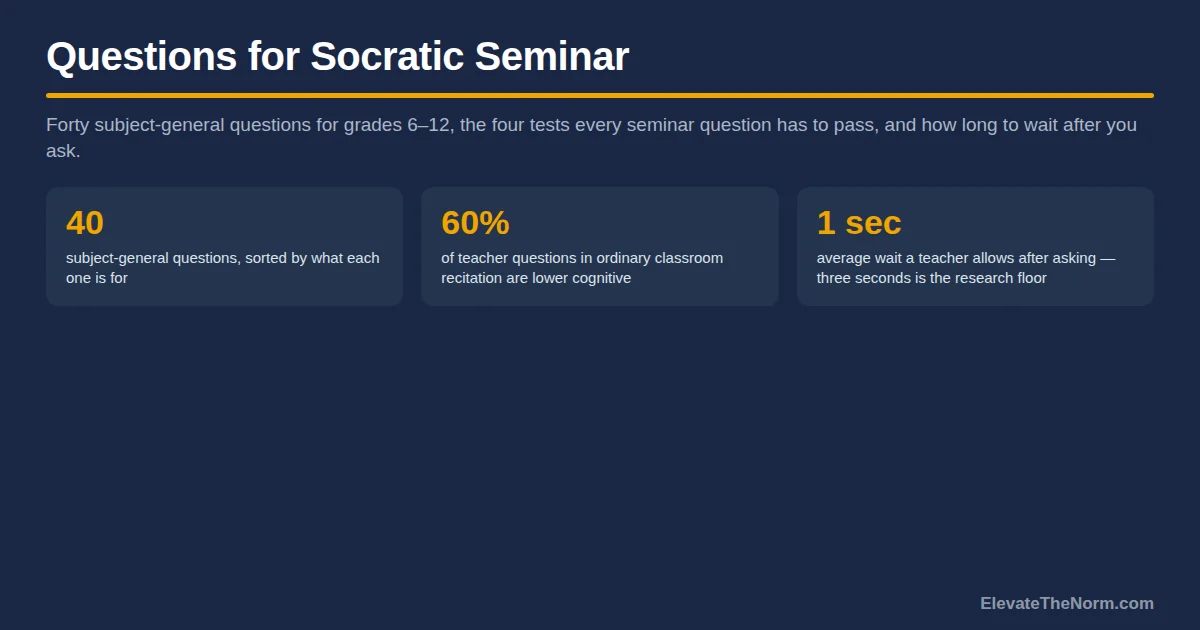
Below are forty questions you can use tomorrow, sorted by what they are for, plus the way to write your own out of whatever text you are already teaching.
Key Takeaways
- Three kinds of question run a seminar: one opening question, several core questions you may never need, and closing questions that ask what changed.
- The research on “higher-order questions” is weaker than the training says. One meta-analysis of 20 studies found a significant positive effect; a second, of 14 studies, found the effect small. Both are true and both are old.
- What does hold up is the authentic question — one the teacher does not already have an answer to. In a study of more than 1,100 eighth and ninth graders, that predicted higher literature achievement.
- Wait longer than feels reasonable. Teachers average about one second. Three is the floor for a recall question, and for a genuinely open one there appears to be no ceiling.
- Students should be writing questions too. A seminar where only the teacher asks is a recitation with the chairs moved.
Free Download · PDF
40 Socratic Seminar Questions
All forty questions in five groups, the six stems to post for students, and the ten-minute method for turning a text of your own into seminar questions.
Free. No email address required. Designed for grades 6–12. Browse every printable in Your Free Library.
What Makes a Good Socratic Seminar Question?
Four things, and you can test all four in about a minute. Write your question down, then run it against this list before you take it anywhere near a class.
- You cannot answer it in one sentence. Try. If you finish in a line, you have written a comprehension check. Keep it — just do not open with it, and file it with your other ways of checking what landed.
- You do not already know the answer. This is the hard one, because teachers are trained to ask questions we can assess. A seminar question is one where you would genuinely take notes on the replies.
- The text can support more than one answer. Not “what do you think” — opinions with no evidence anchor produce a conversation nobody can lose or learn from. The disagreement has to be arguable from the page.
- It cannot be Googled. If a phone settles it in twenty seconds, it will get settled in twenty seconds.
The fourth one has quietly become the most important. A question like “what were the causes of the conflict” is a research task. “Which of the causes the author lists is doing the most work, and which one is there to make the argument look balanced?” is a seminar, because the answer is not written down anywhere.
The Three Kinds of Question a Seminar Needs
An opening question, a stack of core questions, and a closing question — and you should expect to use the opening one and maybe two others. The stack is insurance, not a script.
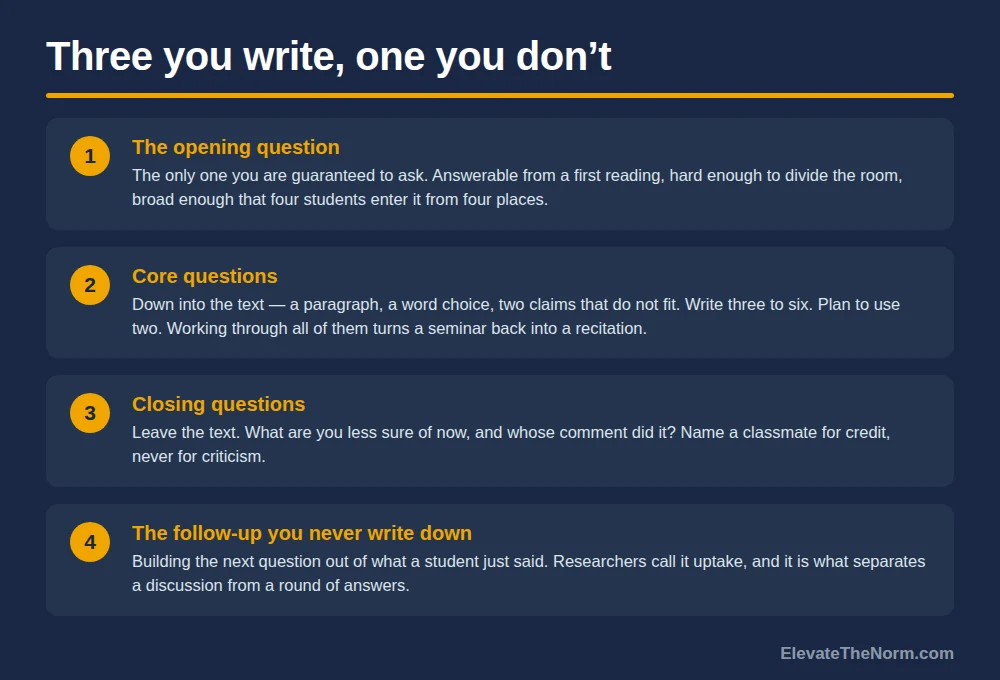
The opening question is the only one you are guaranteed to ask. It should be answerable from a first reading, hard enough to divide the room, and broad enough that four different students can enter it from four different places. It usually points at the whole text rather than a line.
Core questions go down into the text. These are the ones that name a paragraph, a word choice, a contradiction between two claims. Write six and plan to use two — and if you have five preps and six is not happening, write three. Three real ones beat six you assembled at 10pm. The worst thing you can do with a good stack is work through it, because then you are running the agenda and the students are answering it.
Closing questions leave the text. What does this mean for something the students actually deal with? What changed in your thinking, and whose comment did it? That second one belongs in the post-seminar writing, and it is the single best assessment item this format produces. One guard on it: ask students to name a classmate for credit, never for criticism. “What did this conversation get wrong?” is a question about the conversation, and it is worth saying so out loud before they write.
There is a fourth kind that never gets written down, and it is the one that matters most in the room: the follow-up. Building the next question out of what a student just said — researchers call it uptake — is what separates a discussion from a round of answers.
Does Asking Harder Questions Actually Improve Achievement?
Less clearly than the training slides claim, and it is worth knowing why before you rebuild your question bank around Bloom’s taxonomy. Two meta-analyses looked at the same question and did not agree.
Kathleen Cotton’s synthesis for the Northwest Regional Educational Laboratory lays both out. Redfield and Rousseau’s 1981 meta-analysis of 20 studies “concludes that asking higher cognitive questions has a significant and positive effect on student performance.” Samson and colleagues ran a second meta-analysis in 1987 across 14 studies and found that students exposed to higher cognitive questions did outperform others, “but that the effect size is small.”
A later critical review by Mikyeong Yang went further, concluding that this body of work “reported incoherent results” and that the evidence cannot support the expectation that higher-cognitive questions are more effective than fact questions. So: a real effect, a small effect, and a serious argument that the whole line of research is not measuring what it thinks it is.
Here is what survives all three, and it is not about difficulty at all. Nystrand and Gamoran studied eighth- and ninth-grade English classes across sixteen middle schools feeding nine high schools, testing more than 1,100 students in fall and spring. Students whose teachers asked a higher proportion of authentic questions — ones the teacher did not already have an answer to — and who practiced uptake scored significantly higher on literature achievement.
Authentic is not the same as hard. “Analyze the author’s use of irony” is high on Bloom’s and completely inauthentic if you have a rubric in your hand describing the right answer. “Is the last line a joke?” is simple, open, and genuinely contested. Write for authentic, not for the taxonomy. It is the same trade as anywhere else on this site: real questions hand students something to do, which is what giving students a genuine decision rather than a cosmetic one actually looks like inside one class period.
One more number worth carrying, from the same Cotton synthesis: in ordinary classroom recitation, about 60 percent of teacher questions are lower cognitive, 20 percent higher cognitive, and 20 percent procedural. A seminar is one of the few structures that changes that ratio on purpose.
40 Questions for Socratic Seminar
Eight questions in each of five categories, written to be subject-general so you can drop your own text into them. Every one of these is a shell — swap in your author, your document, your data set.
Two things before you use them. They are subject-general on purpose, which means the question is only as safe as the text you put under it; choosing a text on a contested public issue is a decision that belongs to you and your school’s policy, not to a question bank on the internet. And the fourth group — the ones that surface disagreement — is asked to the room, never to a named student. “Who read that line differently?” is an invitation. “Marcus, you disagree, right?” is an ambush, and the student you do it to will remember it longer than the text.
Opening questions (use one)
- What is the most important sentence in this text, and what does the rest of it do?
- What is this author afraid of?
- If you had to remove one paragraph without losing the argument, which one goes?
- Who is this written for? How can you tell?
- What does this text refuse to say?
- Is the author describing the world or arguing about it?
- What would have to be true for this to be right?
- What question is this text an answer to?
Core questions: evidence and claims
- Which claim here has the least support behind it?
- Where does the author stop explaining and start assuming?
- Are the two claims in the second and fourth paragraphs compatible?
- What counts as evidence in this text, and who decided that?
- Is the strongest objection to this argument in the text, or did the author leave it out?
- Which detail would change your reading if it turned out to be wrong?
- Does the author distinguish what they know from what they think?
- If this were written by someone on the other side, which sentence would survive?
Core questions: language and choice
- Why that word and not the obvious one?
- What work is the title doing?
- Where does the tone shift, and what happens right before it?
- Who is given a name in this text, and who is not?
- What is the effect of the thing the author repeats?
- Is the ending earned by what came before it?
- What would be lost if this were written plainly?
- Which sentence do you think the author rewrote the most times?
Questions that surface disagreement
- Who in this room read that line differently than you did?
- What is the strongest version of the argument you disagree with?
- Is this a disagreement about the text or about something outside it?
- What would change your mind?
- Can both readings be true at once?
- What are we assuming that the text never says?
- Which of us is using a word to mean two different things?
- Is the disagreement about what happened or about whether it was right?
Closing and reflection questions
- What did you come in believing that you are less sure of now?
- Whose comment changed or sharpened your thinking, and what did they say?
- What question do we still not have an answer to?
- What would you need to read next to settle this?
- Where does this argument show up outside of school?
- If you had to explain this text to someone in one sentence, what would you leave out?
- What did this conversation get wrong?
- What is the question you wanted to ask and did not?
Question Stems Students Can Use
The fastest upgrade to a seminar is teaching students to ask each other questions instead of taking turns making statements. Most students arrive with one move — say your opinion and stop — and a short posted list fixes it faster than any amount of coaching.
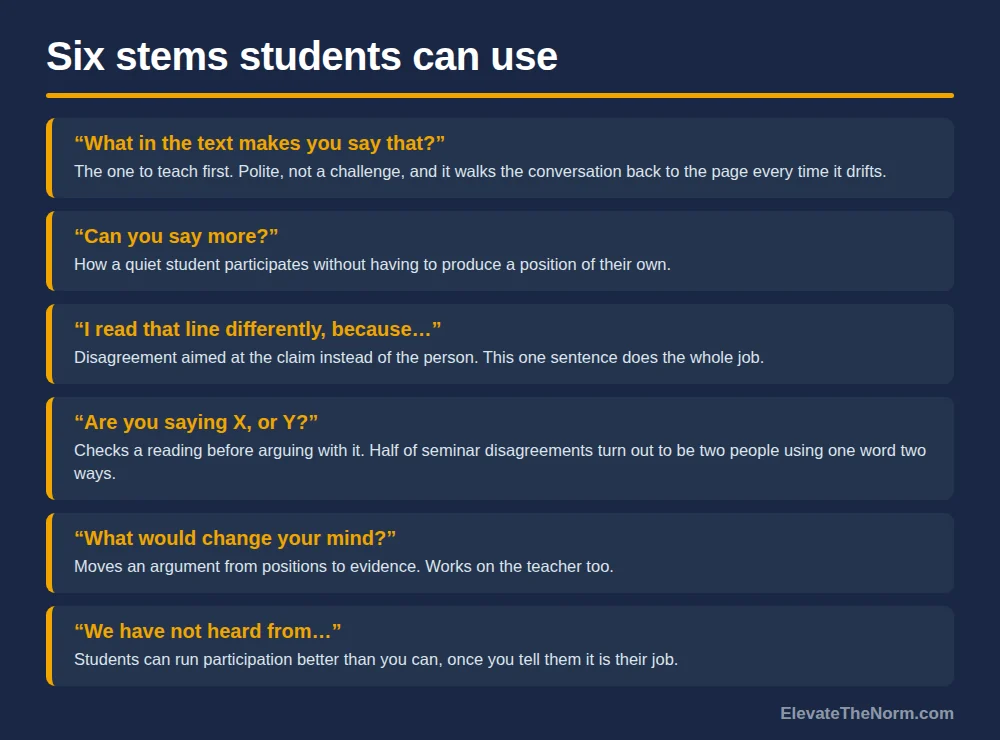
Post six stems and refer to them by name. Do not post twenty; nobody reads twenty.
The other half of this is teaching students to write a question, since you are requiring one at the door. Give them one frame and it stops being mysterious: point at a specific place in the text, say what confused or bothered you about it, and end with a question you cannot answer yourself. “On page two the author says X, but earlier they said Y — which one are they actually arguing?” is a better seminar question than most of mine, and a fourteen-year-old can produce it on the second try.
For a student who found the text hard, say plainly that the question can be about the part they did understand. A question from paragraph one is a real contribution. Nobody has to have finished the text to have something worth asking about it.
Two of these deserve a note. “What in the text makes you say that?” does most of the work of a facilitator and it is the one stem I would teach first — it is polite, it is not a challenge, and it forces the conversation back to the page every time it drifts. And “Can you say more?” is how a quiet student participates without having to produce a position of their own, which matters more than it sounds like.


How Long Should You Wait After Asking?
Three seconds minimum, and for a genuinely open question, longer than you think you can stand. This is the oldest finding in the questioning literature and it is still the one teachers violate most.
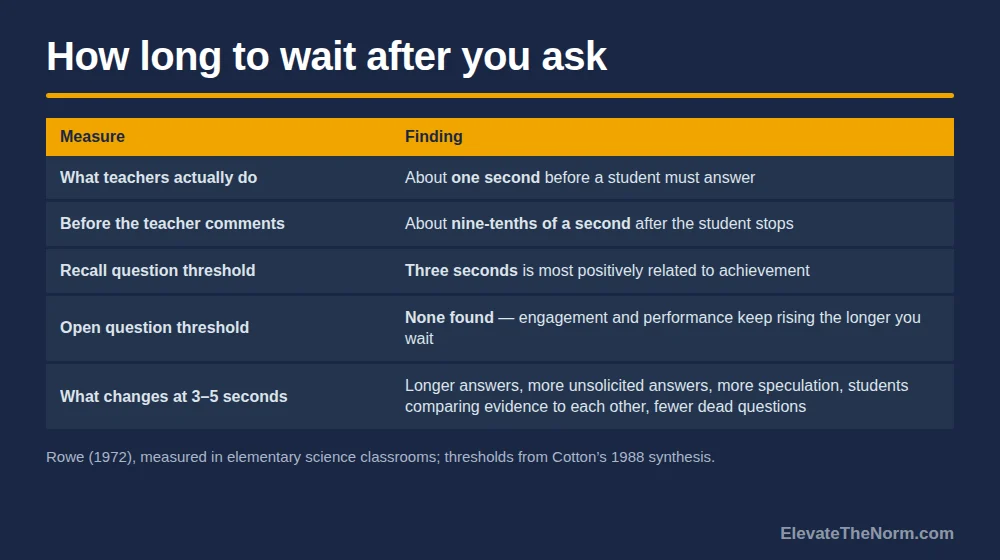
Mary Budd Rowe measured it in the early 1970s. Teachers allowed an average of about one second for a student to respond, and followed a student’s answer with a comment within roughly nine-tenths of a second. When those two waits were stretched to three to five seconds, student responses got longer, more students answered without being called on, speculative thinking went up, students began comparing their evidence to each other’s rather than to the teacher, and fewer questions went unanswered. Worth naming honestly: Rowe’s classrooms were elementary science. The effect has held up widely, but that is the population she measured.
One cheap adjustment that goes with the wait: put the opening question in writing as well as saying it. On the board, on the handout, anywhere it stays. A student who processes slowly, who missed the first three words, or who is rereading the text while you talk should not lose the question because it only existed as sound. It costs nothing and it changes who is able to answer.
Cotton’s synthesis adds the part that matters for seminars specifically: three seconds is the threshold for lower cognitive questions, and for higher cognitive questions there appears to be no threshold at all — students “seem to become more and more engaged and perform better and better the longer the teacher is willing to wait.”
I have tested the ceiling on this and I would not recommend the experiment. I once waited more than five minutes. It was one of the most awkward moments of my life, that section finished nine minutes behind my other classes, and it is the only time I have ever assigned homework. I am not telling that story as a technique. I am telling it because the price of waiting is real and it is worth knowing what it costs before you decide the silence is unbearable at eight seconds. Eight seconds costs you nothing.
How to Turn Your Own Text Into Questions in Ten Minutes
Read for the seams, not for the content. You are not looking for what the text says. You are looking for the places where it strains.
- Mark every hedge. “Arguably,” “some have suggested,” “it is possible that.” Each one is a place the author was not sure, and each one is a question.
- Find two sentences that do not quite fit together. Not a contradiction — a tension. “Are these both true?” is a seminar question that writes itself.
- Note what is missing. Who is not quoted. Which objection is not answered. What the author had to leave out to make the piece work.
- Write your opening question from the whole text, and three core questions from the marks you made.
- Answer your own opening question in one sentence. If you can, go back to step two.
That is the whole process, and it gets faster. The fourth time you do it you will find yourself marking hedges while you read for other reasons, which is a better outcome than any question bank.
Questions That Wreck a Seminar
Four shapes, and all four are easy to write by accident.
- The question you already answered in class. Students will give you your own words back, correctly, and nothing will happen.
- The yes-or-no question with an obvious side. “Was the narrator wrong to lie?” gets twenty-eight yeses. Ask instead what the lie cost, and who paid.
- The question that requires a personal disclosure. “Have you ever been treated this way?” will get an honest answer from a fifteen-year-old in front of twenty-seven peers, and that is exactly the problem. Keep the question on the text and let students bring themselves to it if they choose. If a text is likely to pull the room in that direction, that is a conversation to have with an administrator before it is a seminar question.
- The question with a correct answer you will eventually supply. Students can smell this within four minutes, and once they have, the seminar becomes a guessing game about you.
The third one is the one worth being most careful with, because it usually comes from a good instinct. Relevance is not the same as exposure. A question can matter to a student’s life without requiring them to narrate it to the class.
What to Do Next
Take the text you are teaching this week and spend ten minutes on the five steps above. Write one opening question, three core questions, and one closing question. Then pull four questions from the bank here that fit the same text, so you have something in reserve you did not have to invent.
Ask your opening question once, and count to eight in your head before you do anything else. That is the whole practice. If you want the rest of the format — the norms, the seating, what to do about the students who will not talk — it is in the full guide to running a Socratic seminar. And if the questions you write keep coming out as comprehension checks, that is not a failure; it means you have a set of quick checks for understanding and a seminar question still to write.
Before you go: grab the free 40 Socratic Seminar Questions (PDF) — ElevateTheNorm.com branded, printable, no email required.
Frequently Asked Questions
What makes a good Socratic seminar question?
One you cannot answer in a sentence, that you do not already have an answer to, that the text can support more than one answer to, and that a phone cannot settle in twenty seconds. The first two are the ones teachers miss. We are trained to ask questions we can assess, and a question you can assess is usually a question you already answered.
How many questions should I prepare for a seminar?
One opening question, about six core questions, and two closing questions — and expect to use three of them. The stack is insurance against a dead room, not an agenda. Working through all nine is how a seminar turns back into a recitation with the chairs moved.
What is the difference between an authentic question and a higher-order question?
An authentic question is one the teacher does not have an answer to. A higher-order question is one high on Bloom’s taxonomy. They are not the same thing, and the research suggests the first matters more. “Analyze the author’s use of irony” is higher-order and completely inauthentic if you are holding a rubric describing the right answer.
How long should I wait after asking a seminar question?
Three seconds is the research floor, and for open questions there appears to be no ceiling — students engage more and perform better the longer the teacher is willing to wait. Teachers average about one second, which is why this feels so unnatural. Eight seconds costs you nothing and changes who answers.
Should students write their own seminar questions?
Yes, and it is the change that most reliably fixes a flat seminar. Require one written question from every student, collected on the way in. Make it an expectation rather than a bar — a student who arrives without one writes it in the first two minutes. A seminar where only the teacher asks questions is not a seminar.
Can I use the same questions for any text?
Most of them, yes. The forty here are deliberately subject-general: “what does this text refuse to say?” works on a court opinion, a poem, a lab report and a political speech. What does not transfer is the core questions, because those name a specific paragraph or word choice. Write those yourself from the text in front of you.
What questions should I avoid in a Socratic seminar?
Anything you already answered in class, yes-or-no questions with an obvious side, questions with a correct answer you plan to supply eventually, and questions that require a student to disclose something personal in front of the class. That last one usually comes from a good instinct — relevance — but relevance is not the same as exposure.
Do harder questions actually raise achievement?
The evidence is genuinely split. A 1981 meta-analysis of 20 studies found asking higher cognitive questions had a significant positive effect on performance; a 1987 meta-analysis of 14 studies found the effect small; and a later critical review argued the whole line of research reported incoherent results. What holds up better is the authentic question and the follow-up built on what a student just said.
Sources
- Cotton, Kathleen. Classroom Questioning. School Improvement Research Series, Northwest Regional Educational Laboratory, May 1988. Reports Redfield and Rousseau (1981), 20 studies, “significant and positive effect” for higher cognitive questions, against Samson et al. (1987), 14 studies, effect “small”; a three-second wait-time threshold for lower cognitive questions and no apparent threshold for higher cognitive ones; and a 60 / 20 / 20 split of lower cognitive, higher cognitive and procedural questions in ordinary recitation. https://educationnorthwest.org/sites/default/files/ClassroomQuestioning.pdf
- Rowe, Mary Budd. Wait-Time and Rewards as Instructional Variables: Their Influence on Language, Logic, and Fate Control. 1972. ERIC ED061103. Teachers allowed an average of about one second for a response and commented within about nine-tenths of a second; extending both to three to five seconds produced longer responses, more unsolicited appropriate answers, more speculative thinking, more student-to-student evidence comparison and fewer unanswered questions. Population: elementary science classrooms. https://eric.ed.gov/?id=ED061103
- Nystrand, Martin, and Adam Gamoran. Student Engagement: When Recitation Becomes Conversation. National Center on Effective Secondary Schools, 1990. ERIC ED323581. Eighth- and ninth-grade English classes in sixteen middle schools feeding nine high schools across eight Midwestern communities; over 1,100 students tested fall and spring. Higher proportions of authentic questions and uptake predicted significantly higher literature achievement. https://files.eric.ed.gov/fulltext/ED323581.pdf
- Yang, Mikyeong. “A Critical Review of Research on Questioning in Education: Limitations of Its Positivistic Basis.” Asia Pacific Education Review, vol. 7, no. 2, 2006, pp. 195–204. Argues that the teacher-questioning meta-analyses “reported incoherent results” and that the evidence cannot support the expectation that higher-cognitive questions outperform fact questions. https://files.eric.ed.gov/fulltext/EJ752340.pdf
- Applebee, Arthur N., Judith A. Langer, Martin Nystrand, and Adam Gamoran. “Discussion-Based Approaches to Developing Understanding: Classroom Instruction and Student Performance in Middle and High School English.” American Educational Research Journal, vol. 40, no. 3, 2003, pp. 685–730. 64 middle and high school English classrooms, grades 7, 8, 10, 11 and 12. https://eric.ed.gov/?id=EJ782328
- National Paideia Center. “Paideia Seminar.” The seminar defined as a collaborative intellectual dialogue facilitated with open-ended questions about a text, run as a pre-seminar / seminar / post-seminar cycle. https://paideia.org/blogs/npc/paideia-socratic-seminar