
Student leadership is not a title, an election, or a line on a college application. It is the practice of giving a teenager genuine responsibility — real decisions, real consequences, and real support from an adult who has done the planning to make success possible. Schools that do this well produce students who know how to serve others, solve hard problems, and hold themselves accountable. Schools that do it poorly give students the word leadership and wonder why nothing changes.
This article explains what student leadership actually requires, where most schools fall short, and how any classroom teacher can hand a student real authority and then hold them to it — without setting them up to fail.
What Student Leadership Actually Means
Most school definitions of student leadership center on elected positions: student council president, class officers, homecoming committee. These roles are not without value. But they are also the roles most likely to be filled by students who were already organized, already known, and already comfortable raising their hands. If a school’s model of leadership only rewards students who already look like leaders, it is not developing leadership — it is sorting for it.
A more useful definition: student leadership is any structured situation in which a student holds genuine authority over a meaningful outcome and is held accountable for results. The authority must be real, not ceremonial. The outcome must matter to someone besides the student. The accountability must have consequences the student actually feels.
Research on youth development supports the value of this kind of experience. Sociologist Reed Larson’s landmark review found that voluntary, goal-directed activities — ones that require initiative, not just compliance — produce the kind of intrinsic motivation that transfers to adult life.1 Dana Mitra’s analysis of student voice in secondary schools found that genuine student participation, including planning and decision-making roles, produced measurable gains in engagement, school belonging, and academic motivation — particularly among students who had previously been disengaged.2
The operative word in both bodies of research is genuine. Symbolic participation — filling a role with a title and no real authority — does not produce those outcomes. It often produces the opposite: students who learn that official channels are theater, that adults do not actually share power, and that their effort is not taken seriously.
The Problem With Symbolic Leadership
Consider three common school leadership structures and what they often deliver in practice:
Student government at many schools functions as an event-planning committee with a democratic veneer. Students vote on spirit week themes. They help organize pep rallies. The principal makes all decisions that actually affect the school, and student government exists to generate enthusiasm for those decisions. Students who take this seriously and try to raise real concerns — about grading policy, discipline, cafeteria conditions — often discover that the program’s actual scope is narrower than its name suggests, and that genuine policy decisions belong to administration rather than to the student government structure.
Peer mediators and conflict resolution programs are genuinely valuable when implemented with real training, supervised practice, and institutional backing. They are window dressing when students are given a title and a script and expected to resolve disputes the adults find inconvenient. A peer mediator who cannot actually commit to any outcome, who has no authority to follow up, and who receives no coaching after sessions learns very quickly that the role does not matter.
Student ambassadors and leadership clubs often confuse belonging with leading. Wearing a lanyard is not leadership. Giving a tour of the school to visiting families is service, but it is not the same as holding authority over a meaningful outcome. These programs are not wrong — they build community and recognize students. But when schools call them leadership development, they are doing two harmful things: overstating what the experience provides, and tacitly telling other students that leadership is a reward for being well-liked.
None of this means schools should abandon student government or peer programs. It means schools should be honest about what those programs are and build something more substantive alongside them — something that reaches students who are not already popular, high-achieving, or interested in student government.
What Real Student Responsibility Looks Like
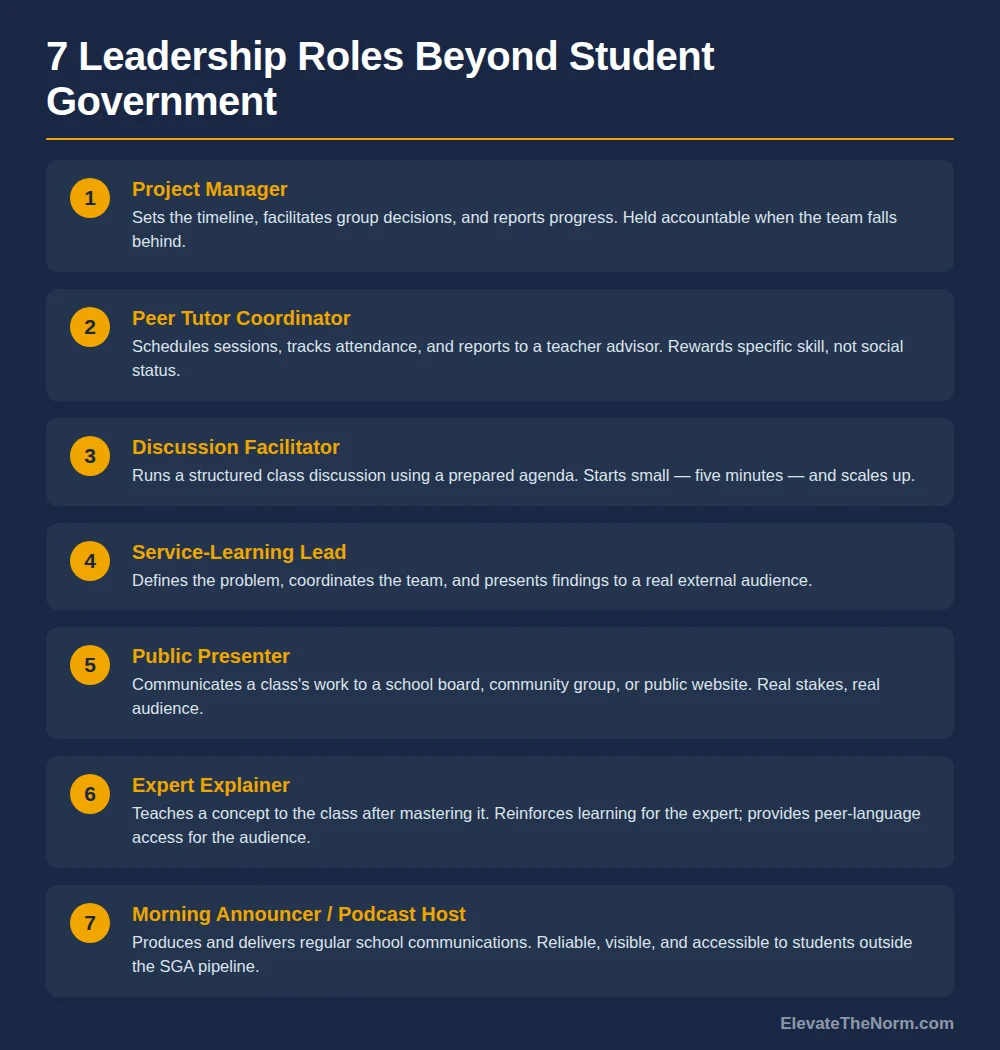
Genuine student leadership roles share three features: the student controls something that matters, an adult has done enough preparation for the student to succeed, and the student is held accountable when things go wrong or go right. Here are several forms this can take across a school day:
Decision-making authority within a project
In a project-based learning unit, one student serves as the project manager for a group. This is not a title for the student most likely to do all the work anyway. It is a structured role with defined responsibilities: managing the timeline, facilitating group decision-making, communicating progress to the teacher, and being the first person the teacher asks when something is behind schedule.
When student responsibility is built into the structure of a project — not as an add-on but as a load-bearing element — students who take the project manager role seriously develop skills they cannot get by sitting in the back of a lecture. They also discover something teachers know very well: managing other people is significantly harder than doing the work yourself.
Service with stakes
Service-learning at its best does not ask students to perform volunteerism. It asks them to solve a real problem for a real audience. A group of students who audits their school’s recycling program and presents findings to the facilities director is doing service. A group of students who sorts recycling bins after school is doing labor. Both are useful. Only one is leadership.
The National Commission on Service-Learning found that service-learning produces stronger civic engagement, deeper content understanding, and greater self-efficacy when students are active problem-solvers rather than passive participants — and when adult educators maintain mentorship and structured reflection throughout the experience.3
Peer teaching and peer support
Students can explain things to each other in ways adults sometimes cannot. A junior who has mastered a concept can reach a struggling sophomore through language, reference points, and social proximity that a teacher does not have. When schools build peer tutoring programs with genuine structure — trained tutors, session protocols, progress tracking, teacher oversight — they create leadership roles that reward competence in a specific skill rather than general popularity.
This is different from simply asking students to help each other. Unstructured peer assistance is not leadership. A tutoring coordinator who schedules sessions, follows up on attendance, and reports to a teacher advisor is holding a leadership role. The difference is the structure and the accountability. For any peer support role, families should receive a brief note at the start of the program explaining what the role involves — and what it does not involve, specifically that trained adults retain responsibility for any serious concerns that arise.
Public communication
Presenting research to a school board, speaking at a community meeting, writing an op-ed for the local paper, producing a podcast episode that goes on the school website — these are forms of student leadership that require preparation, require adult oversight, and require students to be accountable to an audience beyond their classroom. Building student voice and choice into public-facing tasks gives leadership a real audience, which changes how students approach the work.
Leadership for Students Who Are Not Already Known
One of the most persistent problems with school leadership programs is that they tend to select for students who are already recognized. Elected positions favor students with social capital. Competitive leadership programs favor students with the confidence to apply. Teacher nominations for leadership roles can unconsciously favor students who already perform the behaviors associated with “good” students.
This matters because leadership development, by definition, should change someone. A student who already leads well needs affirmation. A student who has never been asked to lead needs a chance. If schools only offer leadership experiences to students who already demonstrate leadership, they are providing a finishing school for existing leaders rather than developing new ones.

Several practical approaches reach students who are not already visible:
Role rotation within the classroom. Not every leadership experience needs to be a program. A teacher who rotates the project facilitator role, the daily discussion leader, the “expert” who explains last night’s reading to the class — that teacher is giving every student repeated low-stakes practice at the behaviors leadership requires. Some students will thrive immediately. Others will struggle, which is exactly when the learning happens. From a student’s perspective, being handed a role they did not seek — and then actually being trusted to carry it — sends a different signal than any motivational poster ever could.
Interest-based leadership, not performance-based. A student who is deeply interested in robotics but is not a top student may be the best person to lead the school’s engineering project. A student who has lived experience with food insecurity may be the right student to lead a school food drive — not because the school wants to exploit that experience, but because that student has a relationship to the work that others do not. When schools match students to leadership roles based on genuine interest and relevant knowledge, they reach students who would never raise their hand to run for class president.
Assigned authority with real stakes. Perhaps the most underused tool available to classroom teachers is the simplest one: assigning a student genuine authority and then treating that authority as real. Handing a student real authority and then holding them to it — not rescuing them when it becomes difficult, not undoing their decisions behind their back, and not abandoning them when they struggle — is the core practice of classroom-based leadership development. It requires the teacher to have done enough preparation that the student can actually succeed, and it requires the teacher to resist the urge to take the authority back the moment things get complicated.
The Teacher’s Role: Planning and Presence
Every effective student leadership experience rests on adult preparation. A student cannot demonstrate leadership in a role that has not been designed well enough for leadership to be possible. When a student “fails” at a leadership role — when the project falls apart, when the peer support session goes nowhere, when the presentation embarrasses everyone — the first question is not what the student did wrong. The first question is what the teacher did not prepare.
This is not a comfortable position. It requires teachers to hold themselves accountable for the conditions that make student success possible. But it is also the only position that actually develops students. A classroom where students are set up to fail so they can “learn from the experience” is not a leadership incubator. It is a classroom with poor design.
Holding high expectations for students does not mean removing all support. It means designing a situation where students are capable of meeting genuine expectations if they apply genuine effort — and then holding them to it when they do not. The high expectation and the adequate preparation are not in tension. They depend on each other.
Adult oversight in a student leadership context also means being present enough to catch problems before they become crises. A student project manager who is drowning should receive coaching from the teacher before the project fails, not sympathy after. A peer mediator who handles a session poorly should debrief with an adult advisor the same day, not two weeks later. Oversight is not micromanagement. It is the sustained adult presence that makes genuine student authority possible — because students are developing, not developed.
Ethical Boundaries: What Students Should Not Be Responsible For
Genuine student leadership has a clear outer boundary: students should never be placed in roles that require them to perform adult professional functions, manage other students’ behavioral or mental health needs without professional support, or bear responsibility for outcomes that exceed their developmental capacity.
A student peer mediator should not be the primary responder to a disclosure of abuse, self-harm, or safety concerns — that is a mandatory reporter responsibility that belongs to trained adults. A student project manager should not be responsible for motivating a peer who is dealing with a serious personal crisis — that is a counseling function. A student ambassador should not be expected to handle a visiting family’s complaint about the school’s discipline policy — that is an administrator’s responsibility.
These boundaries are not signs of low expectations. They are signs that the school understands what leadership development is for. Students are learning to be responsible. They are not responsible for the school. That distinction protects them and produces better learning outcomes. The National Academies of Sciences has noted that adolescents’ development of responsibility, civic identity, and competence is best supported by environments that offer genuine challenge within a framework of consistent adult support — not by environments that expose them to adult burdens before they are ready.4
Building strong relationships with students includes being clear about where their authority ends — and why. Students who understand that their role has real boundaries, and why those boundaries exist, are more likely to take the role seriously than students who feel they have been handed an amorphous responsibility no one has defined.

How to Start: Practical First Steps for Any Teacher
Leadership development does not require a program, a budget, or administrative approval. Every teacher in any classroom can begin with the classroom they already have.

Step 1: Identify one role in your current classroom structure that could be held by a student. Not a fake role. Not a role the teacher secretly controls. A role with a real outcome: discussion leader for the week, group project coordinator, quiz-question author, revision partner who gives written feedback on two other students’ drafts. Start small and make it real.
Step 2: Assign the role intentionally, not by nomination or election. Choose a student who could benefit from the experience — not one who would succeed regardless. A student who is quietly competent but rarely recognized, who is genuinely interested in the work, or who needs to practice leading rather than following is often a better choice than the class’s most visible student. Brief them privately on what the role requires before it begins. For students who are anxious or reluctant, start with a smaller version of the role — five minutes of discussion facilitation before thirty, one group member to coordinate before a full team. Check in with them during the role, especially the first time. Debrief with them honestly after. A good debrief is specific: what went well, what you would do differently next time, one thing the student handled that they might not have expected they could handle.
Step 3: Hold the student to the role. When something goes wrong — and something will — address it directly and specifically. “Your group’s timeline slipped because you didn’t confirm the assignment on Tuesday. How will you handle Tuesday next time?” is more useful than either letting it slide or removing the student from the role. This is where the development happens.
From there, activities for teaching responsibility can build on this foundation. But the first step is the simplest and the hardest: treating a student as capable of holding real authority and then actually letting them hold it.
Schools that do this consistently — across classrooms, grade levels, and subject areas, not just in special programs — produce students who understand that leadership is a practice, not a status. That understanding is more durable, more transferable, and more honest than any title a school can give.
Key Takeaways
- Student leadership is genuine authority over a meaningful outcome — not a title or a symbolic role.
- Most school leadership programs reach only students who are already recognized. Effective leadership development reaches students who have never been asked to lead.
- Real leadership experiences require real preparation by the teacher — students cannot demonstrate leadership in a role the teacher has not designed well enough for success to be possible.
- Student authority must have real boundaries: students are not responsible for adult professional functions, peer mental health crises, or outcomes that exceed their developmental stage.
- The most accessible form of leadership development happens inside existing classrooms: assigning real roles, holding students to them, and debriefing honestly when things go wrong.
- High expectations and adequate preparation work together — they are not in conflict.
Free Download: Student Leadership Planning Guide
A one-page classroom tool for designing real student leadership roles — with a checklist for authority, preparation, and accountability. No email required.
Free Download: Student Leadership Planning Guide — a one-page classroom tool. Download (PDF) →
Frequently Asked Questions
What if a student doesn’t want a leadership role?
This is a reasonable concern, and it comes up more often than schools expect. A student who genuinely refuses a role after a calm, private conversation about what it requires may be signaling something worth understanding — anxiety, lack of preparation, or a personal situation the teacher doesn’t know about. In that case, starting smaller makes sense: a five-minute facilitator role before a thirty-minute project lead. The goal is not to force students into uncomfortable positions but to expand what they believe they can do. Forced reluctance rarely produces leadership growth. A smaller, well-scaffolded role that a student actually performs is worth more than a larger role that a student dreads and does minimally.
Should student leadership roles be graded?
It depends on the context, but grading is not required for the experience to be valuable. Many teachers assess the work the leadership role produces — the project the team completed, the reflection the student writes afterward, the quality of the peer feedback — rather than grading the leadership itself. Grading “how well you led” is difficult and can feel punitive when a student is still learning. What matters most is specific, honest feedback during and after the role. A debrief conversation — what went well, what you would do differently, what you’ll do next time — is often more developmental than a grade. If the class context requires a grade, consider self-assessment as part of the evaluation: students who accurately assess their own performance in a leadership role are demonstrating growth that matters.
What should teachers do when a peer support role exposes a serious student concern?
Train peer supporters explicitly on this scenario before the role begins, not after the fact. Students who serve as peer mediators, tutors, or support partners need to know the clear boundary: they listen, they can acknowledge, and they direct any serious concern to an adult immediately. They are not counselors, they are not mandated reporters, and they are not equipped to evaluate whether a classmate’s situation requires professional intervention. When a peer supporter encounters a disclosure of self-harm, abuse, mental health crisis, or safety risk, their job ends at “let’s tell Ms./Mr. [advisor] together.” Adults handle everything from that point forward. This boundary should be taught, practiced with scenarios, and reinforced with every cohort. Schools running peer programs without explicit training on this boundary are creating risk for students and for the program.
How do you support students who struggle with the leadership role — especially shy students or those with learning differences?
Scaffolding is the answer. A student with social anxiety who is expected to run a full group discussion without preparation will likely confirm every belief they already have about their own limitations. The same student, given a structured agenda in advance, a few rehearsal prompts, and permission to check in quietly with the teacher midway through, can run a discussion effectively. Learning differences require similar thought: a student who processes language slowly may need written prompts rather than on-the-spot decisions. A student with executive function challenges may need the project manager role broken into smaller daily tasks with explicit check-in points. The question is not whether these students can lead — it is whether the teacher has designed the role with enough structure for their specific needs. When the design is right, the role becomes possible. That is the work.
How much additional time does this require from teachers?
An honest answer: the initial design takes time. Creating a role with real authority, identifying which student to assign it to, briefing that student, and planning a debrief is work that does not happen automatically. For a classroom teacher managing multiple preps, 28–35 students, and a full grading load, “just add leadership development” is not a costless suggestion. The most practical approach is to start with one role in one unit and evaluate it. A project manager role in a single project — one briefing conversation, two or three check-ins during the unit, one debrief at the end — adds perhaps thirty to forty minutes across a three-week project. Over time, the routines become faster and the students become better at them. The cost is real and it is worth naming honestly. The alternative — students who graduate without ever having held genuine authority in a structured setting — is also worth naming.
When should schools start building student leadership experiences? Is middle school too early?
Middle school is not too early — but the scale and structure need to match the developmental stage. A seventh grader serving as the daily discussion leader for ten minutes is not the same as a seventh grader managing a semester-long project team. Middle school is an appropriate time to introduce leadership roles at the classroom level: group facilitator for the week, peer reviewer, expert explainer. These experiences build the vocabulary and the habits that high school leadership roles require. By ninth grade, students who have had repeated small-scale leadership experiences are far better prepared for larger roles than students who have only ever been assigned to fill out a group worksheet. Start small, start early, and keep the authority proportional to the preparation.
What’s the difference between giving students real responsibility and putting adult problems on them?
The test is whether an adult professional could reasonably be expected to handle the situation without specialized training or institutional authority. A student can be responsible for a project timeline. A student cannot be responsible for a peer’s mental health crisis. A student can be responsible for facilitating a class discussion. A student cannot be responsible for resolving a conflict involving serious interpersonal harm. A student can communicate a problem to an administrator on behalf of a group. A student cannot be expected to manage the administration’s response to that problem. When the role requires specialized credentials, institutional authority, or the capacity to impose consequences on others, it belongs to an adult. When the role requires planning, communication, collaboration, and follow-through, it can belong to a student — with preparation and oversight. Genuine leadership development stays consistently on the student side of that line.
Should families be informed when their student takes on a peer support role?
Yes, particularly for any program with ongoing peer support, mediation, or advising functions. Families deserve to know that their student is serving in a peer role, what that role involves, and what it does not involve (and specifically that trained adults oversee all serious concerns). For classroom-level leadership roles — project manager, discussion leader, peer reviewer — a brief mention in a class newsletter or course syllabus is usually sufficient. For structured peer programs that carry more weight, a brief parent communication at the beginning of the year or program is appropriate. Transparency builds trust with families who might otherwise wonder what “peer leadership” means in practice. It also gives parents the language to reinforce the experience at home, which extends the learning beyond the classroom.
Sources
- Larson, R. W. (2000). Toward a psychology of positive youth development. American Psychologist, 55(1), 170–183. https://doi.org/10.1037/0003-066X.55.1.170
- Mitra, D. L. (2004). The significance of students: Can increasing “student voice” in schools lead to gains in youth development? Teachers College Record, 106(4), 651–688. https://doi.org/10.1177/016146810410600401
- National Commission on Service-Learning. (2002). Learning in deed: The power of service-learning for American schools. W. K. Kellogg Foundation. https://eric.ed.gov/?id=ED467192
- National Academies of Sciences, Engineering, and Medicine. (2019). The promise of adolescence: Realizing opportunity for all youth. National Academies Press. https://doi.org/10.17226/25388