By Clay Shumate
Student leadership activities are tasks where a middle or high school student holds a real decision, a real deadline, and a real audience — not a title. The test is simple: name what the student actually gets to decide. If you cannot, you have a chore with a nicer word attached. The 25 roles below each pass that test, and each one names the adult guardrail that keeps it honest.
Key Takeaways
- A leadership activity needs a decision in it. Line leader, paper passer and “class representative” with no agenda are not leadership. A role that changes an outcome is.
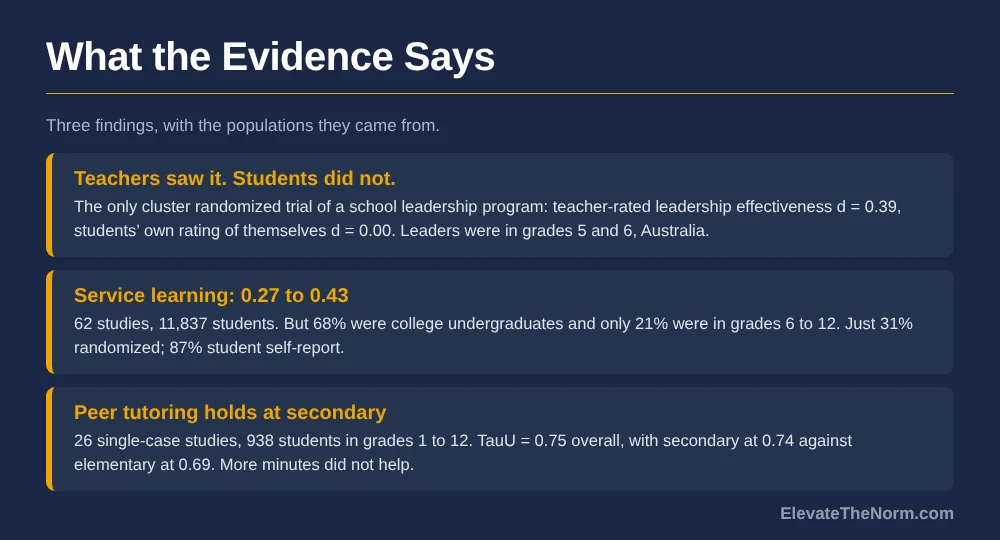
- The only cluster-randomized trial of a school leadership program found something uncomfortable. Teachers rated the student leaders meaningfully more effective (d = 0.39), while the leaders’ own ratings of themselves moved exactly nothing (d = 0.00). Adults saw a change the students did not feel.
- The strongest evidence is for service and peer teaching, not for leadership programs. A meta-analysis of 62 service-learning studies found effects of 0.27 to 0.43 across five outcomes — but 68% of those studies were college undergraduates and only 21% were in grades 6–12.
- Peer tutoring works about as well at secondary as it does at elementary. Across 26 single-case studies of 938 students in grades 1–12, the academic benefit was moderate to large, and secondary students did slightly better than younger ones.
- A student should never be able to fall off a cliff you built. If a teenager can wreck something badly enough to matter, that is a planning failure, not a learning experience. Every role below is bounded by adult presence, not by lowered expectations.
Free Download · PDF
The Student Leadership Role Card and 25-Role Planner (2 pages)
Page 1 is a blank five-line role card plus the rotation grid that stops the same four students getting every role. Page 2 is all 25 roles as a checklist, with the four ways they go wrong.
Free. No email address required. Designed for grades 6–12. Browse every printable in Your Free Library.
What Counts as a Student Leadership Activity?
A student leadership activity is any structured task in which a student makes a decision that other people depend on, inside limits an adult set on purpose. Three parts, and all three have to be there.
A decision. Not a preference — a decision. Which three sources the group cites. What order the presentation runs in. If the answer to “what does this student decide?” is “nothing, they just help,” redesign it.
Dependence. Somebody’s work gets easier or harder depending on how the role is done. That is what makes it leadership instead of homework.
Limits you wrote down in advance. Most lists skip this, and it is the part that protects both of you. A role without a written limit eventually reaches something a fifteen-year-old should not be holding — a grade, a discipline decision, somebody’s private business.
The longer argument about why symbolic titles fail, and why the same four kids keep getting them, is made in the guide to giving teenagers responsibility that actually carries weight. This is the implementation half: the roles, and how to set one up so it survives a Tuesday.
What Does the Research Actually Show?
Short answer: the evidence for peer teaching and service work is reasonably good, the evidence for “leadership programs” is thin, and the one rigorous trial of a leadership program produced a split result that is worth sitting with.
That trial is Learning to Lead, a two-arm cluster randomized controlled trial across 20 schools and 1,898 students, published in Contemporary Educational Psychology in 2026. Leaders got six leadership lessons, then taught twelve movement-skill sessions to younger peers. Teachers rated them significantly more effective afterwards (d = 0.39) and their classroom time on task rose 7 percentage points.
Then the uncomfortable half. The leaders’ own self-reported effectiveness moved by exactly zero (d = 0.00, p = 0.999) and their self-efficacy missed significance too. On the peer side, the younger students’ perceived motor competence improved (d = 0.17) while their actual measured competence did not (d = 0.03, not significant).
And the caveat that matters most on a grades 6–12 site: those leaders were in grades 5 and 6, their peers in grades 3 and 4, in New South Wales, Australia. This is not a secondary result. The design logic transfers; the effect sizes do not come with it.
The service-learning evidence is broader. Celio, Durlak and Dymnicki’s 2011 meta-analysis of 62 studies and 11,837 students found mean effects on attitudes toward self (0.28), attitudes toward school (0.28), civic engagement (0.27), social skills (0.30) and academic achievement (0.43). Read the sample before quoting the numbers: 68% of those students were college undergraduates, 16% high school and 5% middle school. Only 31% of the studies randomized, and 87% relied entirely on student self-report — which the authors flag themselves, noting ratings of community commitment “could be biased by social desirability.”
Peer teaching holds up better for our grade band. Bowman-Perrott and colleagues (2013) synthesized 26 single-case studies covering 938 students in grades 1 through 12 and reported a moderate-to-large academic benefit (TauU = 0.75), with secondary students (0.74) marginally ahead of elementary (0.69). Dosage made no difference — studies above and below the 480-minute median produced identical effects. More minutes is not the lever.
Dana Mitra’s 2004 study in Teachers College Record is the one worth reading in full. It followed student voice work at a struggling high school and found growth in three things — agency, belonging and competence — concentrated in students “who otherwise do not find meaning in their school experiences.” It is qualitative and establishes no cause. It does tell you where to aim.
One honest note on all of it. Teenagers probably do not respond because leadership is intrinsically motivating. Yeager, Dahl and Dweck argued in a 2017 theory review that adolescents are unusually sensitive to status and respect, and that interventions work when a teenager feels “competent, [has] agency and autonomy, and [is] of potential value to the group.” That is a framework, not a finding — but it predicts what the roles below do and do not accomplish.

The Five-Line Role Card
Before a student takes any role, write five lines. If you cannot fill all five, the role is not ready. This takes about ninety seconds per role and it is the difference between a leadership activity and an unpaid chore.
- The decision. One sentence naming what this student gets to decide. “You choose which two sources we cite in the final draft.”
- The limit. What is not theirs. Grades, discipline, anybody’s private information, and anything that requires an adult signature.
- The deadline. When it is due, and who is inconvenienced if it is late. Naming the second part is what makes the first part real.
- The guardrail. What you are watching, and the point at which you step in. Not a threat — a promise that the floor exists.
- The evidence. What you will look at to decide whether it worked. One artifact, not a feeling.
Two things that are not lines on the card but matter as much. Model the role once before handing it over — run the facilitator job yourself for one discussion, naming out loud what you are deciding. And give the student the card. One that lives only in your planner is a role the student has to guess at; families should be able to read it too.
Do not grade the role. Most of the artifacts in the tables below are read in seconds — a reset station, a source list, a 60-second summary — and the moment a role becomes another graded assignment it stops being a role.
Line four is the one people skip, and skipping it is how a good idea becomes a bad week. My own position on this is blunt: if a student can wreck something badly enough to matter, that is poor planning and the adult was not paying attention. Real responsibility and real stakes are not the same thing. Students can struggle, do it badly, need help, and be held to the standard afterward. What they cannot do is fall off a cliff you built.
25 Student Leadership Activities for Grades 6–12
Four groups, running from a single class period out to the community. Every row names the decision the student holds, the guardrail, and the artifact you read. Pick two or three to start — not twelve.
Scope a role to the student, not to an average. A role is a set of decisions and you can hand over two instead of five without making it fake. “You decide the order, I will handle the timing” is still a real decision, and it is often the right first version for a student who is new to the language, new to the school, or working with support.
Inside One Class Period
| Role | What the student decides | Guardrail | Evidence |
|---|---|---|---|
| 1. Discussion facilitator | Who speaks next and when to move on | You keep the right to call on anyone; you stop the clock if it stalls | A participation map plus the facilitator’s one-line debrief |
| 2. Station manager | How their station is explained and reset | You wrote the task; they own the delivery | Station reset on time, three classmates can state the task |
| 3. Opening-question lead | The warm-up question, tied to yesterday’s lesson | You approve it the day before, in writing | The question, and whether the room could answer it |
| 4. Timing lead | When to call each transition inside the posted plan | You overrule on safety or if a group needs more time | Actual times against the posted budget |
| 5. Recap closer | Which two ideas get the 60-second summary | You correct anything wrong before the bell | The summary itself, delivered without notes |
| 6. Question keeper | Which unanswered questions go on the board and stay there | Nothing naming a student goes on the list | The running list, and how many got closed |
| 7. Shared-notes custodian | Format and structure of the class’s running notes | You check accuracy weekly; it is a supplement, not the record | The notes, and whether a returning absentee could use them |
Roles 1 through 7 cost nothing but the ninety seconds of the role card. Role 1 pairs naturally with a text-based seminar where students carry the discussion, because the facilitator job only has a decision in it when the discussion is genuinely theirs. For roles 2 and 4 I keep reusable station frames and recording sheets on hand so the paperwork is not the obstacle — the Station Rotation Toolkit in my store is the version I use.
Across a Unit or a Project
| Role | What the student decides | Guardrail | Evidence |
|---|---|---|---|
| 8. Project lead | Task split and internal deadlines | You set scope and the final date; you attend checkpoints | The team’s own timeline versus what happened |
| 9. Quality-control reviewer | Whether the work is ready to submit against the rubric | They review; they never grade, and only inside their own group | A signed pre-submission checklist with flagged items |
| 10. Research librarian | Which sources survive and which get cut | You spot-check one citation per round | The source list with a one-line reason per cut |
| 11. Revision editor | Which two changes the group makes first | Critique protocol is fixed; tone is not negotiable | Before-and-after on one paragraph or section |
| 12. Rubric co-writer | The wording of one criterion, before the project starts | You own the other criteria and the final weighting | The criterion, and whether students scored themselves on it accurately |
| 13. Checkpoint chair | Agenda order and who reports at the mid-project meeting | Fixed agenda template; you are in the room | Meeting notes and the decisions made |
Roles 8 through 13 earn their keep on group projects, which is where leadership language usually collapses into “one kid does everything.” If that is the failure mode you are fighting, the mechanics in the guide to splitting group work so every member has something only they can do matter more than any title.
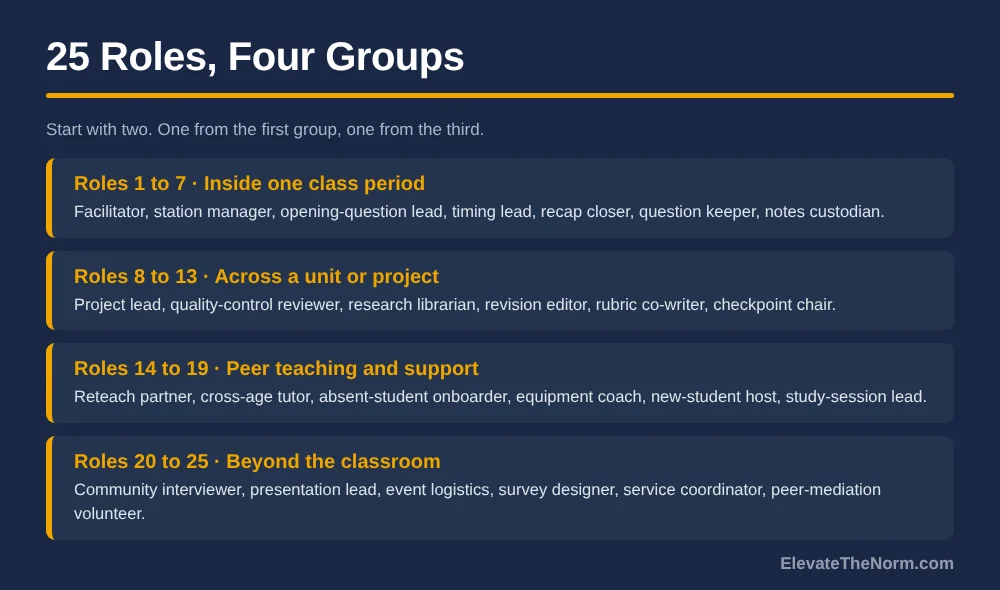
Peer Teaching and Peer Support
| Role | What the student decides | Guardrail | Evidence |
|---|---|---|---|
| 14. Reteach partner | How to explain one skill to two or three classmates | You confirm they have the skill first; you stay within earshot | A short check on the students who were taught |
| 15. Cross-age tutor | Pacing and examples with a younger class | Trained first, scheduled with the receiving teacher, never unsupervised | Tutor log plus the receiving teacher’s read |
| 16. Absent-student onboarder | What a returning classmate needs first | No grades, no reasons for the absence, no commentary | Whether the returning student submitted the right thing |
| 17. Equipment or software coach | How the training is run and in what order | You handle anything with a safety procedure attached | Classmates completing the task without asking you |
| 18. New-student host | What to show, in what order, over two weeks | Volunteer only; you check in with both students in week one | A two-week check-in with the new student |
| 19. Study-session lead | Which five items the pre-assessment review covers | You see the item list beforehand; no leaking the actual test | The item list and attendance, nothing more |
This group has the best evidence behind it, and roles 14 and 15 apply the peer-tutoring finding directly. One practical note from that same research: the benefit did not scale with minutes. A twelve-minute reteach with a clear target beats forty minutes of vague “help each other.”
Beyond the Classroom
| Role | What the student decides | Guardrail | Evidence |
|---|---|---|---|
| 20. Community interviewer | Questions, order, and what gets used | You approve the questions and the contact; school policy on outside contact governs | Transcript or notes plus the consent record |
| 21. Public-presentation lead | How the group presents to the outside audience | You rehearse it once with them, no exceptions | Audience questions answered without you stepping in |
| 22. Event logistics lead | One concrete slice of a real event — setup, signage, running order | One slice only; an adult owns anything involving money or facilities | The slice ran, on time, without rescue |
| 23. Survey designer | Questions and how results are reported | Anonymous, no sensitive items, administrator approval first | The instrument and a written summary of findings |
| 24. Service-project coordinator | One measurable commitment and how it is tracked | Partner organisation vetted by an adult; nothing open-ended | The number committed to versus the number delivered |
| 25. Peer-mediation volunteer | Which low-level disputes they help talk through | Trained only, minor conflicts only. Anything involving safety, harassment or a protected category goes to an adult immediately | Program-level data only — never a write-up on a classmate |
Role 25 needs its own warning. School-based conflict resolution education is rated “promising” by the U.S. Office of Justice Programs, whose profile cites a meta-analysis of 36 studies in which participating students reported fewer antisocial behaviours (effect size 0.26), with fights falling from roughly 14% to 9.5% and bullying from 28% to 20%. Those are real numbers from trained programs. They are not a licence to hand an untrained ninth grader a fight between two of their friends. Past a minor disagreement the adult does it, using a script written for the purpose.
What About Classroom Jobs for Students?
Classroom jobs for middle and high school students are worth running, as long as you call them jobs. A job keeps the room working: papers out, supplies stocked, the board up to date. That is useful work, and teenagers do it well. It only goes wrong when a job gets passed off as leadership, which is the first failure mode further down. A 2026 Edutopia roundup of secondary teachers who run class jobs makes the same case. Tweens and teens want connection, autonomy and purpose, and a job program gives them some of each once it has been taught and practised (Gonser, Edutopia, 2026).
Most jobs on secondary lists fit one of the types below. Each row gives the job, then an upgrade: one small decision you can hand over that turns the job into one of the roles above.
| Job | What it covers | The upgrade: add one decision | Keep this off the job |
|---|---|---|---|
| Materials manager | Hands out and collects papers and supplies | Decides the hand-out order so stations are ready in under a minute | Collecting or handing back graded work |
| Supply manager | Tracks and restocks shared supplies | Decides what goes on the Friday restock list | Spending money |
| Board manager | Date, agenda and learning target on the board | Writes the day’s agenda wording, with your approval | Missing-work lists, or anything with a name on it |
| Absent-student helper | Gathers handouts and notes for absent classmates | Decides what a returning classmate needs first (role 16) | Why someone was absent, and their grades |
| Tech helper | Charges, logs in and troubleshoots devices | Runs the walkthrough when the class starts a new tool (role 17) | Anyone else’s password or account |
| Room reset lead | Puts the room back before the bell | Writes the reset checklist with the class | Chemicals, equipment or anything with a safety procedure |
| Timekeeper | Runs the visible timer | Calls transitions inside the posted plan (role 4) | Extending time on a test |
| Movement-break leader | Leads a one-minute stretch or brain break mid-lesson | Picks which break the class does | Anything that puts one classmate on the spot |
| Classroom library manager | Keeps the shelf organised and tracks checkouts | Decides how new books are displayed | Other students’ reading records |
One job stays with the adult: attendance. Some lists for older students include an attendance monitor or a tardy tracker. Attendance is an official record, and a classmate’s late arrivals and early dismissals are their own business. Keep it, along with anything that touches grades, discipline notes or contact details.
Jobs at the secondary level run on the same tools the roles do. Write a short checklist for each job and practise it once before you hand it over. Rotate jobs on the roster grid below so they do not settle on the most reliable students. Do not give jobs out as a reward for good behaviour. Five or six jobs the room actually needs beat a wall chart of twenty titles nobody uses. If the bigger goal is students running the daily routines without you, start with the classroom routines and procedures checklist.
Who Gets a Role, and How Often?
Use a roster grid, not your judgement in the moment. One sheet per section: write every student’s name down the left side and the roles you are actually running across the top. Every student holds two roles per term. No role gets repeated by anyone until everybody has held one.
That does more than any speech about inclusion, because it takes the decision away from the part of your brain that reaches for the reliable kid at 7:40 in the morning. It also makes you notice when a role has quietly become somebody’s permanent job.
Two adjustments. Let a student decline once, without explanation and without losing the next rotation — a role refused is not a role failed. And do not save the interesting roles for students who already hold titles elsewhere. Mitra’s growth showed up in the students who were not already finding meaning at school, and you do not get that by handing the facilitator job to the student council president again.
If you want students weighing in on which roles exist at all, that is a different and larger question, and the line between genuine input and decoration is drawn in the guide to how much control students should actually have.
Where Student Leadership Activities Go Wrong
Four failure modes, in the order I see them cause trouble.
1. The role with no decision in it. Attendance taker, paper passer, “class rep” with no agenda. The student knows immediately. They will do it, politely, and learn that your word for leadership means errands.
2. The role that is really your work. Grading, filing, chasing missing assignments, policing other students. If you would otherwise do it yourself and it teaches nothing, it is labour. The clean test: would you describe this role honestly to the student’s family?
3. The role used as a reward for compliance. This is the one that quietly undoes the whole thing. The moment roles go to the best-behaved students, every student in the room correctly reads leadership as a prize for being easy to teach rather than a thing you learn by doing. Roles are curriculum. Behaviour is handled separately, through whatever responsibility structure you already run.
4. The role with nobody watching. A student holding a real decision needs an adult present and paying attention — circulating, dropping into checkpoints, reading the artifact. That is not distrust. It is why the role is safe to hand over at all.
A fifth thing, and this is the L2L trial speaking: teachers saw real growth while the students reported feeling no more capable. Do not read a flat teenager as a failed role. My own students once voted on getting a class pet, and the lesson stuck with me — high school students want recognition, they want a say, they even want cheap prizes. They just may not show it on the outside. Tell them plainly what they did well and do not wait for them to look pleased about it.
What to Do Next
Keep every role doable inside the school day. Roles 15, 20, 22 and 24 can drift past the final bell, and a role that quietly requires a ride home is only available to some families. If one is worth running anyway, make it optional and say so.
Pick two roles from the lists above — one from the single-period group and one from peer teaching, because those are the cheapest and the best evidenced. Write the five-line role card for each. Build the roster grid. Run them for three weeks before adding a third.
None of this needs a budget line, a program, or a schedule change, which is the main argument for doing it. If you teach six sections, keep one grid per section and expect the rotations to run at different speeds.
Then check one thing: can the student say what they decided, unprompted? If yes, you have a leadership activity. If they say “I helped,” go back to line one.
The roles are the practice; the abilities are what the practice is for. If you want the companion list, twelve leadership skills with the behaviour you can actually observe sets out what each role is building and how to check it without asking a teenager to rate themselves.
Before you go: grab the free Student Leadership Role Card and 25-Role Planner (2 pages) (PDF) — ElevateTheNorm.com branded, printable, no email required.
Frequently Asked Questions
What is the difference between a student leadership activity and a classroom job?
A job is a task. An activity is a task with a decision inside it. Passing out papers, taking attendance and tidying the lab are jobs — useful, but the student decides nothing. A leadership activity names something the student gets to decide that other people depend on: which two sources survive the cut, what order the presentation runs in, when the transition gets called. If you cannot write that sentence, you have a job.
What are good classroom jobs for middle and high school students?
Pick jobs the room actually needs: materials manager, supply manager, board manager, absent-student helper, tech helper, room reset lead, timekeeper, movement-break leader and classroom library manager. Five or six is plenty. Write a short checklist for each, practise it once, and rotate jobs so they do not always go to the most reliable students. Keep attendance, grades, discipline notes and contact details off every student job. To turn a job into a leadership role, hand over one real decision, such as the order supplies go out or what a returning classmate needs first.
How do I stop leadership roles going to the same four students?
Use a roster grid instead of your judgement in the moment. One sheet per section: every name down the left, the roles you actually run across the top, two roles per student per term, and no repeats for anybody until everyone has held one. Let a student decline once without explanation and without losing the next rotation. Mitra’s 2004 study found the growth concentrated in students who were not already finding meaning at school, which is exactly the group a gut-feel system skips.
Should student leadership roles be graded?
No. Grade the work the role produced, if you grade anything at all. The moment a role becomes another graded assignment it stops being a role and becomes an assignment with a title. Most of the evidence artifacts here — a reset station, a source list, a 60-second summary, a tutor log — are read in seconds and are there to tell you whether the role worked, not to generate a score.
Do student leadership activities actually raise achievement?
The honest answer is that the evidence is mixed and mostly indirect. Service-learning studies report an academic effect around 0.43, but 68% of that sample was college undergraduates and 87% of the studies used self-report. Peer tutoring has better evidence for grades 6–12 specifically, with a moderate-to-large academic benefit and secondary students doing slightly better than elementary. The one cluster randomized trial of a leadership program measured leadership and on-task time, not grades. Treat achievement as a possible side effect, not the promise.
Which leadership activities work best in middle school versus high school?
The roles are the same; the scope changes. In middle school, keep the decision inside one class period and make the deadline short — roles 1 through 7 and the reteach partner role are the natural starting set. In high school, the project-length roles become realistic: a project lead holding internal deadlines, a research librarian cutting sources, a presentation lead facing an outside audience. The failure mode in both bands is identical — a role with no decision in it.
Is it safe to let students run peer mediation?
Only with training, only for minor disputes, and only inside a program an adult runs. School-based conflict resolution education is rated promising by the U.S. Office of Justice Programs, whose profile cites a meta-analysis of 36 studies finding fewer self-reported antisocial behaviours among participants. Those results came from trained programs with adult oversight. Anything touching safety, harassment or a protected category goes straight to an adult, and a student volunteer never writes up a classmate.
How do I do this without adding work for myself?
Three habits. Write the five-line role card once per role and reuse it every term — it takes about ninety seconds. Pick roles whose evidence is something you would have looked at anyway. And start with two roles, not twelve. If a role is costing you time every week, it is almost certainly a role where you kept the decision and gave away the labour.
Sources
- Wade, Levi, Mark R. Beauchamp, Nicole Nathan, Jordan J. Smith, Angus A. Leahy, Ran Bao, Sarah G. Kennedy, Jed Boyer, Thierno M. O. Diallo, Sam Beacroft, and David R. Lubans. “Effects of a School-Based Leadership Program on Student Leaders and Their Peers: The Learning to Lead Cluster Randomized Controlled Trial.” Contemporary Educational Psychology, vol. 84, 2026, article 102444. Two-arm cluster RCT, 20 schools, 1,898 students. Teacher-rated leadership effectiveness d = 0.39; self-rated effectiveness d = 0.00 (p = 0.999); on-task time +7 percentage points; peers’ perceived motor competence d = 0.17 but actual motor competence d = 0.03, not significant. Leaders were in grades 5–6 and peers in grades 3–4, in New South Wales, Australia — not a secondary-school result. https://www.sciencedirect.com/science/article/pii/S0361476X26000020
- Celio, Christine I., Joseph Durlak, and Allison Dymnicki. “A Meta-Analysis of the Impact of Service-Learning on Students.” Journal of Experiential Education, vol. 34, no. 2, 2011, pp. 164–181. 62 studies, 11,837 students. Mean effects: attitudes toward self 0.28, attitudes toward school 0.28, civic engagement 0.27, social skills 0.30, academic achievement 0.43. 68% of participants were college undergraduates, 16% high school, 5% middle school; only 31% of studies used a randomized design and 87% relied entirely on student self-report. https://www.tamiu.edu/profcenter/documents/Meta-AnalysisoftheImpactofSLonStudentts_2011.pdf
- Bowman-Perrott, Lisa, Heather Davis, Kimberly Vannest, Lauren Williams, Charles Greenwood, and Richard Parker. “Academic Benefits of Peer Tutoring: A Meta-Analytic Review of Single-Case Research.” School Psychology Review, vol. 42, no. 1, 2013, pp. 39–55. 26 single-case studies, 938 students in grades 1–12, 195 phase contrasts. Overall TauU = 0.75 (95% CI 0.71–0.78); secondary 0.74 against elementary 0.69; no dosage effect above or below the 480-minute median. Single-case research designs, not group randomized trials. https://cdd.tamu.edu/wp-content/uploads/sites/33/2019/11/BowmanPerrott_SPRAcademicMeta.pdf
- Mitra, Dana L. “The Significance of Students: Can Increasing ‘Student Voice’ in Schools Lead to Gains in Youth Development?” Teachers College Record, vol. 106, no. 4, 2004, pp. 651–688. Found consistent growth in agency, belonging and competence, concentrated among students “who otherwise do not find meaning in their school experiences.” Qualitative and sociocultural; it describes where growth appeared and does not establish cause. https://pure.psu.edu/en/publications/the-significance-of-students-can-increasing-student-voice-in-scho/
- “Practice Profile: School-Based Conflict Resolution Education.” CrimeSolutions, National Institute of Justice, U.S. Office of Justice Programs. Rated Promising; draws on Garrard and Lipsey’s 2007 meta-analysis of 36 studies, reporting an effect size of 0.26 on self-reported antisocial behaviour, fights falling from about 14% to 9.5% and bullying from 28% to 20%. Cited as a federal practice profile summarising a meta-analysis, not as the meta-analysis itself; the profile states no cautions on study quality or publication bias. https://crimesolutions.ojp.gov/ratedpractices/48
- Yeager, David S., Ronald E. Dahl, and Carol S. Dweck. “Why Interventions to Influence Adolescent Behavior Often Fail but Could Succeed.” Perspectives on Psychological Science, vol. 13, no. 1, 2017, pp. 101–122. Argues adolescents are unusually sensitive to status and respect, and that people “feel respected and high status when they are treated as though they are competent, have agency and autonomy, and are of potential value to the group.” A theory review and integration paper, not an empirical test of leadership roles. https://pmc.ncbi.nlm.nih.gov/articles/PMC5758430/
- Gonser, Sarah. “Why Middle (and High) School Students Should Have Class Jobs.” Edutopia, George Lucas Educational Foundation, February 6, 2026. Secondary teachers describe class-job programs, including application-based assignment, job checklists and practice, and sample jobs such as absence helper, supply manager, whiteboard manager and tech helper. Practitioner reporting, not a research study; no outcome data. https://www.edutopia.org/article/why-middle-and-high-school-students-should-have-class-jobs