By Clay Shumate
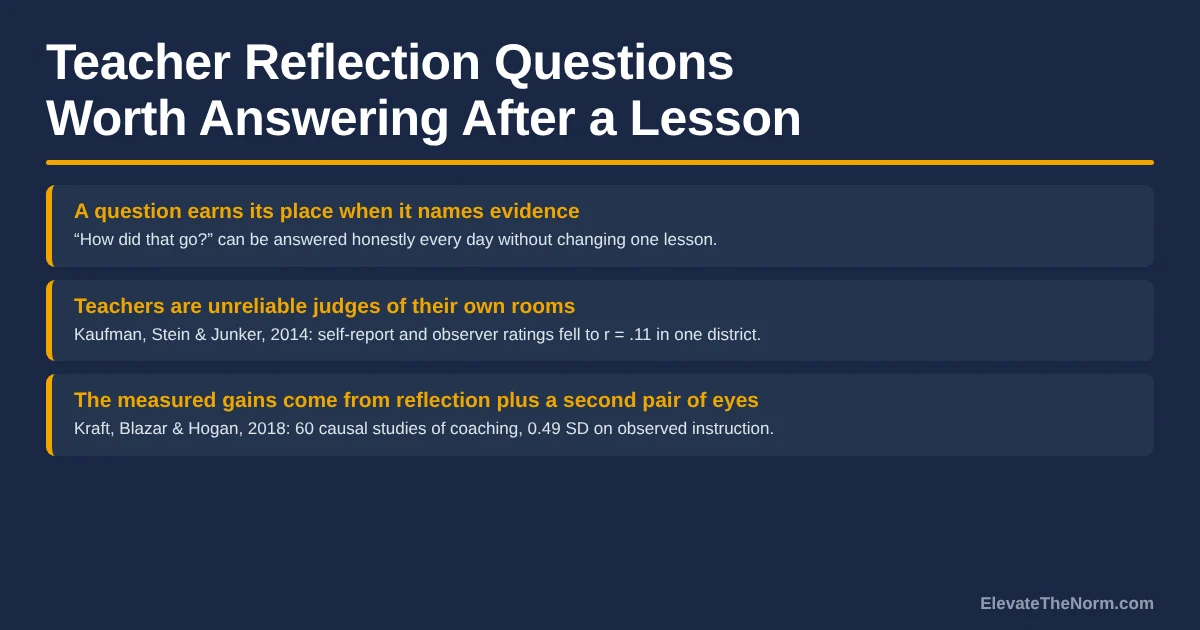
Teacher reflection questions are prompts you answer about a lesson you just taught in order to decide what to change. The useful ones name a piece of evidence — student work, exit data, who spoke — and end in a decision. Questions that ask how a lesson felt produce a mood, not a change.
Most lists of reflection questions fail on that second sentence. “How did that go?” and “Were students engaged?” are not questions, they are feelings with a question mark attached, and you can answer both of them honestly every day for a year without teaching one lesson differently. Below are the questions that pass the test, the evidence on whether any of this works, and the uncomfortable finding about how badly teachers read their own rooms.
Key Takeaways
- A reflection question earns its place when it names evidence and ends in a decision. Everything else on this page is downstream of that one rule.
- 🔴 Teachers are unreliable judges of their own instruction. Kaufman, Stein and Junker compared 47 teachers’ own survey reports against 422 trained observations. Agreement was decent in one district and collapsed in the other — r = .11 in year two, essentially no relationship.
- The teachers who overestimated themselves were the isolated ones. In the same study, teachers who overrated their practice reported little peer conversation about the curriculum; those who underrated it talked with colleagues or a coach regularly and voiced more doubt.
- Reflection paired with feedback has real numbers behind it. Kraft, Blazar and Hogan pooled 60 causal studies of instructional coaching and found 0.49 SD on observed instruction (SE = 0.056) and 0.18 SD on student achievement (SE = 0.037).
- 🔴 Those numbers shrink when the program gets big. In the same meta-analysis, programs under 100 teachers produced 0.63 SD on instruction and 0.28 SD on achievement; programs of 100 or more produced 0.34 SD and 0.10 SD.
Free Download · PDF
Teacher Reflection Questions: The Post-Lesson Card
A three-page printable: the eight post-lesson questions, a six-line lesson log you can fill in, five weak questions rewritten, and the weekly and monthly prompts. No email required.
Free. No email address required. Designed for grades 6–12. Browse every printable in Your Free Library.
What Are Teacher Reflection Questions?
Teacher reflection questions are structured prompts a teacher answers about their own instruction in order to decide what to do next. They sit inside what the research literature calls reflective practice, and the models behind them — Dewey’s reflective thinking, Schön’s reflection-on-action, Kolb’s experiential learning cycle, Korthagen’s ALACT model, Brookfield’s four lenses — all share one move: look at what happened, interpret it, decide something, do the thing.
The decision step is the one that disappears in practice. A 2023 evidence review by Carol Campbell and Maeva Ceau at the University of Toronto, written for Wales’s Education Workforce Council, lists “links to action, so that reflection leads to changes in practice” among the conditions reflection needs to work at all — alongside collaboration, scaffolding and protocols, a safe environment, and the use of actual evidence such as student work, classroom data or video.
That review is also honest about the soft spots, and it is worth repeating them before anybody builds a weekly ritual on this. The literature suffers from conceptual ambiguity about what reflective practice even means. Several of the studies it cites are very small. In one study of pre-service teachers, reflective ability decreased over time without support. And it quotes research from outside education on the obvious risk: self-reflection can turn into rumination.
What Should You Ask Right After a Lesson?
Eight questions, ten minutes, before you teach the next period. The short window matters because the details that answer these questions — who spoke, where the room went quiet, which group stalled — are gone by the drive home.
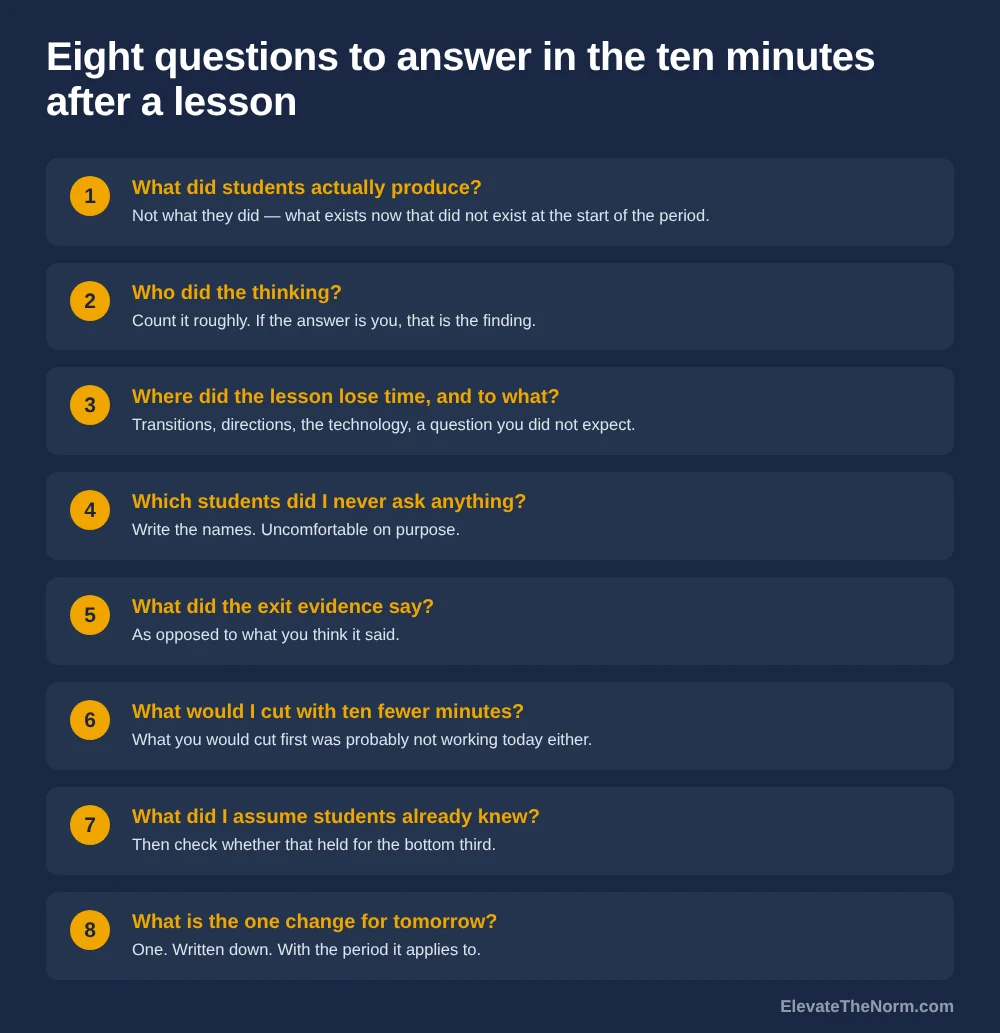
- What did students actually produce? Not what they did. What exists now that did not exist at the start of the period.
- Who did the thinking? Count it roughly. If the answer is you, that is the finding.
- Where did the lesson lose time, and to what? Transitions, directions, the technology, a question you did not expect.
- Which students did I never ask anything? Write the names. This one is uncomfortable on purpose, and it is the question most likely to change next period.
- What did the exit evidence say, as opposed to what I think it said? If you have no exit evidence, that is the first fix — see checking for understanding.
- What would I cut if I taught this again with ten fewer minutes? The thing you would cut first is usually the thing that was not doing any work today either.
- What did I assume students already knew? Then check whether that assumption held for the bottom third of the class.
- What is the one change for tomorrow? One. Written down. With the period it applies to.
Question eight is the whole point. Seven observations and no decision is a diary entry. The two mechanisms the Education Endowment Foundation names under embedding practice — prompting action planning and encouraging self-monitoring — are exactly this step, and they come out of a review of 104 professional development evaluations.
Does Reflecting on Your Teaching Actually Improve It?
Reflection combined with feedback from someone else has solid evidence behind it. Reflection entirely alone does not, and the honest answer is that nobody has run the clean study. What exists is the coaching literature, which is reflection with a second pair of eyes attached.
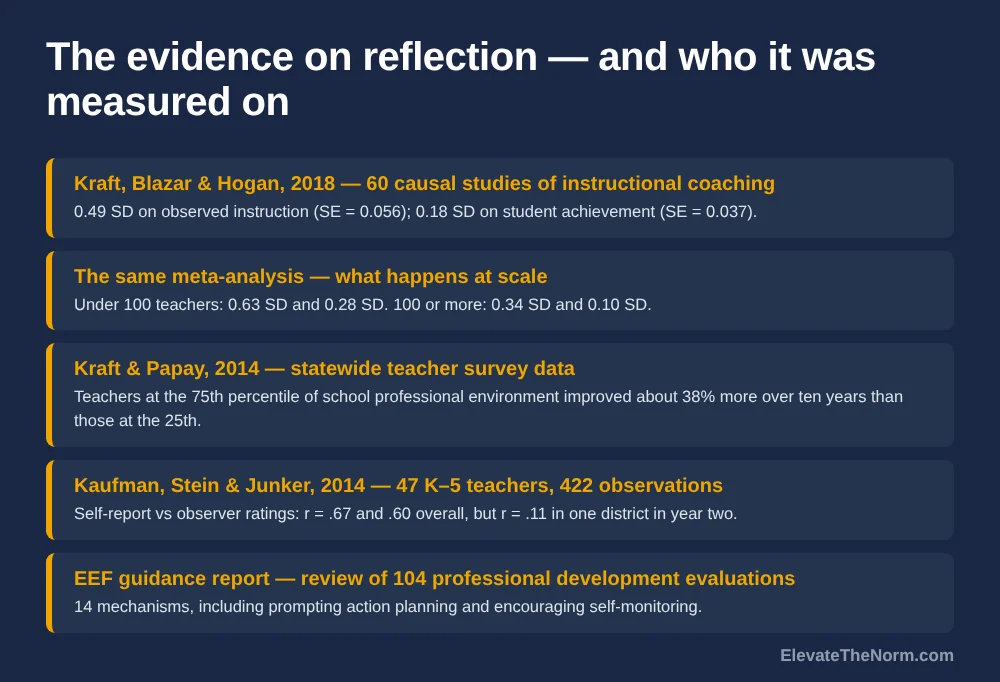
Kraft, Blazar and Hogan’s meta-analysis in Review of Educational Research pooled 60 causal studies of instructional coaching and reported 0.49 standard deviations on observed instruction (SE = 0.056) and 0.18 standard deviations on student achievement (SE = 0.037). By the standards of this field those are large and respectable numbers. Then comes the part that gets left out: effects shrank substantially as programs scaled. Small programs, under 100 teachers, produced 0.63 SD on instruction and 0.28 SD on achievement. Programs of 100 or more produced 0.34 SD and 0.10 SD — roughly half and roughly a third.
Two caveats you should carry out of that. First, the studies measure coaching, in which an instructional expert observes and gives feedback. They do not measure a teacher sitting alone with a set of questions, and it would be dishonest to transfer the effect size. Second, the authors themselves say scaling introduces challenges that demonstration models do not face, which is a polite way of saying the version your district buys will not be the version that was studied. That is also the argument for professional development that changes practice being judged on mechanisms rather than on brand names.
There is one more finding worth knowing, because it reframes the whole question. Kraft and Papay, in Educational Evaluation and Policy Analysis, found that teachers in schools at the 75th percentile of professional environment improved about 38 percent more over ten years than teachers in schools at the 25th percentile. The same teacher, the same decade, a different building — and a materially different trajectory. Whether reflection helps you depends partly on whether anybody around you is doing it too, which is the practical case for collective teacher efficacy.
Why Do Teachers Misjudge Their Own Lessons?
Because we grade our own practice against the practice we can see, and most teachers cannot see much of anyone else’s. Kaufman, Stein and Junker put numbers on this by comparing teachers’ own survey reports of their instruction against trained observers’ ratings of the same classrooms.
Across 47 teachers, 422 observations and 74 surveys in two U.S. districts, self-report and observer ratings correlated reasonably overall — r = .67 in year one, r = .60 in year two. Split by district, the picture broke apart. In one district the relationship held both years. In the other it was significant in year one and then fell to r = .11 in year two, which is no relationship at all. Teachers in one district tended to overestimate their practice; teachers in the other tended to underestimate it.
The explanation the authors found in their interviews is the useful part. Teachers who overestimated reported little peer interaction about the curriculum. Teachers who underestimated reported frequent conversation with colleagues or coaches and expressed more uncertainty about their own teaching. The authors suggest teachers judge themselves against the models available to them — and if you have not watched another teacher work in three years, your reference point is your own memory.
The honest limits: those 47 teachers were K–5, the study was exploratory with a small sample from two districts, it makes no causal claims, and one measure had only 67 percent inter-rater agreement. It is not a secondary-school result and I am not treating it as one. What transfers is not a number — it is the mechanism, and the mechanism is isolation.
What Makes a Reflection Question Useless?
It asks how the lesson felt instead of what the evidence showed. You can answer a feeling question with total sincerity and change nothing, which is why these lists so often get filled out for an evaluation folder and never again.
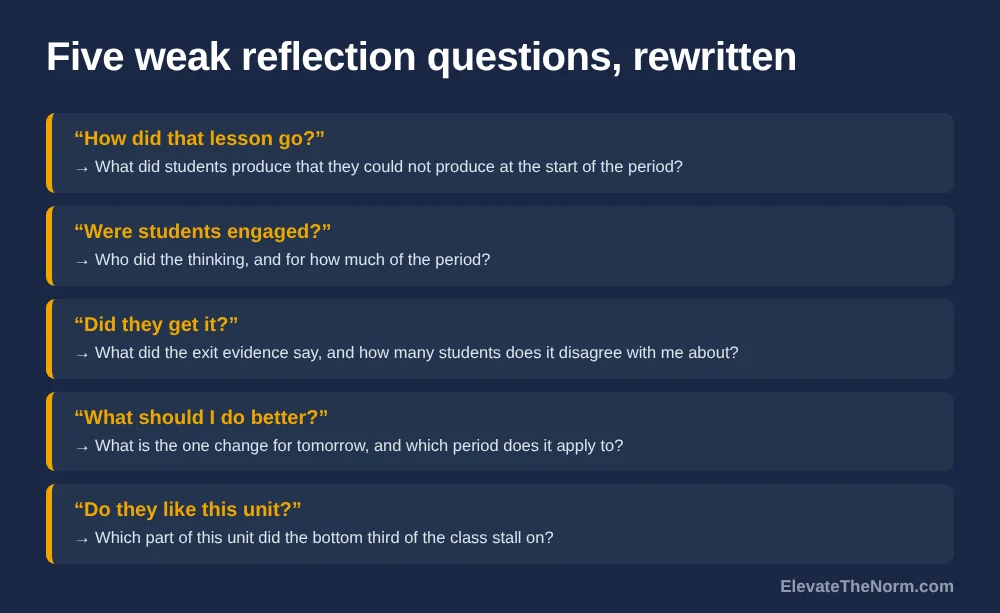
| The question people ask | Why it goes nowhere | Ask this instead | Evidence it needs |
|---|---|---|---|
| How did that lesson go? | Answerable by mood. Yesterday’s “fine” and today’s “fine” are not comparable. | What did students produce that they could not produce at the start of the period? | The work itself, in front of you |
| Were students engaged? | Measures compliance and volume, both of which a quiet copying task scores well on. | Who did the thinking, and for how much of the period? | A rough count of who spoke and who wrote |
| Did they get it? | You already believe they did, or you would have stopped. | What did the exit evidence say, and how many students does it disagree with me about? | An exit ticket, a sample of five, a quick poll |
| What should I do better? | Too big. Produces a resolution, not a change. | What is the one change for tomorrow, and which period does it apply to? | A written note with a class period on it |
| Do they like this unit? | Popularity is real information about climate and poor information about learning. | Which part of this unit did the bottom third of the class stall on? | Grades or work samples, sorted |
Every rewrite in that table does the same thing. It replaces a judgment you make from memory with a judgment you make from something you can look at. That is also the difference between the entries that make keeping a reflection journal worth keeping and the ones that read like a weather log.


Which Questions Belong in a Weekly or Monthly Cycle?
Daily questions are about one lesson. Weekly and monthly questions are about patterns, and they need different evidence. Asking a pattern question after a single period produces noise.
- Weekly: Which students have now gone a full week without saying anything in my room? Where did the same five minutes get lost on more than one day? Which assignment generated the most questions, and were they questions about the content or about the directions?
- Weekly: What did I grade this week that did not tell me anything I did not already know? That one usually finds an assignment worth cutting.
- Monthly: Which standard do I keep reteaching, and is the problem the teaching or the prerequisite? What have I changed this month because of something I noticed, and can I name it?
- Monthly: Whose classroom have I actually been inside since the last time I asked this? Given the isolation finding above, this is not a nice-to-have.
- By term: The longer-horizon version of all of this is covered under the end-of-year version, and it works better in a cycle than as a one-time exercise in May.
How Do You Reflect Without a Coach?
You replace the second pair of eyes with evidence you cannot argue with, and with one colleague. The coaching research is strong and most teachers do not have a coach, so the practical question is which parts of it you can reproduce on your own.
Three substitutes, in order of how much they cost you:
- Student work, sorted. Pull five pieces — top, bottom, and three in the middle — and answer your questions from those instead of from memory. This is the cheapest correction to the self-rating problem and it takes four minutes.
- A recording of yourself. Check your district’s policy on recording before you do this, and keep students out of frame where policy requires it. Watching ten minutes of your own instruction answers question two of the daily list instantly and permanently.
- One colleague, one question, twice a month. Not a formal observation. Swap a single question — “watch who I call on” — and return the favor. The Campbell and Ceau review puts collaborative and dialogic reflection among the conditions that make reflection work, and the Kaufman study suggests the teachers who talk to colleagues are the ones who see themselves accurately.
My own position, as a classroom teacher: the honest obstacle to this is never the questions. It is that the ten minutes after a lesson are also the ten minutes you need for the next one, and a reflection habit that assumes a free planning period is a habit for somebody else’s schedule. Eight short questions you actually answer beat a two-page form you fill in once in October.
What Should You Write Down?
Six lines per lesson, and the sixth one is the only one that has to be acted on. A teacher reflection form or template fails for the same reason a long questionnaire fails — it asks for more than you will give it on a Tuesday.
The six lines: date and period; what students produced; who did the thinking; the names of students I did not reach; what the exit evidence said; the one change for tomorrow. That is a template you can keep in a notebook or a single document, and it is enough structure to make patterns visible after three weeks. If you want longer worked examples of what reflection looks like written out, those are in worked examples of teacher reflection.
Two rules for the writing itself. Keep it specific enough that a version of you in three weeks can tell what happened. And never write anything about a student you would not say to that student’s family — a reflection document is still a document.
What to Do Next
Pick your last lesson of tomorrow and answer only questions two, four and eight — who did the thinking, which students I never asked anything, and the one change. Three questions, four minutes, one piece of paper. Run that for two weeks before you add anything else, then find one colleague willing to trade a single observation question twice a month. The research does not say reflection alone transforms teaching. It says reflection with evidence and another person in it is where the measured gains are, and both of those are available to you without permission from anyone.
Want this as a printable? The eight questions, the six-line log and the weekly prompts, on three printable pages. Download the free PDF — no email address required.
Frequently Asked Questions
What are teacher reflection questions?
They are structured prompts a teacher answers about a lesson they just taught in order to decide what to change. The useful ones name a specific piece of evidence — student work, exit data, who spoke in the room — and end in a written decision. Prompts that ask how the lesson felt, such as “how did that go,” can be answered honestly every day without changing a single instructional choice.
What are the best reflection questions to ask after a lesson?
Eight hold up in grades 6–12: what did students actually produce, who did the thinking, where did the lesson lose time, which students did I never ask anything, what did the exit evidence say, what would I cut with ten fewer minutes, what did I assume students already knew, and what is the one change for tomorrow. Answer them within ten minutes of the lesson, while you can still remember the room.
Does reflecting on your own teaching actually improve it?
Reflection combined with feedback from another person has real evidence behind it. Kraft, Blazar and Hogan pooled 60 causal studies of instructional coaching and found 0.49 standard deviations on observed instruction and 0.18 on student achievement. Those studies measured coaching, not a teacher reflecting alone, so the effect size should not be transferred to solo reflection. Effects also shrank by roughly half once programs passed 100 teachers.
Are teachers good at judging their own instruction?
Not reliably. Kaufman, Stein and Junker compared 47 teachers’ survey reports of their own practice against 422 trained classroom observations. Overall agreement was moderate, but in one district the year-two correlation fell to r = .11, meaning essentially no relationship. Teachers who overestimated their practice reported little conversation with colleagues; those who talked regularly with peers or a coach judged themselves more accurately. Note that these were K–5 teachers.
What does a simple teacher reflection template need?
Six lines per lesson: date and period, what students produced, who did the thinking, the names of students you did not reach, what the exit evidence said, and the one change for tomorrow. Only the last line has to be acted on. Longer forms get filled in once for an evaluation folder and then abandoned, which is why a short template you complete daily beats a thorough one you complete twice a year.
How can I reflect usefully without an instructional coach?
Replace the second pair of eyes with evidence and one colleague. Sort five pieces of student work — top, bottom and three in the middle — and answer your questions from those rather than from memory. Watch ten minutes of a recording of your own teaching, checking district policy on recording first. Then trade a single observation question with one colleague twice a month, which is the cheapest version of the collaboration the research keeps pointing at.
How often should teachers reflect on their teaching?
Daily for one lesson, weekly and monthly for patterns, because a pattern question answered after a single period produces noise. Weekly prompts work well for who has gone silent and where time keeps disappearing. Monthly prompts suit the standard you keep reteaching and whose classroom you have actually been inside. Reviews of professional development have generally found no link between longer duration and greater impact, so frequency matters more than length.
Sources
- Kraft, M. A., Blazar, D., & Hogan, D. (2018). The Effect of Teacher Coaching on Instruction and Achievement: A Meta-Analysis of the Causal Evidence. Review of Educational Research, 88(4), 547–588. 60 causal studies; 0.49 SD on instruction (SE = 0.056) and 0.18 SD on achievement (SE = 0.037), with smaller effects at scale. These measure coaching — an expert observing and giving feedback — not solo reflection, and no effect size on this page is attributed to reflecting alone. education.umd.edu
- Kaufman, J. H., Stein, M. K., & Junker, B. (2014). Factors Associated with Alignment between Teacher Survey Reports and Classroom Observation Ratings of Mathematics Instruction. Elementary School Journal. 47 K–5 teachers, 422 observations, 74 surveys, two U.S. districts. Reported with the authors’ stated limits: exploratory, small sample, no causal claims, and 67 percent inter-rater agreement on one measure. These were elementary teachers, not grades 6–12. stat.cmu.edu
- Kraft, M. A., & Papay, J. P. (2014). Can Professional Environments in Schools Promote Teacher Development? Explaining Heterogeneity in Returns to Teaching Experience. Educational Evaluation and Policy Analysis, 36(4), 476–500. Teachers in schools at the 75th percentile of professional environment improved about 38 percent more over ten years than those at the 25th percentile. Cited from the ERIC record, which carries the full citation and abstract; the full text was not reachable from here. eric.ed.gov
- Education Endowment Foundation. Effective Professional Development guidance report. Review of 104 professional development evaluations; 14 mechanisms across four groups, including prompting action planning and encouraging self-monitoring. The report states that evidence for a balanced design is early and tentative, and that many reviews found no link between longer duration and greater impact. educationendowmentfoundation.org.uk
- Campbell, C., & Ceau, M. (2023). Leading Reflective Practice: Reviewing the Evidence. Ontario Institute for Studies in Education, University of Toronto, for the Education Workforce Council (Wales). Source of the conditions for effective reflection, the named models, and the cautions — including a study in which pre-service teachers’ reflective ability decreased over time without support. ewc.wales