
By Clay Shumate
A teacher reflection journal is a running written record of what you tried in the classroom, what happened, and what you decided to do differently. It is not a diary and it is not a feelings log. Its value is not in any single entry — it is in what twenty entries show you about your own teaching that no single lesson ever could.
That is the whole case for keeping one, and it is a narrower case than most professional development sells you. The evidence that reflective writing changes teaching is thinner than the enthusiasm for it. What follows is the honest version: what a teacher reflection journal is good for, what it is not, and a ten-minute routine that survives past October.
Key Takeaways
- The pattern is the product. One entry tells you about one lesson. Fifteen entries tell you that third period falls apart every time you open with silent reading, which is a thing you would never have noticed on a Tuesday.
- Most reflective writing never gets past description. In a 2024 study of 198 reflective texts, exactly one reached a critical level. Writing it down is not the same as thinking about it.
- The evidence is real but modest, and mostly indirect. Nobody has shown that journaling by itself raises student achievement. What the research supports is feedback and reflection as one ingredient inside sustained, content-focused professional learning.
- Ten minutes a week beats forty minutes in August. Teachers already work about 49 hours a week. A journal that costs more than ten minutes will be the first thing you drop.
- Write for the version of you that reads it in March. Not for an evaluator, not for a supervisor, and not for posterity.
What Is a Teacher Reflection Journal?
A teacher reflection journal is a dated, ongoing record in which a teacher writes down a specific thing that happened in their classroom, what they think caused it, and what they intend to change. Three parts. Take away the specific event and you have a mood ring. Take away the intended change and you have a diary.
The word “journal” does a lot of damage here, because it imports the wrong picture — leather cover, evening, a cup of tea, long paragraphs about your calling. A teacher reflection journal is closer to a maintenance log. A mechanic writes down the noise, the suspected cause, and the part they replaced. You are doing the same thing with a fourth-period lesson.
It is also worth separating the journal from two neighbors. It is not an individual reflection, though it is made of them — a reflection is one unit of thinking, a journal is the container that keeps them next to each other. And it is not an evaluation artifact, even though entries can feed one. The moment a journal exists to be read by an administrator, it stops being a place where you can write “I lost the room and I know exactly why.”
What Does a Journal Give You That a One-Off Reflection Doesn’t?
Patterns. That is the short answer, and it is the only thing a journal does that a good conversation in the hallway cannot.
Any teacher can tell you what went wrong in the lesson they just taught. That is not hard, and it does not need writing down. What is genuinely hard — what memory is actively bad at — is noticing that the same thing has gone wrong eleven times since September, always on the same day of the week, always with the same kind of task. Human memory reconstructs. It keeps the vivid and drops the routine, which means the slow, boring, recurring failure is precisely the one you will never recall unprompted.
A dated record does not have this problem. In February you can read October. Three things tend to show up when teachers actually do this:
- Recurring conditions. The same period, the same day, the same task structure, the same twenty minutes of the block.
- Your own repeated fixes. You will find that you have written “I need to model this first” six times and modeled it twice. That gap is more useful than any single entry.
- What actually stuck. A change you made in September and forgot you made, still running in January because it worked.
None of that requires deep insight in the moment. It requires the entries to exist and to be dated. That is a lower bar than “reflect critically,” and it is the bar most teachers can actually clear in a working week.
Does Keeping a Teacher Reflection Journal Actually Work?
The honest answer: the evidence supports reflection as part of a larger structure, and it does not support journaling on its own as a lever on student achievement. Anyone telling you otherwise is selling a notebook.
Start with the most uncomfortable finding. A 2024 mixed-methods study by Michaela Gläser-Zikuda and colleagues analyzed 198 reflective texts written by 100 pre-service teachers, coded against Hatton and Smith’s four levels of reflection. Thirty-seven were purely descriptive. One hundred twenty-nine were descriptive-reflective. Thirty-one reached a dialogic level. One reached critical reflection.1 Those were novices writing for a course, which is not the same population as a working secondary teacher writing for themselves — but the direction is clear enough. Left alone, reflective writing defaults to retelling.
Elizabeth Jaeger reviewed the field and reached a similar place from a different angle. Journal writing, she notes, is “the most frequently used means of professional reflection in teacher education,” and yet “gaps in the research make it difficult to claim that reflection is a transferrable skill… and that it will produce the desired result of improved student learning.” Her specific complaint about journals is that they run “too confessional in tone” rather than staying on teaching behavior and decisions.2 That is a fixable problem, and most of the practical advice below is aimed at it.
There is a harsher version in the literature too. Pariwat Suphasri and Sumalee Chinokul, reviewing reflective practice in teacher education, describe journals that become “recipe-following” compliance — teachers who “focus on the quantity of the written journals rather than the quality,” writing “long, simple descriptions of classroom routines,” and some who “fake their reflection in order to get approval from their supervisors.”3 If your district has ever mandated reflection logs, you have seen this happen in real time.
So where is the support? It is structural rather than direct. The Learning Policy Institute’s review of 35 methodologically rigorous professional development studies — studies with experimental or comparison-group designs — found seven shared features of PD that moved student outcomes. One of them is “offers feedback and reflection.” The others are content focus, active learning, collaboration, models of effective practice, coaching and expert support, and sustained duration.4 The authors are careful to say what that does and does not mean: because these studies evaluate whole programs, the review “cannot assess individual component effectiveness.” Reflection is in the recipe. Nobody has weighed it separately.
The nearest thing to a clean number comes from coaching, which is reflection with another adult in the room. Matthew Kraft, David Blazar and Dylan Hogan’s meta-analysis of 60 causal studies found pooled effects of 0.49 standard deviations on instructional practice and 0.18 on student achievement — and, importantly, those effects shrank badly at scale, to 0.34 and 0.10 in programs with 100 or more teachers.5 That is worth holding onto for two reasons. It shows structured reflection with feedback does move practice. And it shows the effect is fragile enough that a district rollout can wring most of it out.
A journal is the cheapest, weakest version of that structure. It is one person, no feedback, no expert. Expect it to do proportionally less, and it will still be worth ten minutes.
What Goes In a Single Entry?
Four lines: the event, the evidence, the likely cause, and the one change. If an entry has all four, it is doing its job. If it has three, it is probably missing the change, and an entry with no decision in it is a paragraph about your day.
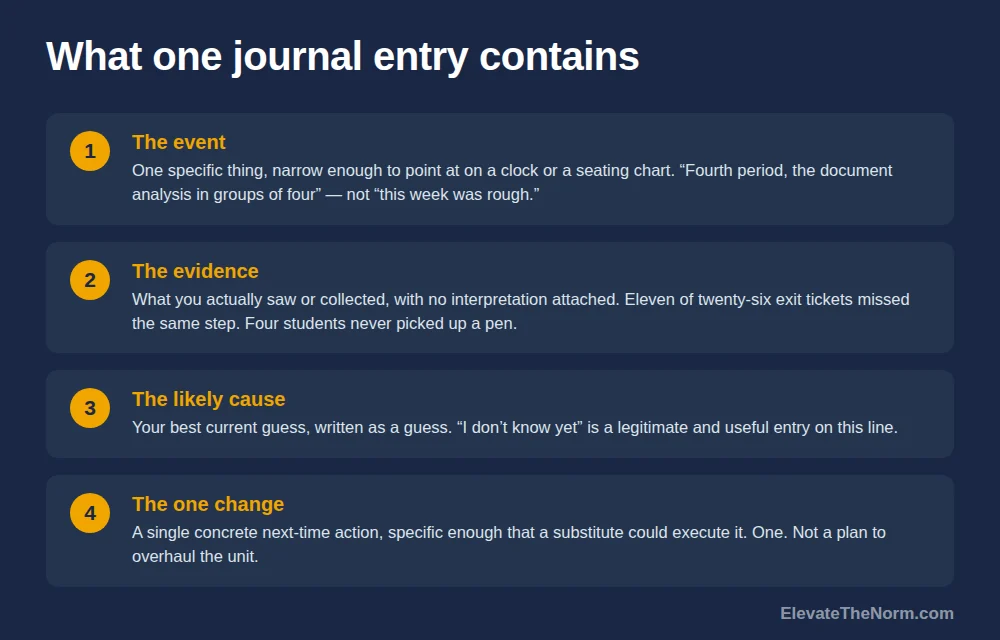
Here is what each line is actually asking for.
The event is one specific thing, not a summary of the week. “Fourth period, the document analysis in groups of four” is an event. So is “the lab write-up, second block, the twelve minutes after I handed back the rubric.” “This week was rough” is not. Narrow it until you could point at it on a seating chart or a clock.
The evidence is what you actually saw or collected, stated without interpretation. Eleven of twenty-six exit tickets missed the same step. Four students never picked up a pen. The room went quiet at minute six and never came back. This is the line teachers skip most often, and skipping it is how a journal turns into a mood log. Interpretation without evidence is just how you felt at 2:40.
The likely cause is your best current guess, written as a guess. “Probably because I gave the directions once, orally, while they were still unpacking” is honest. So is “I don’t know yet.” Writing down that you do not know is genuinely useful — it is the entry you come back to when the same thing happens again and the cause becomes obvious.
The one change is a single, concrete, next-time action. One. Not a plan to overhaul the unit. “Next time, written directions on the board and one student restates them before anyone moves” is a change. “Be clearer” is a wish.
That is the whole format. Four lines, and the last one is the only one that is non-negotiable, because a journal full of observations with no decisions attached is the exact confessional drift Jaeger warns about.2 If you want a longer worked set of entries written out in full, the companion guide collects seven of them, including the awkward ones.
How Often Should You Write In It?
Once a week, at a fixed time, for about ten minutes. Daily is a trap and monthly is not a journal.
The argument for weekly is arithmetic, not philosophy. RAND’s 2025 State of the American Teacher survey found teachers reporting an average of 49 hours of work per week — about ten hours beyond what they are contracted for — while remaining more likely than comparable working adults to report poor well-being on every indicator measured.6 Any professional habit that assumes you have spare capacity is a habit that will not survive a bad October.
Weekly also happens to be the right grain for the thing a journal is actually for. Daily entries produce volume, and volume is the documented failure mode — long descriptions of routine, written to prove the log was kept.3 Weekly forces selection. You have to pick the one thing from five days that was worth writing about, and the picking is itself a piece of thinking.
Two practical notes. Put it on the calendar at a specific time, not “Fridays.” Last twelve minutes of your planning period on Friday, or the ten minutes before you leave the building. And write in the building, not at home. An entry written from your couch four hours later has already lost the evidence line.
One exception is worth making. When something big happens — a lesson that genuinely failed, a conflict with a student you handled badly, an assessment whose results blindsided you — write it that day, while you still have the details. Those entries are the ones you will reread.
Paper, Document, or Phone — What Format Actually Survives?
The one you will still be using in March. That is not a dodge; the format question is almost entirely a friction question, and the trade-offs are real.
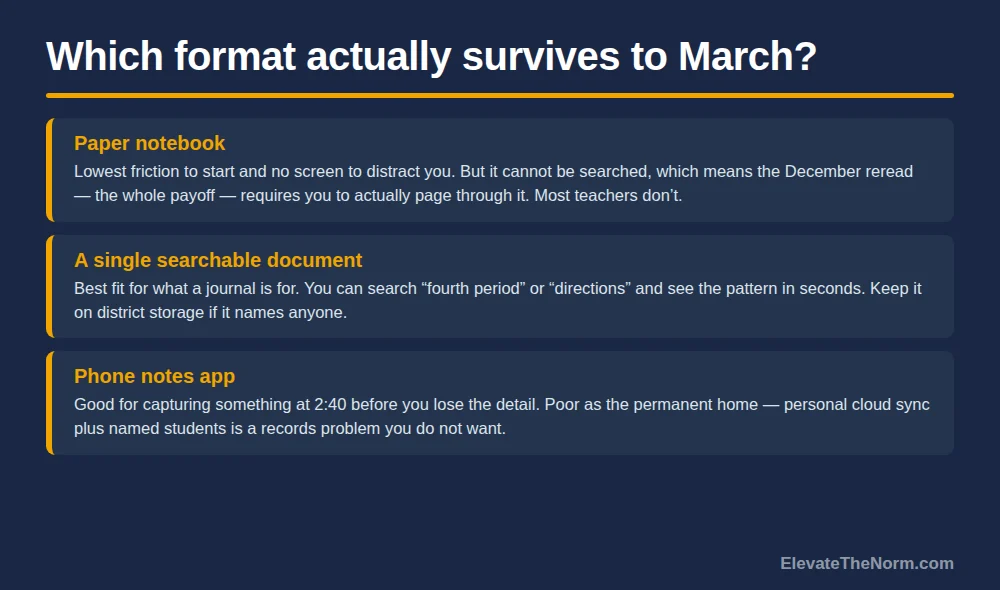
A few things worth knowing before you pick.
Searchability matters more than it sounds like it does. The entire payoff of a journal is finding the pattern, and finding a pattern in a paper notebook means rereading it. Realistically, you will not. A document you can search for “fourth period” or “directions” turns a stack of entries into something you can actually interrogate.
Student names change what the document legally is. Under federal law, a teacher’s private notes fall outside the definition of an “education record” only if they meet all three conditions in 34 CFR 99.3: records “kept in the sole possession of the maker, are used only as a personal memory aid, and are not accessible or revealed to any other person except a temporary substitute for the maker of the record.”7 Share one entry with a colleague, a coach or an administrator and that entry has arguably left the exception. This is not a reason to panic, and it is not legal advice — check your district’s records policy, because districts routinely set stricter rules than the federal floor. It is a reason to do the simple thing: keep student names out. “A student in third period” carries every bit of the meaning you need, and a journal written that way can be shared, quoted in a coaching conversation, or left open on your desk without a second thought.
Decide up front who can read it. If the answer is “only me,” the journal can be honest. If the answer is “me and my evaluator,” it will quietly become a performance document, and the research on that is not ambiguous.3 There is nothing wrong with keeping a second, shorter record for evaluation purposes. There is a lot wrong with pretending one file can be both.


A Ten-Minute Weekly Routine That Survives October
Five steps, in order, once a week. The order matters more than the timing: evidence before interpretation, and one decision at the end.

- Minute 1 — Pick one thing. Scan the week and choose a single lesson, moment or result. Prefer the one you have been avoiding thinking about.
- Minutes 2–4 — Write the evidence first. What you saw, counted, or collected. No causes yet. Numbers if you have them: how many exit tickets, how many students, what minute it turned.
- Minutes 5–7 — Guess at the cause, in writing. Then ask one follow-up of your own guess: what would I expect to see if that were true? This single question is what moves an entry off the description level.
- Minutes 8–9 — Write one change. Concrete enough that a substitute could execute it. If you cannot make it that concrete, the change is really a question, so write it as one.
- Minute 10 — Look back four entries. Not the whole journal. Four. Ask whether this week’s entry rhymes with any of them, and if it does, note that at the top.
Step five is the one people skip, and it is the step that converts a pile of entries into a journal. Four entries back is roughly a month. A month is long enough for a pattern to show and short enough to reread in ninety seconds.
If you would rather work from a prepared format than build your own, the site’s free teacher reflection journal and template pack is a printable version of this same structure — no email required, no form to fill in.
What Do You Do With a Term’s Worth of Entries?
Read them in one sitting, twice a year, with a pen. December and May are the natural windows. The reading is the point of the writing.
Give it forty minutes and do three passes.
First pass — circle repeats. Any condition that shows up three or more times. A period, a day, a task type, a transition, a time of the block. Do not interpret yet, just mark.
Second pass — find the promises you did not keep. Read only the “one change” lines. Which ones did you actually do? The gap between what you decided and what you implemented is usually the single most useful thing in the whole document, and it is invisible week to week.
Third pass — write one page forward. Not a reflection on the term. A short list of what you are carrying into the next one: two changes that worked and are now permanent, one recurring problem you have decided to actually solve, one thing you are going to ask someone for help with.
If you are the coach or the administrator rather than the teacher, the useful move here is narrow: ask to hear about one entry the teacher chooses, and ask the follow-up question rather than the evaluative one — what would you expect to see if that guess were right? What does not work is asking to read the journal. A journal you can be asked to produce is a journal nobody writes honestly in, and the fastest way to kill the practice across a building is to require it.
That last item is where a journal stops being a solitary exercise, which is the thing Jaeger flags as a core weakness of reflective practice — reflection that stays isolated tends not to go anywhere.2 The coaching evidence points the same direction: the versions of reflection with the strongest causal support are the ones with another adult involved.5 Bring one entry to a colleague. Bring one to your instructional coach if you have one. A journal is a good place to think and a bad place to stay.
Three Ways a Teacher Reflection Journal Goes Wrong
It turns confessional. Entries drift from teaching decisions to how you felt about the day, and eventually to how you feel about the job. This is the documented failure — Jaeger names the confessional tone directly as the problem with journals in practice.2 There is a second version of this drift that is worse, and it is worth naming: the journal quietly becomes a file of complaints about teenagers. If your entries are mostly a record of what students did to you, the document has inverted — a reflection journal is a record of your decisions, and the students in it are conditions you are responding to, not defendants. The fix for both versions is mechanical: if an entry has no evidence line and no change line, it is not an entry. Feeling terrible about fourth period is real and worth taking seriously; it is just not what this document is for. If the journal keeps pulling that direction week after week, that is information about workload and burnout, not about the lesson.
It becomes compliance. Someone requires it, so it gets written for them. The reviewed literature is blunt about what happens next — volume over quality, descriptions of routine, and in some cases reflection written to secure approval rather than to figure anything out.3 If your journal is mandated, keep a private one anyway. The mandated one is a work product. The private one is the one that is any use to you.
It never gets reread. This is the quiet one, and it is the most common. The entries are fine, the cadence holds, and nobody ever opens the file again. A journal that is only ever written is a very slow way of doing nothing. If you are going to skip something, skip an entry — never skip the December reading.
Where to Start This Week
Open one document. Title it with the school year. Put next Friday on your calendar with twelve minutes blocked and the word journal on it.
Then write one entry, four lines, about something that already happened this week: the event, what you actually saw, your best guess at why, and one thing you will do differently. Do not try to make it good. The first twenty entries are not the product — they are the raw material for the forty minutes in December that will actually tell you something about your teaching.
That is a modest promise, and it is the one the evidence will support. A journal will not raise your test scores. It will make you harder to fool about your own classroom, which is worth more over a career than most of what gets called professional development. The closest student-side analogue is student self assessment — criteria, evidence, gap, action — and it works for the same unglamorous reason: you cannot fix what you have not looked at squarely.
Frequently Asked Questions
Can my principal require me to hand over my reflection journal?
Check your district policy and your contract, because this varies and this is not legal advice. What is worth knowing is that under federal law a teacher’s private notes sit outside the definition of an education record only when they are kept in the sole possession of the maker, used only as a personal memory aid, and not revealed to anyone except a temporary substitute (34 CFR 99.3). The practical answer is simpler than the legal one: keep student names out of the journal and the question mostly stops mattering. If your school mandates a reflection log, treat that as a separate work product and keep your own journal alongside it.
Do parents have a right to see what I wrote about their child?
If the entry names or identifies a student and you have shared it with anyone else, it may no longer qualify as a sole-possession record, and your district’s records policy takes over. The cleaner practice is to write “a student in third period” rather than a name. You lose nothing — you are writing about your own instructional decisions, not building a file on a teenager — and you avoid the whole question.
How is this different from the reflection I already write for my evaluation?
Audience, and it changes everything. An evaluation reflection is written to be read by someone who rates you, so it tends toward the defensible. A journal is written for the version of you who reads it in March, so it can say “I lost the room and I know exactly why.” There is nothing wrong with keeping both. There is a lot wrong with pretending one file can do both jobs.
I have tried journaling before and quit by October. What should I do differently?
Three things. Make it weekly rather than daily — volume is the documented failure mode, not the goal. Put it on the calendar at a specific time in the building, not at home. And cap it at ten minutes with a timer. Most abandoned journals were abandoned because they were designed for a version of the job that has more free time in it than the real one does.
Does a teacher reflection journal actually improve student learning?
There is no good evidence that journaling on its own moves student achievement, and you should be skeptical of anyone who tells you otherwise. Reviews of reflective practice describe the research base as thin, and reflective writing left unstructured mostly stays descriptive. What the research does support is reflection and feedback as one feature of sustained professional learning, and structured reflection with another adult — coaching — which shows pooled effects of about 0.49 SD on instructional practice and 0.18 SD on achievement, shrinking substantially at scale.
What should a coach or administrator do with this?
Ask about one entry the teacher chooses, and ask the follow-up question rather than the evaluative one: what would you expect to see if that guess were right? Do not ask to read the journal, and do not mandate it building-wide. Mandated reflection reliably produces compliance writing — long descriptions of routine, written for approval rather than for figuring anything out.
Should I write about specific students or only about lessons?
Write about your decisions. Students appear in a good entry as conditions you were responding to — four students never picked up a pen, eleven exit tickets missed the same step — not as subjects of a running file. If your entries are mostly a record of what teenagers did to you, the document has inverted, and it has stopped being useful for the thing it is for.
Handwriting or typing — does it matter?
Only in terms of whether you will still be doing it in March, with one real exception: you cannot search a notebook. The entire payoff of a journal is finding a pattern across months, and finding it in paper means rereading the whole thing, which almost nobody does. Start on paper if that is what gets you writing, but plan to end up somewhere searchable.
Sources
- Gläser-Zikuda, Michaela, Chaoran Zhang, Florian Hofmann, Lisa Plößl, Lea Pösse, and Michaela Artmann. “Mixed methods research on reflective writing in teacher education.” Frontiers in Psychology, vol. 15, art. 1394641, 2024. https://pmc.ncbi.nlm.nih.gov/articles/PMC11496957
- Jaeger, Elizabeth L. “Teacher Reflection: Supports, Barriers, and Results.” Issues in Teacher Education, vol. 22, no. 1, Spring 2013, pp. 89–104. https://files.eric.ed.gov/fulltext/EJ1014037.pdf
- Suphasri, Pariwat, and Sumalee Chinokul. “Reflective Practice in Teacher Education: Issues, Challenges, and Considerations.” PASAA, vol. 62, 2021, pp. 237–264. https://files.eric.ed.gov/fulltext/EJ1334998.pdf
- Darling-Hammond, Linda, Maria E. Hyler, and Madelyn Gardner. Effective Teacher Professional Development. Learning Policy Institute, June 2017. ERIC ED606743. https://files.eric.ed.gov/fulltext/ED606743.pdf
- Kraft, Matthew A., David Blazar, and Dylan Hogan. “The Effect of Teacher Coaching on Instruction and Achievement: A Meta-Analysis of the Causal Evidence.” Review of Educational Research, vol. 88, no. 4, 2018, pp. 547–588. Full text (University of Maryland)
- Steiner, Elizabeth D., Phoebe Rose Levine, Sy Doan, and Ashley Woo. Teacher Well-Being, Pay, and Intentions to Leave in 2025: Findings from the State of the American Teacher Survey. RAND Corporation, RR-A1108-16, June 2025. https://www.rand.org/pubs/research_reports/RRA1108-16.html
- U.S. Code of Federal Regulations. “Education records” definition, 34 CFR § 99.3 (Family Educational Rights and Privacy Act). https://www.ecfr.gov/current/title-34/subtitle-A/part-99/subpart-A/section-99.3