By Clay Shumate
An end of year teacher reflection is a short, structured review you run in the last two weeks of school to decide what to keep, what to cut, and what to fix before next year. It works when it ends in written decisions you will actually reopen in August. It fails when it ends in a form that goes into an evaluation file nobody reads again.
Most of us do the second one. The district sends a self-assessment in May, you fill it in between a final exam and a textbook count, and it disappears. Then August arrives and you rebuild the same course with the same two problems in it, because the only record of what went wrong was in your head in June and your head in June is not reliable.
Key Takeaways
- Reflection that does not end in a decision is description. In one study of 198 reflective texts written by pre-service teachers, 84 percent stayed at the descriptive level and exactly one reached critical reflection. Writing more is not the fix. Deciding something is.
- The research base is thinner than the advice. A review of the teacher-reflection literature found studies linking reflection to better instruction and not one that measured whether it improved student learning. Treat it as a decision tool, not a proven lever.
- Gather before you think. Your gradebook, your students’ opinions and your student work samples all become hard or impossible to reach once the roster rolls over. Export in the last two weeks; think afterward.
- Eight decisions is enough. Keep, cut, fix, front-load, policy, sequence, relationships, yourself. Three answered honestly beats twenty answered in a hurry.
- Write it to yourself, not to your evaluator. The moment you know somebody else is reading it, you start writing the safe version, and the safe version is useless in August.
What Is an End of Year Teacher Reflection?
It is the deliberate review of a full year of teaching, done close enough to the end that you remember it and far enough from the chaos that you can think. It covers what you taught, how you taught it, what your policies actually did as opposed to what they were supposed to do, and which students you reached.
It is not the same thing as the reflective habit you keep during the year. A running reflection journal captures single lessons while they are fresh. An end of year teacher reflection does something a journal cannot: it looks at the whole arc, where the calendar broke, and which problems were actually the same problem showing up in four different months.
It is also not your evaluation paperwork, and conflating the two is the most common way this goes wrong. More on that below.
Does Teacher Reflection Actually Change Anything?
The evidence says it changes instruction. It does not say it changes student results, because almost nobody has checked. That is an uncomfortable thing to put at the top of an article recommending reflection, but this site does not inflate findings and the gap is real.
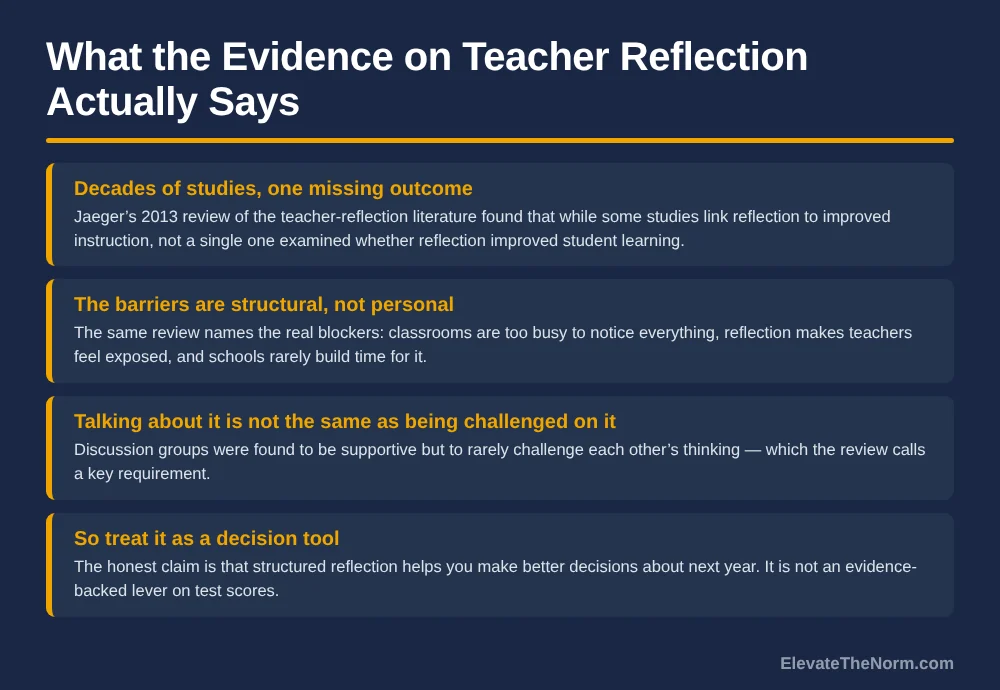
Elizabeth Jaeger’s review of the teacher-reflection literature, published in Issues in Teacher Education in 2013, laid out what supports reflection and what blocks it. The supports are the ones you would guess: structured cases, journals, recording and watching your own lesson, coaching conversations. The barriers are structural rather than personal — classrooms are busy enough that teachers can only attend to a fraction of what happens, reflection pushes people into not-knowing and therefore into feeling exposed, and schools rarely build the time for it.
Then she names the hole. Across decades of research, some studies connect reflection to improved instruction, but she reports that not a single one addressed whether reflection improved student learning. That is a gap in the research rather than evidence that reflection fails. It does mean that anyone quoting you an effect size for teacher reflection is making it up.
The second honest caveat is about quality. A 2024 mixed-methods study of 100 pre-service teachers in Germany analysed 198 reflective texts and sorted them by depth. Thirty-seven were pure description. One hundred twenty-nine were descriptive reflection. Thirty-one reached dialogic reflection. One text out of 198 reached critical reflection. These were trainees, not experienced teachers, and it was one university’s course, so do not read it as a finding about you. Read it as a warning about the default: left alone, reflective writing turns into a summary of events.
Jaeger found the same thing in a different form — groups discussing teaching cases were supportive of each other but rarely challenged each other’s thinking, which she calls a key requirement. Being agreed with is pleasant and teaches you nothing.
So the defensible claim is narrow: a structured end-of-year review helps you make better decisions about next year, and the structure is what keeps it from collapsing into description. That is worth ninety minutes. It is not worth pretending it is an intervention.
The Eight Decisions Worth Making Before You Clear the Room
Every item below has to end in a sentence somebody else could act on. “Group work was rough this year” is not a decision. “Roles get assigned by me for the first two projects and chosen by students after that” is.
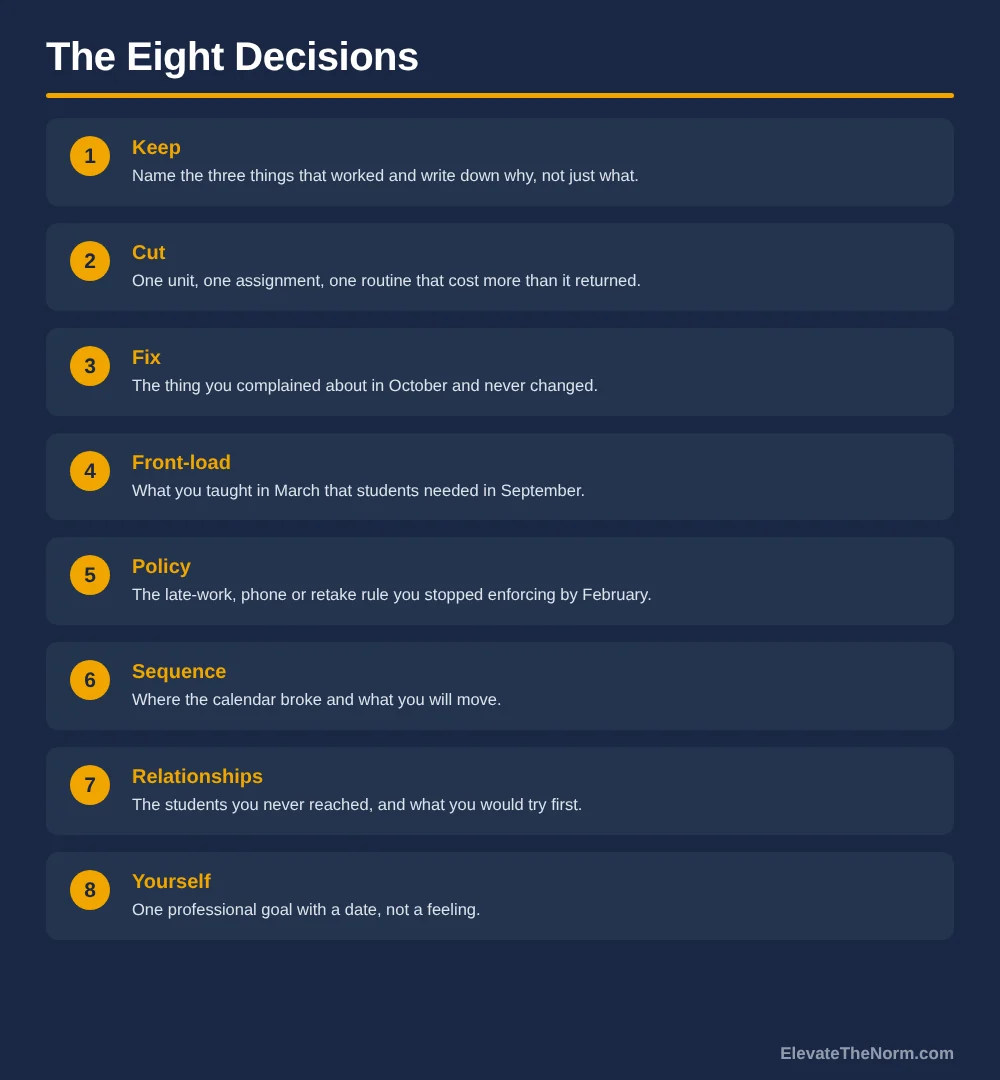
1. Keep. Name three things that worked and write down why, not just what. “The Socratic seminar went well” is useless in August. “The seminar worked because they had two days to prepare evidence and knew the question in advance” is a design rule you can reuse in a different unit.
2. Cut. One unit, one assignment, one routine that cost more than it returned. You are not allowed to cut nothing. Teachers accumulate; almost nobody prunes, and a course that only grows is a course that gets shallower every year.
3. Fix. The thing you complained about in October and never changed. You know what it is. Write the specific change, not the complaint.
4. Front-load. What did you teach in March that students needed in September? Citation format, how to read a chart, how to disagree with a classmate without it becoming personal. If you taught it late because you assumed they had it, move it.
5. Policy. Which written rule did you stop enforcing by February? Late work, phones, retakes, bathroom passes. A rule you abandon mid-year is worse than a looser rule you keep, because teenagers correctly conclude the next rule is negotiable too. Either rewrite it so you can hold it or drop it on purpose. One limit worth stating: if the rule is school-wide rather than yours, it is not yours to drop. Take the fact that it is unenforceable in your room to the person who owns the policy, with the specific reason, rather than quietly going your own way — inconsistent enforcement across a hallway is worse for students than either version of the rule. Our walk-through of late-work policies is the long version of this argument.
6. Sequence. Where did the calendar break? Most years there is one place — a unit that ate three extra weeks, a testing window you forgot, a project that landed in the same fortnight as everyone else’s. Mark it on next year’s calendar now, while you remember the date. While you are there, answer the harder version: what did you not get to, and was it genuinely optional or did you just run out of road? A standard you skipped two years running is a sequencing problem, not an accident.
7. Relationships. Name the students you never reached. Not to feel bad about it — to write down the first thing you would try differently. Usually it is earlier contact home, or a different seat, or a conversation outside the lesson in the first three weeks rather than the tenth.
8. Yourself. One professional goal with a date on it, not a feeling. “Be more organised” is a feeling. “Build the first three weeks of routines and procedures on paper before August 1” is a goal.
What Should You Capture Before You Lose Access to It?
Three things, and all three disappear when the year closes. This is the part of the process that is genuinely time-sensitive, which is why the gathering belongs in the last two weeks of instruction and the thinking can wait.
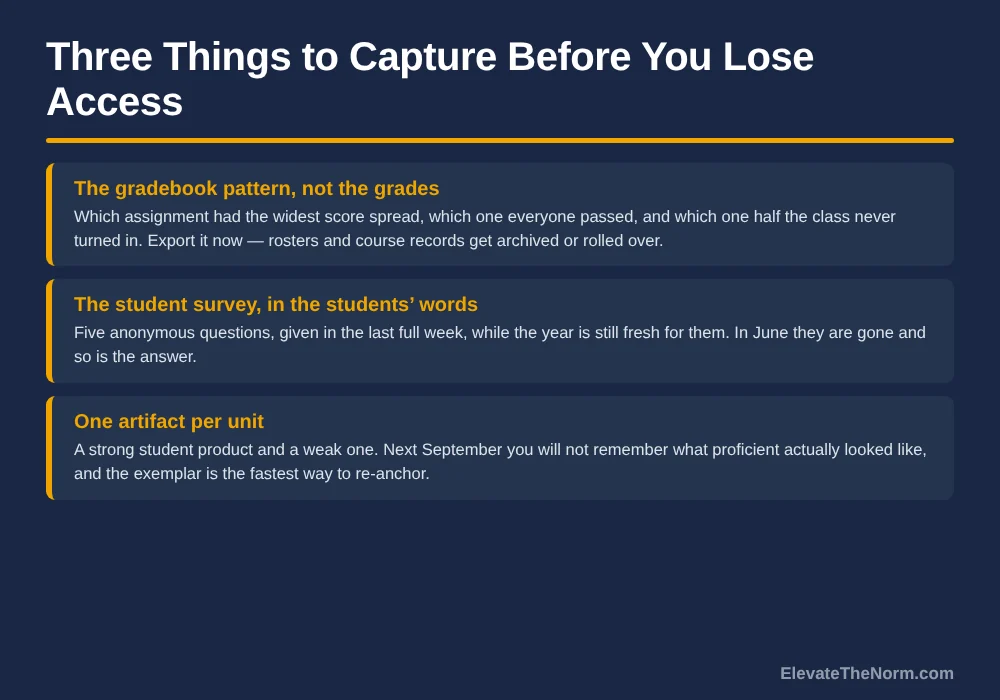
The gradebook pattern, not the grades. You do not need every score. You need which assignment had the widest spread, which one everybody passed, and which one half the class never turned in. Those three facts tell you where your instruction was unclear, where your assessment was too easy, and where the task was badly designed or badly timed. Export it while the course is live; in most systems the roster rolls over and getting it back becomes somebody else’s favour. Before you do, check how your district treats student data leaving the gradebook — many require it to stay inside district-managed accounts rather than a personal drive, and some require approval before you survey students at all. Summary patterns with no names attached are the safest form of all three records here.
The student survey, in their words. Five anonymous questions in the last full week. What should I keep doing? What should I stop? What was the hardest thing and was it hard for a good reason? When did you feel like you actually learned something? What is one thing I did that did not work the way I think it did? The last one gets the best answers and the most uncomfortable ones.
One artifact per unit — a strong one and a weak one. Next September you will not remember what proficient actually looked like. Anchor papers are the fastest way to recalibrate, and they are also the fastest way to find out your rubric and your actual grading had drifted apart.
One practical caution on the third item. Under FERPA’s definition at 34 CFR § 99.3, education records are records directly related to a student and maintained by the school, and they come with handling obligations. The regulation carves out records kept in the sole possession of the maker, used only as a personal memory aid, and not shared with anyone else — which is where your own teaching notes sit, and is not where a stack of named student work sits. If you want exemplars, strip the names or ask permission. Check your district’s records policy before anything leaves the building.

Should You Ask Your Students?
Yes, and their answers are more consistent than you would expect — but be careful what you claim for them. The Measures of Effective Teaching project, published by the Bill & Melinda Gates Foundation in 2012, found that student perception surveys produced more consistent results than classroom observations or achievement-gain measures, on the reasoning that a survey aggregates the impressions of many people who have spent hundreds of hours with you, where an observation is one person for one period.
The same report says student survey results were predictive of student achievement gains. It is worth saying plainly that the practice-and-policy summary presents that as a relationship on a chart and does not publish a correlation coefficient, so “predictive” there means a visible slope, not a number you can quote. It is also worth saying that the MET work was about using surveys inside formal teacher evaluation. You are not doing that. You are asking your own students, anonymously, for your own use, which removes most of the stakes that made that debate contentious in the first place.
Keep it short, keep it anonymous, and do it before the last day, when half the class is already gone and the other half will write whatever ends the period fastest.
One more thing, and it is the part most teachers skip. Tell them what you did with last year’s answers before you hand them this year’s. Teenagers are not naive about surveys; they have filled in plenty that went nowhere, and they can tell the difference between being asked and being harvested. Naming one concrete change — “last year’s classes said the review guide came out too late, so this year it goes out with the unit” — costs thirty seconds and buys you honest answers instead of polite ones.
How Long Should an End of Year Teacher Reflection Take?
About ninety minutes, split across three sittings. One sitting is where this falls apart — you get tired around decision four and the last four turn into one-word answers.
The honest problem with the first sitting is that the last two weeks of school are already full. Finals, checkout lists, textbook counts, a class that has mentally left. That is exactly why the gathering step is twenty minutes and involves no thinking: a gradebook export is two clicks and a five-question form takes the final ten minutes of one class period. If the week collapses, protect the survey. The gradebook you can usually still pull in June; the students you cannot.
- Sitting one, twenty minutes, last two weeks of class. Gather only. Export the gradebook summary, run the student survey, pull the artifacts. No analysis.
- Sitting two, forty minutes, after students leave. Read what you gathered, then write decisions 1 through 5. Longhand or a document, whichever you will actually reopen.
- Sitting three, thirty minutes, a week later. Decisions 6 through 8, which need distance. Then write the handoff paragraph: what you would tell the person teaching this course next year if you only got one paragraph.
Put a calendar reminder on the first contract day of next year that links directly to the file. If you skip that step the whole exercise was a diary entry. If you want a structured place to put this, our free reflection template pack has the forms, and the worked reflection examples show what a decision-shaped entry looks like next to a descriptive one.
Four Ways End of Year Reflection Goes Wrong
All four are failures of audience or timing, not of effort.
You write it for your evaluator. The moment you know somebody else reads it, you stop writing “I lost that class in November and never got them back” and start writing “I continued to refine my engagement strategies.” Fill out the district form honestly and separately. Then write the real one.
You do it in August instead. By August you remember the shape of the year and none of the detail, and the detail is the whole value. You will also be rebuilding the course at the same time, which means you will reflect your way to the decisions you had already made.
You write a performance review of yourself. Reflection is not the same as grading your own year, and turning it into a verdict on whether you were good makes it harder to look straight at what went badly. If this is landing on a year that has worn you down, the more useful read is on what actually protects teachers across a full year — that is a different problem than a weak unit plan, and it does not get solved by a reflection form.
You answer twenty questions instead of eight. Longer forms produce shallower answers. The 198-text study is the warning: given room to write, most people describe. Fewer prompts, each demanding a decision, is the design that resists it.
What to Do Next
Put three calendar entries in now, even if your year ends in seven months. Twenty minutes in the second-to-last week of instruction labelled “export and survey.” Forty minutes the week after students leave. Thirty minutes a week after that.
Then add a fourth: first contract day of next year, “read last year’s eight decisions before touching the syllabus.” That last one is the only step that converts the reflection into a changed course. Everything before it is preparation.
And if the year ahead is only starting — the eight decisions work as a running list from day one. Teachers who keep a short weekly record arrive at the end of the year with the detail already written down, which is the one thing this process cannot manufacture after the fact.
Frequently Asked Questions
When should I do my end of year teacher reflection?
In the last two weeks of instruction, not after the building closes. You want it while classes are still meeting, because two of the most useful inputs — the student survey and your gradebook exports — stop being available the moment the roster rolls over. Do the data-gathering in the last two weeks and the thinking in the first quiet week after.
How is this different from the reflection form my evaluator asks for?
The evaluation form is written to be read by somebody else, which quietly changes what you are willing to put on it. Your own reflection is written to be read by you in August. Keep them separate. Fill out the district form honestly, then write the one that actually tells next year’s you what to change.
Is there research proving teacher reflection improves student outcomes?
No, and anyone telling you otherwise is overselling it. Elizabeth Jaeger’s review of the teacher-reflection literature found studies linking reflection to improved instruction, but not one that examined whether it improved student learning. That is a gap in the research, not proof reflection fails — but it means you should treat reflection as a decision-making tool rather than an intervention.
What if I am leaving the school or the profession?
Do it anyway, and do it sooner. Nationally, 15.1% of teachers moved schools or left teaching between 2020–21 and 2021–22, and nearly three-quarters of those departures were voluntary and not retirements. If you are going somewhere else, the keep-cut-fix list is the part of this job that travels with you, and the person who inherits your course will use the handoff note.
Can I take student work home over the summer to look at it?
Check your district’s records policy first. Under FERPA, education records are records directly related to a student and maintained by the school, and they carry handling obligations. The regulation does carve out records kept in the sole possession of the maker, used only as a personal memory aid, and not shared with anyone else. Your own notes about your own teaching sit closer to that line than a stack of graded work with names on it does.
How many questions should an end of year reflection have?
Fewer than you think. Eight decisions is plenty, and most teachers would be better served by three answered properly than twenty answered in a hurry. A twenty-question form produces description. Description is the failure mode, not the goal.
Should I share my reflection with my department or keep it private?
Share the decisions, keep the raw notes. Your colleagues can use “I am cutting the research paper and replacing it with three shorter writes” immediately. They cannot use four pages of your private second-guessing, and knowing it will be read makes you write a safer, less honest version.
What do I do with it in August?
Open it before you touch a syllabus or a seating chart. That is the whole point and it is the step people skip. Put a calendar reminder on the first contract day of next year that links straight to the file. A reflection you do not reread is a diary entry.
Sources
- Jaeger, Elizabeth L. “Teacher Reflection: Supports, Barriers, and Results.” Issues in Teacher Education, vol. 22, no. 1, Spring 2013, pp. 89–104. Literature review of teacher reflection; identifies reflection-generating activities and structural barriers, and reports that while some studies link reflection to improved instruction, none examined whether reflection improved student learning. A review article, not an original study; the “no study measured student learning” finding is a statement about the literature as of 2013. https://files.eric.ed.gov/fulltext/EJ1014037.pdf
- Gläser-Zikuda, Michaela, Chaoran Zhang, Florian Hofmann, Lisa Plößl, Lea Pösse, and Michaela Artmann. “Mixed methods research on reflective writing in teacher education.” Frontiers in Psychology, vol. 15, art. 1394641, 2024. 100 pre-service teachers, 198 reflective texts, mean length 230 words; 18.7% descriptive writing, 65.2% descriptive reflection, 15.7% dialogic reflection, 0.5% (one text) critical reflection. Pre-service teachers at a single German university; the authors name the small single-institution sample as a limitation. Do not read it as a finding about experienced teachers. https://pmc.ncbi.nlm.nih.gov/articles/PMC11496957/
- Tan, Tiffany S., Wesley Wei, Desiree Carver-Thomas, and Emma García. Teacher Turnover in the United States: Who Moves, Who Leaves, and Why. Learning Policy Institute, March 2026. Between 2020–21 and 2021–22, 15.1% of U.S. teachers moved schools or left the profession — 8.0% moved and 7.1% left; 74% of departures were voluntary and not retirements. https://learningpolicyinstitute.org/product/teacher-turnover-united-states-report
- Student Perception Surveys and Their Implementation: Asking Students about Teaching. Measures of Effective Teaching (MET) Project, Bill & Melinda Gates Foundation, 2012. Reports that student surveys produce more consistent results than classroom observations or achievement-gain measures, and that survey results were predictive of achievement gains. The practice-and-policy summary presents the achievement relationship graphically and publishes no correlation coefficient; the report’s context is formal teacher evaluation, not voluntary self-review. https://cepr.harvard.edu/sites/g/files/omnuum9881/files/cepr/files/asking_students_summary_doc_0.pdf
- U.S. Code of Federal Regulations. “Education records” definition, 34 CFR § 99.3 (Family Educational Rights and Privacy Act). Defines education records as those directly related to a student and maintained by an educational agency or institution, and excludes records kept in the sole possession of the maker, used only as a personal memory aid, and not accessible to any other person except a temporary substitute. Federal floor only — state law and district records policy may be stricter. https://www.ecfr.gov/current/title-34/subtitle-A/part-99/subpart-A/section-99.3