Category: Teacher Support

For teachers about their own professional survival: mentorship, avoiding isolation, and classroom systems that hold up under real conditions.

  • Substitute Teacher Classroom Management: Running a Room That Isn’t Yours

    Substitute Teacher Classroom Management: Running a Room That Isn’t Yours

    Substitute teacher classroom management is not the same job as classroom management. A regular teacher builds authority over weeks. A substitute has to borrow it in the first four minutes, from a room that already has its own rules, its own seating, and its own sense of what is normal — none of which they wrote. The work is not installing your system. It is running theirs well enough that the day holds.

    Most advice on this subject is written as though the substitute controls the outcome. They control some of it. The rest was decided before they ever walked in, by the teacher who wrote the plans — which is the half of this that almost nobody writes about, and the half I can speak to directly.

    This page covers what the person walking in actually has to work with, what they can control on the day, and what the regular teacher owes them before leaving.

    Key Takeaways

    • A substitute’s authority is borrowed, not built. The fastest way to lose a room is to replace its norms with your own on day one. Run the room that exists.
    • The person walking in may have twenty hours of training. In Missouri, a substitute certificate requires either 36 semester hours of college or 20 clock hours of approved training. That is the floor in one state, and it is worth knowing before you judge how a day went.
    • The first four minutes decide most of it. A visible plan, stated out loud, followed by a pause — not a raised voice.
    • Teacher absence is measurable and it is not small. Ten additional days of teacher absence are associated with a decline of roughly 1.7% to 3.3% of a standard deviation in math achievement. The sub day is not a throwaway day.
    • Half of substitute classroom management is written the week before, by someone else. Plans that assume the sub knows the room are the single most common failure, and they are entirely preventable.
    • A class that tests a substitute is usually not scheming. Nobody knows their name, the day reads as a holding pattern, and the adult has no history with them. Using names and making the work visibly real addresses all three.

    The job is not “teach the lesson.” It is “keep the room intact.”

    This is the reframe that makes the rest of it workable. A substitute who measures the day by how much content got delivered will almost always finish feeling like they failed. A substitute who measures it by whether the room is handed back in the condition it was handed over — work attempted, norms intact, nobody humiliated, an honest note left behind — has done the actual job.

    That is not a lowered standard. It is the correct one. The regular teacher can reteach a lesson. What they cannot easily undo is a room that learned, over one day, that the expectations it runs on are negotiable when a stranger is standing there.

    What the person walking in actually has

    It is worth being precise about the preparation the job actually requires, because a lot of staffroom commentary about substitutes assumes a level of training that the credential does not demand.

    Missouri, as one published example, issues a Content Substitute Certificate to an applicant who has completed either a minimum of 36 semester hours from an accredited college or university, or twenty clock hours of department-approved substitute teacher training. Requirements vary by state and some are higher. But twenty clock hours is a real, current, published floor in at least one state — and the person it describes is expected to walk into a room of thirty teenagers and hold it.

    Two things follow. If you are the substitute: the gap you feel between what you were trained for and what the day demands is real, and it is structural rather than personal — the same gap first-year teachers describe in their own rooms. If you are the regular teacher: the plans you leave are not a courtesy. For some of the people who will use them, they are the entire preparation.

    A third thing follows for anyone who sets policy. Nothing in the rest of this article is a substitute for a district actually orienting the people it puts in front of students — a building walkthrough, the safety procedures, where the office is, what the behavior system is called. Most of what gets written about substitute classroom management, including everything below, is individuals compensating for a system that hired someone and pointed at a door. The individual workarounds are worth knowing. They are not the fix.

    The first four minutes: organization to the minute, and then the pause

    The method I use in my own room transfers to a substitute almost unchanged, and it is the one piece of this I would put above everything else: taking control of a room is done by organization to the minute, and then you pause.
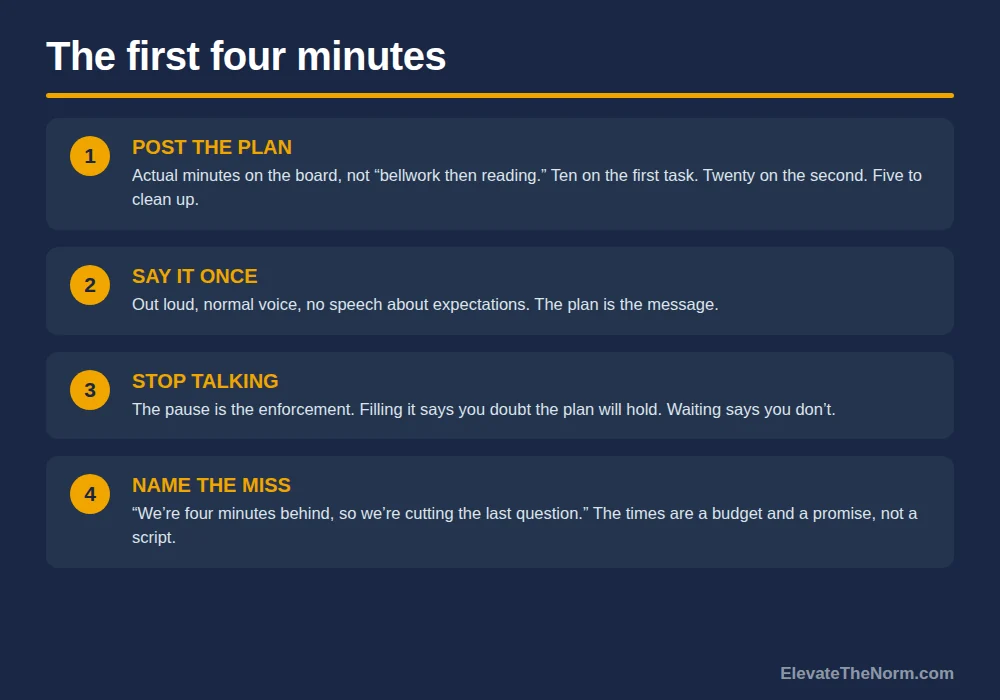
    Four numbered steps for a substitute’s first four minutes: post the plan, say it once, stop talking, name the miss
    The pause is the enforcement. Filling it says you doubt the plan will hold.

    Put the plan where they can see it before the bell. Not “bellwork, then reading” — actual minutes. Ten minutes on the first task. Twenty on the second. Five to clean up. Write it on the board you found it on. Then say it out loud, once, in a normal voice.

    Then stop talking.

    The pause is the part people skip, and it is the part that works. You have laid out a plan that is visibly organized, and then you let the silence do the enforcement instead of your volume. The instinct is to fill it — to repeat yourself, to add a threat, to get louder. Filling it tells the room you are not sure the plan will hold. Waiting tells them you are.

    I should be honest about what that costs, because most versions of “just wait them out” leave the price out. I once held a pause for more than five minutes. It was one of the most awkward moments of my life, that section finished nine minutes behind my other classes, and it is the only time I have ever assigned homework. It worked. It also cost nine minutes and a homework assignment I did not want to give. A substitute will rarely have nine minutes to spend, which is exactly why the posted plan matters — it shortens the pause you need.

    One clarification, since this gets misread: the posted times are a budget and a promise, not a script. When you miss them, say so out loud and give the reason. A substitute who announces “we are four minutes behind, so we are cutting the last question” has just demonstrated that the plan is real. That is worth more than hitting the times.

    Run their room, not yours

    This is where most substitute days are quietly lost, and it rarely looks like a discipline problem. It looks like a reasonable adult correcting something that was never wrong.
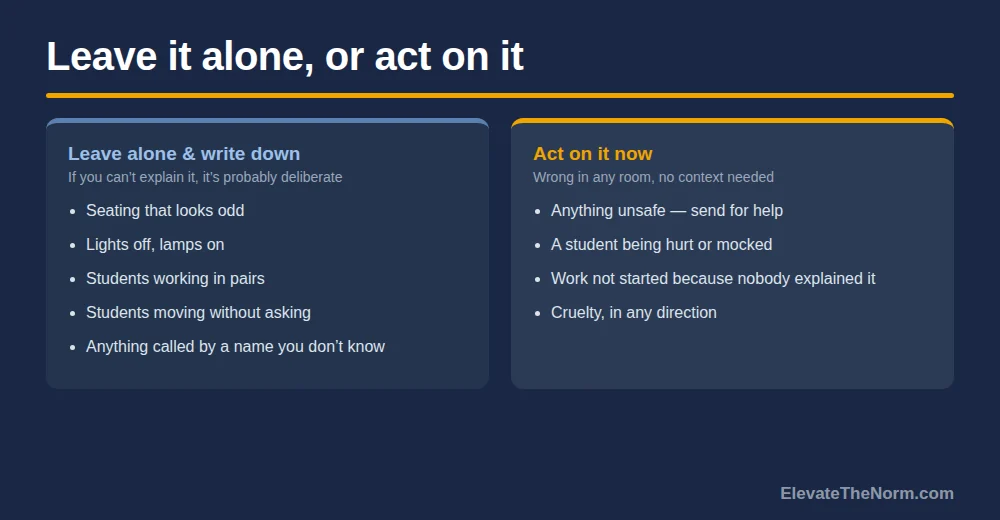
    Two-column comparison of classroom things a substitute should leave alone and write down beside things that require immediate action
    If you can’t explain it, it’s probably deliberate.

    In my room, students are almost always working alongside somebody. Partner work is the resting state, not a reward and not a special occasion — the tables are literally grouped that way and there are no rows to return to. A substitute who walks in, sees students talking, and reads it as the room falling apart will spend the period fighting the room’s actual design. They will separate students who were doing exactly what they were supposed to do, and by second period they will have spent all their credibility on a rule that does not exist in that room.

    The same goes for the lights. I do not turn the overhead fluorescents on — the room runs on floor lamps around the perimeter. It is a deliberate choice about sensory load, and it helps far more students than the ones who would ever have asked for an accommodation. A substitute’s first instinct on walking into a dim room is to find the switch. Flipping it is a small thing that changes the room the students walked into.

    So the working rule is: anything you cannot explain, leave alone and write down. If the seating looks odd, it is probably deliberate. If the lights are off, someone turned them off. If four students get up without asking, there is probably an established procedure for that. Note it, ask afterward, and do not spend your authority correcting a room’s design.

    Reserve your authority for the things that are wrong in any room: cruelty, danger, and a flat refusal to engage with work that has been made doable.

    That last one needs its qualifier. A student who will not start a worksheet nobody explained is not defying you — they are stuck, and “refusal” is the wrong word for it. Check whether the task is actually doable before you treat not-doing-it as a behavior problem. Most of the time on a substitute day, it is not defiance. It is an instruction gap.

    The one line that overrides all of this: if something is unsafe, or a student is being hurt, you do not need permission or context. Send for the neighboring teacher or the office immediately. Knowing where the phone is and who is next door is a two-minute check when you arrive, and it is the only part of this you should never improvise.

    Substitute teacher classroom management: five things you can actually control

    1. Where you stand. Circulating beats presiding. A redirect delivered quietly at close range, to one student, does the work without announcing the problem to twenty-nine other people — and it does not give the room a performance to react to.
    2. What you say first. Names if you have them, the plan if you do not. “Here is what we are doing and how long it takes” outperforms any version of “I expect you to behave for me today.”
    3. Your volume. It is the one resource that only decreases. Every notch you spend is gone for the rest of the day.
    4. What you write down. An honest, specific, unemotional note is the most valuable thing you leave behind. “Third period did not start the reading; two students, seated front left, were the reason” is useful. “Terrible class” is not, and it will be read by someone who has to work with those students tomorrow.
    5. Whether anybody gets humiliated. This one is not negotiable and it is entirely within your control. You will be gone tomorrow. They will not.

    What the regular teacher owes the substitute

    If you are reading this as the teacher who is going to be out, this is the section that changes your sub’s day, and it takes about fifteen minutes to write once and reuse all year.
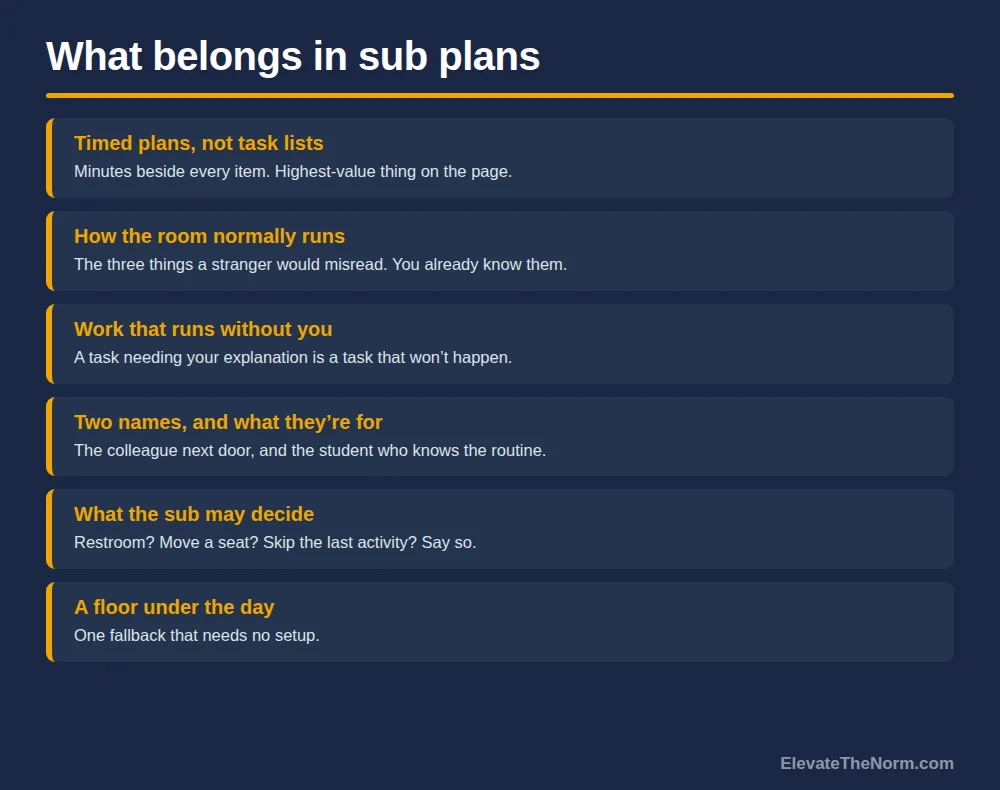
    Six items that belong in substitute teacher plans, including timed plans, how the room runs, and a fallback activity
    Fifteen minutes to write once, and it changes every sub day that follows.

    Write it assuming it will be read in five minutes, standing up, by someone who was called at six that morning and has never been in your building. That is the realistic case, not the exception. Put the timed plan and the three things a stranger would misread on the first page, in that order. Everything else can be on page two, where it may or may not get read.

    • Timed plans, not task lists. Minutes next to every item. It is the single highest-value thing on the page, for exactly the reason in the section above.
    • A one-paragraph description of how your room normally runs. Partner work is expected. The lights stay off. Students may get water without asking. Write the three things a stranger would most likely misread — you already know what they are.
    • Work that can actually be done without you. A task that depends on your explanation is a task that will not happen, and the gap gets filled with whatever the room decides to do instead.
    • Two names, and what they are for. The colleague next door and the student who genuinely knows the routine. Not a list of “problem” students — a list of doors to knock on.
    • What a substitute is allowed to decide. Can they let a student use the restroom? Move a seat? Skip the last activity? Say so, or you have left someone to guess and then be wrong.
    • Where the day goes if it falls apart. One genuinely usable fallback that requires no setup. Every sub plan should have a floor under it.

    One thing that does not belong in sub plans: a discipline ladder invented for the occasion. Your substitute cannot enforce consequences that do not already exist in the room, and asking them to try is how a day gets worse rather than better. Tell them what the room already does.

    Why the day is worth taking seriously

    There is a habit of treating substitute days as time that does not count. The measured picture disagrees, though it needs stating carefully.

    Analysis published by Brookings reports that roughly 29% of teachers were chronically absent — missing ten or more school days — in the 2015–16 federal civil rights data, and that ten additional days of teacher absence are associated with a decline of between 1.7% and 3.3% of a standard deviation in math achievement. Substitute costs run to roughly 1% of all public education spending.

    Two honest caveats. These are associations drawn from observational data, not the result of an experiment, and the effect sizes are modest per unit. And the federal absence figures are from 2015–16, which is the most recent comparable collection but is now several years old. What the numbers support is a modest claim, and the modest claim is enough: sub days are frequent, they cost real money, and they are associated with measurably less learning. They are not a rounding error, and the room deserves a plan.

    What the students are doing, and why

    Almost everything written about substitute teaching treats the students as weather — a condition to be survived. It is worth saying plainly what is actually happening on their side of it, because it changes what you do.

    A class that tests a substitute is usually not running a scheme. Three ordinary things are true at once: nobody in the room knows their name, the day has been signalled to them as a holding pattern, and the adult in front of them has no history with them in either direction — no credit built up, and no relationship to damage. Teenagers read all three accurately and respond to them rationally. If the day looks like it does not count, some of them will treat it as though it does not count.

    Which means the two highest-leverage moves are both about signalling the opposite. Learn some names and use them — from a seating chart, from their work, by asking. And make the work visibly real: something that gets collected, that the regular teacher will see, that connects to what they did yesterday. “Your teacher is going to read these tomorrow” is a true sentence that changes a room, and it costs nothing.

    Students are also owed something on these days, and it is not complicated: to know what they are doing and how long it takes, to not be punished as a group for individuals, to not be talked about as a category in a note they will never see, and to be able to ask a question and get a real answer rather than “I’m just the sub.” That last one is worth retiring. You are the teacher in that room today. Not knowing an answer is fine. Saying you do not count is not, and they will believe you.

    Should a substitute actually teach?

    Sometimes, and the honest answer depends on what the plans ask for rather than on how confident you feel.

    If the plan is practice, review, reading or a project work session — which is the large majority of well-written sub plans — then teaching it is mostly circulating, answering, and keeping the work moving. Do that, and do it properly. If the plan introduces genuinely new content in a subject you do not know, delivering it badly is worse than not delivering it: students will learn it wrong, and the regular teacher will have to undo that before they can teach it. Run the practice portion, write down exactly where the class stopped, and say so.

    One small tool worth borrowing from special-education practice, where it is standard: a visible timer. Putting the remaining minutes somewhere the whole room can see them makes an abstract instruction concrete, and it takes the countdown out of your voice — the clock says it instead of you. It is a phone on the document camera, and it works for far more students than the ones it was designed for.

    The part that is actually hard

    Everything above is manageable on a normal day. The genuinely hard version is the room that has decided, collectively and before you said a word, that today is a day off. No single student is doing anything you could name. The work is simply not starting.

    There is no technique that fixes that in thirty seconds, and any article that tells you otherwise is selling something. What works is narrow and unglamorous: get one table started. Not the room — one table. Sit down next to them, at their height, and do the first item with them. A room that is entirely not working is very hard to move. A room where one group is visibly working is a different room, and the second group is much easier than the first.

    And if it does not turn: finish the period without making it worse, write the honest note, and hand the room back. That is not defeat. On some days that is competence, and a teacher who has been out sick will understand the difference between a sub who lost a room and a sub who protected one.

    Which is the whole of it, really. Substitute teacher classroom management is not a set of tricks for controlling somebody else’s students — it is the practice of running a room you did not build, on borrowed authority, without spending down what the regular teacher has spent months constructing. Post the plan. Pause instead of getting louder. Leave the room’s own rules alone. Use names. Make the work real. Write the honest note.

    And if you are the one writing the plans: fifteen minutes on a page that assumes nothing will do more for that day than anything the substitute can do once they are standing in it.

    Sources

    • Brookings Institution. We should be focusing on absenteeism among teachers, not just students. Read the analysis — source for the 29% chronic-absence figure (U.S. Department of Education Office for Civil Rights, 2015–16), the 1.7–3.3% of a standard deviation math association, and the ~1% of public education spending figure. These are observational associations, not causal estimates, and the federal absence data is from 2015–16.
    • Missouri Department of Elementary and Secondary Education. Substitute Teachers — certification requirements. Read the requirements — source for the 36 semester hours / 20 clock hours standard. One state’s rule, cited because it is current and published; requirements vary considerably by state and your own state’s rule governs.
    • Substitute teaching: evidence-based practices for inclusive classrooms. Helen: The Journal of Human Exceptionality, April 2024. Read the guide — consulted for the visual-schedule and visual-timer practices. Cited as practitioner guidance, not as research: the article describes itself as drawing on evidence-based practice but names no studies and reports no data.

    Every link above was checked on September 20, 2026. The classroom practices described in the first person — the timed plan and the pause, partner work as the room’s resting state, and the lamps — are my own and are used across this site.

    Frequently Asked Questions

    What is the single most important thing a substitute teacher should do first?

    Put a timed plan where the room can see it, say it out loud once in a normal voice, and then stop talking. The visible plan does most of the work and the pause does the rest. What does not work is opening with a speech about expectations — it spends authority before anything has happened and invites the room to test it.

    Should a substitute enforce their own rules or the regular teacher’s?

    The regular teacher’s, with three exceptions that apply in any room: cruelty, danger, and refusal to attempt the work. A substitute’s authority is borrowed from the room’s existing norms, and replacing those norms is what burns it. If something looks wrong but you cannot explain it, the odds are good that it is deliberate — leave it alone, write it down, and ask afterward.

    How much training do substitute teachers actually have?

    Less than most people assume, and it varies a great deal by state. Missouri, as one published example, issues a substitute certificate to applicants with either 36 semester hours of college credit or 20 clock hours of approved training. Some states require more. The practical point for administrators and teachers is that sub plans are, for some of the people using them, the entire preparation for the day.

    What should a substitute do when the whole class refuses to start work?

    Get one table started rather than trying to move the room. Sit down at their height and do the first item with them. A room in which nothing is happening is very hard to shift; a room in which one group is visibly working is a different problem and a much easier one. If it does not turn, finish the period without making it worse and leave an honest, specific note. Protecting a room is not the same as losing it.

    What belongs in sub plans for a middle or high school class?

    Timed plans rather than task lists, a short paragraph on how the room normally runs, work that can be completed without the regular teacher’s explanation, the name of a colleague next door and a student who knows the routine, an explicit statement of what the substitute is allowed to decide, and one genuinely usable fallback activity. Leave out any discipline ladder invented for the occasion — a substitute cannot enforce consequences the room does not already have.

    Does it actually matter how a substitute day goes, or is it a lost day either way?

    It matters, though the evidence supports a modest claim rather than a dramatic one. Brookings reports that ten additional days of teacher absence are associated with a decline of roughly 1.7% to 3.3% of a standard deviation in math achievement, and that substitute costs approach 1% of public education spending. Those are observational associations from older federal data, not experimental results. Read together they support something narrow and sufficient: these days are frequent, expensive, and associated with less learning.

    How should a substitute write the note they leave behind?

    Specifically, honestly, and without adjectives about character. Name what happened, when, and what was or was not completed. “Third period did not start the reading; two students seated front left were the reason” gives the regular teacher something to act on. “Terrible class” does not, and it will be read by an adult who has to face those students the next morning. Report behavior, not verdicts about people.

    Why do students behave differently for a substitute?

    Usually because three things are true at once and teenagers read all three correctly: nobody in the room knows their name, the day has been signalled to them as a holding pattern, and the adult in front of them has no history with them in either direction. That is a rational response to the situation rather than a character flaw, and it points at the fix. Use names, and make the work visibly real — something that gets collected and that the regular teacher will actually see. Telling a class truthfully that their teacher will read this tomorrow changes a room and costs nothing.
    About Clay Shumate

    By Clay Shumate — Clay Shumate is a certified secondary Social Studies teacher in the public schools of West Alabama, now in his seventh year in the classroom, with a B.A. in History and an M.Ed. in Secondary Education. He writes about project-based learning, student responsibility, respect, and practical ways to hold young people to a higher standard while giving them room to learn from mistakes. He is a member of the Society of Professional Journalists and writes to its Code of Ethics; this site’s editorial standards and corrections policy are published in full.

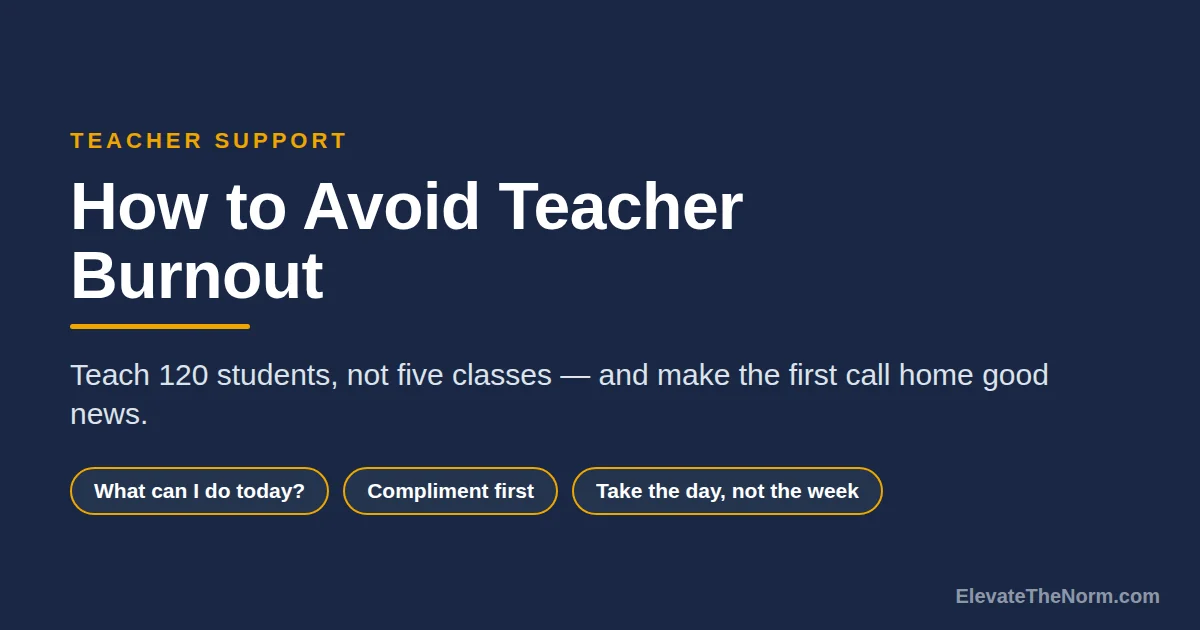
  • How to Avoid Teacher Burnout: Teach 120 Students, Not Five Classes

    How to Avoid Teacher Burnout: Teach 120 Students, Not Five Classes

    Every teacher hits a wall. It does not matter if you are in your first year or your twenty-fifth. It usually shows up a few weeks into a grading period, when the calendar has no days off in sight and you have to grind it out, the same way the long stretch after spring break feels every year. If you are searching for how to avoid teacher burnout right now, you are probably in that stretch.

    I want to start with something you may not believe yet: if your students are showing up, smiling, talking to you and to each other, and picking up the soft skills and life skills that do not show up on a test, you are doing an incredible job. Burnout lies to you about that. The rest of this article is what I actually do to keep the wall from winning.

    Key Takeaways

    • Burnout is a work problem, not a character flaw. The World Health Organization defines it as the result of chronic workplace stress that has not been successfully managed.
    • Teachers report it far more than other workers. In RAND’s 2025 survey, 53 percent of teachers reported burnout, compared with 29 percent of similar working adults.
    • Ask “what can I do today,” not “what do I need to do today.” One question is a to-do list you can never finish. The other is a day you can win.
    • Teach 120 students, not five classes. Every room is its own ecosystem, and every student in it needs something different.
    • Make the first call home a compliment. Then stop talking and listen. It changes every call that comes after it.
    • Treat your observer as a second set of eyes, and take the day off before you need a week off.

    Free Download · 2-page PDF

    Compliment-First Parent Call Planner

    The four-step first call and the five-move follow-up call on one page, a log to track who you have reached, and a tracker for three-minute one-on-one conversations with every student.

    Download the free PDF

    Free. No email address required. Designed for grades 6–12. Browse every printable in Your Free Library.

    What Teacher Burnout Actually Is

    Teacher burnout is exhaustion that comes from the job itself and does not go away with a normal weekend. The World Health Organization classifies burn-out as an occupational phenomenon, not a medical condition, and defines it as a syndrome resulting from chronic workplace stress that has not been successfully managed. It has three parts: feeling drained of energy, feeling mentally distant or cynical about your job, and feeling like you are no longer effective at it.

    That third part is the one I see teachers underestimate. Burnout does not just make you tired. It convinces you that you are bad at teaching, and that belief makes the tiredness worse. So avoiding teacher burnout is partly about rest, and partly about measuring your work correctly.

    Why It Hits a Few Weeks Into the Grading Period

    The numbers explain why so many of us feel it at the same time. In RAND’s 2025 State of the American Teacher survey, 61 percent of teachers reported frequent job-related stress and 53 percent reported burnout, compared with 41 percent and 29 percent of similar working adults. Teachers averaged about 49 hours a week, roughly ten more than they were contracted for. The burnout number was down from 60 percent the year before, which is good news, but it is still more than half of us.

    Then there is the calendar. The first weeks of a grading period run on adrenaline. By the middle, the adrenaline is gone, grades are due, the next break is far away, and every small problem feels heavier than it is. Nothing about you changed. The load did.

    Measure Your Day the Right Way

    When I feel the wall coming, I go back to what actually matters. Are the kids coming to class? Are they smiling? Are they talking? Am I helping them get better at the things they will need for the rest of their lives: showing up, communicating, working with people they did not choose? If the answer is yes, then I am doing my job, and so are you.

    That is not a pep talk. It is a correction. A 2026 systematic review of 55 studies of middle and secondary school teachers found that positive teacher-student relationships were associated with every aspect of teacher wellbeing the researchers measured, from positive emotion to a sense of accomplishment. The authors are careful to say most of those studies used tools designed for elementary classrooms, and the studies show association, not cause. But the direction lines up with what most of us feel: the relationships are not a distraction from the work. They are the part of the work that refills you.

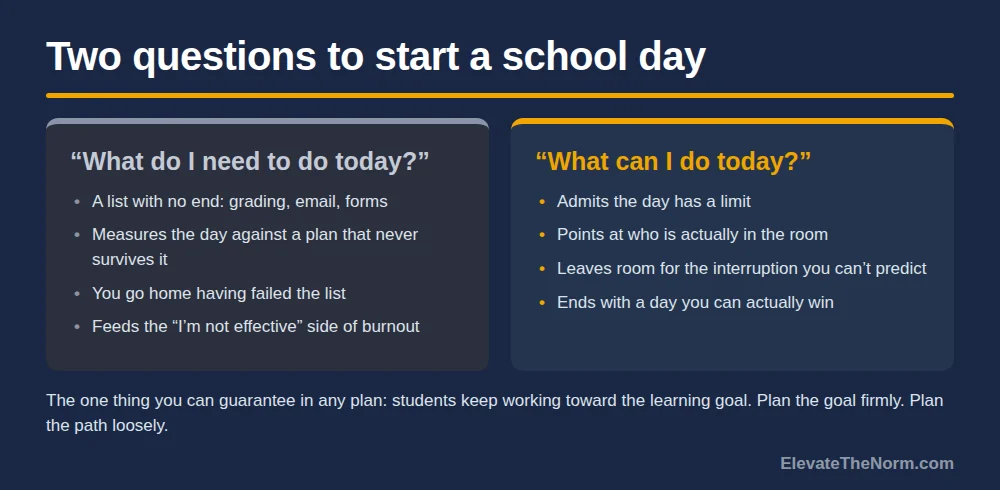
    Side-by-side comparison of two questions to start a school day. What do I need to do today is described as an endless list measured against a plan; what can I do today admits the day has a limit and points at who is in the room
    One question is a list you can never finish. The other is a day you can win.

    Ask “What Can I Do Today?” Instead of “What Do I Need to Do Today?”

    This is the biggest mindset shift I know of for avoiding teacher burnout. “What do I need to do today” is a list that never ends. There is always another stack to grade, another email, another form. You go home every single day having failed the list.

    “What can I do today” is a different question. It admits that the day has a limit, and it points you at what is actually in front of you. It is also the question that makes the next idea possible, because what you can do today depends on who is actually in your room today.

    Stop Teaching a Class. Teach 120 Students.

    Every classroom is its own ecosystem. Inside an ecosystem, every living thing needs something different to survive. Students are not animals, obviously, but the principle holds: every student in your room needs something different to succeed.

    If you view a class as one class, in my opinion, you will fail as a teacher. If you view it as 20 to 30 individual students who all need different things, you have a chance. So if you have 120 students across your day, think of it as 120 different lesson plans. That sounds like a faster road to burnout, not a way out of it. It is not, and here is why: you stop fighting the day for being different from the plan.

    This is also why I do not put much faith in extremely detailed lesson plans. Say you teach the same subject five periods a day. I can write the plan, and so can you. But the only thing on it I can guarantee is that my students will work on the driving question and keep moving toward it. I do not know if first period will get interrupted, if a fight will break out in fourth, or if sixth will need more one-on-one time and slow down. Plan the goal firmly. Plan the path loosely. The day you stop expecting every period to follow the script is the day the script stops making you feel like a failure.

    Spend the First Days Getting to Know People, Not Reading Rules

    Most of us spend the first three or four days of school reciting rules. If you teach high school, you do not need to. Hand out the syllabus and let students read most of it themselves. A fill-in-the-blank version moves even faster, and you can spot-check it for a first grade in the gradebook. If you want a plan for the routines themselves, start with this guide to classroom routines and procedures.

    Use the time you save to genuinely get to know every student. At the start of every new year or semester, I sit down one-on-one with each student for about three minutes, and I get through all of them within the first three school days. Three minutes is short enough to fit and long enough for a student to realize you actually want to know who they are. It is also where you learn, without making a big production of it, who lives at home and who to call.

    Do the math and it is less than it sounds: 30 students at three minutes each is about 30 minutes a class period across three days, which is roughly the time the rules speech was going to take anyway. One caution from the parent and student side of this: keep anything touching home life optional. The point is to learn which adult to call, not to collect a family’s business.

    Make the First Call Home a Compliment

    When you call from a school number, you will scare a parent. Back when I worked as a retail manager, every time a customer asked for the manager, I took a deep breath, because I knew what was coming. Nine times out of ten, I was right. Parents answering a call from the school feel exactly the same way.

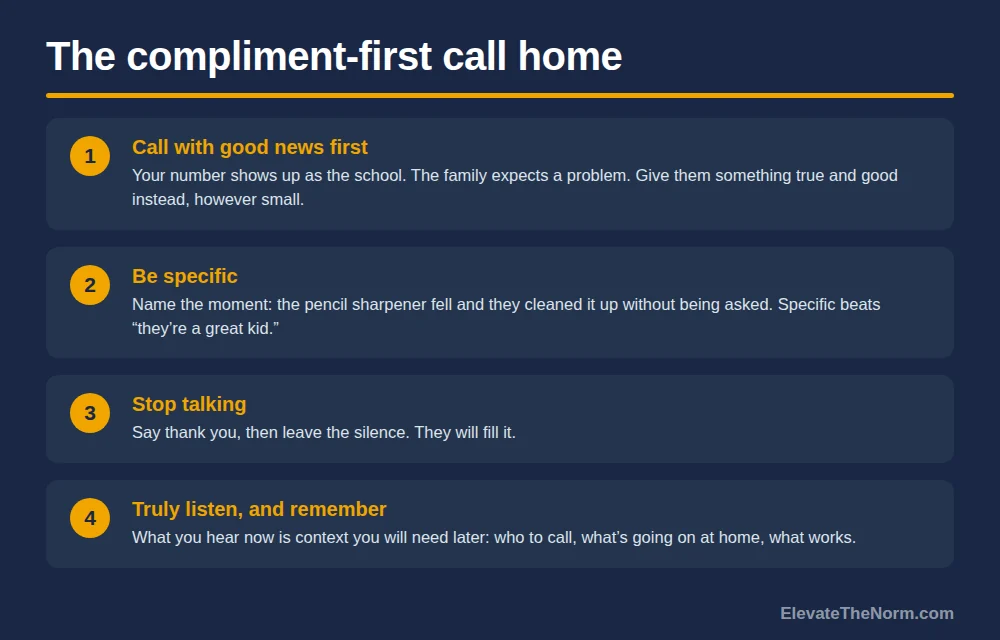
    So the first call is always a compliment, and it does not matter how small. Something like: I am really glad your son was in my class today, because the pencil sharpener fell and he cleaned the whole mess up without being asked, and I wanted you to know you have a thoughtful kid. Then stop talking.

    Four numbered steps for a compliment-first call home: call with good news first, be specific, stop talking, and truly listen and remember
    The first call home should be good news. Then stop talking and listen.

    They will talk. And when they do, you have two jobs. The first is to truly listen. That is a skill I think teachers are losing, with students and with the adults who raise them, and without it we have no idea what is actually going on in a kid’s head. The second job is to remember what you heard, because you will need it.

    I also send a general letter home to every family early in the year saying how excited I am to have their student in class. Between the letter and the first call, the second conversation starts from trust instead of fear. If you want a simple way to keep track of who you have reached, a parent-teacher communication log does the job, and there are apps built for this if your families prefer text.

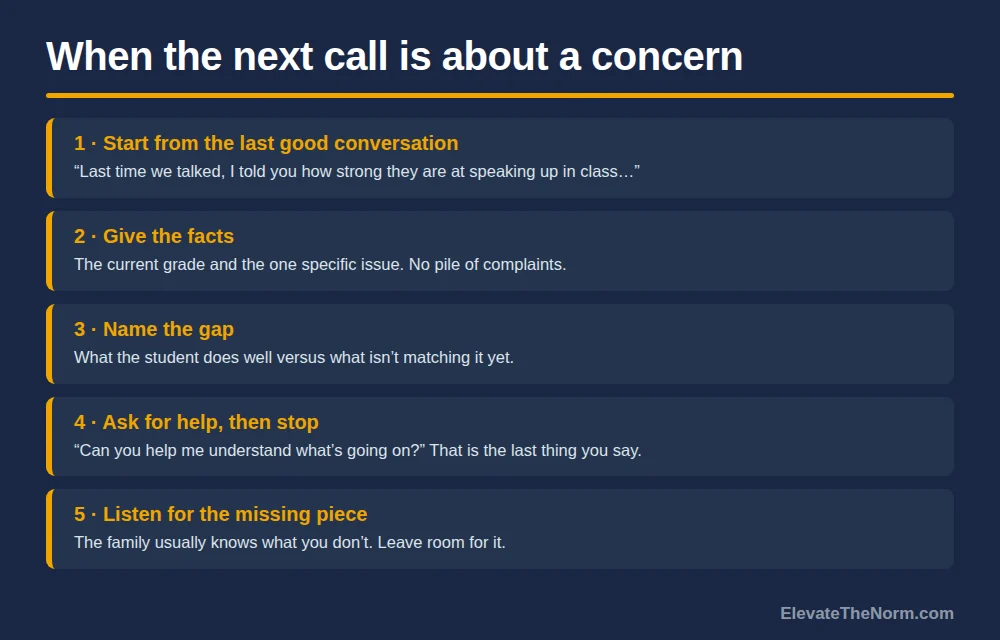
    When the Next Call Is About a Problem

    Here is what the compliment call buys you. This year, I had to call about a student who was not progressing the way I had hoped. The guardian picked up, I explained the situation, and because we had already talked once about something good, and because she had already gotten my letter, she worked with me instead of against me. Now that student is turning in work, keeping their head up in class, and at least thinking about participating. They are involved in a way they were not before.

    Years ago, teaching middle school, I made the same kind of call to the grandmother of a student who would not stop talking and was interrupting class. Because we had spoken before, I could say: last time I told you how strong he is at verbal communication, so I am confused about why his written work does not match. Can you help me understand? Then I stopped. I had told her the grade, the problem, and the specific gap between what he does well and what he does not. She filled in the rest, and you would be surprised how much information you get when you leave room for it.

    Five steps for a parent call about a concern: start from the last good conversation, give the facts, name the gap, ask for help and then stop, and listen for the missing piece
    When the next call is about a problem, the first call has already built the trust you need.

    The research backs the pattern. In a randomized experiment with sixth and ninth graders in a summer program, daily teacher contact with families increased the odds of homework completion by 40 percent, cut the times teachers had to redirect students by 25 percent, and raised participation by 15 percent. The researchers credited stronger teacher-student relationships, more parent involvement, and more student motivation.

    There is an honest wrinkle worth knowing. In a follow-up high school study, weekly messages about what students could improve produced the largest gains in earning course credit, somewhat larger than messages about what they were doing well, though the difference between the two was not statistically clear. I read that as support for doing both in order: the compliment call earns the trust, and the next call spends it on something specific and actionable.

    Treat Your Observer as a Second Set of Eyes

    Newer teachers panic about observations. Remember that, like in any other job, your observer is there first to give you another set of eyes, and they can give you extremely useful information if you listen when they come back. If you stop listening the moment you see a low score and decide you know better than they do, you lose.

    There is evidence on this, too. A study of mid-career teachers in a classroom-observation-based evaluation system found that teachers were more effective in the years after being evaluated, with the largest improvements among teachers who had been performing relatively poorly beforehand. The feedback only worked because the teachers used it. Ask for one specific change, make it, and invite the observer back to see it. If you want a structure for that thinking, these teacher reflection examples are a good place to start.

    Take the Mental Health Day Before You Need a Week

    If you remember three words from this article, make them mental health days. A day off taken when you first notice the signs costs far less than a week taken after you have run empty. Leave a sub plan that works without you, and do not spend the day grading.

    RAND’s 2025 work-life balance findings say the same thing from a different direction: 46 percent of teachers said their job left them too tired for their private lives, compared with 13 percent of similar working adults, and teachers said that leadership support for flexibly using paid leave improved their balance. Fewer than half said their school or district was making efforts to help. So until yours does, take the leave you have earned. I will write more about mental health days on their own soon. And if rest does not lift the exhaustion, that is a reason to talk with a doctor or your district’s employee assistance program, not a reason to push harder.

    The Short Version

    How to avoid teacher burnout comes down to a few habits you can start tomorrow: measure your day by whether students showed up, smiled, and grew; ask what you can do today; teach individuals instead of a class; make the first call home good news and then listen; hear your observer out; and take the day before you need the week. If you are newer to all of this, the guide to classroom management for new teachers and this piece on building relationships with students pick up where this one leaves off.

    You are doing a better job than the wall is telling you.

    Before you go: grab the free Compliment-First Parent Call Planner (PDF) — ElevateTheNorm.com branded, printable, no email required.

    Frequently Asked Questions

    What is the fastest way to avoid teacher burnout in the middle of a grading period?

    Change the question you start the day with. Instead of listing everything you need to do, ask what you can do today, and let the rest wait until tomorrow. Then make one positive phone call. It is the most reliably good conversation a teacher can have in a school day, and it pays you back the next time you have to call that same family about a problem.

    Do I really have to call every family? I have more than a hundred students.

    No one can make 120 calls in a week, and trying to is its own route to burnout. Spread them out: three to five a day across the first several weeks reaches everyone by the end of the grading period. A short welcome letter home covers every family on day one while the calls catch up. If a family prefers text or email, or does not have reliable phone access, use that instead. The point is that the first contact is good news, not that it happens by phone.

    What if I cannot find anything positive to say about a student yet?

    Look smaller. The compliment does not need to be about grades. A student who held the door, helped someone find the page, or came in and sat down without being asked has given you something true to say. If you truly have nothing after a week, that tells you something too: you have not gotten to know that student yet, and that is the first thing to fix.

    How do you fit a three-minute conversation with every student into the first three days?

    Do the math first: 30 students at three minutes each is 90 minutes per class, or about 30 minutes a class period across three days. That is time most of us already spend reading the syllabus aloud. Hand out the syllabus, let students work through it, and pull students one at a time for a short conversation. Keep any question about home life optional. The goal is to learn who a student is and which adult to call, not to collect details about a family.

    My school requires detailed daily lesson plans. Does this approach conflict with that?

    It does not have to. Turn in what your school requires. The point is where you put your confidence: the one part of the plan you can guarantee is the learning goal or driving question, and everything else will bend around the interruptions, pull-outs, and bad days that no plan predicts. Plan the goal firmly and plan the path loosely.

    How should I handle a low observation score?

    Listen before you defend. An observer is one more set of eyes in a room you usually see alone, and research on classroom-observation evaluation found that mid-career teachers got measurably better after being evaluated, with the biggest gains among those who started lowest. Ask for one specific thing to change, change it, and invite the observer back to see it.

    When is it time to take a mental health day?

    Before you need a week. A day off taken when you notice the early signs, such as dreading the building every morning or feeling that nothing you do is working, costs far less than one taken after you have run completely empty. Know your district’s leave policy, leave a sub plan that works without you, and do not spend the day grading. If the exhaustion does not lift with rest, talk with a doctor or your district’s employee assistance program.

    Sources

    • RAND Corporation. Steiner, E. D., Levine, P. R., Doan, S., & Woo, A. (2025). Teacher Well-Being, Pay, and Intentions to Leave in 2025: Findings from the State of the American Teacher Survey. Report — surveyed January–March 2025; 61% frequent job-related stress and 53% burnout among teachers vs. 41% and 29% of similar working adults; 49-hour average work week.
    • RAND Corporation. (2025). To Make Teaching Sustainable, Help Teachers Balance Work and Personal Demands: Findings from the 2025 State of the American Teacher Survey. Report — 46% of teachers vs. 13% of similar adults too tired for private life; leadership support for flexible leave use.
    • World Health Organization. (2019). Burn-out an “occupational phenomenon”: International Classification of Diseases. News release — ICD-11 definition and its three dimensions.
    • Allen, K.-A., Lai, R., Southam, J., Mageean, L., & Roffey, S. (2026). Associations between teacher-student relationship quality and middle and secondary school teachers’ wellbeing: A systematic review. Educational Psychology Review. Article — 55 studies; associations, with measurement mostly borrowed from primary-school research.
    • Kraft, M. A., & Dougherty, S. M. (2013). The effect of teacher-family communication on student engagement: Evidence from a randomized field experiment. Journal of Research on Educational Effectiveness, 6(3). ERIC record — sixth and ninth graders, mandatory summer program.
    • Kraft, M. A., & Rogers, T. (2015). The underutilized potential of teacher-to-parent communication: Evidence from a field experiment. Economics of Education Review, 47. Abstract — high school credit recovery; improvement-focused messages produced the largest effects.
    • Taylor, E. S., & Tyler, J. H. (2012). The effect of evaluation on teacher performance. American Economic Review, 102(7), 3628–3651. Abstract — mid-career teachers more productive after evaluation, largest gains among lower performers.

    Every link above was checked on September 18, 2026. The classroom stories on this page are the author’s own, with identifying details removed; nothing in them is invented or composited.


    About Clay Shumate

    By Clay Shumate — Clay Shumate is a certified secondary Social Studies teacher in the public schools of West Alabama, now in his seventh year in the classroom, with a B.A. in History and an M.Ed. in Secondary Education. He writes about project-based learning, student responsibility, respect, and practical ways to hold young people to a higher standard while giving them room to learn from mistakes. He is a member of the Society of Professional Journalists and writes to its Code of Ethics; this site’s editorial standards and corrections policy are published in full.

  • Teacher Reflection Examples That Change the Next Lesson

    Teacher Reflection Examples That Change the Next Lesson

    Teacher reflection examples are worth reading for one reason: the difference between a reflection that changes Monday and a reflection that just records Friday is visible on the page. It is not depth of feeling. It is whether the writing names evidence, names a cause, and names one thing that will be different.

    Most published examples do not clear that bar. They are prompts — what went well, what would I change, how did the students respond — and prompts produce answers like “the lesson went badly, they were off task,” which is a description of a mood and cannot be acted on.

    Below are seven reflections written out twice: the version that comes naturally, and the version that is actually useful. Then what the evidence says about whether any of this works, including the part that does not support it.

    Key Takeaways

    • A reflection is usable when it names evidence, cause, change and check. Missing any one of the four and it stops short of a decision.
    • Write the number, not the feeling. “Six of 27 could not start” tells you where to go; “they struggled” does not.
    • Assume the plan before you assume the students. Most of what looks like behaviour is a sequencing problem in the lesson.
    • Reflect on the lessons that went well. Nobody does, and it is where the transferable design decisions are.
    • Coaching that is built on structured reflection has real but modest effects — pooled at 0.49 SD on instruction and 0.18 SD on achievement across 60 causal studies, and much smaller when programmes scale up.
    • Reflection required for assessment tends to become performative. Researchers have documented pre-service teachers writing what will mark well, and some faking it outright.
    • One variable at a time. A change you cannot check is a resolution, not a reflection.

    Free Download · Printable PDF

    Teacher Reflection Journal

    Four short formats — a five-minute after-lesson reflection, a weekly pattern review, a midyear reset, and a small-change experiment sheet. The printable version of the structure in this article.

    Download the free PDF

    Free. No email address required. Designed for grades 6–12. See what is inside on the teacher reflection template page.

    What Separates a Useful Reflection From a Performative One

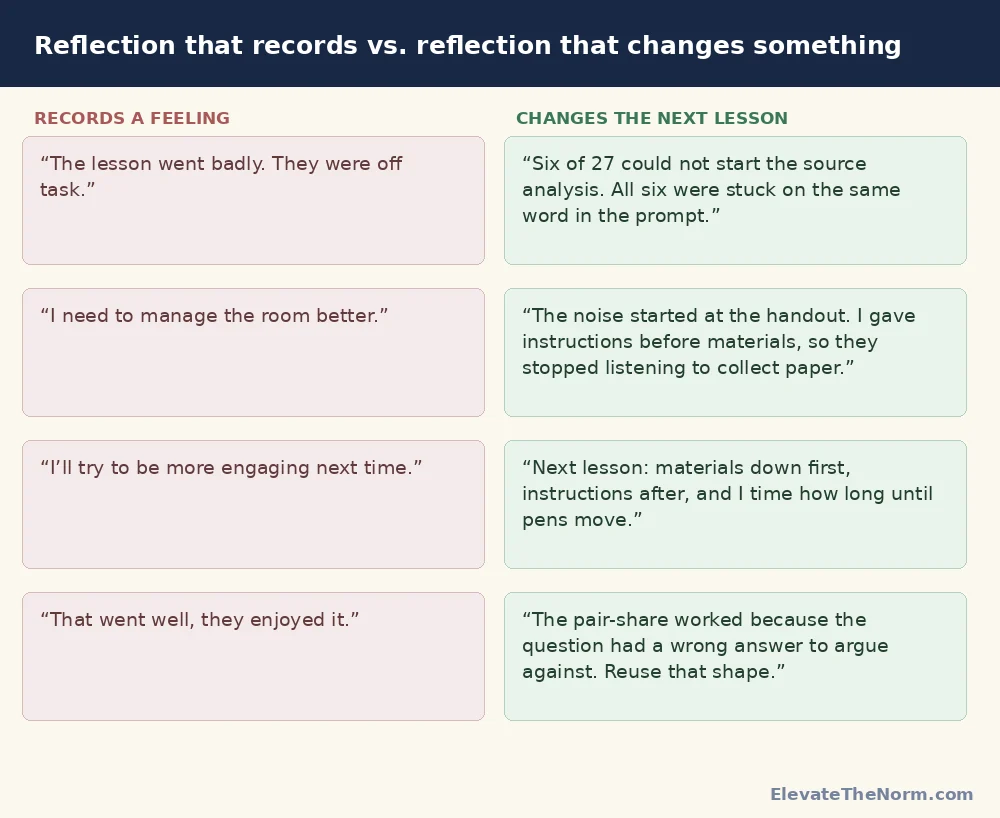
    A reflection is useful when a colleague could read it and know what you are going to do differently. That is the whole test, and most reflective writing fails it.

    Two-column comparison of four teacher reflections: vague statements about mood on the left, specific evidence-based statements on the right
    The same four moments, written twice. Only the right column tells you what to do on Monday.

    The research community has been blunt about this for a long time. A review of reflective practice in teacher education opens by conceding that reflection is a concept that can be “too big, too vague, and too general for everyday application” — quoting Korthagen and Wubbels, who wrote that in 1995. Thirty years on it is still the honest summary.

    The same review documents what happens when reflection is required and graded. Pre-service teachers learn to include the classroom evidence they know will mark well, and the authors note that some “may even fake their reflection” to satisfy a supervisor. Reflective journals fill up with “long, simple descriptions of classroom routines without producing deep reflection” — writing the authors call unproductive. If you have ever sat through a mandated reflection exercise and felt it was theatre, that instinct is supported by the literature.

    So the problem is not that teachers do not think about their teaching. Teachers think about their teaching constantly, usually in the car. The problem is that the written form we have been handed rewards narration, and narration does not survive contact with next week.

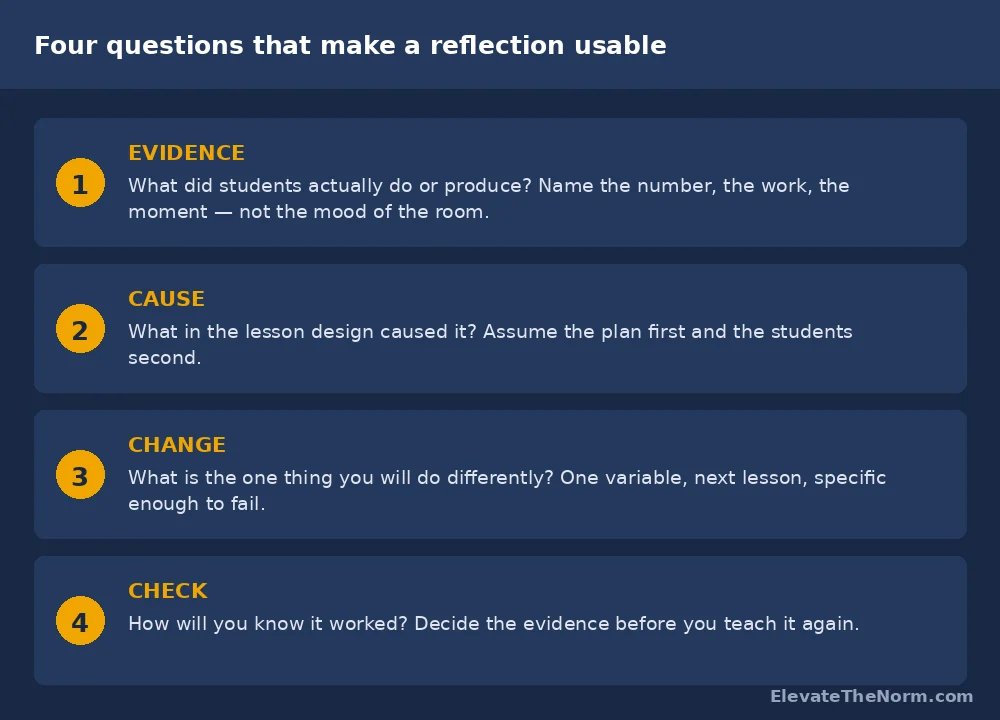
    Four questions fix most of it.

    Four numbered questions for a teacher reflection: evidence, cause, change, and check
    Evidence, cause, change, check. A reflection missing any one of these stops short.

    Evidence. What did students actually do or produce? A count, a piece of work, a specific moment with a time on it. Not the temperature of the room.

    Cause. What in the lesson design produced that? Assume the plan first and the students second — not out of humility, but because the plan is the part you control.

    Change. One thing, next lesson, specific enough that it could visibly fail.

    Check. How will you know? Decide the evidence before you teach it again, because deciding afterwards means deciding whether you feel it worked.

    Seven Teacher Reflection Examples, Written Out

    Each of these is a real situation in a secondary classroom, written the way it usually gets written and then written the way it earns its five minutes. Read the second version of each and notice how much of it is simply more specific.

    1. A lesson that fell flat

    What most of us write: Today’s lesson did not go well. The kids were off task and I had to keep redirecting. I need to work on engagement.

    What is worth writing: Six of 27 could not begin the source analysis. I checked their papers at the end and all six had stopped at the same word in the prompt. The task was not too hard; the prompt was. Next lesson I read the prompt aloud once and ask one student to say it back before anyone starts. I will know it worked if I can walk the room in two minutes and see every pen moving.

    The first version blames the room. The second locates a single word on a single page, which is a problem small enough to fix.

    2. A lesson that went well

    What most of us write: That went really well. They enjoyed it and the discussion was great.

    What is worth writing: The pair-share worked because the question had a defensible wrong answer in it — they were arguing against something rather than producing an opinion from nothing. That is the transferable part, not the topic. Next unit I write the discussion question as a claim I do not believe and see whether the same thing happens.

    Almost nobody reflects on a good lesson, and it is the most expensive habit in the profession. A lesson that worked contains a design decision you could reuse for years, and if you do not name it within a day you will remember only that the topic went down well.

    3. An assessment whose results surprised you

    What most of us write: The test results were disappointing. They clearly did not revise.

    What is worth writing: Question 4 was missed by 19 of 27, and 14 of those gave the same wrong answer. That is not a revision problem, it is a misconception I taught. Looking back at my slides I introduced the term in a caption and never said it aloud. Re-teach Thursday with the term spoken, defined and used three times, then re-ask question 4 as an exit ticket.

    A shared wrong answer is the single most useful thing in a set of marks. Scattered wrong answers mean students did not know; the same wrong answer means somebody taught it, and that somebody is usually in the room at the front. This is also the clearest example of why checking for understanding during the lesson beats discovering it on the test.

    4. A behaviour moment you handled badly

    What most of us write: I lost my patience with a student today. I need to be more consistent.

    What is worth writing: I corrected a student across the room instead of walking over, and the room turned to look. The correction was fair and the delivery made it a public event, which is why it escalated. The trigger was that I was mid-sentence and did not want to stop. Next time I stop the sentence. It costs four seconds.

    Note what the better version does not do: it does not moralise, and it does not promise to be a better person. It identifies the mechanism — not wanting to interrupt myself — and prices the fix. Four seconds is a cost you can actually agree to pay. “Be more consistent” is not. Most of what gets filed under classroom management dissolves this way under a specific enough question.

    5. A student who has quietly disengaged

    What most of us write: I am worried about one student. They seem checked out lately and I am not sure what is going on.

    What is worth writing: One student has not volunteered in three weeks and handed in two of the last four tasks. Going back through my seating notes, it started the week I moved them to the group by the window. I do not know whether that is the cause. Next week I move them back, say nothing about it, and count contributions for five days.

    Reflection about a specific student is where teachers are most likely to drift into speculation about home life, which is both unknowable and not actionable. The better version stays inside the four walls you control, tests one change, and refuses to diagnose. It also carries an honest I do not know whether that is the cause, which more reflective writing should.

    One caveat on this example, and it is the one this site would insist on. Quietly running an experiment on a teenager is a reasonable second move, not a reasonable first one. The first move is usually to ask them — briefly, privately, without making an event of it. Students generally know why they stopped, they are rarely asked, and a reflection that begins “I asked and they said” is better evidence than anything you can infer from a seating chart.

    6. A small-change experiment

    What most of us write: I am going to try to make my starters better this term.

    What is worth writing: For two weeks the starter is on the board before the bell and I say nothing until every pen is moving. Everything else stays the same. I am timing from bell to first instruction, every period, and writing the number down. If it has not moved by the end of week two, the starter is not the variable.

    This is the format worth building a habit around, and it is the one most reflection templates miss. One variable, everything else held still, a number written down. It is also the only version of “I want to improve my practice” that can be wrong — which is what makes it worth doing. The same discipline is what makes a classroom routine hold rather than drift.

    7. A reflection written for an observation or evaluation

    What most of us write: I felt the lesson met the standard. Students were engaged throughout and the objective was clear on the board.

    What is worth writing: The objective was on the board and I did not refer to it after minute three, so I cannot claim it shaped the lesson. What did work was the mid-lesson check — I stopped at minute 22, took three answers, and changed the second task because two of the three were wrong. If you are assessing responsiveness, that is the moment to look at. The starter was weak and I would cut it.

    The instinct in an evaluation reflection is to defend the lesson. It is a bad instinct and experienced observers can see it from the doorway. A reflection that concedes a weak starter and points the observer at the strongest ninety seconds reads as a teacher who watches their own room — which is the thing being assessed. This sits alongside what we ask students to do after a mistake, and the asymmetry is worth noticing.

    That advice assumes an evaluator acting in good faith, and it would be dishonest not to say so. If you are untenured, on an improvement plan, or working for someone who collects admissions rather than uses them, candour on an evaluation document is a different calculation and you are entitled to make it differently. Write the unguarded version for yourself. Decide separately how much of it goes on a form that lands in a personnel file.

    What the Evidence Actually Supports

    Here is where most articles on this topic overclaim, so it is worth being careful. There is no good body of evidence that keeping a reflective journal, on its own, improves student outcomes. What there is evidence for is structured reflection with another person attached to it — which is coaching.

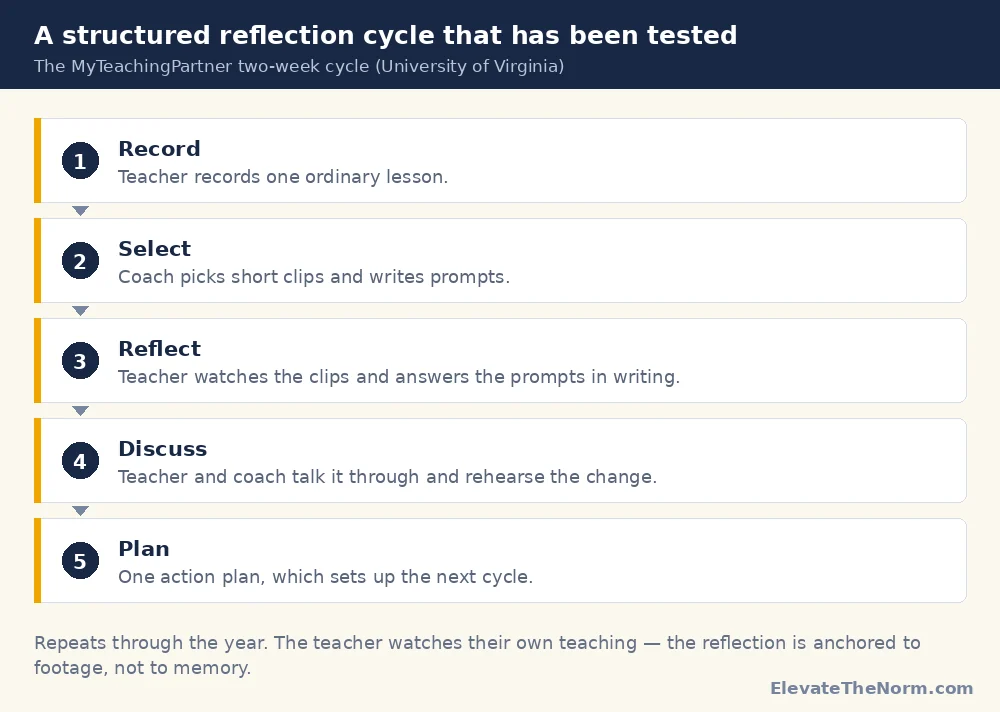
    Five-step video reflection cycle: record, select, reflect, discuss, plan
    The cycle that carries the evidence behind coaching: the teacher watches their own lesson.

    Kraft, Blazar and Hogan pooled 60 studies using causal designs and found effects of 0.49 standard deviations on instruction and 0.18 on student achievement. Those are meaningful numbers for professional development, which mostly produces nothing measurable at all.

    Read the second half of their finding too. Average effects from effectiveness trials of larger programmes are, in the authors’ words, only a fraction of the effects found in efficacy trials of smaller ones. Coaching works best in the conditions of a well-run study and degrades as it scales, which is a caution for any district planning to roll it out to everyone in August.

    The most-cited structured version is MyTeachingPartner, developed at the University of Virginia and used in secondary classrooms. The cycle runs every two weeks: the teacher records an ordinary lesson, a coach selects short clips and writes prompts, the teacher watches and responds in writing, the two of them discuss and rehearse, and it closes with one action plan that sets up the next cycle. The coach deliberately selects clips showing what the teacher did well rather than cataloguing faults.

    And the honest counterweight, which belongs here. A more recent randomised controlled trial of MyTeachingPartner-Secondary run by the American Institutes for Research found no significant impact on student achievement in the first year or after two. The one statistically significant result was teachers’ enthusiasm about teaching. The researchers note the trial began in 2021, that pandemic disruption cut enrolment and implementation, and that this made the study less sensitive to impacts — so it is not a clean refutation. It is a reminder that this is a contested area and that a teacher who reflects diligently and sees no change in their results has not done it wrong.

    The defensible position: structured reflection reliably changes what teachers do, improves how they feel about the job, and moves student outcomes modestly and inconsistently. That is enough to justify five minutes after a lesson. It is not enough to justify a mandated journal.

    Worth separating the two costs, because they are not remotely alike. Coaching is the version with the evidence behind it and it is expensive — trained coaches, release time, recording equipment, and a scheduling problem in every building that adopts it. The four lines described in this article cost a pen and five minutes. A district deciding what to fund should know that the cheap version is the one with the thinner evidence, and that buying the expensive version at scale is precisely where the measured effects have historically shrunk.

    The Reflection That Cost Me Nine Minutes

    The most useful reflection I have written came out of the worst five minutes I have spent in front of a class.

    I had laid out the plan and stopped talking, which is the whole method — organisation to the minute, then the pause — and I waited. I have never been more uncomfortable at work. It went past a minute, then past three. When the room finally came round, that section finished nine minutes behind my other classes, and I assigned homework to close the gap. It is the only time I have ever assigned homework.

    The reflection that mattered was not the pause works. It was the nine minutes. A technique with a price tag written next to it is a technique you can make a real decision about: I know what it costs, I know what it bought, and I can tell you the conditions under which I would pay again. Almost everything written about waiting students out leaves the number off, and leaving the number off is how advice becomes useless.

    That is what a good reflection does that a good instinct cannot. The instinct remembers that it worked. The written version remembers what it cost.

    Making This Take Five Minutes

    The realistic objection is time, and it is correct. Here is the version that survives a teaching week.

    • Do not reflect after every lesson. Pick one class and one week. Reflecting on everything produces the shallow descriptions the research warns about.
    • Write four lines, not four paragraphs. Evidence, cause, change, check. If it runs longer you are narrating.
    • Do it inside ten minutes of the lesson ending — the specific detail is gone by the drive home, and the specific detail is the entire value. If the next class is already walking in, which is most of the time, put three words in your phone and write it properly at planning.
    • Keep the good lessons in the same place as the bad ones. Most teachers only write when something hurt, which produces a record that reads like a problem list.
    • Reread last month before you plan next month. One reflection is a note; twelve are a pattern, and the pattern is usually not what you would have guessed.

    If you want the four formats already laid out — after-lesson, weekly pattern review, midyear reset and small-change experiment — they are in the free journal, and the teacher reflection template page explains what each one is for.

    Reflection has a limit worth naming, though. When the workload itself is the problem, rethinking how you carry 120 students instead of five separate classes does more than any journal entry will.

    Before you go: grab the free Teacher Reflection Journal (PDF) — ElevateTheNorm.com branded, printable, no email required.

    Frequently Asked Questions

    What is a good example of a teacher reflection?

    One that names evidence, a cause, a change and a way to check it. “Six of 27 could not start the task, and all six stopped at the same word in the prompt — next lesson I read the prompt aloud and have a student say it back, and I will know it worked if every pen is moving within two minutes.” Compare that with “the lesson went badly, they were off task.” Both describe the same hour. Only the first one tells you what to do.

    How long should a teacher reflection be?

    Four lines and about five minutes, written within ten minutes of the lesson ending. Length is not a virtue here — research on reflective journals in teacher education found them filling with long descriptions of classroom routines that produced no actual reflection, and the authors described that writing as unproductive. If your reflection is running to paragraphs, you are almost certainly narrating the lesson rather than deciding anything.

    Should I reflect after every lesson?

    No, and trying to is the most common way teachers give this up in October. Pick one class and one week at a time. Reflecting on five lessons a day guarantees the shallow, dutiful writing that makes the practice feel pointless. One class, four lines, for a fortnight will tell you more than a term of doing it everywhere.

    Does teacher reflection actually improve student outcomes?

    Modestly and inconsistently, and the honest answer depends on what is attached to it. There is no strong evidence that a private journal alone moves student results. Structured reflection with a coach does better — a meta-analysis of 60 causal studies found 0.49 SD on instruction and 0.18 SD on achievement — but the same analysis found effects shrink sharply when programmes scale, and a recent randomised trial of a leading video-coaching programme found no significant achievement impact at all. Reflect because it changes your decisions. Do not promise yourself a test-score jump.

    What should I write in a reflection after an observation?

    Concede the weakest part and point the observer at the strongest ninety seconds. The instinct is to defend the lesson, and experienced observers read that instantly. Saying “the starter was weak and I would cut it, but the mid-lesson check at minute 22 is where I changed the second task” demonstrates the thing being assessed — that you watch your own room — far better than a paragraph explaining why everything went to plan.

    Why should I reflect on lessons that went well?

    Because that is where the reusable design decisions are, and nobody looks. A lesson that worked usually worked for a structural reason — the question had a defensible wrong answer in it, the materials went down before the instructions — and if you do not name that reason within a day, all you will retain is that the topic went down well. Writing only after difficult lessons also builds a record that reads like a list of failures, which is discouraging and inaccurate.

    Is it a problem to write reflections that mention individual students?

    It can be, and it is worth thinking about before you fill a notebook. A written note about an identifiable student sits closer to a record than most teachers assume, and depending on where you work and where it is stored it may be something a parent can ask to see, or something that surfaces in a dispute. None of that makes it wrong — it makes it worth writing as though someone might read it. Describe the behaviour and the work rather than the child, leave speculation about home out of it entirely, and if a reflection is really about a concern rather than your own practice, it probably belongs in your school’s actual documented channel instead. Your district almost certainly has a policy on this; it is worth ten minutes to find out what it says.

    Is it worth reflecting if nobody reads it?

    Yes, but change what you write. Reflection written for a supervisor drifts towards what marks well — researchers have documented pre-service teachers selecting evidence to please an assessor, and some fabricating reflections outright. Writing that nobody will grade is free to record the thing that actually went wrong, which is the only version with any diagnostic value. If you do want another reader, a trusted colleague who teaches the same students is worth more than a form.

    Sources

    • Kraft, M. A., Blazar, D., & Hogan, D. (2018). The effect of teacher coaching on instruction and achievement: A meta-analysis of the causal evidence. Review of Educational Research, 88(4), 547–588. Read the record — 60 studies with causal designs; pooled 0.49 SD on instruction and 0.18 SD on achievement. Figures here are taken from the ERIC abstract, which also states that effects from larger effectiveness trials are only a fraction of those from smaller efficacy trials.
    • Sayed, A. (2022). Reflective practice in teacher education: Issues, challenges and considerations. Read the paper (PDF) — source for the “too big, too vague” characterisation (quoting Korthagen & Wubbels, 1995), for faked and strategically written reflections, and for journals filling with unproductive description. This is a review of the literature in pre-service teacher education, not a study of practising secondary teachers.
    • Center for Advanced Study of Teaching and Learning, University of Virginia. MyTeachingPartner. Read the programme description — source for the five-step, two-week video reflection cycle described above.
    • American Institutes for Research. MyTeachingPartner-Secondary: Scaling and sustaining research-based teacher professional development. Read the project page — randomised trial beginning 2021; no significant impacts on student achievement in year one or after two years; teachers’ enthusiasm about teaching was the one significant result. AIR states that pandemic disruption reduced enrolment and implementation and made the trial less sensitive to impacts.

    Every link above was checked on September 17, 2026. Where a primary paper was not reachable, the source actually read is the one cited — the Kraft meta-analysis figures come from the ERIC record rather than the journal PDF, and are labelled as such.


    About Clay Shumate

    By Clay Shumate — Clay Shumate is a certified secondary Social Studies teacher in the public schools of West Alabama, now in his seventh year in the classroom, with a B.A. in History and an M.Ed. in Secondary Education. He writes about project-based learning, student responsibility, respect, and practical ways to hold young people to a higher standard while giving them room to learn from mistakes. He is a member of the Society of Professional Journalists and writes to its Code of Ethics; this site’s editorial standards and corrections policy are published in full.

Teacher Emergency Toolkit — practical resources, real classroom support. Shop on TPT.Teacher Emergency Toolkit — practical resources, real classroom support. Shop on TPT.