By Clay Shumate
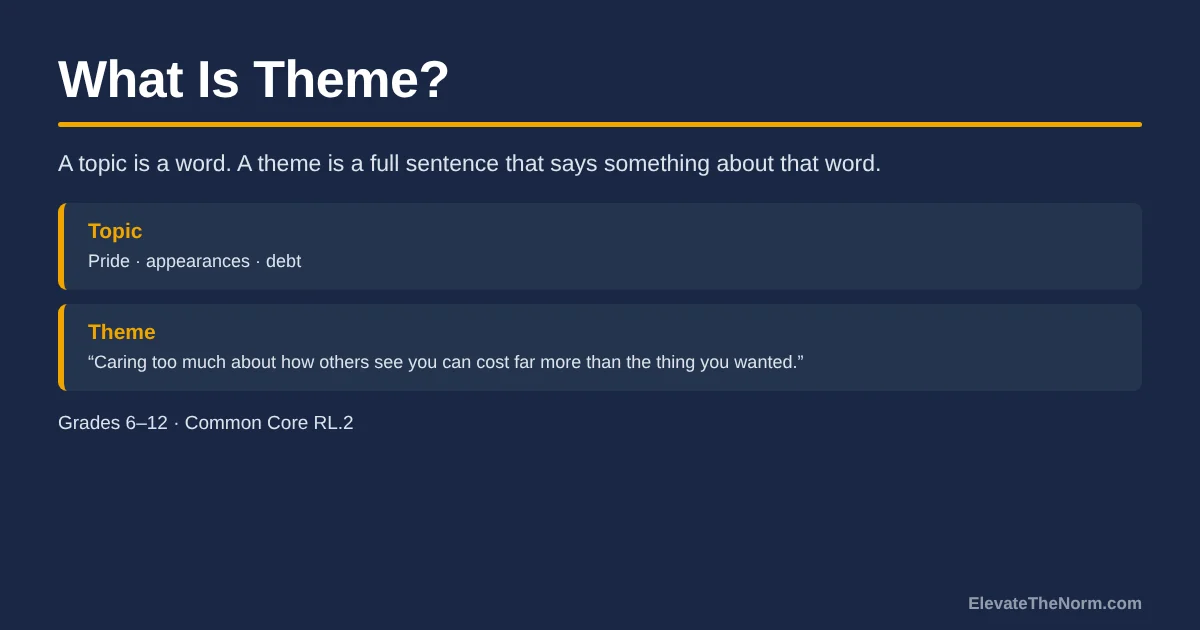
Theme is the central idea about life or people that a story develops through its characters, conflict, and outcome. A topic is a word or two (greed, love); a theme is a full sentence that says something about that topic, such as “Pride can cost more than the thing it was protecting.” Students find it by asking what changed and why the author let it happen.
Key Takeaways
- A theme is a sentence, not a word. “Friendship” is a topic. “Real friends tell you what you don’t want to hear” is a theme.
- The Common Core pairs “theme” with “central idea” at every grade from 6 to 12. The standard (RL.2) asks students to determine a theme and show how the text conveys or develops it, then write an objective summary.
- The demand climbs by grade band. Sixth graders show how a theme is conveyed through details; by 11th and 12th grade students handle two or more themes and how they interact.
- A moral is a stated lesson; a theme is usually inferred. Fables often print the moral at the end. Most literature makes the reader build the theme from evidence.
- The fastest route to theme runs through change. What did the main character want, what happened, what changed, and what does the ending reward or punish?
What is theme in literature?
Theme is the idea about life, people, or the world that holds a story together. The glossary that accompanies Michael Meyer’s Bedford Introduction to Literature describes it as the central meaning or dominant idea of a work, the point that organizes plot, character, setting, and symbol, and it draws a clean line between theme and subject: the subject is what the work is about, while the theme is the abstract idea the work makes concrete through action and character.
That distinction is the whole game in a 6–12 classroom. Ask a seventh grader for the theme of a story about a boy who lies to his coach and you’ll hear “honesty.” That’s the subject. The theme is what the story says about honesty: maybe that a lie protects you for a day and costs you for a season. A usable definition for students is short enough to put on the wall:
Student definition: A theme is a message about life that the author shows through what happens to the characters. Write it as a complete sentence that could apply to people outside the story.
The last clause matters. If a student’s “theme” mentions a character by name, it’s probably a summary. A theme should survive being lifted out of the story and applied to a real person.
What’s the difference between theme, topic, moral, and main idea?
These four terms get used interchangeably, and that’s where most student confusion starts. Here’s how to separate them.
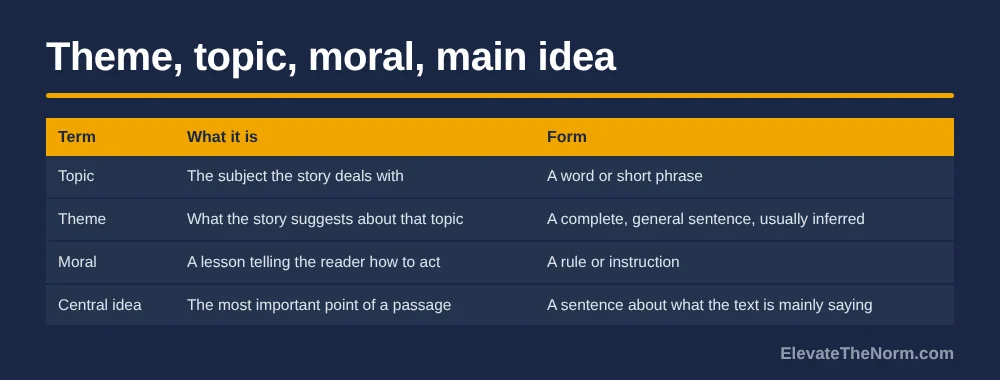
| Term | What it is | Form | Example (“The Necklace”) |
|---|---|---|---|
| Topic | The subject the story deals with | A word or short phrase | Pride; appearances; debt |
| Theme | What the story suggests about that topic | A complete, general sentence, usually inferred | Caring too much about how others see you can cost far more than the thing you wanted. |
| Moral | A lesson, often stated outright, telling the reader how to act | A rule or instruction | Don’t borrow what you can’t afford to lose. (The story never says this; a moral is something a reader or a fable adds.) |
| Main idea / central idea | The most important point of a passage, especially an informational one | A sentence about what this text is mainly saying | Used mostly with nonfiction; in literature the Common Core treats “theme or central idea” together. |
Two notes on that table. First, a moral and a theme can overlap; the difference is that a moral tells you what to do, while a theme observes how life tends to work. Second, the main idea vs. central idea distinction mostly lives in informational reading, which is a separate post on this site, “Central Idea vs Main Idea vs Theme,” publishing shortly.
How do the Common Core standards frame theme in grades 6–12?
Every grade from 6 through 12 has the same anchor, Reading Literature standard 2, and the wording tightens as students move up. At grade 6, the standard reads: “Determine a theme or central idea of a text and how it is conveyed through particular details; provide a summary of the text distinct from personal opinions or judgments.”
| Standard | What students must do with theme | What changes from the grade before |
|---|---|---|
| RL.6.2 | Determine a theme or central idea and how it is conveyed through particular details; summarize without opinion | Starting point: theme plus supporting details |
| RL.7.2 | Determine a theme or central idea and analyze its development over the course of the text; objective summary | From “conveyed through details” to “development over the course of the text” |
| RL.8.2 | Same, plus analyze its relationship to the characters, setting, and plot; objective summary | Theme must be tied to story elements |
| RL.9-10.2 | Determine a theme or central idea and analyze in detail its development, including how it emerges and is shaped and refined by specific details; objective summary | “In detail” and “shaped and refined by specific details” |
| RL.11-12.2 | Determine two or more themes or central ideas and analyze their development, including how they interact and build on one another; objective summary | Multiple themes and how they interact |
Notice two things that run through every grade. The summary requirement never goes away, which tells you the standards writers expected students to separate “what happened” from “what it means.” And every version is paired with RL.1, citing textual evidence. A theme without evidence is a guess, at any grade.
How do students find the theme of a story?
Give them a routine they can run on any text. This five-step version works for a fable in sixth grade and a novel in eleventh, because it starts with plot facts students can find and ends with an idea they have to build.
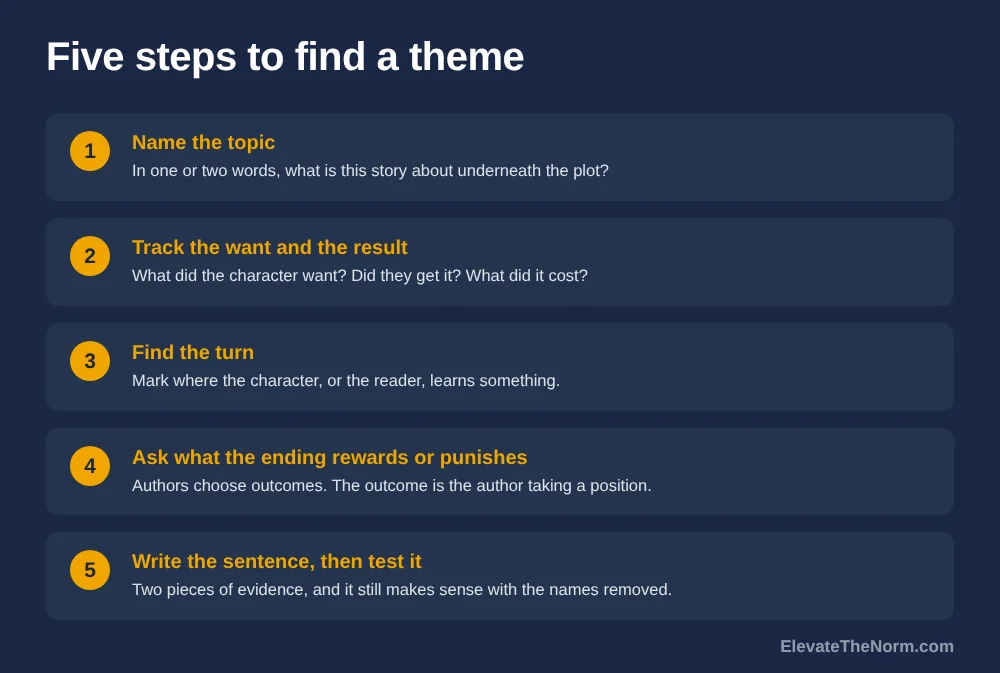
- Name the topic. In one or two words, what is this story about underneath the plot? (Pride. Sacrifice. Work. Loyalty.) List two or three candidates if you’re unsure.
- Track the main character’s want and the result. What did the character want at the start? Did they get it? What did it cost?
- Find the turn. Mark the moment where the character, or the reader, learns something. Endings and reversals are where authors put the weight.
- Ask what the ending rewards or punishes. Authors choose outcomes. If a choice leads to ruin, or to quiet happiness, that’s the author taking a position on the topic.
- Write the sentence, then test it. Turn the topic into a claim about people in general. Then check: Can I point to at least two places in the text that support this? Does it still make sense with the character names removed?
Steps 2 through 4 are where the evidence comes from, so have students mark them on the page as they go. If your class already uses a consistent annotation system, add one symbol for “the turn” and you’ve built theme-finding into the reading itself. On a short, demanding text, the routine also fits naturally into the third pass of a close reading lesson, where the question is what the text means.
What sentence frames help students write a theme statement?
Frames help students who know the idea but can’t get it into sentence form. Copy these onto an anchor chart or the top of a handout. Pull them back as students get comfortable.
- Basic: The story suggests that ______ (topic) can lead to ______.
- Cause and cost: When people ______, they often ______, even if ______.
- Contrast: Although ______ seems ______, the story shows that ______.
- With evidence: In “______,” the author shows that ______. This is clear when ______, and again when ______.
- Development (grades 7–10): At first, ______ suggests ______. By the end, ______ shows that ______.
- Two themes (grades 11–12): The text develops both ______ and ______; these ideas connect when ______.
Quick self-check for students, worth printing under the frames: Is it a full sentence? Does it avoid character names? Does it avoid “you should”? Can I find two pieces of evidence?
What does theme look like in real texts?
Three public-domain texts, from easiest to hardest, each run through the routine above. All three are free to print.
Aesop, “The Ant and the Grasshopper”
In the version collected in The Aesop for Children (illustrated by Milo Winter), the ants are drying grain they stored over the summer when a starving grasshopper asks for food. He admits he spent the summer making music, and the ants tell him to dance and turn their backs. The printed moral is “There’s a time for work and a time for play.”
Use this one to teach the moral/theme difference. The moral is handed to you. A theme statement a student builds from the plot might be: Choices that feel fine in good times can leave a person with nothing when conditions change. A sharper class will also notice the ants refuse to share, which opens a second, harder question: is the story also saying something about how communities treat people who didn’t plan ahead? That’s a good preview of RL.11-12.2’s “two or more themes.”
O. Henry, “The Gift of the Magi”
Della has one dollar and eighty-seven cents to buy her husband Jim a Christmas present. She sells her hair for twenty dollars and buys a platinum fob chain for his gold watch, which costs twenty-one. Jim, meanwhile, has sold the watch to buy her a set of combs for the hair she no longer has.
- Topic: sacrifice; love; gifts.
- Want and result: Each wants to give the other something worthy. Each succeeds, and each gift is now useless.
- The turn: the exchange of gifts.
- What the ending rewards: the narrator calls them foolish, then decides they were the wisest of all gift-givers.
- Theme: The value of a gift lies in what the giver is willing to give up, not in the object itself.
Guy de Maupassant, “The Necklace”
Mathilde Loisel borrows a diamond necklace from her wealthy friend Madame Forestier for a ball, then loses it. She and her husband buy a replacement for 36,000 francs, half of it borrowed, and spend ten years in hard labor and poverty paying the debt. At the end she learns the original was not real diamonds; it was worth at most five hundred francs.
Theme: The need to look like something you’re not can cost far more than the thing itself. Evidence a student should cite: why she borrowed the necklace in the first place, the decision to replace it rather than admit the loss, and the gap between 36,000 francs and five hundred. That last detail is a gift for teaching RL.9-10.2’s “shaped and refined by specific details,” because one number reframes the whole story.
What mistakes do students make when identifying theme?
The same six errors show up at every grade. Name them for students; they’re easier to avoid once they have a label.
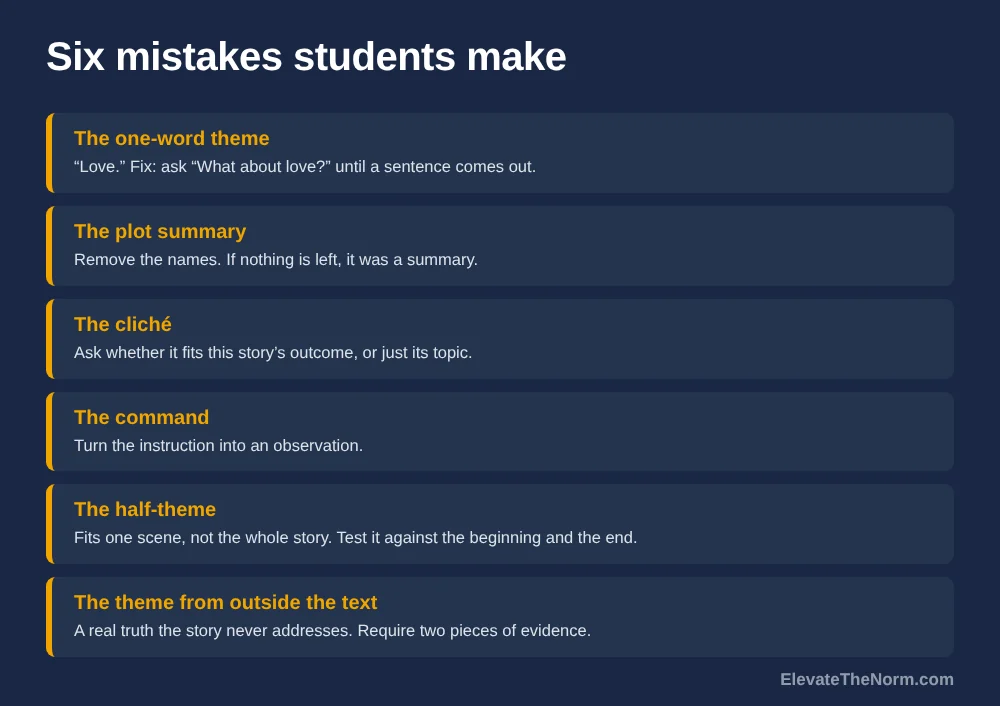
- The one-word theme. “Love.” Fix: ask “What about love?” until a sentence comes out.
- The plot summary. “Della sells her hair to buy Jim a chain.” Fix: remove the names. If nothing is left, it was a summary.
- The cliché. “Don’t judge a book by its cover.” Fix: ask whether the cliché fits this story’s specific outcome, or just its topic.
- The command. “You should always be honest.” Fix: turn the instruction into an observation: “Dishonesty tends to…”
- The half-theme. A statement that fits one scene, not the whole story. New York’s released grade 8 annotated test items show this pattern: on a theme question, the correct option captured both halves of the idea (danger and hesitation), while each wrong option captured only one element. Fix: test the statement against the beginning and the end.
- The theme from outside the text. A real truth about life that the story never addresses. Fix: require two pieces of evidence from the text.
For a fast check for understanding, put three student-style statements on the board, one theme, one summary, one cliché, and have students sort them on a mini whiteboard before writing their own.
Clay’s take: teach theme as an argument
The most useful shift is to stop treating theme as a hidden answer the teacher already knows. A story like “The Necklace” supports more than one defensible theme, and the standards for grades 11–12 explicitly expect multiple themes. What makes a theme statement strong is not whether it matches the answer key; it’s whether the student can defend it with evidence from the beginning, middle, and end.
That framing makes theme a natural fit for discussion. Two students with different theme statements for the same story have a real disagreement to settle with the text, which is exactly what a Socratic seminar is built for. In a social studies room, the same routine works on historical fiction and on speeches: what idea about people does this text want you to leave with, and how do you know?
Start with a fable, because the printed moral gives students something to push against. Move to “The Gift of the Magi” when they can write the sentence. Save “The Necklace” for when they’re ready to argue about which details matter most.
Frequently Asked Questions
What is the definition of theme?
Theme is the central idea about life or people that a literary work develops through its characters, conflict, and outcome. It is different from the subject or topic: the topic is what the story is about, such as pride, while the theme is what the story suggests about that topic, written as a complete sentence that could apply to people outside the story.
What is the difference between theme and topic?
A topic is a word or short phrase naming the subject of a story, like friendship or greed. A theme is a full sentence that makes a claim about that topic, like ’Greed makes people lose the things they already had.’ If a student gives one word, they have named the topic and still need to say what the story shows about it.
Is a theme the same as a moral?
Not quite. A moral is a lesson, often stated outright at the end of a fable, that tells the reader how to behave. A theme is usually inferred from the story and observes how life tends to work rather than giving an instruction. Aesop’s fables print their morals; most short stories and novels leave the reader to build the theme from evidence.
Which Common Core standard covers theme?
Reading Literature standard 2 covers theme at every grade from 6 to 12. Grade 6 asks students to determine a theme and how it is conveyed through particular details. Grades 7 through 10 add analyzing its development over the course of the text, and grades 11 and 12 ask for two or more themes and how they interact and build on one another.
How do you teach theme to middle school students?
Start with fables, where the printed moral gives students a model to compare against. Teach a short routine: name the topic, track what the main character wants and what it costs, find the turning point, ask what the ending rewards or punishes, then write a sentence and test it with two pieces of evidence. Sentence frames help until students can write the statement on their own.
Can a story have more than one theme?
Yes. Most rich stories support several defensible themes, and the Common Core standard for grades 11 and 12 asks students to determine two or more themes and analyze how they interact. What makes a theme statement strong is not matching one correct answer but being supported by evidence from across the whole text, not a single scene.
What is a good theme statement example?
For O. Henry’s ’The Gift of the Magi,’ a strong theme statement is: The value of a gift lies in what the giver is willing to give up, not in the object itself. It is a complete sentence, it avoids character names, it does not give an order, and it is supported by both Della selling her hair and Jim selling his watch.
Sources
- National Governors Association Center for Best Practices & Council of Chief State School Officers. (2010). Common Core State Standards for English Language Arts: Reading Literature, Grades 6–12. Grade 6, Grade 7, Grade 8, Grades 9–10, Grades 11–12. Used for the wording of RL.2 at each grade and the RL.1 evidence standard.
- Meyer, M. (n.d.). Glossary of Literary Terms: Theme, adapted from The Bedford Introduction to Literature. Macmillan Learning. Glossary entry. Used for the definition of theme and the distinction between theme and subject.
- Aesop. (2006 ebook release). The Aesop for Children, with pictures by Milo Winter. Project Gutenberg. Full text. Used for the plot and printed moral of “The Ant and the Grasshopper.”
- Henry, O. (2005 ebook release). The Gift of the Magi. Project Gutenberg. Full text. Used to verify the dollar amounts, the exchange of gifts, and the narrator’s closing judgment.
- Wikipedia contributors. (n.d.). The Necklace. Wikipedia. Article. Used to verify plot details of Maupassant’s 1884 story: the replacement cost, the ten years of repayment, and the value of the original necklace.
- New York State Education Department. (2014). New York State Testing Program Grade 8 Common Core English Language Arts Test: Released Questions with Annotations. PDF. Used for the pattern in which wrong answers on a theme item capture only part of the idea.