The Elevate Blog banner: Real Classrooms. Practical Ideas. Higher Expectations. Three students climb a rocky ridge at sunrise, each pulling the next one up, toward a teacher reaching down to help.

Tag: reading comprehension

  • Vocabulary Instruction in Grades 6–12: What Actually Moves Comprehension

    Vocabulary Instruction in Grades 6–12: What Actually Moves Comprehension

    By Clay Shumate

    Vocabulary instruction is the explicit teaching of word meanings and of strategies for figuring out unfamiliar words. In grades 6–12 it reliably improves comprehension of the text that carries the taught words, and barely moves standardized reading scores. The version that works is one or two essential words per text, taught through use, not a weekly list of ten.

    Key Takeaways

    • The same vocabulary instruction produces two very different numbers depending on which test you give. Across 37 studies, Elleman and colleagues found an effect of d = 0.50 on comprehension measures built for the study and d = 0.10 on standardized reading tests.
    • Students who struggle with reading gain the most. On those study-built measures, controlling for method variables, students with reading difficulties gained d = 1.23 against d = 0.39 for students without — more than three times as much — while gains on the vocabulary tests themselves were similar for both groups.
    • The federal practice guide for grades 4–9 tells you to teach one or two essential words before a text, not a list. Its comprehension recommendation carries a strong evidence rating on 34 studies.
    • A school-randomized trial of academic vocabulary across 28 schools and 1,554 students in grades 6–8 moved the taught words (g = 0.25) and did nothing measurable to general vocabulary. What it moved most was the quality of classroom discussion (d = 0.62).
    • Teaching one or two word-attack strategies is the part with the least support. A review of 36 studies found no empirical evidence that it improves general comprehension. Context clues as a standalone unit is the weakest thing on most vocabulary plans.

    Walk into most secondary classrooms the week before a unit test and you will find a vocabulary list. Ten words, definitions copied, sentences written, quiz Friday. It is the most common literacy practice in grades 6–12 and it is mostly a waste of a class period.

    That is not an argument against teaching words. The research on vocabulary is better than the research behind most things teachers are told to do. It is an argument against the format and the promise attached to it.

    What is vocabulary instruction?

    Vocabulary instruction is the deliberate teaching of word meanings and of strategies for working out unfamiliar words, as opposed to leaving students to pick up words from reading and talk alone. It splits into two things researchers treat separately: direct teaching of specific word meanings, and teaching generalizable word-learning strategies like using context or breaking a word into parts.

    That distinction matters more than any brand-name routine, because the two halves have very different track records. Direct teaching of specific words has a good one; strategy teaching on its own does not. Most programs sell both in the same box.

    You will also hear words sorted into tiers — Tier 1 everyday, Tier 2 high-utility academic words that cross subjects, Tier 3 technical words belonging to one discipline. That comes from Isabel Beck and Margaret McKeown’s work and it is a useful way to triage a reading. It is a sorting scheme, not a finding: no effect size attaches to it.

    Does vocabulary instruction actually improve reading comprehension?

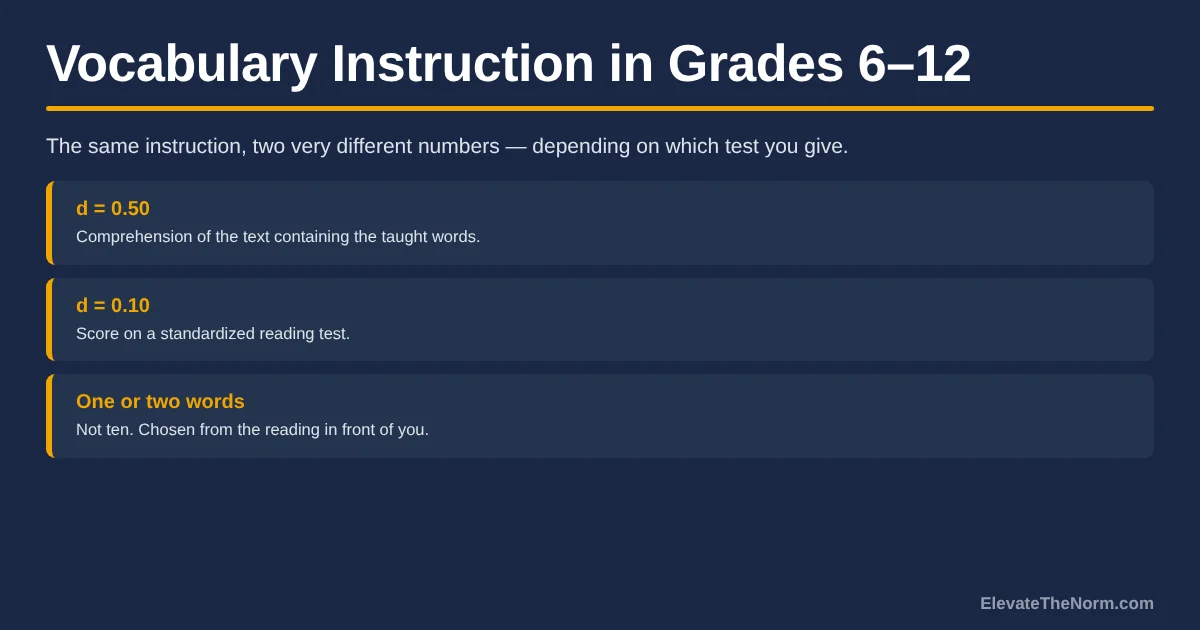
    It improves comprehension of the passage containing the taught words, consistently and by a lot. It barely improves performance on a standardized reading test. Elleman and colleagues meta-analyzed 37 vocabulary intervention studies from pre-K through grade 12 and found d = 0.50 on comprehension measures designed for the study and d = 0.10 on standardized measures.

    Read those two numbers together and the field makes sense. Teaching a student mercantilism helps that student read a passage about mercantilism. It does not make them a better reader of a passage about tide pools.

    What you measureEffect of vocabulary instructionWhat that means for your Monday
    Comprehension of the text containing the taught wordsd = 0.50 across 37 studiesReal and worth the time. This is the claim to make.
    Score on a standardized reading testd = 0.10 across the same studiesClose to nothing. Do not promise this to an administrator.
    Knowledge of the specific words taughtGains similar for strong and weak readersReliable. Students learn the words you teach.
    General vocabulary beyond the taught wordsNo measurable effect in a 28-school randomized trialWord lists do not grow a student’s overall word stock.
    Effect sizes from Elleman et al. (2009); the general-vocabulary row is the null result from Lawrence et al. (2015).

    Wright and Cervetti’s 36-study review lands in the same place from a different direction: teaching word meanings supported comprehension of the texts containing those words in almost every study, while evidence for generalized comprehension was — in their words — very limited, even in long interventions covering many words. They also could not determine how much instruction per word is enough, which is worth noticing in a field full of six-step routines.

    So the defensible claim is narrow and still useful: vocabulary instruction is how you make a hard text readable, not a lever on reading ability. Which leaves a procurement question worth asking out loud. If a program’s own evidence rests on measures it built, the claim you can hold it to is students understand assigned texts better, measured on your own unit assessments. That is a real, checkable commitment. A state-test target written into a vocabulary plan is a commitment the published evidence says will not be met, and writing it down anyway sets up the teachers delivering it to take the blame.

    How many vocabulary words should you teach per week?

    Far fewer than most schedules assume. The federal practice guide for grades 4–9 recommends selecting one or two essential words to teach before a reading — words that are critical to the passage and likely to be hard — then giving quick meanings for other important words as they come up, so reading is not interrupted.

    One or two. Not ten. And run the arithmetic from the student’s side before defending the list: a seventh grader with six teachers who each assign ten words is handling sixty words a week, none of which were chosen with the others in mind. No adult in the building carries that load. The reasoning is not that students cannot learn ten words; it is that deep instruction on two words costs about as much class time as shallow instruction on ten and produces something students can actually use. Wright and Cervetti found that instruction involving active processing generally beat definitions and dictionary work for understanding the text, which is precisely what a ten-word list has no room for.

    You will see other credible guidance say three or four, and the difference is worth naming rather than hiding. Elsewhere on this site, the digital reading routine budgets two minutes for three or four pre-taught words, because a screen reading loses the edges a printed page gives for free and the words are part of what a Lexile measure is detecting. The practice guide is stricter because it is describing deep instruction on an essential word, not a quick gloss. Both can hold at once: one or two words get the full treatment, and another two or three get five seconds each. What nobody’s evidence supports is fifteen.

    That guide’s broader comprehension recommendation is rated strong on 34 studies, 23 of which met What Works Clearinghouse standards without reservations. One caveat worth stating: the guide covers grades 4–9, so the top half of a secondary teacher’s roster sits outside its range. Nothing in it is implausible for grades 10–12, but it has not been tested there.

    There is also a reason not to despair about the arithmetic. Hiebert, Goodwin and Cervetti mapped a core vocabulary of 2,451 morphological families containing 11,298 words, and found those families account for about 89 percent of the words in texts pitched at grade 11 and college readiness. By middle school roughly 20 percent of the distinct words in a text sit outside that core; in high school it is about 25 percent. That is the real size of the problem. It is not an infinite list, and it is not two words either.

    Those two numbers are in open tension and the honest thing is to say so. If a quarter of the distinct words in a high school text sit outside the core vocabulary, teaching one or two words per reading cannot possibly close that gap. Both claims are still true, because they answer different questions. The one-or-two rule is about the words that block comprehension of this passage, which is a problem instruction can solve this week. The long-run size of a student’s word stock is a different problem, and the evidence above does not show that any amount of word-list instruction solves it — the 28-school trial found exactly nothing on general vocabulary after a full year. Anyone who tells you a vocabulary curriculum closes the word-gap is going beyond what has been measured.

    Which words should you choose for instruction?

    Choose the words that carry the meaning of this text and that students will meet again. A word qualifies if removing it would break a student’s understanding of the passage. That test does more work than any tier chart, because it is answered by the reading in front of you rather than by a list someone else made.

    Four questions to run over a reading before you teach it:

    • Would a student who skipped this word misunderstand the paragraph? If not, it is not essential. Give it a synonym in passing and move on.
    • Will they meet it again this year? Infer, precedent and equilibrium earn real instruction. A term appearing once in one chapter does not.
    • Is the hard part the word or the idea? Photosynthesis is a concept with a label on it. Teaching the label without the concept is how students write definitions they cannot use.
    • Does it have usable parts? A word built from a prefix, suffix or root the class already knows is worth teaching twice over, because it pays into the next word too.
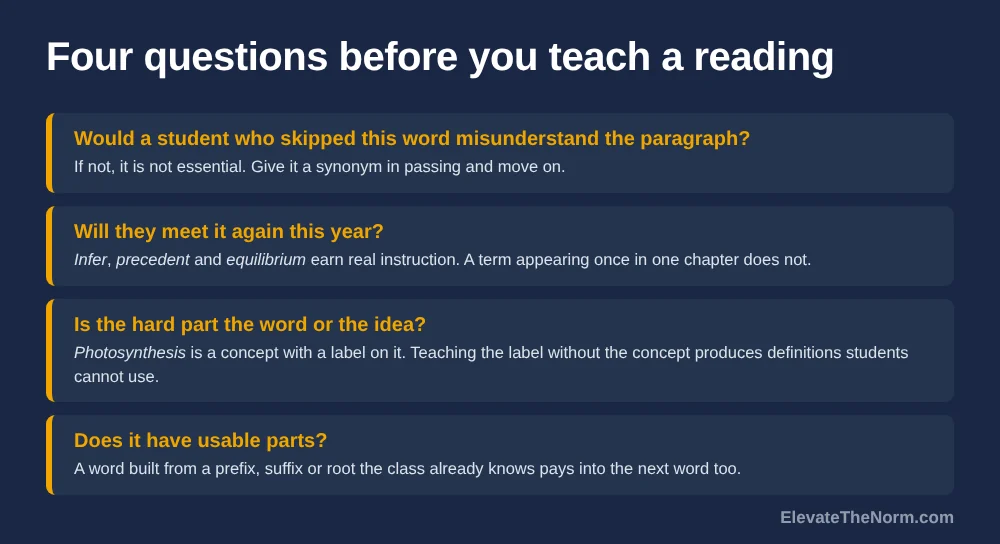
    Four questions to run over a reading before teaching it: would a student who skipped this word misunderstand the paragraph; will they meet it again this year; is the hard part the word or the idea; does it have usable parts.
    Four questions that decide which words earn real instruction.

    The guide’s sequence on word parts is worth keeping: common prefixes and suffixes first, then Latin and Greek roots, using word maps. Prefixes and suffixes are regular and few. Roots are neither.

    What does vocabulary instruction look like in a grades 6–12 content classroom?

    It looks like about four minutes before the reading, a few seconds during it, and one short task a week after it. Here is the routine the practice guide describes, written as steps you can run tomorrow in history, biology, algebra or English.

    • Before reading, pick one or two essential words. Give a student-friendly meaning in plain language — not the dictionary entry. Then give one example and one non-example, because the boundary is where the meaning lives. A precedent is an earlier decision that sets a pattern for later ones. The first state to lower a voting age sets a precedent. A state that lowers it afterward is following one. The non-example is the step teachers skip and it is the one doing the work — a student who can tell you what does not count has the boundary, and a student with only the definition usually does not.
    • Make students use it once, immediately, out loud or in writing. One sentence that requires the meaning, not one that merely contains the word. “Name something in this chapter that set a precedent and say what followed it” works. “Use precedent in a sentence” produces “The precedent was very important.”
    • During reading, hand over other hard words in under five seconds. A synonym or a six-word definition. The point is to keep the student in the text, not to teach a second word.
    • Once or twice a week, make them do something with the words. Sort them, argue about non-examples, use two in an answer to a content question, add them to a running word log. This is the active processing that the reviews found outperforms definitions.
    • Teach the parts when the parts repeat. When three words in a unit share a prefix or a root, stop and map it. That is the only point at which strategy instruction has an argument behind it.
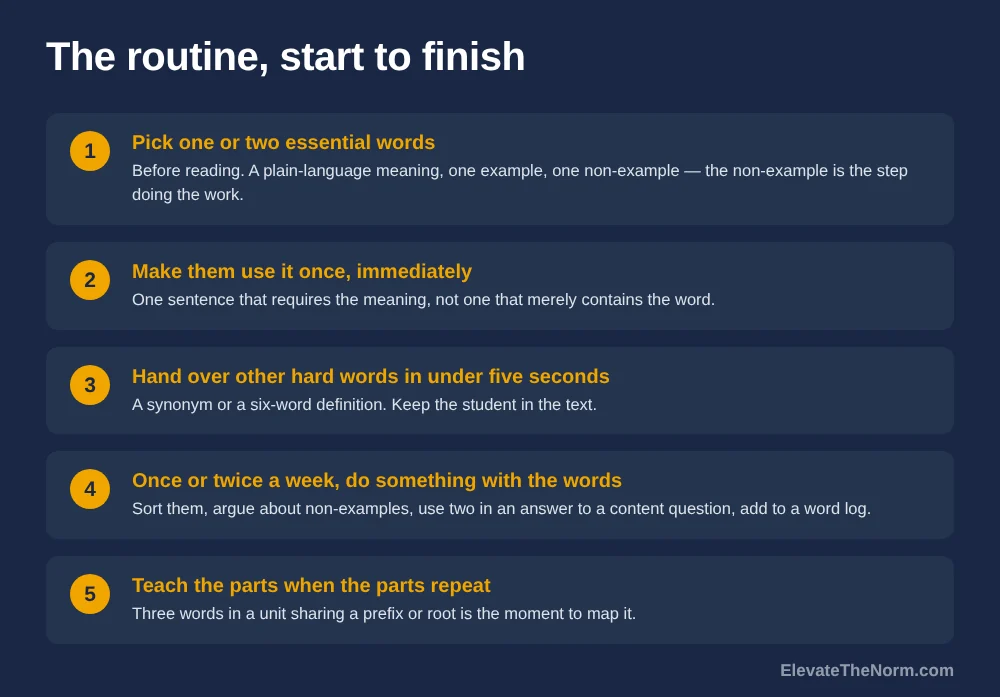
    Numbered five-step routine: pick one or two essential words before reading with a plain-language meaning, an example and a non-example; make students use the word once immediately; hand over other hard words in under five seconds; once or twice a week do something with the words; teach word parts when the parts repeat.
    The whole routine, which fits in the margins of a lesson you were already teaching.

    On prep cost: the only real labor here is reading the text as a student would and marking the words that would stop one. That takes about ten minutes the first time you teach a reading and nothing at all afterwards, provided you keep the marked copy. If you teach six sections of two courses, you are marking two readings, not twelve.

    Notice what is missing: the quiz. Keep one if your gradebook needs it, but do not confuse it with the instruction — matching ten words to ten definitions on Friday demonstrates the one thing the research says transfers least. So collect different evidence. The question worth answering is whether a student can answer a content question that cannot be answered without the word. “Which of these decisions set a precedent, and what followed from it?” tells you something a matching quiz cannot. That is also the easiest thing for a coach or an administrator to look for in a ten-minute walkthrough: not whether words are posted, but whether a student had to use one on the content inside the first fifteen minutes.

    If you already run regular checks on understanding, this folds into them rather than adding a system. The same logic drives formative assessment strategies for reading: find out what the text actually cost students before you move past it. And when a class spans a wide range of reading levels, the word-choice question above is one of the cleanest places to differentiate instruction without writing two lesson plans.

    Do word-learning strategies like context clues and roots actually work?

    Teaching one or two word-attack strategies has the weakest evidence in the whole field. Wright and Cervetti’s review of 36 studies found no empirical evidence that teaching one or two strategies for working out word meanings improves generalized comprehension. That is a null result on the practice most schools spend the most instructional time on.

    This deserves care, not a victory lap: null evidence for a narrow version of a practice is not proof the practice is useless. What the reviewers found promising was the fuller version — teaching students to monitor whether they understand a word and move flexibly among several strategies rather than drilling one. They call that a promising direction for future research, which means nobody has shown it works yet either.

    The practical read: a September context-clues unit that never comes back is the unsupported version. Prefixes and roots taught at the moment three words in a unit share them, repeatedly across a year, is the version with an argument. One is a week of lessons. The other is thirty seconds, forty times.

    Why doesn’t vocabulary instruction raise standardized reading scores?

    Because a standardized reading test samples the whole language while your instruction samples your unit. Teach forty words well in a semester and a student knows forty more words, against a test drawing from tens of thousands. The signal is real and it is swamped.
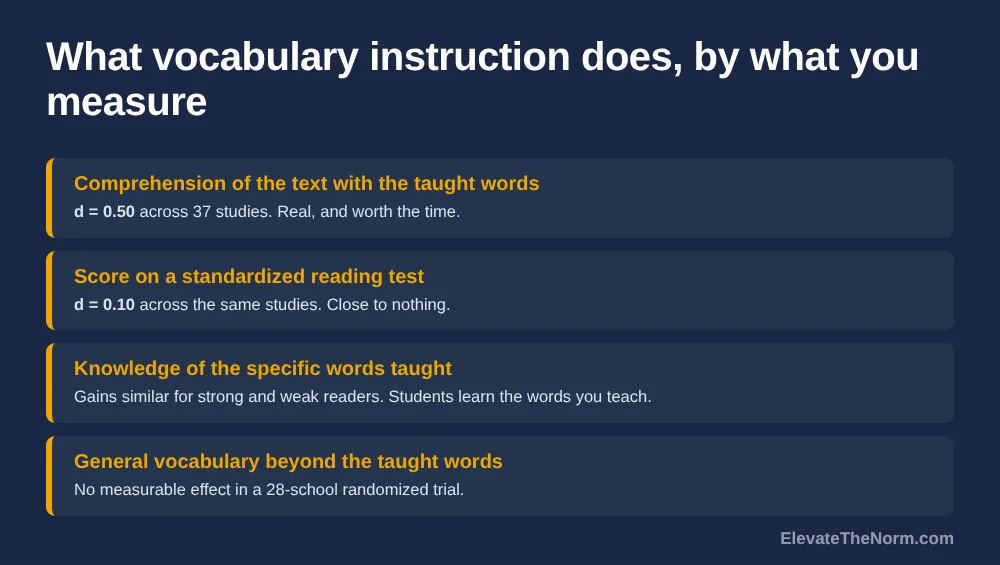
    Four-row comparison graphic: comprehension of the text with the taught words d = 0.50 across 37 studies; score on a standardized reading test d = 0.10 across the same studies; knowledge of the specific words taught shows gains similar for strong and weak readers; general vocabulary beyond the taught words shows no measurable effect in a 28-school randomized trial.
    Same instruction, four different outcomes, depending on what you measure.

    The Word Generation trial shows this cleanly. Lawrence, Crosson, Paré-Blagoev and Snow randomly assigned schools within matched pairs across two districts — 28 schools, 1,554 students in grades 6–8 with pre- and posttest, one full school year, delivered by whole grade-level teams. A significant effect on the taught academic words (Hedges’ g = 0.25), and no significant effect on general vocabulary on the Gates–MacGinitie, estimated at roughly −0.01.

    The most interesting finding there was not about words. Discussion quality improved substantially in treatment schools — d = 0.62 overall and d = 1.13 in math — and mediated about 14 percent of the effect on word learning. A vocabulary program’s most visible consequence was that students argued about ideas more often.

    The authors are candid about the study’s weaknesses, and they matter: posttest completion was 49 percent in treatment schools and 35 percent in control schools, treatment schools started with higher vocabulary scores, observers could not be blinded, and the word test covered only 36 of the 120 words taught. Attrition at that level can bend a result in either direction. Read g = 0.25 as a reasonable estimate rather than a settled number.

    Which students gain the most from vocabulary instruction?

    Students who struggle with reading, by a wide margin. In Elleman’s meta-analysis, looking only at the study-built comprehension measures and controlling for method variables, students with reading difficulties gained d = 1.23 against d = 0.39 for students without reading problems. More than three times the benefit from the same instruction.

    Two qualifications. That contrast comes from the custom measures, the generous end of the evidence. And gains on the vocabulary tests were similar regardless of reading ability — both groups learned the words. The difference was in what the words did for comprehension, which points at word knowledge being the binding constraint for the weaker readers and not the stronger ones. Across studies reporting both outcomes the correlation between vocabulary effects and comprehension effects was r = 0.43 — modest. Learning the words helps; it is not the only thing in the way.

    What about English learners, and classes where reading levels vary widely?

    The honest answer on English learners is that this article cannot give you one. It is one of the most common things teachers ask about vocabulary. Neither review above reports results for English learners as a subgroup, and no English-learner-specific source was read for this article, so nothing here is an evidence claim about them. If somebody hands you a vocabulary program marketed on its results for English learners, ask which studies and which measures — and expect the custom-versus-standardized gap to show up there too.

    For a class with a wide spread of reading levels, word selection is the cheapest lever you have: the same two words serve everybody while the amount of support varies. That is the logic behind differentiated instruction strategies generally: change the scaffold, not the destination.

    And there is a real risk attached to the finding that weaker readers gain most, worth naming before a district acts on it. “Front-load vocabulary where reading is hardest” is a sound instructional read. “Those classes do words while the honors classes do ideas” is how that read turns into a lower-rigor track, and nothing in this evidence supports it. Elleman’s finding is that word knowledge was the binding constraint for those readers on the taught text — remove it and they are reading the same text about the same ideas. The whole point of clearing the word is to get to the argument.

    If a parent asks why the weekly list went away, the one-sentence version is: the list taught words for a Friday quiz, and we would rather spend that time making sure the reading itself is understandable. For what a parent can do at home, the truthful answer is that no source in this article tests home vocabulary work, so treat any specific routine as a guess. Talking about what a kid read, in ordinary language, is a reasonable thing to do and is not a studied intervention.

    Clay’s take: the list is a ritual, and rituals are hard to kill

    The ten-word Friday list survives for reasons that have nothing to do with learning: easy to assign, easy to grade, easy to show a parent, and it produces a number in the gradebook every week. Those are real problems. None of them is comprehension. The honest version is smaller and harder to show off. Two words taught properly before a hard reading. A few seconds of definition handed over during it so nobody stalls. One short task a week using the words on content. That is the whole thing, and it fits in the margins of a lesson you were already teaching.

    Where I would push back: the standardized-test number gets used to argue vocabulary work does not matter, and that is a misreading. A d of 0.10 on a test of everything is perfectly compatible with a d of 0.50 on the text in front of the student — and the text in front of the student is the job. A student who can read today’s document can participate in today’s class, and participation is not a consolation prize. It is the condition for everything else.

    And the thing I would not do is use a vocabulary gap as an explanation for a student’s behavior or ceiling. The evidence says word knowledge was the binding constraint for weaker readers on the taught text. It says nothing about what those students can do. Treat the gap as a thing you remove from in front of them, not as a description of them. Students hear the difference immediately. A room where hard words get handed over without comment is a room where asking is normal; a room where not knowing a word is treated as a finding about you is a room where students stop asking and start guessing.

    What to do next

    Pick the hardest reading on next week’s plan. Read it as a student would and mark every word that would stop one. Cut the list to the one or two that carry the paragraph, write a plain-language meaning plus one non-example for each, and plan the thirty seconds where students have to use them. Keep a word log for the unit and spend five minutes on Friday making students do something with it other than recite.

    If you want the rest of the system this sits inside, the list of formative assessment strategies covers how to find out what a text cost before you move on, digital reading strategies for students deals with the screen-reading problem that makes hard words easier to skip, and formative assessment strategies for listening covers the half of comprehension that never gets checked. And if the hardest readings in your course are documents rather than textbook pages, primary source analysis covers how to excerpt and frame them so the words are not the obstacle. Everything on this site is free and nothing asks for your email address.

    Where a single concept carries a whole unit, a dedicated organizer earns its minutes in a way a routine cannot — when four boxes beat a definition list covers that case, how to score it, and what the evidence will and will not carry.

    Frequently Asked Questions

    What is vocabulary instruction?

    Vocabulary instruction is the deliberate teaching of word meanings and of strategies for working out unfamiliar words, rather than leaving students to absorb words from reading alone. Researchers split it into direct teaching of specific word meanings and teaching generalizable word-learning strategies. The two halves have very different evidence behind them, with direct teaching of specific words faring much better than strategy instruction.

    How many vocabulary words should I teach per week?

    The federal practice guide for grades 4-9 recommends selecting one or two essential words to teach before a reading, then giving quick meanings for other important words as they appear so reading is not interrupted. One or two taught deeply costs about the same class time as ten taught shallowly and leaves students with something they can use. Add one short word task once or twice a week.

    Does vocabulary instruction improve reading comprehension?

    It improves comprehension of the text containing the taught words. Across 37 studies, Elleman and colleagues found d = 0.50 on comprehension measures built for the study and only d = 0.10 on standardized reading tests. So vocabulary instruction is a reliable way to make a specific hard text readable, and a weak lever on general reading ability.

    Which words should I choose for vocabulary instruction?

    Choose words that carry the meaning of the passage and that students will meet again. The working test is whether a student who skipped the word would misunderstand the paragraph. High-utility academic words that cross subjects, such as infer, precedent or equilibrium, earn real instruction. A technical term that appears once in one chapter usually does not.

    Do context clues and root words actually work?

    A review of 36 studies found no empirical evidence that teaching one or two strategies for working out word meanings improves generalized comprehension. The version with more promise, which the reviewers call a direction for future research rather than a finding, teaches students to monitor their own understanding and move flexibly among several strategies. A one-off context-clues unit is the weakest part of most vocabulary plans.

    Which students benefit most from vocabulary instruction?

    Students who struggle with reading. On study-built comprehension measures, controlling for method variables, students with reading difficulties gained d = 1.23 against d = 0.39 for students without reading problems. Both groups learned the taught words at similar rates, so the difference was in what knowing the words did for their comprehension of the passage.

    Is Marzano’s six-step vocabulary process evidence-based?

    Treat named routines carefully. The reviews find that instruction involving active processing beats definitions and dictionary work for understanding the text, which supports the general shape of multi-step routines. What the research does not establish is how much instruction per word is enough, or that any specific branded sequence outperforms another. Wright and Cervetti say so directly.

    Will a vocabulary program raise our state reading scores?

    Probably not measurably. A school-randomized trial across 28 schools and 1,554 students in grades 6-8 found a significant effect on the academic words taught and no significant effect on general vocabulary. A standardized test samples the whole language while your instruction samples your unit. Promise better comprehension of assigned texts instead.

    Sources

    • Elleman, A. M., Lindo, E. J., Morphy, P., & Compton, D. L. (2009). The impact of vocabulary instruction on passage-level comprehension of school-age children: A meta-analysis. Journal of Research on Educational Effectiveness, 2(1), 1–44. 37 studies, pre-K through grade 12. d = 0.50 custom comprehension measures, d = 0.10 standardized; reading difficulties d = 1.23 vs. d = 0.39 on custom measures controlling for method variables; r = 0.43 between vocabulary and comprehension effects. Read at ERIC abstract level — the full article is paywalled, so no figure beyond those reported in the abstract is quoted here, and the grade distribution across the 37 studies is not reported.
    • Wright, T. S., & Cervetti, G. N. (2017). A systematic review of the research on vocabulary instruction that impacts text comprehension. Reading Research Quarterly, 52(2), 203–226. 36 studies. Teaching word meanings supported comprehension of texts containing the taught words in almost all cases; active processing beat definitions and dictionary use; evidence for generalized comprehension very limited; no evidence that teaching one or two word-solving strategies improves generalized comprehension; amount of instruction needed indeterminate. Read via the ERIC record and the University of Michigan Deep Blue repository record; the Wiley full text is paywalled.
    • Institute of Education Sciences / What Works Clearinghouse (2022). Providing Reading Interventions for Students in Grades 4–9 (WWC 2022007). Recommendation 3 (“Routinely use a set of comprehension-building practices”) rated strong on 34 studies, 23 meeting WWC standards without reservations and 11 with reservations. Part A specifies selecting one or two essential words before reading, brief meanings during reading, word work once or twice a week with a word log, and prefixes and suffixes before Latin and Greek roots. Covers grades 4–9; grades 10–12 are outside its tested range. Full guide read.
    • Lawrence, J. F., Crosson, A. C., Paré-Blagoev, E. J., & Snow, C. E. (2015). Word Generation randomized trial: Discussion mediates the impact of program treatment on academic word learning. American Educational Research Journal, 52(4), 750–786. Schools randomized within matched pairs in two districts; 28 schools, 1,554 students grades 6–8 with pre- and posttest, one school year. Taught academic vocabulary g = 0.25 (p < .01); general vocabulary (Gates–MacGinitie) not significant; discussion quality d = 0.62 overall and 1.13 in math; discussion mediated about 14 percent of the effect. Authors’ stated limitations include posttest completion of 49 percent (treatment) and 35 percent (control), higher treatment-school pretest scores, unblinded observers, and a word test covering 36 of 120 taught words. Full text read.
    • Hiebert, E. H., Goodwin, A. P., & Cervetti, G. N. (2018). Core vocabulary: Its morphological content and presence in exemplar texts. Reading Research Quarterly, 53(1). 2,451 morphological families containing 11,298 words; coverage of 97.1 percent of tokens in grades K–1 exemplar texts falling to 89.1 percent at grade 11/college-and-career-ready, and 95.6 percent to 74.9 percent for unique words; roughly 20 percent of unique words outside the core by middle school and 25 percent in high school. Read as the authors’ pre-copyedit manuscript posted by TextProject.
    • Tier 1/2/3 word classification is attributed to Beck and McKeown’s work on robust vocabulary instruction and is described above as a sorting framework rather than an evidenced intervention. No effect size is claimed for it here, and no source above tests it against an alternative.
    • The four word-selection questions and the example wording for precedent are written for this article to illustrate the practice guide’s criteria. They are worked examples, not findings, and not a report of any teacher’s classroom.
    About Clay Shumate

    Clay Shumate is a certified secondary Social Studies teacher in the public schools of West Alabama, with seven years of classroom experience, a B.A. in History, and an M.Ed. in Secondary Education. He writes about project-based learning, student responsibility, respect, and practical ways to hold young people to a higher standard while giving them room to learn from mistakes. He is a member of the Society of Professional Journalists and writes to its Code of Ethics; this site’s editorial standards and corrections policy are published in full. More about Clay.

  • Formative Assessment Strategies for Reading: Five Checks That Fit a Real Week

    Formative Assessment Strategies for Reading: Five Checks That Fit a Real Week

    By Clay Shumate

    Formative assessment strategies for reading are short, ungraded checks that show you what students understood from a text while the lesson is still running. A two-sentence gist, a flagged confusion, a prediction. They take two minutes, they are not graded, and they are only worth doing if the answer changes what you teach next.

    What follows is the honest version: five checks that survive a real secondary schedule, a routine that does not require reading 120 responses, and the numbers — including the ones that are smaller than your last in-service claimed.

    Key Takeaways

    • The check is not the intervention. What you do with the answer is. Studies where reading checks fed differentiated instruction showed nearly five times the effect of studies where they did not.
    • The honest effect is modest. Around +0.19 to +0.20, not the 0.40 to 0.70 that gets quoted. English language arts does better than math or science at 0.32.
    • Sort, do not mark. Twenty-eight gist statements is a five-minute sort into three piles. Marking them is what kills the practice by week three.
    • Nothing here requires reading aloud in front of the class. That is a design decision, not an oversight.
    • The high school evidence gap is real. An IES review found twelve adolescent literacy programs with positive effects and not one of them studied in a high school.

    Free Download · PDF

    Formative Assessment Quick-Use Pack

    A strategy decision matrix, an evidence tracker, four exit-ticket formats, and a next-day response planner — four pages built around changing the next instructional move.

    Download the free PDF

    Free. No email address required. Designed for grades 6–12. Browse every printable in Your Free Library.

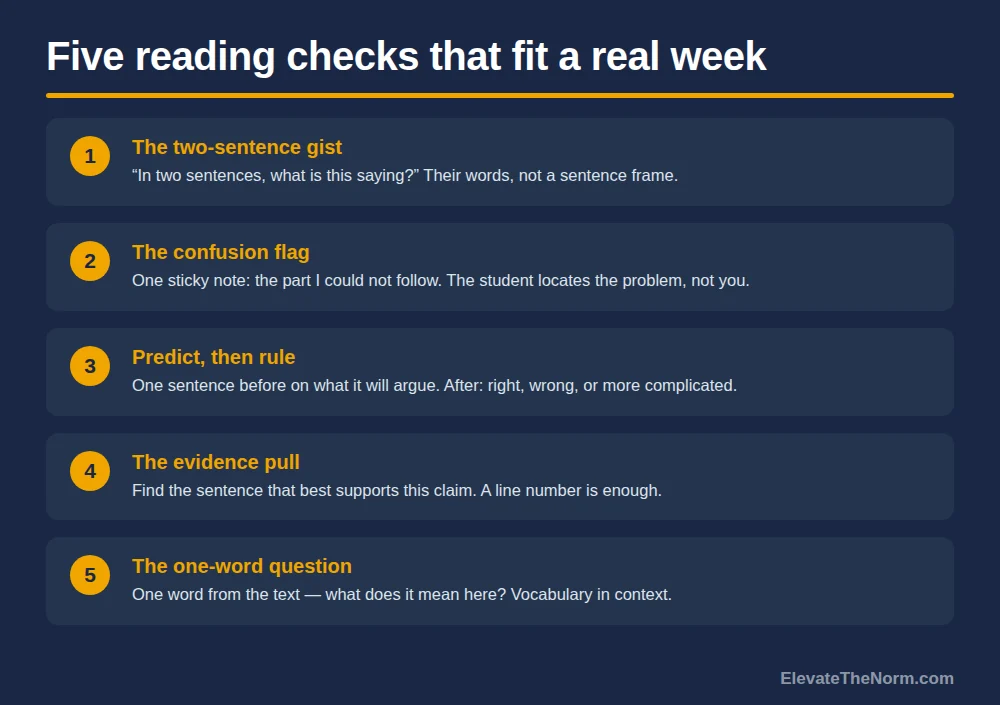
    Numbered list of five formative reading checks: the two-sentence gist, the confusion flag, predict then rule, the evidence pull, and the one-word question, each with a one-line description
    Five checks. None takes more than three minutes and none requires reading aloud.

    What Counts as a Formative Assessment Strategy for Reading?

    Any short check that tells you what a student took from a text in time for you to act on it. The format is negotiable. The timing is not.

    That definition rules more out than it rules in. A comprehension worksheet collected at the bell and returned Thursday is not formative — not because worksheets are bad, but because the information arrived after the decision it was supposed to inform. A five-question quiz you grade and record is summative wearing different clothes. The line is whether the answer reaches you while you can still change the next ten minutes.

    It also rules out the thing most reading checks actually measure, which is whether a student did the reading. That is a useful fact and it is not comprehension. “Did you read it” and “what did you understand” require different questions, and a margin that demands a restatement is one of the cheaper ways to make the second one visible, and conflating them is how a teacher ends up with a stack of evidence that everyone read a chapter nobody understood. The broader version of this distinction is covered in the cross-subject guide to choosing a check and acting on it; this page is the reading-specific case.

    What Does the Research Actually Show?

    A modest, consistent benefit — smaller than the number most professional development quotes.

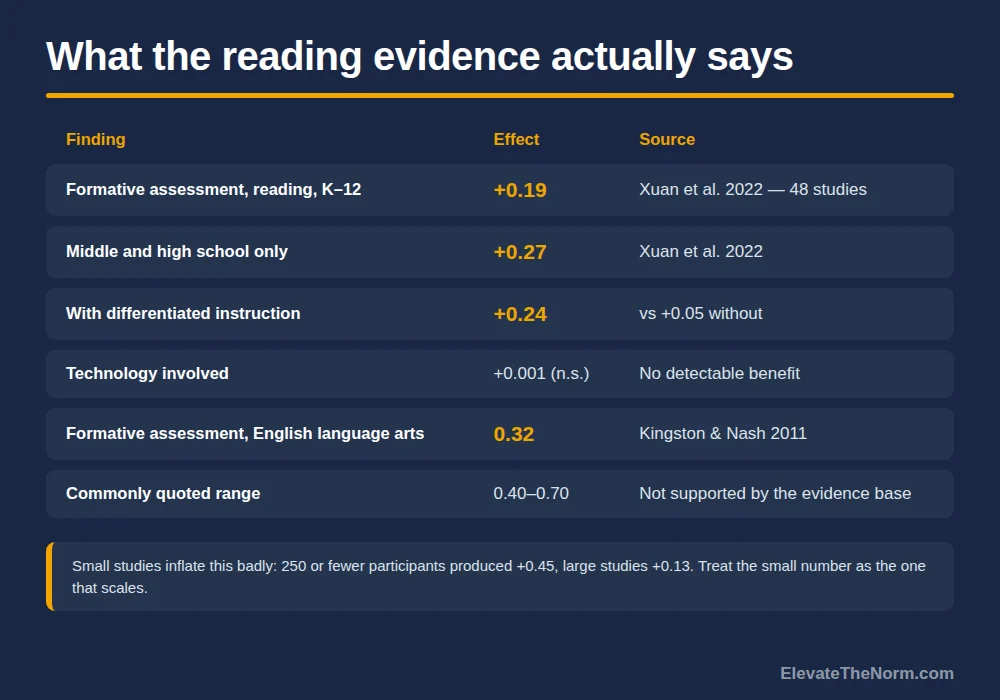
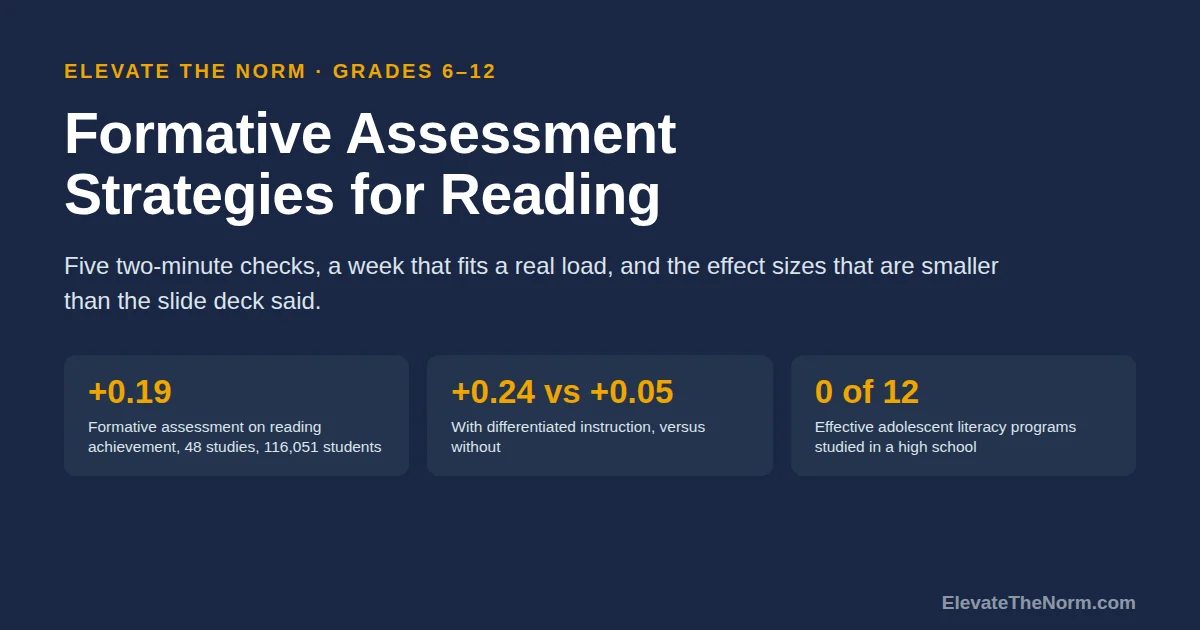
    The most direct evidence is a 2022 meta-analysis by Xuan, Cheung and Sun covering 48 qualifying studies and 116,051 K–12 students. The pooled effect of formative assessment on reading achievement was +0.19 (95% CI 0.15–0.23). By grade band: kindergarten +0.28, elementary +0.16, and middle and high school +0.27 — though the meta-regression found grade-level differences were not significant once other variables were controlled. Secondary students are not the weak case here.

    The older and more quoted number is worse than people think. Kingston and Nash reviewed more than 300 studies, found only 13 with enough data to analyze, and reported a weighted mean effect of 0.20. Their conclusion is unusually blunt for a meta-analysis: the 0.40 to 0.70 figure “often claimed for the efficacy of formative assessment… is not supported by the existing research base.” The one genuinely encouraging row for a reading teacher is the subject breakdown — English language arts came in at 0.32, against 0.17 for mathematics and 0.09 for science.

    So: real, replicated, worth two minutes a day. Not transformational, and anyone selling it as transformational is selling something.

    Table of effect sizes for formative assessment on reading: plus 0.19 across K-12, plus 0.27 for middle and high school, plus 0.24 with differentiated instruction versus plus 0.05 without, plus 0.001 for technology involvement, and 0.32 for English language arts
    The numbers, including the one that contradicts the slide deck.

    What Makes the Difference Between a Check That Works and One That Does Not?

    Two moderators did most of the work, and neither is the check itself.

    First, who uses the information. In the Xuan meta-analysis, teacher-directed approaches alone produced significantly smaller effects than approaches that integrated teacher and student use of the results (coefficient −0.12, p < 0.001). Purely student-directed assessment showed no significant advantage either. The winning configuration is both: you see the pattern, and the student sees their own answer against what the text actually said.

    Second, whether anything got differentiated. Studies in which the information fed differentiated instruction showed an effect of +0.24. Studies where it did not: +0.05. That is close to the whole finding. A reading check that produces a number you record and nothing you change is worth almost nothing, and the meta-analysis says so with a p-value. If the next question is what the changing actually looks like on a Tuesday, we walk through five ways to teach a mixed-readiness room without writing five lesson plans.

    And one thing that made no difference at all: technology. The moderator coefficient for technology involvement was +0.001 (p = 0.978). A Google Form and a sticky note perform identically. Pick the one your students will finish in ninety seconds.

    Which Five Reading Checks Fit a Real Secondary Schedule?

    These five take two to three minutes, need no materials beyond paper, and none requires a student to read aloud in front of peers.

    • The two-sentence gist. After a passage: “In two sentences, what is this saying?” Not a summary, not a main idea in a sentence frame. Two sentences in their own words. The students who can’t do it in their own words are the ones you need to find.
    • The confusion flag. One sticky note, one sentence: the part of this text I could not follow. Nothing else on it. Collected at the door. This is the highest-yield check on the list because it is the only one where the student, not you, locates the problem.
    • Pre-reading prediction, post-reading verdict. Before: one sentence on what you expect this will argue. After: right, wrong, or more complicated, and why. The post-reading half is the assessment; the pre-reading half is what makes them read looking for something.
    • The evidence pull. “Find the sentence in the text that best supports this claim.” Line number is enough. It is fast to scan and it catches the student who agrees with an argument without being able to find it on the page.
    • The one-word question. Give a single word from the text and ask what it means here. Vocabulary in context is the check with the strongest evidence behind it — explicit vocabulary instruction is one of the two practices the What Works Clearinghouse panel rates strong for adolescent literacy. What that rating covers is worth being precise about: the measured effect is far larger on the taught text than on a standardized reading score.

    The WWC practice guide is worth reading alongside these. Its five recommendations carry explicit evidence ratings: explicit vocabulary instruction (strong), direct and explicit comprehension strategy instruction (strong, based on five randomized experiments), extended discussion of text meaning (moderate), increasing motivation and engagement (moderate), and intensive individualized intervention for struggling readers (strong). The panel is honest about its own limits: most of the discussion studies used narrative texts, which is a meaningful caveat if you teach history or science. When I need a quick way to analyze a source with students, I use my Current Events and Media Literacy Bundle on TPT.

    How Do You Run This Without Reading 120 Responses?

    You sort them. You do not mark them.

    This is the single practical thing that decides whether a teacher is still doing reading checks in November. Twenty-eight two-sentence gist statements is not a marking job. It is a five-minute sort into three piles — got it, partial, missed the point — and the only thing you write down is how many are in each pile. Three numbers. That is your instructional decision. If you would rather not design the recording sheet yourself, the free quick-use pack includes a class evidence tracker built for exactly that three-pile sort.

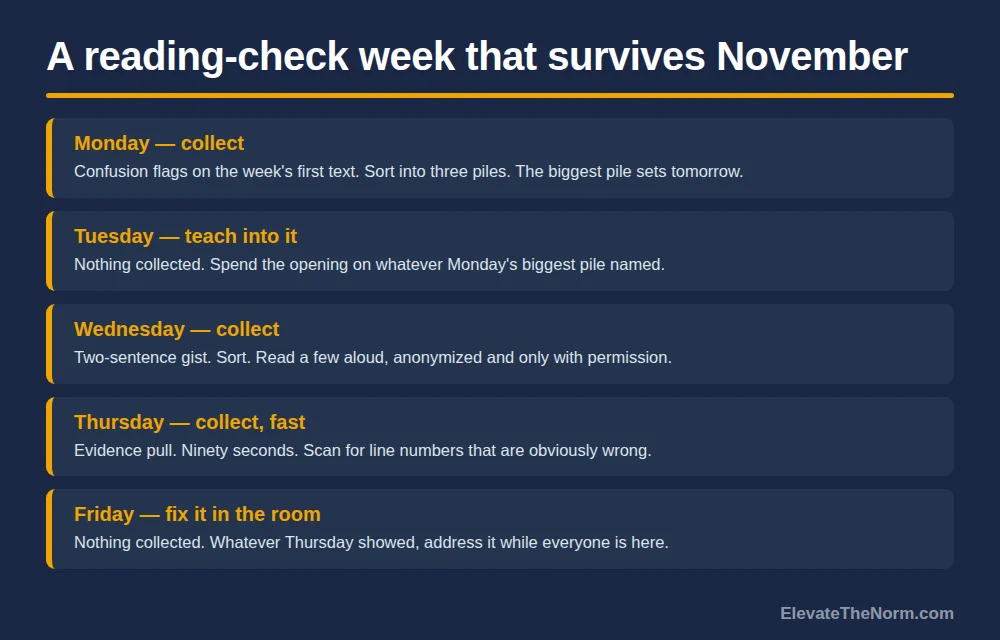
    Here is a week that fits a normal load:

    • Monday. Confusion flags on the week’s first text. Sort into piles. Whatever the biggest pile names becomes Tuesday’s opening five minutes.
    • Tuesday. Nothing collected. Teach into Monday’s biggest pile. This is the differentiation the research is actually measuring.
    • Wednesday. Two-sentence gist. Sort. Read four aloud — anonymized, and only with the writer’s permission, because every student recognizes their own sentences.
    • Thursday. Evidence pull on the same text. Ninety seconds. Scan for line numbers that are obviously wrong.
    • Friday. Nothing collected. Whatever Thursday showed, fix it in the room.

    Two collection days, two teaching-into days, one flexible. That is the whole system, and it is deliberately smaller than what a district rollout would design, because a smaller system that runs every week beats a comprehensive one that runs until October.

    Five-day routine showing Monday collect confusion flags, Tuesday teach into the biggest pile, Wednesday collect two-sentence gists, Thursday collect a fast evidence pull, and Friday fix what Thursday showed
    Two collection days. Two days spent on what they showed. That is the ratio that matters.

    What Does This Look Like in a Room?

    My room runs as a workshop, and the piece of furniture that does the most work is a whiteboard table I built, set in a corner under a lower lamp, with a rug and better chairs than the rest of the room has. Students ask to go there. That matters more than it sounds like it should.

    When a confusion flag says something I cannot fix from the front of the room, that table is where the conversation happens — not as a remediation station, because it is the seat everyone wants. A student reading a paragraph out loud at that table, with one other person, is doing the same thing that would humiliate them standing at their desk. The check tells you who needs the conversation. The room decides whether the conversation costs them anything.

    That is the part no meta-analysis measures and the part a teacher controls completely.

    Two ready-to-run versions of that table, one for grades 6–8 and one for grades 9–12, are laid out in the site’s guide to small group instruction in middle and high school.

    Where Does the Evidence Run Out?

    At high school, more precisely than most people admit.

    An IES review summarizing twenty years of adolescent literacy research screened 111 studies, found 33 meeting What Works Clearinghouse evidence standards, and identified 12 programs and practices with positive or potentially positive effects on reading comprehension, vocabulary or general literacy across grades 6–12. And then the line that belongs in every conversation about this: none of the 12 was conducted in a high school setting. The evidence base for adolescent literacy is, in practice, a middle school evidence base.

    Three more honest limits from the meta-analytic work. Small studies inflate the result badly — studies with 250 or fewer participants produced an effect of +0.45 against +0.13 for large ones, which is the usual sign that tightly-supervised implementations outperform real ones. The Xuan authors found no significant difference between published and unpublished studies, so publication bias is not the explanation, but the sample-size gap is a warning about what happens when a practice scales. And only 8 of the 48 studies came from Confucian-heritage contexts against 40 Anglophone, so the authors caution against moving interventions across cultures unadapted.

    None of that is a reason not to run a two-minute gist check. It is a reason not to build a district initiative on a number somebody rounded up.

    What Should You Do Next?

    Pick one check — the confusion flag if you want the highest yield for the least work — and run it twice a week for three weeks on a text you were teaching anyway. Sort, do not mark. Spend one whole class period in those three weeks teaching into whatever the biggest pile said, and notice whether the next set of flags moves.

    If it does, add a second check. If it does not, the problem is probably that the flags are not changing your lesson yet, which is the failure mode the research is loudest about. Two related pages are worth having open: the site’s guide to what counts as evidence that a class understood something for the general-purpose version of these moves, and the version that runs while a draft is still being written for the same problem on the production side. Listening is that problem again with nothing on the page to re-read — seven checks for what students heard covers it, standards and honest effect sizes included. If your reading happens on screens, the medium changes some of this — digital reading has its own comprehension research and its own accessibility upside. And if you want students doing more of the judging themselves, which is what the strongest moderator in the meta-analysis points at, start with student self-assessment.

    Before you go: grab the free Formative Assessment Quick-Use Pack (PDF) — ElevateTheNorm.com branded, printable, no email required.

    Same idea, different subject: see how these checks work in a science classroom, where the goal is catching a misconception while there is still time to teach into it. For the category question underneath all of these — planned written check or live questioning — see formal vs informal formative assessment.

    Frequently Asked Questions

    What is a formative assessment strategy for reading, exactly?

    It is any short, ungraded check that shows you what a student understood from a text while you can still do something about it. A two-sentence gist statement, a confusion flag, a one-question prediction, a retell in the student’s own words. The test is not the format. The test is whether the information changes what you do in the next ten minutes. If you collect it and file it, you ran a quiz.

    Should reading checks be graded?

    No, and the reason is practical rather than philosophical. The moment a gist statement counts for points, students write what they think you want instead of what they actually understood, and the check stops telling you anything. Keep them in a separate column or in no column at all. If your school requires a reading grade, take it from something summative and say out loud that the daily checks do not feed it.

    How do I do this without reading 120 responses every night?

    Sort, do not mark. A stack of 28 two-sentence gist statements is a five-minute sort into three piles — got it, partial, missed the point — and the only thing you write is the number in each pile. That number is the instructional decision. Reading every response carefully is what makes teachers abandon this in week three, and it is not what produces the benefit.

    Does the research actually support this for high school students?

    Partly, and the gap is worth knowing before anyone quotes a number at you. The meta-analysis evidence for formative assessment and reading achievement includes middle and high school studies and finds them performing at least as well as elementary. But an IES review of twenty years of adolescent literacy research found that of twelve programs with positive or potentially positive effects on reading outcomes, none was conducted in a high school setting. The practices are defensible. The claim that they are proven in a high school is not.

    Is the effect size big enough to be worth the class time?

    It is modest and it is real. The most recent meta-analysis puts formative assessment’s effect on reading achievement at +0.19 across 48 studies and 116,051 students. An earlier meta-analysis found a weighted mean of 0.20 overall and 0.32 for English language arts specifically — and explicitly rejected the 0.40 to 0.70 range that gets quoted in professional development. Two or three minutes a day for a modest, reliable gain is a good trade. A forty-minute assessment system for the same gain is not.

    What about the student who cannot read the text at all?

    A comprehension check tells you that, which is most of its value. What it must not do is tell the whole room. None of the checks here require reading aloud in front of peers, and that is deliberate. A written gist, a confusion flag on a sticky note, or a quiet conversation at a side table all give you the same information without making a struggling reader perform. The WWC panel rates intensive individualized support for struggling adolescent readers as a strong recommendation, and a daily check is how you find out who needs it — not a substitute for it.

    Does technology make these checks better?

    The evidence says not much. The same meta-analysis that found a +0.19 effect for formative assessment in reading tested whether technology involvement moderated it and found essentially nothing — a coefficient of +0.001. A form on a laptop and a sticky note produce the same result. Use whichever one your students will actually complete in ninety seconds.

    What actually predicted bigger effects, if not technology?

    Two things, and both are about what happens after the check. Approaches that integrated teacher and student use of the information beat teacher-directed approaches alone by a significant margin. And studies where the information fed differentiated instruction showed an effect of +0.24 against +0.05 for those where it did not. Collecting the data is not the intervention. Changing the next lesson is.

    Sources

    1. Xuan, Qingzhi, Alan C. K. Cheung, and Danping Sun. “The Effectiveness of Formative Assessment for Enhancing Reading Achievement in K-12 Classrooms: A Meta-Analysis.” Frontiers in Psychology, vol. 13, 2022. 48 studies, 116,051 students; pooled ES +0.19; middle/high school +0.27; differentiated instruction +0.24 vs +0.05; technology coefficient +0.001 (n.s.); small-sample studies +0.45 vs +0.13 for large. https://www.frontiersin.org/journals/psychology/articles/10.3389/fpsyg.2022.990196/full
    2. Kingston, Neal, and Brooke Nash. “Formative Assessment: A Meta-Analysis and a Call for Research.” Educational Measurement: Issues and Practice, vol. 30, no. 4, 2011, pp. 28–37. 13 studies, 42 effect sizes; weighted mean 0.20, median 0.25; English language arts 0.32, mathematics 0.17, science 0.09. https://eric.ed.gov/?id=EJ951173
    3. Kamil, Michael L., et al. Improving Adolescent Literacy: Effective Classroom and Intervention Practices. IES Practice Guide, NCEE 2008-4027, What Works Clearinghouse, 2008. Five recommendations with evidence levels; explicit vocabulary instruction and explicit comprehension strategy instruction both rated strong. https://ies.ed.gov/ncee/wwc/docs/practiceguide/adlit_pg_082608.pdf
    4. Institute of Education Sciences, Regional Educational Laboratory Southeast. Summary of 20 Years of Research on the Effectiveness of Adolescent Literacy Programs and Practices. 111 studies screened, 33 met WWC evidence standards, 12 programs with positive or potentially positive effects — none conducted in a high school setting. https://ies.ed.gov/use-work/resource-library/report/systematic-literature-review/summary-20-years-research-effectiveness-adolescent-literacy-programs-and-practices
    5. Agarwal, Pooja K., Ludmila D. Nunes, and Janell R. Blunt. “Retrieval Practice Consistently Benefits Student Learning: A Systematic Review of Applied Research in Schools and Classrooms.” Educational Psychology Review, vol. 33, no. 4, 2021, pp. 1409–1453. 50 experiments, 5,374 participants; 57% of effect sizes medium or large. https://link.springer.com/article/10.1007/s10648-021-09595-9

    About Clay Shumate

    Clay Shumate is a certified secondary Social Studies teacher in the public schools of West Alabama, with seven years of classroom experience, a B.A. in History, and an M.Ed. in Secondary Education. He writes about project-based learning, student responsibility, respect, and practical ways to hold young people to a higher standard while giving them room to learn from mistakes. He is a member of the Society of Professional Journalists and writes to its Code of Ethics; this site’s editorial standards and corrections policy are published in full. More about Clay.

  • From Books to Screens: How to Make Digital Reading Work for Every Student

    From Books to Screens: How to Make Digital Reading Work for Every Student

    Most secondary classrooms now do the majority of their reading on a screen. The article is a link, the novel is a PDF, the primary source is a scan, and the class set of paperbacks is three years out of date and eleven copies short. That shift happened for practical reasons, not instructional ones, and it happened faster than anyone built a plan for it.

    The research on screen reading is genuinely unflattering in places. It is also narrower than the headlines suggest, and the conditions where the gap shows up are conditions a teacher can change. That is the useful part.

    What follows is what the evidence supports, what a Lexile measure does and does not tell you, how to run one text at three levels without writing three lessons, and which of the free platforms are actually free.

    Key Takeaways

    • The print advantage is real but small and conditional. The largest meta-analysis found an effect of roughly g = −0.21 favoring paper — and no advantage at all for narrative text.
    • Time pressure is where the gap opens. Under a clock the paper advantage roughly triples compared with self-paced reading.
    • Students overestimate how much they understood on screen. That miscalibration is the finding with the clearest classroom fix.
    • Lexile bands describe texts, not students. They overlap on purpose, and they say nothing about background knowledge, motivation, or content maturity.
    • Three pathways, one question. Differentiating the text is not the same as differentiating the thinking.
    • "Free" varies. ReadWorks and Project Gutenberg are free outright. CommonLit has a real free tier. Newsela’s free account is a rotating sample, not the library.

    Free Download · 2-page PDF

    Digital Reading Setup Planner

    The 20-minute routine with space to write your own version, a five-question check for the text before you assign it, a three-pathway planner, and a blank comprehension tracker.

    Download the free PDF

    Free. No email address required. Designed for grades 6–12. Browse every printable in Your Free Library.

    What Actually Changed When the Books Went Away

    Three things changed at once, and they are worth separating because only one of them is about screens.

    The text became infinitely available. A teacher can now put a 1914 telegram, a modern historian’s argument, and a plain-language summary of the same event in front of thirty students in about four minutes. That is a genuine gain and it is the reason nobody is going back.

    The text lost its edges. A paperback tells you how far in you are by feel. A scroll bar tells you almost nothing, and an article with three embedded videos and a comment section tells you less than that. Physical location in a text turns out to be part of how people remember it.

    The reading moved onto a device built for skimming. This is the part that matters most, and it is also the part a classroom can control. The device is not the problem so much as the habit the device was trained into.

    What the Research Says About Print and Digital Comprehension

    The most cited study here is Delgado and colleagues’ 2018 meta-analysis in Educational Research Review, published under the blunt title "Don’t throw away your printed books." It pooled 54 studies and more than 171,000 participants, and it found a small advantage for paper: Hedges’ g of about −0.21.

    Read the moderators and the picture gets more useful than the title suggests:

    • Time pressure. Under a time limit the paper advantage was about g = −0.26. When readers set their own pace it fell to roughly −0.09.
    • Text type. The advantage appeared for informational text (about −0.27) and mixed text (−0.30). For narrative text alone it was essentially zero.
    • Not the device. The type of digital device did not explain the difference, and neither did educational level.
    • The gap grew over time. Effect sizes favoring paper increased across the publication years studied, which is the opposite of what "digital natives will adapt" predicted.

    Clinton’s 2019 systematic review in the Journal of Research in Reading reached the same direction across 33 studies and added the finding that is most actionable in a classroom: across eleven studies of metacognition, readers were more overconfident after reading from screens. They thought they had understood more than they had.

    Be careful what you do with this. It is not evidence that technology harms achievement, and it is not a case for banning devices. It is evidence that a particular combination — dense informational text, a clock, and a screen — produces worse comprehension and more confidence in it than the reader has earned. Every one of those three is under a teacher’s control. The same argument runs one level up in the wider case for and against phones in a grades 6–12 room, where the device is likewise easier to blame than the habit around it.

    What a Lexile Measure Is — and What It Does Not Tell You

    A Lexile measure is a number produced by an algorithm that looks at two things: sentence length and word frequency. Longer sentences and rarer words produce a higher number. That is the whole mechanism.

    It is genuinely useful for the thing it does. It is a fast, consistent way to sort a pile of texts by surface difficulty, which is a real problem when you are choosing among forty search results at 9 p.m.

    Here is what it cannot see:

    • Background knowledge. A 900L article about the Dust Bowl is harder for a student who has never heard of it than an 1100L article about a sport they play.
    • Conceptual difficulty. Short sentences and common words can carry a genuinely hard idea. Some philosophy scores low and reads hard.
    • Content maturity. Lexile has nothing to say about whether a text is appropriate for a fourteen-year-old. Of Mice and Men scores around 630L.
    • Structure and layout. Headings, images, and paragraph length change how readable a text is and are not part of the measure.
    • Accessibility. Contrast, font, line length, and whether the text works with a screen reader do not register at all.

    The most important distinction, and the one most often collapsed: a Lexile text measure and a Lexile reader measure are two different numbers. A student is not "a 1000L reader" in any fixed sense, and a grade band is not a requirement anyone has to hit.

    The Lexile Text-Complexity Bands by Grade

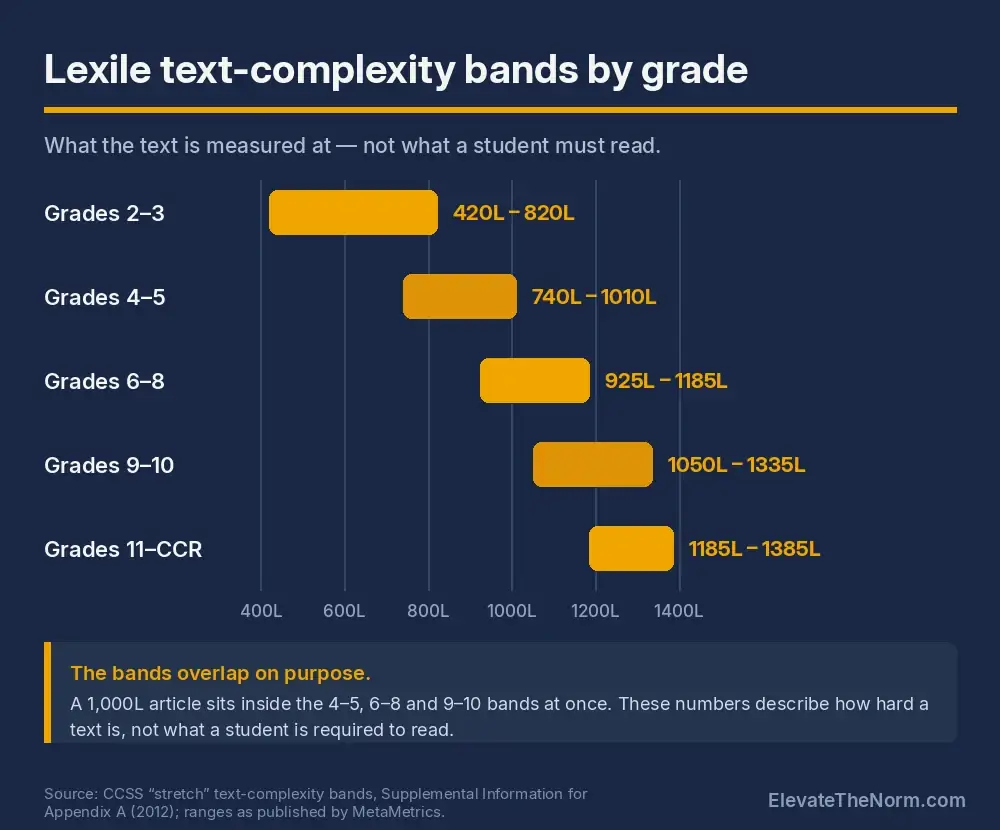
    Chart of Lexile text-complexity bands by grade: 420L-820L for grades 2-3, 740L-1010L for grades 4-5, 925L-1185L for grades 6-8, 1050L-1335L for grades 9-10, and 1185L-1385L for grades 11-CCR
    The bands overlap by design. They describe text difficulty, not student ability.

    The bands below are the ones most state documents and platform filters use. They are the "stretch" text-complexity bands published in the 2012 Supplemental Information for Appendix A of the Common Core State Standards, which revised the original 2010 ranges upward to close the gap between high school text and college and career text. The figures match those published by MetaMetrics, the organization that develops the Lexile Framework.

    Grade bandLexile text range
    Grades 2–3420L – 820L
    Grades 4–5740L – 1010L
    Grades 6–8925L – 1185L
    Grades 9–101050L – 1335L
    Grades 11–CCR1185L – 1385L
    CCSS "stretch" text-complexity bands, Supplemental Information for Appendix A (2012).

    Notice the overlap. A 1,000L article sits inside the 4–5, 6–8, and 9–10 bands simultaneously. That is not sloppiness; it is an admission that a single number cannot place a text in one grade. Treat the bands as a sorting aid and nothing more.

    Differentiating Without Writing Three Lessons

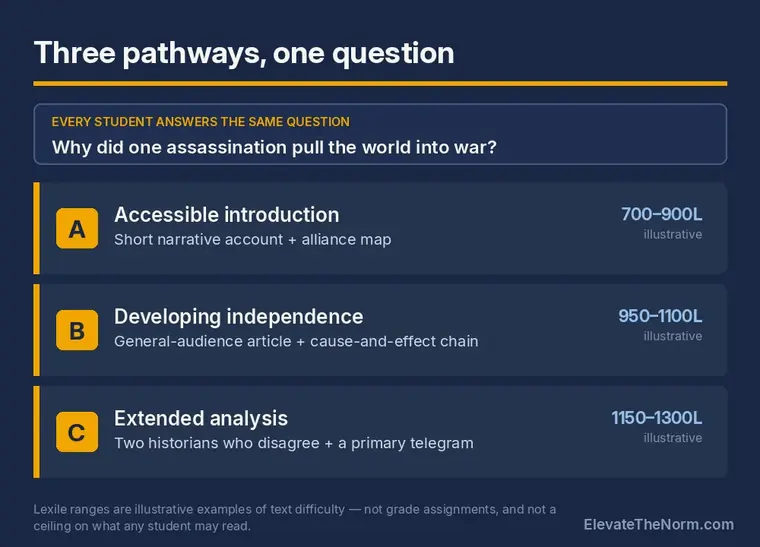
    Three reading pathways into one World War I question: an accessible narrative account, a general-audience article, and two historians who disagree, each with an illustrative Lexile range
    Same question for everyone. Three ways in.

    The mistake most differentiation makes is differentiating the thinking along with the text. The student on the easier reading gets the easier question, and by March everyone knows which group they are in and what it means.

    The alternative is to hold the question fixed and vary the road to it. Take a World War I unit and the question Why did the assassination of one archduke pull the world into war?

    • Pathway A — a short narrative account of June 1914 with a labeled alliance map. Students mark who was bound to defend whom, then answer the question in four sentences using two pieces of evidence.
    • Pathway B — a general-audience history article covering alliances, mobilization timetables, and imperial rivalry. Students build a cause-and-effect chain and rank the causes they can defend.
    • Pathway C — two historians who disagree about German responsibility, plus a primary telegram. Students weigh the interpretations and argue which cause carries the most weight.

    All three students answer the same question, and all three can be part of the same discussion, because the discussion is about the question and not about the article. If you want more worked versions of this in a history context, the history project ideas collection has units built the same way.

    Two rules keep this from becoming tracking. First, students move between pathways within a unit, and they know it. Second, nobody is prevented from taking a harder pathway because a number said so — the expectation stays where it was and the support changes.

    Seven Strategies That Make Digital Reading Work

    Each of these targets something the research actually identified, rather than being a general good idea about technology.

    1. Take the clock off, or move it. The paper advantage roughly triples under time pressure. If a reading has to be timed, time the task after the reading rather than the reading itself.
    2. Require a mark on every paragraph. A question, an underline, a two-word summary — the form matters less than that it makes passive scrolling impossible. This is the single cheapest fix on the list.
    3. Restore the edges. Tell students how long the text is, how many sections it has, and where they should be at the halfway point. Give a screen text the boundaries a book has for free.
    4. Break the overconfidence before it sets. Ask for a prediction of their own score, then check. One round of being wrong about how much they understood is worth more than a lecture about careful reading.
    5. Pre-teach three or four words, not fifteen. Vocabulary load is half of what a Lexile measure is actually detecting. Clearing the four words that carry the argument changes the reading more than a long list does. The federal practice guide for grades 4–9 goes narrower still — one or two essential words per reading, chosen by whether skipping them would break the paragraph.
    6. Put discussion between reading and assessment. Talk repairs a surprising amount of what a first read missed, and it does it before the misunderstanding gets written down.
    7. Move the final answer to paper. Not because paper is sacred, but because it removes the copy-paste path and forces retrieval from memory. There are other engagement moves worth pairing with this, but this one is the least negotiable.

    Four Free Digital Reading Tools, Described Honestly

    "Free" means four different things across these platforms, and the difference matters if you are planning a unit around one. The details below were checked on September 17, 2026.

    ToolWhat is freeWhat is not
    ReadWorksEverything. The nonprofit states it is free and will always be free for all teachers and students: 6,000+ K–12 texts, question sets, vocabulary tools, paired texts, automated grading, Google Classroom and Clever integration.No paid tier is offered. It runs on donations.
    CommonLitA real free tier — the full text library, the CommonLit 360 curriculum, on-demand training, and kickoff webinars, with no contract.School-wide paid plans (School Essentials PRO and PRO Plus, priced per school per year) add administrator data dashboards, LMS integrations, a dedicated account manager, and implementation support.
    Newsela LiteA rotating, staff-selected sample of articles at five reading levels, with assignments, due dates, level locking, quiz scores, annotations, and Google Classroom.The full library. Free articles expire after about four weeks. Text Sets, Collections, Power Words, printing and data download, admin console, LMS auto-rostering and auto-rostered accounts are paid.
    Project GutenbergEverything, with no registration — 79,000+ ebooks whose U.S. copyright has expired, readable in a browser or on an e-reader.No leveling, no questions, no teacher tools. It is a library, not a platform. Nothing published recently enough to still be in copyright.
    Availability and tier features verified September 17, 2026.

    One practical note on leveled versions: when a platform rewrites an article down a level, it usually shortens sentences and swaps vocabulary, which is exactly what the Lexile algorithm measures. It does not always preserve the argument’s structure. Read the lower version before you assign it, particularly if the lesson turns on how the author reasons rather than what the author concludes. The same caution applies to the free templates and planning tools that come bundled with these platforms: useful, but not a substitute for looking at the thing.

    The 20-Minute Digital Reading Routine

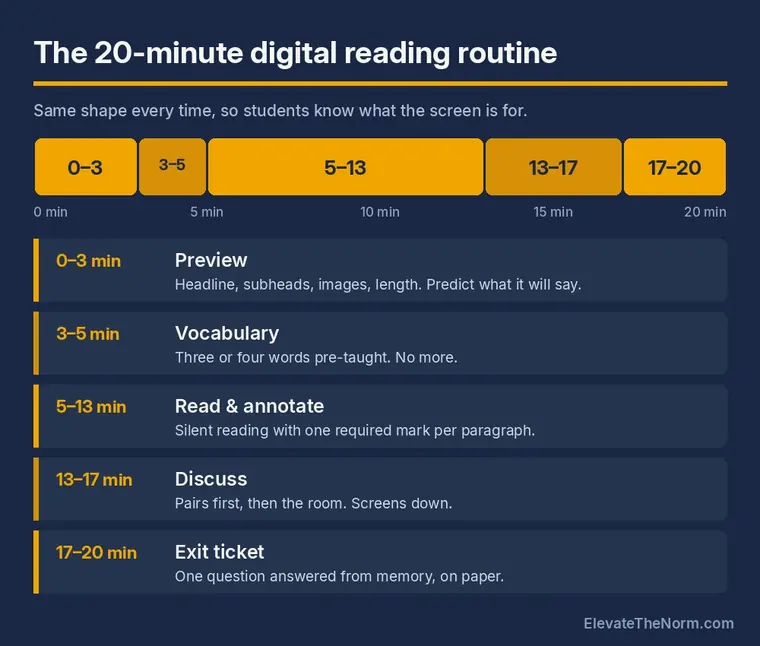
    Horizontal timeline of a 20-minute digital reading routine: 0-3 minutes preview, 3-5 vocabulary, 5-13 read and annotate, 13-17 discuss, 17-20 exit ticket
    Same shape every time, so students know what the screen is for.

    The shape matters more than the minutes. Students who know what a reading block is going to look like stop treating the tab as an invitation to open another one.

    • 0–3 — Preview. Headline, subheads, images, length. Predict what it will say. This is the step that restores the edges a printed page gives for free.
    • 3–5 — Vocabulary. Three or four words, pre-taught. No more.
    • 5–13 — Read and annotate. Silent, self-paced, with one required mark per paragraph. Self-paced is the condition where the research gap nearly closes.
    • 13–17 — Discuss. Pairs first, then the room. Screens down.
    • 17–20 — Exit ticket. One question, answered from memory, on paper.

    Like any other classroom procedure, this has to be taught and practised rather than announced. The first three or four times it will run long. After that it runs itself, and the eight minutes of actual reading are worth more than twenty unstructured ones.

    How to Tell Whether Comprehension Actually Improved

    This is where most articles about digital reading show you a chart of rising scores. There is no such chart here, because any numbers on it would be invented. What is worth tracking, and what the research suggests you should track, is the gap between what students think they understood and what they did.

    Ask for a predicted score before the exit ticket, record both, and watch the difference. That difference is the overconfidence effect made visible, and it is the number most likely to move first. The template below is empty on purpose — fill it with your own class.

    WeekText and LexileAvg. predicted scoreAvg. actual scoreGapWhat changed
    1
    2
    3
    4
    5
    A blank tracking template. No illustrative data, because illustrative data on a chart stops looking illustrative by the second time someone shares it.

    Two cautions. Five weeks of one class is not evidence of anything beyond that class, so resist writing it up as a finding. And if scores rise, the reading routine is one of a dozen things that changed — including the students getting better at your exit tickets. The point of the table is to notice, not to prove. Wider habits for checking what students actually know apply here without modification.

    Accessibility Is Not Lowering the Bar

    Digital text is the first format in the history of schooling that a student can adjust without asking permission, and that is the strongest argument for it. Font size, contrast, line spacing, text-to-speech, translation and dictionary lookup all happen without a conversation, a form, or a visible accommodation.

    Make those adjustments available to everyone by default. A student who needs larger text and has to request it in front of the class has been handed a choice between reading and dignity, and plenty of fourteen-year-olds will pick dignity.

    Two limits worth being straight about. Text-to-speech is a route into the content, but listening and reading are not the same skill, and a student who only ever listens is not practising the one they are graded on. And scanned PDFs of book pages are images: they cannot be resized usefully, searched, or read aloud by assistive software. If the only version you have is a scan, that is an accessibility problem before it is a comprehension one. Whichever medium the text arrives in, you still need a way to find out what stuck: a short ungraded comprehension check does that in about two minutes and none of them requires reading aloud. And when the text arrived from a search result rather than from you, evaluating the source becomes part of the reading: twelve ways to teach students to check who made a claim, with the strongest-evidenced one named and the untested ones labelled as such. When I need a quick way to analyze a source with students, I use my Current Events and Media Literacy Bundle on TPT.

    Before you go: grab the free Digital Reading Setup Planner (PDF) — ElevateTheNorm.com branded, printable, no email required.

    Frequently Asked Questions

    Is reading on a screen actually worse for comprehension?

    Slightly, and only under certain conditions. The largest meta-analysis found a small advantage for paper — about g = -0.21 across 54 studies — but that advantage was concentrated in informational text read under time pressure. For narrative text it was essentially zero, and for self-paced reading it shrank to about -0.09. So the honest answer is that a screen is not inherently worse; a screen plus a clock plus dense informational text is worse, and a teacher controls two of those three.

    What Lexile level should my students be reading at?

    That question has a false premise built into it. Lexile bands describe text difficulty, not students, and they overlap heavily — a 1,000L article sits inside the grades 4-5, 6-8 and 9-10 bands at once. The published grades 6-8 band is 925L-1185L and the grades 9-10 band is 1050L-1335L, but those are ranges for choosing texts, not targets a student has to hit. A student reading below the band with strong support and real interest is in a better position than one placed in the band and left alone.

    Are Newsela, CommonLit, ReadWorks and Project Gutenberg really free?

    Two of them are free outright. ReadWorks states it is free and always will be for all teachers and students, and Project Gutenberg is free with no registration. CommonLit has a genuine free tier that includes the text library and the 360 curriculum; the paid school plans add admin dashboards, LMS integration and support. Newsela is the one to watch: the free Lite account gives you a rotating, staff-selected sample of articles at five reading levels, and those articles expire after about four weeks. The full library, Text Sets, Power Words, printing and data download are paid.

    Should I print everything out instead?

    No, and the research does not support that conclusion either. Printing throws away the adjustable text, the instant availability, the text-to-speech and the ability to put three versions of the same source in front of three students. Print the things where the evidence is strongest — long, dense informational text that has to be read under time pressure, such as a test passage — and keep the rest digital with the reading routine around it.

    How do I know a leveled version has not gutted the text?

    Read it before you assign it, specifically looking for the argument rather than the facts. Automated and editorial leveling works mainly by shortening sentences and swapping vocabulary, which is what the Lexile algorithm measures. Nuance, qualification and the author’s reasoning are what tend to go. If the lesson turns on how the author argues rather than what the author concludes, the lower version may not carry the lesson, and you are better off keeping the original and adding support around it.

    Does giving students text-to-speech mean they are not really reading?

    It means they are getting the content, which is usually the point of the lesson. Listening and reading are not identical skills, though, so the honest position is that text-to-speech is a route into material a student could not otherwise reach, not a replacement for decoding practice. Make it available to the whole class by default rather than as a named accommodation, and keep separate time for the reading skill itself.

    What is the single change with the biggest return?

    Requiring one mark per paragraph. It costs nothing, needs no platform, and it makes passive scrolling structurally impossible. The second-best is asking students to predict their own exit-ticket score before they take it: the research consistently finds that readers overestimate their comprehension after reading on screen, and being visibly wrong about it once does more than any amount of reminding to read carefully.

    Sources

    • Delgado, P., Vargas, C., Ackerman, R., & Salmerón, L. (2018). Don’t throw away your printed books: A meta-analysis on the effects of reading media on reading comprehension. Educational Research Review, 25, 23–38. Full text (PDF) — 54 studies, 171,055 participants; overall g ≈ −0.21 favoring paper, moderated by time pressure and text genre, with no effect for narrative text.
    • Clinton, V. (2019). Reading from paper compared to screens: A systematic review and meta-analysis. Journal of Research in Reading, 42(2), 288–325. ERIC record — 33 studies; small negative effect for screens, and readers more overconfident about their comprehension after screen reading across 11 calibration studies.
    • Council of Chief State School Officers & NGA Center. Supplemental Information for Appendix A of the Common Core State Standards: New Research on Text Complexity (2012). Document — the source of the revised "stretch" text-complexity bands used above.
    • MetaMetrics. Lexile Measures and Grade Levels (FAQ). PDF — per-grade and grade-band Lexile ranges aligned to the 2012 CCSS measures.
    • ReadWorks. About ReadWorks — statement that the platform is free and always will be for all teachers and students; 6,000+ texts.
    • CommonLit. Pricing — free Classroom Basics tier and the paid School Essentials PRO tiers.
    • Newsela. Newsela Lite (free account) — five reading levels on a rotating selection, four-week article expiry, and the list of paid-only features.
    • Project Gutenberg. Home — 79,000+ free ebooks, public domain in the United States, no registration.

    Every link above was checked on September 17, 2026. Where a figure comes with limits on how far it travels, those limits are stated in the text rather than left in a footnote. No classroom results, student work, or research findings on this page are invented; the tracking table is deliberately empty for that reason.


    About Clay Shumate

    By Clay Shumate — Clay Shumate is a certified secondary Social Studies teacher in the public schools of West Alabama, with seven years of classroom experience, a B.A. in History, and an M.Ed. in Secondary Education. He writes about project-based learning, student responsibility, respect, and practical ways to hold young people to a higher standard while giving them room to learn from mistakes. He is a member of the Society of Professional Journalists and writes to its Code of Ethics; this site’s editorial standards and corrections policy are published in full.

Teacher Emergency Toolkit — practical resources, real classroom support. Shop on TPT.Teacher Emergency Toolkit — practical resources, real classroom support. Shop on TPT.