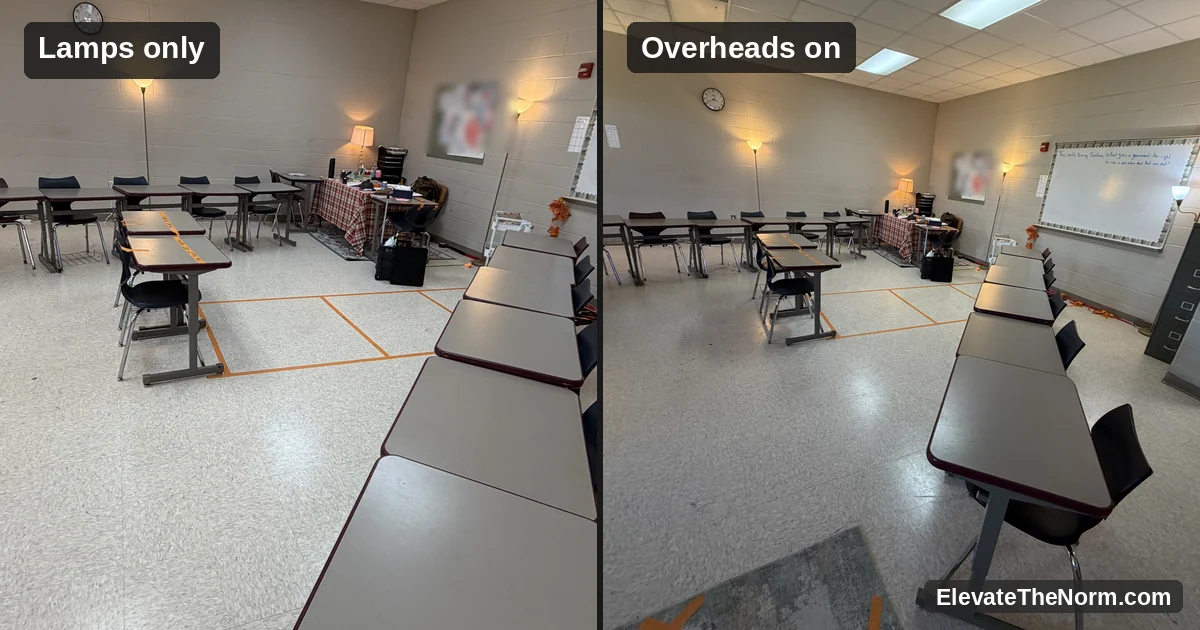
Classroom lighting is the cheapest variable in the room and the one most teachers never touch. Mine runs on floor lamps. The overhead fluorescents stay off, and they have stayed off long enough that turning them on is now the most effective consequence I have — not because darkness is a reward, but because the overheads are what every other room in the building already looks like.
That is the whole mechanism, and it took me a while to notice I was running it.
What follows is what the evidence on classroom lighting actually supports, what it does not, what a lamp-lit room costs and how to check you have not just made the room too dark to work in — and the part nobody writes about, which is what happens to a class when you put the ceiling back on.
Key Takeaways
- Light is the strongest single physical factor in the best-known study of classroom design — but that study was 3,766 pupils aged 5 to 11 in England, and it was mostly about daylight and light quality, not about switching the ceiling off.
- Flicker is the real mechanism behind the headaches, and it is measurable. Halving it halved headaches and eyestrain in a double-blind office study.
- “Just switch to LED” is not the fix people think it is. LEDs driven at twice the mains frequency can modulate deeper than the fluorescents they replaced.
- Check the light level before you trust the vibe. The IES puts classroom reading and writing at about 30 foot-candles at desk height, with a usable range of 15 to 60. Under 15 you have not made a calm room, you have made a squint.
- Lamps only become a management tool once they are the baseline. The consequence is not turning something off. It is turning the normal thing back on.
- Check the fire code first. Extension cords are not permanent wiring, and halogen torchieres have a body count.
- It is still a collective consequence. Say so out loud rather than pretending it is just weather.
Free Download · 2-page PDF
Classroom Lighting Setup Planner
The four conversations to have first, a safety checklist, a flicker check, a desk light-level log, a two-week trial plan and a wall card for your room.
Free. No email address required. Designed for grades 6–12. Browse every printable in Your Free Library.
What the Research on Classroom Lighting Actually Says
The study everyone cites is the HEAD project, summarised as Clever Classrooms. Peter Barrett and colleagues tracked 3,766 pupils across 153 classrooms in 27 English schools for a year and found that differences in the physical characteristics of classrooms explained 16% of the variation in learning progress. Of the seven design factors that mattered, light carried the most weight — about 21% of the explained variation. The authors write that “of all the design parameters considered, lighting has the strongest individual impact.”
Now the caveats, because they matter more than the headline.
Those pupils were aged 5 to 11. This is a grades 6–12 site, and a primary-school result does not transfer to a room of sixteen-year-olds just because we would like it to. The authors say so themselves: the findings “are conditioned by the geographical and pedagogical particularities here,” and applying them elsewhere “careful reinterpretation may be needed.” It is also an observational study — associations across real classrooms, not an experiment where somebody changed the lights and measured what happened.
And the light factor in that model is largely about daylight and light quality — window area, glare control, orientation. It is not a finding that says “turn the overheads off.” Anyone quoting the 16% figure at you to sell a lighting retrofit is stretching it, and most of the pages ranking for this keyword are doing exactly that.
What the study does support is modest and useful: light is not a trivial variable, and it is one of the few in the room a teacher can change without a budget line.
The Headaches Are Real, and the Cause Is Flicker
This is the strongest evidence in the article, and it is nearly forty years old.
Arnold Wilkins and colleagues ran a double-blind crossover study in offices, swapping conventional fluorescent ballasts — which pulse at 100 Hz with something like 43–49% modulation depth — for high-frequency electronic ballasts running at 32 kHz, which drop that 100 Hz modulation below 7%. Same fixtures, same rooms, nobody knowing which was which. The average incidence of headaches and eyestrain was more than halved under the high-frequency lighting. Occupants also chose to leave the high-frequency lighting on about 30% longer.
Read that result carefully, because it does not say what teachers usually think it says. The fix in that study was better fluorescent lighting, not less of it. The problem was never the ceiling. It was the flicker.
Which is why “just switch to LED” is not the answer
Wilkins later worked on the IEEE standard for LED flicker, and the finding there is the one nobody selling LED retrofits puts on the page: “LEDs driven so that they flicker at a frequency twice that of the AC supply may have a depth of modulation greater than that from most fluorescent lamps.” The retina still resolves modulation between roughly 100 and 160 Hz, and up to about 200 Hz, even though you cannot see it. The modulation depth known to induce headaches at 100 Hz is around 35%. The paper explicitly declines to recommend a safe threshold.
So a cheap LED retrofit into old fixtures can leave a room flickering worse than it did before, and everyone congratulates themselves on the energy savings. If your building went LED three years ago and the headaches did not go away, that is a plausible reason why.
You can check without buying anything. Point a phone camera at the ceiling fixture and look for banding on the screen, or wave a pencil quickly under it and see whether the blur breaks into discrete images. Neither is a measurement, but a fixture that fails both is not the fixture giving your room headaches.
What a Lamp-Lit Classroom Actually Looks Like
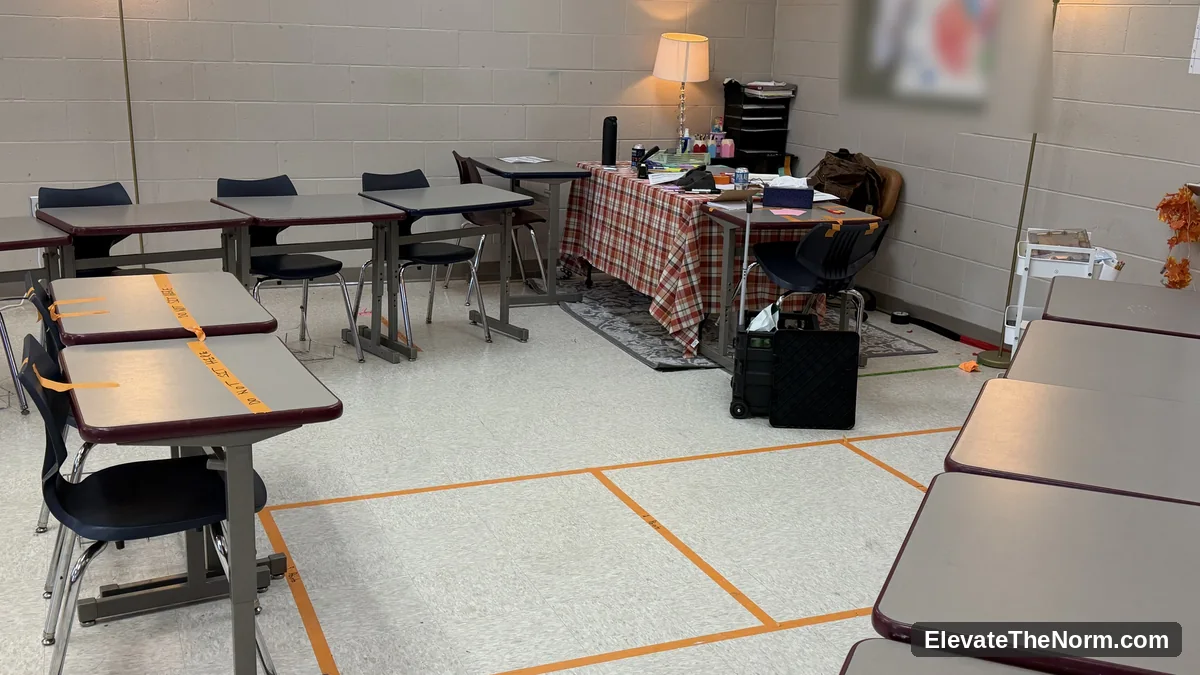
Six floor lamps around the perimeter, a couple of table lamps on surfaces, and the overhead bank off. That is it. The lamps came from a big-box store and the whole setup cost less than a set of novels.
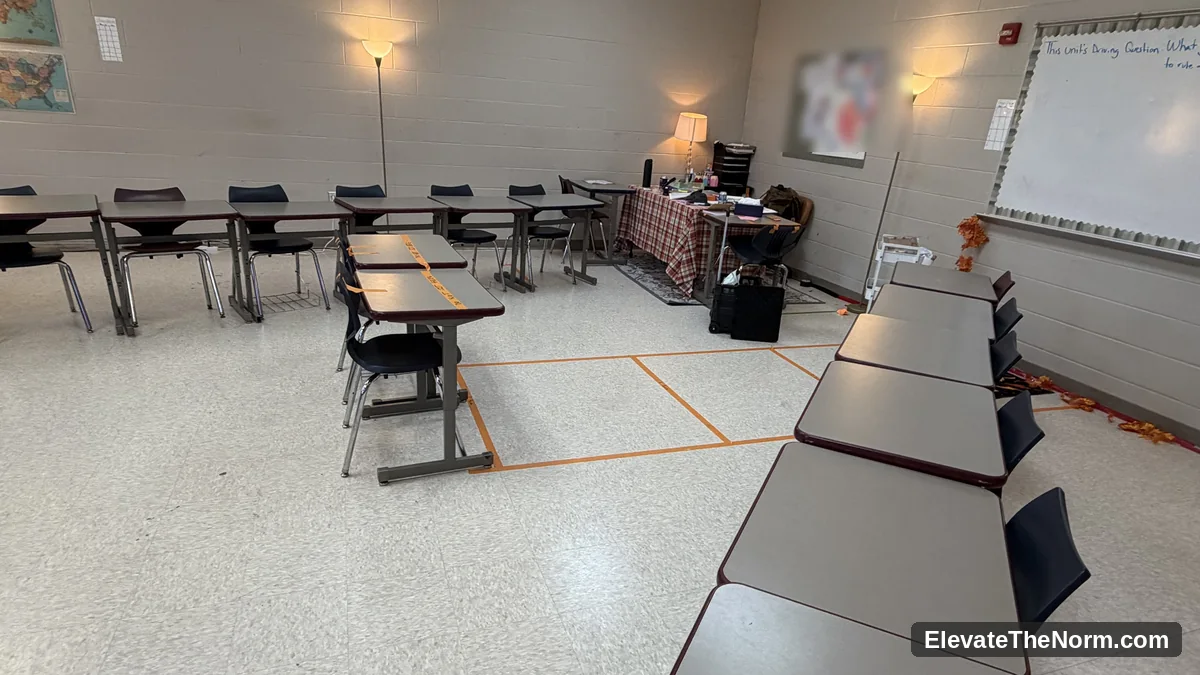
What changes is not dramatic and I am not going to pretend it is. The room is quieter at the edges. Students walk in at a lower volume and it takes less to bring them down further. The glare on the screens goes away. Nobody squints at the whiteboard. I stopped getting the four-o’clock headache I had assumed was just what teaching felt like.
What does not change: nothing about the light makes a bored student interested, and no lamp has ever taught a standard. The room is a floor, not a lever.
Measure it before you trust it
Here is the step almost every “cozy classroom lighting” post skips, and it is the one that separates a considered room from a dim one.
The Illuminating Engineering Society puts classroom reading and writing tasks at a maintained horizontal average of about 30 foot-candles measured at desk height, with a range of 15 to 60. Free light-meter apps are close enough to tell you which side of 15 you are on. Walk the room during the period you actually teach, put the phone flat on six different desks, and write the numbers down.
If the far corner reads 8, you have not created a calm environment. You have created a corner where a student with uncorrected vision cannot read the handout and will not tell you. Add a lamp there. The fix is a lamp, not a philosophy.
Two other honest limits. Warm lamps are pleasant and low-glare, but on the two or three days a year you hand out something with genuinely small print, turn the ceiling on and do not be precious about it. And a room this size needs the lamps spread to the perimeter — clustering them near your desk lights you beautifully and leaves the students in a cave.
The Part Nobody Writes About: the Lights Become a Consequence
Once the lamps have been the baseline for a few weeks, something happens that I did not plan.
The room becomes a thing students have an opinion about. They notice other rooms. They say so. And the moment they have a preference, you are holding a lever you did not build — because you can put the room back to normal at any time, and normal is what everybody else’s room already looks like.
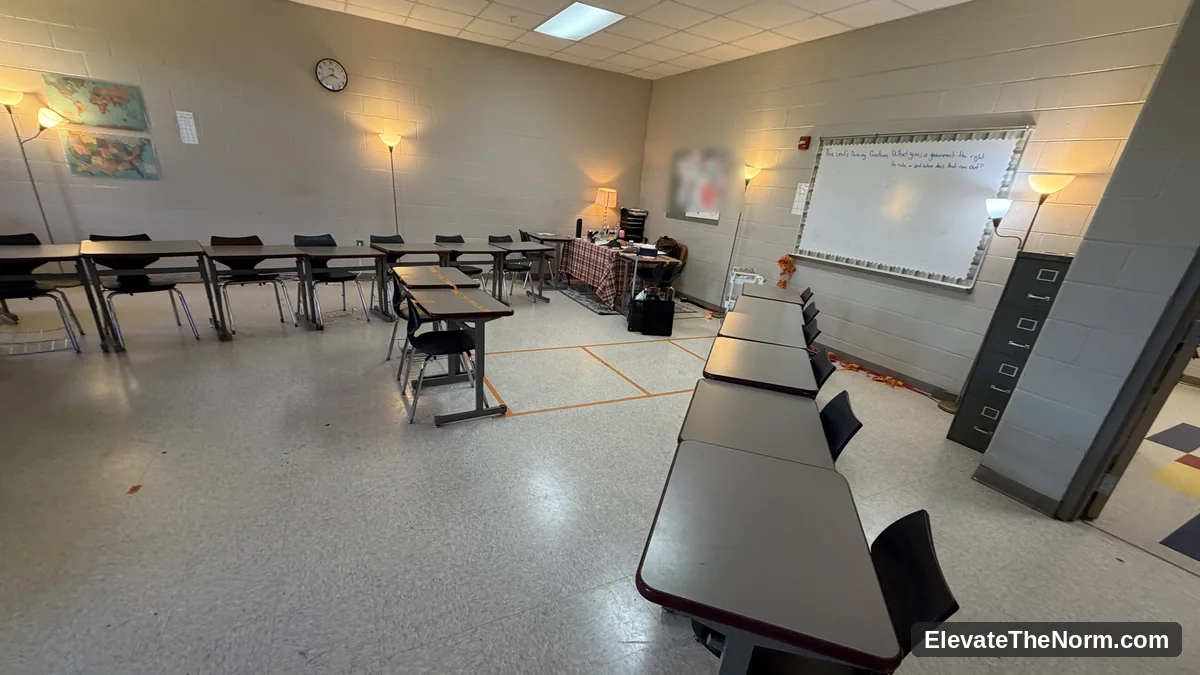
So when a class has a bad run, the overheads go on for a couple of days. No announcement, no name on the board, no lecture. They walk in, they see it, and they know exactly what it means because we talked about it in August.
Then it goes back.
The reason this works better than most things I have tried is that there is nothing to argue with. I have not taken anything away from anyone. I have not singled a student out, raised my voice, or manufactured a penalty. The room is simply in its standard state — the state the district issued it in — and the extra thing has paused. A teenager can be furious at a consequence that was imposed. It is much harder to build a grievance around a light switch.
It is also completely reversible, costs nothing, escalates nothing, and never once has required me to be the loudest person in the room. If you have read what yelling actually costs a classroom, the appeal of a consequence delivered by a switch will be obvious.
This is positive reinforcement and a consequence at the same time
That sounds like a contradiction and it is not.
Ninety-five percent of the time the lamps are doing reinforcement work, silently, for every student, with no points and no chart and nothing anyone has to earn each morning. It runs all day and nobody experiences it as being managed. That is the version of positive reinforcement I actually believe in — built into the room rather than administered to the student.
The other five percent is removal of an extra, not addition of a punishment, which is the distinction that keeps it from curdling. It sits on the same line as the rest of classroom consequences that teach rather than humiliate: proportionate, predictable, over quickly, and containing no message about anyone’s character.
Get that line wrong and it stops being clever. If the lights go on for a week, or go on because one student annoyed you, or go on with a speech attached about how this is why we cannot have nice things, you have converted a quiet environmental nudge into a grudge with a fixture. The test is the one that applies to any natural consequence: it should follow from the situation rather than from your mood. Two days, no commentary, back to normal.
Sometimes I Turn Them On and It Is Not a Consequence at All
This is the part that keeps the whole thing honest, and it is a bigger share of the switch-flipping than the discipline use.
- There is a substitute. A sub does not know the room, the routines, or which corner they cannot see. Handing them a dim room and a seating chart is a setup. The lights go on and I leave a note saying so.
- I cannot see everything. Some days the room is configured so a sightline is blocked, or I know I am going to be head-down with a small group. Supervision beats ambiance every single time, and it is not close.
- Somebody needs the light. A student with a visual impairment, a new IEP accommodation, a kid squinting at a text. That is not a negotiation.
- Fine-detail work. Small-print primary sources, close annotation, anything with a map.
I say which one it is out loud. Thirty seconds. “Lights are on today because I’ll be at the back table with a group and I need to see the whole room” costs nothing and stops students from reading a supervision decision as a punishment they cannot account for. A consequence nobody can distinguish from weather is not a consequence — it is just an unpredictable room, and unpredictable rooms make teenagers anxious rather than compliant.


Before You Move a Single Lamp: Four Conversations
I did most of these in the wrong order. Do them in this one.
1. The fire marshal, via your principal
This is the one that gets teachers in trouble, and the rules are more specific than people assume. Fire codes generally hold that extension cords are not a substitute for permanent wiring, and that relocatable power taps — power strips — must plug directly into a permanently installed receptacle, never into another strip or an extension cord, and never run under a floor or through a wall. Codes vary by state and district; the Indiana school guidance above is a clear example rather than the rule where you are.
The practical upshot: lamps go where outlets are, cords stay against the wall and out of walkways, and nothing gets daisy-chained. A lamp you have to reach with an extension cord is a lamp in the wrong place.
And do not buy halogen torchieres. The CPSC linked them to at least 189 fires and 11 deaths between 1992 and 1997, which is why they are banned outright in a lot of dorms and school buildings. The bulb runs hot enough to ignite anything that touches the shield. A modern LED torchiere is a different object and the risk does not carry over — but check what you are actually buying, and check your district’s policy before you plug anything in.
2. Whoever cleans your room
Custodians have to work in there at night, they need real light to do it, and they will reasonably flip everything on and leave it on. Ask. Six lamps in the path of a floor buffer is a problem you created for somebody else, and moving two of them is a five-minute fix if you hear about it in September rather than January.
3. Your case managers
If a student’s IEP or 504 plan speaks to the environment — reduced distraction, preferential seating, a visual accommodation — change the room before you change it, not after a parent calls. You do not get to unilaterally decide a documented accommodation is satisfied by a different arrangement. Bring the observation to the team.
4. Your students, in August, out loud
Tell them the lamps are the normal state of the room, tell them the overheads come back on when the room stops working or when you need to see everything, and tell them how long it lasts. Then tell them that anybody who wants more light gets a brighter seat, no conversation required.
A consequence a fifteen-year-old could have predicted on day one is fair. The identical consequence delivered as a surprise is a mood, and they can tell the difference instantly. It is the same reason routines have to be taught rather than announced — the system is only as good as the part they knew about in advance.
Where This Fails, and Who It Is Hardest On
I am wary of lamp-lighting posts that present this as universally kinder, because the research does not say that.
Noble and Isaacs’ 2025 study in Lighting Research & Technology asked 13 autistic adults in New Zealand to photograph and rate the electric lighting around them — 133 photographs in all. Flicker was identified as a problem by every single participant. Linear fixtures arranged in grid arrays drew strong dislike regardless of what lamp was actually in them. Warm colour temperature was generally liked. All of which supports the case above.
And then the finding that complicates it: some participants also disliked dim lighting, and brightness preferences varied by context — several valued bright light for tasks. Thirteen autistic adults in New Zealand is a small qualitative sample and not a classroom study, so hold it loosely. But it is enough to kill the idea that low light is automatically the accommodating choice.
So the honest version is: a lamp-lit room removes a real irritant for a lot of students and creates a new one for a few. The answer is not to pick a side. It is to build a room with both — a genuinely bright, well-lit seat that exists permanently and is available without anybody having to explain themselves, in exactly the same way a lower-stimulus seat should exist in a student-centered classroom.
Four other places it breaks:
- A shared room or a cart. If you do not own the space you cannot own the baseline, and without a stable baseline the consequence half of this does not exist at all. The comfort benefits still work. The management mechanism does not.
- A room with no windows. Lamps plus no daylight is a much bigger drop in total light than lamps plus a wall of glass. Measure, and expect to need more lamps than I do.
- An administrator who wants to see in. Some buildings have a visibility expectation, written or not. That is a legitimate concern and not one to quietly ignore — ask rather than wait to be told.
- Using it too often. If the overheads are on most weeks, the lamps are not the baseline any more and you have simply got a dim room and an inconsistent rule.
What to Do Next
Do not buy six lamps this weekend.
Buy two, put them in the two darkest corners, and run the room with half the overhead bank off for a fortnight — most classrooms are on two or more switches and almost nobody checks. Measure the desks. Ask the class what they notice, and take the answer seriously even if it is “nothing.”
If it holds, go the rest of the way in September rather than mid-year, because the baseline has to be established before it can be removed, and a change made in February reads as a reaction to something. Then tell them the rule on day one and use it four times a year.
Like most of the things that have actually worked in my room, it is cheap, slow, and boring — and it does more than the expensive thing it replaced. The same is true of where you put the desks, which is the other free variable most teachers set once in August and never revisit.
Before you go: grab the free Classroom Lighting Setup Planner (PDF) — ElevateTheNorm.com branded, printable, no email required.
Frequently Asked Questions
Will working in a dimly lit classroom damage my child’s eyes?
No. This is one of the most persistent eye-health myths there is. As an optometrist at the University of Utah’s Moran Eye Center puts it, “while more light can be helpful, reading in dim light will not hurt your eyes.” Low light can cause temporary eye strain and fatigue, which is a real comfort issue and a reason to measure the light level at the desks — but it does not cause lasting damage. A room that is too dark for a particular student to read comfortably is a problem to fix with a lamp, not a health risk.
Isn’t turning the lights on because the class misbehaved a collective punishment?
Partly, yes, and a teacher using this should say so rather than pretend otherwise. It affects everyone in the room including students who did nothing. What keeps it defensible is that nothing is taken from anybody: the room returns to the standard condition every other classroom in the building is in all day, for a day or two, and then it goes back. No student loses points, privileges, seat, or standing, and nobody is named. That is a meaningfully different object from a collective penalty. It is still worth using sparingly, never in response to one student, and never with a speech attached.
How much does this cost, and who pays for it?
A workable set of six floor lamps and a couple of table lamps runs to well under a couple of hundred dollars, and the bulbs last for years. The uncomfortable part is that in most schools it comes out of the teacher’s own pocket, which quietly means the teachers who can afford a nicer room have one. That is a real equity problem and not one an individual solves. If a school wants this, the cheap version is to fund lamps as classroom supply rather than leaving it to whoever can spare the money.
Doesn’t lower light make reading and focused work harder?
It can, and this is the step to take seriously rather than on faith. The Illuminating Engineering Society puts classroom reading and writing at roughly 30 foot-candles at desk height with a usable range of 15 to 60, and a lamp-lit room can sit comfortably inside that range or fall well below it depending on how many lamps there are and where they sit. Measure with a free light-meter app at several desks during the period you teach, not after school with the blinds open. If a desk is below about 15, add a lamp there. And for genuinely fine-detail work — small print, close annotation, maps — turn the ceiling on for that lesson.
What if my principal or the fire marshal says no?
Then the answer is no, and it is worth finding out which specific thing the objection is about, because it is usually fixable. Most concerns are about extension cords, daisy-chained power strips, cords across walkways, or halogen bulbs — all of which have straightforward remedies. Some buildings also have a visibility expectation about being able to see into a classroom. Ask before you set anything up rather than after; a lamp arrangement that has been cleared is stable, and one that has not can be removed on an afternoon’s notice.
Could a whole school or district do this?
Not really, and it would be the wrong lever anyway. This is a teacher-level choice that depends on owning the room, and the benefits are modest and partly about comfort rather than measurable achievement. The district-level version of the same insight is different and bigger: specify low-flicker drivers when fixtures are replaced. The evidence that flicker causes headaches and eyestrain is decades old and stronger than anything on lamps, and an LED retrofit into old gear can flicker worse than the fluorescents it replaced. That is a purchasing decision, and it reaches every room instead of one.
What if a student actually wants the overhead lights on?
Then they should be able to get more light without having to make a case for it. The practical version is a permanently well-lit seat that exists from day one, described to the whole class in August as an ordinary option rather than an accommodation, so that taking it is not a disclosure. Research on how autistic adults experience lighting finds that flicker and grid-array fixtures are close to universally disliked, but that preferences about brightness genuinely vary, and some people dislike dim light. A room built on the assumption that everyone wants it dark has just swapped one imposed environment for another.
Sources
- Barrett, P., Zhang, Y., Davies, F., & Barrett, L. (2015). Clever Classrooms: Summary report of the HEAD project. University of Salford, Manchester. Full report (PDF) — the source for the 16% figure and for light carrying about 21% of the explained variation. The sample was 3,766 pupils aged 5–11 across 153 classrooms in England; it is observational, and the authors caution that applying it elsewhere needs careful reinterpretation.
- Wilkins, A. J., Nimmo-Smith, I., Slater, A. I., & Bedocs, L. (1989). Fluorescent lighting, headaches and eyestrain. Lighting Research & Technology, 21(1), 11–18. Abstract and paper — the source for headaches and eyestrain being more than halved under high-frequency lighting. Participants were office workers, not students, and the intervention was better ballasts rather than less light.
- Lehman, B., Wilkins, A., Berman, S., Poplawski, M., & Miller, N. J. (2011). LED lighting flicker and potential health concerns: IEEE standard PAR1789 update. Full text (PDF) — the source for LEDs potentially modulating more deeply than fluorescents, for the ~35% modulation depth associated with headaches at 100 Hz, and for the paper’s own refusal to name a safe threshold.
- Noble, B., & Isaacs, N. (2025). Autistic people’s perception of interior electric lighting systems: An initial study. Lighting Research & Technology. Article — the source for flicker being identified by all participants, for grid arrays being disliked regardless of lamp type, and for the finding that some participants disliked dim lighting. Thirteen autistic adults in New Zealand; qualitative and small, and not conducted in classrooms.
- Illuminating Engineering Society recommended light levels, as summarised in this quick-reference guide (PDF) — the source for roughly 30 foot-candles maintained horizontal average at desk height for classroom reading and writing, range 15–60. This is a reference summary of the IES tables, cited as such rather than as the standard itself.
- U.S. Consumer Product Safety Commission (1997). CPSC and industry announce corrective action to improve safety of halogen torchiere floor lamps — the source for at least 189 fires and 11 deaths between 1992 and 1997, and for the guard and wattage remedies.
- Indiana Department of Homeland Security, Fire Code Awareness in Schools (PDF) — the source for extension cords not substituting for permanent wiring and for relocatable power taps needing a direct connection to a permanent receptacle. Cited as a clear worked example of school fire-code language; your state and district rules govern.
- University of Utah Health, Can reading in low light harm your eyes? Top 10 eye health myths debunked — quoting Gabriel Hulewsky, OD, of the John A. Moran Eye Center, for the point that reading in dim light does not damage eyes.
Every link above was checked on September 14, 2026. Where a figure comes from a summary rather than the primary document, the entry says so, and where a study’s sample does not match a secondary classroom, the article says so in the text rather than only here.