
Standards-based grading fails in practice more often than its advocates admit, and almost never for the reason its critics give. The objection is rarely that measuring proficiency against standards is a bad idea. It is that schools adopt a system requiring absolute consistency, deliver it inconsistently, and then discover that students, teachers and families all noticed.
This article takes the objections seriously rather than dismissing them as resistance to change. Several of them are correct.
If you want the case for it and what the evidence shows, that is a separate piece: what standards-based grading is and what the research supports. This one is the other half.
Key Takeaways
- Teachers are not marginally opposed to some of this. In a survey of nearly 1,000, 81 percent called no-zero policies harmful.
- Students object on specific, checkable grounds — inconsistency between teachers above all, not a general dislike of change.
- Reassessment can be socially costly. Some students said it made them appear stupid, which no policy document accounts for.
- Piecemeal adoption is the norm and the problem. These practices were designed as a connected system; almost nobody implements them that way.
- The most common failure is sequencing. Changing the report card before agreeing the standards produces a form nobody can complete consistently.
- None of this makes it a bad idea. Most of it makes it a bad idea right now, in a specific building, under specific conditions.
Free Download · 2-page PDF
Standards-Based Grading Readiness Check
The five “not yet” conditions as a department checklist, plus the one-hour moderation test, a reassessment rule builder and a transcript answer planner.
Free. No email address required. Designed for grades 6–12. Browse every printable in Your Free Library.
What Teachers Actually Say
The Thomas B. Fordham Institute, working with RAND, surveyed nearly a thousand K–12 teachers about grading policies commonly bundled with standards-based and equitable grading reform. The results are not close.

Eighty-one percent rated no-zero policies as harmful, with the consensus holding across demographic groups. Fifty-six percent said the same about removing late penalties. Unlimited retakes were the most accepted of the five policies studied, and even there the split was 41 percent helpful against 37 percent harmful.
A leader looking at those numbers has two options. Conclude that most of the profession is wrong, or take seriously that the people delivering the policy think it damages engagement.
There is a detail in that survey which matters more than the headline. Only 6 percent of teachers worked in districts using four or more of these policies, and just 2 percent had all five. Researchers flagged that piecemeal adoption as a concern, because the practices were designed as an interconnected system rather than standalone interventions.
Which means a large share of the teachers rating these policies harmful were rating them as they experienced them — one piece, bolted onto a system built on different assumptions. A no-zero policy inside a traditional points gradebook really is incoherent. That is not a misunderstanding on the teacher’s part. It is an accurate reading of a half-finished reform.
Writing for Fordham, Meredith Coffey makes a related argument: doing this well depends on school-level adaptation rather than district mandate, on standards rigorous enough that “meeting expectations” means something, and on students having genuine opportunities to demonstrate competency. Her named failure modes are a low bar, a top-down mandate without buy-in, and large schools with high teacher turnover.
What Students Say — and Why They Are Mostly Right
The most useful study here is secondary-specific, which is rare in this field. Peters, Kruse, Buckmiller and Townsley analysed over 500 critical statements from students at one high school during its first year of standards-based grading, published in American Secondary Education.
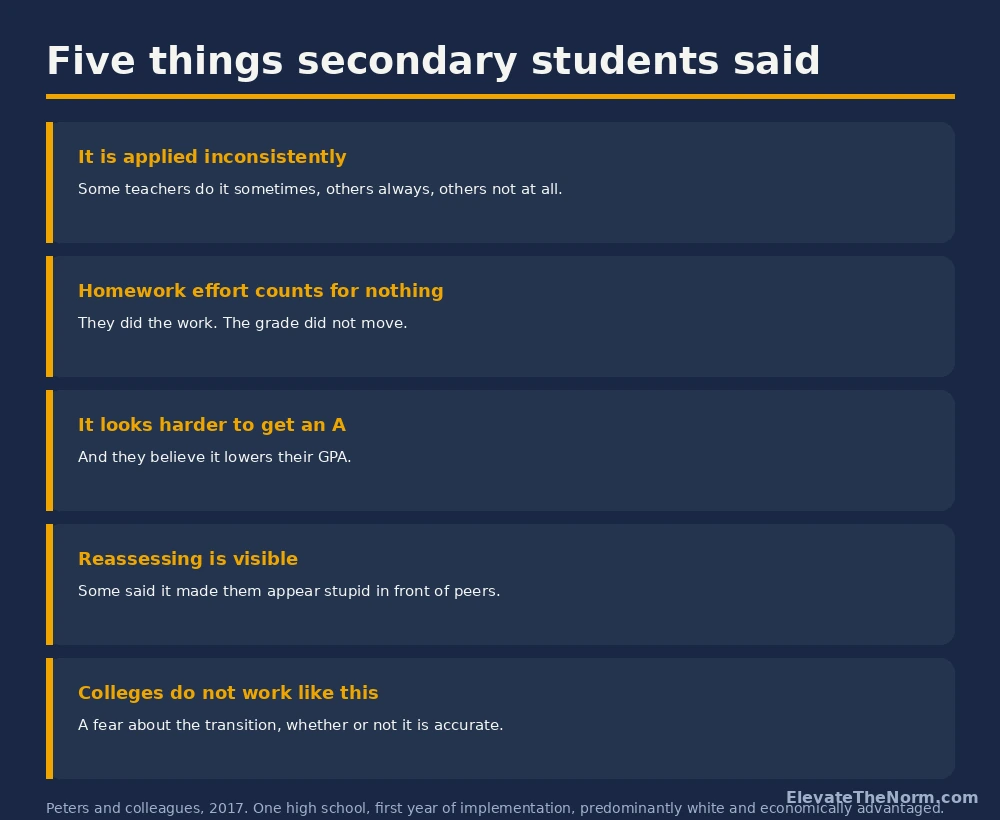
Inconsistency came first. As one student put it, “some teachers do it sometimes, others all the time, and some don’t do it at all.” Reassessment timelines, eligibility and limits all varied by classroom.
Read that as a finding rather than a complaint. A student is describing, accurately, a system that promises objectivity and delivers a different rule in every room. Their conclusion — that it is unfair — is a reasonable inference from the evidence available to them.
Homework counting for nothing came second. Students had done the work and watched the grade not move. The theory is sound: effort is a work habit, not evidence of proficiency. But if that has not been explained repeatedly, what a fifteen-year-old experiences is the school announcing that their effort was pointless.
Reassessment carried social cost. Some students said it made them “appear stupid.” This one rarely appears in implementation plans at all, and it is the one I find most persuasive, because no amount of policy design removes it. If reassessing is visible, it is a public statement about who did not get it the first time.
Motivation shifted early. Students reported studying less at first, reasoning they could just reassess later. That is rational behaviour in response to the incentives as they understood them.
The limitations, which the authors state: one high school of about 500 students, predominantly white and economically advantaged, during a first year of implementation when inconsistency would be at its peak, with the analysis deliberately focused on critical comments in order to understand resistance. Three of the four authors were university professors who use standards-based grading themselves. So this is not a representative picture of how students feel everywhere — it is a detailed picture of what goes wrong in year one.
The Reassessment Problem, and What I Do About It
When I need to redirect a student, I do it quietly, at close range, rather than announcing it to the room. It takes the same number of seconds and it costs the student nothing in front of thirty people.
The reassessment stigma finding is the same problem wearing different clothes. A student who has to publicly identify as someone who did not meet the standard has been handed a cost the policy never intended and never accounted for.
Most of the fix is logistical rather than philosophical. Reassessment that happens quietly, at a normal time, in a way that does not mark anyone out — scheduled during work everyone is doing, arranged in a two-word conversation at the table rather than announced, with more than one student doing it at once wherever possible. None of that changes the grading system. All of it changes whether a fifteen-year-old will use it.
A reassessment policy nobody will be seen using is not a reassessment policy. It is a line in a handbook.
The Objections That Do Not Hold Up
Not every criticism survives contact with the detail, and it is worth separating those out rather than treating all resistance as equally well founded.
- “It lowers standards.” It can, if “meeting expectations” is set at a trivial bar — Coffey names exactly that as a failure mode. But that is a decision about rigour, not a property of the system. A traditional gradebook with generous partial credit lowers standards just as effectively and less visibly.
- “Students will game the retakes.” Some will, early on, and the student data confirms it. It is also the objection most easily fixed by a written rule about what a student must do to earn a reassessment. “Unlimited” is not a policy.
- “It does not prepare them for the real world.” Most work outside school involves revision, feedback and redoing things until they are right. The single-attempt model is the unusual one.
- “Colleges do not use it.” Students raised this and it is a genuine anxiety, but it is a transcript-conversion question rather than an argument about grading. It has an answer; schools just have to give it before the first report card rather than after.
The pattern across all four: each is a real risk that a school can design against, and each becomes a genuine failure when nobody does.


When Standards-Based Grading Is the Wrong Move Right Now
Five conditions under which the honest recommendation is “not yet.”
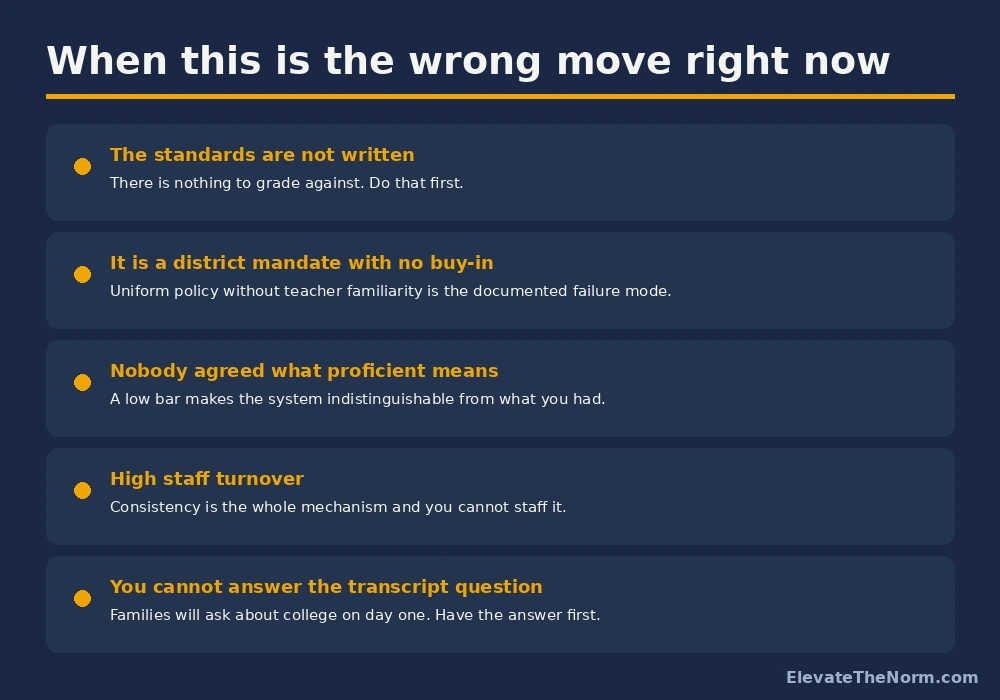
The first is the one that sinks most rollouts. If the standards themselves are not written in language a student could read, there is nothing to grade against, and every teacher will invent their own — which produces precisely the inconsistency students identified as the core injustice.
The second is structural and largely outside a teacher’s control. A district mandate with no buy-in is the documented failure mode, and Coffey’s argument is that school-level adaptation is what makes this work. A staff told to implement something they do not understand will implement five different versions of it.
And the last one is the cheapest to fix and the most often skipped. Families will ask about transcripts and college on day one. Not having an answer does not make the question go away; it just means the first person to answer it will be someone on a parents’ group who has guessed.
What to Do Next
If your school is considering this, the most useful meeting you can have is not about the report card. It is about whether every teacher in a department would give the same proficiency level to the same piece of work. Test it — take one student’s work, have four teachers score it independently, and compare.
If the answers diverge, you have found the actual problem, and it is the same problem whether you are grading by standards or by percentages. Standards-based grading did not cause it. It just makes it visible to students, who will then tell you it is unfair, and they will be right.
Fix the agreement first. The free proficiency-level rubrics are a reasonable place to start that conversation, no email required.
The conversion objection deserves its own answer rather than a footnote. Turning proficiency levels back into a percentage is the point where most of these arguments actually stall.
Before you go: grab the free Standards-Based Grading Readiness Check (PDF) — ElevateTheNorm.com branded, printable, no email required.
Frequently Asked Questions
Do most teachers dislike standards-based grading?
They dislike specific policies bundled with it, sometimes overwhelmingly. In a Fordham and RAND survey of nearly 1,000 teachers, 81 percent called no-zero policies harmful and 56 percent said the same about removing late penalties. Unlimited retakes split roughly evenly. What that survey does not show is teachers rejecting the underlying idea of grading against standards — it shows them rejecting individual practices, frequently as they experienced them bolted onto a traditional gradebook.
What is the strongest argument against standards-based grading?
Inconsistency, and it comes from students rather than from critics. When secondary students were asked what was wrong with it, their first and loudest answer was that different teachers applied it differently — different reassessment rules, different timelines, different eligibility. A system that promises a more accurate grade and delivers a different rule in every classroom has undermined its own central claim, and students notice that immediately.
Do students really dislike it?
In the one detailed secondary study available, yes — during the first year, in one school. They objected to inconsistency, to homework effort not counting, to a perception that As were harder to get, to the social cost of reassessing, and to a fear about college. The authors are clear about limits: one high school of around 500 students, predominantly white and economically advantaged, analysed specifically to understand resistance. It is a good picture of year-one problems, not a verdict on the model.
Does it lower standards?
It can, and that is a decision rather than a property of the system. If “meeting expectations” is set at a trivial bar, the grades mean no more than the ones you had before. The rigour of the standard is the thing to argue about — and it is worth noticing that a traditional gradebook with generous partial credit and extra-credit points lowers standards just as effectively, only less visibly.
Will students stop trying if they can always retake?
Some will at first. Students in the research said exactly that — they studied less initially because they believed they could reassess later. The fix is not abandoning reassessment but writing down what a student has to do to earn one. “Unlimited retakes” is the absence of a policy, and the schools that struggle most with this are the ones that never specified.
Why do so many districts reverse course on it?
Usually sequencing and mandate. Changing the report card before the staff has agreed what the standards are produces a form nobody can complete consistently, and a district-wide requirement without school-level buy-in produces as many versions of the system as there are teachers. Add a first-year dip in work completion, which is well documented and widely unexpected, and a leadership team reads month three as proof of failure.
So should a school do it or not?
It depends almost entirely on whether the groundwork exists. If your standards are written in student-readable language, your department can score the same work the same way, your reassessment rule is specific, and you can answer the transcript question — it is a better system for telling the truth about what students can do. If any of those are missing, fix that first. Most failures documented in this article are failures of preparation, not of the idea.
Sources
- Peters, R., Kruse, J., Buckmiller, T., & Townsley, M. (2017). “It’s just not fair!” Making sense of secondary students’ resistance to a standards-based grading. American Secondary Education, 45(3), 9–28. Full text (PDF) — one high school, first year of implementation, predominantly white and economically advantaged; analysis focused deliberately on critical statements.
- Geduld, A. (2025, September 17). A thousand teachers were asked about “equitable” grading. Most didn’t like it. The 74. Read the article — reporting on a Thomas B. Fordham Institute survey conducted with RAND. The survey itself was not read directly; this article is the source for the figures quoted above.
- Coffey, M. (2025, October 2). Standards-based grading can benefit students — in the right context. Thomas B. Fordham Institute. Read the commentary — the source for the conditions for success and the named failure modes.
- Marsh, V. L. (2023, November). Standards-based grading: History, practices, benefits, and challenges. Center for Urban Education Success, University of Rochester. Read the brief (PDF) — context on the implementation dip and stakeholder resistance.
Every link above was checked on September 12, 2026. Two of these sources are advocacy or commentary rather than primary research, and the text says which is which.