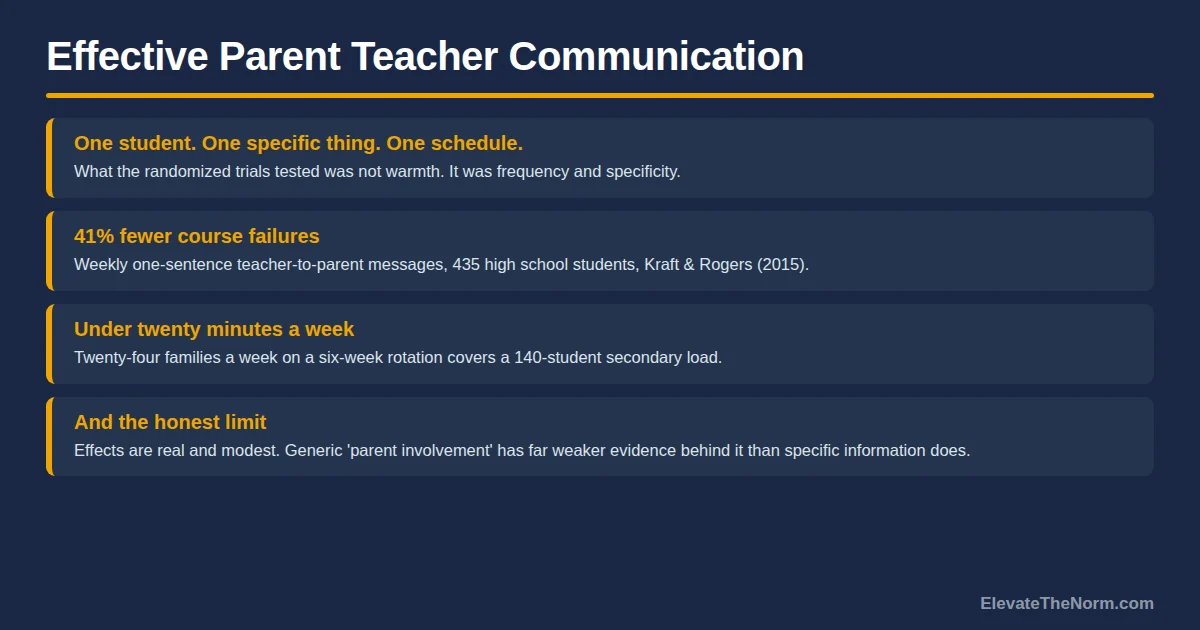
Effective parent teacher communication is short, specific, about one student, and sent on a schedule — and it starts before anything goes wrong. The strongest evidence in this corner of education research is not for longer conferences or better newsletters. It is for brief individual messages that reach a phone the family actually checks. That is the finding, and it is unusually consistent.
Most writing on this subject treats the problem as tone. Be warm. Build partnerships. Assume good intent. None of that is wrong and none of it is the part that moves a student. What moves a student is a parent who knows something specific and current that they did not know an hour ago.
This page covers what researchers actually tested, what they found, where the evidence runs out, and how a secondary teacher carrying 140 students can run the thing without giving up their evenings.
Key Takeaways
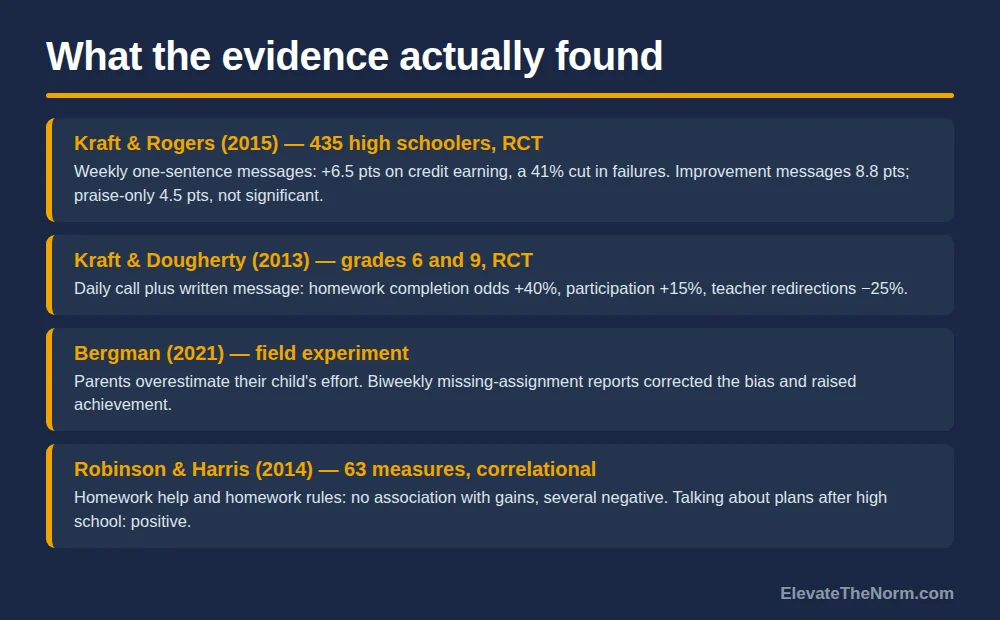
- Weekly one-sentence messages cut course failure. In a randomized field experiment with 435 high school students in summer credit recovery, weekly individualized teacher-to-parent messages raised credit earning by 6.5 percentage points — a 41% reduction in the failure rate.
- “Here is what to fix” outperformed “here is what went well.” In that same trial, improvement-focused messages produced an 8.8-point gain. Positive-only messages produced 4.5 points and did not reach statistical significance.
- Frequency matters more than length. A daily phone call plus a written message in a sixth- and ninth-grade summer program raised the odds of homework completion by 40% and cut the number of times a teacher had to redirect a student by 25%.
- Parents are wrong about their own kids in a predictable direction. They overestimate how much work their child is doing. Correcting that with regular reports on missed assignments improved achievement.
- Not everything called “parent involvement” helps. Across 63 involvement measures in two national datasets, helping with homework and setting homework rules were not associated with gains, and several forms were linked to worse outcomes.
- The barrier is structural, not attitudinal. Teachers spend about an hour a week on family contact — roughly 8% of their noninstructional hours — and report missing contact information, no protected time, and no stated expectation from the building.
What does effective parent teacher communication actually look like?
Four things: it names one student, it names one specific and recent thing, it arrives on a predictable schedule, and it reaches a device the family checks. Everything else is decoration.
The cleanest evidence comes from a randomized field experiment run by Matthew Kraft and Todd Rogers and published in Economics of Education Review. Teachers in a five-week summer credit recovery program wrote one sentence a week about each student. Not a paragraph. Not a form. One sentence, delivered to the parent by phone, text or email in whichever of four languages the family used. Students were randomly assigned to receive improvement-focused messages, positive messages, or nothing beyond an introductory call.
Credit earning rose 6.5 percentage points in the combined treatment group, which the authors describe as a 41% reduction in the course failure rate. Absenteeism fell 2.5 percentage points. The gain was driven largely by a 6.1-point drop in students dropping the program altogether.
Pay attention to how small the teacher’s job was in that design. The whole intervention was one sentence per student per week. That is the reason it is worth your attention: it is a finding about something a real teacher can actually sustain, not a finding about an ideal that collapses in October.
The honest limits matter too, and the authors state them. The sample was 435 students, predominantly Black and Hispanic, 81% eligible for free or reduced-price lunch, in one large urban district in the Northeast. External validity, in their words, is likely limited to low-performing urban high school students. Their planned replication never happened, for an unusually good reason — the district liked the result enough to roll parent outreach out everywhere, which erased the comparison group.
Should the message name the problem or the good news?
Name the problem. In the one trial that separated them, improvement messages moved the outcome by 8.8 percentage points and praise-only messages moved it 4.5 points without reaching statistical significance.
Be careful how far you carry that. The positive condition’s point estimate was still positive. What the study shows is that the improvement message was the one researchers could be confident about, not that praise is worthless. The practical reading is narrower and more useful: if you only get one message a week, spend it on something the family can act on.
There is a second reason not to write off positive contact, and it comes from the earlier Kraft study. Kraft and Shaun Dougherty ran a randomized experiment in a mandatory summer program with sixth and ninth graders, where the treatment was a daily phone call home plus a written message. Homework completion odds rose 40%, class participation rose about 15%, and instances requiring teacher redirection fell 25%. The authors traced those gains to three mechanisms: stronger teacher-student relationships, expanded parental involvement, and increased student motivation. The first of those does not get built out of bad news alone.
My own read, stated as opinion rather than finding: the first contact of the year should be the one with nothing wrong in it, because it buys you the credibility to make the second one count. The research does not test that sequence. It is a judgment call.
How often is often enough?
Weekly is the tested dose. Daily works better and will not survive a secondary teaching load. Monthly is close to nothing.
Three studies bracket the range. Kraft and Rogers sent one message a week. Kraft and Dougherty called daily. A third randomized trial, run by Samuel Berlinski and colleagues across seven low-income schools in Santiago, Chile, texted parents weekly attendance and monthly grade and behavior updates, and found a 0.083 standard deviation gain in math GPA and a 4.5 percentage point increase in students meeting the attendance requirement.
That Chilean study is worth citing and worth qualifying in the same breath. It covered grades 4 through 8, so much of the sample was younger than the students this site is about. The effects were smaller than comparable U.S. interventions, which the authors attribute to Chile’s exam-based grading. Only about 60% of the messages were confirmed delivered. And its most interesting result for a secondary teacher is the heterogeneity: students at higher baseline risk showed effects roughly two to three times larger than their lower-risk peers. Where you spend your twenty minutes is not a neutral choice.
What should the message actually say?
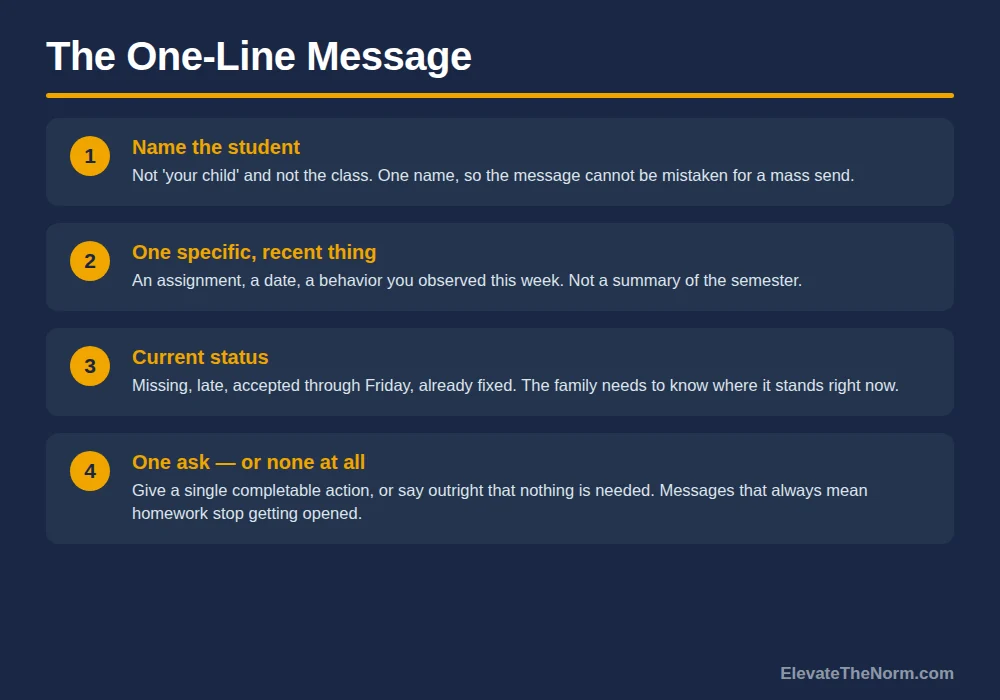
Four parts, one sentence or two. A name, a specific and recent thing, the current status, and either one clear ask or an explicit statement that there is nothing to do.
That last part is the one most teachers skip, and it is the one that keeps families reading. If every message you send implies homework for the parent, the messages stop getting opened by November.
Three patterns that work
- Nothing needed. “[Name] turned in the unit argument paper today and it was one of the strongest drafts in the period. Nothing needed on your end — just wanted you to know.”
- Actionable and time-bound. “[Name] has two missing practice sets from last week. Both can still be turned in by Friday for full credit.”
- Early flag, no verdict. “[Name] has been quiet in discussion for about two weeks. Not in trouble, not a discipline thing. Flagging it in case something is going on.”
What to leave out
- Adjectives about character. “Disrespectful,” “lazy,” “doesn’t care.” Report the behavior and the date. The parent can draw conclusions about their own child; that is their job, not yours.
- Anything that sounds like a diagnosis. You are not qualified to speculate about attention, anxiety, or home life in a text message, and a guess in writing follows a kid around.
- An ask the family cannot complete. “Please talk to him about his attitude” is not an action. “Two practice sets, due Friday” is.
- A consequence the office has already assigned. Relitigating a referral by text puts you between the family and the administrator, and it will not go well for you.
What does not work — and what the research does not say
Generic “parent involvement” is not the same thing as specific information, and the evidence for the first is much weaker than schools assume.
Keith Robinson and Angel Harris examined 63 different parental-involvement indicators across two national longitudinal datasets spanning three decades. Helping with homework was not associated with achievement gains. Setting rules about homework or GPA was not either. Several forms of involvement were linked to negative outcomes. What did show an association: conversations between parents and children about plans after high school, and parents holding high educational expectations.
The authors are careful, and anyone citing them should be too. Their data are correlational, and they say outright that their findings cannot definitively confirm or deny whether parental involvement improves outcomes. Their sharper point is a policy point: telling parents to be “involved” without specifying which involvement is unlikely to accomplish anything.
Put their work next to the randomized trials and a reading emerges, though I want to be clear this is my interpretation and not a claim either set of authors makes. The experiments that worked did not ask parents to teach. They handed parents accurate, current, specific information and let the family decide what to do with it. That is a materially different intervention from “be more involved,” and it happens to be the one with random assignment behind it.
Peter Bergman’s field experiment, published in the Journal of Political Economy, points the same direction. He found that parents hold upwardly biased beliefs about how much effort their child is putting in. Biweekly information about missed assignments attenuated that bias and improved achievement, and he attributes the effect to more accurate beliefs and lower monitoring costs. Parents were not short on willingness. They were short on facts.
How do you do this with 140 students?
Run a rotation. Roughly two dozen families a week, in a fixed block you protect, so that every family in your roster hears from you inside six weeks.
The arithmetic is the whole argument. 140 students divided across a six-week cycle is about 24 contacts a week. At forty-five seconds a message — which is what a one-sentence text actually takes once you stop drafting it like an email — that is under twenty minutes. Five minutes a day, four days a week.
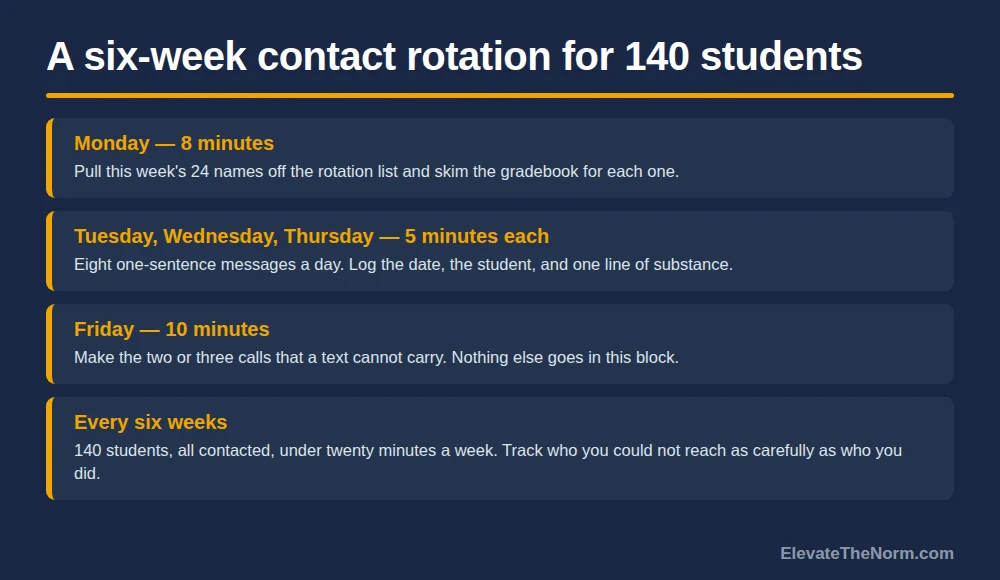
| Day | What happens | Time |
|---|---|---|
| Monday | Pull the week’s 24 names off the rotation list. Skim the gradebook for each. | 8 min |
| Tuesday | Send eight messages. Log each one with date and substance. | 5 min |
| Wednesday | Send eight more. Handle any replies from Tuesday. | 5 min |
| Thursday | Send the last eight. Flag anything that needs a call instead of a text. | 5 min |
| Friday | Make the two or three actual phone calls. Nothing else. | 10 min |
Four rules that keep a rotation alive past October
- Audit contact information in the first two weeks. Outdated and missing numbers are the single most reported structural barrier, and a rotation built on a bad roster quietly stops reaching the families who most need it.
- Never let a family’s first message be a problem. Front-load the cycle so every family gets a neutral or positive contact before anything goes wrong.
- Log it. Date, student, medium, one line of substance. A simple contact log is the difference between a practice and a vague memory of having called somebody.
- Do not automate the sentence. An auto-generated “missing assignment” alert is a different product from a teacher writing one line. Both have a place, and the apps built for this are genuinely useful for logistics. Neither replaces the other.


What about the conversation you do not want to have?
Lead with the fact, hand the family the floor, and leave with one agreed next step and a date on it.
- Open with the specific, not the summary. “There were four missing assignments in the last two weeks and a zero on the unit test” is a starting point. “He is struggling” is not.
- Stop talking. Ask what they are seeing at home and then actually wait. Families often know the reason and will not volunteer it into a monologue.
- Say what you can and cannot change. Deadlines you control, you can move. School policy you do not control, you should not pretend to.
- Agree on one thing, not five. One action, one owner, one date. A plan with five parts is a plan nobody completes.
- Write it down and send it. Two sentences, same day, so the family and the file both have the same version.
If a parent is angry, do not defend and do not re-argue a consequence the office assigned. Restate what you heard, confirm the facts you are sure of, and say plainly which part of it is not yours to decide. If the subject is academic dishonesty, the documentation matters more than usual and the wording is its own problem — that is covered separately in how to write the academic integrity email.
Teenagers should know these conversations are happening. A student who finds out their teacher and their parent have been talking for six weeks behind them learns something about you that you did not intend to teach. Tell them the rotation exists and that everyone is on it. It also removes the signal value of a phone call, which is most of what makes students dread one.
Three ways this practice goes wrong
A message that improves a student’s grade can still do harm. None of the trials cited above measured what happened at home after the text arrived, and that gap deserves to be named rather than glossed.
- It can turn into punishment you did not order. An improvement message lands in a house you know nothing about. Most families handle it fine. Some do not. Write messages that describe work and deadlines rather than character, keep “he refuses” and “she does not care” out of writing entirely, and pair a problem with the path back to fixing it in the same sentence. If you have reason to believe a message will make a student’s evening worse, that is a conversation with a counselor, not a text.
- It can leak through the wrong channel. Use the district’s approved platform, school email, or a school-provided number. Not your personal cell. That is partly a records question — family communication about a student is often a record — and partly self-protection. Once your personal number is in a hundred phones you do not get it back.
- It can quietly skip the families hardest to reach. A parent working nights, a family sharing one phone, a household that needs a language you do not have, a number disconnected in September. A rotation that only reaches the easy 80% will read as a success in your log and will be a failure in the only place it matters. Track who you could not reach as carefully as who you did, and hand that list to someone in the building who can do something about it.
One more, from the student’s side. Grades 6–12 students are old enough to be told what is being said about them, and old enough to resent finding out later. Tell your classes the rotation exists, tell them everyone is on it, and be willing to show a student the sentence you sent about them. If you would not show it to them, do not send it.
What administrators owe teachers here
Accurate contact data, protected time, and a stated expectation. Without those three this is a volunteer program, and volunteer programs produce unequal coverage.
The Federal Reserve Bank of Boston’s Communities & Banking reported that teachers give roughly an hour a week to parent communication — about 8% of their noninstructional work hours — while principals spend around 3% of their workday on it. The barriers teachers named were not about caring: inaccessible or outdated parent contact information, language barriers, no noninstructional time during the school day, and no clear expectation from the building about when or why to contact families.
That last one is the cheapest to fix and the one most worth fixing. A building that states an expectation — every family hears from a teacher inside the first three weeks, and again at least monthly — and then protects twenty minutes a week for it, has done more than any platform purchase will. A building that buys the platform and states nothing has bought a log of messages nobody sent.
There is an equity argument here that superintendents should hear plainly. When contact is voluntary, the families who get contacted are disproportionately the families who already contact you. The Chilean trial found the largest effects among the highest-risk students. If the practice is left to individual initiative, those are precisely the students it will reach last.
What to do next
Pick one class period, not all six. This week, verify the contact information for every student in it and find out which families prefer text, which prefer a call, and which need another language. Next week, send twenty-four one-sentence messages and write down that you sent them. Six weeks after that, put your failure list next to your contact log and see whether the names overlap.
That is what effective parent teacher communication comes down to in practice, and it is unglamorous: under twenty minutes a week, and it has better randomized evidence behind it than most of what gets presented at professional development. Build it into the routines you already run rather than treating it as one more initiative, and pair it with expectations students can actually see so the message a family gets matches the room their kid sits in. If attendance is your presenting problem rather than grades, the absenteeism evidence points at family messaging for that too.
Frequently Asked Questions
What is the most effective way for teachers to communicate with parents?
Short, individual messages sent on a regular schedule, through whatever channel the family actually checks. In a randomized field experiment with 435 high school students, teachers who sent one individualized sentence per week to each family raised course credit earning by 6.5 percentage points, a 41% reduction in the failure rate. The medium mattered less than the fact that the message named one student and one specific, recent thing. Newsletters, group emails, and general updates were not what was tested and are not what produced the result.
How often should teachers contact parents in middle and high school?
Weekly is the dose with the best evidence behind it, and it is achievable if you run a rotation rather than trying to contact everyone every week. Roughly two dozen families a week across a six-week cycle covers a 140-student load in under twenty minutes of actual work. Daily contact produced larger effects in one summer-program study, but that study involved a handful of students per teacher and does not transfer to a full secondary schedule. Monthly is better than nothing and close to nothing.
Should the first contact home be positive or about a problem?
The research is narrower than the advice you usually hear. In the one trial that separated them, improvement-focused messages produced an 8.8 percentage point gain while positive-only messages produced 4.5 points and did not reach statistical significance. That is an argument for spending a scarce message on something actionable, not an argument that praise is useless — the positive estimate was still positive. Making the first contact of the year a neutral or good one is a judgment call about credibility, not a research finding.
Does texting parents actually improve student grades?
In several randomized trials, yes, with modest effect sizes. Weekly texts and calls reduced course failure in a U.S. high school credit recovery program. Biweekly reports on missed assignments corrected parents’ overly optimistic beliefs about their child’s effort and improved achievement. A trial in Chile covering grades 4 through 8 found a 0.083 standard deviation gain in math GPA, with effects two to three times larger for higher-risk students. These are real but moderate gains from a very cheap intervention, not a transformation.
What should a teacher never put in a message home?
Adjectives about character, anything that reads as a diagnosis, an ask the family cannot actually complete, and any attempt to relitigate a consequence the office already assigned. Report the behavior and the date rather than your conclusion about the student. “Two missing practice sets, both accepted through Friday” gives a family something to do. “He does not care” gives them nothing and follows the kid around in writing. Use the district’s approved channel, not your personal phone number.
How can one teacher contact 140 families without losing their evenings?
Divide the roster across a six-week rotation: about 24 families a week, eight messages a day on three days, with one short block on Friday for the two or three situations that need an actual phone call. A one-sentence text takes about forty-five seconds once you stop drafting it like an email. Log the date, the student, and one line of substance each time. The log is what turns this from a vague sense of having called somebody into a practice you can check against your failure list.
Do parent-teacher conferences still matter if short messages work better?
They do different jobs. A conference is the right setting for a complicated situation, a plan involving several adults, or a conversation that needs faces. What the evidence suggests is that a conference is a poor substitute for frequency — twice a year cannot carry the information load that a weekly sentence can. Conferences also reach the families who can attend, which is not the same set as the families who need contact. Treat conferences as a supplement to a rotation, not as the system itself.
What do schools need to do to make this work?
Three things, and none of them is buying software. Keep parent contact information accurate and current, because outdated numbers are the most commonly reported barrier. Protect actual time in the schedule for it. And state an explicit expectation — every family hears from a teacher within the first three weeks and at least monthly after that. Teachers give roughly an hour a week, about 8% of their noninstructional hours, to family contact. Without a stated expectation, coverage skews toward families who already reach out.
Sources
- Kraft, Matthew A., and Todd Rogers. “The Underutilized Potential of Teacher-to-Parent Communication: Evidence from a Field Experiment.” Economics of Education Review, vol. 47, 2015, pp. 49–63. Full text (PDF).
- Kraft, Matthew A., and Shaun M. Dougherty. “The Effect of Teacher–Family Communication on Student Engagement: Evidence From a Randomized Field Experiment.” Journal of Research on Educational Effectiveness, vol. 6, no. 3, 2013, pp. 199–222. ERIC record EJ1164707.
- Bergman, Peter. “Parent-Child Information Frictions and Human Capital Investment: Evidence from a Field Experiment.” Journal of Political Economy, vol. 129, no. 1, 2021, pp. 286–322. Journal listing.
- Berlinski, Samuel, Matias Busso, Taryn Dinkelman, and Claudia Martínez A. “Reducing Parent-School Information Gaps and Improving Education Outcomes: Evidence from High-Frequency Text Messages.” IDB Working Paper Series No. IDB-WP-1221, Inter-American Development Bank, 2021. Working paper (PDF). Sample was grades 4–8 in Chile; cited here with that limit stated.
- Robinson, Keith, and Angel L. Harris. The Broken Compass: Parental Involvement with Children’s Education. Harvard University Press, 2014. Summary of findings via the Center for the Study of Religion and Society, University of Notre Dame. Cited from this summary, which is what was read; the book itself was not obtained.
- “The Underutilized Potential of Teacher-Parent Communication.” Communities & Banking, Federal Reserve Bank of Boston, Spring 2016. Article (PDF).
A note on the evidence. Four of the six sources above are randomized experiments or peer-reviewed research, and one is deliberately included because it cuts against the grain. The effect sizes here are real and modest. Anyone telling you that texting parents transforms a school is selling something.