
By Clay Shumate
The best questions to ask at a parent teacher conference in middle or high school are the ones that produce something your kid can act on by Monday. Not “how is he doing,” which gets you “he’s doing fine.” Ask what specifically is going wrong, what it would look like fixed, and who is responsible for which part.
Most conference question lists online were written for the parent of an eight-year-old with one teacher. At thirteen and sixteen the event is different, and the research on what parent involvement does at this age points somewhere those lists do not go.
Key Takeaways
- The involvement that correlates best with achievement in middle school is not the kind most conferences produce. In a meta-analysis of 50 studies, academic socialization — helping a teenager connect schoolwork to where they are going — had the strongest positive association. Homework help had the strongest negative one.
- Ask for specifics, because vague questions get vague answers. “What does a 4 look like on the next project?” is a different question from “how’s she doing?” and it is the only one of the two a teacher can answer usefully in fifteen minutes.
- Bring your kid. In a four-school study of student-led conferences, parent attendance was at least 92% at every site. Whatever else changes, more families show up when the student is running the meeting.
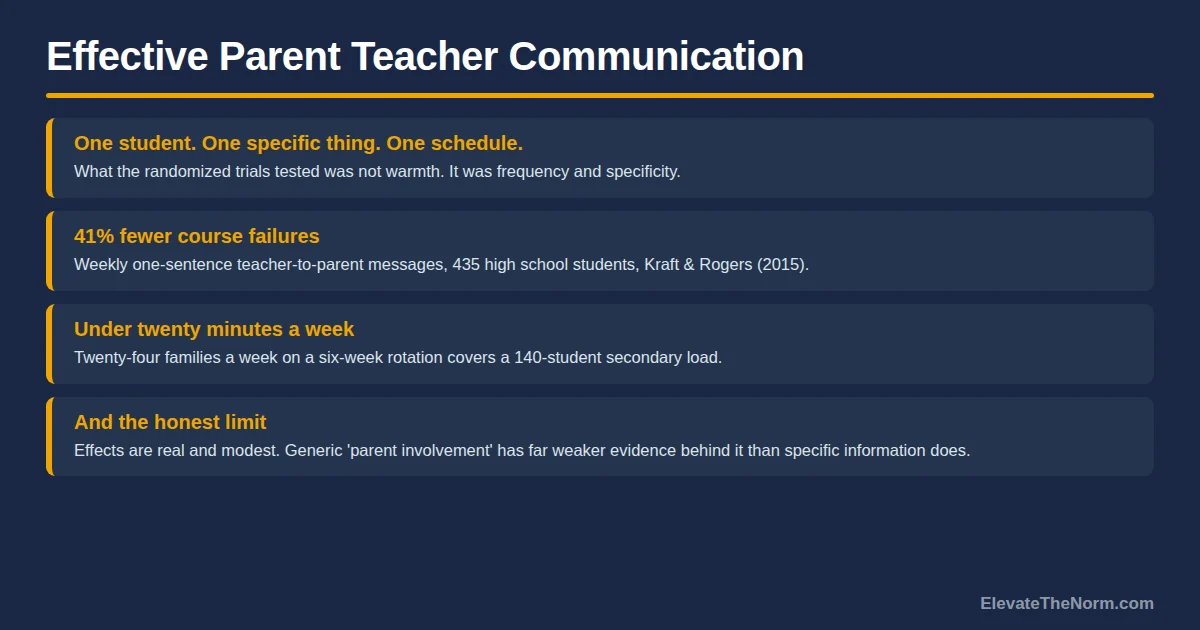
- What happens after the conference is what decides whether it mattered. A randomized trial of weekly one-sentence teacher-to-parent messages cut the share of high school students failing to earn credit by 41%. Fifteen minutes in October does not do that on its own.
- Specific, improvement-focused messages beat warm general ones. In the same trial, messages about what a student needed to improve produced a significant gain. Messages about what the student was doing well did not.
Free Download · PDF
The Parent-Teacher Conference Question Card (2 pages)
Page 1 is the ten questions with what each one is for, the four to ask when the news is bad, and the five that waste the slot. Page 2 is a notes grid for up to seven teachers, with a column for the follow-up date you should not leave without.
Free. No email address required. Designed for grades 6–12. Browse every printable in Your Free Library.

What Should You Actually Ask at a Parent Teacher Conference?
Ask four things: what the specific problem is, what fixed looks like, what the student does next, and how you will both know whether it worked. Everything else is a variation on those four.
The reason to be that blunt is arithmetic. A secondary conference is ten to fifteen minutes, and a teacher with five sections sees north of a hundred students a day. Teachers are not being evasive when they say “she’s doing great.” They are answering the question you asked.
Why the Middle and High School Conference Is a Different Event
You now have six or seven teachers instead of one, less time with each, and a student old enough to have a position on being talked about. Those three changes break most of the standard advice.
In elementary school one adult sees your child all day and can describe them whole. In seventh grade nobody has that view. Each teacher sees your kid for fifty minutes in one subject, often in one mood. That is the structure, not a flaw in the teachers — but it means six teachers asked “how is she doing” will give you six fragments and no picture.
So decide in advance what you are trying to find out and ask the same focused question in every room. Patterns show up fast. Behind in one class is a problem with that class. Behind in five is a problem with time, sleep, or something nobody has named yet.
What Does the Research Say Parent Involvement Should Look Like at This Age?
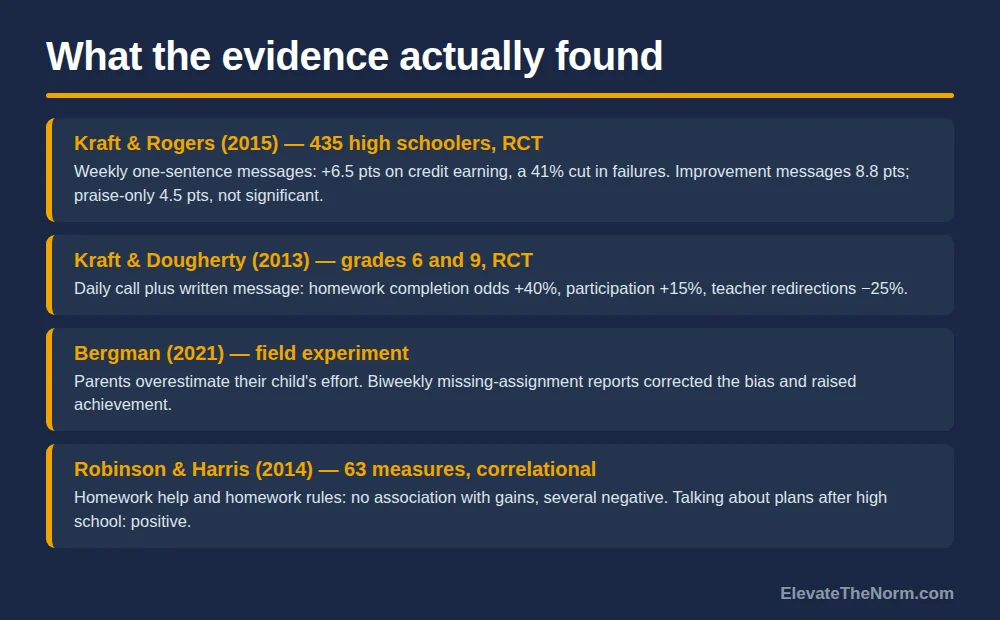
It says the most effective thing a parent can do with an adolescent is help them see the point. Nancy Hill and Diana Tyson’s meta-analysis of 50 studies of parental involvement in middle school, published in Developmental Psychology in 2009, found an average correlation of r = .18 between involvement overall and achievement. Underneath that average, the types split sharply.
Academic socialization had the strongest positive association. That is the clumsy research name for an ordinary thing: talking with your kid about why school matters, what they want, what their plans require, and how the work in front of them connects to it. Communicating expectations, discussing learning strategies, linking coursework to goals.
School-based involvement — volunteering, showing up, attending events — was positive and significant but smaller. Home-based involvement was not statistically significant. And helping with homework had the strongest negative association of anything they measured.
Read that last one carefully, because it is easy to turn into a slogan it does not support. This is correlational, and parents help most with homework when a student is already struggling, so some of that negative number is parents responding to a problem rather than causing one. The honest reading is not “helping with homework hurts your child.” It is that there is no evidence more homework help is the lever, and a conference spent negotiating who checks the math packet is spent on the form of involvement with the least support behind it.
Which gives you a sorting rule. A question that ends with you doing more of your teenager’s work is a weak question. A question that ends with your teenager understanding what the work is for is a strong one.
The Ten Questions, and What Each One Is For
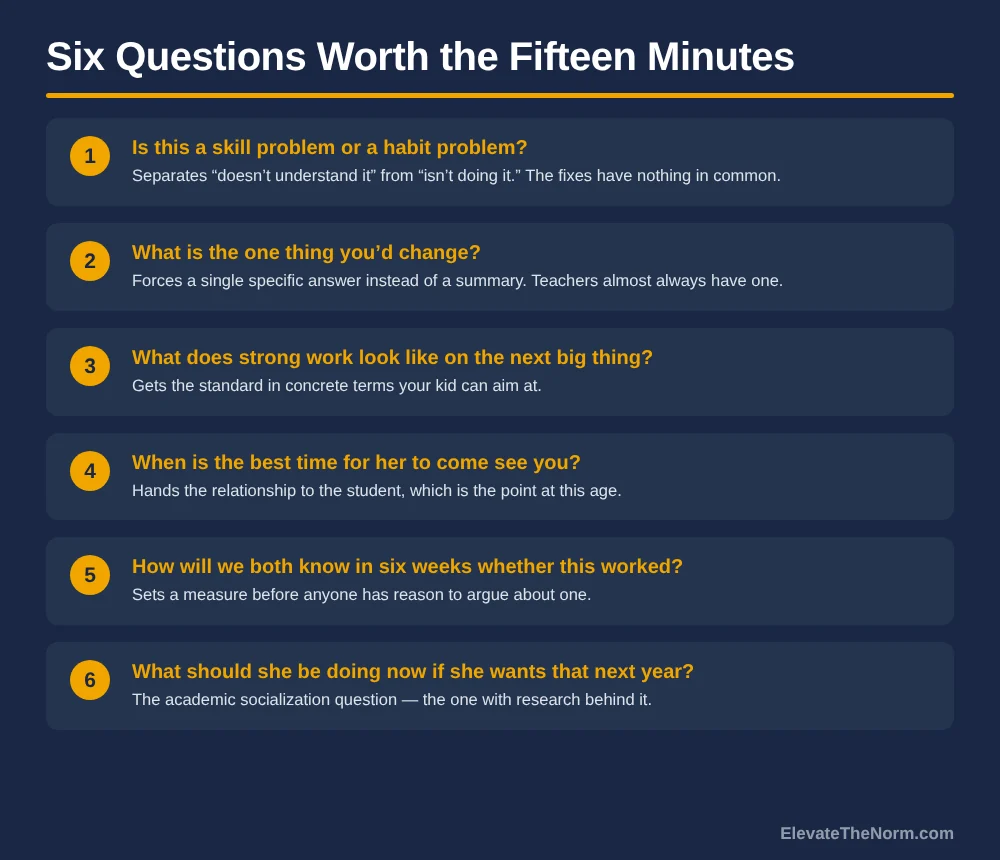
Pick four or five — you will not get through ten — and ask the same ones in every room so you can compare.
| Ask this | What it is actually for |
|---|---|
| “What is the one thing you’d change about how she works in your class?” | Forces one specific answer instead of a summary. Teachers almost always have one. |
| “Is this a skill problem or a habit problem?” | Separates “doesn’t understand it” from “isn’t doing it.” The fixes have nothing in common. |
| “What does strong work look like on the next big thing?” | Gets the standard in concrete terms your kid can aim at. |
| “What would you want him to do differently tomorrow?” | Converts a judgment into an action with a date on it. |
| “When is the best time for her to come see you?” | Hands the relationship to the student, which is the point at this age. |
| “What is he like in class when I’m not there?” | You know your kid at home, not at 10:40 in a room of thirty. |
| “Is anything I’m doing at home making this harder?” | Rarely asked, often answerable, and it signals you are not here to litigate. |
| “How will we both know in six weeks whether this worked?” | Sets a measure before anyone has reason to argue about one. |
| “What’s the fastest way to reach you, and how fast is realistic?” | Prevents the two-week silence that turns into a grievance. |
| “What should she be doing now if she wants that next year?” | The academic socialization question — the one with research behind it. |
Write the answers down in the room. Not because you will forget — because a teenager reads a parent taking notes as evidence the meeting was real.
What About the Homework Question?
Ask about homework, but ask about the system rather than the assignment. “Where does she find out what’s due?” and “what happens when something comes in late?” are system questions. “Can you send me the list every week so I can check it” is an assignment question, and you have just volunteered to be your kid’s secretary for the rest of the year.
The distinction tracks the research. Knowing how the class works is information your teenager can be handed. Doing the tracking yourself is the form of involvement with the weakest evidence behind it and the highest cost to the thing you are supposedly building, which is a kid who can run their own week — and every piece of that you take over is a piece they do not get to practice.
Should Your Teenager Be in the Room?
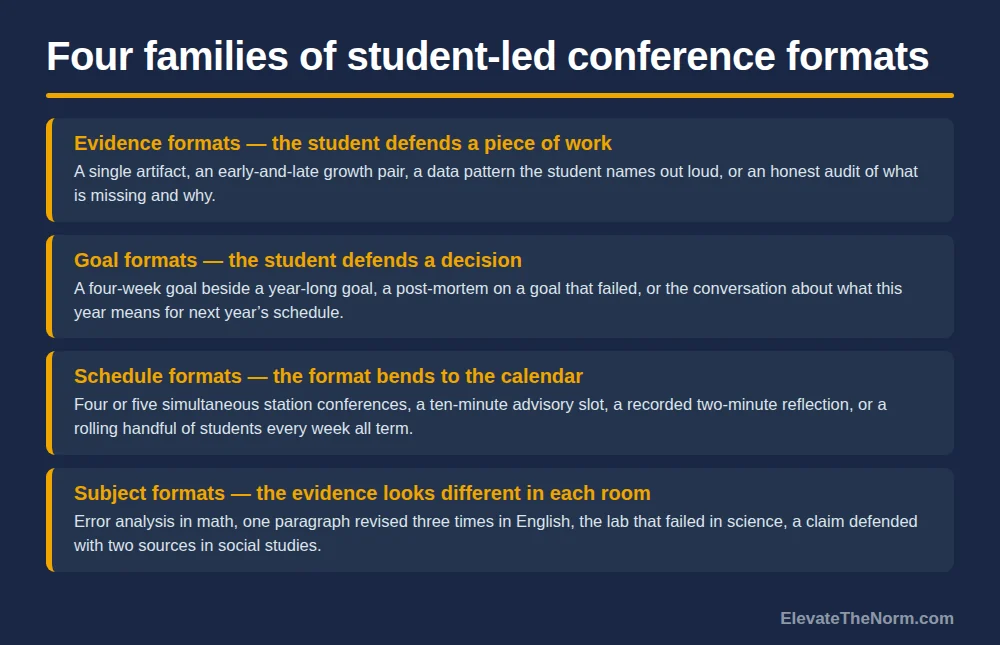
Yes, and it is the single highest-leverage change available to most families. Conferences held about a student who is standing in the hallway teach that student that their education is a negotiation between adults.
The clearest evidence comes from a four-school program evaluation by Christine Tuinstra and Diana Hiatt-Michael, published in The School Community Journal in 2005, covering 524 middle school students and 523 parents across California, Oregon, Texas and Washington. Parent attendance reached at least 92% at every one of the four schools. Over 94% of students reported revising work and 90% reported setting academic goals.
Be careful with the rest of it. This was a program evaluation with surveys and interviews, not a controlled trial, and there was no comparison group. Administrators reported higher test scores and fewer discipline problems, but those are reports rather than measured outcomes. The attendance figure is the hard number here. The satisfaction data says people liked it, which is worth something and is not proof it raised achievement.
Even so, 92% is a result most schools would take — and bringing your own kid to your own conference requires no program at all. If your school runs student-led conferences, go. If not, bring your kid anyway and let them answer first. Hand them the opening question — “tell Mr. Reed what you think is going on in here” — and watch what the teacher does with it. If the student runs the meeting, a student led conference template keeps it on track.
Two exceptions, and they are real. Anything touching a disability, a mental health concern, or a formal plan belongs in a different meeting with different people, not a crowded cafeteria at 6pm — ask for it separately. And if a parent genuinely needs to say something without their kid hearing it, say it in the last two minutes after the student steps out, openly, rather than arranging to have the real conversation behind them.
Give the student the right of reply. If a teacher describes something and the student thinks it is wrong, they get to say so in the room. Not to win — to be corrected, or to correct the record, which is what we claim to want from them everywhere else. A meeting where a sixteen-year-old sits silently while two adults characterize them is not teaching accountability. It is teaching that accountability happens to you.
What Do You Ask When the News Is Bad?
Ask what the recovery path is, and ask it before you ask anything about blame.
Bad news usually arrives as a number — a 58, four missing labs, a referral. The number is not the useful part. These four questions are, in this order:
- “What is recoverable and what isn’t?” Some of it can be fixed; some is arithmetic that has already happened. Know which before you plan anything.
- “What is the first thing, and when is it due?” One task with a date. A list of eleven is a list a struggling teenager will not start.
- “What do you need from me, specifically?” Sometimes it is a quiet place and a bedtime. Sometimes it is nothing. Let the teacher say.
- “What do you need from him?” Asked with the student in the room, out loud, so the agreement has a witness.
Then stop. Spending the last six minutes on whose fault it is has never once changed a grade. And if the real issue is that your kid has decided the class is pointless, that belongs to the longer conversation about a student who appears not to care, not to fifteen minutes in a cafeteria.
What If You Can’t Get There?
Then it happens on the phone, and that is not a lesser version of the meeting. Conference night is scheduled for the convenience of the building, not of a family working second shift, and a parent missing from the sign-in sheet has not declined to be involved.
Email the two teachers who matter most this term, ask for ten minutes by phone, and send the same focused question you would have asked in person.
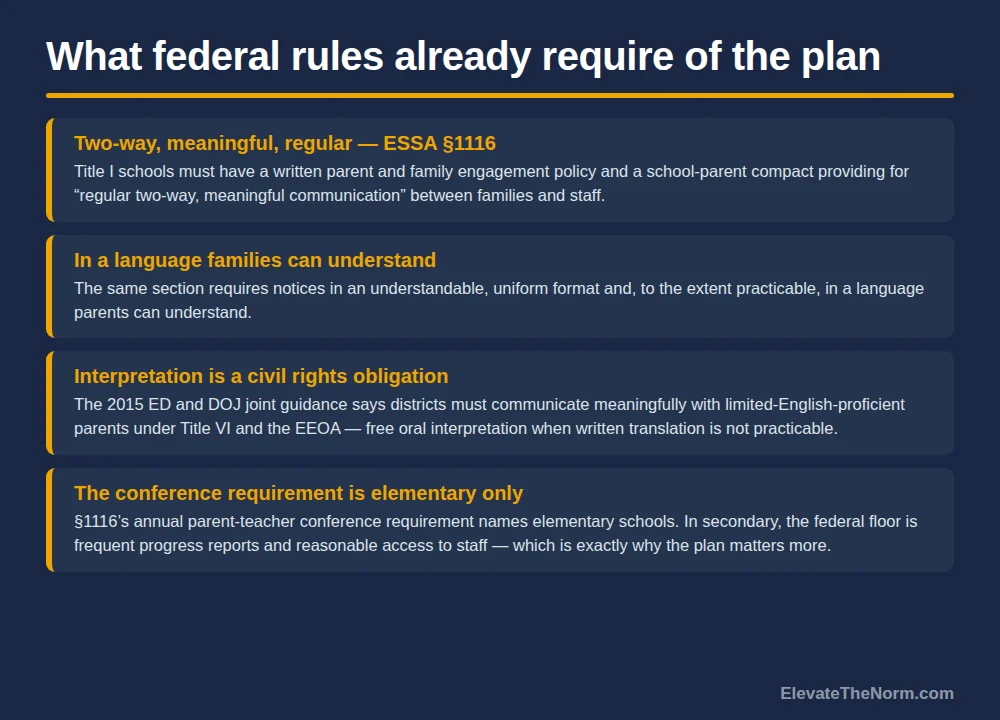
If English is not the language you want this conversation in, ask the school for an interpreter, in writing. Districts receiving federal funds are required to communicate with families in a language they understand. A bilingual student translating a conversation about their own grades is not meaningful access and puts a teenager in an impossible position. Schools generally arrange it when asked; the asking is the part that often does not happen.
For the school side: if attendance at your conference night is 30%, the answer is not a sterner reminder letter. It is finding out what the other 70% are doing between four and eight on a Thursday.
What Teachers Should Do With Fifteen Minutes
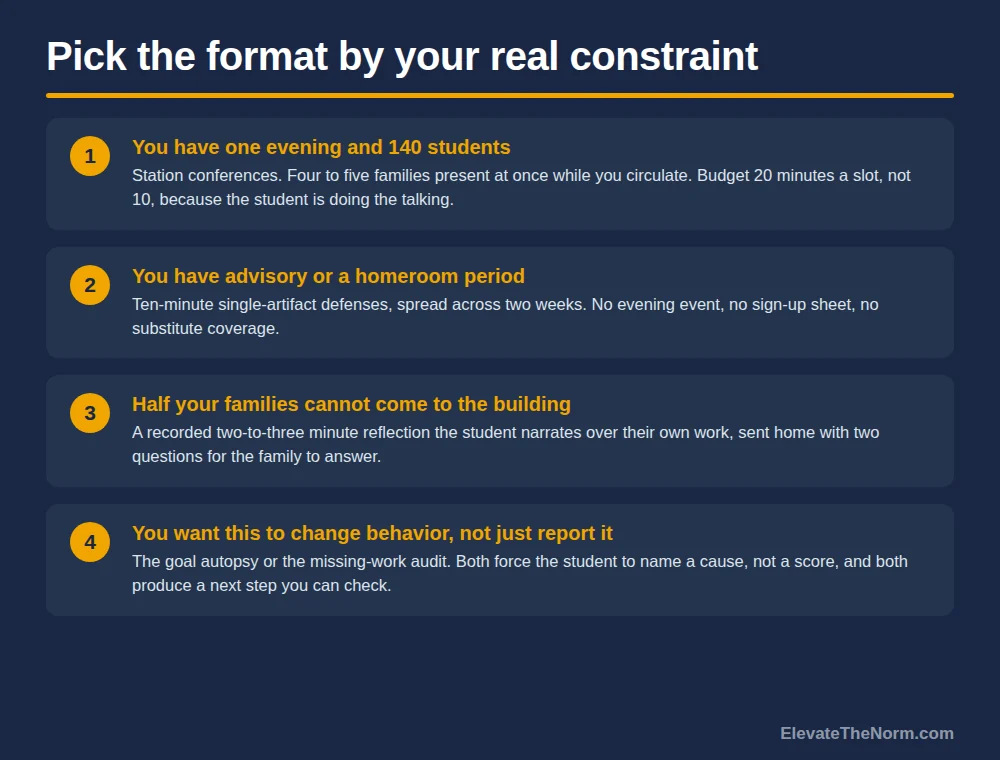
First, a reality check. Plenty of secondary schools run conference night arena-style — every teacher at a table in the gym, a line at each one, ninety seconds a family. The structure below assumes a scheduled slot. For the arena, cut it to three sentences: one specific thing going well, one specific problem with a number attached, one next step and a date. Then hand over your email and mean it.
Second, for whoever runs the building: if a conference in October is the first a family has heard about a problem that started in August, the conference is not the failure. The communication system is. A conference should confirm what a parent already knows, not break news.
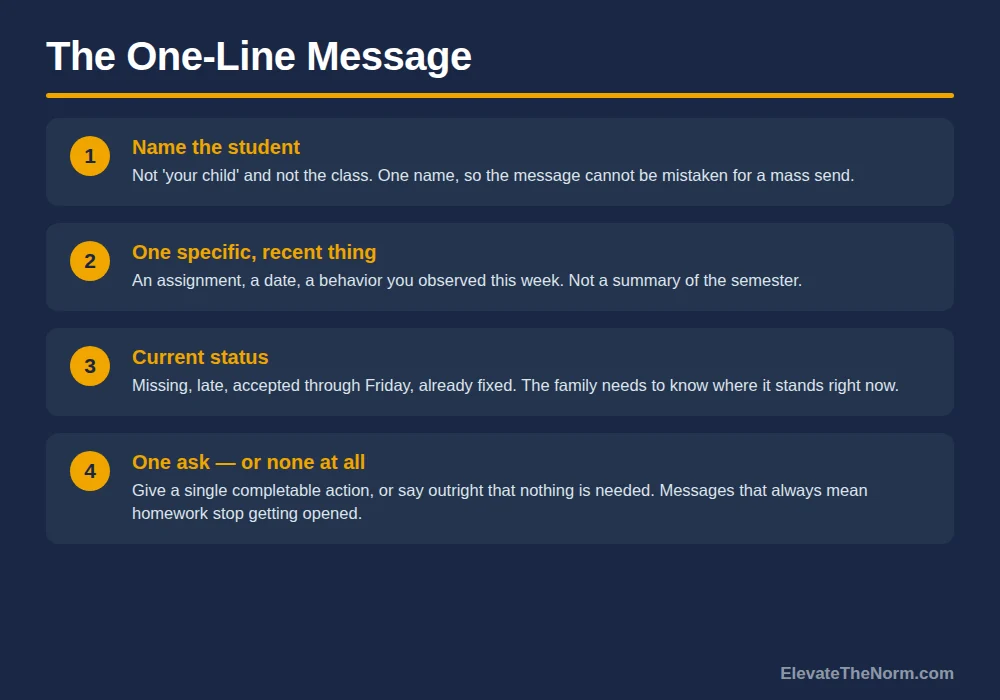
Open with one specific observation, not a summary. “She’s a pleasure to have in class” costs you thirty seconds and tells a parent nothing. “She writes a better argument than almost anyone in that period and she has turned in four of seven” tells them everything, and it takes the same thirty seconds.
A workable structure for a short conference:
- Minute 1 — one thing genuinely going well, named specifically. Not flattery. Something you could show them.
- Minutes 2–4 — the one problem, with evidence in front of you. A gradebook screen, a piece of work, a count. One problem, not five.
- Minutes 5–9 — the student talks. Ask what they think is happening and let the silence sit.
- Minutes 10–13 — the plan. One action for the student, one for you, one for the family if there is one. Dates on all of them.
- Minutes 14–15 — how you will follow up, and when. Then actually do it.
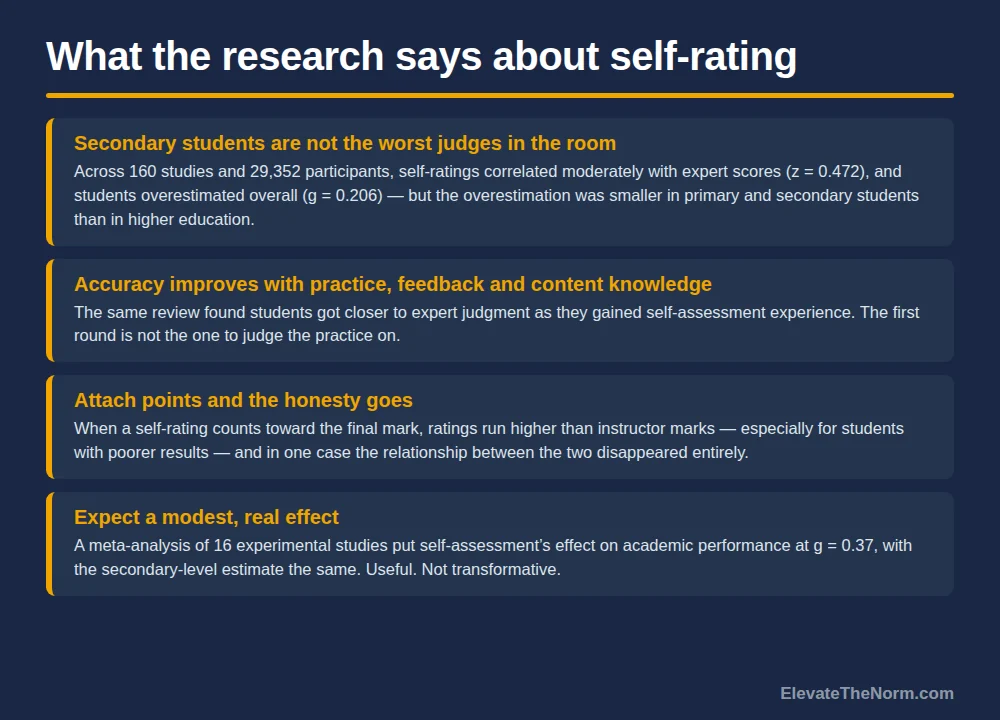
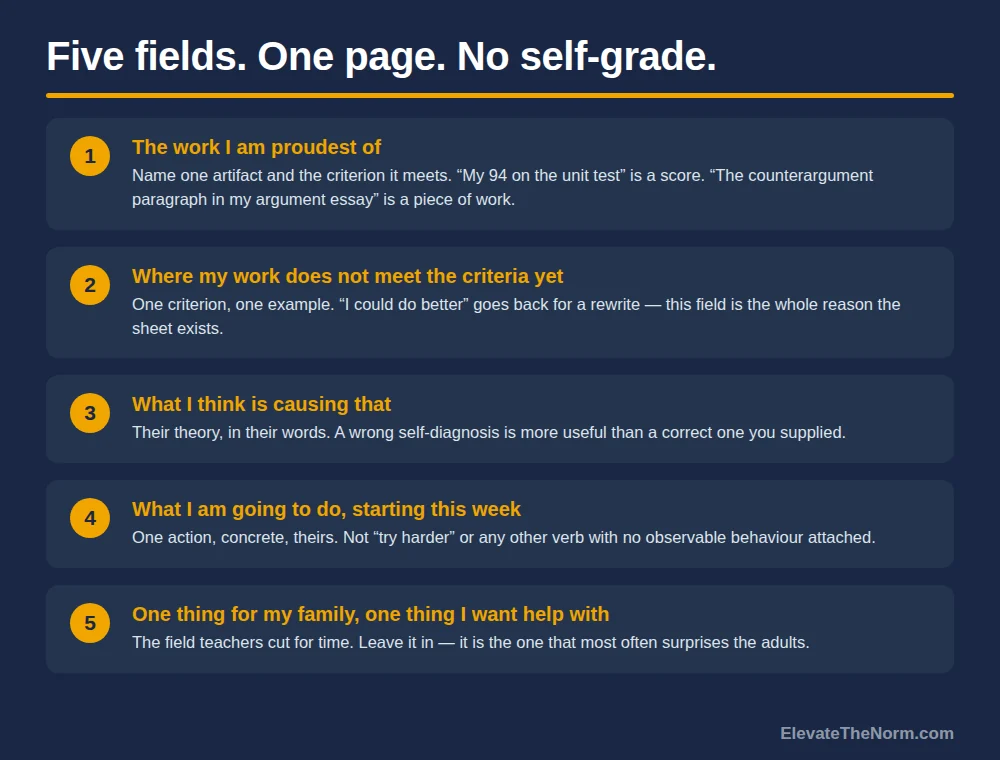
The preparation that makes this work across a whole evening is a student self-assessment filled out before the conference. It gives the student something to say and means the first voice in the room is not yours.
Two lines not to cross. Do not discuss another student, even when the parent in front of you has clearly been told a name at home — “I can’t talk about anyone else’s child” is a complete sentence and parents accept it. And do not improvise a plan that belongs to a formal process. If a parent asks for something requiring a 504, an IEP, or an administrator’s signature, say it is a real question that needs the right meeting, then make sure that meeting gets requested. Promising something at a table in a gym that you cannot deliver in a classroom does more damage than saying you do not know.
What Happens After the Conference Decides Whether It Mattered
The follow-up is where the measurable effect is, and there is a randomized trial that says so.
Matthew Kraft and Todd Rogers ran a blocked randomized experiment on 435 high school students in a five-week summer credit recovery program in a large urban Northeastern district, published in Economics of Education Review in 2015. Teachers sent parents a brief individualized message each week. Students whose parents got messages were 6.5 percentage points more likely to earn course credit — 84.2% to 90.7% — a 41% reduction in the share failing to earn credit. The gain came mostly from preventing dropout rather than from improving work.
The part worth sitting with: they tested two kinds of message. Messages about what the student needed to improve produced an 8.8 percentage point gain and were statistically significant. Messages about what the student was doing well produced 4.5 points and were not. The authors attribute the difference to actionability — an improvement message tells a parent something specific to do.
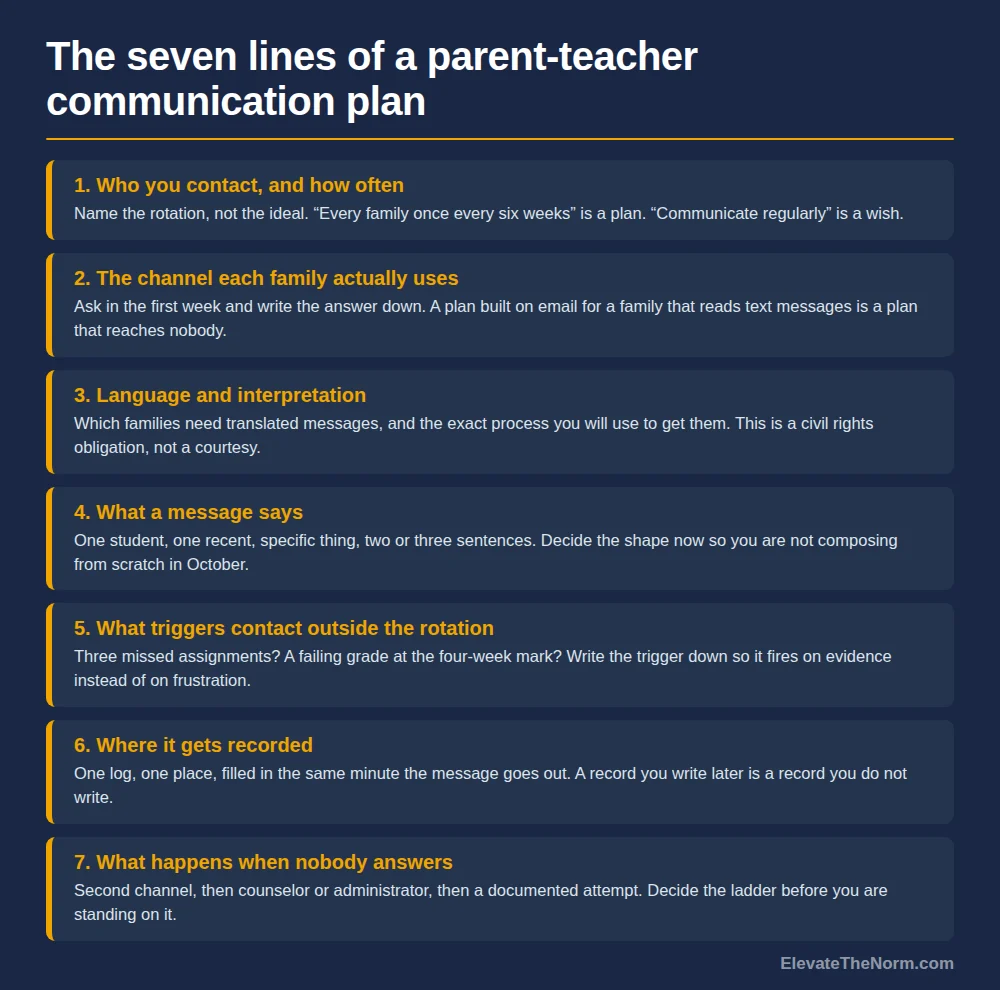
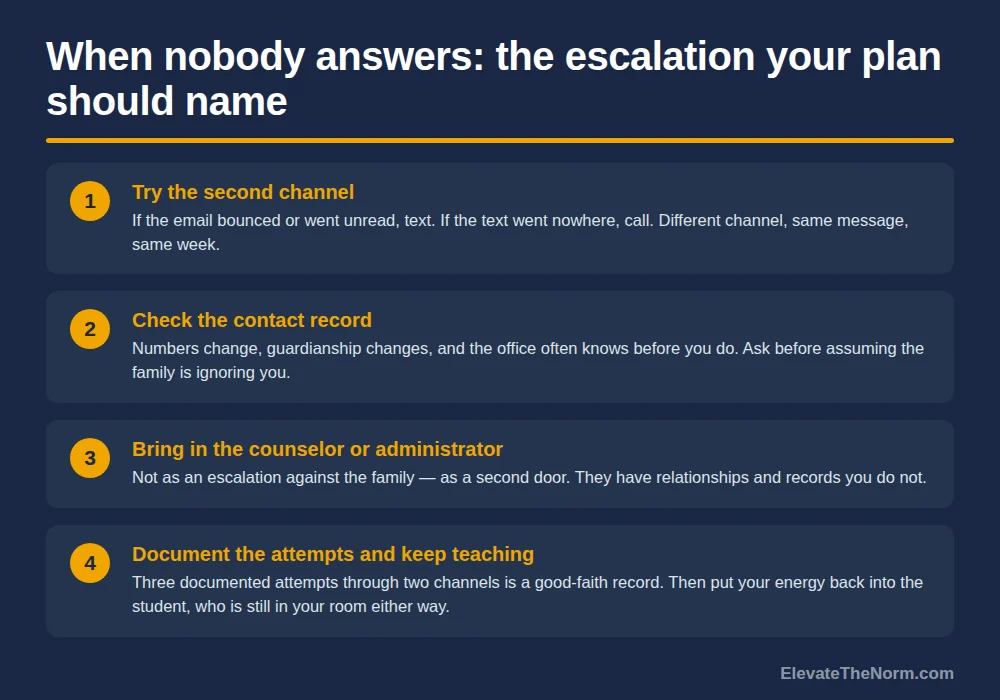
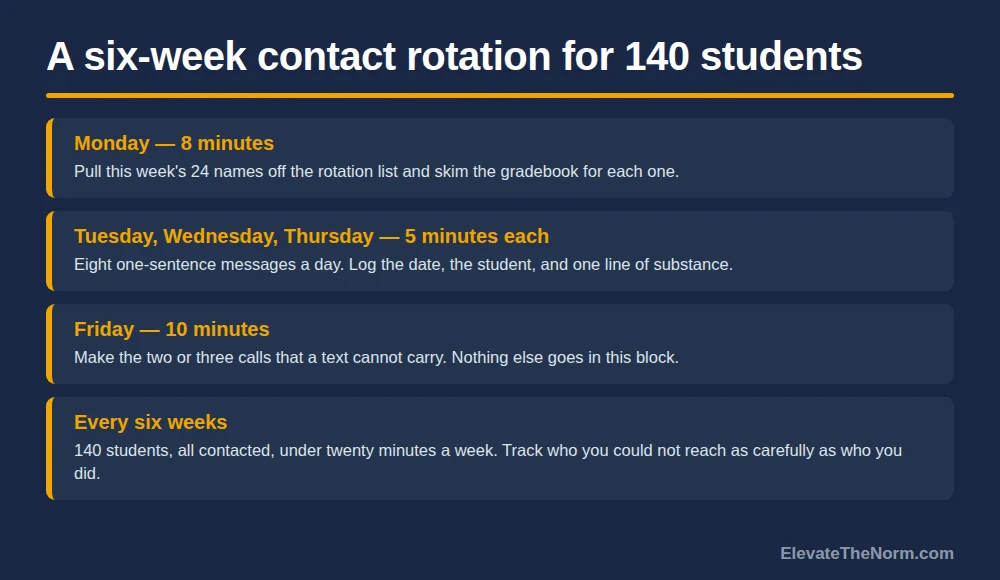
Two limits, plainly. This was a summer credit recovery population — students already behind, 58% African-American and 32% Hispanic, over 80% free or reduced-lunch eligible. Lots of room to move. Do not expect a 41% reduction in your honors section. And it is evidence for weekly contact, not for one conference. The conference’s job is to set up the contact that follows it, which is the argument for an actual parent-teacher communication plan rather than improvising one family at a time.
So the last thing said in the room, by either party, is a date.
Questions That Waste the Fifteen Minutes
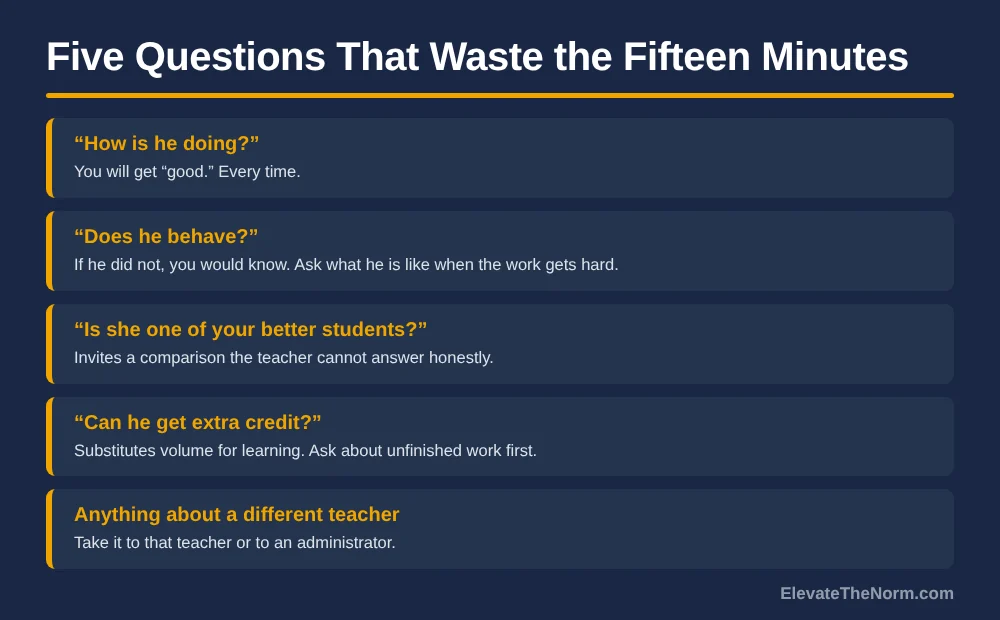
- “How is he doing?” You will get “good.” Every time.
- “Does he behave?” If he did not, you would know. Ask what he is like when the work gets hard.
- “Is she one of your better students?” Invites a comparison that helps nobody and that the teacher cannot answer honestly anyway.
- “Can he get extra credit?” Asked before the real work is finished, this substitutes volume for learning. Ask what unfinished work can still be completed first.
- Anything that is really about a different teacher. Take it to that teacher or to an administrator.
What to Do Next
Before the next conference: pick the one question you most need answered and write it on your phone, ask your teenager what they think each teacher will say, and bring them with you.
If you are the teacher, use the structure above, put a gradebook on the screen, and let the student talk in the middle of it. Set the follow-up date out loud, because the evidence says the five minutes a week after October does more work than the fifteen minutes in it. The wider version of that argument is in the guide to effective parent-teacher communication, and what a conference should hand a student at the end is a goal they wrote themselves — which is what student goal setting is for.
Before you go: grab the free The Parent-Teacher Conference Question Card (2 pages) (PDF) — ElevateTheNorm.com branded, printable, no email required.
Frequently Asked Questions
What are the best questions to ask at a parent teacher conference?
The four that do the most work are: what is the specific problem, what does fixed look like, what does my student do next, and how will we both know in six weeks whether it worked. Everything else is a variation. Vague questions get vague answers — "how is he doing?" reliably returns "good." Pick four or five specific ones and ask the same ones of every teacher so you can compare instead of collecting impressions.
How many questions can I realistically ask in a middle or high school conference?
Four or five. A secondary conference is usually ten to fifteen minutes, and plenty of schools run them arena-style in a gym with ninety seconds per family and a line behind you. Decide in advance what you are trying to find out and ask that. If you need more time, ask for a phone call rather than trying to extend the slot while five families wait.
Should my teenager come to the parent teacher conference?
Yes, and it is probably the single highest-leverage change available to a family. A four-school evaluation of student-led conferences covering 524 middle school students found parent attendance of at least 92% at every site. Even without a formal program, bringing your kid and letting them answer first changes the meeting from something adults negotiate about them into something they participate in. Two exceptions: anything touching a disability, a mental health concern, or a formal plan belongs in a separate meeting.
What should I ask if my child is failing a class?
Four questions, in this order. What is recoverable and what is not? What is the first thing and when is it due? What do you need from me, specifically? And — asked with the student in the room — what do you need from him? Then stop. Spending the last six minutes on whose fault it is has never changed a grade.
Is it true that helping with homework hurts my child’s grades?
That overstates it. In Hill and Tyson’s 2009 meta-analysis of 50 studies of middle school parent involvement, homework assistance showed the strongest negative association with achievement of anything they measured — but the design is correlational, and parents help most with homework when a student is already struggling. The defensible reading is not that helping hurts. It is that there is no evidence more homework help is the lever, and that the involvement with the strongest positive association was academic socialization: talking with your teenager about why the work matters and what their plans require.
What if I can’t attend conference night?
Then it happens by phone, and that is not a lesser version of the meeting. Email the two teachers who matter most this term, ask for ten minutes, and send the same focused question you would have asked in person. If English is not the language you want this conversation in, ask the school for an interpreter in writing. Districts receiving federal funds are required to communicate with families in a language they understand, and a bilingual student translating a conversation about their own grades is not meaningful access.
What should I ask when everything seems fine?
Ask the forward-looking one: what should she be doing now if she wants that next year? That is the academic socialization question, and it is the form of involvement with the strongest research behind it at this age. Also worth asking: what is he like in class when I am not there? You know your kid at home. You do not know your kid at 10:40 in a room of thirty.
What should teachers do differently in a fifteen-minute conference?
Open with one specific observation rather than a summary — "she writes a better argument than almost anyone in that period and she has turned in four of seven" costs the same thirty seconds as "a pleasure to have in class" and tells a parent everything. Then one problem with evidence on the screen, the student talking in the middle, a plan with dates, and a stated follow-up. And if a conference in October is the first a family has heard of a problem that started in August, the conference is not the failure. The communication system is.
Sources
- Hill, Nancy E., and Diana F. Tyson. “Parental Involvement in Middle School: A Meta-Analytic Assessment of the Strategies That Promote Achievement.” Developmental Psychology, vol. 45, no. 3, 2009, pp. 740–763. Meta-analysis of 50 empirical studies. Overall involvement r = .18. Academic socialization showed the strongest positive association; school-based involvement positive and significant; home-based involvement not significant; homework assistance showed the strongest negative association. The authors note the correlational design limits causal inference. https://courses.edx.org/assets/courseware/v1/afb13fe949b60e70e83a2d18c32dacc0/asset-v1:HarvardX+GSE4x+1T2020+type@asset+block/ParentalInvolvementinMiddleSchoolAMeta-Analysis.pdf
- Kraft, Matthew A., and Todd Rogers. “The Underutilized Potential of Teacher-to-Parent Communication: Evidence from a Field Experiment.” Economics of Education Review, vol. 47, 2015, pp. 49–63. Blocked randomized trial, 435 students in a five-week high school summer credit recovery program, large urban district in the Northeastern United States. Credit earned rose from 84.2% to 90.7%, +6.5 percentage points, a 41% reduction in the share failing to earn credit, driven primarily by reduced dropout. Improvement-focused messages +8.8 points (significant); positive messages +4.5 points (not significant). Population was students already behind; 58% African-American, 32% Hispanic, over 80% free/reduced-lunch eligible. https://scholar.harvard.edu/files/todd_rogers/files/empirical_in_press.kraft_rogers.pdf
- Tuinstra, Christine, and Diana Hiatt-Michael. “Student-Led Parent Conferences in Middle Schools.” The School Community Journal, vol. 15, no. 1, 2005, pp. 59–80. Mixed-methods program evaluation at four middle schools in California, Oregon, Texas and Washington; 524 students (mostly 7th grade), 523 parents, 30 teachers, 7 administrators. Parent attendance at least 92% at all four sites. Over 94% of students reported revising work; 90% reported setting goals. No control group; the achievement and discipline claims are administrator reports rather than measured outcomes. https://www.adi.org/journal/ss04/Tuinstra & Hiatt-Michael.pdf
- Harvard Family Research Project. “Parent–Teacher Conferences: A Tip Sheet for Parents.” October 2010. Distributed by state education agencies including the Texas Education Agency and the Nebraska Department of Education. Practical guidance, not research: review work and progress reports beforehand, bring a written list of questions, treat the meeting as a two-way conversation, record action items for both sides, schedule a follow-up, and share the outcome with the child — “don’t forget to include him or her.” https://education.ne.gov/wp-content/uploads/2017/07/Parent-Teacher-ConferenceTipSheet-100610-2.pdf
- Weiss, Heather B., quoted in “A New Look at the Parent-Teacher Conference.” Usable Knowledge, Harvard Graduate School of Education, 2014. Argues conferences should be “accessible, understandable, and actionable” and should cover both strengths and difficulties using student data. Cited here as professional guidance: the piece reports an interview and does not present original research. https://www.gse.harvard.edu/ideas/usable-knowledge/14/09/new-look-parent-teacher-conference