By Clay Shumate
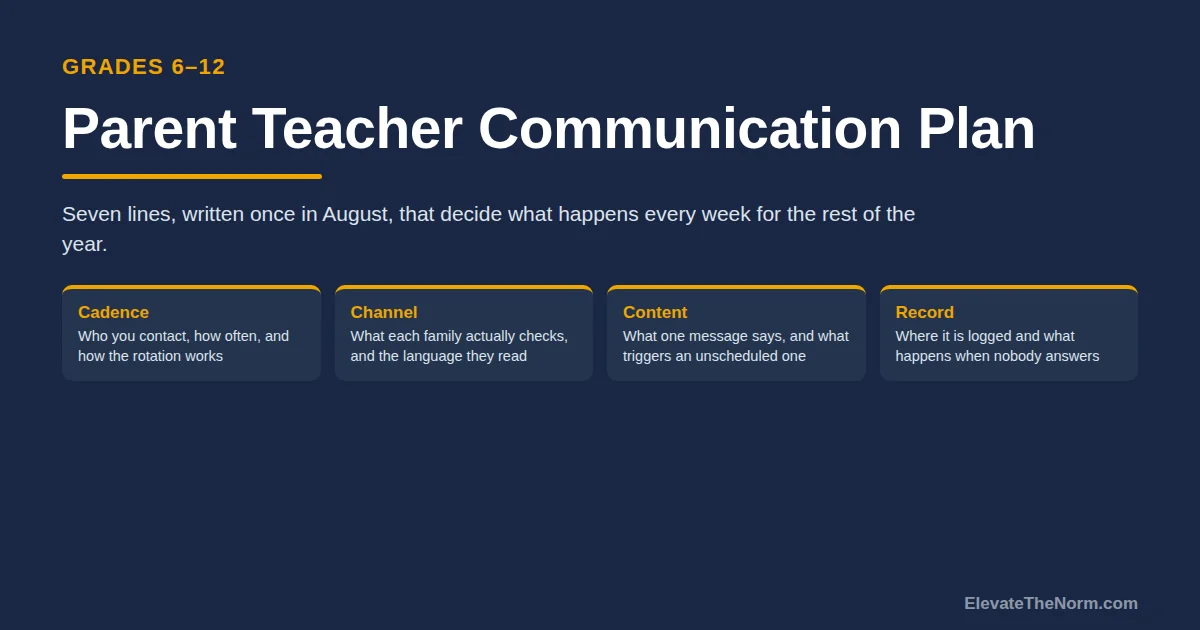
A parent teacher communication plan is a written decision — made before the year gets loud — about who you contact, how often, through which channel, what the message says, and what happens when nobody answers. It fits on one page. Writing it down in August is the only reason it still exists in February.
Key Takeaways
- A plan is seven lines, not a philosophy. Rotation, channel, language, message shape, triggers, record, escalation. If a line is not written down, it is not in the plan.
- Name a rotation, not an ideal. “Every family once every six weeks” is a plan. “Communicate regularly” is a wish that dies in October.
- Weekly and individual is the dose with evidence behind it. In a high school credit-recovery program, one-sentence weekly messages cut the share of students failing to earn credit from 15.8% to 9.3%.
- “Lead with good news” is folklore, not a finding. In that same experiment, messages naming what a student needed to improve outperformed messages naming strengths.
- Part of your plan is already federal law. ESSA §1116 requires regular two-way communication in a language families can understand, and the 2015 ED/DOJ guidance makes interpretation a civil rights obligation.
Free Download · 2-page PDF
Parent-Teacher Communication Plan Worksheet
The seven lines with room to write, a six-week rotation grid for a full secondary roster, and the escalation ladder for families who do not respond.
Free. No email address required. Designed for grades 6–12. Browse every printable in Your Free Library.
What is a parent teacher communication plan?
It is a one-page written record of the decisions you would otherwise make under pressure. Not a mission statement about partnership. A set of specific, checkable answers: this many families, this often, on this channel, saying roughly this, logged here, and here is what I do on the third week of silence.
The reason to write it down has nothing to do with accountability paperwork. It is that every one of those decisions is easy in August and impossible in October. In October you are grading, you are covering someone’s class, a kid has just said something that ruined your afternoon, and the question “should I call this family?” becomes a question about your energy rather than about the student. A written plan takes the decision out of the moment. That is its entire job.
This page is about the plan itself. What the evidence says about which messages actually change student behavior is covered separately in the guide to what effective parent teacher communication looks like, and the forms for recording it are on the communication logs page. Read those for the why. Read this for the page you fill in.
What goes on the one page?
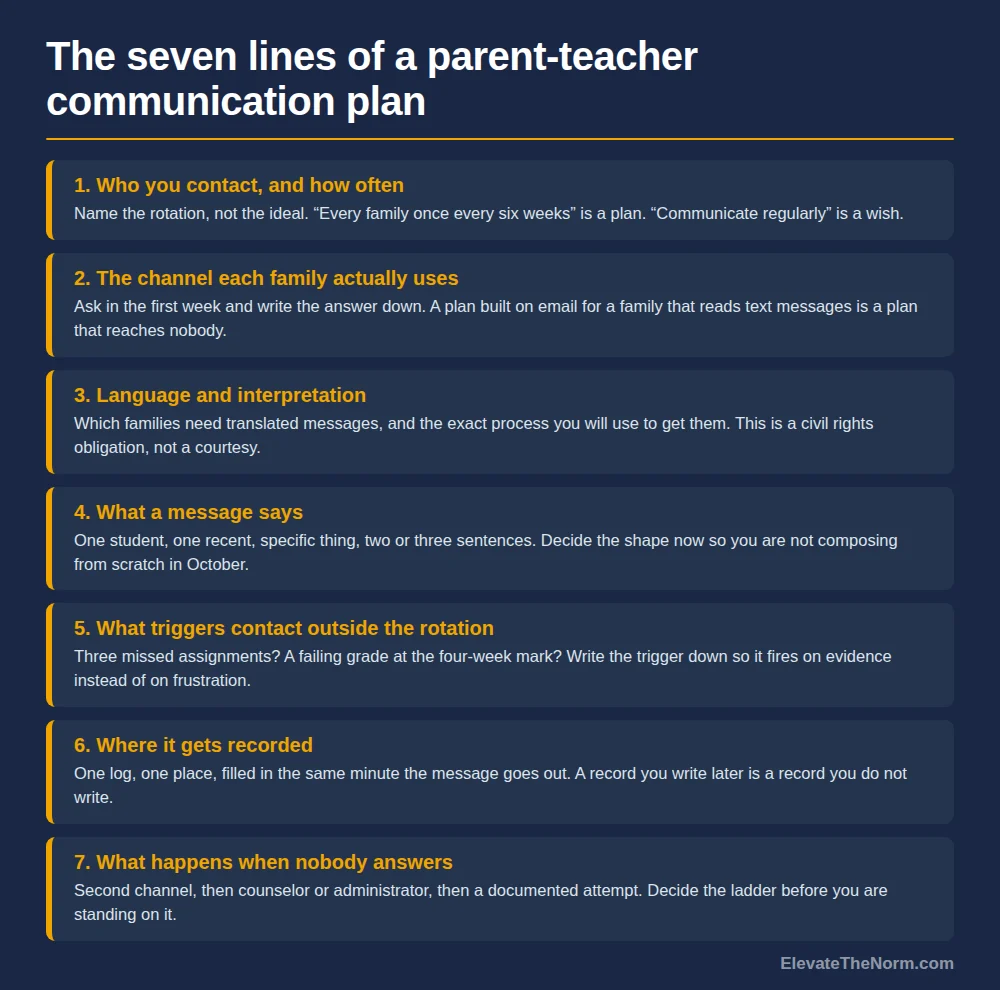
Seven lines. Each one is a decision that will otherwise get made badly, at speed, in the middle of a bad week.
- Who you contact, and how often. Write the rotation. A six-week cycle over a 140-student roster is roughly twenty-three families a week, which is fifteen or twenty minutes if the messages are short. Six groups, one group a week, and you never have to remember who you spoke to last. If 140 is not your number — if you are at 180, or you coach, or you have a duty period that is not a period — stretch the cycle to eight weeks and write eight on the page. A longer cycle you finish beats a shorter one you abandon.
- The channel each family actually uses. Ask in the first week and write the answer down per family. Some families read texts and never open email. Some check a school app. Some want a phone call and nothing else. A plan built on your preferred channel instead of theirs reaches the families who were already reachable. Two-way means a return path, so the same line records how a family reaches you and how fast you promise to answer. “Within two school days” is a promise you can keep; “anytime” is a promise you will break by the second week.
- Language and interpretation. Which families need translated messages, and the exact process for getting them — the person, the office, the turnaround. This is the line teachers most often leave blank, and it is the one with actual legal weight behind it.
- What a message says. One student, one recent and specific thing, two or three sentences. Decide the shape now and write a template sentence you can adapt, so you are not composing from a blank screen at 9:40 at night.
- What triggers a contact outside the rotation. Be exact. Three missed assignments. A failing grade at the four-week mark. A second week of the same tardy pattern. A written trigger fires on evidence; an unwritten one fires on how annoyed you are, which is not the same thing and everybody knows it.
- Where it gets recorded, and when. One log, one place, filled in the same minute the message goes out. A record you plan to write up on Friday is a record that does not exist by Friday. One caution, because the log is a student record: keep it where other students and other families cannot read it, write it the way you would want it read aloud, and follow whatever retention rule your district already has for contact documentation. A shared classroom spreadsheet on a screen you project is not a log, it is a disclosure.
- What happens when nobody answers. The ladder, written before you are standing on it.
How often should the plan say you contact families?
Weekly and individual is the dose with the best evidence behind it, and a rotation is how you afford it. Everything else is a compromise with your calendar, which is fine as long as you write down which compromise you made.
The study people cite for this is Matthew Kraft and Todd Rogers’s field experiment on teacher-to-parent communication, published in Economics of Education Review in 2015. Teachers in a high school credit-recovery program sent one individualized sentence per week to each family. The share of students who failed to earn course credit fell from 15.8% to 9.3% — a 41% relative reduction, at a cost the authors put at less than a tenth of the district’s typical cost per credit earned.
Now the honest part. That was a summer credit-recovery program, not a regular semester with a full roster and seven sections. The students were already identified as at risk of not graduating, which is exactly the population where a small nudge has the most room to move. The authors also report that the effect came mostly from preventing students from dropping out rather than from reducing failures among those who stayed. None of that makes the finding weak. It makes it a finding about a specific setting, and a plan that promises a 41% anything for a general-education roster is promising something nobody has tested.
What transfers is the shape: short, individual, and on a schedule. Write the schedule into the plan and the shape into line four.
Should the plan tell you to lead with good news?
Probably not, and this is the most widely repeated piece of advice in the whole field that the evidence does not support.
Every new-teacher orientation tells you to make the first call home a positive one. It is good relational instinct and it costs nothing, so keep doing it if it works for you. But in the Kraft and Rogers experiment, the messages that produced the larger effects were the ones that named something the student needed to improve — not the ones highlighting strengths. That is one study in one setting and it should not be treated as settled either. What it does do is knock the certainty out of the folk rule.
So write line four honestly: the message is specific and recent, and it is allowed to be about a problem. What it is not allowed to be is vague, global, or about the student’s character. “Marcus has not turned in the last two lab write-ups and I want to catch it before the unit test” is a message. “Marcus needs to apply himself” is a complaint with a stamp on it.
What does federal law already require your plan to cover?
More than most teachers realize, and less than most teachers fear. Two documents do the work.
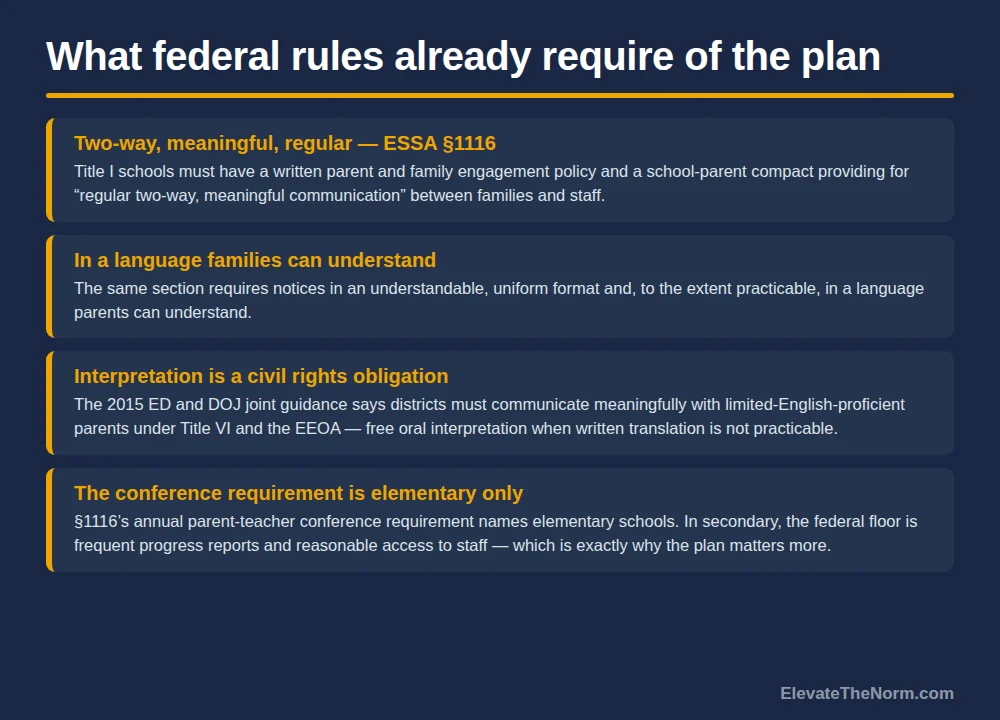
ESSA Section 1116. Every school receiving Title I funds has to have a written parent and family engagement policy, developed jointly with parents, plus a school-parent compact. That compact must provide for “regular two-way, meaningful communication between family members and school staff, and, to the extent practicable, in a language that family members can understand,” along with frequent progress reports and reasonable access to staff. Notice what is not in there for you: the statute’s explicit annual parent-teacher conference requirement names elementary schools. In middle and high school the federal floor is frequent reporting and access — which is precisely why a personal plan matters more at the secondary level, not less. Nothing above you is going to force the structure into existence.
The 2015 ED/DOJ guidance on English learner students and limited-English-proficient parents. Issued jointly by the Department of Education’s Office for Civil Rights and the Department of Justice’s Civil Rights Division on January 7, 2015, it states that meaningful communication with limited-English-proficient parents is a federal civil rights obligation under Title VI of the Civil Rights Act and the Equal Educational Opportunities Act — independent of what funding a school receives. Where written translation is not practicable, districts must provide free oral interpretation. That is line three of your plan, and it is the line that turns a nice idea into a legal floor.
One practical note that follows from this: do not use the student as the interpreter for a conversation about the student. It puts a fifteen-year-old in charge of how their own academic problem gets described to their parent, which is neither meaningful communication nor fair to the kid.
What does the plan say about families who do not answer?
It names a ladder with an end. The point is not to reach everyone. The point is that you know what you owe and when you have paid it.
Start by not assuming the silence means what it feels like it means. Federal survey data puts parent attendance at regularly scheduled conferences at 54% in grades 9–12 and 72% in grades 6–8, down from 90% in the earliest elementary grades. That drop is structural — one teacher becomes seven, the child gets more independent, work schedules do not bend — and it is not a referendum on how much a family cares. A plan that treats non-response as evidence of indifference will produce worse messages and worse outcomes than a plan that treats it as a logistics problem, because that is mostly what it is.
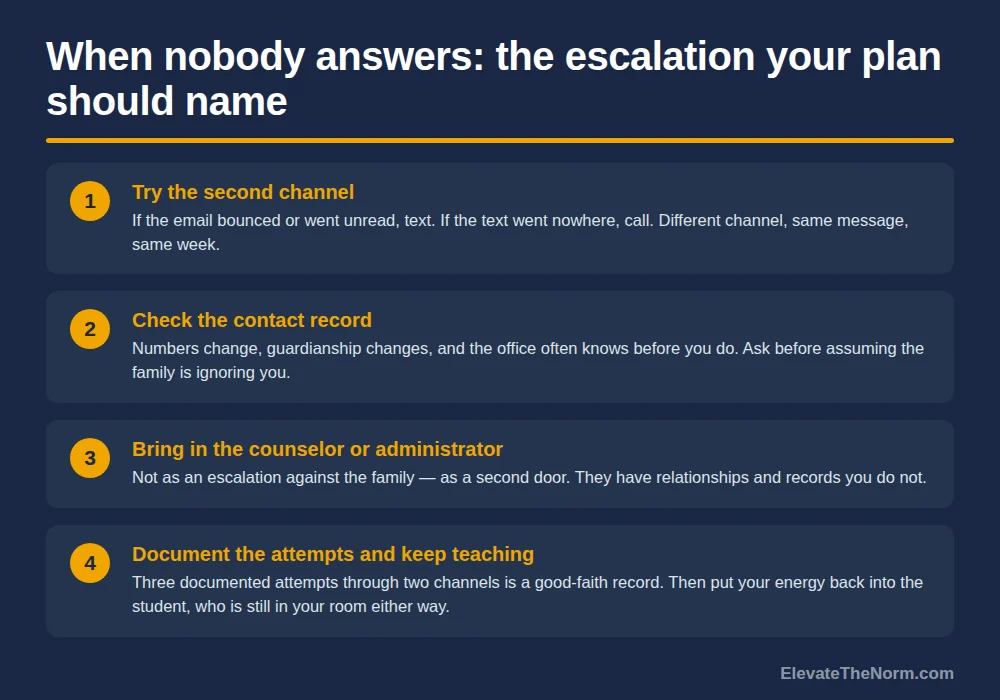
Then run the ladder: second channel, check the contact record with the office, loop in a counselor or administrator as a second door rather than an escalation, and document the attempts. Three attempts across two channels is a good-faith record. Write that number into the plan so you are not improvising a standard while you are frustrated. And if the underlying problem is that the student is not in the building, the attendance evidence points at family messaging as one of the few levers that has actually moved in trials.


Does the plan belong to you or to the school?
Yours works without the school’s. The school’s does not work without yours.
The Dual Capacity-Building Framework for Family-School Partnerships, developed by Karen Mapp with Paul Kuttner and published by SEDL in 2013, is the most-used map of this at the building level. Its argument is that family engagement fails when it is treated as an event rather than a capability — and that initiatives work when they are “linked to learning,” relational, collaborative and interactive, and when they are systemic, integrated into existing programs, and sustained with real resources rather than run on one enthusiastic person’s evenings.
That last phrase is worth sitting with, because it describes how most teacher communication plans actually die. If yours depends entirely on you having a good week, it is not sustained, it is just willpower with a template. The fix is not more willpower. It is a smaller plan: a rotation you can finish on your worst week, not your best one. If the tooling is what is eating your time, the comparison of communication apps is worth twenty minutes before you commit to a channel.
Should students know the plan exists?
Yes, and tell them in the first week. A teenager who finds out in November that you have been emailing their family on a rotation since August has learned that adults talk about them behind their back on a schedule. That is a worse lesson than anything the messages contained.
Say it plainly: I contact every family about once every six weeks, I will tell you what I said if you ask, and if something is going badly enough that I am calling early, you will hear it from me first. Then keep that last part. A student who knows a message is coming can get ahead of it, which is the whole behavior you are trying to build — the same logic behind letting students carry the account of their own work. A student ambushed by one learns to manage information instead.
Three ways a communication plan dies
- It was written for your best week. A plan that requires forty minutes on Thursday survives until the first Thursday you do not have forty minutes, which is usually the second week of September. Size it for your worst week and let the good weeks be a bonus.
- The log lives somewhere you do not already go. A separate spreadsheet in a separate tab is a record that stops getting filled in by week four. Put it wherever you already are — in the gradebook, in the same document as your seating chart, on paper in the folder you open every period.
- Nothing in it is checkable. “Build strong relationships with families” cannot be true or false in a given week, so it is never false, so it is never fixed. “I contacted group three this week” can be false by Friday, which is the only reason it ever gets done.
What to do next
Fill in the seven lines for one course, not for your whole load. Pick the section where communication is currently worst, split that roster into six groups, and write one template sentence. That is twenty minutes of work and it is the entire plan.
Then run it for six weeks without changing anything, and at the end look at the log rather than your memory. You will know two things you do not know now: which families you actually reached, and which line of the plan was the one you kept skipping. Fix that line. Do not rewrite the plan — rewriting the plan is what people do instead of running it. If the fall conference is coming and you want the student in the room for it, the conference formats that fit a secondary schedule pair well with a plan that is already working.
Before you go: grab the free Parent-Teacher Communication Plan Worksheet (PDF) — ElevateTheNorm.com branded, printable, no email required.
Frequently Asked Questions
What is a parent teacher communication plan?
A one-page written record of seven decisions: who you contact and how often, which channel each family actually uses, how you handle translation and interpretation, what a message says, what triggers contact outside the rotation, where it gets logged, and what you do when nobody answers. It is not a philosophy statement. Every line has to be specific enough to be false by Friday, or it will never get done.
How do I write a parent communication plan with 140 students?
Split the roster into six groups and contact one group a week. That is roughly twenty-three short messages a week, fifteen to twenty minutes if the messages are two or three sentences, and every family is reached once every six weeks without you tracking anything. If your load is larger or your schedule is worse, stretch the cycle to eight weeks and write eight on the page. A longer cycle you finish beats a shorter one you abandon in October.
How often should teachers contact parents in middle and high school?
Weekly and individual is the dose with the strongest evidence behind it. In Kraft and Rogers’s 2015 field experiment, one-sentence weekly messages in a high school credit-recovery program cut the share of students failing to earn course credit from 15.8% to 9.3%. Read that with its limit: it was a summer credit-recovery setting with students already identified as at risk, and the effect came mostly from preventing dropout. The shape that transfers is short, individual, and on a schedule – not the specific percentage.
Should the first message home be positive?
It is a reasonable instinct, but it is not what the evidence shows. In the same Kraft and Rogers experiment, messages naming something the student needed to improve produced larger effects than messages naming strengths. That is one study in one setting, so do not flip the rule over entirely. What it should do is stop you treating ‘lead with good news’ as established. The thing that matters more is that the message names one student and one specific, recent thing rather than a trait.
Does federal law require a parent teacher communication plan?
Not from an individual teacher, but the surrounding requirements shape what yours has to cover. ESSA Section 1116 requires Title I schools to have a written parent and family engagement policy and a school-parent compact providing for regular two-way, meaningful communication, to the extent practicable in a language families can understand. The 2015 joint guidance from the Department of Education’s Office for Civil Rights and the Department of Justice makes meaningful communication with limited-English-proficient parents a civil rights obligation under Title VI and the EEOA, with free oral interpretation where written translation is not practicable. Note that Section 1116’s annual conference requirement names elementary schools, not secondary.
What should the plan say about families who never respond?
Name a ladder with an end: try a second channel, check the contact record with the office because numbers and guardianship change, bring in a counselor or administrator as a second door rather than as an escalation, then document the attempts. Three attempts across two channels is a good-faith record. Write that number down before you need it. And do not read silence as indifference – federal survey data puts conference attendance at 54% in grades 9-12 and 72% in grades 6-8, and that drop is mostly structural.
Should students know I am contacting their families on a schedule?
Yes, and tell them in week one. A student who discovers in November that you have been messaging home on a rotation since August learns that adults discuss them on a schedule without telling them. Say it plainly instead: here is how often I contact families, you can ask me what I said, and if I am calling early about a problem you will hear it from me first. Then keep that promise.
Where should I keep the communication log?
Somewhere you already go every day – the gradebook, the same folder as your seating chart, a page in the binder you open each period. A separate spreadsheet in a separate tab stops getting filled in by week four. Keep in mind that the log is a student record: store it where other students and families cannot read it, write entries the way you would want them read aloud, and follow your district’s retention rule for contact documentation.
Sources
- Every Student Succeeds Act, Section 1116, “Parent and Family Engagement.” Statutory text as distributed by the North Carolina Department of Public Instruction. Section text (PDF). The annual parent-teacher conference requirement in the school-parent compact provision names elementary schools; the two-way communication and language provisions apply generally.
- U.S. Department of Education Office for Civil Rights and U.S. Department of Justice Civil Rights Division. “Dear Colleague Letter: English Learner Students and Limited English Proficient Parents.” 7 January 2015. Letter (PDF).
- Kraft, Matthew A., and Todd Rogers. “The Underutilized Potential of Teacher-to-Parent Communication: Evidence from a Field Experiment.” Economics of Education Review, vol. 47, 2015, pp. 49–63. Working paper abstract via RePEc (HKS RWP14-049). Setting was a high school summer credit-recovery program; the effect came largely from preventing dropout rather than reducing failure among students who stayed.
- Kraft, Matthew, and Todd Rogers. “The Underutilized Potential of Teacher-Parent Communication.” Communities & Banking, Federal Reserve Bank of Boston, Spring 2016. Article (PDF).
- McQuiggan, Meghan, and Mahi Megra. Parent and Family Involvement in Education: Results from the National Household Education Surveys Program of 2019 (NCES 2020-076). National Center for Education Statistics, U.S. Department of Education. Conference attendance by grade band, Table 2. Full report (PDF).
- Mapp, Karen L., and Paul J. Kuttner. Partners in Education: A Dual Capacity-Building Framework for Family–School Partnerships. SEDL in collaboration with the U.S. Department of Education, 2013. Framework (PDF).
A note on the evidence. Two of these sources are federal statute and federal civil rights guidance, which are binding rather than suggestive. One is a randomized field experiment whose setting is narrower than the way it usually gets quoted, and that limit is stated in the text above rather than buried here. The framework is a synthesis, not a trial, and is cited as a map rather than as proof.