By Clay Shumate
Student self assessment of behavior is a short routine in which a student rates their own conduct against visible criteria, gives evidence for the rating, and names one thing to do differently. Not an apology form, not a mood check. Done right it takes four minutes and moves the work of noticing from you to them.
Narrow is the point. The research here is better than what sits behind most in-service handouts, and more limited than the workshop slides admit. What follows is what the evidence supports for grades 6–12, what it does not, and a routine that survives a real Tuesday.
Key Takeaways
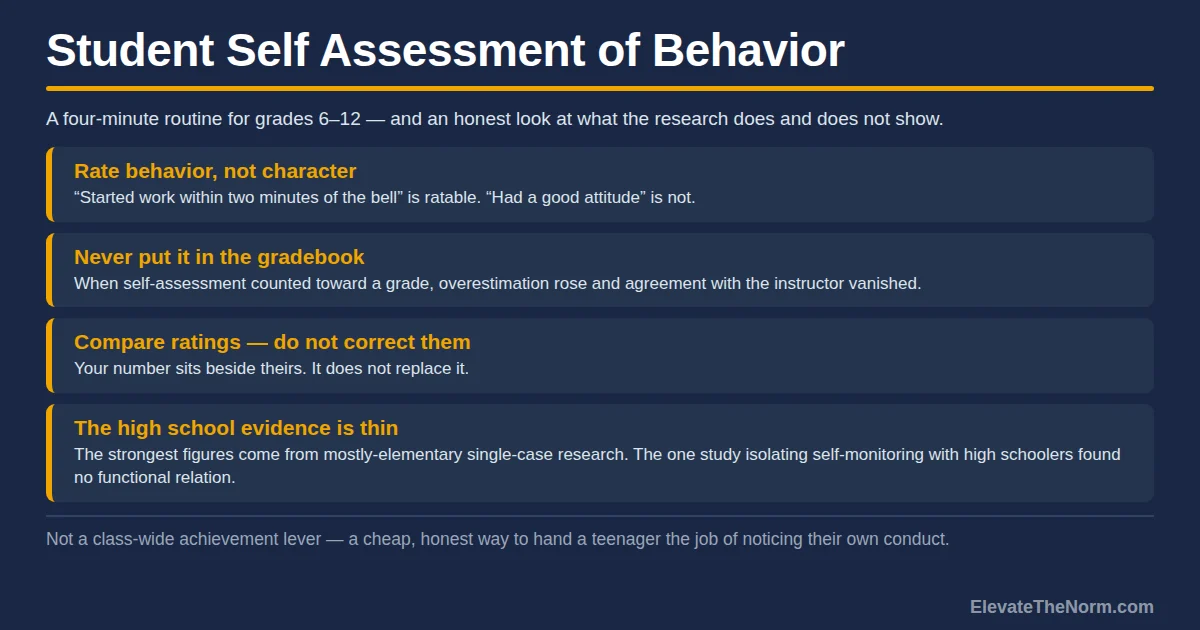
- Rate behavior you can point at, not character. “Started work within two minutes of the bell” is ratable. “Had a good attitude” is not — and a student who disagrees has nowhere to go.
- The moment you grade it, it stops working. In one study of self-assessment counted toward a final mark, overestimation rose sharply and the correlation with the instructor’s rating vanished.
- The evidence is real, and the high school evidence is thin. A federal practice guide reports large average improvements. The one study found here that isolated self-monitoring with high schoolers found no functional relation.
- Two behaviors. Not eight. Every version that survives past October tracks a small number of specific, positively stated behaviors on a form the student can fill out in under two minutes.
- Compare ratings, do not correct them. Rating the same period yourself is the accuracy check. Overwriting the student’s number turns the whole thing back into your paperwork.
Free Download · PDF
Student Self-Assessment Forms for Grades 6–12
A printable self-assessment form with space to write your own behavior criteria, a 0–3 rating scale, and a next-step line. No email required.
Free. No email address required. Designed for grades 6–12. Browse every printable in Your Free Library.
What Is Student Self Assessment of Behavior?
It is a student judging their own conduct against stated criteria and recording it. Three parts, all required: an observable behavior, a rating, a next step. Drop the observable behavior and you have a feelings survey. Drop the next step and you have a confession.
The U.S. Department of Education’s Office of Special Education Programs describes two forms in its 2022 practice guide on self-monitoring systems: students record whether a behavior happened, or they rate it against criteria set in advance. The second is what most secondary teachers want. A checkbox says a thing occurred. A rating asks a student to hold their own conduct against a standard and say how close they came — a different and more useful act with a fifteen-year-old.
Two neighbors to separate from. Not a restorative conversation — that happens after harm and involves the people affected. Nor is it academic self-assessment, though it borrows the machinery; the guide to judging your own work against criteria covers that version. Behavior just changes what sits in the criteria column. A third variant narrows it to a single project: what one student contributed inside a group that shares a grade.
Does Student Self Assessment of Behavior Actually Work?
Yes, with caveats big enough that you should read them. The headline numbers are good. The ones that apply specifically to teenagers are much thinner, and one is a null result.
Start with the strongest claim. The OSEP guide cites a 2015 systematic review by Bruhn and colleagues covering 41 studies and reports that every one showed improvement: problem behavior falling from an average of 22% to 4%, academic engagement rising from 37% to 86%. Those are the figures that get onto the slide.
Forty-one out of forty-one should make you suspicious rather than confident. A literature in which nothing ever fails usually has a publication problem, and nearly all of this work uses single-case designs — a handful of students, observed intensively, with effects judged by eye or by a non-standard metric. Single-case research is useful for showing something can work for a particular student. It is weak evidence for how far it moves a class of twenty-eight.
The better evidence is the randomized trial. Bruhn, Wehby, Hoffman and colleagues ran a multisite RCT of a self-monitoring app across 25 schools and 57 student–teacher pairs (Behavioral Disorders, 2022). Students using it improved academic engagement more than controls (d = 0.44) and cut disruptive behavior more (d = −0.35) — and the behavior reduction largely held two weeks after the intervention stopped, while the engagement gain faded (d = −0.30). Note the grade band: 3rd through 8th. That is mostly elementary. It is not a high school result.
Which brings us to the honest part. The one study located here that isolated self-monitoring with high schoolers is Estrapala, Bruhn and Rila (2022), comparing goal reminders against interval self-monitoring with three students with emotional or behavioral disorders. Visual analysis found no functional relation for either condition. Tau-U effect sizes ran 0.44 to 0.64, moderate to large, with self-monitoring slightly ahead — but the authors report classroom management as a substantial confound. Three students is three students; it does not overturn the wider literature. It does mean nobody should tell you this is proven for eleventh graders.
The general picture for this age group is modest too. Murray, Kurian, Soliday Hong and Andrade (2022, Journal of Adolescence) pooled 33 randomized trials of self-regulation interventions with 7,269 young people aged 10–15 and found Hedges g = 0.12. Small. Emotion-regulation approaches reached g = 0.20; cognitive regulation, parent training, physical activity and working-memory approaches showed no significant effects at all.
The defensible claim is this: behavior self-assessment reliably helps individual students who are struggling, is cheap, and has no plausible downside when it is not graded. It is not a class-wide achievement lever and nobody has shown that it is.
Two things follow from that at building scale. First, this is about as cheap as an intervention gets — a half sheet of paper, no license, no platform, no staffing line, and so no procurement decision needed to try it in three classrooms. Second, and harder: who ends up holding a behavior sheet is an equity question, not a neutral one. Discipline data in most systems is not evenly distributed, and a practice assigned one student at a time inherits whatever pattern already exists in who gets noticed. Anyone running this as a tier-two intervention should read the roster of assigned students the way they read a referral report. Skipping that five-minute check is how a well-meant practice ends up pointed at the same kids as everything else.
Will a Teenager Rate Themselves Honestly?
More honestly than you expect, right up until the rating counts for something. That single design decision explains most of the variance between a routine that works and one that becomes theater.
Heidi Andrade’s 2019 critical review in Frontiers in Education lays the accuracy picture out plainly. Correlations between student self-ratings and external measures run from about 0.20 to 0.80, few above 0.60. Males tend to overrate, females to underrate, and older and more academically competent students are more consistent — mildly good news for secondary teachers.
The decisive finding is about grading. Andrade cites Tejeiro and colleagues (2012), where self-assessment counted toward the final grade: overestimation increased dramatically and no correlation emerged between the professor’s rating and the student’s. Run formatively, agreement with external evaluators improved substantially. All twenty studies in Andrade’s review that used self-assessment formatively showed a positive association with learning.
A second finding is worth stealing. Andrade reports that concrete, task-specific criteria outperform vague competence-based ones — a result from Fastré and colleagues. In behavior terms: “I was ready when the bell rang” beats “I was responsible today,” and it is far harder to argue about.
Andrade also makes a point most summaries skip: the obsession with accuracy may be misplaced. Her review notes little evidence that inaccurate self-assessment produces worse learning, and that students act on their predictions regardless of accuracy. The purpose is not a number that matches yours. It is to get a student to look.
What Should Students Actually Rate?
Two or three behaviors, each stated as something a stranger could watch and score. The OSEP guide is specific: targets should be stated positively, defined in observable and measurable terms, and taught with examples and non-examples before anyone rates anything.
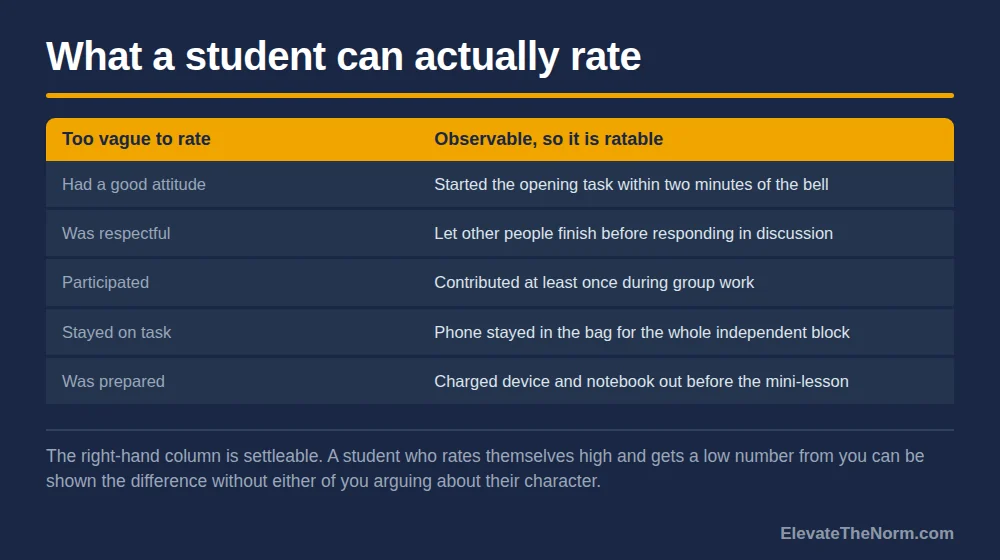
Stated positively matters more than it sounds. “Did not disrupt” gives a student nothing to aim at. “Asked for help by raising a hand or coming to the desk” names the thing you want more of. Here is the difference in practice:
| Not ratable | Ratable |
|---|---|
| Had a good attitude | Started the opening task within two minutes of the bell |
| Was respectful | Let other people finish before responding in discussion |
| Participated | Contributed at least once in the group work segment |
| Stayed on task | Phone stayed in the bag for the whole independent work block |
| Was prepared | Had the charged device and the notebook out before the mini-lesson |
The right-hand column has a property the left lacks: a student who rates themselves high and gets a low number from you can be shown the difference without either of you arguing about their character. It moves a disagreement about a person into a disagreement about a fact, and facts are settleable.
Pick two. A student tracking six behaviors is doing clerical work, and clerical work gets abandoned. Few, specific and observable beats many and inspirational — the same discipline that makes a short list of classroom expectations work at all.
Let the student pick the second one. You choose the first target — you can see the pattern from the front of the room. Hand them the second. Ask what they would fix about their own class period if they could fix one thing, and write down their words. This costs nothing and it changes what the sheet is: a form you assigned becomes a form with something of theirs on it. It also produces better targets than you would guess, because a fifteen-year-old knows things about their own period that are invisible from six feet away — the argument for taking student voice seriously in the first place.
A Four-Minute Behavior Self-Assessment Routine
Four steps, once a period or once a day, on one sheet. The design constraint is that it has to be cheap enough that you still run it in week nine.
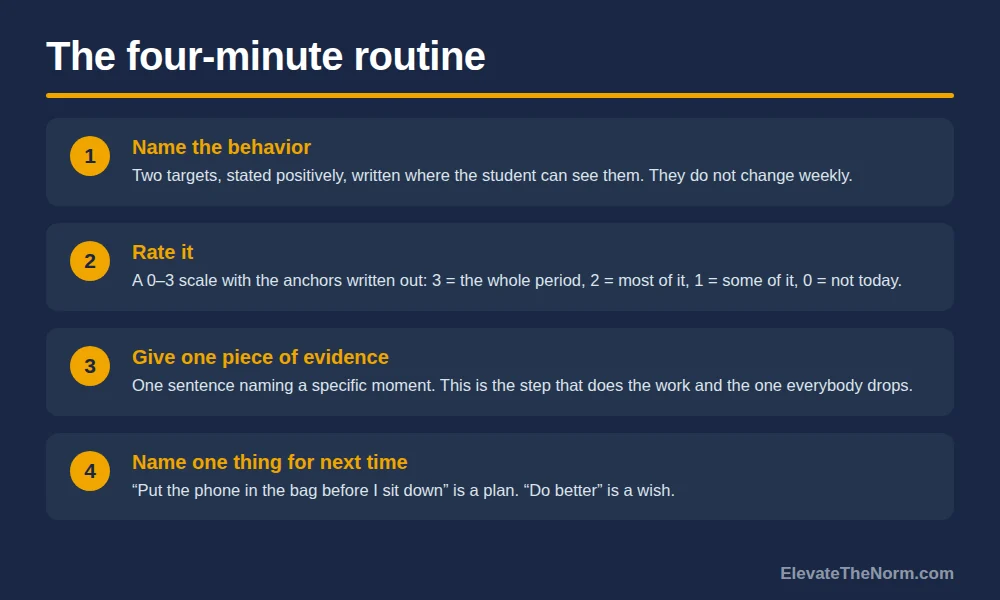
- Name the behavior. Two targets, stated positively, written where the student can see them. They do not change weekly; a target that moves every few days never gets a baseline.
- Rate it. A 0–3 scale beats 1–5. Fewer points means less hedging toward the middle, and the anchors fit on the page: 3 = the whole period, 2 = most of it, 1 = some of it, 0 = not today.
- Give one piece of evidence. One sentence naming a specific moment. This is the step that does the work and the one everybody drops. A rating with no evidence is a guess; with evidence it is an observation — and a student who has to produce evidence starts watching for it during the period instead of reconstructing it afterward.
- Name one thing for next time. Specific and small. “Put the phone in the bag before I sit down” is a plan. “Do better” is a wish.
Two easy-to-skip things make it stick. First, teach it before you run it. The OSEP guide recommends explaining the definition in student-friendly language, modeling the steps, guided practice, and telling students why the behavior matters — that last one builds buy-in rather than compliance. Fifteen minutes once beats re-explaining it daily for a month.
Second, let them see their own trend. The guide recommends self-graphing, the cheapest motivational feature available: a strip of boxes down the side of the sheet the student shades in. Ten shaded days is the first time most students have seen their own conduct as a line rather than a series of unrelated bad days — which is what makes learning from a mistake possible at all.
One adjustment before you print anything: the written version is not the only version. Step three assumes a student who can produce a sentence quickly in writing, and plenty cannot — a student with a writing disability, a newcomer still building English, a student whose handwriting speed turns four minutes into twelve. None of them needs less self-assessment; they need a different container. Saying the evidence out loud in the last minute of class does the same cognitive work, and so does an evidence line offering three pre-written options plus a blank. What has to survive is the judgment against criteria, not the paragraph.
If you want a form rather than building one, the free student self-assessment pack has a general version you can retype the criteria into. No email required.


How Do You Check Accuracy Without Turning It Into a Trap?
Rate the same period yourself, compare the two numbers, and talk about the gap — do not replace their number with yours. The OSEP guide describes exactly this: the teacher takes data at the same time the student self-records, and the comparison establishes accuracy. It calls this verification that supports rather than replaces student self-assessment, and that distinction is doing real work.
Be realistic about frequency. Rating two behaviors for one student while teaching twenty-seven others is not a daily act, and a version that demands it quits on you in week three. Three days out of ten is enough to tell whether a student’s ratings track reality. Mark your numbers on a sticky note rather than building a second tracking sheet.
The failure mode is obvious once you name it. If your rating overwrites theirs, the student learns that the sheet is a quiz with one right answer, which is you. They will start guessing what you wrote instead of watching what they did, and you have rebuilt teacher-managed behavior tracking with an extra step and the student’s handwriting on it.
What to do with a gap depends on its direction, and this is where the practice earns its keep:
- Higher than you. Ask what they were looking at. Usually the criteria are fuzzier than you thought, or they counted a different part of the period. That is information about your criteria, not evidence of dishonesty.
- Lower than you. Say so. A student who gives themselves a 1 on a day you saw a 3 is telling you something, and it is rarely about the behavior.
- A match. Say that once, then fade the checking. Matching is the exit condition, not a reason to keep checking forever.
On fading, the guide is clear: the goal is a student who monitors their own behavior without the system, faded individually through longer intervals, higher goals or less frequent recording, while you keep watching the behavior itself. A behavior self-assessment with no exit plan is a permanent accommodation you did not mean to create. Decide at the start what “done” looks like, and tell the student.
Four Ways This Goes Wrong
All four are design errors, and all four are fixable before you start.
It becomes a punishment record. The fastest way to kill it: a stack of sheets pulled out at a parent meeting or a referral. Once a student suspects the form is evidence against them, the ratings go to 3 and stay there, and you have taught them that honest self-report is a liability. Decide up front who sees the sheets and say so. If a sheet genuinely has to go into a behavior plan, tell them before the first one is filled out, not after.
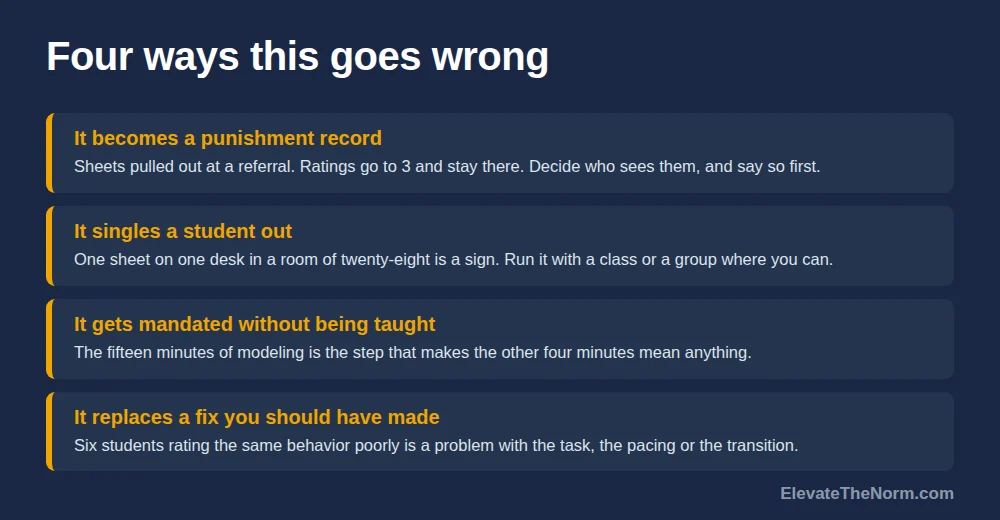
It singles a student out. A behavior sheet on one desk in a room of twenty-eight is a sign, and teenagers read signs. That is a real cost, and it is why the practice is often worth running with a whole class or group even when one or two students need it. If it has to be individual, make the form unremarkable and handle the handoff privately — not at the front of the room on the way out.
It gets mandated without being taught. When this arrives as a tier-two box to check, the teaching step is the first thing cut — it is the only step that costs a block of class time. A student handed a sheet with no instruction rates it the way they rate everything handed over with no instruction: fast, high, without looking. The fifteen minutes of modeling is what makes the other four mean anything, and a school adopting this should build that time into the rollout.
It replaces a fix you should have made. If six students rate themselves poorly on the same behavior, the problem is not six students. It is the task, the seating, the pacing, or the transition around it. Self-assessment data is a diagnostic you collect for free, and reading it only as a statement about individual kids wastes it. Sometimes the right response to the sheets is to change the lesson. That is not a failure of the practice; it is the practice working.
Where to Start This Week
Pick one class. Write two behaviors on the board, stated positively, in language a student would use. Put a 0–3 scale under each with the anchors written out. Spend fifteen minutes teaching what a 3 looks like and what it does not, using examples from the actual room. Then run it ten days without changing anything, rating the same two behaviors yourself on three of those days. On day ten, hand students their own ten days and ask one question: what does this show you that you did not know on day one? That question is the entire product. Everything before it is setup.
Keep it out of the gradebook. Keep it to two behaviors. Plan the exit before you plan the start. Behavior self-assessment will not turn a hard section into an easy one, and anything promising that is selling something. What it does is hand a teenager the job of noticing their own conduct — a job they are old enough to have and one almost nobody has ever formally given them. The natural next step, once they can rate themselves against criteria, is doing it out loud to someone other than you, which is what building student responsibility looks like as a sequence rather than a slogan.
Before you go: grab the free Student Self-Assessment Forms (PDF) — ElevateTheNorm.com branded, printable, no email required.
Frequently Asked Questions
Should a behavior self-assessment ever count toward a grade?
No. This is the single clearest finding in the research. When self-assessment counted toward a final grade in Tejeiro and colleagues’ study, student overestimation increased dramatically and the correlation with the instructor’s own assessment disappeared entirely. Run formatively, the same practice produced substantially better agreement with external evaluators. A grade converts an honest instrument into a negotiation. If your school requires a conduct grade, keep it in a separate column and say out loud that the self-assessment sheet does not feed it.
Is this just a behavior chart for teenagers?
It looks similar and it works differently. On a behavior chart, an adult records what a student did. On a self-assessment, the student records it, produces evidence for the rating, and names the next step. The recording is the intervention — the point is the act of judging your own conduct against a standard, not the data. If you fill in the sheet for the student, you have a chart, and you should not expect the self-assessment findings to apply to it.
How do I do this without embarrassing the one student who needs it?
Run it with the whole class or a whole group where you can. A single sheet on a single desk is visible and teenagers read it correctly as a label. If it has to be individual, make the form look ordinary, hand it over and collect it privately rather than at the door, and tell the student at the start exactly who will see it. Then hold to that. A promise about who sees the sheet is the whole basis of honest ratings.
Can parents or an administrator ask to see the sheets?
Possibly — records policies vary by district and this is not legal advice. The practical move is to decide before the first sheet is filled out and tell the student. If the sheets will feed a behavior plan or a meeting, say so up front; students can handle a known rule and cannot handle a surprise one. If the sheets are for the two of you, write nothing on them you would not want read aloud, and keep other students’ names off them entirely.
Does the research support this for high school students?
Less than you would gather from a workshop. The strongest average figures come from a federal practice guide citing a 41-study review that is overwhelmingly single-case research, and the best randomized trial covers grades 3 through 8. The one study located here that isolated self-monitoring with high schoolers — Estrapala, Bruhn and Rila (2022), three students with emotional or behavioral disorders — found no functional relation, though effect sizes were moderate to large and the authors flag classroom management as a confound. The honest summary: it plainly helps individual struggling students, it costs almost nothing, and it is not proven as a class-wide lever for teenagers.
How long before I should expect to see anything?
Give it ten school days before you judge it, and expect the first week to look like nothing. Students need several cycles before the ratings stabilize enough to be worth reading, and the useful moment is usually the first time a student sees ten days of their own data at once rather than any single entry. If nothing has moved after three or four weeks of consistent use, the target behavior is probably too vague or the real problem is somewhere in the lesson rather than in the student.
Should I tell families their child is doing this?
Yes, and it takes one sentence. A short note home saying what the two behaviors are, that the student rates themselves, that it is not graded, and who sees the sheet prevents the version of this conversation where a parent finds a behavior form in a backpack and reasonably assumes their child is in trouble. It also tends to produce useful information back — families often know which part of the day is hard and why. Send it before the first sheet, not after the first question.
What if a student refuses to fill it out?
Ask what they think it is for. A refusal is usually a reasonable read of the situation — they have decided it is surveillance, or paperwork, or a trap that ends in a referral. All three are things the design can fix. If the answer is that they do not see the point, that is fair, and the counter is to show them what ten days of their own data looks like rather than to argue. Do not make compliance with the sheet itself a disciplinary issue; you will win that fight and lose the practice.
Sources
- Avina, A., Boyle, S., Duble Moore, T., Hicks, T., and Wiggins, A. “Intensive Intervention Practice Guide: Self-Monitoring Systems to Support Students’ Behavioral Needs.” U.S. Department of Education, Office of Special Education Programs / National Center on Intensive Intervention, Fall 2022. https://files.eric.ed.gov/fulltext/ED628226.pdf
- Andrade, Heidi L. “A Critical Review of Research on Student Self-Assessment.” Frontiers in Education, vol. 4, art. 87, 2019. https://www.frontiersin.org/journals/education/articles/10.3389/feduc.2019.00087/full (The Tejeiro et al. 2012 and Fastré et al. 2010 findings cited above are reported in this review; the primary papers were not read directly.)
- Bruhn, Allison, Joseph Wehby, Lesa Hoffman, Sara Estrapala, Ashley Rila, Eleanor Hancock, Alyssa Van Camp, Amanda Sheaffer, and Bailey Copeland. “A Randomized Control Trial on the Effects of MoBeGo, a Self-Monitoring App for Challenging Behavior.” Behavioral Disorders, vol. 48, no. 1, 2022, pp. 29–43. https://files.eric.ed.gov/fulltext/EJ1351615.pdf
- Estrapala, Sara, Allison Leigh Bruhn, and Ashley Rila. “Behavioral Self-Regulation: A Comparison of Goals and Self-Monitoring for High School Students With Disabilities.” Journal of Emotional and Behavioral Disorders, 2022. https://files.eric.ed.gov/fulltext/EJ1349728.pdf
- Murray, Desiree W., Jennifer Kurian, Sandra L. Soliday Hong, and Fernanda C. Andrade. “Meta-Analysis of Early Adolescent Self-Regulation Interventions: Moderation by Intervention and Outcome Type.” Journal of Adolescence, vol. 94, no. 2, 2022, pp. 101–117. https://files.eric.ed.gov/fulltext/ED622592.pdf