By Clay Shumate
A learning target is a short statement of what a student should be able to do by the end of one lesson, written in the student’s own language and paired with a description of what good work looks like. It is not the standard. It is not the objective in your plan book. Those are written for you. The target is written for them.
That distinction sounds like semantics until you walk into a room at minute twenty-five and ask three students what they are working on. If you get three different answers, there was no target. There was a sentence on a whiteboard.
Key Takeaways
- A target answers three student questions: what am I learning, why does it matter, and how will I know when I have it. Drop the third and you have a topic, not a target.
- Objectives and learning targets are not the same document. An objective is a planning tool written in standards language. A target is a communication tool written in student language.
- The evidence is thinner than the training says. One video study of 13 physics classes found real benefits from goal clarity. A broad review by the same lead author put “goal setting and orientation” near the bottom of the list at .03.
- In real classrooms, goals are usually implicit. Across 146 videotaped lower-secondary maths lessons in five Nordic systems, only about 19 percent of segments had an explicit goal. Most had to be inferred by the researchers.
- Do not quote the famous effect sizes. The 0.5 and 0.88 numbers that circulate for learning intentions come out of a synthesis whose method has been published as statistically unsound. Argue for targets on what they do for students, not on a number.
What Is a Learning Target?
It is a lesson-sized piece of learning, stated from the student’s point of view, that a student could repeat back in their own words and use to judge their own work before you grade it.
Connie Moss, Susan Brookhart and Beverly Long put it plainly in Educational Leadership: a shared learning target “unpacks a ‘lesson-sized’ amount of learning” and frames the lesson from where the student is sitting. They argue instructional objectives “are not designed for students but for the teacher,” and that targets have to be translated into language that is developmentally appropriate and culturally respectful before they are worth anything.
They also name the part most people skip. The single best way to share a target, they argue, is a learning experience that embodies it — a task where finishing the task is the evidence. Not a sentence read aloud at the bell and never mentioned again.
How Is a Learning Target Different From an Objective?
An objective tells you what you are teaching. A target tells a student what they are learning and how they will know they got there. You need both, and they are written at different times, for different readers, in different words.
Here is the same lesson three ways.
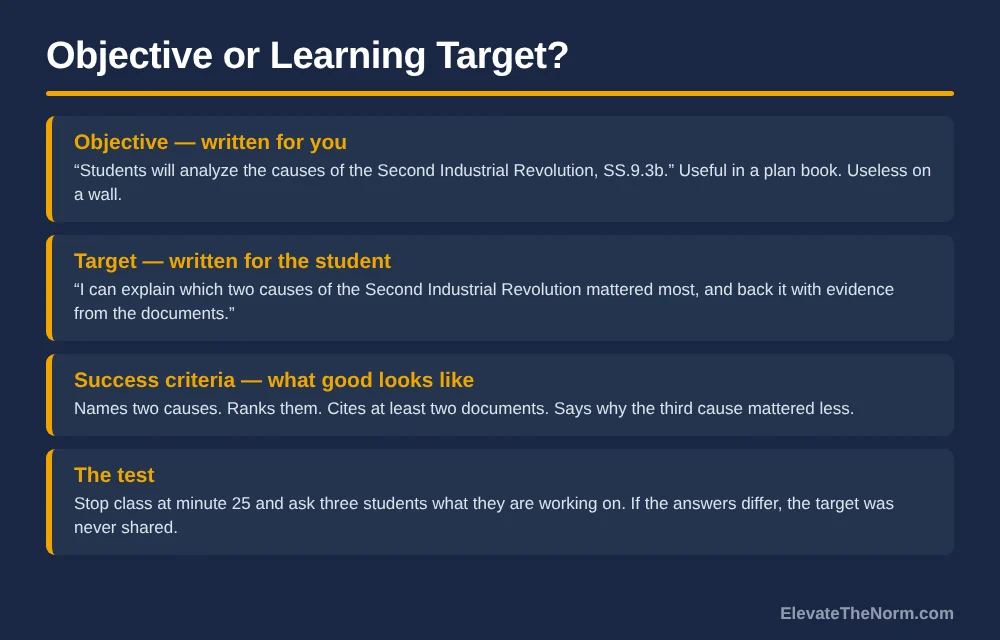
- The standard: “Analyze the causes and effects of industrialization in the late nineteenth century.”
- The objective, in your plan book: “Students will analyze primary and secondary sources to evaluate the relative significance of three causes of the Second Industrial Revolution.”
- The target, on the board and in their mouths: “I can explain which two causes of the Second Industrial Revolution mattered most, and back it up with evidence from the documents.”
The third one is the only version a fifteen-year-old can act on. It also tells them what you will not be asking for, which matters more than teachers usually admit. Students spend a lot of class time guessing at the real assignment.
Do Learning Targets Actually Improve Learning?
The honest answer is that goal clarity shows up as a real effect in a small number of careful classroom studies, and close to nothing in broad averages across the field. That is a reason to write good targets, not a reason to build a school initiative on them.
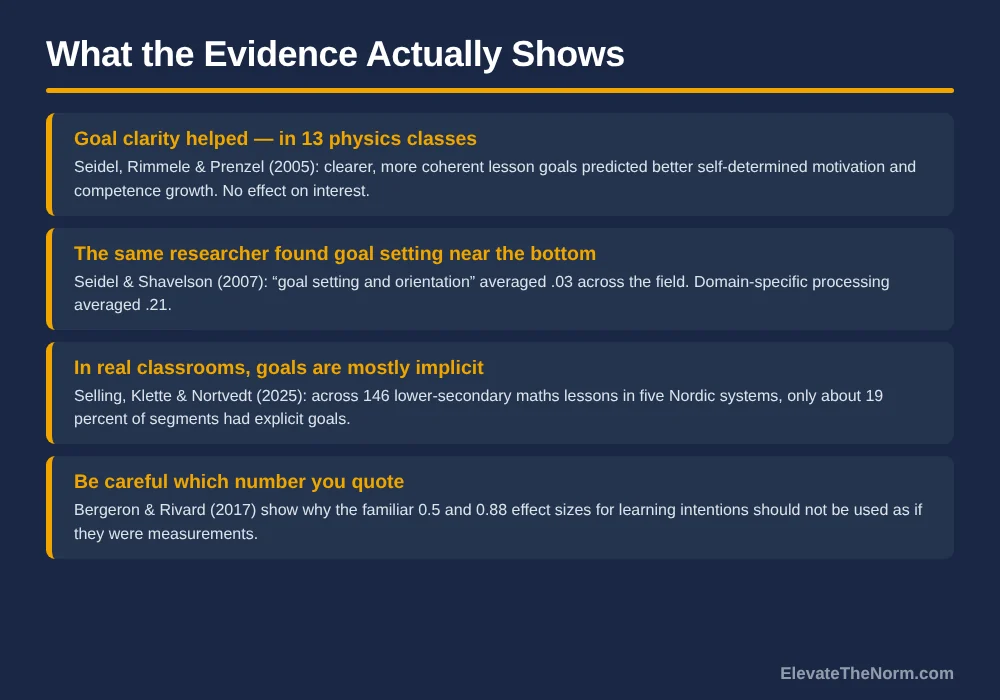
Start with the study that supports the practice. Tina Seidel, Rolf Rimmele and Manfred Prenzel video-recorded introductory lessons for two topics across 13 physics classes and rated how clear and coherent the lesson goals were. Classes with high goal clarity and coherence reported more supportive learning conditions, more self-determined motivation, and better organization of their own learning. Over a school year, high clarity was also linked to positive competence development. It had no effect on individual interest.
Thirteen classes, one subject. That is a careful study, not a large one, and the abstract does not report the grade level or an effect size. Treat it as suggestive.
Now the part the professional development rarely includes. Two years later Seidel co-authored a review of a decade of teaching-effectiveness research with Richard Shavelson in the Review of Educational Research. Across the field, “goal setting and orientation” averaged .03. Domain-specific processing — the actual thinking students do inside your subject — averaged .21, by far the largest component. The same researcher who found goal clarity mattered in physics classrooms also found that, averaged across everything, goal setting is one of the smallest levers in teaching.
Both of those can be true. Clarity probably matters most when it is the thing that is missing, and almost not at all once it is adequate. That is how most classroom variables behave.
There is also a related body of work on teacher clarity, which is broader than learning targets. Titsworth, Mazer, Goodboy, Bolkan and Myers ran two meta-analyses, one covering 144 reported effects across more than 73,000 participants. They found a moderate overall relationship, with clarity accounting for roughly 13 percent of the variance in student learning, and a larger effect on affective learning than on cognitive learning. Worth knowing — but the ERIC record does not state what education levels those studies drew on, so I am not going to hand it to you as a secondary-school finding.
Why Shouldn’t I Quote the Effect Size I Was Shown in Training?
Because the most-quoted numbers for learning intentions and success criteria come from a synthesis whose statistical method has been formally challenged in print, and the challenge has not been answered to the satisfaction of people who do statistics for a living.
Pierre-Jérôme Bergeron’s critique, translated by Lysanne Rivard in the McGill Journal of Education, lays out the specifics: common language effect values that come out negative or above 100 percent, averaging incompatible effects together, converting correlations into Cohen’s d in ways that make weak relationships look strong, and a 0.4 “desired effect” threshold with no stated basis. He notes that a correlation of .196 lands in the desired zone while explaining under four percent of the variance. His conclusion is blunt: the method should be qualified as pseudoscience.
You will still see 0.88 quoted for success criteria. It turns up, for example, in a 2023 practitioner article in the NECTFL Review, attributed onward to another source. That article collects no original data and reports no sample. The number has a long life because it is convenient, not because it was measured in rooms like yours.
None of this means targets are useless. It means you should defend them the way you would defend any other practice that asks students to be treated as capable adults — on the grounds that a student who knows what they are doing and why can do something about it.
Why Don’t Students Know the Target Even When It’s on the Board?
Because in most lessons the goal is never actually said out loud. Researchers watching real classrooms find they have to infer the goal themselves most of the time.
Selling, Klette and Nortvedt analyzed 146 videotaped lessons from 48 lower-secondary mathematics classrooms across Norway, Sweden, Finland, Denmark and Iceland. Using the PLATO observation protocol, they found most lesson segments scored a 2 on Purpose — meaning the goal existed but had to be inferred. Only about 19.4 percent of segments scored a 3 or 4 for explicit goals, and just 3.7 percent scored at the top. In Sweden, roughly 94 percent of segments sat at the inferred level.
They also found that in Iceland, Norway and Sweden, more than 40 percent of segments made no reference at all to what students already knew. A goal with no bridge from prior knowledge is a destination with no road to it.
Two honest caveats. This study measured instruction, not outcomes — it did not test whether clearer goals produced more learning. And the only relationship it reports is a weak correlation (r = 0.265) between the Purpose score and references to prior knowledge. What it shows is simply that the practice everyone says they do is rare when someone puts a camera in the room.
How Do You Write a Learning Target?
Four parts: what the student will be able to do, why it is worth doing, how they will show it today, and what good looks like. If you cannot write all four in under two minutes, the target is too big for one lesson.
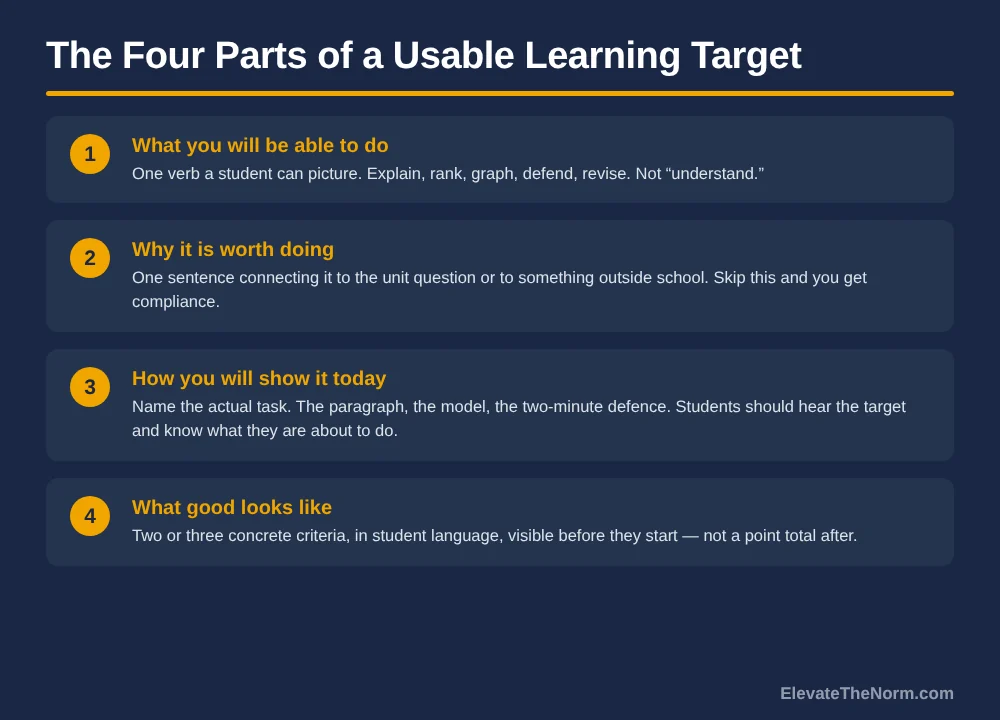
1. What you will be able to do. One verb a student can picture. Explain, rank, graph, defend, revise, predict, trace. Not “understand,” not “be exposed to,” not “explore.” If a student cannot tell from the verb whether they are writing, talking, building or calculating, pick a different verb.
2. Why it is worth doing. One sentence tying it to the unit question or to something outside the building. Skip this and the best you get is compliance. Teenagers give you compliance cheaply and it is worth exactly what you paid.
3. How you will show it today. Name the actual task. The paragraph, the labeled model, the two-minute defense, the corrected problem set. Students should hear the target and already know what they are about to be doing.
4. What good looks like. Two or three concrete criteria, in student language, visible before they start. Not a point total handed back afterward.
Learning Target Examples for Grades 6–12
Each of these is one lesson, with criteria attached. Steal the shape, not the content.
Social studies, grade 9
Target: “I can rank three causes of an event by importance and defend my ranking with evidence.”
Criteria: Names all three causes accurately. Puts them in an order and says why. Uses at least two documents. Names the strongest objection to my ranking.
Science, grade 7
Target: “I can tell the difference between a result my data supports and one it doesn’t.”
Criteria: Points to the specific numbers behind each claim. Says what the data cannot tell us. Does not use the word “prove.”
Algebra, grade 8
Target: “I can find my own mistake in a solved equation and explain what rule I broke.”
Criteria: Circles the exact line. Names the property or step. Rewrites from that line forward instead of starting over.
English, grade 11
Target: “I can rewrite a paragraph so the evidence comes before the opinion, and say why that order is stronger.”
Criteria: Quote appears before the claim is restated. Explains the quote in my own words. Cuts at least one sentence that was doing no work.
Notice what is missing from all four: a standard code. Put the code in your plan book and your standards-based gradebook where it belongs. A student does not need to read “SS.9.3b” to learn anything.
What Are Success Criteria, and How Are They Different?
The target says what you are learning. The success criteria say what it will look like when you have learned it. The criteria are the half that gets dropped, and they are the half students actually use.
Moss, Brookhart and Long describe success criteria as “developmentally appropriate descriptions and concrete examples” of quality — not grades and not item counts. Three to five points. Rubrics and real work samples help, because most students cannot picture “well organized” until they have seen two versions side by side.
The strongest version of this is letting students help build the criteria from exemplars. Hand two anonymous pieces of past work to a table group, ask them what the better one does that the other does not, and write their answers on the board. You will get most of your rubric back in their words, which makes it far more likely to be used. It also pairs naturally with student self-assessment, which is close to pointless when students are guessing at the standard.


A Two-Minute Check Before You Post It
- Can a student read it and say what they will be doing in the next ten minutes?
- Is there exactly one lesson in it? Two verbs usually means two days.
- Does it survive the “so what” question without a speech?
- Are the criteria specific enough that two students would grade the same paper the same way?
- Is there any jargon in it you would not use at a dinner table?
- Can you check it at the end of class in under four minutes? Pick one of the quick formative checks and name it before the lesson starts. If you cannot, you have no way of knowing whether the target landed.
That last one matters more than the wording. A target with no check at the end of the period is a prediction nobody ever scores.
Where Learning Targets Go Wrong
They become a compliance item
The fastest way to kill the practice is to audit it. When a walkthrough form has a box for “objective posted,” every board in the building gets a sentence on it by 8:05 and nothing else changes. If you lead a building and you want to know whether targets are working, do not look at the wall. Ask three students in the hallway what they were working on and why. That takes ninety seconds and it is the only version of this audit that measures anything.
They get written for five preps every night
Nobody is writing twenty-five fresh targets a week in December. The realistic move is to write targets at the unit level once, during planning, and break them into lesson-sized pieces as you go. Most units have four to six real targets in them, not twenty. Reusing a target across two days is fine and honest — it tells students the thing is hard enough to take two days.
They are read aloud and then abandoned
A target mentioned at the bell and never again is theater, and students know it faster than adults do. Come back to it twice: once in the middle, when you stop and ask what part of it they have so far, and once at the end, when the exit check is visibly the same thing the target promised.
They get confused with a schedule
“Today we will finish the packet and start the lab” is an agenda. Agendas are useful. They are not targets, and posting one in the target’s slot is how most classrooms end up believing they do this already.
What About Targets for a Multi-Day Project?
Keep one project-length target for the whole arc, and write a smaller daily target underneath it that names today’s piece.
On a three-week project, “I can design and defend a solution to a real problem” is the arc. Today’s is “I can write two interview questions that will get me something I cannot find online.” Students need both: the arc so the work has a point, the daily piece so they know what finished looks like by 2:15. This is also where students setting their own goals stops being an add-on — once the criteria are public, a student can name their own next step without you assigning it.
What to Say to a Parent
You will get the question eventually, usually phrased as “what are they actually supposed to be learning?” A posted target makes that a short conversation. “Here is the target for this week, here is what good work looks like on it, and here is where your son is against those three criteria” is a different conference than reading a column of percentages aloud. It also makes a low grade explicable instead of mysterious, which is most of what parents want from a conference.
Learning Targets: What to Do in Your Next Lesson
Pick one lesson you are teaching this week. Write the target in a student’s voice, add three criteria, and name the four-minute check that will tell you whether it landed. That is the entire practice.
Then do the thing that actually tests it: stop the class halfway through and ask three students what they are working on and how they will know they did it well. If you get the same answer three times, the target is doing its job. If you get three different answers, the problem is not that your students were not listening. The sentence was never written for them in the first place.
And if you only change one thing, add the criteria. The target without them is a topic.
Frequently Asked Questions
What is a learning target?
A learning target is a short statement of what a student should be able to do by the end of one lesson, written in the student’s own language and paired with a description of what good work looks like. It is distinct from an instructional objective, which is written in standards language for the teacher’s planning. Moss, Brookhart and Long describe a shared learning target as unpacking a “lesson-sized” amount of learning from the student’s point of view.
What is the difference between a learning target and an objective?
The reader. An objective is a planning document written in standards language for the teacher — “students will analyze primary sources to evaluate the relative significance of three causes.” A learning target is a communication document written for the student — “I can explain which two causes mattered most, and back it up with evidence from the documents.” You need both, and they are written at different times in different words.
Do learning targets improve student achievement?
The evidence is mixed and thinner than most training implies. Seidel, Rimmele and Prenzel (2005) found that clearer, more coherent lesson goals across 13 physics classes predicted more self-determined motivation and positive competence development over a year, though no effect on interest. But Seidel and Shavelson’s (2007) review of a decade of teaching-effectiveness research placed “goal setting and orientation” near the bottom at .03, well below domain-specific processing at .21. Clarity most likely matters when it is missing and much less once it is adequate.
Why shouldn’t I quote the 0.88 effect size for success criteria?
Because it traces back to a synthesis whose statistical method has been formally challenged in print. Bergeron and Rivard (2017), in the McGill Journal of Education, document miscalculated common language effects, averaging of incompatible effects, unreliable conversion of correlations into Cohen’s d, and an unexplained 0.4 threshold, and conclude the methodology should be qualified as pseudoscience. Argue for learning targets on what they do for students, not on a number.
How many learning targets should one lesson have?
One. If your target contains two verbs, you most likely have two lessons. A realistic planning approach is to write four to six real targets at the unit level during planning and break them into lesson-sized pieces as you go, rather than drafting a fresh target every night for every prep. Reusing a target across two days is honest — it tells students the content is hard enough to need two days.
What are success criteria?
Success criteria describe what it will look like when a student has met the target. Moss, Brookhart and Long call them developmentally appropriate descriptions and concrete examples of quality — not grades and not item counts. Three to five specific points works. The strongest version is building them with students from two anonymous work samples, because most students cannot picture “well organized” until they have seen a better and a worse version side by side.
Do students actually hear the learning target?
Usually not. Selling, Klette and Nortvedt (2025) analyzed 146 videotaped lessons from 48 lower-secondary mathematics classrooms in five Nordic systems and found that only about 19.4 percent of lesson segments contained an explicit goal; in most, researchers had to infer the goal themselves. More than 40 percent of segments in three of the countries made no reference to students’ prior knowledge. The test in your own room is to stop at minute 25 and ask three students what they are working on.
Should administrators check whether learning targets are posted?
Checking the wall measures the wall. If a walkthrough form has a box for “objective posted,” every board in the building will have a sentence on it and nothing else will change. The useful version takes ninety seconds: ask three students in a hallway what they were working on and how they would know they did it well. That measures whether the target was shared, which is the only thing that matters.
Sources
- Seidel, T., Rimmele, R., & Prenzel, M. (2005). Clarity and Coherence of Lesson Goals as a Scaffold for Student Learning. Learning and Instruction, 15(6), 539–556. Video ratings of introductory lessons in 13 physics classes; high goal clarity and coherence predicted supportive learning conditions, self-determined motivation, better organization of learning, and positive competence development over a year, with no effect on individual interest. Thirteen classes, one subject; the ERIC abstract does not state grade level, country, or effect sizes, and the full text is paywalled. https://eric.ed.gov/?id=EJ724179
- Seidel, T., & Shavelson, R. J. (2007). Teaching Effectiveness Research in the Past Decade: The Role of Theory and Research Design in Disentangling Meta-Analysis Results. Review of Educational Research, 77(4), 454–499. Weighted Fisher’s Z-based effects across all outcomes: domain-specific processing .21; goal setting and orientation .03; organization of learning .01. These are not Cohen’s d and should not be read as such; cited from the abstract and published tables, as the full article is paywalled. https://journals.sagepub.com/doi/10.3102/0034654307310317
- Selling, A. J. V., Klette, K., & Nortvedt, G. A. (2025). Teachers’ Goal Communication in Nordic Mathematics Classrooms. Mathematics Education Research Journal, 37(3), 483–506. 146 videotaped lessons from 48 lower-secondary mathematics classrooms in Norway, Sweden, Finland, Denmark and Iceland; about 19.4 percent of segments scored 3 or 4 for explicit goals and 3.7 percent scored 4. The study measured instruction, not student outcomes. https://link.springer.com/article/10.1007/s13394-024-00498-w
- Titsworth, S., Mazer, J. P., Goodboy, A. K., Bolkan, S., & Myers, S. A. (2015). Two Meta-analyses Exploring the Relationship Between Teacher Clarity and Student Learning. Communication Education, 64(4), 385–418. 144 reported effects (N = 73,281) and a second random-effects analysis of 46 studies (N = 13,501); clarity accounted for roughly 13 percent of the variance in student learning, with a larger effect on affective than cognitive learning and significant unexplained heterogeneity. The ERIC record does not state the education levels sampled, so this is not presented here as a secondary-school finding. https://eric.ed.gov/?id=EJ1082982
- Bergeron, P.-J., & Rivard, L. (trans.) (2017). How to Engage in Pseudoscience With Real Data: A Criticism of John Hattie’s Arguments in Visible Learning From the Perspective of a Statistician. McGill Journal of Education, 52(1), 237–246. Documents miscalculated common language effects, averaging of incompatible effects, unreliable correlation-to-d conversion, and an unexplained 0.4 threshold. https://mje.mcgill.ca/article/view/9475
- Moss, C. M., Brookhart, S. M., & Long, B. A. (2011). Knowing Your Learning Target. Educational Leadership, 68(6), 66–69. Defines a shared learning target, distinguishes it from an instructional objective, and describes success criteria as developmentally appropriate descriptions and concrete examples rather than grades. A practitioner article, cited for its definitions rather than as empirical evidence. https://www.montanalanguageteachers.org/uploads/6/6/4/8/66489615/3_excerpts_brookhart_knowing_your_learning_target_march_2011.pdf
- Eagan, T. (2023). Unlocking Student Success: The Power of Success Criteria, Relationships, and Clarity. NECTFL Review, Number 90, 95–102. Cited as an example of the .88 success-criteria figure circulating in practitioner literature; the article reports no original data and no sample. https://files.eric.ed.gov/fulltext/EJ1382629.pdf