By Clay Shumate
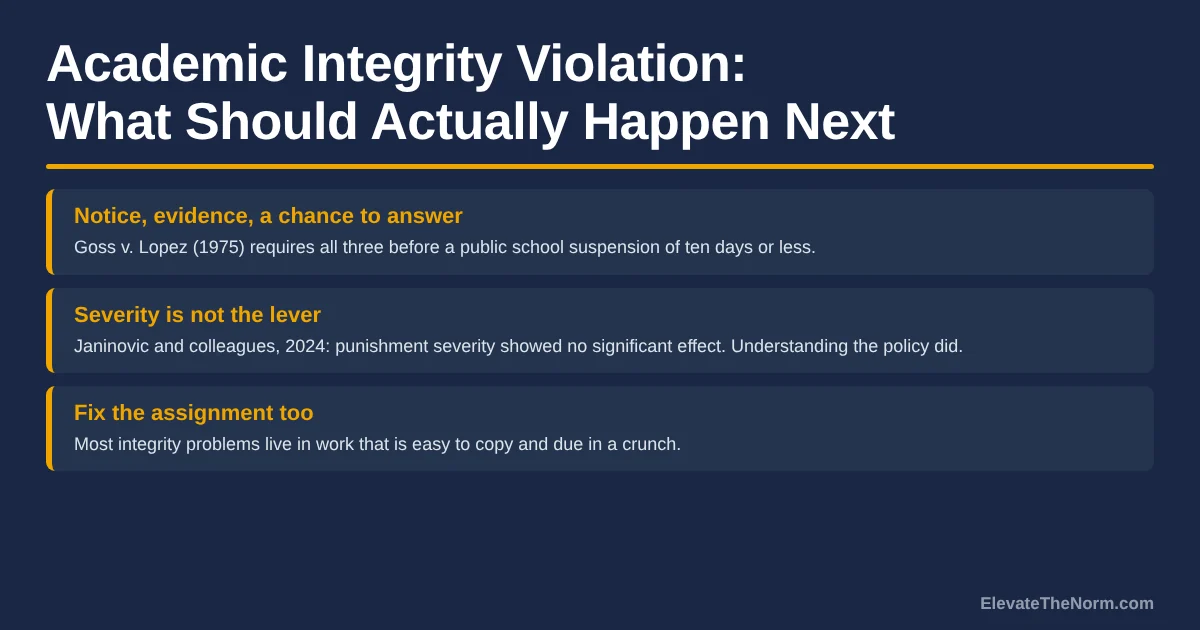
An academic integrity violation is a confirmed act of cheating, plagiarism, unauthorized collaboration, or falsified work. A defensible school response has four parts: tell the student the charge and the evidence, let them answer, apply a consequence tied to the assignment, and require the work be redone honestly. Punishment severity is not what deters it.
That last sentence is the one most handbooks get backwards. The instinct after catching a kid cheating is to make the penalty hurt enough that nobody tries it again. The evidence does not support that instinct, and the rest of this page is about what to do instead — the sequence, the script, the paperwork, and the line where it stops being yours to handle.
Key Takeaways
- Notice, evidence, and a chance to answer are not a courtesy. In Goss v. Lopez (1975) the Supreme Court held that a public school student facing a suspension of ten days or less is owed oral or written notice of the charges, an explanation of the evidence, and an opportunity to present his side of the story.
- 🔴 Severity of punishment showed no measurable effect. Janinovic and colleagues surveyed 486 university students and found severity of punishment did not significantly predict how seriously students regarded cheating (b = −0.15, not significant). A read honor code was weak on its own (b = 2.74, p = .10).
- Understanding the policy is what made either one work. In the same study, the honor code’s effect grew sharply among students who understood the rules (interaction b = 3.20, p = .01) and among those who supported them (b = 3.90, p < .01).
- AI did not cause a cheating spike in high schools. Lee, Pope and Miles report in Phi Delta Kappan that high school cheating levels did not significantly increase after ChatGPT’s release. Before it, roughly 60 to 70 percent of students in Challenge Success surveys reported at least one cheating behavior in the previous month.
- 🔴 Students often cannot tell you what the rule is. In a Common Sense Media survey of 1,045 U.S. teens aged 13 to 18, 40 percent had used generative AI for a school assignment, 46 percent of those said their most recent use was without the teacher’s permission, and 37 percent were not sure whether their school had any AI rules at all.
Free Download · PDF
Academic Integrity Violation Response Sheet
A three-page printable: the six-step response sequence, the five escalation triggers, a six-line incident record template, and the five-move conversation script. No email required.
Free. No email address required. Designed for grades 6–12. Browse every printable in Your Free Library.
What Counts as an Academic Integrity Violation?
An academic integrity violation is a confirmed act of presenting work that is not honestly yours, or helping someone else do it. In grades 6–12 that comes down to five recurring categories: plagiarism, copying on an assessment, unauthorized collaboration, fabricated sources or data, and unauthorized use of a tool. Everything else is a variation on one of those.
The word doing the work in that definition is confirmed. A suspicion is not a violation. A hunch about a kid’s writing style is not a violation. Until you have evidence you can state out loud to the student, you have a question, and the honest move is to go ask it. If you want the positive version of all this — what integrity looks like when nothing has gone wrong — start with what academic honesty actually means and the worked examples of honest and dishonest work.
The International Center for Academic Integrity frames the whole subject around six values: honesty, trust, fairness, respect, responsibility, and courage. That framing is more useful than it sounds, because it tells you what a violation actually damages. A kid who copies a lab table has not broken a rule about lab tables. He has taken a shortcut that, if everyone took it, would make the grade meaningless for the students who did the work. That is the thing worth saying to him, and it is more persuasive to a sixteen-year-old than a policy number.
| Category | What it usually looks like in grades 6–12 | A first-time response that fits | When it escalates |
|---|---|---|---|
| Plagiarism | Paragraphs pasted from a site or a classmate, no citation, often mid-paper where the student ran out of time | Conference, zero on the affected section, honest rewrite due on a set date, contact home | Whole paper, repeat offense, or a graded research project |
| Copying on an assessment | Phone under the desk, answers shared between class periods, a photographed quiz | Retake of a different version, grade on the retake, documented conference, contact home | Final exam, state or AP testing, or a distributed answer key |
| Unauthorized collaboration | Two nearly identical homework sets from students who were told to work alone | Both students redo separately; teach the difference between helping and handing over | Repeat after the rule was taught and documented |
| Fabricated sources or data | Citations that do not resolve, a survey nobody ran, numbers that do not match the raw data | Zero on the evidence portion, resubmit with verifiable sources, conference | Any work entering a competition, publication, or transcript-level grade |
| Unauthorized tool use | A chatbot wrote it; a translator wrote it; a solver produced the steps | Student reproduces the thinking in front of you; grade reflects what they can actually do | Repeat, or a rule the student can prove was never communicated — that one is on the adults |
Two things about that table. The responses in column three all attach to the assignment rather than to the student’s record, and every one of them ends with the student doing the work. That is deliberate, and it is the same logic behind consequences that teach instead of humiliate.
What Happens If You Get an Academic Integrity Violation?
The sequence that holds up is a conference, a written record, a contact home, a consequence attached to that assignment, and a required honest redo. Formal discipline — detention, suspension, removal from an honor society, loss of eligibility — belongs to repeat cases and major assessments, not to a first-time homework copy. Your handbook may say otherwise, and your handbook wins.
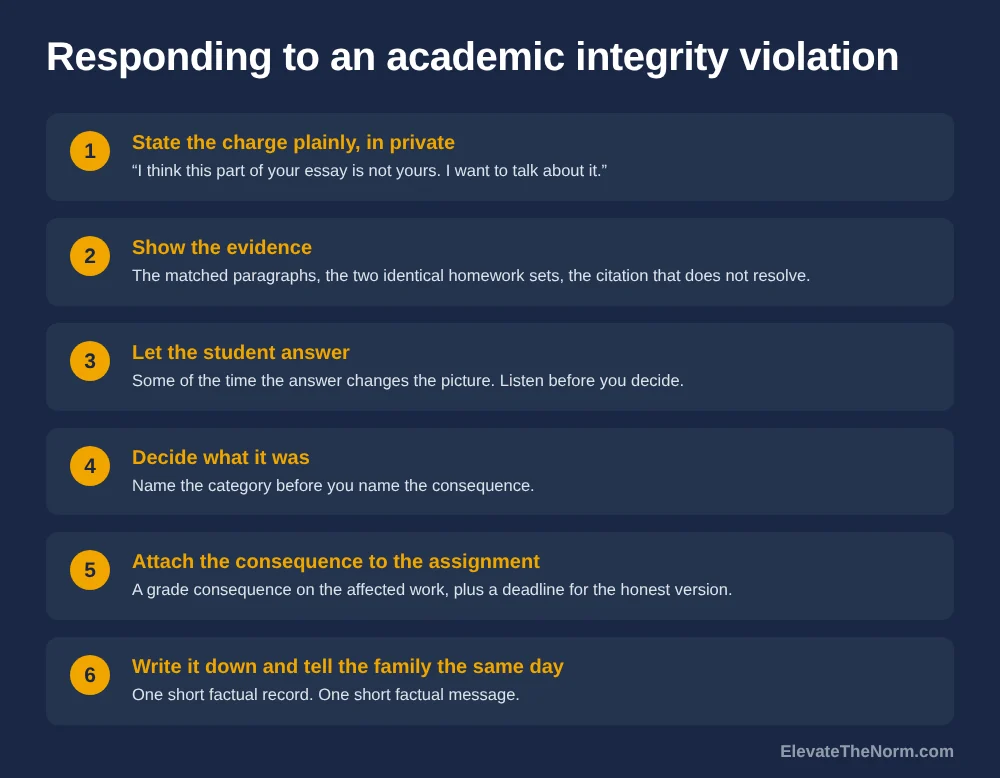
Here is the order I would run, and the order matters more than any single step in it.
- State the charge plainly, in private. “I think this part of your essay is not yours. I want to talk about it.” Not in front of the class, not in the hallway, not by email first.
- Show the evidence. The matched paragraphs, the two identical homework sets, the citation that does not resolve. If you cannot show it, you are not ready to have the conversation.
- Let the student answer, and actually listen. Some of the time the answer changes the picture. A kid who shared notes with a friend who then copied them has done something different from the kid who copied.
- Decide what it was. Name the category. “Plagiarism” and “you cut corners because you were out of time” call for the same consequence and a very different conversation.
- Attach the consequence to the assignment. A grade consequence on the affected work, plus a deadline for the honest version. Not a zero in the gradebook forever, and not a behavior referral for a homework problem.
- Write it down and tell the family the same day. One short factual record and one short factual message. There is a full walkthrough of the message itself under writing the email home.
Step five is where most policies go wrong in the direction of leniency and most teachers go wrong in the direction of severity. A permanent zero teaches a student that the fastest way out of an integrity problem is to stop caring about the grade. Requiring the real work, on a real deadline, with the grade reflecting what they can genuinely do, is both harder on the student and more useful to them. That is the whole argument of accountability and a second chance.
Does a Harsher Penalty Stop Cheating?
The best available evidence says it does not. Janinovic, Pekovic, Djokovic and Vuckovic surveyed 486 students with a 97 percent response rate and found that students’ rating of how severe the penalties were had no significant relationship to how seriously they regarded cheating. The direct effect was b = −0.15, not significant — and the sign is pointing the wrong way.
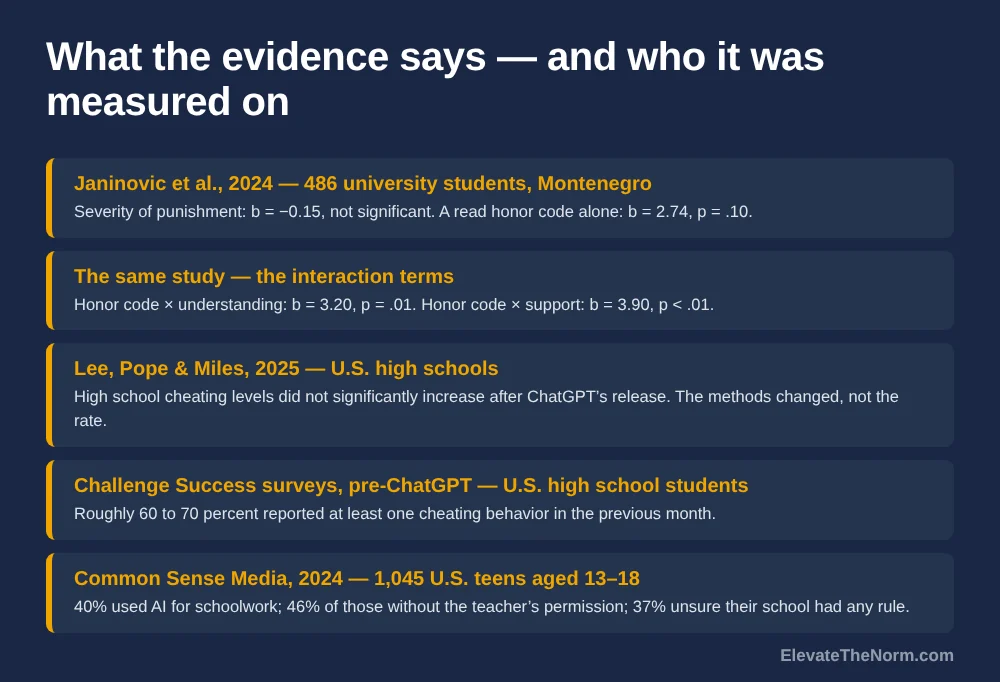
Having an honor code did a little better and not much: b = 2.74, significant only at the 10 percent level, which the authors themselves describe as partial support. What changed the picture was the interaction terms. Among students who understood the policies, the honor code’s effect rose to b = 3.20 (p = .01), and among students who supported them, to b = 3.90 (p < .01). Severity also became significant once students understood the rules, and never mattered on its own.
Now the honest limits, because they are substantial. That study ran on university students in Montenegro, not American teenagers. The data were collected between December 2019 and March 2020. The outcome was students’ perceived seriousness of cheating, which is not the same thing as whether they cheated. It is self-report, from one institution, in one country. The paper’s own text and tables do not fully agree on two of the coefficients. None of that makes it useless — it is a carefully controlled model on a real sample asking exactly the right question — but anyone telling you that research proves harsh penalties do not work has overstated it. What it supports is narrower and still worth acting on: severity alone has no demonstrated effect, and comprehension has a measured one.
Which has a practical consequence. If you want fewer violations next semester, the time is better spent making sure every student can state the rule in their own words than on rewriting the penalty schedule.
What Does Due Process Require Before You Punish a Student?
In a U.S. public school, Goss v. Lopez (1975) requires oral or written notice of the charges, an explanation of the evidence the school has, and an opportunity for the student to present their side before a suspension of ten days or less. The Court asked for “at least an informal give-and-take between student and disciplinarian, preferably prior to the suspension.”
Read what that is and is not. The Court did not require a lawyer, cross-examination, or witnesses for a short suspension. It did say longer removals may require more. And it allowed immediate removal where a student’s presence is a continuing danger or an ongoing threat of disruption, with notice and hearing to follow as soon as practicable.
I am a teacher, not a lawyer, and none of this is legal advice — your student handbook, your state code and your district’s counsel govern what you can actually do. But the shape of it transfers cleanly to a grade-level integrity case even where no suspension is on the table, and it is the same three steps as the top of the sequence above. Notice. Evidence. A chance to answer. A school that does those three things before deciding has already removed most of the ways this goes badly.


How Do You Handle an AI Case You Cannot Prove?
Treat an unprovable AI case as an assignment problem rather than a discipline case. Ask the student to walk you through their process and reproduce the thinking in front of you. If they cannot, the work does not demonstrate the standard, and that is a grading judgment you can defend without accusing anyone of anything.
This matters because the accusation is the part you cannot take back. A detector score is not evidence a student can answer, and a kid who did the work and gets called a cheater remembers it for years. The grading route asks the same underlying question — can this student do this? — and survives being wrong.
It also helps to know the scale of the problem is not what the headlines say. Lee, Pope and Miles report in Phi Delta Kappan that high school cheating levels did not significantly increase after ChatGPT’s release; what changed was the method, not the rate. Before ChatGPT, Challenge Success surveys of U.S. high school students were already finding roughly 60 to 70 percent reporting at least one cheating behavior in the previous month. That number is the actual problem, and it predates every tool anyone is currently panicking about.
Meanwhile the rules are genuinely unclear to students. In Common Sense Media’s 2024 survey of 1,045 teens, 35 percent said their school had generative AI rules, 27 percent said it had none, and 37 percent were not sure. Among teens who had used AI for schoolwork, 46 percent said their most recent use was without the teacher’s permission. You cannot run an integrity case on a rule a third of your students cannot confirm exists. Write the rule for each assignment, in a sentence, on the assignment.
What Should the Conversation Sound Like?
Short, private, factual, and finished in five minutes. The goal is not a confession. It is a shared understanding of what happened and what the student is going to do about it. Five moves:
- Open with the fact, not the verdict. “These two paragraphs match a site I found. Tell me about them.”
- Let the silence sit. Most students fill it. Some of what they say will change your mind.
- Separate the act from the kid. “This was copied” is a statement about the paper. “You are a cheater” is a statement about a person, and it ends the useful part of the conversation.
- Name what happens, all of it, at once. The grade, the redo, the deadline, the call home. No drip-feed of consequences over three days.
- End on the path back. “Turn in the real version by Friday and we are square on this.” Then honor that exactly. Standing by your word is the entire mechanism here.
If your school runs formal restorative conferences, this conversation is the classroom-scale version of one, and the honest limits of that approach are covered under restorative practice in schools.
How Do You Document It Without Building a Case Against a Kid?
Write down what you can show and what was decided, and nothing else. The record exists so a future adult — a counselor, an administrator, next year’s teacher — can see what already happened. It does not exist to prove you were right.
A usable record has six lines: date, assignment, what you observed, what the student said, what was decided, and when the honest work is due. That is it. Leave out adjectives, leave out your read on the student’s character, and leave out anything you could not repeat to the family. Then check four things before you file it:
- Could the student read this record and recognize the conversation they were in?
- Is every factual claim in it something you can still show next month?
- Does it record what the student said, including the parts that cut against you?
- Does it name a specific next step with a date, so the case can actually close?
When Does This Stop Being a Classroom Matter?
The moment the consequence reaches beyond your gradebook, it is no longer only your call. Hand it up when any of the five triggers below is true — not because you cannot handle it, but because consequences that touch a transcript, an eligibility list or a disciplinary record are supposed to run through the people whose job that is.
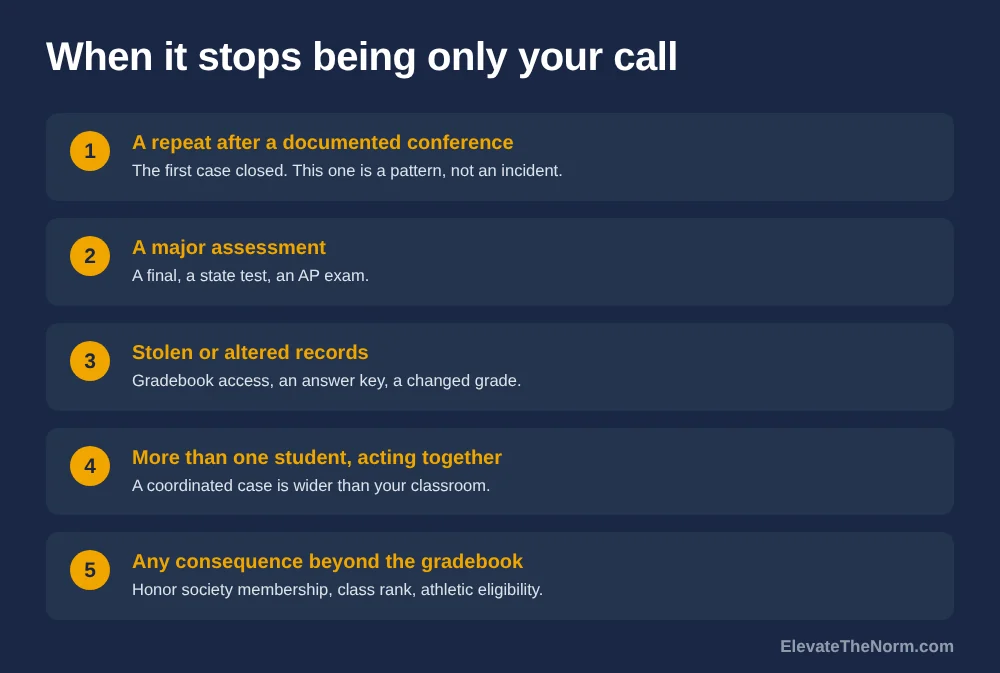
Those triggers are: a repeat after a documented conference; a major assessment such as a final, a state test or an AP exam; stolen or altered records, including access to a gradebook or an answer key; more than one student involved in a coordinated way; and any consequence touching honor society membership, class rank or athletic eligibility. If you are unsure which side of the line a case falls on, ask an administrator before you act, not after.
What Should Change in Your Assignments Afterward?
Assume the next violation will come from the same assignment design, because it usually does. After you close a case, look at the task rather than the kid. Most integrity problems in a secondary classroom live in work that is easy to copy, graded heavily, and due at a moment when honest students are also out of time.
Four changes that cost almost nothing:
- Put the tool rule on the assignment. One sentence: what help is allowed, what is not, and what you expect students to be able to explain afterward.
- Make part of the grade live in the room. A two-minute defense, a handwritten annotation, a revision done in class. Work that has to be explained is work that has to be understood.
- Fix the deadline crush before it arrives. A lot of copying is a time problem wearing an integrity costume, which is an argument for a late-work policy you can actually hold rather than a stricter penalty.
- Stop reusing the assessment that got photographed. It is gone. Rewrite it.
My position on all of this, as a classroom teacher: if a student can get all the way through a major assignment dishonestly without anyone noticing until the end, part of that is a planning problem, and the response should include fixing the plan. Holding a kid accountable and looking hard at the task that made it easy are not in competition.
What to Do Next
Pick the single assignment in your current unit that would be easiest to cheat on, and add the two cheapest fixes to it: one sentence on the assignment saying what help is allowed, and one small in-class component the student has to explain out loud. Then, before the next case lands, write your six-line record template and decide in advance which of the five escalation triggers sends a case up the hall. Deciding that while nothing is happening is much easier than deciding it with a crying sophomore in your room.
Want this as a printable? The six-step sequence, the record template and the conversation script, on three printable pages. Download the free PDF — no email address required.
Frequently Asked Questions
What is an academic integrity violation?
It is a confirmed act of presenting work that is not honestly yours, or helping someone else do it. In middle and high school the recurring categories are plagiarism, copying on an assessment, unauthorized collaboration, fabricated sources or data, and unauthorized use of a tool such as a chatbot or a solver. The word that matters is confirmed — a suspicion about a student’s writing style is a question to go ask, not a violation to act on.
What happens if you get an academic integrity violation in high school?
Typically a private conference with the teacher, a short written record, a contact home, a grade consequence on the affected assignment, and a requirement to redo the work honestly by a set date. Formal discipline such as detention, suspension, loss of eligibility or removal from an honor society is generally reserved for repeat cases and major assessments. Your school handbook governs the specifics and should be read before anyone acts.
Does a harsher punishment stop students from cheating?
There is no good evidence that it does. Janinovic and colleagues (2024) surveyed 486 university students and found that how severe students rated the penalties had no significant effect on how seriously they regarded cheating. An honor code had only a weak direct effect. Both became more effective among students who understood the policies. That study was run on university students in one country, so treat it as suggestive rather than settled.
Does a student have due process rights in an academic integrity case?
In a U.S. public school, Goss v. Lopez (1975) requires that a student facing a suspension of ten days or less receive oral or written notice of the charges, an explanation of the evidence, and a chance to present their side first. The Court did not require counsel or cross-examination for short suspensions, and longer removals may require more. This is general information, not legal advice — your handbook, state code and district counsel control.
Has AI made cheating worse in high schools?
Not in rate, according to the available research. Lee, Pope and Miles report in Phi Delta Kappan that high school cheating levels did not significantly increase after ChatGPT’s release, though the methods changed. Before ChatGPT, Challenge Success surveys were already finding roughly 60 to 70 percent of high school students reporting at least one cheating behavior in the previous month. The baseline, not the tool, is the real problem.
What do you do when you suspect AI use but cannot prove it?
Handle it as a grading question rather than a discipline case. Ask the student to walk you through their process and reproduce the thinking in front of you. If they cannot, the work does not demonstrate the standard and the grade should reflect what the student can actually do. That judgment is defensible, survives being wrong, and avoids an accusation you cannot take back if a detector score was all you had.
When should a teacher send an integrity case to an administrator?
When the consequence would reach beyond the gradebook. Five common triggers: a repeat after a documented conference, a major assessment such as a final or a state test, stolen or altered records including gradebook or answer-key access, several students acting in a coordinated way, and any consequence touching honor society membership, class rank or athletic eligibility. If a case is close to the line, ask before acting rather than after.
Sources
- Goss v. Lopez, 419 U.S. 565 (1975). U.S. Supreme Court. Holding on notice, explanation of evidence and opportunity to respond for suspensions of ten days or less. law.cornell.edu
- Janinovic, J., Pekovic, S., Djokovic, R., & Vuckovic, D. (2024). Assessing the Effectiveness of Academic Integrity Institutional Policies: How Can Honor Code and Severe Punishments Deter Students’ Cheating—Moderating Approach? SAGE Open, 14(4). 486 students at one university in Montenegro, data collected December 2019 to March 2020, Tobit regression. Reported with its stated limits: the outcome is perceived seriousness of cheating rather than cheating itself, the data are self-report from a single institution, and the text and tables disagree on two coefficients. journals.sagepub.com
- Lee, V. R., Pope, D., & Miles, S. (2025). Cheating: The AI elephant in the classroom. Phi Delta Kappan, 107(3–4), 24–28. Key finding quoted here: high school cheating levels did not significantly increase after ChatGPT’s release. The article is restricted-access; the abstract was read and no figure is attributed to it beyond that statement. journals.sagepub.com
- Stanford Graduate School of Education (2023). What do AI chatbots really mean for students and cheating? Interview with Denise Pope and Victor Lee on Challenge Success survey data. Source of the 60–70 percent pre-ChatGPT figure and of Pope’s note that the surveys were anonymous and may be underreported. ed.stanford.edu
- Common Sense Media (2024). The Dawn of the AI Era: Teens, Parents, and the Adoption of Generative AI at Home and School. Nationally representative survey of 1,045 U.S. teens aged 13–18 and their parents, fielded March 15 to April 20, 2024. commonsensemedia.org
- International Center for Academic Integrity. The Fundamental Values of Academic Integrity (3rd ed., 2021) — honesty, trust, fairness, respect, responsibility and courage. Values list verified against ICAI’s own published summary. academicintegrity.org