By Clay Shumate
Classroom incentives work in grades 6–12 when they reward a specific, taught behavior, feel worth having to a teenager, and fade as the habit sticks. They backfire when they turn interesting work into a transaction, reward perfection instead of effort, or become a prize students expect for everything.
That’s the whole tension with incentives in middle and high school. A small, well-placed reward can get a routine off the ground. The same reward handed out carelessly can teach students that nothing is worth doing unless something is attached to it.
This guide is about that judgment call: when an incentive helps, when it hurts, how to pick ones teens actually care about, and how to phase them out. If you want a ready list of no-cost ideas, start with free classroom rewards instead.
What Counts as a Classroom Incentive?
An incentive is anything you offer ahead of time to make a behavior more likely: points, privileges, recognition, a snack, a few minutes of free time. A reward is what students get after the fact. In practice the two blur together, but the difference matters. An incentive is a promise, so you have to be able to keep it in every period, every week.
Incentives also aren’t the same as a full classroom rewards system. The system is the structure: who earns what, how it’s tracked, when it’s redeemed. An incentive is one piece you plug into it. Most secondary teachers need only a few.
When Do Incentives Help, and When Do They Backfire?
Deci and Ryan’s self-determination theory is the most useful lens here. Their research argues that people stay motivated when three needs are met: autonomy (some control over what they do), competence (feeling capable), and relatedness (feeling connected to others). An incentive that supports those needs tends to help. One that undercuts them, especially by making students feel controlled, tends to drain motivation that was already there.
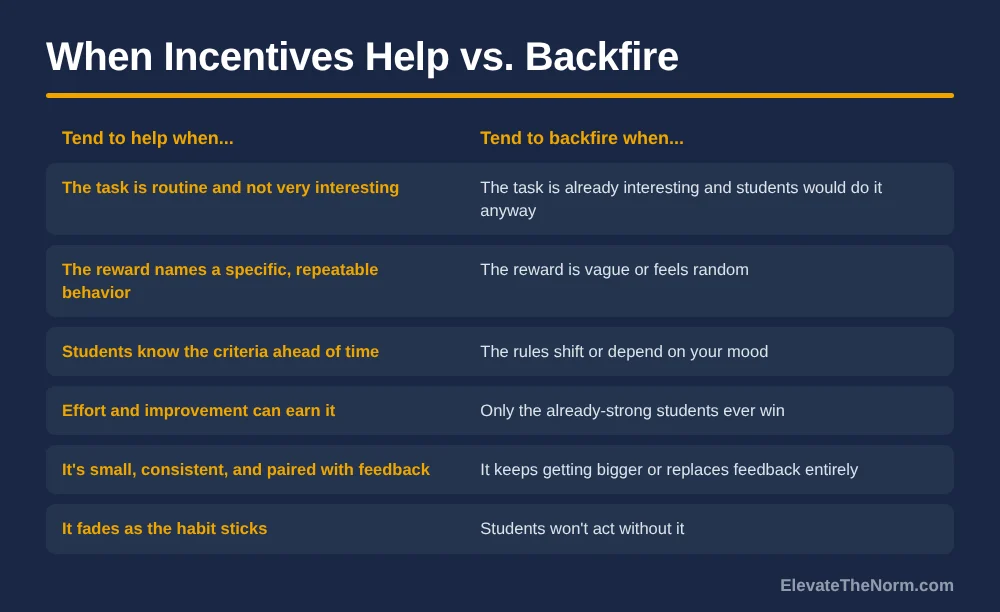
| Incentives tend to help when… | Incentives tend to backfire when… |
|---|---|
| The task is routine and not very interesting (getting quiet, turning work in, transitions) | The task is already interesting and students would do it anyway |
| The reward names a specific behavior students can repeat | The reward is vague (“good day”) or feels random |
| Students know the criteria ahead of time | The rules shift or depend on your mood |
| Effort and improvement can earn it | Only the already-strong students ever win |
| It’s small, consistent, and expected | It keeps getting bigger to hold attention |
| It’s paired with feedback about the work | It replaces feedback entirely |
| It fades as the habit sticks | Students won’t act without it |
The practical rule: use incentives for the boring stuff, and protect the interesting stuff. Paying students in points to discuss a primary source they find fascinating can make the discussion feel like a chore. Paying them in points to get quiet faster just makes getting quiet faster.
How Do You Choose Incentives Teens Actually Value?
Teenagers can smell a sticker chart from across the building. What works for them is almost always status, autonomy, time, or a small, real treat.
Ask Them First
Before you buy anything, ask. A quick anonymous poll with a short list of options, plus a write-in line, tells you more than any idea list. Ask one more question too: would they rather be recognized publicly or privately? Plenty of strong students would rather crawl under the desk than hear their name announced.
What Usually Lands in Grades 6–12
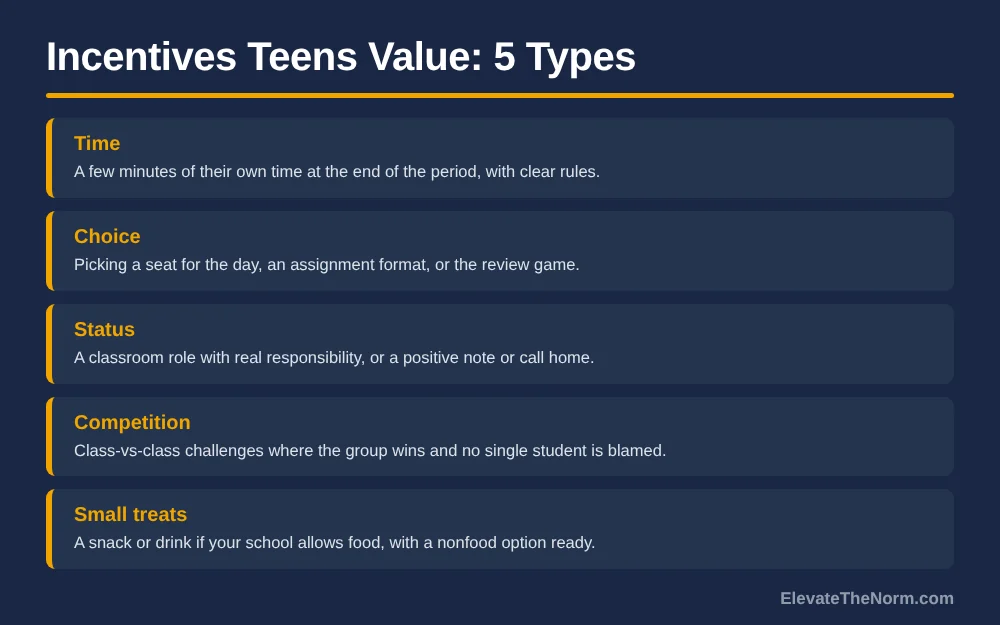
- Time: a few minutes of their own time at the end of the period, with clear rules on what’s allowed
- Choice: picking a seat for the day, choosing between two assignment formats, choosing the review game
- Status: a classroom role with real responsibility, being named for something specific, a positive note or call home
- Competition: class-vs-class challenges, where the group wins and no single student can be blamed
- Small treats: a snack or drink, if your school allows food, with a nonfood option ready
What usually falls flat: anything babyish, anything that publicly ranks students, and prizes nobody asked for. If you teach younger middle schoolers, some elementary ideas still work, but adapt them. Ask before you introduce collectibles or desk pets.
Be Careful With Grade-Based Incentives
Homework passes and bonus points are tempting because they cost nothing. They also blur what a grade means. If an assignment is essential practice, don’t let a pass erase it. A late pass that extends a deadline under your late work policy is easier to defend than one that changes a score.


What Do Effective Incentives Look Like in Practice?
Here’s how the Elevate approach handles it. Recognition runs on three tiers: Immediate Recognition, Student of the Week, and Student of the Month. My whole Elevate program runs about $81 a year, and I pay for it myself. That’s one example, not a target. Free incentives can carry most of the load.
Immediate Recognition: Specific and Quick
This is the everyday layer, and it costs nothing. Name the action and why it mattered: “You pulled your group back to the document when the conversation drifted.” Specific praise supports competence, because the student knows exactly what they did well and can do it again. Generic praise (“great job, everybody”) doesn’t.
Student of the Week: Reward Improvement, Not Perfection
In my classes, Student of the Week is judged on self-improvement and consistency, not perfection, because nobody’s perfect. A winner might earn it simply by always being on time, participating, and doing the bell ringers. I build anticipation by walking the room with the prize bag while I explain the award.
That criteria choice is the whole point. When only the top students can win, everyone else stops trying. When improvement counts, the student who’s been struggling has a real shot, and a tough new student who simply rises to the occasion and tries can land on the shortlist. The full setup is in the student of the week guide.
A Whole-Class Incentive: 3-2-1-Done
For group behavior, a shared goal beats individual points. In the 3-2-1-Done routine, each class starts the week at zero and earns points for how fast it gets quiet on a countdown: 3 points on “three,” 2 on “two,” 1 on “one,” 1 on “done,” and minus one for every second after that. Each week my 3-2-1-Done winning class gets Pringles, a water, and 15–20 minutes of their own time if they stay seated at a low murmur.
The key is a consistent reward. Buy-in usually takes me about three weeks; this year’s group took closer to six. Don’t quit at week two. More whole-class rewards are worth a look once one routine is running.
How Do You Fade Incentives Without Losing the Behavior?
The goal of any incentive is to make itself unnecessary. If students only behave when a prize is on the table, the incentive became the point.
Signs a Routine Is Ready to Fade
- Students do the behavior before you mention the reward
- The class corrects itself without you counting down
- The behavior holds on days the incentive isn’t running
- Students stop asking “what do we get?”
How to Phase It Out
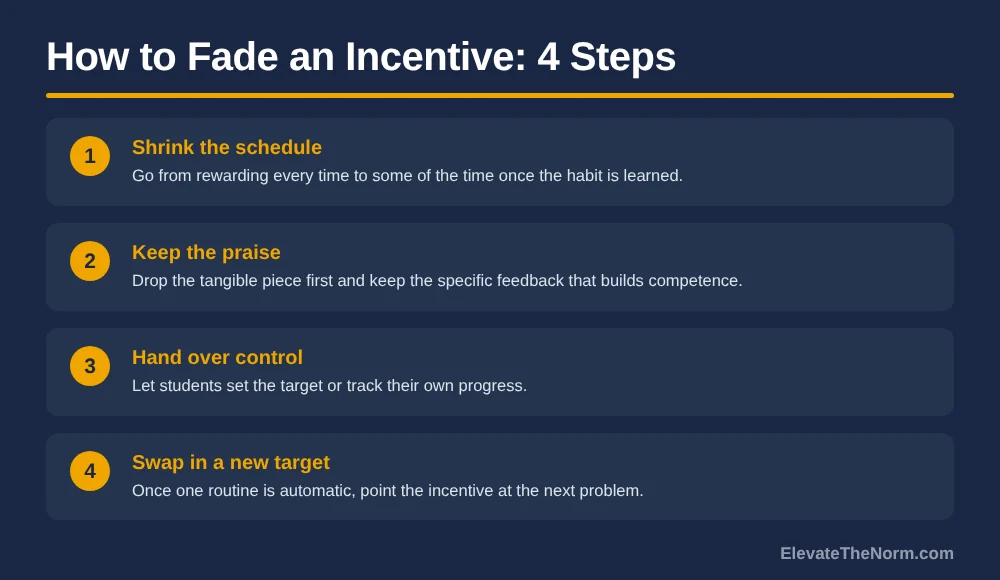
- Shrink the schedule. Go from rewarding every time to some of the time. Occasional rewards are usually enough to hold a habit once it’s learned.
- Keep the praise. Drop the tangible piece first and keep the specific feedback. The feedback is what builds competence.
- Hand over control. Let students set the target or track their own progress. That’s autonomy, and it moves motivation inside. Student goal setting works well here.
- Swap in a new target. Once one routine is automatic, point the incentive at the next problem instead of retiring it entirely.
If the behavior collapses the moment you fade, you faded too fast or the skill was never really taught. Re-teach, bring the incentive back briefly, and try again more slowly.
What Mistakes Make Incentives Stop Working?
Most incentive failures come from the same handful of habits:
- Inconsistency. The reward shows up some weeks and not others. Students learn it’s not real.
- Escalation. Each prize has to beat the last one. Keep it small and steady instead.
- Taking earned rewards away. Once it’s earned, it’s theirs. Handle misbehavior through your normal classroom consequences, separately.
- Group punishment. When one student can sink the whole class, peers start policing each other.
- Incentives instead of relationships. Positive reinforcement only works once students know your kindness isn’t weakness. Follow through on exactly what you say, and remember respect goes both ways.
- Bribing in the moment. “If you stop talking, I’ll give you a point” teaches students to wait for an offer.
For new teacher classroom management, the safest start is one incentive, one target behavior, and the same rules every week. Add more only when that first one runs on its own. The bigger picture of motivating students is mostly about relationships and meaningful work. Incentives are a support, not the engine.
Frequently Asked Questions
Do incentives kill intrinsic motivation?
They can, if you attach them to work students already enjoy or use them to control behavior. Self-determination theory suggests rewards that feel controlling undercut motivation, while ones that give clear feedback about competence are less likely to. Use incentives for routine behaviors and keep them small.
Are classroom incentives too childish for high school?
Not if you pick the right ones. High schoolers respond well to free time, choice, class-vs-class competition, and specific recognition. Skip stickers and public charts and ask students what they’d actually want.
How often should I give out incentives?
Often at the start, while a routine is new, then less as it sticks. A weekly whole-class incentive plus everyday specific praise is plenty for most secondary classrooms.
What if only a few students ever earn rewards?
Change the criteria. Reward improvement and consistency, not just top performance, so every student has a realistic path. Keep a quick record of who you recognize so quieter students don’t get missed.
Start With One Incentive You Can Keep
Pick one routine behavior, one incentive teens actually want, and run it the same way every week. Watch for the signs it’s working, then fade it and point it at the next problem. The best incentive is the one your students eventually stop needing.
Want a printable starting point? The free Elevate the Norm resource library has classroom tools built for grades 6–12. Free to download, no email required.