By Clay Shumate
The best free classroom rewards for middle and high schoolers are privileges, recognition, choice, and time: picking a seat, requesting the work-time playlist, leading a routine, a specific positive message home, or a few minutes of their own time at the end of class. Teenagers will work for these as hard as they work for candy, and none of them cost you a dime.
What makes a free reward work isn’t the reward itself. It’s that students know exactly what earns it, they actually get it when you say they will, and it feels like a privilege instead of a sticker chart.
With 150 or so students across five or six periods, you also need rewards you can hand out without shopping, bookkeeping, or negotiating. Everything below runs inside your own room and your own schedule.
The Big List: Free Rewards Teenagers Actually Want
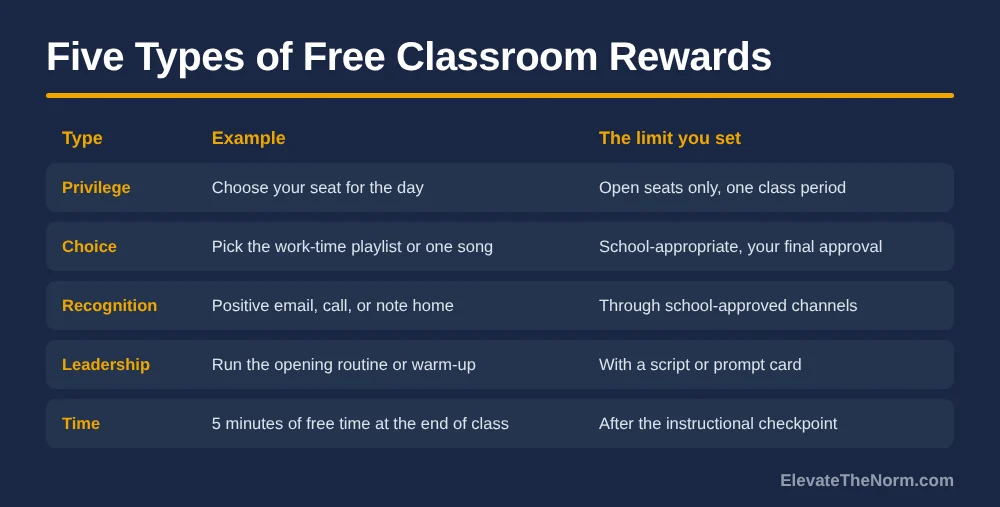
Use this as a menu. You don’t need all of it. Pick six to eight options you can deliver every time, and let students tell you which ones they care about.
| Type | Free reward | The limit you set |
|---|---|---|
| Privilege | Choose your seat for the day | From open seats that don’t disrupt accommodations or groups |
| Privilege | First in line for supplies, laptops, or group picks | One turn, not a standing pass |
| Privilege | Use the teacher chair or a “special” desk | For independent work only |
| Privilege | Front of the line for questions during work time | One period |
| Choice | Pick the work-time playlist or one song | School-appropriate, your final approval |
| Choice | Pick the review game format | From games you’ve already prepared |
| Choice | Choose the order you present in | Any open slot |
| Choice | Pick which bell ringer prompt the class answers | From two or three you wrote |
| Choice | Choose partner for one activity | With your veto if it won’t work |
| Recognition | Specific shout-out in front of the class | Only if the student wants public praise |
| Recognition | Positive email, call, or note home | Through school-approved channels |
| Recognition | Name on the “Student of the Week” board | Criteria posted in advance |
| Recognition | Work displayed on the wall or class site | Student’s permission first |
| Recognition | A handwritten note on their desk | Keep it to one specific sentence |
| Leadership | Run the opening routine or warm-up | With a script or prompt card |
| Leadership | Be the class timekeeper or discussion leader | Rotate it so everyone gets a turn |
| Leadership | Help choose images or sources for a lesson | From a set you’ve vetted |
| Time | 5 minutes of free time at the end of class | After the instructional checkpoint |
| Time | 15–20 minutes of their own time (whole class) | Seated, low murmur |
| Time | Optional lunch conversation with the teacher | Supervised, and only if you want to give up the lunch |
Privileges: Small Freedoms That Feel Big
Teenagers spend most of the day being told where to sit, when to move, and when to talk. That’s exactly why a little freedom works. A seat choice, first pick of laptops, or skipping to the front of the help line costs you nothing and gives a student something they can feel.
Explain the boundary before anyone earns it. “Choose your seat” means from the open seats, for one class period, and it ends if the seat turns into a social hour.
Choice: Let Them Steer Something Real
Choice rewards work well in grades 6–12 because they connect to student voice and choice without handing over the lesson. A student who picks the review game format or the bell ringer prompt for the day is still doing the same learning. They just had a say in how.
Keep everyday instructional choices open to everyone. Save the bonus choices for recognition so they still mean something.
Recognition: Specific Beats Loud
The cheapest reward in the building is a teacher noticing something and saying exactly what it was. “You started the source comparison before the timer ended” gives a student something to repeat. “Good job today” doesn’t.
A positive message home is one of the strongest free rewards you have, and middle schoolers especially rarely get one. Name one observable action, send it through the school’s normal channel, and ask the student privately whether they’re fine with you mentioning it in class. It’s also one of the easiest ways to start effective parent-teacher communication on a good note instead of a bad one.
Leadership: Give the Role a Real Decision
“Classroom helper” turns into a chore fast. Attach an actual decision: choosing the warm-up question from your options, leading a familiar review routine, or picking which historical images go up for a discussion. Let students decline, and rotate the roles so leadership isn’t just for the confident kids. More ideas live in the guide to student leadership.
Time: The Reward Teenagers Want Most
Time is the most valuable free reward on the list. In my 3-2-1-Done class-vs-class competition, the weekly winning class gets Pringles, a water, and 15–20 minutes of their own time if they stay seated at a low murmur. The snack costs money; the time doesn’t, and it’s the part that carries the reward.
If you want the whole thing free, keep the time and drop the snack. Just protect the instruction first: free time comes after the planned checkpoint, not instead of it.
Free Whole-Class Rewards That Fit a Secondary Schedule
Whole-class rewards need to fit inside one period and have a clear end. The full breakdown is in the guide to whole-class rewards, but here are the free ones that work best with teenagers:
- Choice time at the end of class: drawing, low-volume conversation, a classroom game.
- A review game the class votes on from options you already have.
- A music break with an optional seated version and a clear cleanup signal.
- A virtual field trip the class picks from destinations you’ve previewed (a museum collection works well in World History).
- A short video clip or scene, previewed, captioned, and within school rules. A full movie rarely fits a secondary period.
- Outdoor reading or discussion, if your school allows it and you’ve planned supervision and a weather backup.
- A theme day students can join with things they already own, with regular clothes equally welcome.
Check device access, dress code, and outdoor rules before you promise anything. A reward you have to cancel costs more trust than it ever earned.


How to Keep Free Rewards Meaningful
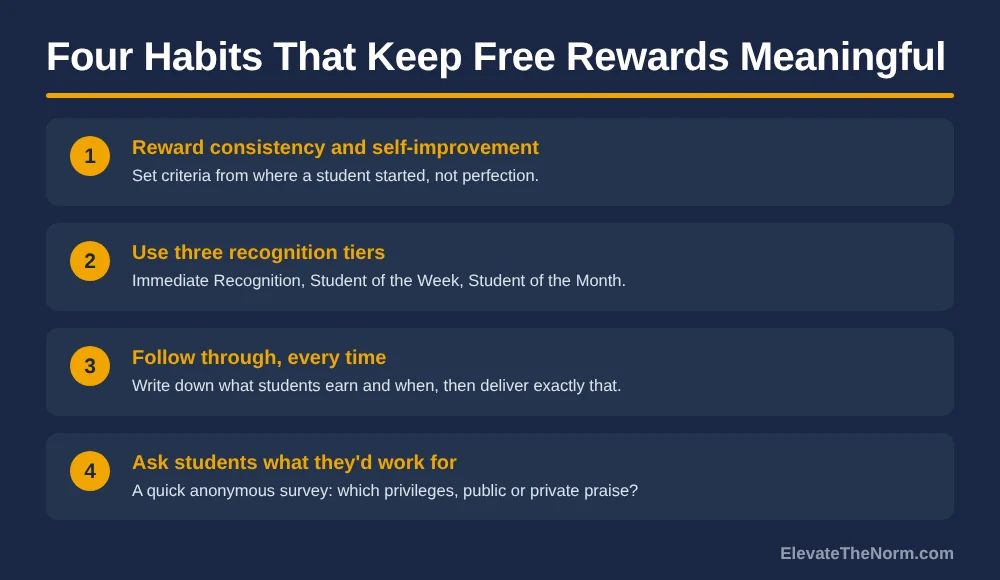
A free reward loses its value when it’s handed out for everything, promised and forgotten, or tied to perfection. These habits keep it worth earning.
Reward Consistency and Self-Improvement, Not Perfection
Nobody’s perfect, so don’t build a system that only rewards perfect students. Set criteria based on where a student started. A kid working on starting tasks promptly should be able to earn recognition for doing exactly that.
This is how my Student of the Week works: it’s judged on self-improvement and consistency, not perfection. One winner earned it by always being on time, participating, and doing the bell ringers. Student goal setting helps you and the student agree on what progress looks like.
Use Three Tiers So Recognition Has Somewhere to Go
Elevate runs recognition on three tiers: Immediate Recognition, Student of the Week, and Student of the Month. Immediate Recognition happens the moment you see the action. The weekly and monthly tiers reward patterns over time, so keep a few quick notes and you’ll make fairer picks. The whole program costs me about $81 a year, self-funded.
If you’re building the structure from scratch, start with the classroom rewards system guide.
Follow Through, Every Time
The fastest way to kill a reward system is to promise free time and then run out of class. Write down what students can earn, when they can use it, and what happens if it has to be rescheduled. Then deliver exactly what you said.
That consistency is what buy-in actually depends on. In my 3-2-1-Done competition, buy-in usually takes about three weeks; this year’s group took about six.
Ask Students What They’d Work For
Run a quick anonymous survey: which privileges interest you, and do you prefer public or private recognition? Some teenagers would rather get a quiet note than a shout-out in front of 30 classmates. Start with a short menu, drop the options nobody picks, and add the ones they ask for.
A Quick Checklist Before You Launch
- Students know exactly what earns each reward.
- Every reward fits inside your room and your schedule.
- You can track it on a roster without a complicated chart.
- Quiet students and slow-but-steady improvers can earn it too.
- Students get a say in public versus private recognition.
- Every reward has a stopping point and an accessible alternative.
Which Free Rewards Need Limits?
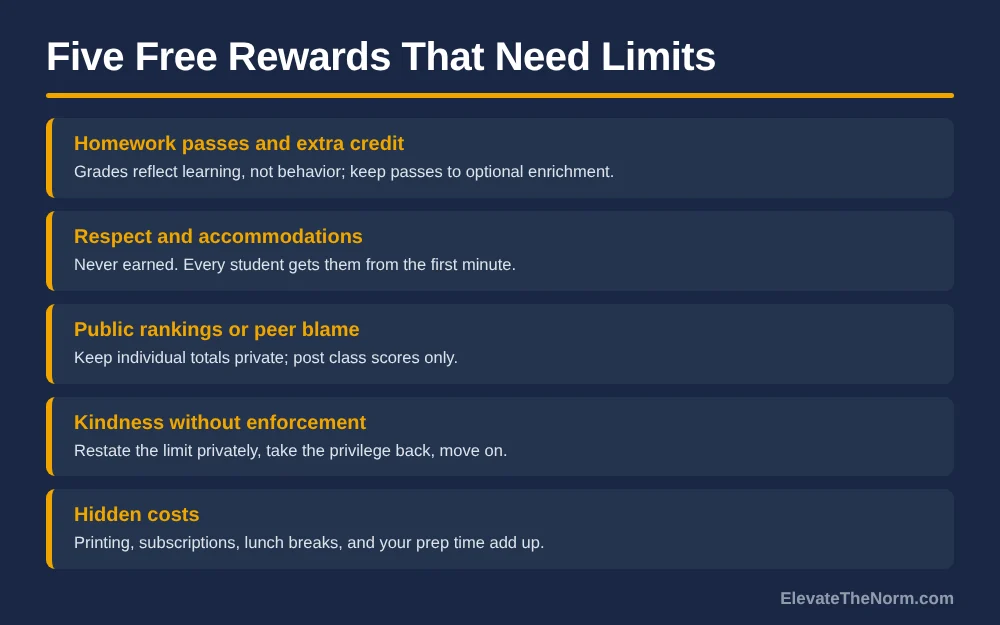
Some popular “free” rewards cause more problems than they solve. Keep rewards separate from grades, basic dignity, and required supports.
Homework Passes and Extra Credit
Grades should reflect learning, not behavior. A homework pass that skips practice a student needs, or extra credit for good conduct, mixes the two. If you want a pass, limit it to optional enrichment that doesn’t touch the grade. An activity choice is usually the better reward.
Respect and Accommodations Are Never Earned
Every student gets respectful treatment, explanations, feedback, and their IEP or behavior plan supports from the first minute of class. None of that is a reward. Your classroom consequences also stay the same whether a reward is on the line or not.
No Public Rankings or Peer Blame
Keep individual totals private. In class-vs-class competitions, post class scores only and handle individual disruptions yourself. Never announce that one student cost everyone the reward. If peer pressure starts, pause the competition and reteach.
Kindness Still Needs Enforcement
Positive reinforcement only works once students know your kindness isn’t weakness. A positive classroom still needs enforcement, and respect goes both ways. When a student pushes past a privilege’s limits, restate the condition privately, take the privilege back if that’s what you said would happen, and move on. For new teacher classroom management, that calm follow-through matters more than any reward on the menu. For the bigger picture, see positive reinforcement in the classroom.
Watch the Hidden Costs
“Free” can still cost printing, subscriptions, supplies, or your lunch break. Count your time, too. A reward that needs heavy prep or repeated lunch supervision isn’t free if it burns you out by October. When something does need buying, this list of cheap classroom supplies for grades 6–12 ranks what earns its spot.
Frequently Asked Questions
What are good free rewards for high school students?
Privileges and time work best: seat choice, picking the playlist, leading a routine, a few minutes of free time, or 15–20 minutes of their own time for a winning class. Specific recognition and a positive message home also land well, as long as the student is comfortable with the attention.
Do middle schoolers still care about rewards?
Yes, but they want rewards that don’t feel babyish. Choice, leadership roles, class competitions, and public recognition (for students who want it) usually beat stickers and charts in grades 6–8.
How often should I give free classroom rewards?
Give immediate recognition whenever you see the behavior, and keep bigger rewards on a predictable schedule like weekly or monthly. The schedule matters less than consistency. Students need to trust that the reward actually comes.
Should free rewards be individual or whole-class?
Use both. Individual rewards recognize specific progress, and whole-class rewards build shared goals. Keep whole-class rewards from turning into group punishment, and handle individual corrections privately.
Start With a Short Menu and Deliver Every Time
Pick six to eight free classroom rewards you can deliver without fail, post what earns them, and recognize the behavior specifically when you see it. Review the menu after a few weeks, cut what nobody wants, and keep the follow-through steady.
For printable support, the free Elevate the Norm resource library has classroom tools built for grades 6–12. Free to download, no email required.