By Clay Shumate
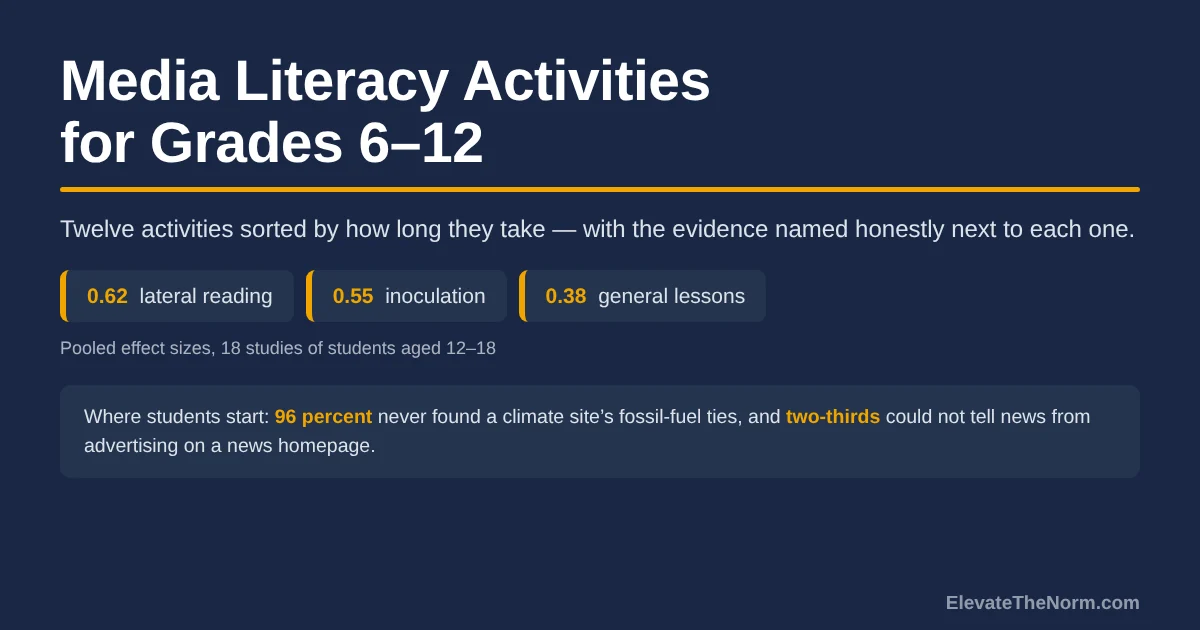
Media literacy activities teach students to check who made a claim and what the evidence behind it is, using real online content rather than made-up examples. In grades 6–12, lateral reading has the strongest evidence: students leave the page and look up the source in a new tab. Most published activities have never been tested at all.
Key Takeaways
- Across 18 studies of adolescents aged 12–18, media literacy instruction moved misinformation outcomes by a standardised mean difference of 0.48 (95% CI 0.31–0.65). Lateral-reading activities were the strongest category at 0.62; general media literacy lessons were the weakest at 0.38.
- The cheapest activity with a real randomised test is a printed list of tips. Reading ten tips for spotting false news improved discernment by 26.5 percent in a nationally representative U.S. sample. Weeks later the effect on false-headline ratings had attenuated by more than half, though discernment was still measurably above zero.
- Gamified "spot the fake" activities may not do what they appear to do. A reanalysis of five studies of two popular misinformation games found no improvement in students’ ability to tell true from fake — only a general willingness to call everything fake.
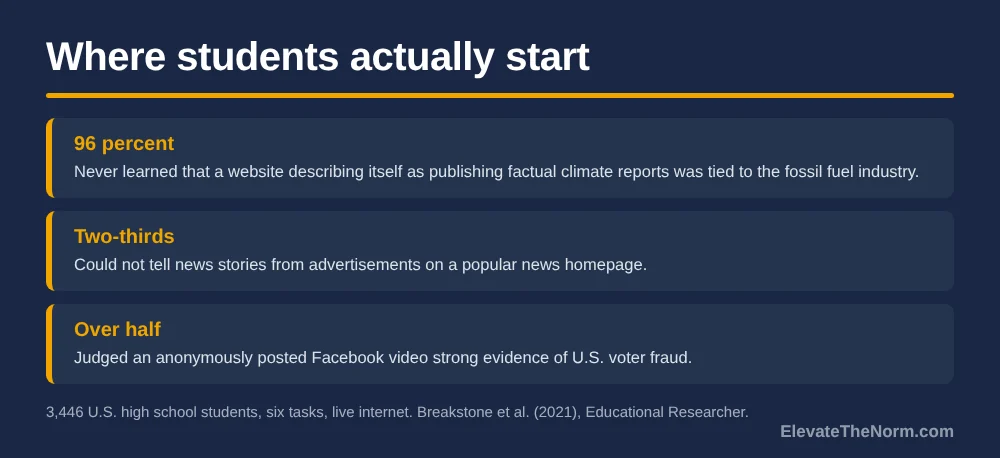
- Students start lower than most teachers expect. Of 3,446 U.S. high school students, two-thirds could not tell news stories from advertisements on a news homepage, and 96 percent never discovered that a climate website was tied to the fossil fuel industry.
- Repetition is the moderator that keeps showing up: in a meta-analysis of 49 experiments and 81,155 participants, multi-session interventions outperformed single-session ones. One activity in October does not survive to April.
Most media literacy activity lists have the same problem. They hand you twenty ideas with no indication of which ones have ever been tested on teenagers, how long each takes, or what goes wrong when you run it on a Tuesday in a room of ninth graders who have already decided the whole internet is lying to them.
So this article does it the other way round. Twelve activities, sorted by how long they take, with the evidence named honestly next to each one — including the three categories that have been measured on students this age, and the nine that are reasonable and untested. Everything here is written for grades 6–12. If you teach elementary, the activities below will not transfer cleanly and I would rather say so than pretend.
What are media literacy activities?
Media literacy activities are classroom tasks in which students evaluate real media — a website, a post, an ad, a video, a news story — by asking who made it, what evidence supports it, and what other sources say. The defining feature: students judge live content they did not write.
That last part matters more than it sounds. The curriculum that produced measurable gains in the one classroom study of ninth graders was built on four design principles, and one of them was evaluating real online content rather than sanitised samples. A worksheet about a fictional website teaches students to complete worksheets.
Media literacy overlaps with two things this site covers separately. It is not the same as teaching document analysis with primary sources, which asks students to read a historical source for what it reveals about its maker — same three habits, different material and a different framework. It is also not the same as reading comprehension on screens. Media literacy is the credibility question specifically: should I believe this, and how would I find out?
Do media literacy activities actually work?
Yes, modestly, and it depends heavily on which activity you run. A 2026 meta-analysis of adolescents aged 12 to 18 pooled 18 studies and found a moderate overall effect of SMD 0.48 (95% CI 0.31–0.65). That is real movement, not a transformation.
What makes that review worth more than its headline number is the breakdown by type. Rodríguez Castillo and colleagues report three categories separately:
| Activity category | Effect (SMD) | 95% CI | Studies |
|---|---|---|---|
| Lateral reading ("side reading") | 0.62 | 0.45–0.79 | 6 |
| Cognitive inoculation (prebunking, games) | 0.55 | 0.37–0.73 | 5 |
| General media literacy instruction | 0.38 | 0.21–0.55 | 7 |
A broader meta-analysis that was not limited to teenagers reached a larger figure — d = 0.60 overall across 49 experiments and 81,155 participants, with discernment moving 0.76 and sharing behaviour 1.04. Two cautions on that one. Its samples were mostly college students and online panels rather than secondary students, and the effects were stronger with multiple sessions than with one. I read it at abstract level; the full text sits behind a paywall, so nothing beyond those figures is claimed here.
The honest summary: a single activity produces a small, decaying effect. A sequence of them, run across a year in a subject that already asks students to evaluate claims, produces something closer to a skill.
Which media literacy activity has the strongest evidence?
Lateral reading, at SMD 0.62 in the adolescent meta-analysis. Lateral reading means leaving the page you are judging and opening new tabs to find out what other sources say about it — instead of staying on the page and judging it by how professional it looks.
The reason it is the headline activity is that it came out of watching people who are good at this. Wineburg and McGrew compared 10 professional fact checkers, 10 PhD historians and 25 university undergraduates as they evaluated websites and tracked down who funded a lawsuit. The fact checkers were faster and more accurate than both other groups. The historians — subject-matter experts with doctorates — largely judged an advocacy group’s website reliable, and the students overwhelmingly rated it more reliable than the mainstream pediatric association’s.
That finding is the one I would put in front of a sceptical department. The problem is not that students lack subject knowledge. A PhD in history did not protect against this. The thing the fact checkers had was a procedure, and a procedure can be taught in a class period.
The second move those fact checkers used has a name too: click restraint — reading the whole search results page before clicking anything, rather than taking the top result because it is the top result. The students and several historians clicked high-ranking links without asking why they ranked high.
What are 12 media literacy activities for grades 6–12?
Twelve activities, grouped by the time they take. The evidence column in the table above applies to categories, not to each specific task — so each activity below is labelled tested, category-tested or untested, and I have not blurred the three.
Five-minute activities for the start of class
These fit the first five minutes of class and are the only version of this work that survives a full year, because they cost almost nothing to run.
- The tips card. Tested. Put ten short tips for spotting false news on the board or on a half-sheet, have students read them, then apply them to one headline. This is almost exactly the intervention Guess and colleagues randomised, and it produced a 26.5 percent improvement in discernment in the U.S. sample. It is the lowest-effort activity on this list with a randomised trial behind it — and most of the effect was gone within weeks, which is the argument for running it more than once rather than once well.
- New tab, thirty seconds. Category-tested. Project an unfamiliar site’s homepage. Students get thirty seconds and one instruction: do not read this page, find out who runs it. Then compare what they found. This is lateral reading stripped to its smallest unit.
- News or ad? Untested as a task, grounded in a documented failure. Screenshot a news homepage, number six items, and ask students to sort them into news, opinion and advertising. Two-thirds of 3,446 high school students could not do this, so expect it to be harder than it looks and do not treat a bad first result as a behaviour problem.
- Headline versus body. Untested. Give the headline and the third paragraph of the same real article and ask whether the headline is supported. Good for teaching that an inaccurate framing does not require anyone to have lied.
One-period activities
- Who paid for this? Category-tested. Give students a real website making a claim in your subject area and one question: who funds it, and how do you know? In the national study, 96 percent of students never found the fossil-fuel ties of a site that described itself as disseminating factual climate reports. The funding question is almost always answerable and almost never answered on the page itself.
- Trace the video. Category-tested. Take a circulating video or image and have students work backwards to its first appearance using reverse image search and date-filtered results. Over half of the 3,446 students accepted an anonymously posted video as strong evidence of voter fraud; the fix is procedural, not attitudinal.
- Click restraint drill. Category-tested. Project a search results page with the links disabled or covered. Students must rank which three results they would open and justify the order before anyone clicks. This isolates the single habit that separated fact checkers from historians.
- What’s the evidence? Category-tested. Students take one specific claim from a post or article and locate the evidence actually offered for it — a study, a named source, a number, or nothing. Stanford’s Civic Online Reasoning curriculum publishes this as a free introductory lesson under that name.
- Two sources that disagree. Category-tested. Put two credible outlets’ accounts of the same event side by side and ask what each includes, omits and asserts. This is corroboration, and it is the activity that overlaps most with document work in a history class — if you already run that, you are already running this.
Multi-day activities and projects
- Algorithm audit. Untested. Students record what their feed showed them over two days in one category — sport, politics, clothes — and write up what the pattern suggests the platform believes about them. Keep it voluntary and keep the data private; see the privacy note below, because this one has a real consent problem.
- Local story, traced. Untested. Take one local story and have groups identify every source in it, who is missing, and what a reader would need to verify it. Pairs well with project work in social studies, and local stories are short enough to finish.
- Students build the explainer. Untested. Groups produce the one-page credibility guide they would hand a younger student, and the class critiques each against a shared standard. If you want a ready structure for the critique round, the free source evaluation checklist and peer critique protocol on this site both fit without modification.
What are the best media literacy activities for middle school versus high school?
For middle school, use short visual content and one question at a time. For high school, use text and funding trails and let students run the full procedure themselves. The activities are the same; what changes is how much of the thinking the student carries alone.
No study I could find compares the grade bands directly, so this split is editorial judgment rather than a finding. It is based on what the research says goes wrong. The national assessment found students were misled by weak signals — how a site looked, its domain ending, the content of its About page, how much information it offered. Those are the cues a twelve-year-old reaches for first, and they are also the cues a seventeen-year-old reaches for when the reading is hard. So the design principle is the same at both ends: make the page itself unavailable as evidence.
In grades 6–8, that means images and videos before articles. A tracing task on a photo asks nothing of reading stamina and still teaches the procedure, which is why "trace the video" and "news or ad?" belong early. Give one question per activity rather than three, and script the search — tell students exactly what to type the first several times. Middle schoolers do not fail these activities because the thinking is beyond them; they fail because searching well is a separate skill nobody taught them.
In grades 9–12, hand over the whole sequence and make the targets harder. "Who paid for this?" is the best high school activity on the list because the answer is genuinely buried, finding it takes four or five moves, and the result is often surprising enough to be remembered. This is also the band where the two-sources-disagree activity pays off, because older students can hold two accounts in mind and argue about omission rather than accuracy. And it is where you can say out loud what the historian study found — juniors and seniors are old enough to be interested in the fact that expertise did not protect the experts.
One thing that does not change: do not switch frameworks between grades. If a student gets a three-question version in eighth grade and a different acronym in tenth, the procedure never becomes automatic, which is the entire point of having one.
How do you teach lateral reading, step by step?
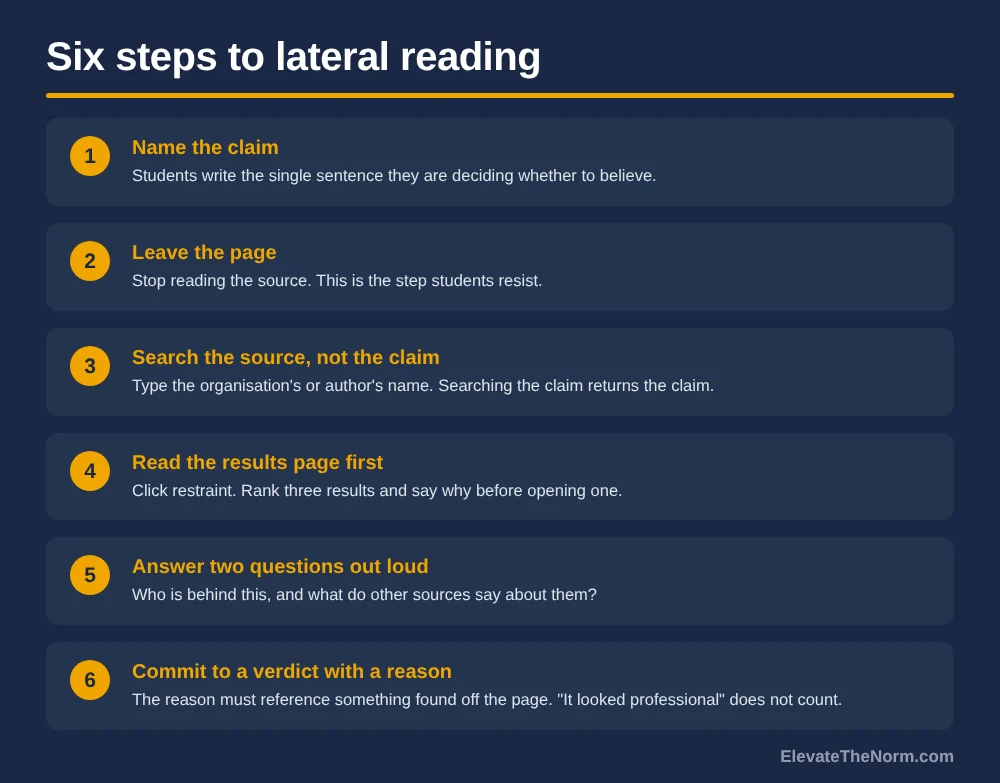
Teach it as a fixed sequence students run without you, on real content, in under ten minutes. The six steps below operationalise the habits described in the research above; they are a recommendation for sequencing it, not a finding from any study.
- Name the claim. Students write the single sentence they are deciding whether to believe. Vague targets produce vague verdicts.
- Leave the page. Explicitly instruct students to stop reading the source. This is the step they resist, because judging the page in front of you feels like doing the work.
- Search the source, not the claim. Type the organisation’s or author’s name, not the claim itself. Searching the claim returns the claim.
- Read the results page first. Click restraint. Students rank three results and say why before opening one.
- Answer two questions out loud. Who is behind this, and what do other sources say about them? Stanford’s curriculum uses a three-question version adding "what is the evidence?"
- Commit to a verdict with a reason. Credible, not credible, or cannot tell yet — and the reason must reference something found off the page. "It looked professional" is the failure mode the research documents, so rule it out by name.
Keep "cannot tell yet" as a legitimate answer. Forcing a verdict on thin evidence trains the exact habit the next section warns about.
Can media literacy activities make students too cynical?
Yes, and some popular activities do mainly that. A 2023 reanalysis of five studies of two widely used misinformation games found that after playing, participants did not get better at telling true news from fake — they simply called more things false, including the true items.
The methodological point is worth understanding, because it recurs. Earlier studies compared average ratings of true and fake headlines before and after play, a measure that cannot separate discrimination (telling them apart) from response bias (a general shift toward saying "false"). Modirrousta-Galian and Higham reran the data using ROC analysis from signal detection theory, which separates the two, and concluded the games "are not as effective as previously believed and may even be counterproductive."
Note the tension with the meta-analysis above, because this site is not going to hide it: the adolescent review scores cognitive inoculation at 0.55, a solid second place. Both can be true. The review pools outcomes including belief and sharing, where a general increase in scepticism counts as success; the ROC reanalysis asks the narrower question of whether students can tell the difference, and answers no for those two games. If your goal is students who are harder to fool, the distinction matters. If your goal is students who distrust everything, you do not need an activity for that.
The practical consequence is small and specific: every activity above should include at least one credible item that students are expected to accept. An activity made entirely of fakes teaches that everything is fake.
Where can you get free media literacy lesson materials?
Two sources cover most of what a grades 6–12 teacher needs, and both are free. The notes below reflect what each site states about itself as of this writing, and nothing beyond that is claimed.
| Source | Cost | Account needed | What you get | Worth knowing |
|---|---|---|---|---|
| Civic Online Reasoning (Stanford / Digital Inquiry Group) | Free | Sign-in offered; single lessons downloadable | Lessons and assessments, plus a video library of skill explainers. Named lessons include "What’s the Evidence?", lateral reading and click restraint | Built by the research team behind the lateral-reading findings. The site does not publish a total lesson count or grade bands per lesson |
| Checkology (News Literacy Project) | "100% free for educators," no paid tier | Yes — register with email, or Google / Microsoft / Clever sign-on | Advertised as 250+ lessons, activities and teaching tools for grades 5–12, including Intro to Algorithms, InfoZones, Misinformation and Evaluating Science-based Claims | The 250+ figure covers resources of all kinds combined, not lessons alone |
If you want one starting point rather than two: the Civic Online Reasoning lessons are closer to the evidence base, since the group that publishes them ran the studies that produced the lateral-reading result.
What do you need to run these activities, and who gets left out?
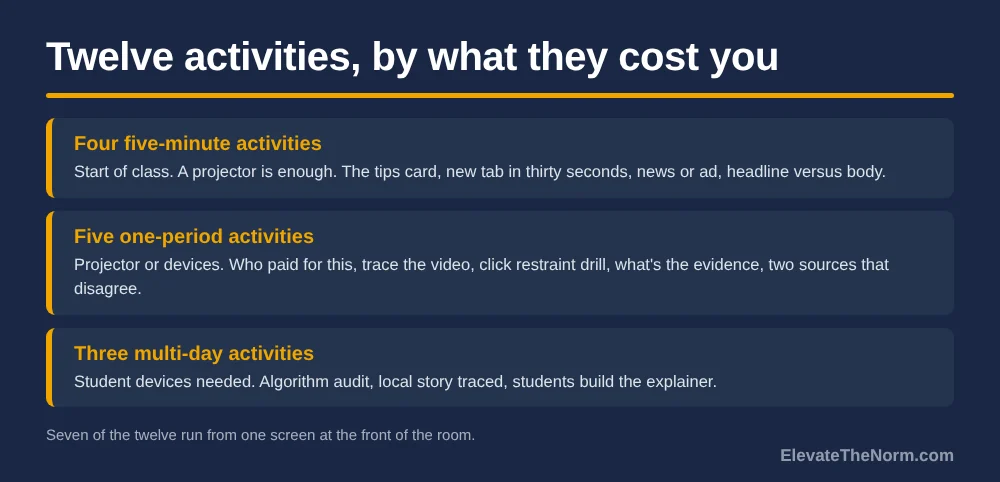
A projector is enough for seven of the twelve media literacy activities. Student devices are genuinely required only for the three multi-day projects and for "trace the video," which needs reverse image search in a student’s own hands. Every five-minute activity runs off one screen at the front.
For grades 6–8, I would keep it that way on purpose. Use pages you chose and loaded in advance rather than sending twelve-year-olds into open search on a live claim. You get the same procedure, you keep the lesson on the rails, and you avoid the filter-block detour that eats ten minutes of a fifty-minute period.
The harder question is who these activities serve less well, and the national data answers it uncomfortably. In that study of 3,446 students, scores varied by grade level, self-reported grades, locality, socioeconomic status, race, maternal education, and free or reduced-price lunch eligibility — and the assessment was administered in English. So the gap it measured is partly a gap in who has been taught this and partly a gap in who could read the task quickly. Both matter to how you run it.
Two adjustments follow directly. Read the claim aloud and keep it on the board, so the activity tests source evaluation rather than reading speed. And for multilingual learners, let the written verdict be one short sentence or a sentence frame — the thinking you are assessing happens before the writing, and a procedure is easier to demonstrate than to narrate.
Worth knowing at the district level: this does not have to live in English or social studies. In that study of 574 students, the lessons were taught by biology and world geography teachers, embedded in their existing curriculum. Evaluating a claim about a vaccine and evaluating a claim about a border are the same procedure.


Is media literacy required in your state?
Possibly. Media Literacy Now reports that 25 states have media literacy laws on their books, drawing on legislative activity through 30 October 2025 with its map last updated in January 2026.
Read that number carefully, because the organisation itself does. Its count tracks states that have moved something through the legislative process, and it says plainly that it has not evaluated how state education departments actually integrated media literacy into standards. A law on the books is not a standard in your pacing guide and not a required course. Before telling an administrator that your state mandates this, check your own state’s standards document — the law and the standard are frequently different things.
How do you grade media literacy activities without drowning in marking?
Grade the reasoning, not the verdict, and grade one sentence. The scorable product of every activity above is a verdict plus a reason that cites something found off the page. That is one sentence per student, and it can be read at a glance.
Three things make this sustainable rather than another stack to carry home:
- A fixed three-point scale. No reason, a reason from the page itself, or a reason from outside the page. The middle category is the one that shows you the instruction is landing.
- Most of these are formative and should stay that way. The five-minute versions are checks on where the class is, not assessments of a student. Scoring a bell-ringer on credibility punishes students for not yet having a skill you are in the middle of teaching.
- Score a sample, not a set. Eight responses tell you what the class can do. Read eight, adjust tomorrow, and move on.
Expect low scores for a long time. In the one classroom study of ninth graders, curriculum-embedded lessons produced "statistically significant growth in students’ ability to evaluate the credibility of online content" across 574 students — and the repository record for that study does not report how large the improvement was, so no size is claimed here. The design was single-group, pretest and posttest, with no control group and no randomisation, in one suburban high school, which makes it movement rather than proof of a cause. Plan for years, not a unit.
What about privacy and politically contested content?
Two rules keep media literacy activities defensible. First, no activity requires a student to show anyone their own accounts, feeds or data. Second, pick claims whose verification question has a checkable answer.
The algorithm audit is the one activity above with a genuine consent problem: a student’s feed is personal information, and the teacher does not need to see it. Keep participation voluntary, let students describe a pattern rather than submit screenshots, and offer an alternative using a public account for anyone who would rather not.
On the second rule: "Who funds this organisation" and "when did this video first appear" are checkable. "Which side is right about immigration" is not a media literacy activity, it is a debate, and running it as one puts you in a conversation with a parent you cannot win. If you do want students arguing two sides, set it up as a structured debate with a resolution chosen for that purpose. The national study used a climate-funding task and a voter-fraud video precisely because both have verifiable answers independent of anyone’s politics — the ties existed, the video’s origin was traceable.
Tell families what you are doing before you need to. A one-line note that students are learning to check sources, with the two or three sites you will use, converts almost every version of this complaint before it starts. Say the other half of it too, because it is the part parents actually worry about: no activity here asks a student to evaluate, rate or report on the news their family watches. The targets are chosen by the teacher and they are public organisations, not anybody’s household. The same framing covers a weekly routine built around the news, where those parent questions tend to arrive sooner.
Clay’s take: the procedure is the whole lesson
The finding I keep coming back to is the one about the historians. Ten people with doctorates, trained for years in evaluating sources, looked at an advocacy website and mostly called it reliable. What the fact checkers had was not knowledge. It was a habit of leaving the page.
That reframes what these activities are for. We tend to teach media literacy as a disposition — be sceptical, think critically, consider the source — and dispositions are exactly what the games produced: students who say "fake" more often and cannot tell any better. A procedure is different. It is six steps, it takes nine minutes, a fourteen-year-old can run it without me in the room, and it works whether or not they feel sceptical that morning.
Which is also why I would rather run the thirty-second version twenty times than the two-week unit once. The decay in the tips-card study is the clearest number in this whole literature: measurable improvement, more than half of it gone within weeks. Nothing about teenagers makes that surprising. It is the same reason we spiral everything else.
And treat the low starting scores as information rather than as a verdict on the kids. Two-thirds of a nationally representative sample could not separate advertising from news on a homepage built to blur exactly that line. That is a design problem they were handed, not a character flaw. Our job is to give them the procedure nobody has given them yet.
What to do next
Pick one activity, not twelve. For the strongest evidence at the least preparation, run "new tab, thirty seconds" on Monday with a site from your own unit, then again on Thursday with a different site. That is lateral reading, the 0.62 category, at two minutes of planning.
Then do three things across the term. Teach the six-step procedure once properly so students have a sequence to run. Put one credible item in every activity so you are building discernment rather than suspicion. And repeat it monthly, because every study here says one session does not hold.
If you already teach document work, you are closer than you think — sourcing and corroboration are the same two habits, pointed at a website instead of a letter. The primary source analysis frameworks transfer, and the annotation routines you already use will carry the written half of the work.
Frequently Asked Questions
What are media literacy activities?
Media literacy activities are classroom tasks in which students evaluate real media – a website, a post, an advertisement, a video or a news story – by asking who made it, what evidence supports it, and what other sources say about it. The defining feature is that students judge live content they did not write, rather than a sanitised textbook example.
What is the best media literacy activity for middle school?
Tracing an image or short video back to its first appearance. It teaches the whole procedure without asking anything of reading stamina, which is the usual obstacle in grades 6-8. Use a page you selected and loaded in advance rather than open search, give students one question instead of three, and script exactly what to type the first several times you run it.
Do media literacy activities actually work?
Modestly, and it depends on which one. A 2026 meta-analysis of 18 studies of adolescents aged 12 to 18 found an overall effect of SMD 0.48, with lateral-reading activities strongest at 0.62 and general media literacy lessons weakest at 0.38. Effects from a single session are small and decay within weeks, so repetition across a year matters more than any individual lesson.
How long should a media literacy activity take?
Five to ten minutes for most of them, and that is the version worth repeating. Four of the twelve activities on this list fit the start of a class period, five fill one period, and three run across several days. Because the measured effects decay within weeks, a short activity run monthly beats a two-week unit run once a year.
Where can I get free media literacy lessons for high school?
Two providers cover most of it. Stanford’s Civic Online Reasoning curriculum, now published by the Digital Inquiry Group, offers free lessons and assessments including lateral reading and click restraint. Checkology from the News Literacy Project states it is 100 percent free for educators with no paid tier, covering grades 5 to 12, and requires registration with an email or a Google, Microsoft or Clever sign-on.
Can media literacy activities make students too cynical?
Some can. A 2023 reanalysis of five studies of two popular misinformation games found players did not get better at telling true news from fake – they simply called more things false, including the true items. The fix is cheap: put at least one genuinely credible item in every activity, and accept “cannot tell yet” as a legitimate verdict rather than forcing a call.
Do students need devices for media literacy activities?
Not for most of them. A projector is enough for seven of the twelve activities on this list, including every five-minute version, where the class argues over one screen at the front of the room. Student devices are genuinely needed only for the three multi-day projects and for tracing an image, which requires reverse image search in a student’s own hands.
Is media literacy instruction required by law?
In some states. Media Literacy Now reports that 25 states have media literacy laws on their books, based on legislative activity through October 2025. Read that carefully: the organisation counts states that moved something through the legislative process and says it has not evaluated how education departments integrated media literacy into standards. Check your own state’s standards document before telling an administrator it is mandated.
Sources
- Rodríguez Castillo, N. E., Mendoza Carrera, J. E., Andrade-Vásquez, M. M., & Acosta-Barreno, K. (2026). Media literacy education and misinformation in social media among adolescents: A systematic review and meta-analysis. Journalism and Media, 7(2), 71. 46 studies in the qualitative synthesis, 18 in the meta-analysis, adolescents aged 12–18 primarily from secondary schools. Overall SMD 0.48 (95% CI 0.31–0.65), I² = 56 percent, random effects. By type: side (lateral) reading 0.62 (6 studies), cognitive inoculation 0.55 (5 studies), general literacy 0.38 (7 studies). Limitations the authors state: only three databases searched, English and Spanish only, 2019–2025, varied designs, and some included studies relied on self-reported measures. One inconsistency noted on reading it: its own Table 1 lists studies from 2016 and 2018, outside the stated window.
- Huang, G., Jia, W., & Yu, W. (2024). Media literacy interventions improve resilience to misinformation: A meta-analytic investigation of overall effect and moderating factors. Communication Research, 53(7), 899–926. 49 experimental studies, 81,155 participants, overall d = 0.60; belief in misinformation 0.27, discernment 0.76, sharing 1.04. Multi-session interventions outperformed single-session ones; effects were stronger among college students than among crowdsourced adults. Read at abstract level only — the full text is behind a restricted landing page, so no confidence intervals, limitations or intervention-type moderators are quoted here. Its samples are not secondary students.
- Guess, A. M., Lerner, M., Lyons, B., Montgomery, J. M., Nyhan, B., Reifler, J., & Sircar, N. (2020). A digital media literacy intervention increases discernment between mainstream and false news in the United States and India. PNAS, 117(27). Preregistered survey experiments; respondents randomly assigned to read tips adapted from Facebook’s "Tips to Spot False News" — 10 tips verbatim in the U.S., 6 adapted in India. U.S. wave 1 N = 4,907, wave 2 N = 4,283; India online 3,273 and 1,369; India face-to-face (Uttar Pradesh) 3,744 and 2,695. U.S. ITT β = 0.146 (SE 0.024), a 26.5 percent improvement in discernment; d = 0.20 on false headlines. In wave 2 the effect on false-headline ratings attenuated by more than half while discernment remained above zero (β = 0.050, SE 0.020, p < .05). Honest caveats: the paper reports 17.3 percent for the India online sample in its body text and 17.5 percent in its abstract; the India online effect did not hold in wave 2; and there was no effect at all in the rural face-to-face sample, where 11 percent used WhatsApp (versus 90 percent online), 24 percent passed comprehension checks, and 6 percent were college graduates. A correction to this paper exists (PNAS, doi 10.1073/pnas.2221752120); it could not be opened from this session, so what it changes is not described here and the figures above are the originally published ones. Read via an openly licensed full-text reproduction (CC BY-NC-ND 4.0).
- Modirrousta-Galian, A., & Higham, P. A. (2023). Gamified inoculation interventions do not improve discrimination between true and fake news: Reanalyzing existing research with receiver operating characteristic analysis. Journal of Experimental Psychology: General, 152(9), 2411–2437. Reanalysis of five prior studies of the Bad News and Go Viral! games using ROC analysis from signal detection theory. Where comparable true and fake items were used, neither game improved discrimination; participants instead gave more "false" responses to all items. Authors conclude the interventions "are not as effective as previously believed and may even be counterproductive." Read at repository-record level; the sample sizes of the five reanalysed studies are not reported there and none is quoted here.
- McGrew, S., & Breakstone, J. Civic online reasoning across the curriculum: Developing and testing the efficacy of digital literacy lessons. Stanford Digital Repository, doi 10.25740/dd707pp9195; published in AERA Open, 9 (2023). 574 ninth graders, pretest/posttest; lessons taught by biology and world geography teachers and built on four design principles including evaluating real online content and support for teacher learning. Reports "statistically significant growth in students’ ability to evaluate the credibility of online content." Caveats: single-group pretest/posttest, no control group, no randomisation, one suburban high school. The repository record does not state the number of lessons, their duration, or the size of the improvement, and none of those is claimed here. It dates the work 2022 while the journal version is 2023; both are given above.
- Breakstone, J., Smith, M., Wineburg, S., Rapaport, A., Carle, J., Garland, M., & Saavedra, A. (2021). Students’ civic online reasoning: A national portrait. Educational Researcher, 50(8). 3,446 U.S. high school students, six constructed-response tasks completed with a live internet connection, sample reflecting the national high school demographic profile. 96 percent never learned of a climate website’s fossil-fuel industry ties; two-thirds could not distinguish news stories from advertisements on a popular homepage; over half judged an anonymously posted Facebook video strong evidence of U.S. voter fraud. Students were misled by weak cues — a site’s appearance, its top-level domain, its About page and the sheer volume of information. Scores varied by grade level, self-reported grades, locality, socioeconomic status, race, maternal education and free or reduced-price lunch status, on an assessment administered in English. Read via the Stanford Digital Repository record, which does not list the six tasks individually. This site’s companion article on primary source analysis quotes more precise per-task percentages from the published journal version; the rounded figures above are what the record read this time states.
- Wineburg, S., & McGrew, S. Lateral reading and the nature of expertise: Reading less and learning more when evaluating digital information. Stanford History Education Group. 10 professional fact checkers, 10 PhD historians holding full-time faculty positions, and 25 Stanford undergraduates evaluated two websites on bullying and traced who financed the legal team in Vergara v. California. Fact checkers were fastest and most accurate; historians largely judged both pediatric sites reliable and students overwhelmingly rated the advocacy site more reliable. Fact checkers also showed "click restraint," reviewing results before clicking, while some historians and students opened top-ranked links without asking why they ranked. Cited from Stanford Graduate School of Education’s own summary of the study, not from the paper — the repository record for the paper reports no findings. Exact per-group correct counts are not published in that summary and none is claimed here.
- Current Policy, Media Literacy Now. States that "to date, 25 states have media literacy laws on their books." Page dated 28 April 2026; its map was last updated January 2026 and the underlying report covers legislative activity as of 30 October 2025. The page does not name the 25 states, and the organisation states that it has not evaluated how state education departments integrated media literacy into standards. Its map tracks states that have moved something through the legislative process only.
- Civic Online Reasoning, Digital Inquiry Group (the former
cor.stanford.edunow redirects here). Describes its lessons and assessments as free, downloadable individually or as a full curriculum, with a video library of skill explainers and classroom examples. Named lessons include "What’s the Evidence?", lateral reading and click restraint, and a three-question frame: who is behind the information, what the evidence is, and what other sources say. The page does not publish a total lesson count or grade bands per lesson, and neither is claimed here. - Checkology, News Literacy Project. States it is "100% free for educators" with "no paid tier," requires registration by email or Google, Microsoft or Clever single sign-on, and advertises "250+" resources for grades 5–12. Named items include Intro to Algorithms, What is News?, Practicing Quality Journalism, Misinformation, InfoZones, Evaluating Science-based Claims and Democracy’s Watchdog. The 250+ figure is described on the page as lessons, activities and teaching tools combined, so it is not a lesson count.
- Editorial notes. The twelve activities, the six-step lateral reading sequence, the three-point marking scale and the middle-school-versus-high-school split are compiled and written for this article to operationalise the habits described in the sources above. They are recommendations, not a report of any teacher’s classroom, and no study above tests these twelve activities as a set or in this sequence. The tested, category-tested and untested labels are this article’s own mapping of each activity onto the meta-analysis categories: tested means a randomised trial of substantially that task exists, category-tested means the activity belongs to a category measured in the adolescent meta-analysis, and untested means no study above measures it. The two free-resource providers have not been compared with each other and no ranking between them is implied.