By Clay Shumate
Interleaving means mixing different problem types inside one practice set instead of grouping them. In a randomized trial of 787 seventh graders, interleaved math practice produced 61 percent on a later test against 38 percent for blocked practice. It feels worse while students are doing it, which is why most sets go back to blocked.
Key Takeaways
- The strongest evidence is in secondary math, and it is strong. Rohrer, Dedrick, Hartwig and Cheung (2020) randomized 54 seventh-grade math classes across five schools and reported 61 percent against 38 percent on an unannounced test, d = 0.83, with a positive effect for every one of the 15 teachers.
- Interleaving does not work on everything. The meta-analysis of 238 effect sizes found a small positive effect for math tasks, nothing reliable for expository text, and an effect pointing the other way for vocabulary words.
- The practice-day score is supposed to drop. In a grades 9–12 science study the interleaved quizzes ran 55 percent against 59 percent for blocked quizzes, and the interleaved group still came out ahead a month later.
- Mix similar things, not unrelated things. Mixing two methods students keep confusing is the intervention. Mixing a science unit with a foreign-language unit is not, and has not been found to help.
- Nobody has tested it on students who are already behind. The flagship trial ran in a course the district labeled Honors. That is the single biggest gap between the research and most classrooms.
What is interleaving?
Interleaving is practicing several different kinds of problem in one mixed set, instead of doing all of one kind and then all of the next. The opposite is called blocked practice, and it is what almost every textbook section and almost every worksheet does by default.
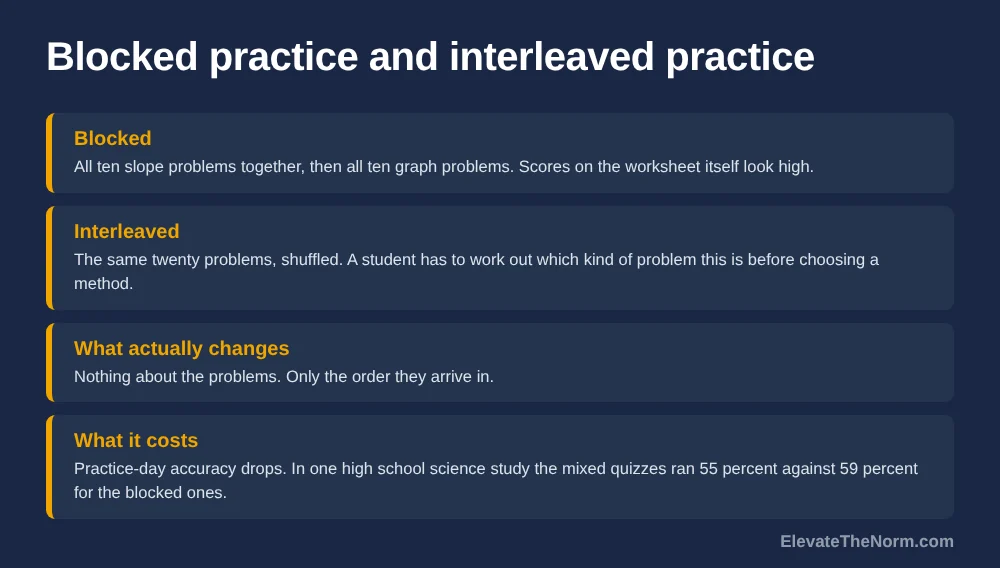
The distinction matters because of what each one asks a student to do. On a blocked page, the student solves the first problem, works out which method applies, and then reuses that method nineteen more times without ever asking the question again. On a mixed page, every problem starts with the same question a test asks: what kind of problem is this? That is the skill that goes missing when a kid can do every problem in the chapter and then freezes on the unit test.
Worth saying early, because the two get swapped constantly: interleaving is about order within a set. Spacing is about gaps between sessions. They often travel together and they are not the same move.
Does interleaving actually work in a real classroom?
Yes, in secondary math, in real classrooms, with large effects. Four classroom studies have tested interleaving with students in grades 7 through 12, and all four found the mixed sets beat the blocked ones on a delayed test.
That is unusually good evidence for a practice that costs nothing to adopt.
| Study | Who | Design | Delayed test result | Effect |
|---|---|---|---|---|
| Rohrer, Dedrick, Hartwig & Cheung (2020) | 787 seventh graders, 54 classes, 5 schools | Randomized by class, 15 teachers, test 33 days after review | 61% vs 38% | d = 0.83 |
| Rohrer, Dedrick & Burgess (2014) | 140 seventh graders, 8 classes | Crossover, test two weeks after last assignment | 72% vs 38% | d = 1.05 |
| Rohrer, Dedrick & Stershic (2015) | 126 seventh graders, 9 classes | Within-subject, delay randomized | 74% vs 42% at 30 days | d = 0.79 |
| Sana & Yan (2022) | 155 students, grades 9–12, 8 science classes | Within-subject quizzing, test one month later | 63% vs 54% (no-quiz control 47%) | d = 0.35 |
The 2020 trial is the one to know. Fifty-four classes, fifteen teachers, five middle schools, assigned at the class level, with eight worksheets spread across the semester and an unannounced test a month after the last one. The authors report a positive effect for every single teacher in the study, which is rare and is the part that should interest a department.
Sana and Yan (2022) is the only one outside math: biology, chemistry, physics and general science classes in one Canadian public high school, using weekly ten-minute quizzes. Smaller effect, one school, one study. It is the best evidence that this travels beyond a math worksheet, and it is one building.
One limitation nobody puts on the slide: three of those four classroom studies come from the same research group. That is not a reason to dismiss them — the 2020 trial is a proper randomized design across five schools and fifteen teachers — but a district deciding policy should know that the secondary-math evidence base is one research program and one high school science study, not a broad literature.
Why does interleaving feel like it is not working?
Because the mixed set is harder to do, and the payoff does not arrive until weeks later. Students score lower on the practice itself, feel less confident, and tell you they liked the old worksheets better. Every one of those signals points the wrong way.
Sana and Yan measured it: on the practice quizzes themselves, the interleaved version ran 55 percent against 59 percent for the blocked version. Same students, same content, four points worse in the moment — and nine points better a month out.
The classic demonstration of the illusion is Kornell and Bjork (2008), where 78 percent of participants performed better after interleaved study and 78 percent said the blocked version was as good or better. Be careful quoting that figure at a faculty meeting, though: those were UCLA undergraduates learning to recognize paintings by twelve artists, not teenagers doing math. The illusion is real; that specific number is not a classroom finding.
This is the same shape as the argument for letting students wrestle with something before you rescue them. Difficulty that produces learning and difficulty that produces nothing feel identical from the front of the room on Tuesday. The only way to tell them apart is to look at a delayed measure, which is exactly the thing a weekly grading cycle never shows you.
What does interleaving not work for?
Vocabulary words, long expository text, and anything mixed with something unrelated. The meta-analysis that pooled 238 effect sizes from 59 papers found the overall benefit was g = 0.42, but that the number moves enormously depending on what is being learned.
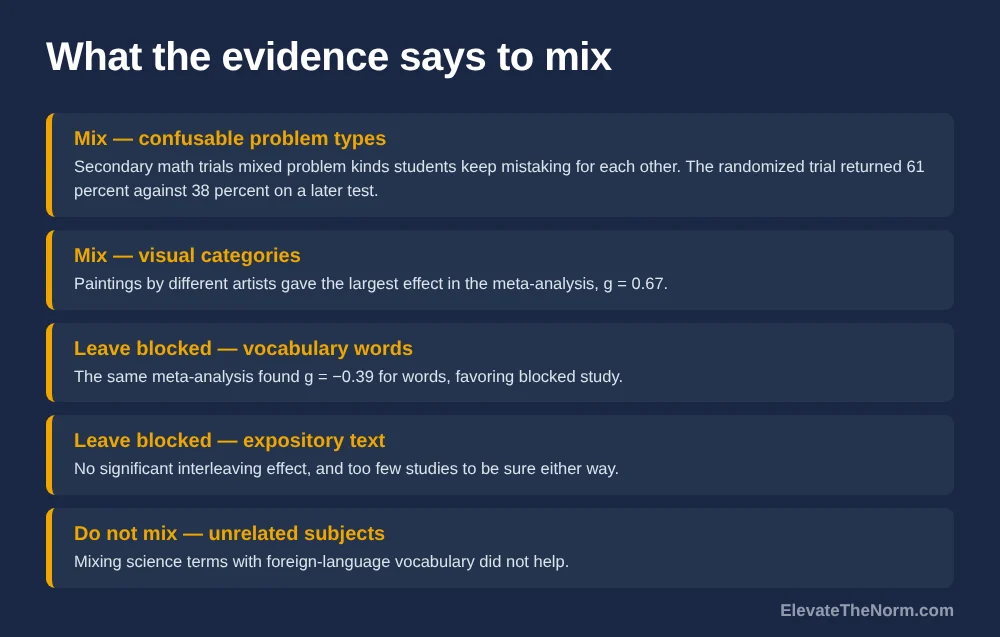
Paintings came out best at g = 0.67. Mathematical tasks came out at g = 0.34, which the authors call small. Expository texts and tastes produced nonsignificant effects. And for words, the effect ran the other way: g = −0.39, an advantage for blocked study. If a reading coach tells your department to interleave the vocabulary list, that is the number to bring.
Mixing unrelated material does not help either. The 2021 systematic review by Firth, Rivers and Boyle reports that studies interleaving unrelated items have not found a benefit — one of them mixed science terms with foreign-language vocabulary. The point is not variety for its own sake. The point is forcing a choice between options a student confuses.
Nobody has tested interleaving whole lessons or whole units, either. Firth and colleagues say so plainly. A department that decides to interleave the curriculum itself is extrapolating from twelve-item worksheets.
Why do the classroom trials and the meta-analyses disagree?
They measure different things. The classroom math trials of interleaving report effects between d = 0.35 and d = 1.05, while meta-analyses pooling mostly laboratory studies land near 0.42. Both numbers are accurate. Neither one describes the other.
This site has published the lower number itself: the rundown of which study techniques actually work lists interleaved practice at 0.47, inside the low band of the meta-analysis it comes from. That article is not wrong and this one is not either, which is worth explaining rather than leaving a reader to find the gap.
Three reasons for the gap, and they all run the same direction. First, the pooled literature is mostly not school. Firth and colleagues found that across their 26 included studies, none used high school participants — three used adult online samples and the rest were undergraduates. Second, it is mostly not math: the meta-analysis authors say visual materials dominate the field, and the math estimate rests on a thin slice. Third, the meta-analysis of learning techniques behind that 0.47 figure included nothing published after 2014, which means the two biggest classroom trials in this article are not in it.
So the honest summary is narrower than either headline. Averaged across paintings, word lists and laboratory tasks, interleaving is a moderate technique with real exceptions. Applied to confusable problem types on a secondary math worksheet, it is one of the largest effects anybody has measured in a real classroom. Those are not the same claim and you should not let a slide deck collapse them.
How do I build an interleaved practice set?
Keep the problems you already assign and change the order they appear in. Agarwal and Agostinelli, writing in American Educator, put it in one line: there is no need to change the problems, simply mix up what you assign. The work is in choosing what to mix.
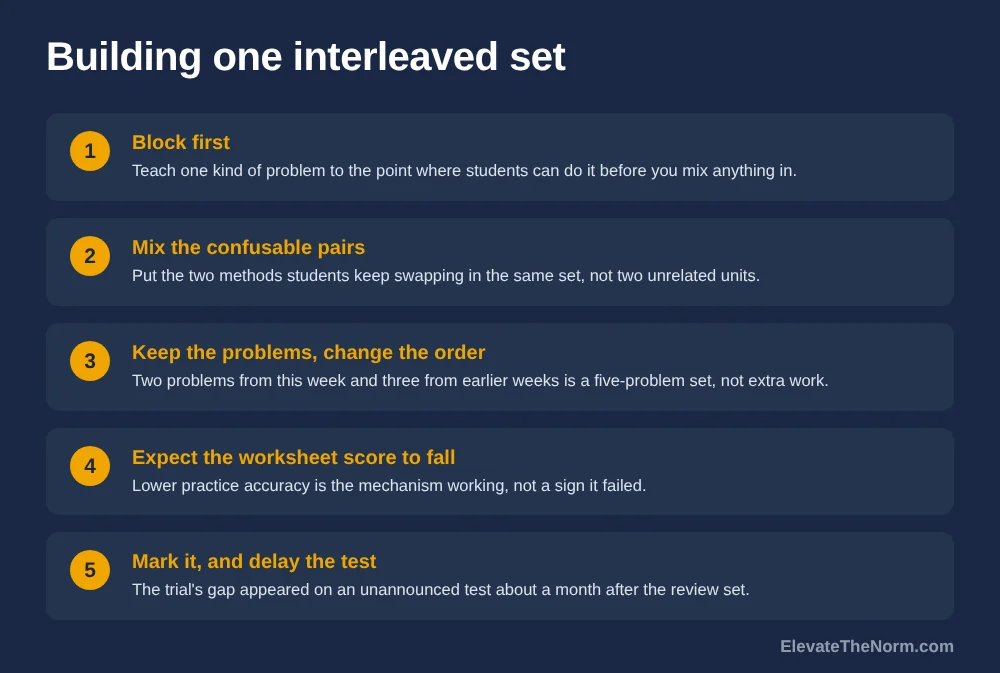
- Block first, then mix. Deans for Impact recommends blocked practice at the start and a move to interleaved, spaced practice once initial fluency is achieved. Mixing on the day you introduce a method is not the intervention these studies ran.
- Mix the pair students keep swapping. Agarwal and Agostinelli are explicit that the key is mixing up similar ideas. In practice that means the two formulas that look alike, the two graph types with the same axes, the two document types that call for different moves.
- Keep the set small. The American Educator piece describes a five-problem homework set from a middle school math classroom: two problems on this week’s content and three pulled from last week, last month and last year. That is not extra work, it is the same work in a different order. The cheapest source of the three old problems is the set you already assigned three weeks ago.
- Strip the labels off the page. If the heading says Section 4.3, the student knows which method to use before reading the problem and the mixing buys you nothing. That is also the one-second look-for if somebody is coaching this: can a student tell which method to use from the layout, before reading a word of the problem?
- Tell the students what you are doing and why. They are the ones whose scores dip, and if nobody explains the design they will reasonably conclude they are getting worse at math. Say it plainly before the first mixed set: this page is built to be harder, the first-attempt score is not the measure, and the comparison that counts is the unit test.
- Give answers back fast. Rohrer and colleagues list feedback as one of the conditions their trial cannot rule in or out, and their students got worked solutions. Until somebody tests the version without feedback, assume mixed practice without it is guessing practice.
- Judge it on a delayed, unannounced check. The 2020 trial’s gap appeared 33 days after the review assignment. A Friday quiz on Friday’s content will show you nothing, which is also the difference between a check used to steer teaching and a check used to record a grade.


Does interleaving confuse students who are already behind?
Nobody knows, and anyone who tells you otherwise is going past the evidence. This is the first question every teacher asks and it is the question the research has not answered.
Start with the flagship trial: the students were in a course the district called Honors Advanced Grade 7 Mathematics. The authors also note that interleaving might be less effective, or simply too hard, without some prior blocked practice. In a German study of 236 third graders — younger than this site’s grade band, so read it as a signal and not a finding — the authors raise the same concern directly, that the cognitive-load demands of interleaving may matter for weaker students.
What there is evidence for is that the benefit is not universal. Yan and Sana (2021) found about 30 percent of participants showed no interleaving benefit on average — but also that who benefited on one set of materials barely predicted who benefited on another. There is no evidence of a stable type of student who needs the blocked version, which cuts against sorting kids into two worksheets.
The practical answer is the sequencing one. Block until a student can actually do the thing, then mix. The trials interleaved review of material students had already been taught, not first exposure, and that distinction is doing a lot of work.
Is interleaving the same as spaced practice?
No. Spacing is about putting time between practice sessions. Interleaving is about mixing problem types inside a session. A mixed set naturally revisits older material, so the two overlap in a real worksheet, but they are separate decisions with separate evidence.
They also do not simply stack. Firth and colleagues report that adding spacing on top of interleaving was not additive, and in places reduced the benefit. For a classroom that is a relief rather than a problem: you do not have to engineer both at once. Pull three old problems into this week’s set and you have already got most of both, which is the same logic behind a do-now that asks about last week instead of last night.
Doesn’t the federal practice guide already recommend interleaving?
No. The federal practice guide recommends interleaving worked example solutions with problem-solving exercises, which means alternating a worked-out solution with a problem the student tries alone. That is a different intervention from mixing problem types inside one set.
The Institute of Education Sciences guide on organizing instruction and study rates that recommendation at a moderate evidence level, and its first recommendation, to space learning over time, is also moderate. Neither one is about problem sets that mix topic types, and the confusion between the two meanings of the word is everywhere.
This matters because “the federal government recommends interleaving” is the kind of sentence that ends an argument in a PD session, and in this case it ends it about the wrong practice. The real federal-grade support for mixing problem types is the randomized trial, not the guide.
Clay’s take: this is the cheapest thing on the list, and the easiest to quit
Most research-backed practices cost money, training, or a schedule change. This one costs the five minutes it takes to reorder a problem set, which makes it the rare recommendation a department can adopt on Monday without asking anybody for anything.
Keep the transition out of the gradebook. If mixed sets are scored for accuracy while students are still learning to read the page, a practice designed to raise learning has been converted into a grade penalty for the kids who are slowest to adjust — and the email from a parent asking why their child’s homework average fell in October is both inevitable and fair. Score completion, or score nothing, until the first unit test tells you something.
The catch is that everything about the first two weeks tells you to stop. Scores dip. Kids complain, and their complaint is accurate — the work is harder. Pull a formative check on Thursday and the numbers back the complaint. That is the design, and it is why I would not hand this to a team without also telling them what the first fortnight looks like. A practice that gets abandoned on week two is worse than one nobody tried, because now everyone has evidence it does not work.
Two honest limits worth saying out loud to students. Rohrer and colleagues state that interleaved practice probably takes more time, and that they did not measure time on task — so part of the gain may simply be that a mixed set is slower work. And this is practice design, not a difficulty setting: a mixed worksheet of recall questions is still a worksheet of recall questions, and how hard the thinking is is a separate decision you still have to make.
Where to start: pick the two topics your students most reliably mix up on the unit test. Build one five-problem set a week that includes both, strip the section headings, hand back answers the next day, and do not look at the results until the unit test. If it works, the place it will show up is the question your students have always gotten wrong for the same reason — not the practice page. For review days, the same logic applies to the formats you use to review: mixing the question types is what makes the game a review instead of a round of trivia.
Frequently Asked Questions
What is interleaved practice?
Interleaved practice means mixing different problem types inside one practice set instead of doing all of one kind and then all of the next. The opposite, blocked practice, is what most textbook sections and worksheets do by default. The point of mixing is that every problem forces the student to decide which method applies before using it.
Is interleaving better than blocked practice?
On a delayed test, yes, in secondary math. A randomized trial across 54 seventh-grade classes found 61 percent for interleaved practice against 38 percent for blocked, with a positive effect for every teacher in the study. On the practice itself blocked usually looks better, which is why the comparison has to be made weeks later rather than the same day.
Does interleaving work for subjects other than math?
Partly. One study in grades 9 through 12 science classrooms found interleaved quizzes beat blocked quizzes a month later, 63 percent against 54. Outside that, the meta-analytic picture is mixed: visual categories benefit, expository text shows no reliable effect, and vocabulary words show an advantage for blocked study instead.
Why do my students score worse on mixed practice?
Because that is how it works. Choosing a method is harder than reusing one, so accuracy during practice falls. In one high school science study the interleaved quizzes ran 55 percent against 59 percent for the blocked ones, and the same students were nine points ahead on a test a month later. The practice-day score is not the measure.
Does interleaving confuse students who are already behind?
Nobody has tested it properly. The flagship trial ran in a course the district labeled Honors, and the authors note interleaving may be too difficult without some prior blocked practice. The safe sequence is to block until a student can do the method, then mix for review. There is no evidence supporting a separate blocked worksheet for struggling students.
Is interleaving the same as spaced practice?
No. Spacing puts time between practice sessions; interleaving mixes problem types inside one session. They overlap in a real worksheet, because a mixed set naturally revisits older material. One systematic review found that adding spacing on top of interleaving was not additive and sometimes reduced the benefit, so there is no need to engineer both at once.
How many old problems should go in a practice set?
A five-problem set with two problems from this week and three from earlier weeks is the pattern described in American Educator by a middle school math teacher. That keeps the workload identical to a standard homework set while making most of the page cumulative. The cheapest source for the older three is the assignment you gave three weeks ago.
What should I tell a parent whose child’s practice scores dropped?
That the practice set changed, not the student. Mixed practice is designed to be harder in the moment and the research measures its payoff weeks later, on a delayed test. The honest version also includes what you are doing about it: scoring the transition for completion rather than accuracy, so a deliberate difficulty does not turn into a grade penalty.
Sources
- Rohrer, D., Dedrick, R. F., Hartwig, M. K., & Cheung, C.-N. (2020). A Randomized Controlled Trial of Interleaved Mathematics Practice. Journal of Educational Psychology, 112(1), 40–52. Accepted manuscript. Source of the 61 against 38 percent result, d = 0.83, the 787-student analyzed sample across 54 classes and five schools, the 33-day delay, the positive effect for each of 15 teachers, and the authors’ own caveats. The course was described by the district as Honors Advanced Grade 7 Mathematics, and the authors state that interleaved practice probably takes more time and that time on task was not measured. Read via the author manuscript because the journal version is paywalled.
- Rohrer, D., Dedrick, R. F., & Burgess, K. (2014). The Benefit of Interleaved Mathematics Practice Is Not Limited to Superficially Similar Kinds of Problems. Psychonomic Bulletin & Review. Full text. Source of the 72 against 38 percent result and d = 1.05 with 140 seventh graders, tested two weeks after the final assignment.
- Rohrer, D., Dedrick, R. F., & Stershic, S. (2015). Interleaved Practice Improves Mathematics Learning. Journal of Educational Psychology. Full text. Source of the 74 against 42 percent figure at a 30-day delay with 126 seventh graders. The copy read is the advance-online version, which is headed with a different year and volume than the final citation; the figures above are from the text itself.
- Sana, F., & Yan, V. X. (2022). Interleaving Retrieval Practice Promotes Science Learning. Psychological Science, 33(5), 782–788. Full text. Source of the 63, 54 and 47 percent final-test figures, d = 0.35, and the 55 against 59 percent practice-quiz figures. 155 students in grades 9–12 at one Canadian public high school; the authors note the study was not preregistered, the outcome measure was researcher-designed, and generalization to standardized exams is untested.
- Brunmair, M., & Richter, T. (2019). Similarity Matters: A Meta-Analysis of Interleaved Learning and Its Moderators. Psychological Bulletin. DOI 10.1037/bul0000209. Accepted manuscript. Source of g = 0.42 overall across 59 papers, 158 samples and 238 effect sizes; paintings 0.67; mathematical tasks 0.34; words −0.39 favoring blocking; nonsignificant results for expository texts and tastes. The authors state that visual materials dominate the field and that most studies examined college students.
- Firth, J., Rivers, I., & Boyle, J. (2021). A Systematic Review of Interleaving as a Concentration and Learning Strategy. Review of Education. Full text. Source of the statement that none of the 26 included studies used high school participants, the finding that interleaving unrelated items has not been beneficial, the absence of research on interleaving whole lessons, and the finding that adding spacing to interleaving was not additive.
- Kornell, N., & Bjork, R. A. (2008). Learning Concepts and Categories: Is Spacing the “Enemy of Induction”? Psychological Science, 19(6). Full text. Source of the 78 percent figures. Participants were UCLA undergraduates learning to recognize paintings by twelve artists, not secondary students, and the paper’s “spaced” condition is what this article calls interleaved.
- Yan, V. X., & Sana, F. (2021). The Robustness of the Interleaving Benefit. Journal of Applied Research in Memory and Cognition, 10. Full text. Source of the finding that about 30 percent of participants showed no interleaving benefit and that benefit on one material set barely predicted benefit on another. Undergraduate samples, visual categories only.
- Pashler, H., Bain, P., Bottge, B., Graesser, A., Koedinger, K., McDaniel, M., & Metcalfe, J. (2007). Organizing Instruction and Study to Improve Student Learning. NCER 2007-2004, Institute of Education Sciences. Full text. Source of Recommendation 2, “interleave worked example solutions with problem-solving exercises,” at a moderate evidence level, and Recommendation 1, space learning over time. This guide does not evaluate mixing problem types, which is the practice this article is about.
- Nemeth, L., Werker, K., Arend, J., Vogel, S., & Lipowsky, F. (2019). Interleaved Learning in Elementary School Mathematics. Frontiers in Psychology, 10:86. Full text. Source of the authors’ concern that the cognitive-load demands of interleaving may matter for weaker students. 236 German third graders, outside this site’s grade band, and the study combined interleaving with comparison prompts so the two cannot be separated. The paper carries a published corrigendum correcting its description of the interleaving meta-analysis.
- Agarwal, P. K., & Agostinelli, A. (2020). Interleaving in Math: A Research-Based Strategy to Boost Learning. American Educator, Spring 2020. Article. Source of the instruction to mix similar ideas without changing the problems and of the five-problem homework pattern, which is described there as one middle school math teacher’s own classroom routine. A practitioner article, not a study.
- Deans for Impact. The Science of Learning, second edition. Full text. Source of the recommendation that practice move to interleaved, spaced practice once initial fluency is achieved. A summary document for teacher preparation, not primary research.