By Clay Shumate
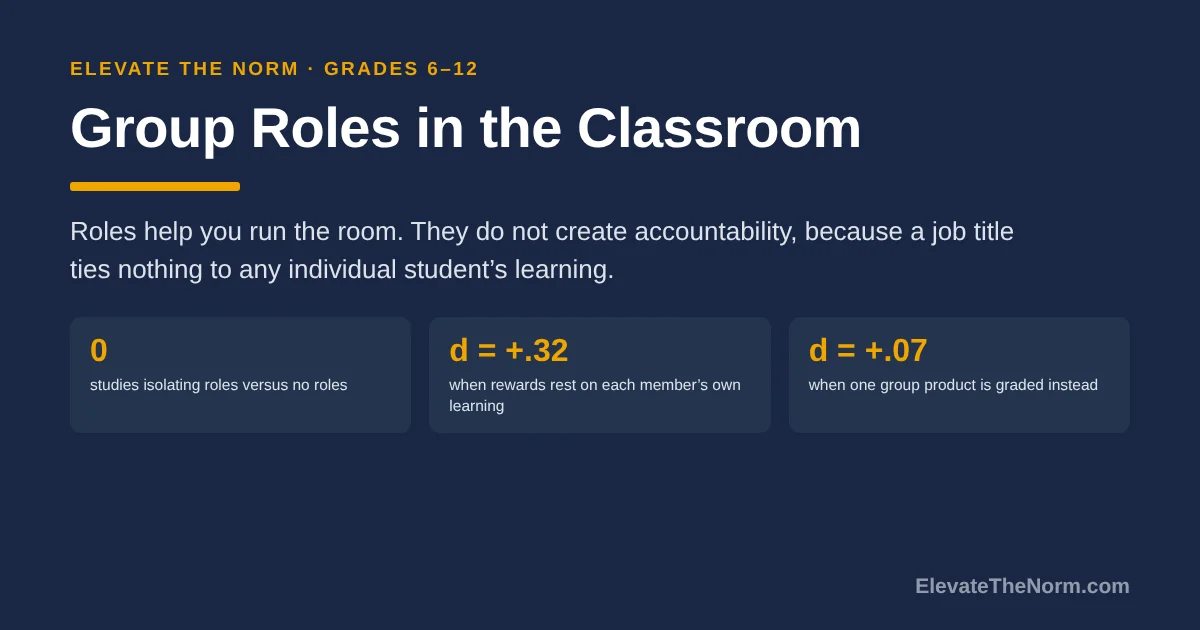
Group roles are assigned jobs — facilitator, recorder, timekeeper, reporter — handed out to structure group work. No study has isolated roles and measured what students learn. Roles help you run the room. They do not create accountability, because a job title ties nothing to any individual student’s learning.
Key Takeaways
- No study assigns students to roles versus no roles and measures achievement. The research people cite for role cards is about structured collaboration generally, in which role assignment is one optional ingredient bundled with prompts, sequencing and materials.
- Roles are not one of the five elements of cooperative learning. Johnson and Johnson list complementary roles as one of four optional ways to structure the first element, positive interdependence. The five are positive interdependence, individual accountability, promotive interaction, social skills and group processing.
- Slavin’s finding is the one worth memorising. Group structure raises achievement “if and only if” rewards rest on “the sum of group members’ individual learning” — median d = +.32. Tie them to one group product instead and the median drops to d = +.07.
- Status, not ability, decides who talks. In one study, students artificially labelled high status dominated the interaction regardless of whether they could actually help. A laminated title is just another status label.
- “Recorder” is a legitimate way to disappear. A student can write for forty minutes and think about nothing. That is the problem with buying participation with a job: effort is not the same as impact.
What are group roles?
Group roles are jobs assigned to students inside a small group so that everyone has something specific to do. The standard set comes from higher education: Carnegie Mellon’s Eberly Center publishes a twelve-role list that is probably the ancestor of the version taped to your tables.
Four of the twelve do most of the work in school classrooms. The facilitator “moderates team discussion, keeps the group on task, and distributes work.” The recorder “takes notes summarizing team discussions and decisions.” The timekeeper “keeps the group aware of time constraints and deadlines.” The reporter speaks for the group afterwards. The handout never states what age it is for, and every source it cites is written for college instructors — which is worth knowing before you hand the same list to thirteen-year-olds.
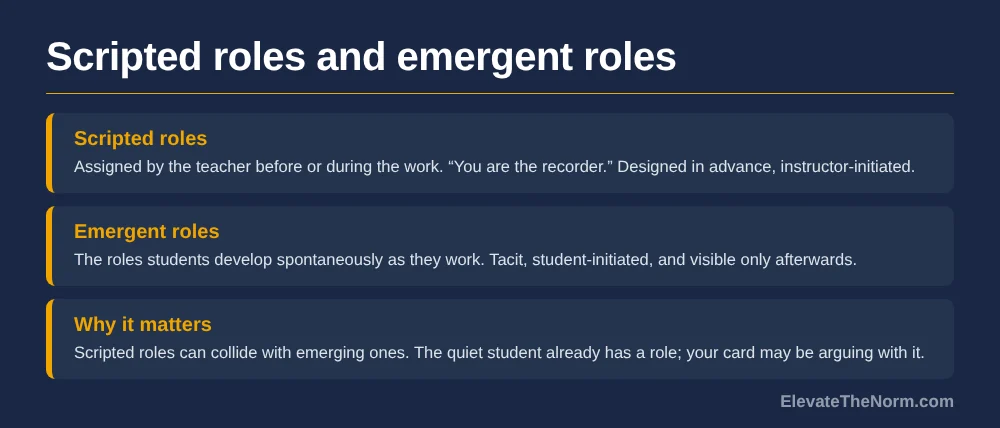
Researchers draw a distinction teachers usually do not. Strijbos and Weinberger separate scripted roles, which “specify and externalise the roles expected from the learners before or during collaboration,” from emergent roles, which students “develop spontaneously.” Their warning is the useful part: scripted roles “can collide with emerging roles.” The quiet kid in your third period already has a role. Your card may be arguing with it.
Do assigned group roles actually work?
Nobody knows, because nobody has tested it directly. No study I could find randomly assigns students to roles versus no roles and measures what they learn. That is the honest starting point, and most writing on this topic skips it.
What gets cited instead is research on structured collaboration, where roles are one ingredient among several — usually bundled with prompts, a required sequence and distributed materials. Attributing the whole effect of that package to the role cards is a category error, and it is the error almost every training slide makes.
The closest anyone has come is a 2025 preprint on role distribution — and it is a preprint, it is observational, and the students are university physics majors aged 18 and over. More on what it found further down. For grades 6–12 specifically, the ground is almost bare.
That is not a reason to stop using roles. It is a reason to be clear about what you are buying. Roles are a classroom-management tool: they reduce the thirty seconds of milling around at the start, they give a shy student a defined entry point, and they give you something to say when a group stalls. Those are real. They are just not learning gains, and they are not accountability.
What does the research on structured collaboration show?
Structuring collaboration beats leaving it alone — modestly for content and substantially for the skill of collaborating. That is the defensible version of the claim, and it comes with numbers.
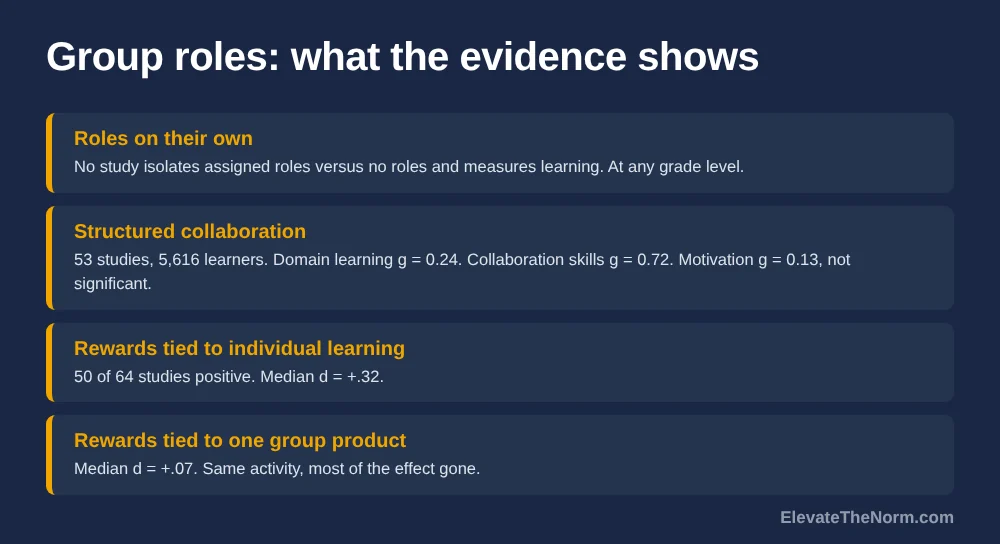
Radkowitsch, Vogel and Fischer’s 2020 meta-analysis synthesised 53 studies covering 5,616 learners in K–12, higher education and professional development. Scripted collaboration produced a small positive effect on domain learning, Hedges’ g = 0.24, and a medium positive effect on collaboration skills, g = 0.72. The effect on motivation was g = 0.13 and not statistically significant. An earlier meta-analysis from the same group reported d = 0.20 for domain knowledge and d = 0.95 for collaboration skills.
Two things in that result matter more than the headline. First, most of those studies are higher education — only a minority were primary or secondary school, and the age range runs from 6 to 64. Second, the active ingredient is identified: domain learning benefits most when the structure prompts transactive activity, where one student’s reasoning builds on another’s. Not when it hands out stationery. That is also the bridge to accountable talk, which is about exactly what makes one student’s reply to another count as thinking.
Among the motivation studies, role-assigning scripts were common and many of them found nothing. Where roles did show a motivational benefit, it tended to be when roles rotated or when they followed real differences in what students knew — not when they were handed out at random on laminated cards.
What does Slavin say makes group work raise achievement?
Individual accountability, stated more precisely than most people quote it. Robert Slavin’s review of 99 cooperative learning studies found group rewards help “if and only if” they rest on each member’s own learning.
The numbers are stark. Of 64 studies where group rewards were based on the sum of group members’ individual learning, 50 (78 percent) found significantly positive effects on achievement, with a median effect size of d = +.32. Where the reward was based on a single group product instead, the median was d = +.07. Same activity, same kids, different accountability structure, and most of the effect disappears.
Slavin hedges his own claim and the hedge is worth carrying: group goals and individual accountability “may not always be absolutely necessary,” but to ignore them “would be to ignore the tool with the most consistent evidence of positive effects on student achievement.” His earlier synthesis also notes that research has more often happened in grades 3–9 than 10–12, while finding senior high results “about as positive as those at earlier grade levels.”
Now read a role card against that standard. “Timekeeper” ties nothing to anybody’s learning. It is a job, and the group turns in one product, which is exactly the d = +.07 condition. This is the central point of the article: roles are not accountability, and treating them as accountability is why they keep disappointing you.
Why don’t role cards fix the student who does nothing?
Because the problem is status and task design, not job allocation. The student doing nothing is usually reading the room correctly, and a card does not change what the room rewards.
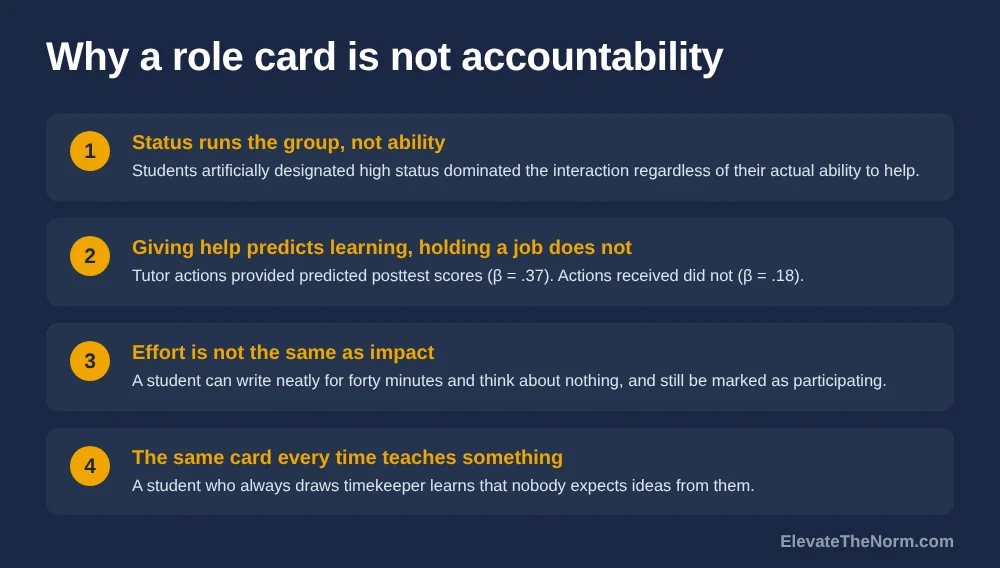
Noreen Webb’s review of collaborative dialogue is the best place to see this. Benefits depend on the extent to which students give and receive help, and students often neither request nor provide explanations. High-status students are more active and more influential; low-status students talk less and offer fewer suggestions. The finding that should stop you cold is Dembo and McAuliffe’s: students artificially designated as high status dominated the interaction regardless of their actual ability to help. Status was manufactured and it still ran the group. A laminated title is another manufactured status label.
What predicts learning is giving substantive help, not holding a job. Oortwijn and colleagues coded nine hours of maths lessons with Dutch fifth-graders and found tutor actions provided predicted posttest scores, β = .37, p < .05, while tutor actions received did not, β = .18, and requests for explanation were actually negative, β = −.23, p < .05. Note the population: 101 pupils aged 10 to 12 in the Netherlands, and the roles were coded from observed interaction rather than assigned. It is evidence about emergent helping, not about your cards.
Student passivity in cooperative groups is documented and it concentrates where you would expect: Mulryan’s work with fifth- and sixth-graders found some students, mainly low achievers, showed high levels of passive behaviour in cooperative maths groups. That is the problem role cards are sold to solve, and roles are the wrong tool for it.
The part students see and adults do not
Being assigned “recorder” is a legitimate way to disappear. A student can write neatly for forty minutes, hand in a full page and never once think about the content, and you will mark them as participating. From a desk that is not laziness, it is good strategy: the card told them the job, the job did not require thinking, and they did the job.
Strijbos and De Laat put it in one line that belongs on every group-work handout: “effort is not the same as impact.” They also warn against reading participation styles as character — “lurkers are not selfish free-riders,” and their stance taxonomy was explicitly not built to assess students. Worth remembering before you grade somebody for being quiet.
And the kid who draws timekeeper every time learns something you did not intend to teach: that nobody expects ideas from them. If you are going to use roles with teenagers, rotate them, and make sure the roles that involve thinking are not reserved for the same four students.
Can you over-script group work?
Probably, but the evidence for it is weaker than the warning’s fame suggests. Pierre Dillenbourg’s over-scripting argument is a design warning from a leading researcher, not a demonstrated harm, and it is worth knowing which it is.
His concern, restated in his own later paper, is “constraining collaboration in a way that makes it sterile by inhibiting the ‘natural’ peer interaction mechanisms,” and that “too rigid scripts would spoil the richness of collaborative interactions.” Anyone who has watched a group robotically execute a four-step protocol while learning nothing knows the shape of this.
But Radkowitsch and colleagues went looking for the harm in their meta-analysis and did not find it: scripts did not significantly depress motivation, and they concluded that the criticism remains a postulate without matching empirical evidence. What the data do support is the weaker, more useful version — less is more. Scaffolding fewer collaborative activity types generally produced larger effects on collaboration skills than scaffolding many.
So the practical rule is not “avoid structure.” It is “structure one thing well rather than six things thinly.” If your group protocol has a role card, a sentence-stem sheet, a timer, a rubric and a reflection form, the research points at cutting four of them.
Which group roles are worth using?
The ones that cannot be done without thinking about the content. That is the whole filter, and it eliminates most of the standard set.
| Role | What it claims to do | What it actually does | Worth it? |
|---|---|---|---|
| Timekeeper | Keeps the group on pace | Watches a clock. Requires no contact with the content | Management only. Not accountability |
| Recorder | Captures the group’s thinking | Transcribes. Can be done without thinking, and often is | Only if the recorder must write the reasoning, not the answer |
| Materials manager | Keeps the group supplied | Hands out paper | Useful in a lab. Never mistake it for participation |
| Reporter | Speaks for the group | Reads out whatever the group decided | Yes, if the reporter is chosen after the work, at random |
| Checker | Confirms everyone understands | The one standard role that forces content contact | Yes. This is the one to keep |
| Devil’s advocate | Raises counter-arguments | Forces a second line of reasoning into the room | Yes, with a strong task. Pointless on a worksheet |
Notice the pattern. The roles worth keeping are the ones that cannot be performed without engaging the material. The rest are logistics, and logistics are fine — just do not count them as evidence a student participated.
Should you rotate roles or let students share them?
Share them if you can, and rotate rather than fixing them permanently. The only direct evidence on this question is thin and comes from college labs, but it points the same way as the classroom logic.
Feinleib, Dew and Holmes’s 2025 preprint compared university physics students who shared roles, rotated them weekly, or split them and kept the same one all term. Role distribution made no significant difference to critical thinking. But permanently splitting roles was significantly negative for self-efficacy (−0.17, p = .003), perceived agency (−0.14, p = .016) and recognition (−0.13, p = .028), while sharing was mildly positive for self-efficacy (0.13, p = .032).
Read that carefully before using it. It is a preprint, not peer-reviewed as far as I can tell; it is observational, and the authors say so plainly and call for randomised studies; the students are 18 and older; and the survey asked about hands-on roles rather than decision-making roles. “Share it, don’t split it” is the most that evidence will bear, and it comes from a physics lab, not an eighth-grade classroom.
It is still the right default, because the classroom version of “split it” is the student who is the timekeeper in every group for the whole semester.
How do you set up group work that actually holds students accountable?
Six moves. Roles are optional in all of them; individual assessment is not.
- Keep groups to three to five. The Education Endowment Foundation reports that “the most promising collaborative learning approaches tend to have group sizes between 3 and 5 pupils.” Six is a crowd and the sixth student knows it.
- Assess every student individually on the content. This is Slavin’s finding turned into a procedure. A short individual check at the end, graded separately from any group product, is the single change with the most evidence behind it.
- Build a task that cannot be finished by one student. If one capable kid can do the whole thing in fifteen minutes, they will, and no card prevents it. Different information in different hands is the oldest fix and it still works — the jigsaw method is that principle built into a structure.
- Pick the reporter after the work, at random. Announce it in advance. Now every student has a reason to understand the group’s reasoning rather than just its answer — the same mechanism behind numbered heads together.
- Teach the collaboration explicitly. The EEF is blunt: “Pupils need support and practice to work together; it does not happen automatically.” Ten minutes on how to disagree with someone’s idea without disagreeing with them buys more than a year of role cards.
- Watch the quiet student directly. Not their card — them. The EEF’s own warning is that if collaborative work just involves high attainers solving problems with no input from their peers, “this is likely to widen existing gaps in attainment.”
What should a coach or administrator look for?
Whether students are explaining things to each other, and whether every student is individually assessed on the content. Those two observables cover almost everything that matters here.
What not to look for is role cards on the table. They are the easiest thing in the room to see and the least informative, and the moment they appear on a walkthrough rubric every teacher produces them and nothing else changes. A coach watching a group for five minutes can count something better: how many times a student explains reasoning rather than stating an answer. That number is low in most classrooms, it moves with teaching, and it is what the scripting research says actually drives domain learning.
At district scale, two honest notes. The EEF rates collaborative learning at +5 months additional progress on average, slightly higher in secondary (+6 months) than primary (+5) — and rates the security of that evidence as low. The grade-band picture is genuinely contested: one meta-analysis puts secondary below primary, while Slavin found high school results about as positive as earlier grades. Anyone telling you the direction is settled has not read both.
Clay’s take: roles run the room, tasks do the teaching
Use roles if they help you run the room. Just stop expecting them to do a job they were never built for.
I understand exactly why teachers reach for them. You have thirty-two kids, eight groups, forty-seven minutes, and two students per group who would happily let somebody else carry it. A card with a job on it feels like a lever. And it is — for the first ninety seconds, which is not nothing when you are trying to get eight groups moving at once.
But the thing you actually want is for every student to have to think, and that is a property of the task and the assessment, not of the stationery. If the group turns in one product and nobody is individually checked, you have built the d = +.07 condition no matter how carefully the roles were distributed. If every student gets assessed individually on the content, you have built the d = +.32 condition even if nobody holds a card at all.
And treat students as young adults about it. A teenager can tell the difference between a job that matters and a job invented to keep them busy, and handing a fifteen-year-old a timekeeper card is often read, correctly, as the second one. If you want them to contribute ideas, build a task that needs their ideas and then check whether they had any.
What to do next
Take the group task you are running this week and ask one question: if one student did the whole thing, would you find out?
If the answer is no, add a short individual check at the end and grade it separately from the group product. That one change has more evidence behind it than every role card ever laminated. Then cut your protocol down — keep the structure that forces students to explain reasoning to each other, drop the rest. If you want the next layer, start with what cooperative learning actually is and the catch that comes with it, then peer tutoring in grades 6–12 for what happens when you shrink the group to two.
Frequently Asked Questions
Do group roles actually improve learning?
No study has isolated assigned roles and measured what students learn, so nobody can honestly claim they do. The research usually cited is about structured collaboration in general, where roles are one optional ingredient among prompts, sequencing and materials. Roles are a reasonable classroom-management tool. They are not an evidence-based intervention and they do not create accountability on their own.
What are the most common group work roles?
Facilitator, recorder, timekeeper and reporter are the four most classrooms use. Carnegie Mellon’s published list adds checker, devil’s advocate, harmonizer, prioritizer, explorer, innovator, runner and wildcard. That handout never states an age group and every source it cites was written for college instructors, which is worth knowing before handing the same list to a thirteen-year-old.
Are group roles one of the five elements of cooperative learning?
No. The five elements are positive interdependence, individual accountability, promotive interaction, social skills and group processing. Johnson and Johnson list complementary roles as one of four optional ways to structure positive interdependence, alongside mutual rewards, distributed resources and a mutual identity. Roles are a technique for building one element, not an element themselves.
How do I stop one student doing all the work?
Assess every student individually on the content and grade that separately from the group product. Slavin’s review found group rewards raise achievement only when they rest on the sum of each member’s individual learning, with a median effect size of d = +.32 against d = +.07 when a single group product is graded. Design the task so one student cannot finish it alone.
Should students rotate group roles?
Rotate rather than fixing roles permanently, and let students share roles where the task allows. The one direct study of role distribution found permanently splitting roles was significantly negative for self-efficacy, agency and recognition while sharing was mildly positive. That study is an observational preprint on university physics students, so treat it as a sensible default rather than a proven result.
Can you over-structure group work?
Possibly, though the evidence is thinner than the warning’s reputation. Dillenbourg argued that rigid scripts make collaboration sterile by inhibiting natural peer interaction, but a 2020 meta-analysis looked for that harm and did not find it. What the data support is a milder rule: scaffolding fewer collaborative activities produced larger effects than scaffolding many. Structure one thing well.
Is group work less effective for high school students?
The evidence genuinely disagrees and anyone claiming otherwise has not read both sides. The Education Endowment Foundation rates collaborative learning at plus five months overall and slightly higher in secondary than primary, while one meta-analysis puts secondary below primary. Slavin found senior high results about as positive as earlier grades. The EEF also rates the security of that evidence as low.
What group size works best?
Three to five students. The Education Endowment Foundation reports that the most promising collaborative learning approaches tend to use group sizes in that range. Larger groups make it easier for an individual student to disappear without anyone noticing, and the student who disappears is usually the one who most needed the talk. Small enough that silence is conspicuous is the practical test.
Sources
- Johnson, D. W., & Johnson, R. T. Cooperative Learning: The Foundation for Active Learning. In Brito (Ed.), Active Learning — Beyond the Future. IntechOpen (2018). Full text. Source of the five basic elements and of complementary roles being listed as one of four ways to structure positive interdependence. The chapter claims over 1,200 studies and reports no effect sizes, which is why none is quoted here.
- Slavin, R. E. Instruction Based on Cooperative Learning. In Mayer & Alexander (Eds.), Handbook of Research on Learning and Instruction, pp. 388–404. Routledge (2016). Full text (PDF). Source of the “if and only if” claim, the 50 of 64 studies figure, and the median effect sizes d = +.32 and d = +.07. Covers preschool to college; reports no separate elementary and secondary effect sizes.
- Slavin, R. E. Synthesis of Research on Cooperative Learning. Educational Leadership, February 1991, pp. 71–82. Full text (PDF). Source of the observation that research has more often taken place in grades 3–9 than 10–12 while senior high results are about as positive. Reports vote counts, not effect sizes.
- Radkowitsch, A., Vogel, F., & Fischer, F. Good for learning, bad for motivation? A meta-analysis on the effects of computer-supported collaboration scripts. International Journal of Computer-Supported Collaborative Learning 15, 5–47 (2020). Full text (PDF). 53 studies, 5,616 learners across K–12, higher education and professional development. Source of g = 0.24 for domain learning, g = 0.72 for collaboration skills, the non-significant motivation result, the transactivity moderator, the absence of empirical support for over-scripting, and the “less is more” design finding.
- Vogel, F., Wecker, C., Kollar, I., & Fischer, F. Socio-Cognitive Scaffolding with Computer-Supported Collaboration Scripts: a Meta-Analysis. Educational Psychology Review 29(3), 477–511 (2017). Repository record. The earlier meta-analysis from the same group, reporting d = 0.20 for domain-specific knowledge and d = 0.95 for collaboration skills. Abstract only — the full text could not be opened, so no study count or confidence interval is quoted from it.
- Dillenbourg, P., & Tchounikine, P. Flexibility in macro-scripts for computer-supported collaborative learning. Journal of Computer Assisted Learning. Full text (PDF). Cited as the readable restatement of Dillenbourg’s over-scripting argument; the original 2002 book chapter could not be reached, so nothing is quoted from it directly.
- Strijbos, J. W., & Weinberger, A. Emerging and scripted roles in computer-supported collaborative learning. Computers in Human Behavior 26, 491–494 (2010). Full text (PDF). Source of the scripted versus emergent roles distinction and the warning that scripted roles can collide with emerging ones. An editorial review, not a primary study.
- Strijbos, J. W., & De Laat, M. F. Developing the role concept for computer-supported collaborative learning: An explorative synthesis. Computers in Human Behavior 26, 495–505 (2010). Full text (PDF). Source of “effort is not the same as impact”, of the caution that lurkers are not selfish free-riders, and of the authors’ statement that their participation stances were not intended for assessing students. Based on a small number of groups in two datasets; reports no experimental test of assigned roles.
- Webb, N. M. The teacher’s role in promoting collaborative dialogue in the classroom. British Journal of Educational Psychology 79, 1–28 (2009). Full text (PDF). A narrative review, largely of elementary and middle school mathematics in the US and UK. Source of the status findings, including Dembo and McAuliffe’s result that artificially designated high-status students dominated regardless of ability to help. The review does not report sample sizes for most studies it cites.
- Oortwijn, M. B., Boekaerts, M., Vedder, P., & Strijbos, J. W. Helping behaviour during cooperative learning and learning gains. Learning and Instruction 18, 146–159 (2008). Full text (PDF). 101 pupils aged 10–12 in 27 groups, multiethnic Dutch schools, mathematics. Source of the beta coefficients for tutor actions provided, received, and requests for explanation. Pupils were not assigned roles; roles were coded from observed interaction.
- Feinleib, J., Dew, M., & Holmes, N. G. Share, Rotate, Split: The Effects of Group Work Role Distributions on Student Outcomes. arXiv:2512.16094 (2025). Preprint (PDF). A preprint, and observational. University physics lab students aged 18 and over at two US institutions. Source of the share, rotate and split coefficients. The authors state their results are observational and call for randomised studies; their critical-thinking outcome showed no significant difference by role distribution.
- Carnegie Mellon University, Eberly Center for Teaching Excellence. Team Roles. Handout (PDF). Source of the twelve-role list and the role definitions quoted. The handout never states an intended age group; every source it cites is written for college instructors.
- Education Endowment Foundation. Collaborative learning approaches. Teaching and Learning Toolkit. Toolkit entry. Source of the +5 months headline, the +6 secondary and +5 primary split, the 3–5 group size, the statement that working together does not happen automatically, and the warning about widening attainment gaps. The EEF rates the security of this evidence as low.