By Clay Shumate
A late work policy decides two separate things: what happens to the grade, and what happens to the student. Most policies collapse those into one number and then stop working. The evidence does not hand you a clean answer, and the study most often quoted in these arguments was retracted in September 2026 — which is the first thing anybody writing a policy this year should know.
Below is what the research actually supports, what it does not, and a six-part policy you can write on one page and still defend in a parent meeting.
Key Takeaways
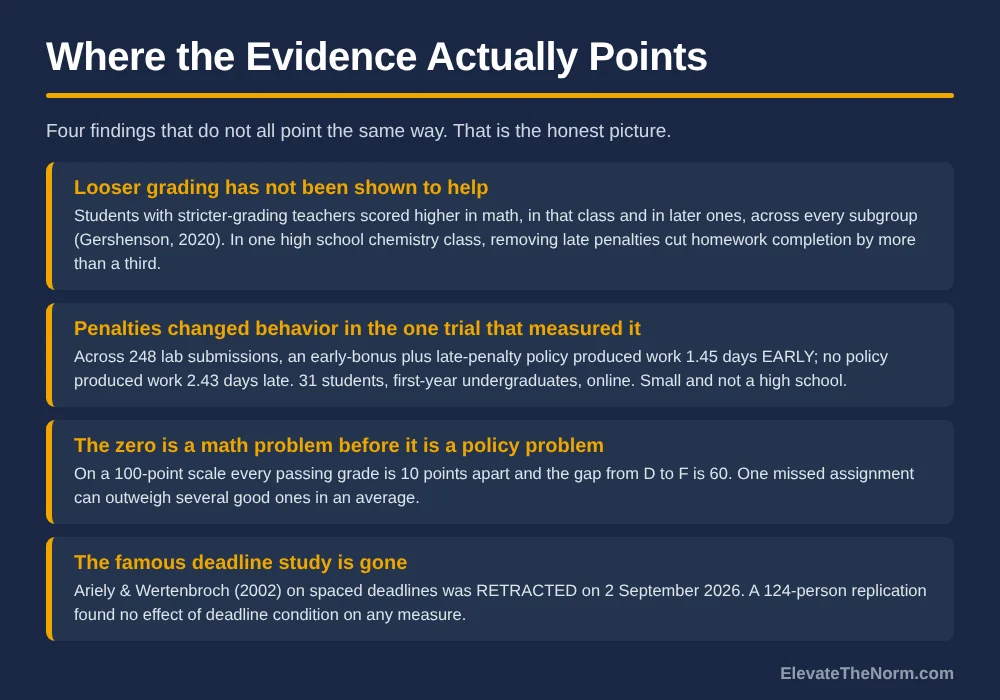
- The famous deadline study is gone. Ariely and Wertenbroch’s 2002 paper on spaced deadlines was retracted on 2 September 2026. A 124-person replication found no effect of deadline condition on any outcome measure.
- Loosening grading has not been shown to help students. Students assigned to stricter-grading teachers scored higher in math — in that class and in later ones — across every subgroup studied.
- Removing late penalties has a measured cost. In one high school chemistry class, homework completion fell by more than a third.
- The zero is a math problem before it is a policy problem. On a 100-point scale, the gap between passing grades is 10 points and the gap from D to F is 60.
- The deeper issue is the scale and the averaging, not the zero. Research supports grading scales with four to seven levels for reliability; the 100-point scale invents precision that is not there.
- Separate the grade from the behavior. Report lateness as conduct and let the grade report what the student knows. That one move resolves most of the argument.
Free Download · PDF
The One-Page Late Work Policy and Window Log (2 pages)
Page 1 is the six-part policy to fill in, the practice-versus-assessment split, and the sentence to give a parent. Page 2 is the window log that turns the policy into information, plus the honest cost of all three common policies.
Free. No email address required. Designed for grades 6–12. Browse every printable in Your Free Library.
Why Is a Late Work Policy So Hard to Get Right?
Because a grade is being asked to do two jobs at once, and they conflict.
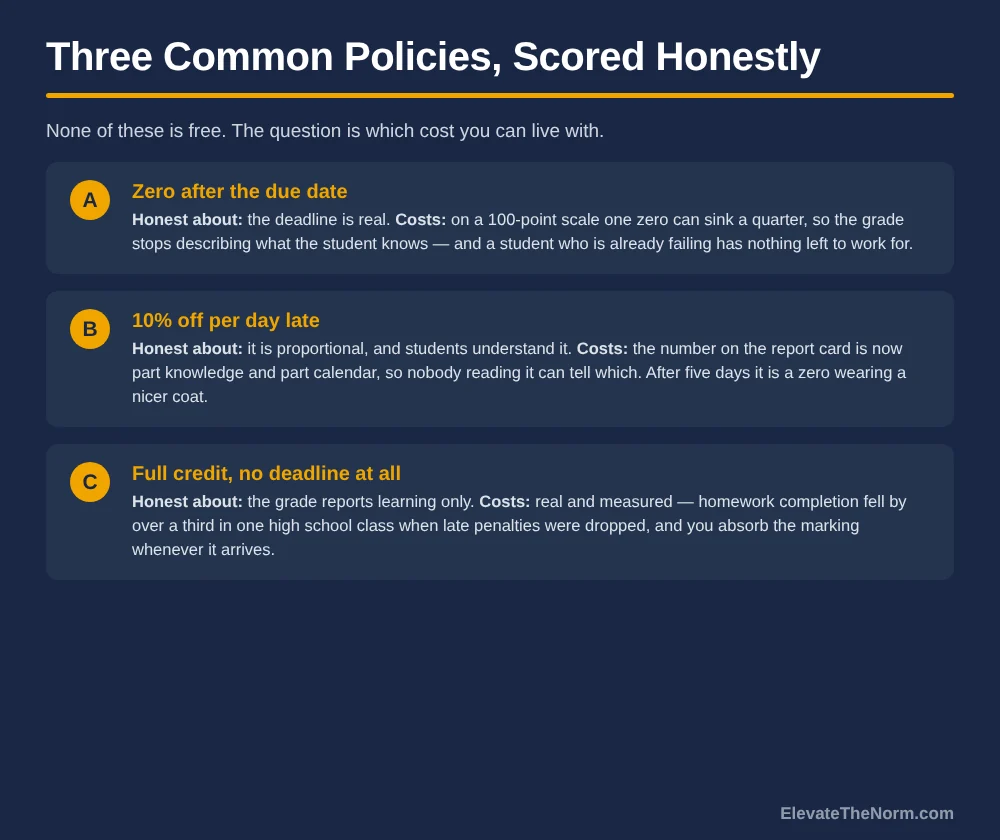
Job one is reporting what a student knows and can do. Job two is enforcing a deadline. A 10-percent-per-day deduction does job two by corrupting job one: after five days the number on the report card is half knowledge and half calendar, and nobody reading it — not the next teacher, not a parent, not the student — can tell which half is which.
A zero does job two harder and job one worse. And the people on the other side of the argument are not making a soft case. The claim that deadlines do not matter has a measured cost attached, which is the part that usually goes missing in articles about this.
So the honest version of the problem is not “should kids face consequences.” It is: how do you keep the deadline real without making the grade lie?
What Does the Research Actually Say About Deadlines?
Less than you have been told, and one widely quoted finding has been formally withdrawn.
For twenty years, the standard citation for “students do better with evenly spaced interim deadlines” has been Ariely and Wertenbroch (2002) in Psychological Science. You have probably read it quoted in a PD slide deck. It was retracted on 2 September 2026.
The retraction is not a technicality. Data Colada’s analysis of Study 2 found eighteen of twenty participants in one condition had exact duplicates across all three tasks, correlations that should have been strong were absent, and self-reported times showed almost none of the rounding that real human responses show. Their conclusion was that the data were “severely tampered with or fabricated.” Coauthor Klaus Wertenbroch stated that “much or all of the data — and therefore the results — are false.”
A pre-registered replication by Hyndman and Bisin, published in 2025 with 124 participants across three deadline conditions, found no statistical evidence that performance was influenced by the deadline condition on any of three measures — errors found, days late, or payment, all p > 0.1. The original had reported all differences significant at p < 0.01. The replication authors concluded that the received wisdom about spaced deadlines limiting procrastination is “possibly false.”
Two things follow. First, if your department’s late work policy was built on that study, it needs a different foundation. Second — and this is the part worth holding onto — the retraction says nothing about whether deadlines matter in a classroom. It says one famous laboratory result about self-imposed versus imposed deadlines cannot be relied on. Interim checkpoints on a long project may still be good practice. They just are not evidence-backed in the way everyone has been saying.
Does Removing Late Penalties Hurt Students?
There is real evidence that looser grading costs something, and it deserves to be stated as plainly as the case for reform usually is.
Gershenson’s work on high school math found that students with tougher-grading teachers scored higher in math, both in that teacher’s class and in subsequent math courses, and that this held across every student subgroup. Figlio and Lucas found the same direction at elementary level: students assigned to stricter graders showed greater test-score growth in reading and math. In one high school chemistry class where late penalties were removed, homework completion dropped by more than a third.
The strongest single trial on late policies specifically is small and not from a high school. Korpusik, Freitas and Dionisio compared four late policies across 248 lab submissions in an introductory programming course. Work came in 2.43 days late under no policy, 4.71 days late under an early-completion bonus alone, 0.44 days late under a late penalty, and 1.45 days early under a combined early bonus and late penalty — which also produced the highest grades. Their read was that late penalties externally regulate students who have not yet regulated themselves.
Size that evidence honestly before you use it: 31 students who consented to the analysis, mostly first-years, taught online during the pandemic. It is a signal, not a mandate. But it points the same direction as the grading-strictness work, and a teacher who ignores both because the conclusion is unfashionable is doing the thing this site complains about when it goes the other way.
Does It Matter What the Assignment Was For?
More than any other question here, and most policies never ask it.
If the work was practice — a problem set, a draft, a reading check whose job was to tell you what to reteach — then late is a timing failure with a real instructional cost, because the information arrived after you needed it. The honest response is to collect it, use it, and record the lateness as conduct. Scoring it down does not recover the information.
If the work was the assessment — the essay, the project, the unit test — then the deadline is doing something different. It is the point at which you are claiming to know what the student can do. Here a window still makes sense, but a narrow one, and after it closes the student demonstrates the standard some other way rather than handing in the same artifact in December.
Running one blanket rule over both is why so many late work policies feel wrong in practice. A missing formative check and a missing final project are not the same event and should not get the same sentence.
So Why Not Just Give Zeros?
Because of arithmetic, not sentiment.
Reeves laid this out in Phi Delta Kappan. On a standard 100-point scale with letter grades at 10-point intervals, every passing grade sits 10 points from its neighbor — and the interval between D and F is not 10 points but 60. A single zero therefore carries roughly six times the weight of any other failing mark in an average. Reeves’s point is that if an F is one interval below a D, the mathematically consistent value is 50, not 0. On a 4-point scale nobody hesitates: missing work gets a 0, exactly one point below a 1. The same logic on a 100-point scale would require a –6, which no one would give.
Guskey, Fisher and Frey take that further in Educational Leadership, and their version is the one to carry into a faculty meeting: “The true problem is not the zero; it’s the use of the 100-point percentage grading scale and the practice of averaging scores.” They point out that the problems with percentage scales have been documented since Starch and Elliott in 1913, and that research supports scales with four to seven levels for optimal reliability and discrimination. A 101-level scale manufactures precision nobody can actually defend.
That reframing matters for a late work policy because it tells you where the real fix is. Arguing about whether a missed assignment is a 0 or a 50 is arguing about a symptom. If your gradebook averages percentages across a semester, a single missed assignment distorts the picture no matter which number you put in the box.
If this is live at your school, the fuller version of that argument is in the standards-based grading guide, and the honest case against it is in why standards-based grading doesn’t work. Both are worth reading before anyone proposes a schoolwide change.
What Does a Workable Late Work Policy Look Like?
Six parts. It fits on one page, and every part of it survives a parent asking why.
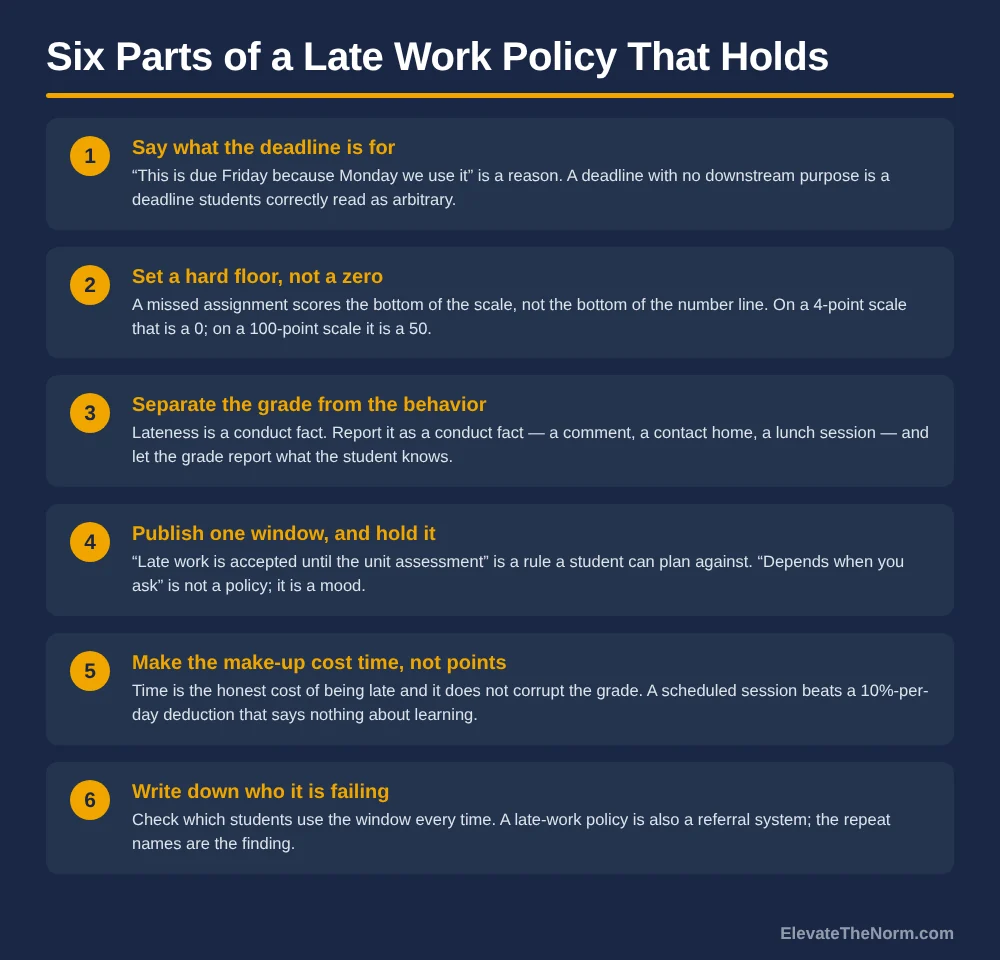
1. Say what the deadline is for
“This is due Friday because on Monday we build on it” is a reason. “Because I said Friday” is not, and teenagers are unusually good at telling the difference. A deadline with a downstream purpose gets taken seriously by more students than a deadline without one, and it also tells you which deadlines you should actually defend. If nothing depends on Friday, Friday was arbitrary and you should stop pretending otherwise.
2. Set a hard floor, not a zero
A missed assignment scores the bottom of the scale, not the bottom of the number line. On a four-point scale that is a 0. On a 100-point scale it is a 50. The point is not generosity; it is that the floor should be one interval below the lowest passing mark, which is what every other grade boundary already is.
3. Separate the grade from the behavior
This is the move that resolves most of the argument, and it costs nothing. Lateness is a conduct fact. Report it as one — a comment on the report, a contact home that happens the same week, a scheduled session — and let the grade report what the student knows. A parent who is told “she understands this material and she has turned in four assignments late” has two usable pieces of information. A parent told “she has a 61” has none.
4. Publish one window and hold it
“Late work is accepted until the unit assessment” is a rule a fourteen-year-old can plan against. “Depends when you ask me” is not a policy, it is a mood, and students read inconsistency as unfairness faster than they read strictness as unfairness. Pick a window, write it in the syllabus, and then do exactly what you said — which is the whole of respecting students in practice rather than on a poster.
5. Make the make-up cost time, not points
Being late should cost something. Time is the honest currency: a scheduled session at lunch, before school, or during an intervention block. It is a real cost, students feel it, and it leaves the grade intact. A ten-percent-per-day deduction costs them something too — the accuracy of the transcript.
6. Write down who keeps using the window
Keep a list. Not to punish with — to read. Three students using the late window every single time is not a late work problem, it is a signal about workload, home, organization, or something nobody has asked about yet. A policy that generates that list is doing a second job for free. A policy that just applies a deduction tells you nothing you did not already know. This is the same logic as treating attendance data as a referral system rather than a compliance record. The same read applies to arrival times, where a tiered response sorts the one-off from the pattern in a way a blanket deduction never will.
One cost this policy does carry, and it should be named rather than buried: an open window produces a flood at the end of it. If the window closes at the unit assessment, expect a stack the night before, and expect it to arrive in the same week you are marking the assessment itself. Two things keep that survivable. Cap what comes back — late work gets a score and a one-line comment, not the full written feedback a punctual draft gets, and say so in advance. And put the make-up session mid-unit rather than at the end, so the work trickles in instead of arriving at once. A policy that quietly doubles your marking in the last week of a unit is a policy you will abandon by Thanksgiving, which is its own kind of unfairness. The workload side of this is not a side issue; it decides whether the policy still exists in March.
What Does This Look Like From the Student’s Side?
Clear, and askable in advance. Those are the two things students actually want from a late work policy, and neither is the same as lenient.
Clear means they can find it. Not buried in a syllabus they signed in August — posted, in nine words, where the due dates are. A student should be able to answer “what happens if I turn this in Monday” without asking you.
Askable in advance means the policy has a front door. A fifteen-year-old working a closing shift, or watching younger siblings, or without reliable internet at home, usually knows on Tuesday that Friday is not going to happen. Right now most classrooms give that student nothing to do with that knowledge except apologize on Friday. Say out loud, more than once, that asking before a deadline is a different conversation than explaining after one — and then make it true, which means the student who asks on Tuesday gets a straight answer rather than a lecture.
That is not softness. It is the difference between treating a teenager as someone managing competing obligations, which they are, and treating them as someone who needs catching out. The deadline does not move for the student who never asks. It is just that the student who plans ahead gets something for planning ahead, which is the behavior the whole policy claims to be teaching.
How Do You Explain This to a Parent Who Thinks It Is Too Soft?
Lead with what did not change, because something did not.
The work is still required. The deadline is still real. There is still a consequence, and it is time rather than points. What changed is that the report card now tells you what your child knows instead of telling you a blend of what they know and when they handed it in.
That sentence survives most objections because it is not a concession, it is a clarification. And it is worth having ready in writing — in the syllabus and in the first message home — rather than improvised on the phone in October. Parents who object to no-zero policies are usually objecting to the version where nothing is required; the fastest way to settle it is to show this is not that version.
There is a fair version of the objection too, and it should not be waved off. If a student can turn anything in whenever they like, some will discover that and use it, and a policy that pretends otherwise is not being honest. That is precisely why parts 4, 5 and 6 exist: a published window, a real cost in time, and somebody actually watching the list.
What Does This Mean for a Department or a School?
Consistency across a hallway matters more than the specific policy chosen.
A student with six teachers running six different late policies cannot plan, and the student least able to absorb that is the one the policy was supposed to help. If a department can agree on a window and a floor, that is worth more than any individual teacher’s preferred version of either.
Two cautions for anyone proposing this above the classroom level. A policy that requires teachers to accept unlimited late work without additional marking time is a workload decision disguised as a grading decision, and it will be abandoned by March. And a schoolwide floor applied on top of a 100-point averaging gradebook is, by Guskey, Fisher and Frey’s argument, treating the symptom — worth doing, but not worth calling a reform.
Two constraints sit above everything on this page, and both of them outrank it.
Your district may already have a grading policy with the force of board approval. A teacher who unilaterally sets a 50 floor in a district whose policy says otherwise has a problem that has nothing to do with pedagogy. Read the policy before writing yours, and if the two conflict, that is a conversation with an administrator rather than a decision to make quietly in a gradebook.
And an IEP or 504 plan governs. If a student’s plan includes extended time or modified deadlines, the plan is the policy for that student, full stop — no classroom rule and no research finding on this page overrides it. Build your policy so that honoring a plan looks like the ordinary case rather than a visible exception, which mostly means making the window generous enough that nobody has to be singled out to use it.
What to Do Next
Write the policy on one page before the next unit starts. One window. One floor. One sentence saying lateness is reported as conduct, not deducted from the grade. One line about what the make-up session is and when it runs.
Then put it in the syllabus and in a message home the first week, so that the first time a family hears about it is not after a missed assignment.
And keep the list. At the end of the first unit, look at who used the window and how often. That list will tell you more about your classroom than the policy itself does.
Before you go: grab the free The One-Page Late Work Policy and Window Log (2 pages) (PDF) — ElevateTheNorm.com branded, printable, no email required.
Frequently Asked Questions
Is it true that the study everyone quotes about deadlines was retracted?
Yes. Ariely and Wertenbroch’s 2002 paper in Psychological Science on spaced deadlines and procrastination was retracted on 2 September 2026, after analyses found duplicated observations, missing expected correlations and implausible response patterns in Study 2. One of the coauthors stated that “much or all of the data — and therefore the results — are false.” A 2025 replication with 124 participants found no significant effect of deadline condition on any outcome. If a PD session or a department policy still cites that study, it needs a new basis. It does not mean deadlines are useless — it means that one famous laboratory result cannot be used as evidence.
Is giving a 50 for work that was never done just a gift?
It is a scale decision, not a generosity decision. On a 100-point scale every passing grade sits 10 points from the next, and the gap from D to F is 60 — so a zero carries about six times the weight of any other failing mark in an average. A floor at 50 makes the F one interval below the D, which is what every other boundary already is. The work is still missing, the student still has not demonstrated the standard, and the grade still shows a failure. What changes is that one missing assignment can no longer outweigh several completed ones.
Can a teacher set a 50 floor if the district grading policy says otherwise?
No, and this should be checked before anything on this page is implemented. Many districts have a board-approved grading policy, and a teacher who quietly overrides it in a gradebook has created a problem that is not pedagogical. Read the policy first. If it conflicts with what you believe is right, that is a conversation to have with an administrator, and the argument from grading-scale reliability is a strong one to bring to it — but it is a conversation, not a unilateral change.
How does a late work policy interact with an IEP or 504 plan?
The plan governs, without exception. If a student’s plan provides extended time or modified deadlines, that is the policy for that student and no classroom rule overrides it. The practical design point is to build the general policy so that honoring a plan looks ordinary rather than exceptional — a window generous enough that a student using it is not visibly marked out. If you are unsure how a plan applies to a specific assignment, ask the case manager before the deadline rather than after.
Should practice work and assessments have the same late policy?
No, and running one rule over both is why many late policies feel wrong in practice. Practice work — problem sets, drafts, reading checks — exists to tell you what to reteach, so when it arrives late the instructional cost is already paid and scoring it down recovers nothing. Collect it, use it, record the lateness as conduct. An assessment is different: the deadline is the point at which you claim to know what a student can do. Keep a window there too, but a narrow one, and after it closes have the student demonstrate the standard another way rather than submitting the same artifact months later.
Won’t accepting late work bury me in grading?
It can, and a policy that ignores that will not survive to March. Two things keep it manageable. Cap what comes back: late work gets a score and a one-line comment rather than the full written feedback a punctual draft earns, and say so in advance so it reads as a stated rule and not as neglect. And schedule the make-up session mid-unit rather than at the window’s close, so work trickles in instead of landing as a stack the night before the unit assessment.
Does removing late penalties actually hurt students?
There is real evidence that it costs something, and it should not be waved away. In one high school chemistry class, homework completion fell by more than a third when late penalties were removed. Separately, students assigned to tougher-grading teachers scored higher in math — in that class and in later courses, across every subgroup studied. None of this proves zeros are correct, and none of it is a randomized trial of a specific late policy. What it does say is that “no deadline, no consequence” is a position with measured costs, which is why the policy described here keeps a real cost and moves it from points to time.
What should a student do if they know in advance they cannot meet a deadline?
Ask before it, not explain after it — and the teacher’s job is to make that worth doing. A student working a closing shift or caring for siblings usually knows on Tuesday that Friday will not happen. Most classrooms give them nothing to do with that information. Say out loud, more than once, that a request made before a deadline gets a different conversation than an apology made after one, then honor it: a straight answer rather than a lecture. The deadline does not move for the student who never asks. Planning ahead is the behavior the policy claims to be teaching, so it should get something.
Sources
- Retraction notice: Ariely, D., & Wertenbroch, K. (2002), “Procrastination, Deadlines, and Performance: Self-Control by Precommitment,” Psychological Science. Retracted 2 September 2026. The notice cites a replication study and Data Colada analyses that “raised questions about the underlying data” and “called into question the veracity of the overall findings.” Coauthor Wertenbroch is quoted: “much or all of the data — and therefore the results — are false.” https://retractionwatch.com/?p=135929
- Data Colada, post 138, on Study 2 of Ariely & Wertenbroch (2002). Eighteen of twenty participants in the Last Day Deadline condition had exact duplicates across all three proofreading tasks, with ID numbers ten positions apart; expected correlations were absent (original task-performance correlations +.03 to +.27 against +.74 to +.90 in replication); self-reported times showed 11.7% rounding against 85% in the replication. Conclusion: the data “were severely tampered with or fabricated.” https://datacolada.org/138
- Hyndman, K., & Bisin, A. (2025). Replication of Ariely & Wertenbroch (2002). 124 participants, three randomly assigned deadline conditions (none, evenly spaced, self-imposed), three proofreading tasks over three weeks. No statistically significant effect of deadline condition on errors found (F = 0.181), days late (F = 0.353) or payment (F = 0.215), all p > 0.1. https://bpb-us-e1.wpmucdn.com/wp.nyu.edu/dist/c/16384/files/2025/09/Ariely_Replication-1.pdf
- Korpusik, M., Freitas, J., & Dionisio, J. D. N. (2022). “Impact of Late Policies on Submission Behavior and Grades.” ASEE Annual Conference. Loyola Marymount University, introductory programming lab, 248 submissions, 31 students consenting to analysis, mostly first-years, taught online during the pandemic. Average submission timing: no policy +2.43 days, early incentive +4.71, late penalty +0.44, combined −1.45 days (early). Grades 94.2% / 96.6% / 97.1% / 99.5% respectively. Undergraduates, not grades 6–12 — the mechanism may transfer, the numbers do not. https://people.csail.mit.edu/korpusik/asee22.pdf
- Guskey, T. R., Fisher, D., & Frey, N. “The Unwinnable Battle Over Minimum Grades.” Educational Leadership (ASCD). Argues minimum-grade floors treat a symptom: “The true problem is not the zero; it’s the use of the 100-point percentage grading scale and the practice of averaging scores.” Cites Starch and Elliott (1913) on percentage-scale problems and Lozano et al. (2008) and Preston and Colman (2000) on four-to-seven-level scales producing optimal discrimination, validity and reliability. https://www.ascd.org/el/articles/the-unwinnable-battle-over-minimum-grades
- Reeves, D. B. (2004). “The Case Against the Zero.” Phi Delta Kappan, 86(4). The arithmetic argument: on a 100-point scale the interval between passing grades is 10 points while “the interval between the D and F is not 10 points but 60 points,” making the mathematically consistent value of an F 50 rather than 0. https://www.researchgate.net/publication/285846142_The_Case_against_the_Zero
- Thomas B. Fordham Institute. “Think Again: Does ‘equitable’ grading benefit students?” Cited as a review, not as the primary studies. This is where the grading-strictness findings above come from: Gershenson (2020) on high school math students with tougher-grading teachers scoring higher in that class and in later courses across all subgroups; Figlio and Lucas (2004) on elementary test-score growth; and the high school chemistry case in which removing late penalties cut homework completion “by more than one-third.” The review’s own position is that there is no hard evidence that more lenient grading benefits students long term — a contested claim, and presented here as the strongest version of the case against loosening a late work policy. https://fordhaminstitute.org/national/research/think-again-does-equitable-grading-benefit-students