The Elevate Blog banner: Real Classrooms. Practical Ideas. Higher Expectations. Three students climb a rocky ridge at sunrise, each pulling the next one up, toward a teacher reaching down to help.

Tag: active learning

  • Numbered Heads Together: How the Structure Works and What the Evidence Really Says

    Numbered Heads Together: How the Structure Works and What the Evidence Really Says

    By Clay Shumate

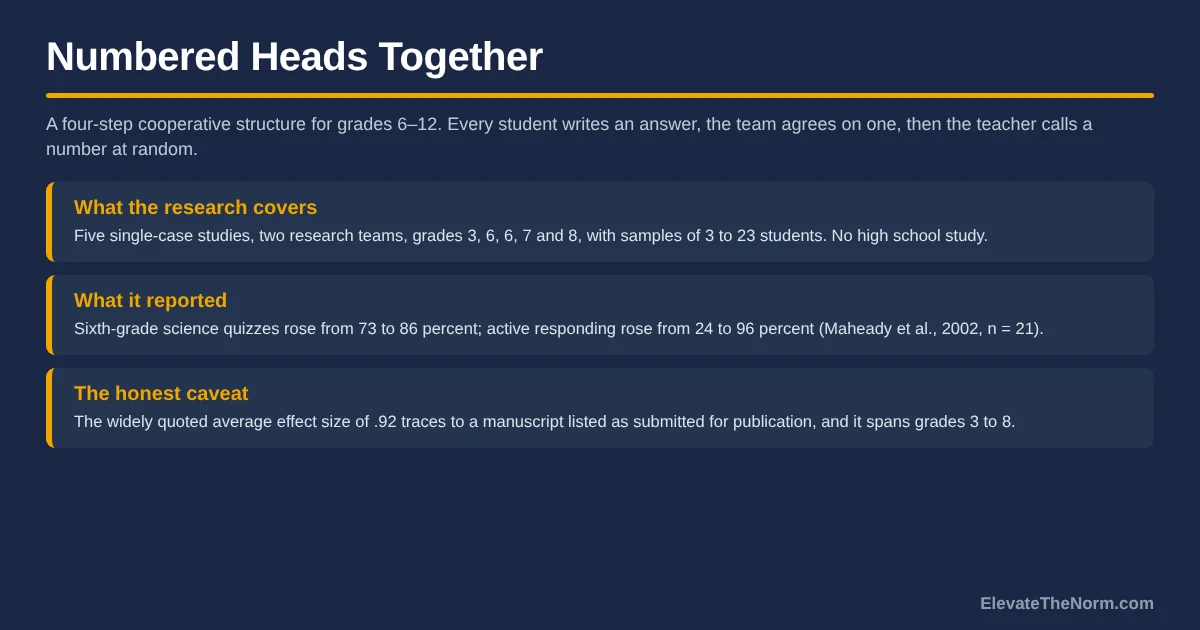
    Numbered heads together is a cooperative structure where students in numbered teams of four each write an answer, agree on a team answer, then wait for the teacher to call one number at random. Reported quiz gains run from 9 to 46 percentage points — across five small single-case studies, none of them in high school.

    Key Takeaways

    • The random call is the whole point. Nobody knows who will answer until after the team has agreed, so there is no way to volunteer out of it and no way to sit back and let the strongest student carry it.
    • The evidence is real, consistent and very small. Five single-case studies covering grades 3, 6, 6, 7 and 8, with samples of 3 to 23 students. Every one found gains. None was a randomised trial and none was in high school.
    • It was produced almost entirely by two research teams. The authors of the 2015 review say so plainly: “To date, empirical evidence has been collected primarily by two research teams” — and several of those authors wrote the studies the review summarises.
    • The effect size everyone quotes has a weak chain of custody. The figure of .92 comes from Kagan’s own magazine, averages seven comparisons across grades 3 to 8, and is cited in the research literature to a manuscript listed as submitted for publication.
    • The cooperative-learning research it leans on is about something slightly different. Slavin’s syntheses found that group goals plus individual accountability are what make group work raise achievement — but his individual accountability means a team reward based on each member’s own quiz score, which is not what a random call does.

    What is numbered heads together?

    Numbered heads together is a cooperative learning structure in which small mixed teams of four are numbered off, answer a question individually in writing, agree on one team answer, then find out which number the teacher has drawn at random to give it.

    It is a questioning routine with a built-in reason for every student to be ready.
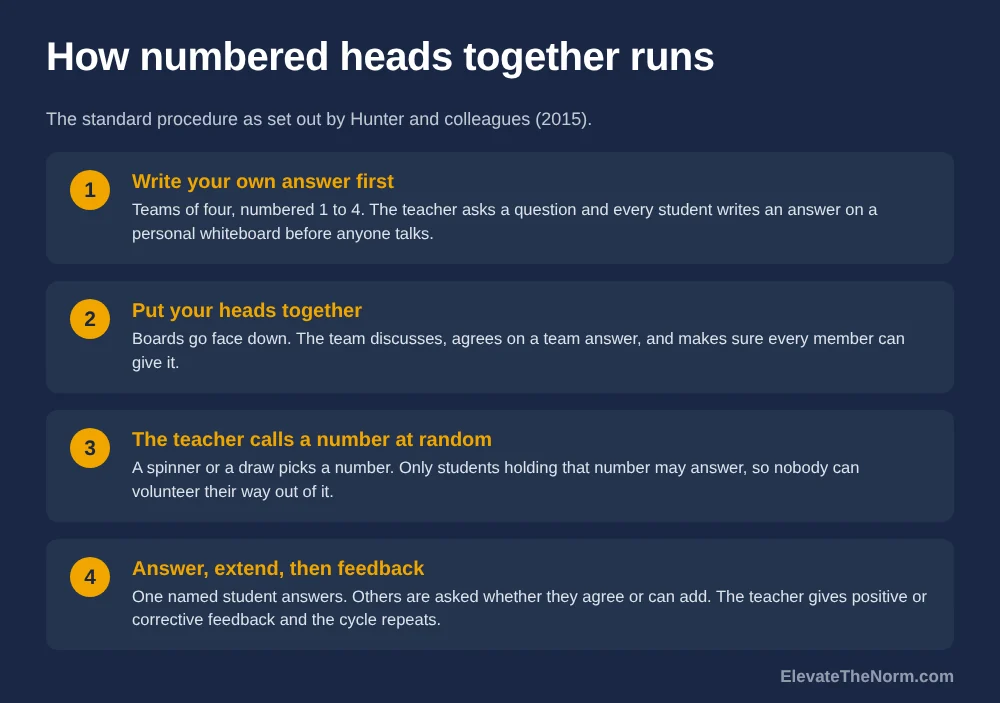
    Numbered graphic of the four steps of numbered heads together: write your own answer first, put your heads together, the teacher calls a number at random, then answer, extend and give feedback.
    The four steps of numbered heads together, following the standard procedure described by Hunter and colleagues in 2015.

    It belongs to the same family as the other structures on this site — think pair share, the jigsaw method, and peer tutoring — all of which sit under cooperative learning as the umbrella. What distinguishes this one is the delay. Students commit to an answer, then help each other, then discover who is accountable for saying it out loud. The order matters, and most classroom versions get it wrong.

    How do you run numbered heads together, step by step?

    The procedure set out by Hunter and colleagues runs in a repeating cycle of four moves. A full round on one question takes two or three minutes once students know the routine.

    1. Form small heterogeneous teams and number off. The review specifies teams “preferably with four members,” numbered 1 to 4. Heterogeneous means you build them, not the students.
    2. Give every student something to write on. The studies used a personal dry-erase board, a marker and a cloth. Paper works; the point is that each student produces an answer with their own hand.
    3. Ask the question, then make everyone answer it alone. Students write their own answer and turn the board face up in front of them before any discussion happens.
    4. Heads together. Boards go face down. The team discusses, settles on a team answer, and — this is the step that gets cut — makes sure every member can give it.
    5. Draw a number. A spinner, a deck of cards, a dice. Students holding that number stand or raise a hand, and the teacher picks one of them.
    6. Answer, then extend. The named student answers. The teacher then asks others whether they agree or have something to add, which keeps the rest of the room in the question.
    7. Feedback, recognition, reset. Positive or corrective feedback, recognition for the team’s effort, boards wiped, next question.

    The review publishes a 15-item observer checklist for watching the routine run over at least twenty minutes, which is a useful signal in itself: these are not loose suggestions, they are the conditions the studies tested.

    Does numbered heads together actually work?

    In every published study, yes — and the published studies are five in number, all small, all single-case designs, and all below grade 9. Quiz scores rose in all five and on-task behaviour rose in the four that measured it.
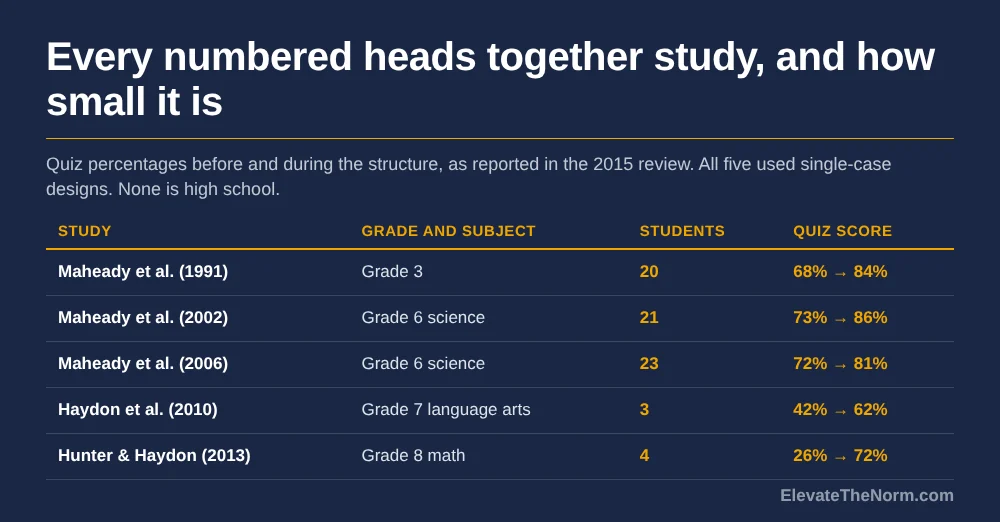
    Table of the five numbered heads together studies showing author and year, grade and subject, number of students from 3 to 23, and quiz percentages before and during the structure.
    Every numbered heads together study in the 2015 review, with its grade level, sample size and reported quiz change.
    StudyGrade and subjectStudentsQuiz scoreOn-task behaviour
    Maheady et al. (1991)Grade 3 social studies2068% → 84%39% → 71%
    Maheady et al. (2002)Grade 6 science2173% → 86%Active responding 24% → 96%
    Maheady et al. (2006)Grade 6 science2372% → 81%, and 89% with incentivesNot reported in the review’s table
    Haydon et al. (2010)Grade 7 language arts342% → 62%63% → 96%
    Hunter & Haydon (2013)Grade 8 mathematics426% → 72%48% → 86%

    The sixth-grade science results are the ones closest to a general secondary classroom. In the 2002 study, 21 students went from a 73 percent average under whole-group question and answer to 86 percent under the structure, and the proportion of students actively responding went from 24 percent to 96 percent. That second number is the more interesting one. It is not a claim about learning; it is a measurement of how many students in the room were doing anything at all.

    The two studies with the largest gains have the smallest samples. Haydon, Maheady and Hunter (2010), published in the Journal of Behavioral Education, ran with three students with disabilities in seventh-grade language arts. Hunter and Haydon (2013) ran with four students in a self-contained class for students with emotional and behavioural disorders. Those are real findings about real students and they are not estimates of what will happen in a class of 28.

    Why is the evidence base thinner than it looks?

    Because five single-case studies from two research teams, with no high school data and no randomised trial, is a thin base to carry a strategy that appears in every cooperative learning handbook. The authors of the review say this themselves.

    Their stated limitations are worth quoting in order. They write that “there is need for additional replications across geographic locations, age/grade levels” and settings; that “to date, empirical evidence has been collected primarily by two research teams”; and that longer durations and measures of generalisation and maintenance are needed. The review also lists Maheady and Hunter among its own authors, which does not make the findings wrong but does mean the field has not yet been checked by anyone outside it.

    Two of the five studies used the same sixth-grade science teacher in the same small urban district, a teacher with 27 to 28 years of experience. That is a strong implementation under the best possible conditions. It is not evidence about a second-year teacher with five preps.

    Then there is the number everyone repeats. Kagan’s own article reports “the average positive effect size for Kagan Structures was .92” and says the experiments examined grades 3 through 8. The 2015 review cites the same .92 figure and attributes it to a source its reference list describes as a manuscript submitted for publication. So the most quoted figure in this literature comes from a vendor’s magazine, averages seven comparisons drawn from four papers, spans elementary through middle school, and traces to something unpublished. It may well be about right. It is not a number to put in a slide deck without saying where it came from.

    Do you need an incentive or reward package?

    No. The review says the structure worked “with and without” behavioural incentives, and reports no clear difference between the two versions in the 2010 study. Incentives may add something, but the evidence does not make them a requirement.

    The one study that compared them directly, Maheady et al. (2006) with 23 sixth graders in science, reported quiz averages of 72 percent under existing practice, 81 percent under the plain structure, and 89 percent with a package of team points and certificates added. That looks like a real additional bump. The review’s own verdict is more cautious: future work should “tease out the relative contributions and costs and benefits of a behavioral incentive package.” If you are weighing it up, the costs side of that sentence is the part worth sitting with — points and certificates are a system you then have to maintain, and they change what the activity is about.

    How is it different from cold calling or think pair share?

    All three distribute participation; they differ in when the student finds out they are on the hook. Cold calling puts a student on the spot before they have rehearsed. Think pair share gives rehearsal without accountability. Numbered heads together gives rehearsal first, then accountability.

    RoutineWhen the student knows they might answerWhat they have before they speakMain weakness
    Cold callingThe moment their name is saidWhatever they had in their head alreadyCan feel like a trap if the class culture is not right
    Think pair shareUsually never — sharing is often volunteeredA rehearsed answer and a partner’s viewThe same students volunteer; the rest coast
    Numbered heads togetherAfter the team has agreed, never beforeTheir own written answer plus the team’sTakes longer per question and needs built teams
    JigsawThey always present; the role is assigned up frontExpertise on one piece onlyDepends on every expert group doing its job

    Put plainly: numbered heads together is what you use when you want the honest answer to “does this class understand it?” rather than “does anyone in this class understand it?” That is a different question from the one a show of hands answers, and it is the same question behind every decent check for understanding.

    What does cooperative-learning research say about why it should work?

    The standard justification is Robert Slavin’s: group work raises achievement when it combines a group goal with individual accountability, and mostly does not when it lacks either.

    His 1991 synthesis of more than 70 studies is blunt about it — “two elements must be present if cooperative learning is to be effective: group goals and individual accountability.”

    The numbers behind that sentence are stark. Slavin reports that 37 of 44 studies (84 percent) using both elements found significant positive achievement effects, against only 4 of 23 studies (17 percent) lacking them. His wider review of 99 studies of at least four weeks puts the median effect size at +.32 for methods with group rewards based on the sum of individual learning, against +.07 for methods using a single group product or no group reward at all.

    Here is where honesty costs the argument something. Slavin’s “individual accountability” is specific: a team reward calculated from each member’s own quiz score. He writes that the effect holds “if and only if the group rewards are based on the individual learning of all group members.” Numbered heads together does not do that. One student’s answer, drawn at random, stands in for the team. Slavin does mention structures in which “group members might be chosen at random to represent the group” — but in his version that student’s performance determines the reward, which is a harder and rarer arrangement than a teacher drawing a number to pick who speaks.

    So the Slavin research is supporting evidence by analogy, not direct support. He does also write that “carefully structuring the interactions among students in cooperative groups can also be effective, even in the absence of group rewards,” which is the closest thing in his work to a defence of structures like this one. Anyone who cites Slavin as proof that numbered heads together works has not read him carefully.

    Where does numbered heads together go wrong in grades 6–12?

    Four places, and three of them are the teacher quietly dropping a step. The structure is doing a specific job, and each shortcut removes the part that does it.
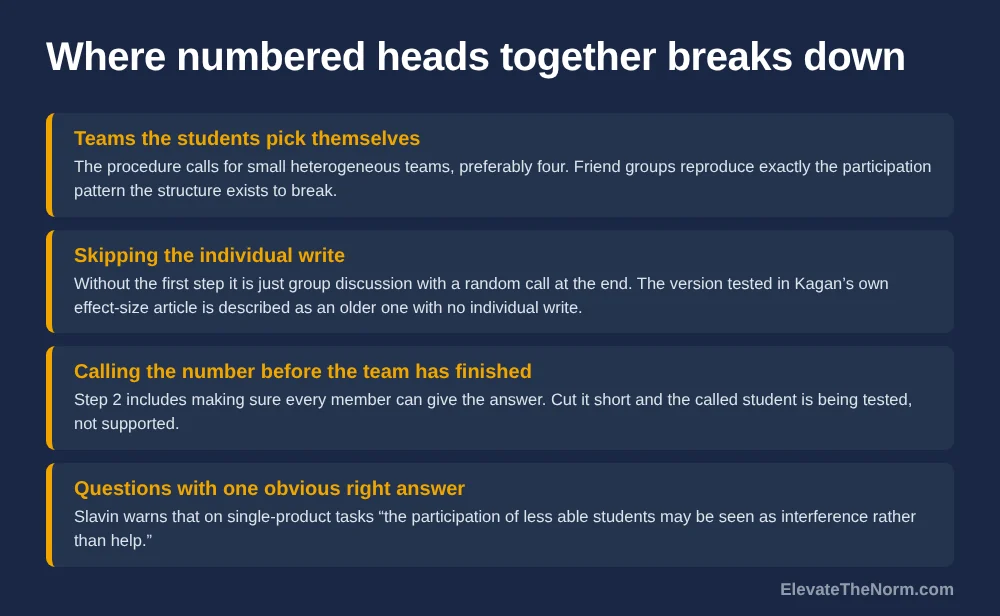
    Four panels listing common failure points: letting students pick their own teams, skipping the individual write, calling the number too early, and using questions with one obvious answer.
    Four ways numbered heads together stops working in a grades 6–12 classroom.
    • Students pick their own teams. The procedure calls for small heterogeneous teams you build. Friend groups reproduce exactly the participation pattern the structure exists to break, and they put the quiet student with the other quiet students.
    • The individual write gets skipped. Without it the routine is group discussion with a random call bolted on, and the student who was not thinking has nothing of their own to fall back on. Notably, the version tested in Kagan’s own effect-size article is described there as an older one without an individual write.
    • The number is drawn before the team has finished. Step four includes making sure every member can give the answer. Cut that short and the called student is being tested rather than supported, which is the thing this structure was designed not to do.
    • The questions have one obvious right answer. Slavin warns that on single-product tasks “the participation of less able students may be seen as interference rather than help.” If the answer is a date or a definition, the fastest student says it and the team nods. Questions with reasoning in them are the ones worth the three minutes.
    • It becomes the whole lesson. The studies ran it in sessions of 30 to 42 minutes as the questioning portion of a lesson, not as a replacement for teaching. There is nothing in this research that says a period of whiteboard rounds is a good period.

    What about the student who freezes when the number comes up?

    Plan for them before you start, not in the moment. The structure is built so nobody is caught unprepared, but preparation is not the same thing as being willing to speak in front of 28 people.

    The sensible accommodations do not break anything. A student can read their board rather than speak from memory. A student can be allowed to hold up the team’s board instead of narrating the answer. The teacher can pick a different student from among those holding the drawn number, which the standard procedure already allows — everyone with that number raises a hand and the teacher chooses one of them. And where a student has a plan in place for oral participation, that plan governs; a classroom routine is not a reason to override it. None of that removes the accountability, because the student still had to have an answer ready.

    What does break the structure is quietly never drawing the number of the student you are worried about. Students work that out in about two rounds, and the moment they do, the routine has told them they are not expected to be able to answer. That is a much heavier message than being asked a question.

    Clay’s take: a good structure with an overstated research record

    Two things are true at once here, and the training materials only ever tell you the first one. The structure itself is well designed, and it solves a problem every secondary teacher actually has: a show of hands tells you nothing.

    It solves it without ambushing anybody, too. Writing your own answer, then helping your team, then finding out you are the one who has to say it — that sequence respects students. It gives them a fair shot before it holds them responsible, which is the right order.

    The second thing is that the evidence behind it is five small studies from two research teams, topping out at eighth grade, with a headline effect size traced to an unpublished manuscript. That is not a reason to avoid it. Plenty of sensible classroom practice has less behind it than that. It is a reason to stop calling it research-proven, and it is a reason to watch what happens in your own room rather than assuming the 86 percent transfers.

    What I would want to know before committing a unit to it: do the questions actually need four people, or am I running an elaborate routine to get a one-word answer? That is the question that decides whether this is good teaching or theatre, and no study is going to answer it for you.

    What to do next week

    Pick one lesson with three or four questions in it that genuinely need reasoning, not recall. Build the teams yourself, four to a team, mixed. Run the full four steps on those questions only, and draw the number with something visibly random.

    Keep the individual write and the check that everyone on the team can give the answer. Those are the two steps that get dropped first and they are the two doing the work.

    Then measure the thing the studies measured that is easiest to see: how many students in the room were doing something during the question. If the honest answer is a lot more than usual, it is worth keeping. If students are waiting for the number and then switching off, one of the four steps has gone missing, and it is almost always the write.

    Frequently Asked Questions

    What is numbered heads together?

    It is a cooperative learning structure in which students sit in numbered teams of about four, answer a question individually in writing, agree on a team answer, make sure every member can give it, and then wait for the teacher to draw a number at random to decide who answers. The random call is what makes every student prepare.

    How long does one round take?

    Two to three minutes per question once students know the routine. The published studies ran it in sessions of 30 to 42 minutes as the questioning part of a lesson, covering several questions, rather than as a whole-period activity. Budget more for the first few rounds while students learn the sequence.

    Does numbered heads together work in high school?

    Nobody has published a high school study. The five studies in the 2015 review cover grades 3, 6, 6, 7 and 8, with samples of 3 to 23 students. The sixth-grade science results are the closest thing to a general secondary classroom. Treat high school use as reasonable and untested rather than evidence-based.

    Do you need team points or rewards for it to work?

    No. The review reports the structure worked with and without behavioural incentives and found no clear difference between the two versions in one study. One sixth-grade study did report 81 percent under the plain structure against 89 percent with team points and certificates added, so incentives may help, but they are not a requirement.

    How is it different from think pair share?

    Think pair share gives students rehearsal but usually lets them volunteer, so the same students answer. Numbered heads together gives the same rehearsal and then removes the choice by drawing a number. The accountability arrives after the preparation, not instead of it.

    Is there strong research evidence for numbered heads together?

    There is consistent evidence and very little of it. Five single-case studies, all finding gains, produced primarily by two research teams, none in high school and none randomised. The widely quoted .92 average effect size comes from the publisher’s own magazine and is traced in the literature to a manuscript submitted for publication.

    What do you do about a student who will not speak in front of the class?

    Decide in advance, not mid-round. Let them read from their board, hold up the team’s answer, or be one of several students holding the drawn number from whom the teacher picks. Where a student has a plan covering oral participation, follow it. What does not work is silently never drawing their number, because students notice and read it as low expectations.

    What kind of questions suit it best?

    Questions with reasoning in them, where four students have something to work out together. Recall questions waste the structure, because the fastest student supplies the answer and the team simply agrees. Slavin notes that on single-answer tasks weaker students’ contributions can be treated as interference rather than help.

    Sources

    • Hunter, W. C., Maheady, L., Jasper, A. D., Williamson, R. L., Murley, R. C., & Stratton, E. Numbered Heads Together as a Tier 1 Instructional Strategy in Multitiered Systems of Support. Education and Treatment of Children, 38(3), 345–362 (2015). Full text (PDF). Source of the step-by-step procedure, the 15-item fidelity checklist, every study in the comparison table with its grade level and sample size, the statement that evidence has been collected primarily by two research teams, the call for replications across age and grade levels, and the note that the relative contribution of a behavioural incentive package is still to be determined.
    • Haydon, T., Maheady, L., & Hunter, W. Effects of Numbered Heads Together on the Daily Quiz Scores and On-Task Behavior of Students with Disabilities. Journal of Behavioral Education, 19(3), 222–238 (2010). doi:10.1007/s10864-010-9108-3. ERIC record with abstract. Source of the three-student seventh-grade language arts study and the finding that both versions of the structure raised on-task behaviour and daily quiz scores. The numerical results quoted here are as reported in the 2015 review; the ERIC record itself carries no figures.
    • Slavin, R. E. Synthesis of Research on Cooperative Learning. Educational Leadership, February 1991. Article (PDF). Source of the statement that two elements must be present — group goals and individual accountability — the counts of 37 of 44 and 4 of 23 studies, the finding that effects appear at all grade levels 2–12 while research has more often taken place in grades 3–9 than 10–12, and the warning about single-product tasks.
    • Slavin, R. E. Research on Cooperative Learning and Achievement: What We Know, What We Need to Know. Center for Research on the Education of Students Placed at Risk, Johns Hopkins University. Working-paper version (PDF). Source of the median effect sizes of +.32 and +.07, the review of 99 studies of at least four weeks, the “if and only if” condition on group rewards, and the statement that structuring interactions can be effective even without group rewards. Note that the copy read for this article is a Johns Hopkins working-paper version dated October 1995 and adapted from Slavin (1992); the figures also appear in the published 1996 review, which was not accessible.
    • Kagan, S. Effect Size Reveals the Impact of Kagan Structures and Cooperative Learning. Kagan Online Magazine, Winter 2014. Article. Source of the .92 average effect size for Kagan Structures, the statement that the experiments examined grades 3 through 8, and the description of the tested version as an older one without an individual write. This is the publisher’s own site and it sells the training and materials described, which is why the figure is reported here with its provenance attached.
    About Clay Shumate

    Clay Shumate is a certified secondary Social Studies teacher in the public schools of West Alabama, with seven years of classroom experience, a B.A. in History, and an M.Ed. in Secondary Education. He writes about project-based learning, student responsibility, respect, and practical ways to hold young people to a higher standard while giving them room to learn from mistakes. He is a member of the Society of Professional Journalists and writes to its Code of Ethics; this site’s editorial standards and corrections policy are published in full. More about Clay.

  • Classroom Escape Room: How to Build One for Grades 6–12 Without Losing a Week

    Classroom Escape Room: How to Build One for Grades 6–12 Without Losing a Week

    By Clay Shumate

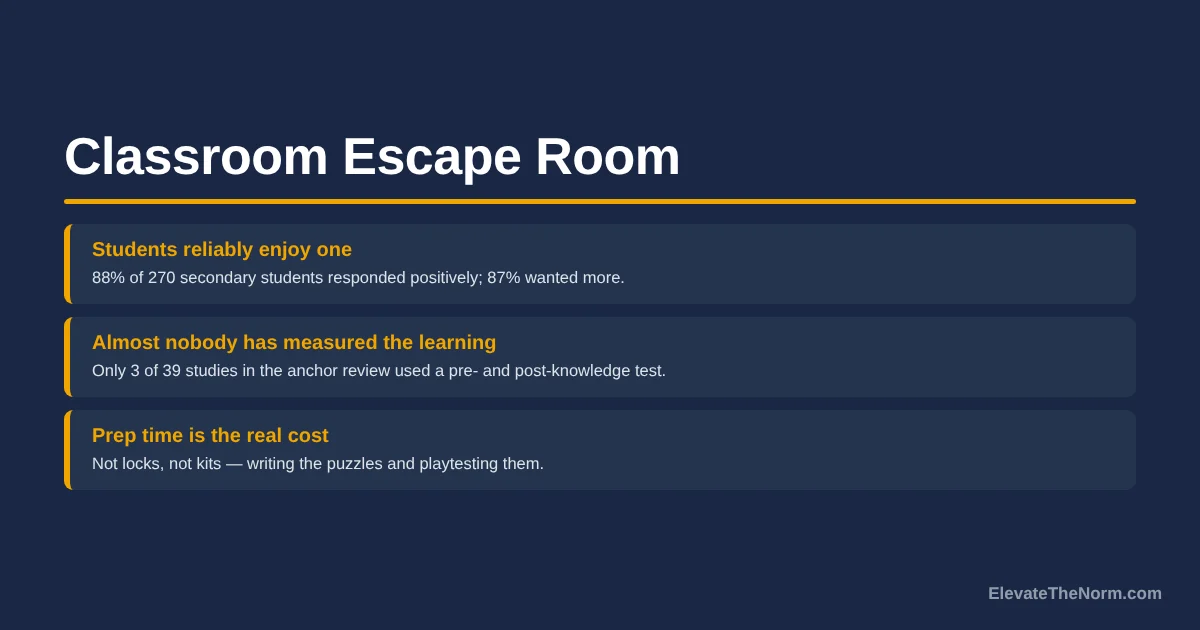
    A classroom escape room is a timed activity where student teams solve content problems to open a sequence of locks, physical or digital. Students reliably enjoy one. The measured learning evidence is thin and wildly inconsistent, and the real cost is teacher prep time. Build one well, debrief it hard, and do not run it every week.

    Key Takeaways

    • Almost nobody has measured whether a classroom escape room teaches anything. The largest systematic review screened 39 studies and found only three that gave students a pre- and post-knowledge test. Thirty-one of the 39 were in higher education; three were in secondary schools.
    • The pooled effect looks big and means less than it looks. A 2024 meta-analysis of 22 studies put knowledge gains at g = 0.86 with heterogeneity of I² = 94.69 percent. That much inconsistency means the average does not predict your room.
    • Students enjoy it and often cannot tell you what they learned. Among 270 secondary students, 88 percent were positive about the experience, and most interviewed groups could not describe the content they had covered.
    • Prep time is the binding constraint, not money. A full escape room runs with no locks and no kit. What you cannot avoid is writing the puzzles and playtesting them — the barrier teachers name most often — and the debrief, which is the first thing cut when the bell is close.

    What Is a Classroom Escape Room?

    A classroom escape room is a timed activity in which small teams solve a sequence of content-based puzzles, each yielding a code that opens the next lock, until the final lock opens. Nobody is locked in anything. The locks are the scoring mechanism.

    They are also what makes the format honest: a team either has the right answer or the box stays shut. No partial credit, no bluffing.

    Three things separate it from the rest of the activity drawer. It is a designed one-off rather than a routine, built once for a specific unit. The sequence is locked, so teams cannot skip a puzzle they cannot solve — a strength for rigour and a serious problem for pacing. And every student should be working the whole time, or the design has failed.

    If what you want is something repeatable for the Friday before a test, you want a different tool: the two review formats broken down here are built for that job and run on a fraction of the prep. This article is about the event version.

    One note first, because it is the first question an administrator asks: the name is misleading and worth correcting out loud. Nothing here confines a student. Doors stay unobstructed, nothing locks with a person inside it, and the only things that lock are boxes and envelopes. Say so before you run it, because “we did an escape room in class” sounds like something it is not.

    Do Classroom Escape Rooms Actually Improve Learning?

    Almost nobody has checked properly, and the studies that did check mostly found nothing. Escape rooms are one of the most enthusiastically adopted classroom formats of the past decade and one of the least rigorously evaluated.

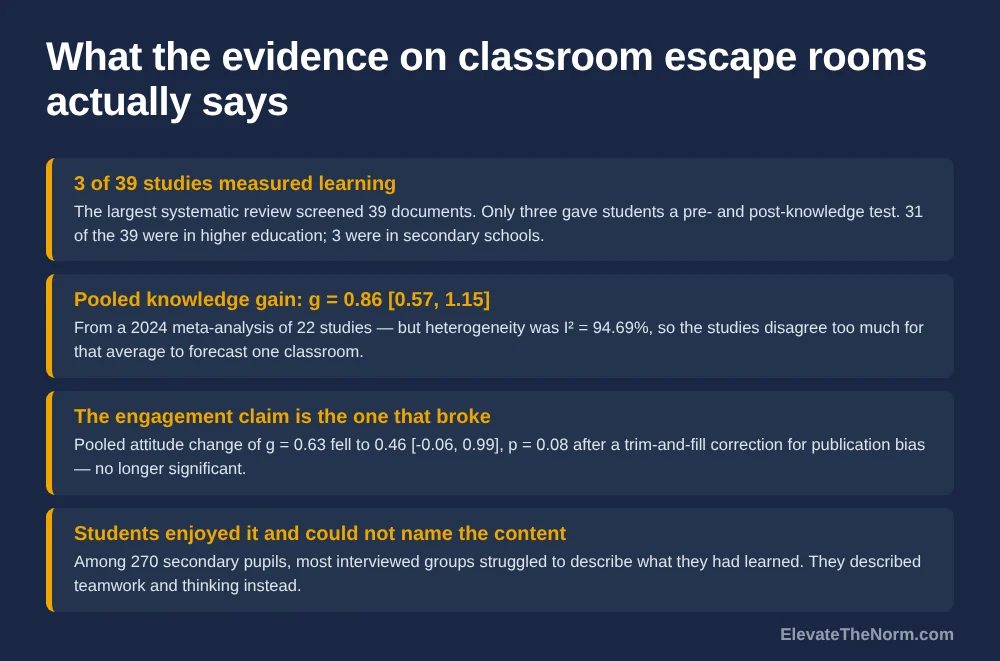
    Graphic listing four findings on classroom escape room evidence: only 3 of 39 studies in the largest systematic review measured learning with a pre- and post-knowledge test, and 31 of 39 were in higher education; a 2024 meta-analysis of 22 studies found pooled knowledge gains of g equals 0.86 with a confidence interval of 0.57 to 1.15 but heterogeneity of I squared equals 94.69 percent; pooled attitude change of g equals 0.63 fell to 0.46 and became non-significant after a trim-and-fill correction; and among 270 secondary pupils most interviewed groups could not describe the content they had learned.

    The anchor study is a systematic review by Veldkamp and colleagues in Educational Research Review, which screened 39 documents on escape rooms in education. Only three of the 39 measured achievement against the learning goals with a pre- and post-knowledge test. One compared an escape room with a regular case activity in 19 students: 18 of 19 preferred the escape room, only 11 thought they learned better from it, and it produced no measurable gain or drop. One found no significant pre/post result while 96 percent of its 51 students said the debrief improved their learning. One found scores rising from 56 to 81 percent — but a week passed between the test and the game, and those authors concluded that “the knowledge increase cannot be solely attributed to the game.”

    None used a randomised design. The review’s verdict was that one study showed a disputable improvement in content knowledge while most students experienced learning. Those are different claims about different things.

    A 2024 meta-analysis takes a more favourable view and is worth reading alongside it. Kim, Na, Zhang and Bai pooled 22 studies and reported knowledge gains of g = 0.86, 95% CI [0.57, 1.15]. Two numbers in the same paper complicate that:

    • Heterogeneity was I² = 94.69 percent. Nearly all the variation between studies is real difference, not sampling noise. An average drawn from results that disagree that violently does not forecast your classroom.
    • The attitude effect did not survive a correction for publication bias. Pooled attitude change was g = 0.63, but the funnel plot was asymmetric and a trim-and-fill correction dropped it to 0.46, 95% CI [-0.06, 0.99], p = 0.08 — no longer statistically significant.

    That second point is the opposite of what most people assume: the claim everybody is confident about — students love it — is the one that weakened once the analysis corrected for missing studies. The same paper found no significant differences by escape room type, subject or educational level, but its level categories were K–12, college and adults, so secondary students sit pooled with elementary ones. That is not evidence the format works equally well with a middle school class.

    Clay’s read, as a grades 6–12 teacher: enough evidence to justify building one, nowhere near enough to justify building a unit around one. Treat it as an expensive consolidation activity whose job is making students retrieve content under pressure, and judge it by what they can do the next day.

    Why Do Students Love a Classroom Escape Room and Still Not Remember the Content?

    Because the puzzle is memorable and the content is the thing students pass through to reach the puzzle. Students remember what they spent attention on, and in a badly structured escape room that is the padlock, not the causes of the war.

    The clearest evidence comes from the one large study run with secondary students rather than undergraduates. Veldkamp and colleagues studied a national escape room challenge with 50 teachers and 270 seventh-grade biology pupils, average age 12. Eighty-eight percent responded positively and 87 percent wanted more escape rooms. And:

    • Sixteen interviewed groups reported learning or strengthening knowledge, but most struggled to describe the biology content they had actually learned. Their descriptions focused on teamwork and thinking skills.
    • Observers recorded frustration in 9 percent of groups when students got stuck.
    • Only 3 of 14 observed teachers discussed teamwork in the debrief at all.

    That is the whole problem in one study. The experience lands. The content does not attach to it by itself.

    The fix is the debrief. In the systematic review, 25 of the 39 studies included one, ranging from five minutes to two hours, and the reviewers concluded that implementing a debrief “seems crucial.” A debrief is not “good job everyone, pack up” — it is a structured return to the content: which puzzle mapped to which concept, which answer your team got wrong first, what the correct reasoning was. One published workshop structure ran 20 minutes of introduction, 60 minutes of play and 40 minutes of debrief, which is more debrief than most teachers would ever plan.

    Do not grade it for accuracy. The locks already give students immediate feedback, which is the useful part, and attaching a grade turns a consolidation activity into a timed high-stakes test — exactly the combination that penalises the slowest reader in the room for something other than knowing the content. Grade participation if your gradebook demands an entry. Keep the diagnostic information for yourself.

    How Long Does It Take to Build a Classroom Escape Room?

    Longer than you expect, and the cost sits almost entirely in writing and testing puzzles rather than in buying anything. Teacher time is the barrier teachers themselves name most often, and it is why most classroom escape rooms get built once and never again.

    In the study of 270 secondary students, time was the dominant constraint teachers reported. They described development as time-consuming relative to the effective time it bought with students, and every time-related condition teachers raised beforehand reappeared afterwards as a real barrier, in 71 percent of cases. Finances, materials and finding a suitable room were named too, but well behind time.

    The expensive, unavoidable step is playtesting. The systematic review called defining a realistic playtime through playtests crucial, and it is the step everybody skips. In one project where senior high school students aged 17 to 18 designed eight escape rooms themselves, teams were expected to test each room at least ten times. You are not going to playtest ten times before second period. Playtest once, on somebody who is not you, because the first run always reveals that one puzzle is impossible and another takes eleven seconds.

    Two honest ways to cut the cost: build four puzzles, not eight — four well-written ones with a clean lock sequence beat eight thin ones and halve the testing load — and reuse the shell, change the content. The structure is reusable across units; the puzzles are what you rewrite, so the second escape room costs a fraction of the first.

    And one thing worth saying plainly: if your real reason for building one is to check what students know before a test, there are far cheaper instruments. A page of formative checks that fit a real week will tell you more about the class for a twentieth of the preparation. Build the escape room because the event is worth something on its own, not as an expensive exit ticket.

    Do You Need to Buy Locks for a Classroom Escape Room?

    No. A classroom escape room needs a way to verify an answer and refuse a wrong one, and that can be a padlock, a digital form that rejects an incorrect code, or an envelope a student cannot open without saying the code to you. Physical locks buy atmosphere, not learning.

    The commercial route is priced per classroom. Breakout EDU, the best-known vendor, lists its Single Classroom plan at a starting price of $99 per year for up to one educator with access starting at 60 students, and its School or District plan at a starting price of $1,499 per year. That mainly buys a library of ready-made games, which is a genuine saving on the expensive part — writing puzzles. It is not a requirement.

    Lock typeCostBuild timeGrade fitBest forMain drawback
    Physical locks and a boxOne-off purchase of padlocks and a hasp, or from $99/year per classroom for a commercial kit and game libraryHighest — build, test, and reset between every classWorks across 6–12; novelty lands hardest in middle schoolA showpiece event you repeat yearlyResetting between periods, and one broken lock stops a team dead
    Digital locks (a form that rejects wrong codes)Free with tools your school already hasMedium — no reset at all between classesStrongest fit for high schoolRunning the same room across five periodsEverything happens on a screen, which removes most of the physical energy
    Paper-only, no locksFreeLowestAny, including classes where devices are unreliableA first attempt, or a 50-minute periodYou are the lock, so you verify every code and cannot watch the room

    A paper-only build is the right first attempt for most teachers. Teams bring you a code, you check it and hand over the next envelope. It costs nothing, it cannot break, and it tells you whether your puzzles work before you spend money on hardware.

    How Do You Build a Classroom Escape Room, Step by Step?

    Start from the content you want retrieved and work outwards to the puzzles, never the reverse. The common failure is designing a clever puzzle first and bolting curriculum onto it, which produces an activity students enjoy and learn nothing from.

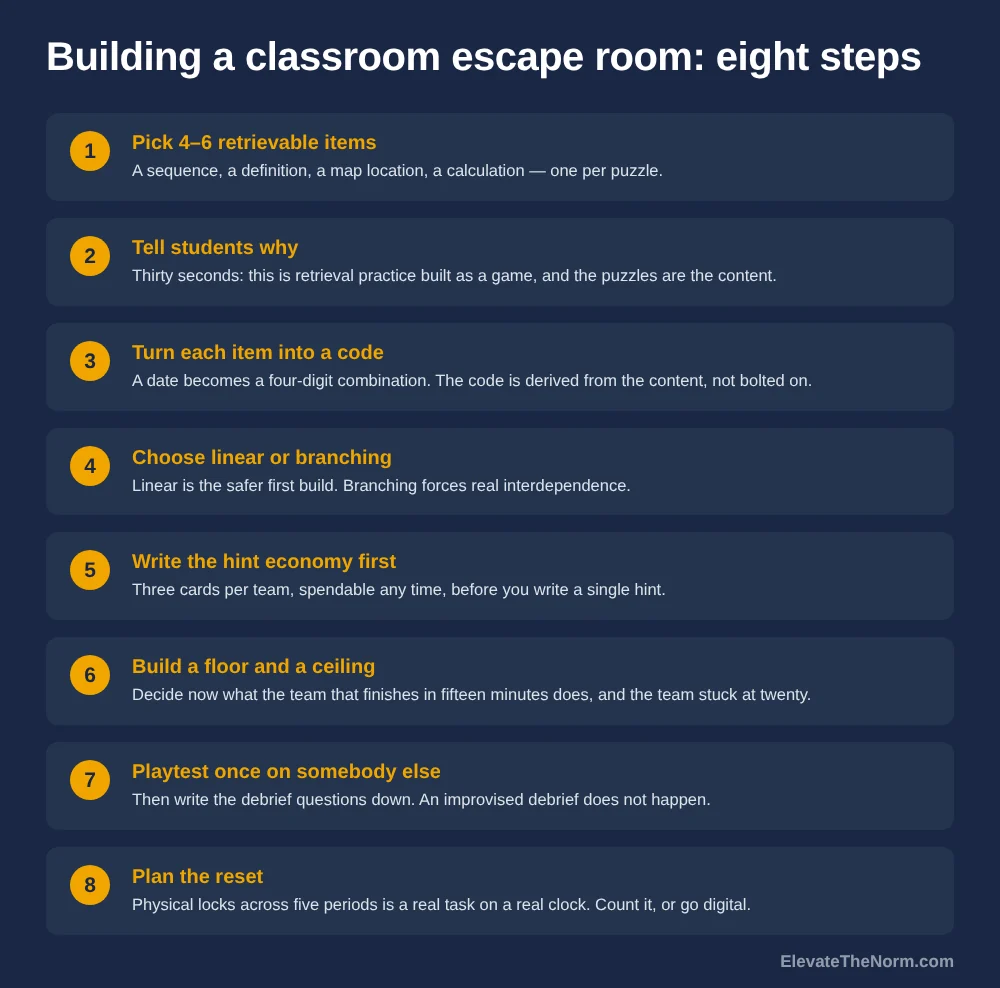
    Numbered graphic showing eight steps for building a classroom escape room: pick four to six retrievable items; tell students why you are running it; turn each item into a code derived from the content; choose a linear or branching structure; write the hint economy before writing hints; build in a floor and a ceiling for fast and stuck teams; playtest once on somebody else and write the debrief questions down; and plan the reset between class periods.
    1. Pick four to six things students must be able to retrieve. Not topics — specific retrievable items: a sequence, a definition, a map location, a calculation, a document’s author. These become your puzzles, one each.
    2. Tell students what the activity is and why you are running it. Thirty seconds at the start: this is a retrieval exercise built as a game, the puzzles are the content, and pulling an answer out of your head is what makes it stick. Students in grades 6–12 are old enough to be told the method being used on them, and a class that knows the content is the point attends to the content instead of the padlock.
    3. Turn each item into a code. A date becomes a four-digit combination, three events in order become a three-letter sequence, a map location becomes a direction lock. The code must be derived from the content, not attached to it arbitrarily.
    4. Choose your structure. A linear chain is easier to follow and needs less guidance from you. A branching structure, where several puzzles must all be solved before a final lock opens, forces real interdependence because no single student can run the whole chain. Linear is the safer first build; branching is the better activity.
    5. Write a hint economy before you write the hints. Decide how many hints each team gets, what they cost and how a team asks. Three cards per team, spendable any time, is a workable default. Without the rule you spend the period rescuing whoever shouts loudest.
    6. Build in a floor and a ceiling. Decide what a team that finishes in fifteen minutes does next, and what happens to a team stuck on puzzle two at twenty minutes. Both will happen in the same period.
    7. Playtest once, on somebody who is not you, then write the debrief questions down before the day. If the debrief is improvised at the bell, it will not happen.
    8. Plan the reset. With physical locks across multiple periods, reset is a real task on a real clock. Count it in your prep time, or go digital.

    Teams of four to six is what the national challenge used and it is about right. Below four, a weak link stalls the team; above six, students disappear. If you want the groups to function rather than simply exist, the five conditions that separate cooperative learning from furniture arrangement apply here exactly as anywhere else.

    How Do You Stop One Team Finishing in Four Minutes and Another Never Getting Out?

    Design for the spread before the day, because it is guaranteed. Give fast teams a second-layer task that is genuinely harder rather than a reward, and give stuck teams a priced hint they can choose to spend rather than waiting to be rescued.

    The failure to avoid is ending the activity when the first team wins. In the national challenge studied with 270 students, the game ended when the first team opened the vault — so every other team’s experience was terminated mid-thought, and the slowest team’s last memory of the content is failing at it in public. Let every team finish, or set a hard stop that applies to everyone equally and announce it at the start.

    • A second-layer task for finishers. Have them write next year’s fifth puzzle, with the answer key. That is harder than solving one and it is not busywork.
    • Priced hints, not pity hints. Three cards per team. Spending one is a legitimate strategic choice rather than an admission of failure, which is what makes a stuck team willing to use it.
    • An escalating ladder. First hint narrows the content, second names the concept, third gives the mechanism. Never give the code.
    • A floor, delivered quietly. At twenty minutes, any team still on puzzle one gets the first code outright — handed over at the table, not announced from the front, because a rescue announced to everybody is just a slower way of telling a team they lost.

    One caution from the research: the systematic review found that sequential puzzle structures do not align well with genuinely collaborative goals, because a chain can be solved by one capable student while the rest watch. If you want all hands working, parallel puzzles converging on a final lock do that work — the structure carries the interdependence, not your instructions.

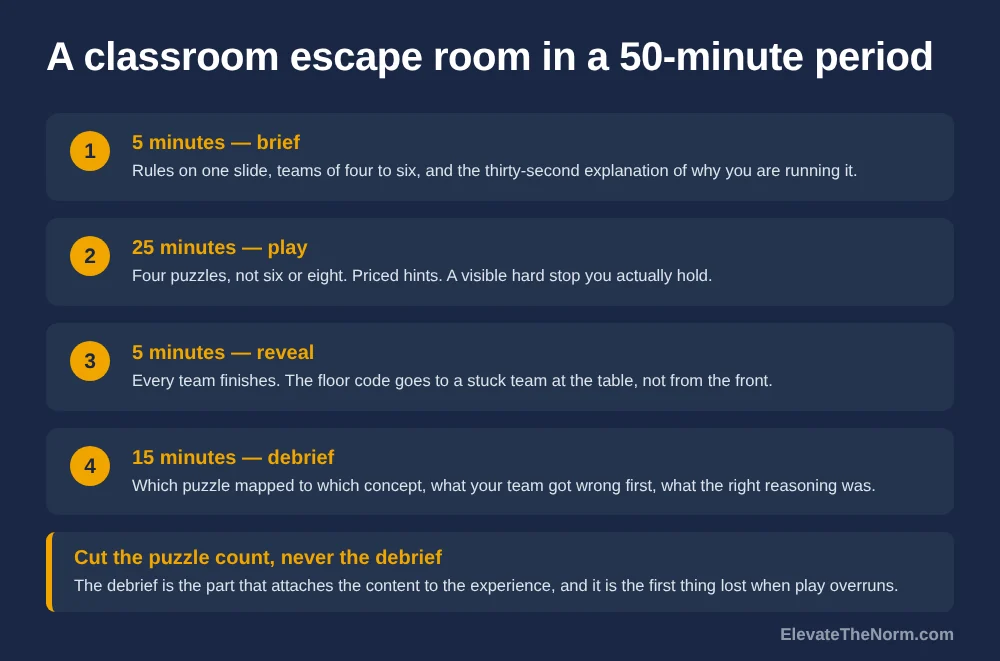
    Graphic showing a 50-minute classroom escape room schedule: five minutes to brief with rules on one slide and teams of four to six; twenty-five minutes of play with four puzzles and priced hints; five minutes for the reveal, with the floor code handed to a stuck team at the table; and fifteen minutes to debrief. A closing note says to cut the puzzle count, never the debrief.

    In a 50-minute period, cut the puzzle count and never the debrief. A workable split is five minutes to brief, twenty-five to play, five for the reveal and fifteen to debrief, which makes four puzzles the honest maximum. The national challenge ran six connected puzzles in 40 minutes, but that was a ready-made, heavily tested game. Two things go wrong in a short period, always the same two: the brief overruns because the rules were not written down, and the debrief gets eaten because play overran. Put the rules on one slide and hold a visible hard stop. If you want the energy without the build, a recurring format beats an event — the 25 short management games catalogued here are aimed at routines rather than content and cost almost no prep.

    What About Students Who Freeze Under a Countdown?

    A visible timer and a competitive puzzle in front of peers is a genuinely different activity for a student who reads slowly, processes carefully, or experiences test anxiety. Plan for that student at design time, because this format concentrates exactly the pressures that disadvantage them.

    The direct evidence on time pressure is suggestive rather than settled, and it is not drawn from teenagers. A 2023 experiment with 211 adults aged 18 to 40 learning unfamiliar times tables found that participants in the timed condition reported higher state anxiety after every session and were less accurate on the immediate test than the untimed group. Those were adults doing arithmetic online, so a secondary teacher reading across to a classroom escape room is extrapolating and should say so. The directional point still holds: time pressure is not a free source of energy.

    • Reduce the reading load. Long puzzle text turns a content assessment into a reading-speed assessment. Keep prompts short and put the difficulty in the thinking.
    • Give the timer a floor, not a cliff. “Twenty-five minutes, and every team finishes” is a different instruction from “first team out wins.”
    • Make hints visibly normal. If the strongest team spends a card early, nobody else has to be embarrassed about it.
    • Give every student a job. One reader, one recorder, one code-tester, one checker. A student who cannot push to the front still has a defined contribution, and a genuine quiet role — running the hint desk, keeping time, verifying codes — is real work inside the activity for a student for whom the scrum is intolerable.

    None of that lowers the standard. It removes a barrier that has nothing to do with whether the student knows the content, which is the logic behind every other differentiation move that does not require five lesson plans.

    Is a Classroom Escape Room Worth It, and What Should You Do Next?

    Once or twice a year, for a unit that genuinely rewards retrieval under pressure, yes. As a regular instructional strategy, no — the build cost is too high and the measured learning evidence too weak to justify the hours.

    The honest case for building one anyway: students in the one substantial secondary study reported needing to think harder and reported feeling autonomy and mastery, which is worth something even with content gains unproven. A well-designed escape room also produces assessment data that is hard to get any other way — you watch which concept each team stalls on, live, which is more diagnostic than a quiz score. Against that sits the evidence base already described, and the fact that teachers consistently report the build takes more time than it returns.

    For anyone deciding this at building or district level: the evidence does not support a district-wide purchase or a mandate. Fund a licence where teachers are already asking, and leave it optional. There is also a quiet equity problem in a format whose main input is unpaid prep time — it will always be easier for the teacher with one planning period than for the teacher with four sections and a duty.

    So pick one unit. Write down four things students must be able to retrieve from it, turn each into a four-digit or four-letter code, and build the paper-only version with envelopes instead of locks. Write your three debrief questions before the day and playtest it once on somebody who is not you.

    Then make the check specific rather than a feeling: a five-item retrieval quiz the next day, on the four things the puzzles were built from, scored against what the same class usually does on a comparable unit. That is a low bar and a real one, and it is the only way to find out whether the period bought learning or bought enthusiasm. If it worked, buy the locks for version two. If it did not, you spent a weekend and no money, and the review formats that run on five minutes of prep are still there.

    Sources

    • Veldkamp, A., van de Grint, L., Knippels, M.-C. P. J., & van Joolingen, W. R. (2020). “Escape education: A systematic review on escape rooms in education.” Educational Research Review, 31, 100364. Veldkamp and colleagues (2020). Source of the 39 included documents; the three studies measuring achievement by pre- and post-test and their individual results; the 31-of-39 higher-education and 3-of-39 secondary split; the debrief count of 25 of 39 and the “seems crucial” conclusion; the playtest recommendation; and the finding on sequential structures and collaborative goals. Read in full.
    • Veldkamp, A., Knippels, M.-C. P. J., & van Joolingen, W. R. (2021). “Beyond the Early Adopters: Escape Rooms in Science Education.” Frontiers in Education, 6, 622860. Veldkamp, Knippels and van Joolingen (2021). Source of the 50 teachers and 270 pupils; the 88 percent positive and 87 percent wanting more figures; the finding that most interviewed groups could not describe the content learned; frustration observed in 9 percent of groups; teams of four to six with six puzzles in 40 minutes; the game ending when the first team opened the vault; 3 of 14 teachers debriefing teamwork; and time as the dominant barrier at 71 percent. Population is Dutch seventh-grade biology pupils, average age 12. Read in full.
    • Kim, C., Na, H., Zhang, N., & Bai, C. (2024). “Escape rooms for education: A meta-analysis.” International Journal of Instruction, 17(4), 219–234. Kim, Na, Zhang and Bai (2024). Source of the 22 included studies; knowledge gains of g = 0.86 [0.57, 1.15] with I² = 94.69 percent; attitude change of g = 0.63 reduced to 0.46 [-0.06, 0.99] at p = 0.08 after trim-and-fill; and the non-significant moderation by escape room type, subject and educational level. Read in full.
    • Jazbutis, O. R., Wiseheart, M., Radvansky, G. A., & McNeil, N. M. (2023). “Distributed practice and time pressure interact to affect learning and retention of arithmetic facts.” Journal of Numerical Cognition, 9(2), 302–326. Jazbutis and colleagues (2023). Source of the finding that timed participants reported higher state anxiety after every session and were less accurate on the immediate test. Participants were 211 adults aged 18 to 40 learning arithmetic online, not secondary students; cited as directional evidence and labelled as such in the body. Read in full.
    • Rawlinson, R. E., & Whitton, N. (2024). “Escape Rooms as Tools for Learning Through Failure.” The Electronic Journal of e-Learning, 22(4), 19–29. Rawlinson and Whitton (2024). Source of the 40 senior high school students aged 17 to 18 who designed eight escape rooms, the expectation that teams test each room at least ten times, and the 20/60/40-minute workshop structure. A qualitative case study with no control group and self-reported outcomes; used for design guidance only. Read in full.
    • Breakout EDU. “Pricing.” breakoutedu.com/pricing. The seller’s own pricing page and the source of the Single Classroom plan starting at $99 per year for up to one educator with access starting at 60 students, and the School or District plan starting at $1,499 per year. Prices change; check the page.

    What is a classroom escape room?

    A classroom escape room is a timed activity in which student teams solve content-based puzzles to open a sequence of locks, physical or digital, until a final box opens. Nothing confines a student and no door is blocked. The locks simply verify answers: a team either has the right code or the box stays shut, which removes partial credit and guessing.

    Do classroom escape rooms actually improve learning?

    The evidence is thin. The largest systematic review screened 39 studies and found only three that measured achievement with a pre- and post-test, and those three produced no gain, no significant result, and one gain the authors themselves discounted. A 2024 meta-analysis of 22 studies reported knowledge gains of g = 0.86, but with 94.69 percent heterogeneity, so that average cannot predict your classroom.

    How long does it take to build a classroom escape room?

    Longer than teachers expect, and the cost is in writing and testing puzzles rather than buying materials. Time is the barrier teachers name most often, and in one study of 270 secondary students every time-related concern teachers raised beforehand reappeared afterwards as a real obstacle in 71 percent of cases. Build four puzzles rather than eight and reuse the shell for the next unit.

    Do I need to buy locks or a kit?

    No. A paper-only build works: teams bring you a code, you verify it and hand over the next envelope. Digital locks using a form that rejects wrong codes are free and need no reset between class periods. Breakout EDU lists a Single Classroom plan starting at $99 per year, which mainly buys ready-made games and saves you the expensive part, writing the puzzles.

    Should a classroom escape room be graded?

    No, not for accuracy. The locks already give students immediate feedback, which is the useful part. Attaching a grade turns a consolidation activity into a timed high-stakes test, which penalises the slowest reader in the room for something other than knowing the content. Grade participation if your gradebook requires an entry, and keep the information about which concepts stalled teams for yourself.

    How do I handle a team that gets completely stuck?

    Price the hints in advance instead of rescuing teams in the moment. Three hint cards per team, spendable whenever they choose, makes asking a strategy rather than an admission of failure. Escalate the ladder: the first hint narrows the content, the second names the concept, the third gives the mechanism, and none gives the code. Set a floor too, and hand it over at the table rather than announcing it.

    What about a student who panics under a timer?

    Design for that student rather than managing them on the day. Keep puzzle text short so the activity measures thinking instead of reading speed, say at the start that every team finishes rather than that the first team wins, make spending a hint visibly normal, give every student a defined job in the team, and offer a genuine quiet role such as running the hint desk or verifying codes.

    Can I run a classroom escape room in a 50-minute period?

    Yes, with four puzzles rather than six or eight. A workable split is five minutes to brief, twenty-five to play, five for the reveal and fifteen for the debrief. Cut the puzzle count, never the debrief, because the debrief is the part that attaches the content to the experience. Write the rules on one slide so the briefing does not overrun.

    About Clay Shumate

    Clay Shumate is a certified secondary Social Studies teacher in the public schools of West Alabama, with seven years of classroom experience, a B.A. in History, and an M.Ed. in Secondary Education. He writes about project-based learning, student responsibility, respect, and practical ways to hold young people to a higher standard while giving them room to learn from mistakes. He is a member of the Society of Professional Journalists and writes to its Code of Ethics; this site’s editorial standards and corrections policy are published in full. More about Clay.

  • How to Run a Classroom Debate in Grades 6–12: A Step-by-Step Format

    How to Run a Classroom Debate in Grades 6–12: A Step-by-Step Format

    By Clay Shumate

    To run a classroom debate, pick a resolution with two defensible sides, assign sides by lot, give students a short source packet and prep time, then run timed speeches and cross-examination in small pods while classmates judge reasoning on a rubric. End by switching sides or writing a synthesis. Plan about four class periods.

    Key Takeaways

    • A classroom debate needs fixed structure: a resolution with two defensible sides, assigned sides, a shared source packet, timed speeches, cross-examination, a rubric and a debrief. Without them, a debate tends to reward whoever talks fastest.
    • The evidence for debate in ordinary classrooms is thin. The strongest classroom study followed one urban middle school for three years: 48 students in a dialogue program, 23 taught conventionally. The program group did better, but the summary I could read gives no statistics.
    • League debate shows an association, not a proven effect. Among at-risk Chicago students, debaters were 3.1 times as likely to graduate as non-debaters (95% CI 2.7 to 3.5), in an observational study of a sustained league.
    • Structured disagreement beat debate in its own authors’ meta-analysis: an effect size of 0.40 on achievement across six comparisons. The authors designed the method, and the article’s examples come from college courses.
    • Build the switch into any debate. A switch round, a concession statement or a synthesis paragraph has students state the other side’s best argument, which both structured-controversy methods require.

    Debate is easy to start and hard to run well. With no structure, a few confident students do all of the talking while everyone else waits for the bell. The fix is the format, not the topic: who speaks, for how long, from what evidence, and who is judging. For a lighter-weight format built on the same principle, running philosophical chairs in grades 6–12 needs one debatable statement and one rule: summarize the last speaker before you answer them.

    This guide shows how to run a classroom debate in grades 6–12 and is honest about what the research shows. The evidence for debate in everyday classrooms is thinner than the enthusiasm around it, and the format below is compiled from the sources at the end, so treat it as a recommendation rather than a record of any one classroom. For open discussion with no sides and no winner, a Socratic seminar is the better tool.

    What Is a Classroom Debate, and When Should You Use One?

    A classroom debate is a structured, timed exchange in which students argue assigned sides of a resolution using evidence, while classmates judge the reasoning. Use one when a question has two defensible answers and the goal is evidence-based argument. Use a discussion format when the goal is open exploration.

    Three related formats are worth telling apart. In constructive controversy and structured academic controversy, students defend assigned sides but then switch or concede and build a shared position. In a Socratic seminar, no one is assigned a side. The format below is a debate that borrows the switch from the other two. The student discourse guide covers the everyday talk that all three depend on.

    Does Classroom Debate Actually Work? What the Research Says

    The evidence for classroom debate is limited. One multi-year middle school program favored structured dialogue, and one observational study favored competitive league debate, but neither tested a single classroom unit. The longest research line, largely by its own developers, supports structured disagreement that ends in a shared position.

    The most relevant classroom study is Deanna Kuhn and Amanda Crowell’s multiyear intervention. According to the Association for Psychological Science’s summary, it took place at an urban middle school beginning in sixth grade: two intervention classes totaling 48 students and a comparison group of 23 taught conventionally. Over three years, each quarter ran a 13-class segment on a social issue. Students chose sides, prepared in groups, anticipated the other side’s arguments, debated opposing pairs on a computer, and wrote individual essays. The comparison group held teacher-led discussions and wrote more essays, 14 a year against four.

    The published abstract reports that the intervention groups wrote stronger arguments on new topics and showed greater awareness of the relevance of evidence. Two cautions apply. This was a multicomponent, three-year program, not a one-period debate. And the summary gives no statistics; the full paper is behind a login, so I could not check how students were assigned to groups.

    Competitive debate has a larger but weaker record. Anderson and Mezuk’s analysis of urban debate participation among at-risk students in Chicago Public Schools, over a ten-year period, found that debaters were 3.1 times as likely to graduate as non-debaters (95% confidence interval 2.7 to 3.5) and more likely to meet ACT college-readiness benchmarks in English, reading and science. It is observational, and it concerns a sustained league rather than a classroom unit. The federal CrimeSolutions site rates the practice “Promising” on one study.

    The research with the longest history comes from David Johnson, Roger Johnson and Karl Smith. They compare constructive controversy, in which students argue assigned sides, switch, and then write a joint position, against debate, concurrence-seeking and individual work. In their article, the authors cite their own meta-analysis and report an effect size of 0.40 on achievement and decision quality against debate (six comparisons) and 0.68 against concurrence-seeking (15 comparisons). The authors designed the method, and the article does not say how many studies involved school-age students; its examples are college courses.

    Structured academic controversy, the classroom adaptation, has sides present, argue freely, pick the other side’s strongest argument, concede it, and seek consensus, as the Arizona State University description lays out. That page says research supports the method but cites no study. For contested political questions, Diana Hess and Paula McAvoy’s large mixed-method study of discussion in high school classrooms offers detailed cases and a framework, not an effect size for debate.

    Taken together, the sources support a modest recommendation. Run debate as a structured, repeated format rather than a one-off event, because the strongest classroom evidence comes from a program that ran for three years. Build in a switch or a synthesis, because that is the feature the longest research line favors. And treat debate as one tool for teaching argument, not a proven fix. Nothing cited here tests a single classroom debate unit, so the unit described below is a reasoned design built from these sources, and your own ballots and student writing will be better evidence about it than anything above.

    Standards are one reason to try it anyway. Kuhn and Crowell open their abstract by noting that argumentive reasoning is featured in the K–12 Common Standards, which say little about how to build it. Check your own state’s argument and discussion standards for the specific expectations. The ballots and the written synthesis described below can serve as the evidence of learning.

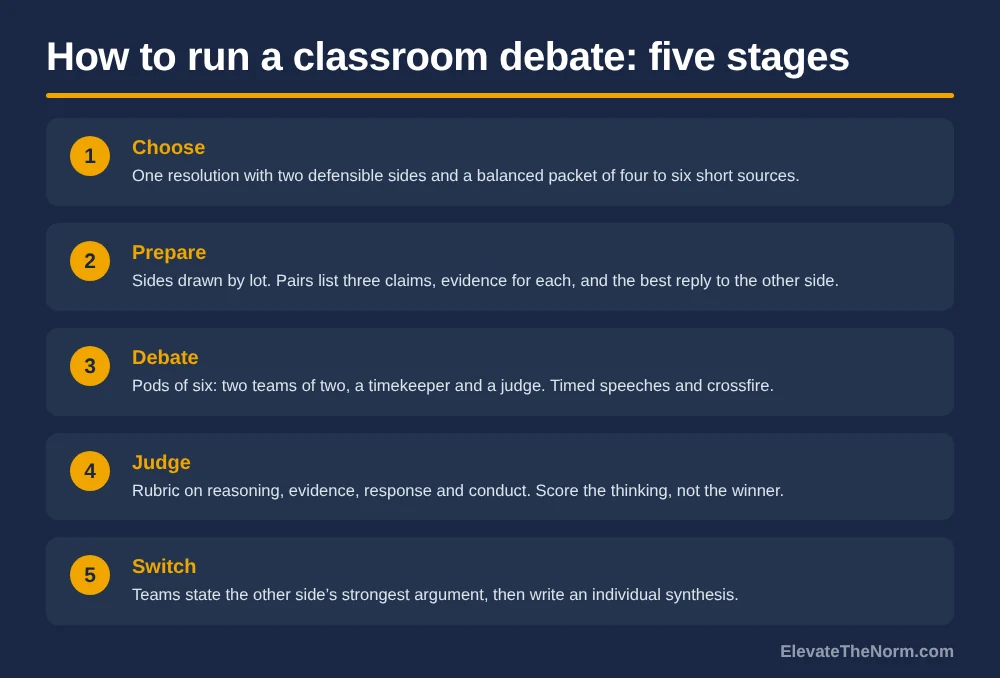
    Five-stage graphic for how to run a classroom debate: choose a resolution and source packet, prepare with sides drawn by lot, debate in pods of six, judge with a rubric, then switch sides and write a synthesis.

    How Do You Run a Classroom Debate Step by Step?

    Run it in five stages: choose a resolution and source packet, assign sides and prepare, hold timed rounds in pods, score the reasoning with a rubric, then switch sides and write a synthesis. A first unit fits about four class periods.

    1. Choose one resolution and build a packet. Write one sentence students can affirm or reject. Collect four to six short sources, balanced across both sides, so evidence quality does not depend on what students find at home.
    2. Draw sides by lot and form pods. Pods of six are a workable default: two teams of two debaters, one timekeeper and one judge. Say plainly that an assigned side is a thinking exercise, not a statement of belief.
    3. Prepare for one full period. Each team lists three claims, evidence from the packet for each, and the strongest argument the other side will make, with a reply. Kuhn and Crowell’s program built in the same prepare-and-anticipate work.
    4. Run timed rounds. Use the times in the table below. Judges and timekeepers take notes with one column per speech.
    5. Judge on reasoning, in writing. Each judge scores the rubric criteria and finishes one sentence: “The most convincing point was ___ because ___.” Ballots are feedback. The teacher sets the grade.
    6. Switch or concede. In a short second round, teams argue the other side for two minutes, or each states the other side’s strongest argument and what would change its mind.
    7. Write and debrief. Each student writes an individual position that uses evidence from both sides. Then the class discusses what moved anyone and what evidence was missing.
    PeriodWhat students doWhat the teacher does
    1Read the resolution and packet, draw sides, begin preparingExplains the rules and models one short speech
    2Finish preparing and rehearse speeches in pairsChecks each team’s claims and evidence
    3Debate in timed pod rounds and write ballotsCirculates and notes one rubric line per student
    4Switch round, individual synthesis, debriefCollects ballots and writing and returns feedback
    Assumes standard class periods. Compiled for this guide and untested in any study.

    How Do You Choose a Resolution Students Can Actually Debate?

    Choose a resolution with two defensible sides, enough readable evidence for both, and stakes that are real but not personal. Phrase it as one sentence students can affirm or reject. Avoid questions with settled factual answers and questions about students’ own identities, families or safety.

    • Two defensible sides. You can name a credible source for each side before you assign anything.
    • Readable evidence. Students can read a source in minutes and pull out a claim.
    • Real stakes, not personal ones. Choose questions about policy, interpretation or design, not about who students are.
    • Not already settled. If a quick search ends it, it is a research question.

    Examples that meet those tests: “Industrialization improved ordinary workers’ lives more than it harmed them” (social studies); “Victor Frankenstein is more responsible than his creature for the harm in the story” (English); “Nuclear power should be expanded to cut carbon emissions” (science); “Our school day should start later” (school policy).

    Build the packet the same week you pick the resolution. Aim for sources that disagree on the facts and not only on the conclusion, so students have something real to weigh. Trim each source to the passages students need and number the paragraphs, so a speaker can cite “source two, paragraph three” and the other team can find it. A one-page claims sheet, with a row for each claim, its evidence and its source, makes the preparation period visible to you and keeps teams from arriving with nothing but opinions.

    Before running a charged topic, read your school’s policy on controversial issues and tell an administrator the topic and format. Send families a short note naming the resolution, saying sides are assigned by lot, and explaining how grades work. Hess and McAvoy’s framework centers on questions about how people should live together, a useful test for whether a political question is worth a class period.

    Should Students Argue Sides They Disagree With, and Should They Switch?

    Draw sides by lot and tell students plainly that an assigned side is a thinking exercise, not a belief. Then add a switch or a concession, because both structured-controversy methods end that way. Offer a researcher or judge role to any student whose family or identity the topic touches.

    The research does not settle who should choose sides. Kuhn and Crowell’s students chose theirs, while Johnson, Johnson and Smith’s pairs and structured academic controversy assign them, and no source read for this guide compares the two. A random draw removes the social cost of picking a side in front of friends.

    The switch matters more than the draw. Johnson and colleagues’ procedure has pairs reverse perspectives and then drop advocacy to write a joint position, and structured academic controversy ends with each side conceding the other’s strongest argument. In a debate, a switch round, a concession or a synthesis paragraph does the same work and shows whether students understood the other side.

    You can give students a voice without losing quality control. Offer three resolutions that you have already checked against the tests above and let the class vote. Students get a real say in what they argue about, and you keep the packets balanced and the topics safe.

    How Long Should Each Speech Be?

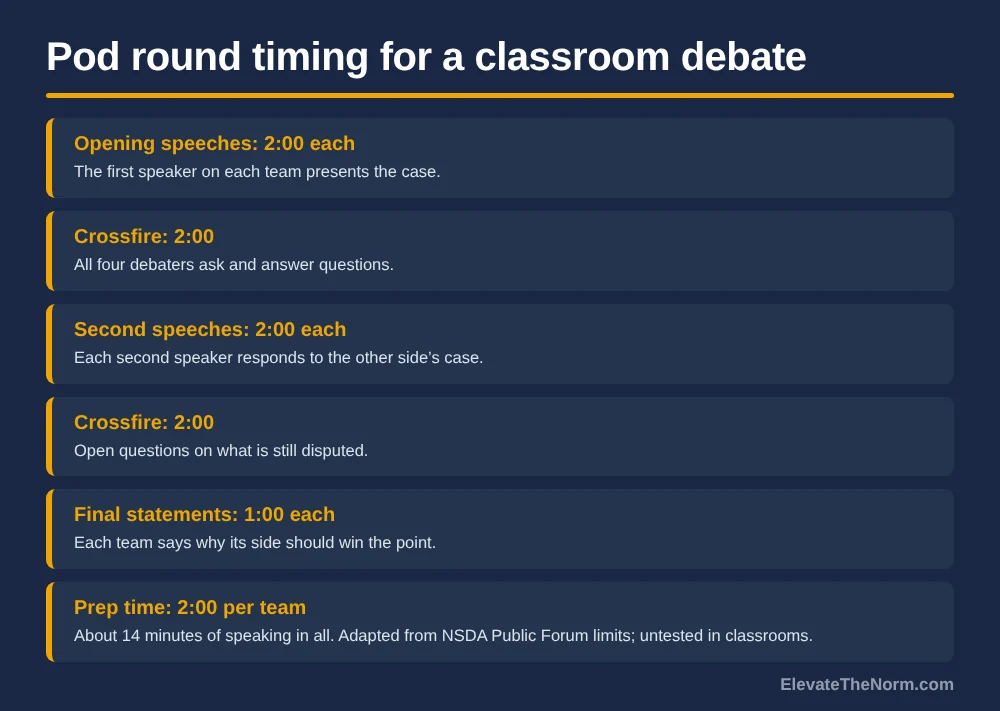
    For a pod round, use two minutes for each opening and second speech, two-minute crossfires, one-minute final statements, and two minutes of prep per team. That is about 14 minutes of speaking. The times are adapted from NSDA Public Forum limits and have not been tested in classrooms.

    SegmentNSDA Public Forum pilot rulesPod round (adapted for this guide)
    Opening speeches4:00 each2:00 each
    Crossfire3:002:00
    Second speeches4:00 each2:00 each
    Crossfire3:002:00
    Summaries3:00 eachSkipped
    Grand crossfire3:00Skipped
    Final statements (final focus)2:00 each1:00 each
    Prep time3:00 per team2:00 per team
    Total speaking time35 minutes14 minutes
    NSDA times are from its Public Forum pilot rules; the pod column compresses them for a classroom.

    Logistics decide whether a pod round runs on time. The timekeeper holds a visible clock, calls time without commentary and stops a speech at the limit, and teams spend prep minutes between speeches, not during them. Rotate roles so every student debates once and judges once, and stagger the pods so a round finishes inside one class period with time left for ballots. If a pod falls behind, drop the second crossfire before shortening any speech.

    No study tests the compression or the pod format, which were adapted for this guide, so treat the times as a starting point and adjust after the first round.

    Timing graphic for a classroom debate pod round: two-minute opening speeches, two-minute crossfire, two-minute second speeches, two-minute crossfire, one-minute final statements, and two minutes of prep per team, about 14 minutes of speaking.

    How Do You Grade a Classroom Debate Fairly?

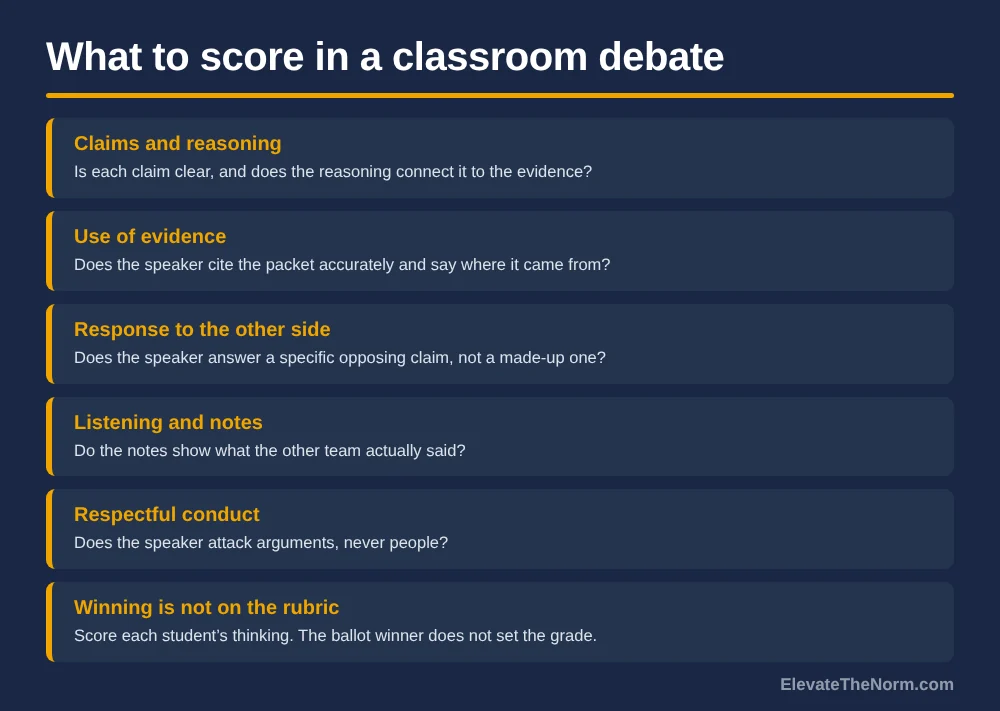
    Grade the reasoning each student shows, not who wins and not how confident they sound. Score individual contributions on a short rubric covering claims, evidence, response to the other side, listening and conduct, and grade the written synthesis separately so quieter students have another way to show what they learned.

    Treat judges’ ballots as feedback and keep the grade in the teacher’s hands, since a student’s grade should not depend on which classmate held the pen, and return ballots to teams privately rather than posting scores. The presentation rubric guide makes the same point about separating delivery from content.

    Rubric graphic listing what to score in a classroom debate: claims and reasoning, use of evidence, response to the other side, listening and notes, and respectful conduct, with a reminder that winning is not on the rubric.
    • Claims and reasoning. Is each claim clear, and does the reasoning connect it to the evidence?
    • Use of evidence. Does the speaker cite the packet accurately and say where a fact came from?
    • Response to the other side. Does the speaker answer a specific claim the other team actually made?
    • Listening and notes. Do the notes show what the other team said?
    • Respectful conduct. Does the speaker attack arguments rather than people?

    A workable synthesis prompt has four parts: state your position in one sentence, give two pieces of evidence, state the strongest argument against you, and answer it. Grade it on the same rubric lines. A quiet student can then earn full marks on reasoning, evidence and response without speaking in front of the class.

    To keep your workload manageable, grade from the written ballots and the synthesis instead of scoring live. One rubric line per student per round is enough.

    What About Students Who Do Not Want to Speak?

    Give every student a role with real work: debater, researcher, timekeeper, note-taker or judge. Offer written crossfire as an alternative to speaking aloud, and rotate roles so no one sits on the sidelines. Anxiety about speaking is a design problem, not a participation grade to subtract.

    Roles can carry real weight. A researcher can scan the packet during prep and hand the team a one-line summary of each source. A note-taker can build the record of what each side claimed, which becomes raw material for the written synthesis. A judge learns the rubric from the inside, which makes the criteria concrete before that student is graded on them.

    The group work roles guide covers giving each role a visible product so it counts as work. A debate also gives a quiet student a prepared turn with a known slot, easier than a surprise. If you use cold calling elsewhere, the cold calling guide explains how to keep it from feeling like a gotcha.

    How Do You Keep a Classroom Debate Respectful and Safe?

    Set the rules before the first round: attack arguments, not people; cite the packet; interrupt only in crossfire; and let any judge or the teacher stop a round that turns personal. Post sentence frames for disagreeing, and apply the same rules to every student every time.

    • Sentence frames on the desk. “The source says ___, but it leaves out ___.” “I agree with ___ about ___. Where I would push back is ___.”
    • A stop rule. Any judge or the teacher can pause a round, restate the rule and resume.

    End every round out of role. Name that the assigned sides were exercises, then ask each student to say one thing they learned from the other side’s case. That closing step keeps students from carrying a position that was never theirs and gives you a quick read on whether the switch worked.

    Debate rules work best as an extension of expectations the room already has. If you are building those, the classroom expectations framework is a good place to start.

    What Goes Wrong in a Classroom Debate, and How Do You Fix It?

    The usual failures are lopsided sources, one dominant speaker per team, memorized speeches that ignore the other side, and winner-takes-all grading. Fix them with balanced packets, assigned speaking turns, a required response to one opposing claim, and rubric grades that ignore who won.

    Most failures trace back to design rather than to students. A packet that favors one side decides the round before it starts, so check that both sides hold comparable evidence. A team with one strong speaker lets that student carry the work, so assign each speech to a named student and require both teammates to speak. Memorized speeches that never touch the other side are fixed by requiring every second speech to answer one specific claim from the opening.

    Two failures need a different fix. When students quit because they are losing, the switch round helps, because it hands everyone a fresh start on the opposite argument. When grades follow the ballots, grade from the rubric and the written synthesis and treat ballots as feedback only.

    How Should the Format Change for Different Grade Bands?

    Shorten speeches and add sentence frames for grades 6–8, use the full pod timings for grades 9–10, and add summaries and a longer final statement for grades 11–12. These are starting points, not tested settings, so adjust them after the first round.

    Grade bandSpeech lengthSupport to add
    6–81:00 to 1:30Sentence frames on every desk, a packet of three short sources, teams of two
    9–10Full pod timings (2:00)Packet of four to six sources, one source students find with teacher approval
    11–12Pod timings plus a 3:00 summary roundStudents choose the resolution from a short list and write their own ballots
    Recommendations compiled for this guide. No source tests speech length by age, though the one multi-year study found began in sixth grade.

    Can a Department or School Use This Format at Scale?

    Yes, because the cost is mostly teacher time. A department can share vetted resolutions, balanced packets and one rubric so each teacher is not rebuilding from scratch. Start with one pilot unit in one course, then adjust the packet, times and rubric before others adopt it.

    The main costs are printing the packets and the planning time to build them, and the main risk is topic selection. Agree on a short approved list of resolutions, a common rubric and a shared family note, so a parent or administrator hears the same explanation from every classroom. Keep the pilot’s ballots and syntheses as evidence, since nothing in the research above shows how this format performs across a whole school.

    The Short Version: How to Run a Classroom Debate This Month

    If you only change one thing about how you run a classroom debate, build in the switch. Choose a resolution with two real sides, draw sides by lot, give every student a prepared role, grade the reasoning, and end by asking each team to state the other side’s best argument.

    Run the format once, then change the times, packet or topic based on what your ballots and student writing show. Because the evidence is thin, your own results are the best data you will have.

    Frequently Asked Questions

    Does classroom debate improve student learning?

    The evidence is limited. A three-year middle school dialogue program produced stronger arguments than conventional discussion, and a Chicago study linked league debate to higher graduation rates. Neither tested a single classroom unit, and the second was observational. Treat debate as one useful tool for teaching argument, not a proven fix for achievement.

    How many students should be on each debate team?

    Two per team is a sound default in pods of six: two debaters per side plus a timekeeper and a judge, with roles rotating each round. Larger teams let one student carry the work. In a single whole-class debate, three per side is workable if every student has a defined speech or task.

    How long does a classroom debate take?

    A first unit fits about four class periods: introduce the resolution and packet, prepare, run timed rounds with written ballots, then switch sides, write a synthesis and debrief. A pod round runs about 14 minutes of speaking plus prep time. Later debates in a familiar format can usually be shorter.

    Should students have to argue a position they disagree with?

    Drawing sides by lot is reasonable if you say plainly that an assigned side is a thinking exercise, not a belief, and if students can take a researcher or judge role when a topic touches their family or identity. Kuhn and Crowell’s students chose sides, while the structured-controversy methods assign them.

    How do you grade a debate without rewarding the loudest student?

    Grade each student’s reasoning, not the winner and not the volume. Score claims, evidence, response to the other side, listening and conduct on a short rubric, and grade a written synthesis separately so students who speak less can still show their thinking.

    Can you debate political or controversial topics in class?

    Often yes, with preparation. Read your school’s policy on controversial issues, tell an administrator and families the topic and format in advance, use balanced source packets, and choose questions on which informed people really disagree. Hess and McAvoy’s framework centers on questions about how people should live together.

    What is the difference between a debate and a Socratic seminar?

    A debate assigns sides, sets time limits and judges reasoning. A Socratic seminar assigns no side, has no winner and asks open questions about a shared text. Choose a debate for a question with two defensible answers; choose a seminar when you want students to explore a text together.

    Sources

    About Clay Shumate

    Clay Shumate is a certified secondary Social Studies teacher in the public schools of West Alabama, with seven years of classroom experience, a B.A. in History, and an M.Ed. in Secondary Education. He writes about project-based learning, student responsibility, respect, and practical ways to hold young people to a higher standard while giving them room to learn from mistakes. He is a member of the Society of Professional Journalists and writes to its Code of Ethics; this site’s editorial standards and corrections policy are published in full. More about Clay.

  • One Pager Assignment: How to Make It Think Instead of Decorate

    One Pager Assignment: How to Make It Think Instead of Decorate

    By Clay Shumate

    A one pager assignment asks a student to put their thinking about a text, a topic or a unit onto a single page, combining writing and drawing. Done well, it is a compact analysis task with a visual element. Done badly, it is a craft project with a quotation glued to it — and the difference is almost entirely in what you require and what you grade.

    The format came out of AVID and has spread well beyond it. The spread is the problem: most of what teachers see online is the finished art, which tells you nothing about whether the student understood anything.

    Key Takeaways

    • Require elements, not an aesthetic. A claim written as a sentence, two cited pieces of evidence, a drawing that carries an idea, a labelled connection, a lingering question, and one line of so-what. If you can hit every requirement and still not have thought, the requirements are wrong.
    • The research supports the ingredients, not the poster. Drawing to learn improved outcomes in 26 of 28 comparisons at a median effect size of 0.40; summarizing in 26 of 30 at a median of 0.50. Both come with a condition: students need to be taught how.
    • Do not justify a one-pager with “visual learners.” The meshing hypothesis has been examined and found wanting. Justify it because drawing and summarizing are generative work — which is a better reason anyway.
    • Grade the thinking. Four criteria: accuracy of the claim, quality of the evidence, whether the image carries an idea, and completeness. Artistic skill appears nowhere.
    • A template is not a crutch. It is the thing that lets the non-artist start, and the research on drawing says explicitly that pretraining and structure improve the effect rather than diluting it.

    What Is a One Pager Assignment?

    It is a single page on which a student represents their understanding of something, in words and images, using a required set of elements. That is the whole definition. The page is the constraint; the elements are the assignment.

    AVID developed the strategy and it is now used well outside AVID classrooms. In practice you will see it most in English and social studies — after a novel, a chapter, a documentary, a unit — but nothing about the format is subject-specific. A one-pager works anywhere a student needs to compress something large into something defensible.

    What it is not is a poster. A poster communicates to an audience. A one-pager is evidence of thinking, submitted to you. Those two things want different rules, and most of the trouble with one-pagers starts when a teacher writes poster rules and grades them as analysis.

    Three-row research graphic: drawing to learn supported with 26 of 28 comparisons positive and median effect size 0.40, summarizing supported with 26 of 30 positive and median 0.50 but requiring training, and visual learners not supported
    Two of the three claims people make about one-pagers hold up. The third does not.

    Does the Research Support One-Pagers?

    Not directly — there is no body of research on “one-pagers” as such. What there is, and it is good, is evidence on the two things a one-pager makes students do: draw and summarize.

    Fiorella and Mayer’s 2015 review in Educational Psychology Review is the best single place to see it. They assessed eight generative learning strategies against the experimental record. Drawing produced positive effects in 26 of 28 comparisons, with a median effect size of d = 0.40, across elementary, high school and college students — one of their strongest examples was ninth graders working on chemistry comprehension. Summarizing produced positive effects in 26 of 30 comparisons, median d = 0.50.

    So far, so encouraging. Here is the part that changes how you run the assignment. For drawing, the authors are explicit that the effect improves when students receive explicit pretraining in how to draw, detailed guidance about which elements to include, partial illustrations to work from, or a chance to compare their drawing with the author’s. The thing they warn against is “extraneous cognitive load caused by the mechanics of drawing” — a student spending their working memory on composition is not spending it on the content. For summarizing, the training studies they review gave middle schoolers roughly six hours of instruction over five weeks before the summaries got good.

    Read that honestly and it says something uncomfortable: handing out a blank page and saying “be creative” is the version of this assignment the research does not support.

    There is a second line of evidence worth knowing. Fernandes, Wammes and Meade’s 2018 review in Current Directions in Psychological Science describes a reliable “drawing effect” on memory — drawing a word at encoding beats writing it, repeatedly, and the benefit holds for older adults and even appeared in a small group of patients with dementia. Two details matter for a classroom. The benefit arrived with as little as four seconds of drawing per item, and it applies “regardless of one’s artistic talent.” The caveat is the population: these were adults in memory experiments with word lists, not teenagers writing about a novel. It tells you the mechanism is real. It does not tell you the size of the effect on a literary analysis.

    What About “Visual Learners”?

    Leave it out of your rationale. It is the most common justification given for one-pagers and it is the weakest one available.

    Pashler, McDaniel, Rohrer and Bjork examined the evidence for the meshing hypothesis — the idea that matching instruction to a student’s preferred style improves learning — in Psychological Science in the Public Interest in 2008. Their finding was blunt: they found “virtually no evidence for the interaction pattern” that would be required to validate the educational application, and concluded that “there is no adequate evidence base to justify incorporating learning-styles assessments into general educational practice.”

    This is not a reason to stop assigning one-pagers. It is a reason to describe them accurately to students, to parents and to an administrator who asks. The honest sentence is: drawing and summarizing are generative activities with a decent evidence base, so I am asking every student to do both. That is stronger ground than a learning style, and it does not sort children into categories the research does not support.

    Six-row graphic listing required elements of a one pager assignment: a claim written as a sentence, two pieces of cited evidence, one drawn image that carries meaning, a labeled connection, a question the student still has, and one sentence of so-what
    Six required elements. Every one of them is thinking, not decoration.

    What Should a One-Pager Actually Require?

    Six elements, each of which is a thinking move rather than a design choice. The test for any element you add: could a student satisfy it without understanding the material? If yes, cut it.

    A claim, written as a sentence. Not a title, not a theme word. An arguable statement the student could defend out loud. This single requirement does more work than the other five combined, because it is the one that cannot be faked with a border.

    Two pieces of cited evidence. Quoted or paraphrased, with a page number, a line, or a source. “Cited” is doing real work here — if a student cannot point to where it came from, it is not evidence yet.

    One drawn image that carries meaning. The drawing has to do something the words are not doing: show a relationship, a sequence, a contrast, a scale. A decorative border is not an element. A badly drawn diagram that makes a comparison visible is.

    A labelled connection. An arrow, a line or a bracket with words on it, showing how two things on the page relate. This is the cheapest way to force synthesis, and it is the element students most often skip.

    A question the student still has. In their own voice. It is the most honest window you will get into what they actually understood, and it costs them thirty seconds. If you want a wider version of this, it is the same instinct behind asking a student to judge their own work before you do.

    One sentence of so-what. Why this matters outside the unit. Short, and theirs. Most students will write something flat the first time. They get better at it the fourth time, which is an argument for assigning one-pagers more than once a year.

    Numbered four-criteria grading graphic for a one pager assignment: accuracy of the claim, quality of the evidence, whether the image carries an idea, and completeness and legibility rather than neatness
    Four criteria, none of which is artistic skill.

    How Do You Grade a One-Pager Without Grading Art?

    Put artistic skill nowhere on the rubric, and tell students that before they start. Four criteria will carry it. The same problem turns up on any student artefact that repeats every unit; our piece on grading an interactive notebook without grading the craft works through that version.

    Accuracy of the claim is the heaviest weight. Is it defensible against the text or the evidence? This has nothing to do with how the page looks. Quality of the evidence comes second: cited, relevant, and actually supporting the claim rather than being the first quotation the student found. Does the image think? — scored on whether the drawing carries an idea, never on execution. A labelled stick figure can score full marks and should. Completeness and legibility is the last and the smallest: all six elements present, and a reader can follow it. Legibility is not neatness. A page can be messy and perfectly readable.

    Two things to resist. Do not add a “creativity” or “visual appeal” category — it is unscoreable, it rewards students who already had art supplies at home, and it is the single fastest way to turn this into an equity problem. And do not give points for colour. If you want the general version of this argument, the same reasoning applies to any rubric where presentation can hide thin understanding.

    Three practical conditions follow from that. The assignment has to be completable with a pencil — if markers are required, you have built a supply test, so keep whatever you have in a tub on the counter and do the work in class rather than at home. Score the “question you still have” element present-or-absent, never on quality, or students will stop telling you the truth in the one place they were being honest. And tell families the rubric excludes artistic skill before the first grade goes in the book, because a parent looking at a drawing with a C on it will reasonably assume you graded the drawing. If you grade on a 4-point scale, this 1-4 grading scale chart shows the percentage behind each level.

    Alternatives need to be available without a formal plan: typed and printed elements pasted down, cut images instead of drawn ones, or the whole thing explained to you verbally while you score the same four criteria. A student with a fine-motor difficulty, a visual impairment, or a hand in a cast should not have to disclose anything to get a different route.

    On grading time — this is the objection every teacher with 150 students will have, and it is correct. Score in one pass, in bands rather than points, and write a comment only on the claim. If the claim is wrong, nothing downstream of it is worth your ink. Four criteria scored 1–4 with one sentence on the first of them runs about ninety seconds a page.

    One more move that costs four minutes and is worth more than the rubric. Walk the room while they work and ask three or four students to defend the claim on their page out loud — not to justify the picture, just the sentence. I do a version of this constantly: circulating, pulling a student aside, and making them explain the decision they made rather than telling them whether it was right. You find the gap between a page that looks finished and a page that is understood in about twenty seconds, and you find it while there is still time to fix it. That is the same thing any good in-the-moment check is for.

    What About the Student Who Says They Cannot Draw?

    Give them a template and say the sentence out loud: nobody is being graded on drawing. Then mean it, because teenagers will test whether you meant it.

    Betsy Potash, writing at Cult of Pedagogy, identifies the problem exactly: the one-pagers that circulate online are made by artistic students, and everybody else concludes the assignment is not for them. Her fix is a template — a page with designated spaces for each required element — which she describes as a creative constraint that paradoxically frees students up, because the paralysis is usually about placement rather than content. Students who want a blank page can flip the template over and use the back.

    That is a practitioner’s recommendation rather than a research finding, and it should be read as one. But it points the same direction the research does: Fiorella and Mayer found that structure, partial illustrations and guidance about which elements to include increase the benefit of drawing rather than watering it down. The template is not a concession. It is the scaffold the evidence asks for.

    Where One-Pagers Go Wrong

    Four failure modes, and three of them are the teacher’s.

    The first is the blank page with no requirements, which produces decoration from the artists and panic from everyone else. The second is grading the aesthetic, which teaches students that the assignment was about markers all along. The third is assigning it once, at the end of a unit, as a summative grade — the first one a student makes is always the worst one, and the research on summarizing says the skill takes weeks of instruction to develop. Run the first as practice. The fourth is the student version: filling every element with something technically present and entirely hollow. The claim sentence catches most of this, and the four-minute verbal check catches the rest.

    How Do You Launch It the First Time?

    Spend twenty minutes before anyone touches a page. This is the pretraining the drawing research keeps pointing at, and skipping it is why most first attempts disappoint.

    Show two finished examples — one strong, one weak — and have the class score both against your four criteria before they know which is which. Make the weak one visually attractive and analytically thin, because that is the trap. Then model the hardest element: write a claim sentence in front of them, out loud, and revise it once. Then let them start, with the template on the desk and the requirements on the board.

    If you want the pages to do a second job, hang them and run a structured walk around the room where students read each other’s claims and leave one question each. The reading is worth more than the display, and it makes the “question you still have” element feel like it has a purpose beyond the gradebook. Make the display opt-out without explanation — some students are genuinely uncomfortable having a drawing on the wall, and nothing about the learning requires it to be public.

    Afterwards, do not just file them. Read the question column across the whole class in one sitting; it is the cheapest reteach list you will ever assemble, and it was generated by students who thought nobody was grading it.

    What to Do Next

    Take whatever you were going to assign as a written response this month and convert it — same content, six required elements, four grading criteria, a template on every desk, and twenty minutes of launch before the first page gets made. Run it as practice rather than as a test grade.

    Then do it again inside the same semester. Almost everything useful about one-pagers shows up on the second and third attempt, once students have stopped worrying about the layout and started arguing on paper. If you need the in-between measurement, a two-minute check sorted by where it falls in a lesson will tell you more, sooner, than waiting for the pages to come in.

    Frequently Asked Questions

    What is a one pager assignment?

    A single page on which a student represents their understanding of a text, topic or unit using both words and images, against a required set of elements. The strategy came out of AVID and is now used well beyond it, most commonly in English and social studies. The page is the constraint; the required elements are the actual assignment. It is not a poster — a poster communicates to an audience, while a one-pager is evidence of thinking submitted to a teacher, and the two want different rules.

    Is there research showing one-pagers work?

    Not on one-pagers as a named format. There is good evidence on the two things a one-pager makes students do. In Fiorella and Mayer’s review of generative learning strategies, drawing produced positive effects in 26 of 28 comparisons at a median effect size of d = 0.40, and summarizing in 26 of 30 at a median of d = 0.50, across elementary, high school and college students. Both come with the same condition: the effect improves when students are explicitly taught how, and the summarizing training studies gave middle schoolers roughly six hours of instruction over five weeks.

    Should I say one-pagers are good for visual learners?

    No. Pashler, McDaniel, Rohrer and Bjork examined the meshing hypothesis — that matching instruction to a preferred style improves learning — and found “virtually no evidence” for the interaction pattern it requires, concluding there is “no adequate evidence base” for using learning-styles assessments in general practice. Use the better justification instead: drawing and summarizing are generative activities with real support, so every student does both. That reasoning survives a conversation with an administrator, and it does not sort students into categories the evidence does not back.

    How do I grade a one-pager fairly?

    On four criteria, none of which is artistic skill: accuracy of the claim, quality of the cited evidence, whether the drawn image carries an idea rather than decorates, and completeness and legibility. Weight the claim heaviest. Do not add a creativity or visual-appeal category — it is unscoreable and it rewards students who own art supplies. Tell families the rubric excludes drawing before the first grade is entered, because a parent seeing a low mark on a page with a picture on it will assume you graded the picture.

    What do I do about students who say they cannot draw?

    Give them a template with a designated space for each element and say out loud that nobody is graded on drawing — then hold to it, because they will test whether you meant it. A labelled stick figure that makes a comparison visible should score full marks. Alternatives need to be available without a formal plan: typed elements pasted down, cut images rather than drawn ones, or explaining the page to you verbally while you score the same four criteria.

    Does a template make the assignment too restrictive?

    The evidence points the other way. Fiorella and Mayer found that structure, partial illustrations and guidance about which elements to include increase the benefit of drawing rather than diluting it, and the risk they name is extraneous cognitive load from the mechanics of drawing — which is exactly what a blank page creates. The template removes the paralysis about placement so the student can spend their attention on the content. Students who want the open page can use the back of it.

    Should a one-pager be a test grade?

    Not the first one. The first attempt is always the worst attempt, and the research on summarizing says the skill takes weeks of instruction to develop, so a summative grade on a first try is measuring unfamiliarity with the format. Run the first as practice, assign a second inside the same semester, and grade that one. Almost everything useful about one-pagers appears on the second and third attempt, once students have stopped worrying about layout and started arguing on paper.

    Does handwriting the page help more than typing it?

    There is no good evidence for that, and it is worth knowing because the claim gets repeated a lot. Urry and colleagues ran a direct replication of the well-known longhand-versus-laptop study with 142 undergraduates and found a negligible effect in the opposite direction on conceptual questions, and a mini meta-analysis across eight studies found no significant difference in quiz performance. Assign a one-pager because drawing and summarizing are generative, not because the student held a pen.

    Sources

    1. Fiorella, Logan, and Richard E. Mayer. “Eight Ways to Promote Generative Learning.” Educational Psychology Review, vol. 27, 2015, pp. 1–47. Drawing: positive effects in 26 of 28 comparisons, median d = 0.40, across elementary, high school and college students; effect increases with explicit pretraining in how to draw, guidance on elements, partial illustrations or comparison with author-provided drawings, and the stated risk is extraneous cognitive load from the mechanics of drawing. Summarizing: 26 of 30 comparisons positive, median d = 0.50; middle-school training studies required roughly six hours of instruction over five weeks. https://doi.org/10.1007/s10648-015-9348-9
    2. Fernandes, Myra A., Jeffrey D. Wammes, and Melissa E. Meade. “The Surprisingly Powerful Influence of Drawing on Memory.” Current Directions in Psychological Science, vol. 27, no. 5, 2018, pp. 302–308. Reports a reliable recall advantage for drawn over written words, benefits arriving with as little as four seconds of drawing per item, and the authors’ statement that the benefit applies “regardless of one’s artistic talent.” Populations are younger adults, older adults and a group of 13 patients in long-term care — not secondary students, and the materials are word lists rather than academic content. Cited for mechanism, not for an effect size on classroom work. https://doi.org/10.1177/0963721418755385
    3. Pashler, Harold, Mark McDaniel, Doug Rohrer, and Robert Bjork. “Learning Styles: Concepts and Evidence.” Psychological Science in the Public Interest, vol. 9, no. 3, 2008, pp. 105–119. The authors found “virtually no evidence for the interaction pattern” required to validate learning-styles instruction and concluded “there is no adequate evidence base to justify incorporating learning-styles assessments into general educational practice.” https://doi.org/10.1111/j.1539-6053.2009.01038.x
    4. Urry, Heather L., et al. “Don’t Ditch the Laptop Just Yet: A Direct Replication of Mueller and Oppenheimer’s (2014) Study 1 Plus Mini Meta-Analyses Across Similar Studies.” Psychological Science, vol. 32, no. 10, 2021, pp. 1479–1492. Direct replication, N = 142 undergraduates. Conceptual-question performance showed a negligible effect in the opposite direction to the original (Hedges’s g = −0.13, 95% CI [−0.45, 0.20]), significantly different from the original result. A mini meta-analysis of eight studies found g = 0.04, 95% CI [−0.13, 0.20], not significant. The authors conclude results “do not support the idea that longhand note taking improves immediate learning via better encoding of information.” Cited as contrary evidence: do not justify handwritten work on the grounds that writing by hand beats typing. https://doi.org/10.1177/0956797620965541
    5. Potash, Betsy. “A Simple Trick for Success with One-Pagers.” Cult of Pedagogy, 26 May 2019 (updated 2026). Credits AVID with developing the strategy; describes the template as a creative constraint that helps non-artistic students start, and recommends simple rubric categories such as textual analysis, required elements and thoroughness. Cited as practitioner recommendation, not as research evidence. https://www.cultofpedagogy.com/one-pagers/

    About Clay Shumate

    Clay Shumate is a certified secondary Social Studies teacher in the public schools of West Alabama, with seven years of classroom experience, a B.A. in History, and an M.Ed. in Secondary Education. He writes about project-based learning, student responsibility, respect, and practical ways to hold young people to a higher standard while giving them room to learn from mistakes. He is a member of the Society of Professional Journalists and writes to its Code of Ethics; this site’s editorial standards and corrections policy are published in full. More about Clay.

  • Gallery Walk Activity: How to Run One So the Feedback Is Worth Reading

    Gallery Walk Activity: How to Run One So the Feedback Is Worth Reading

    By Clay Shumate

    A gallery walk activity posts student work around the room and sends classmates around to read it and leave written feedback. The walking is not what makes it work. The peer assessment underneath it is the part with research behind it, and that research says it only pays off when students are told exactly what they are looking for before they stand up.

    What follows is what the evidence actually supports, the one study at the right grade level and why it is weaker than it looks, and a six-step version that produces feedback worth reading instead of thirty sticky notes that say “good job.”

    Key Takeaways

    • Peer assessment has real evidence. The gallery walk format does not, separately. A meta-analysis of 54 control-group studies put peer assessment at g = 0.31 on achievement, and at secondary level specifically, g = 0.44.
    • Peer assessment beat teacher assessment in that analysis (0.31 versus 0.28) and tied with self-assessment. It is not a second-best substitute for your own marking.
    • Attaching a grade to peer feedback helped university students and did not help school students. Keep the walk ungraded in grades 6–12.
    • Feedback is not automatically good. Across 607 effect sizes, feedback raised performance on average but made it worse in over a third of cases — mostly when it pointed at the person instead of the work.
    • The single highest-leverage change is naming one focus before students circulate. Open-ended walks produce praise, not information.
    • If nobody revises anything afterward, you ran a walking tour. The revision block is the lesson, not the extra.

    Free Download · PDF

    The Gallery Walk Planner (2 pages)

    Page 1 plans the walk: the four decisions, the three sentence stems, the access check and the two rules that keep it fair. Page 2 runs it: the six steps in order, a student revision slip, and the four failure modes with their fixes.

    Download the free PDF

    Free. No email address required. Designed for grades 6–12. Browse every printable in Your Free Library.

    What Is a Gallery Walk Activity?

    It is a critique protocol: student work goes up on the walls or tables, students circulate in small groups, and each group leaves written feedback on what it sees. Then the authors read their feedback and change something.

    That last clause is the one teachers drop, and it is the one that turns the activity into instruction. Everything before it is logistics.

    The format is flexible in the ways that do not matter much and rigid in the one way that does. It works with drafts, lab write-ups, solved problems, design sketches, annotated sources, project prototypes. It works on paper taped to a wall or on a shared digital board. What it does not work without is a stated thing students are supposed to judge.

    Does a Gallery Walk Activity Actually Improve Learning?

    The peer assessment inside it does. The format itself has almost no rigorous evidence, and that is worth saying out loud because most articles about gallery walks imply otherwise.

    Double, McGrane and Hopfenbeck published a meta-analysis of peer assessment in Educational Psychology Review covering 54 experimental and quasi-experimental control-group studies. The overall effect on academic performance was g = 0.31 — small to medium, and statistically significant. Peer assessment outperformed no assessment and outperformed teacher assessment (g = 0.28). It showed no advantage over self-assessment.

    Two details in that analysis matter more for a grades 6–12 classroom than the headline number.

    First, the effect at secondary level was higher than the average: g = 0.44 across 13 studies. That runs against the usual pattern on this site, where secondary tends to be the weakest band in cooperative-learning research. Second, the effect held up across implementation choices — online or in person, anonymous or named, frequent or occasional, trained or untrained. None of those moderators came out significant. That is good news for a teacher deciding whether to buy clipboards: the fiddly choices are not where the result lives.

    There was one moderator that did split, and it splits against school students. Peer feedback that carried a grade significantly helped university students (g = 0.55). The same effect could not be shown for primary or secondary students. Do not grade the sticky notes.

    Three-part evidence summary comparing well-evidenced peer assessment at g equals 0.31 overall and 0.44 at secondary level, thin evidence for the gallery walk format itself from one Grade 8 study with no control group, and the finding that feedback made performance worse in over a third of cases
    Two different claims get mixed together. Only one of them is well supported.

    What About Research on Gallery Walks Specifically?

    Thin, and the one study at the right grade level found less than its abstract suggests.

    The closest match is a 2023 study of 198 Grade 8 students at a public high school in the Philippines, measuring knowledge, interest and attitude across three social studies lessons taught through gallery walk activities. It is a genuine secondary-level sample, which almost nothing else in this literature is.

    It is also a one-group pre-test/post-test design with no control group. Students gained on the researcher-made test — mean gained scores of 7.88, 8.15 and 8.01 across the three lessons — but with no comparison class, there is no way to separate the gallery walk from three weeks of teaching. More pointed: when the researchers correlated the specific features of how the walk was implemented against outcomes, none of the correlations with cognitive skills were significant, and none of the correlations with interest were significant either. Only attitude moved reliably.

    So the honest summary is: students liked it, and this study cannot tell you whether it taught them anything. Most of the remaining gallery-walk literature is small single-classroom work outside the United States, often in language instruction, and frequently without a control group either.

    The best-known practitioner guide, from PBLWorks, is also worth reading accurately. It describes a protocol and reports that giving participants a specific focus and criteria “helps generate higher-quality feedback,” while open-ended walks produced superficial comments like “good DQ!” That is a credible observation from people who run these constantly. It is not a study, and the article cites none. It should be quoted as what it is.

    None of this means skip the activity. It means the reason to run it is the peer assessment evidence, and the way to run it should be built to make that peer assessment real.

    Why Does Feedback Sometimes Make Students Worse?

    Because a lot of feedback is about the student instead of the work, and that redirects attention away from the task.

    Kluger and DeNisi’s review of feedback interventions remains the uncomfortable finding in this whole area. Across 607 effect sizes and 23,663 observations, feedback raised performance on average, d = 0.41. But in over a third of cases it lowered performance. Their explanation is that when feedback draws attention to the self rather than the task, the recipient spends their effort on defending themselves rather than improving the thing.

    Anybody who has watched a fifteen-year-old read a comment on their essay knows what that looks like. “This is confusing” is a verdict on a person. “I couldn’t find your claim in the second paragraph” is information about a page. The second one gets acted on; the first one gets argued with.

    That is also why the sentence stems matter more than they sound like they should. “I notice…” and “I wonder…” are not politeness training. They are a grammatical trick that forces the comment to describe the work. The EL Education framing that runs through a lot of critique practice — feedback should be kind, specific and helpful — is making the same move from a different direction, and the people who use it are explicit that it depends on an existing culture. As Ron Berger puts it in that work, this is not a strategy you drop into a classroom without a respectful one already in place.

    That is a real precondition, not a throat-clearing caveat. A gallery walk in a room where students are not already being treated decently by each other and by you produces insults on sticky notes, and you will spend the period on discipline instead of drafts.

    How Do You Run a Gallery Walk That Produces Useful Feedback?

    Six steps. Five of them cost nothing; the sixth costs ten minutes of class time and is the one that makes the other five worth doing.

    Six numbered steps for running a gallery walk activity: name the one thing students look for, hand out criteria before they walk, require written feedback, give descriptive sentence stems, put a clock on each station, and build in revision time
    None of these adds a planning period. The last one is the one that gets cut.

    0. Model it once, on one piece of work, before anybody walks

    Put a single piece of work up on the projector — ideally one of yours, or an anonymous sample from a previous year — and have the whole class write one note about it together. Then read three of their notes aloud and say plainly which one is useful and why. That takes eight minutes and it is the difference between a protocol students understand and a protocol they are performing. Skipping it is the most common reason a first gallery walk falls flat, and it is also the thing a coach watching your room will ask about first.

    1. Name one thing they are looking for

    Not “give feedback.” One focus: content accuracy, or evidence quality, or whether the claim is actually answerable. If you name three, you get one sentence about the easiest of the three. This single decision is what separates a walk that generates information from a walk that generates compliments.

    2. Hand over the criteria before they walk, not after

    Students should be holding the same rubric you will grade against while they circulate. Giving it to them afterward turns peer feedback into a guessing game about what you wanted. If you do not have a rubric for this task yet, three success criteria written on the board will do.

    3. Require it in writing

    Spoken feedback evaporates at the bell. Sticky notes work. So does a feedback slip per station, or a shared document with a row per project. The requirement is that the author can read it later, because step six depends on that.

    4. Give stems that describe rather than judge

    Post three and require them: I notice… / I wonder… / One thing that would strengthen this is… Teenagers will write “nice” if you let them, and they will write something sharper than you expect if you make the sentence start with a verb that forces specificity.

    5. Put a clock on each station

    Two or three minutes, then rotate on a signal. Without a timer the quick groups finish in forty seconds and the room drifts, which is a transition problem dressed up as a behavior problem. A posted rotation order prevents the traffic jam at station one. My Station Rotation Toolkit on TPT has eight reusable station frames, signs, and recording sheets if you would rather not build them.

    6. Build in the revision

    Ten minutes at the end: read your notes, pick one change, make it. Not “consider the feedback.” Pick one, make it, and be ready to say what you changed and why. This is the step that gets cut when the period runs long, and cutting it is what turns a critique into a field trip around your own classroom.

    One more thing belongs in that ten minutes, and it is the part students care about most: they do not have to take the advice. Some peer feedback is confidently wrong. A student who reads “your thesis is unclear” from someone who skimmed two sentences is entitled to decide that note is not useful. The requirement is that they can say which note they acted on and why, or which note they rejected and why. Both are evidence of judgment, which is the actual skill being taught. A protocol that forces a student to obey bad advice is teaching the opposite of what peer assessment is for.

    Whose Work Goes on the Wall?

    This is the question a parent asks first, and most guides to this activity never raise it.

    Putting a student’s work in front of thirty classmates is not a neutral act. For the student who knows their draft is the weakest in the room, a gallery walk can be the worst twenty minutes of their week, and no amount of “I wonder…” stems fixes that by itself.

    Three things keep it fair. First, everything goes up, every time — a walk where only the strong work is displayed is a showcase, and students read the selection as the verdict. Second, do not use personal writing. Narrative and reflective pieces where a student has written about their own life do not belong on a wall; use the analytical task, the lab, the problem set, the project artifact. Third, let a student put work up unnamed if they ask. Peer assessment effects in the meta-analysis held up whether feedback was anonymous or not, so you are giving away nothing that the research says you need.

    If a family asks why their child’s work was displayed, the answer should be a sentence you already have: everyone’s work goes up, nobody’s name has to, and nothing personal is ever used. Worth putting in a back-to-school message the first time you run it, rather than after a phone call.

    What Goes Wrong, and How Do You Tell It Is Your Structure?

    Four failure modes cover almost all of it, and all four are things you set up rather than things students did.

    Four numbered failure modes of a gallery walk activity: no focus so no substance, feedback aimed at the person rather than the work, no revision after the walk, and running critique before the classroom culture can support it
    Every one of these is a structure problem, not a student problem.

    The first is no focus, which produces “good job” and a smiley face. Students are not being lazy. They have not been told what to judge, so they default to the safest comment available.

    The second is feedback aimed at the person. See above. The fix is mechanical — stems, and a rule that every note names a specific part of the work.

    The third is no revision, which is the most common and the most expensive. If the notes go into a backpack, the walk taught judgment to nobody and cost you a period.

    The fourth is running it too early. Critique is a high-trust activity. In a room where that trust is not there yet, start with something lower stakes — structured peer response on a single paragraph at their desks, with you reading over shoulders — and build toward the full walk over a few weeks.

    Two practical notes, because the guides tend to skip both. Prep is roughly ten minutes — deciding the focus, writing three criteria, and finding the sticky notes. There is no packet to build, which is a large part of why this protocol survives in real classrooms. And the student who has nothing to post is an ordinary Tuesday, not a crisis. They post what exists, even if it is a title and two sentences, and they do the walk and give feedback like everybody else. Giving feedback is most of the cognitive work in this activity anyway. Exempting them from the one part they can still do teaches them that the room has stopped expecting anything from them.

    Where Does This Fit in a Unit?

    Mid-draft, not at the end. A gallery walk on finished work is a showcase, which is a fine thing but a different thing. The activity earns its period when the work is still changeable.

    In a project, the natural slot is the day the first full draft exists and before any of it is graded. The critique and revision tools in a PBL toolkit are built around exactly that moment. In a writing unit, it is after the first full draft and before the revision conference. In a problem-based math or science lesson, it is after groups have committed to an approach and before they have invested two days in it.

    One per unit is plenty. Run it weekly and it becomes the thing students perform rather than the thing they use, which is the same failure mode that eventually catches every student-centered routine that gets over-used.

    Does This Work in a Class of Thirty-Five?

    Yes, and it is one of the few protocols that gets easier as the class gets bigger, because it runs in parallel.

    Eight or nine stations, groups of four, three minutes each, and the whole room is working at once. The constraint is wall space and traffic flow, not headcount. If the room is tight, put work flat on desks and rotate groups between desk clusters instead of around the perimeter — same protocol, less collision.

    Where class size does bite is the revision block. Thirty-five students each wanting to ask you about one piece of feedback does not fit in ten minutes. The answer is that they do not ask you. They pick one change and make it. You circulate. The ones who are genuinely stuck will find you.

    Access is worth planning for rather than improvising. A student who reads well below grade level cannot absorb six peers’ drafts in three minutes, and a student newer to English may be able to judge the work and not able to write the note quickly. Both are solved the same way: let feedback be spoken to a partner who writes it, or give a sentence frame with the technical words already in it. Neither reduces the demand — the judgment is still theirs — and both stop the activity quietly sorting the room by reading speed.

    What to Do Next

    Pick a task you already have, where the work is half-finished and you were going to collect it anyway. Decide the one thing students will look for. Write three success criteria on the board. Give them sticky notes, three sentence stems and three minutes a station, and reserve the last ten minutes of the period for one change each.

    Do not grade it. The research says the grade does nothing for students this age, and the moment it is graded you are back to students writing what they think you want to read.

    Then look at the revisions rather than the sticky notes. The sticky notes tell you how well you set up the protocol. The revisions tell you whether anybody learned anything, which is the only question that matters.

    Before you go: grab the free The Gallery Walk Planner (2 pages) (PDF) — ElevateTheNorm.com branded, printable, no email required.

    Frequently Asked Questions

    Is there actual research behind the gallery walk activity, or just blog posts?

    Both, and they are not the same strength. The peer assessment that happens inside a gallery walk is well evidenced: a meta-analysis of 54 control-group studies found g = 0.31 on academic performance, rising to g = 0.44 at secondary level. The gallery walk format is a different claim, and the evidence there is thin. The closest study at the right grade level followed 198 Grade 8 students but had no control group, and found no significant relationship between how the walk was run and students’ knowledge gains or interest. Run the activity for the peer assessment, and build it so the peer assessment is real.

    How do you keep a gallery walk from humiliating the student whose work is weakest?

    Three rules handle most of it. Everyone’s work goes up every time — a wall of selected work tells the room exactly who was selected. Never use personal or narrative writing; use the analytical task, the lab, the problem set or the project artifact. And let a student display work without their name if they ask for that. Anonymity was not a significant moderator in the peer assessment research, so you lose nothing measurable by allowing it. If a student still refuses, take it privately rather than in front of the room.

    Should peer feedback on a gallery walk be anonymous or signed?

    Either works, and you can decide it on classroom grounds rather than research grounds. In the Double, McGrane and Hopfenbeck meta-analysis, anonymity was one of several implementation choices that showed no significant difference in effect. Signed notes tend to be more careful and let the author follow up with a question; anonymous notes tend to be more honest early in the year. A reasonable default is signed, with the caveat that you will read them.

    Should you grade the feedback students give?

    No, not in grades 6–12. The one place the research splits by age is exactly here: peer feedback carrying a grade significantly improved university students’ performance, and that effect could not be shown for primary or secondary students. Grading it also changes what students write — they start producing what they think you want rather than what they noticed. Hold them accountable for completing it, not for a score on it.

    What if a student gets feedback that is simply wrong?

    They are allowed to reject it, and saying so out loud is part of the lesson. Require that every student can name one note they acted on and why, or one note they decided not to act on and why. Both answers show judgment, which is the skill peer assessment is supposed to build. A protocol that makes a student obey bad advice from a classmate is teaching compliance, not critique.

    How long does a gallery walk take, and how much preparation?

    One class period, and about ten minutes of prep. The prep is deciding the single focus, writing three success criteria, and finding sticky notes — there is no packet to build. In the period, allow eight minutes to model the protocol the first time, two to three minutes per station, and a protected ten minutes at the end for revision. If the period is short, cut the number of stations, never the revision block.

    What do you do when a student writes something unkind on a note?

    Collect it, handle it privately, and do not re-run the whole protocol as a punishment for the class. Then look at what made it possible: unkind notes are far more common when the focus was vague, because “say something about this” invites personal commentary while “find the claim and say whether the evidence supports it” does not. Critique also depends on an existing classroom culture — if the room is not there yet, scale back to partner feedback at desks and build up to the full walk.

    How do you know whether the gallery walk actually taught anything?

    Look at the revisions, not the sticky notes. The notes tell you how well you set up the protocol; the changes students made tell you whether the feedback was understood and used. A quick version: collect the one-sentence statement of what each student changed and why. If most of them name a surface change — spelling, formatting, length — the focus you set was too broad and the next walk needs a narrower one.

    Sources

    1. Double, K. S., McGrane, J. A., & Hopfenbeck, T. N. (2019). “The Impact of Peer Assessment on Academic Performance: A Meta-analysis of Control Group Studies.” Educational Psychology Review, 32. Meta-analysis of 54 experimental and quasi-experimental control-group studies; overall g = 0.31 (p < .001) on academic performance; peer assessment outperformed no assessment and teacher assessment (0.28) and was comparable to self-assessment; effects robust across delivery mode, frequency and educational level. https://ora.ox.ac.uk/objects/uuid:0a09975c-e7e6-416f-b888-977230b29ba4
    2. Clearinghouse Unterricht (TUM), Short Review 28 on Double et al. (2020). Cited as a summary, not as the primary study. This is where the secondary-level figure used above comes from — g = 0.44 across 13 studies — together with the moderator finding that peer feedback carrying a grade significantly helped university students (g = 0.55) but could not be shown to help primary or secondary students. https://www.clearinghouse.edu.tum.de/wp-content/uploads/2023/10/CHU-KR-28_ENG_Double_2020.pdf
    3. “Gallery Walk Activities in Teaching Social Studies: Inputs in Enhancing Knowledge, Interest, and Attitude of Grade 8 Students” (2023). International Journal of Research Publications. 198 Grade 8 students, Philippines. One-group pre-test/post-test and correlational design with no control group. Mean gained scores 7.88 / 8.15 / 8.01 across three lessons; correlations between implementation features and cognitive skills were not significant, and correlations with interest were “not significant at 0.05 level”; only attitude correlations reached significance. https://ijrp.sfo3.cdn.digitaloceanspaces.com/pubjournal/5094/1001281720235215.pdf
    4. PBLWorks / Buck Institute for Education. “Using Gallery Walks for Critique & Revision in PBL.” Practitioner protocol. The claim that a specific focus and criteria produce higher-quality feedback is reported by the authors as their own experience — “We’ve found” — and the article cites no studies. Quoted here as practice knowledge, not as research. https://www.pblworks.org/blog/using-gallery-walks-critique-revision-pbl
    5. Kluger, A. N., & DeNisi, A. (1996). “The Effects of Feedback Interventions on Performance: A Historical Review, a Meta-analysis, and a Preliminary Feedback Intervention Theory.” Psychological Bulletin, 119(2). 607 effect sizes across 23,663 observations; average d = 0.41; feedback interventions reduced performance in over a third of cases. The primary article was not reachable from this session; the figures above are taken from a secondary summary of it and are labelled as such. https://explore.psychsafety.com/n/kluger-denisi-1996/
    6. Varlas, L. (2017). “Peer Feedback Without the Sting.” Educational Leadership (ASCD), May 2017. Source of the “kind, specific, helpful” framing attributed to Ron Berger of EL Education, and of the point that peer critique depends on existing classroom culture rather than on the protocol alone. https://www.ascd.org/el/articles/peer-feedback-without-the-sting

    About Clay Shumate

    Clay Shumate is a certified secondary Social Studies teacher in the public schools of West Alabama, with seven years of classroom experience, a B.A. in History, and an M.Ed. in Secondary Education. He writes about project-based learning, student responsibility, respect, and practical ways to hold young people to a higher standard while giving them room to learn from mistakes. He is a member of the Society of Professional Journalists and writes to its Code of Ethics; this site’s editorial standards and corrections policy are published in full. More about Clay.

Teacher Emergency Toolkit — practical resources, real classroom support. Shop on TPT.Teacher Emergency Toolkit — practical resources, real classroom support. Shop on TPT.