By Clay Shumate
Mnemonic devices are memory tricks that attach hard-to-recall information to something easy to picture or say. They work, and the research is clear about where: ordered lists, terms, labels and vocabulary. They do not make students understand anything, and the benefit can fade fast when the trick replaces real practice.
Key Takeaways
- The effect sizes look spectacular until you read where they came from. The Visible Learning database pools four meta-analyses into a weighted mean of 0.65. One of those four reports 1.62 from 19 studies of students with disabilities. The other three report 0.50, 0.64 and 0.45.
- The most careful review of learning techniques rates the best-studied mnemonic as low utility. Dunlosky and colleagues (2013) write that the keyword mnemonic “is difficult to implement in some contexts” and that “it appears to benefit students for a limited number of materials and for short retention intervals.”
- In one controlled comparison, plain repetition beat the mnemonic on the delayed test. The same review reports that when groups were equated, “performance on the delayed test was significantly better for the rote-repetition group than for the keyword-mnemonic group,” and concludes the mnemonic “leads to accelerated forgetting.”
- Mnemonics are memory strategies, not comprehension strategies. Mastropieri and Scruggs, who spent a career studying them, say so outright: trained students do score better on comprehension tests, “but that is generally because they remember more information.”
- Secondary students are the thinnest slice of the evidence. In Donoghue and Hattie’s 2021 meta-analysis of ten learning techniques, “most participants were undergraduates (65%).” Secondary students were 11 percent.
What is a mnemonic device?
A mnemonic device is a deliberate memory aid that links information a student cannot easily hold onto to a cue they can — a picture, a rhyme, a familiar word, or a sentence whose first letters stand in for a list. HOMES for the Great Lakes is a mnemonic. So is a mental image of a bear in a courtroom for the word barrister.
The mechanism is not mysterious. Most of what we ask students to memorize is arbitrary. There is no reason the Stamp Act happened in 1765 rather than 1768, and nothing about the sound of barrister tells you it means lawyer. Arbitrary pairs are exactly what human memory is worst at. A mnemonic manufactures a connection where the content does not supply one.
That is the whole trick, and it is worth naming plainly, because it also tells you the limit. A mnemonic does not make the Stamp Act make sense. It makes the date stick.
Do mnemonic devices actually work?
Yes, for the narrow job they are built for, and the measured effects are large. But the headline numbers are driven by a particular body of work with a particular population, and a teacher who quotes the big number without the context is quoting the wrong one.
Here is what the aggregated evidence looks like when you open it up. The Visible Learning MetaX database (version 1.4, updated February 2026) lists mnemonics across four meta-analyses, 166 studies and 4,278 students, with a weighted mean effect size of 0.65 and a rating of “potential to considerably accelerate.” The four entries underneath that average are not interchangeable.
| Meta-analysis | Studies | Effect size | What that row is |
|---|---|---|---|
| Mastropieri & Scruggs (1989) | 19 | 1.62 | The outlier. The same 1.62 appears in the authors’ own later synthesis of students with learning and behavior difficulties |
| Runyan (1987) | 32 | 0.64 | An unpublished dissertation, 3,698 students |
| Hattie & Donoghue (2016) | 107 | 0.50 | The largest row, and the one closest to the 2021 published meta-analysis |
| Kim and colleagues (2008) | 8 | 0.45 | The smallest row |
The 1.62 is the number that travels. It comes from Scruggs and Mastropieri’s research synthesis in the Journal of Behavioral Education, whose abstract reports an “overall mean standardized ‘effect size’ of 1.62, indicating an unusually large effect for treatment.” Two things about it matter and neither one is a criticism of the research.
- The population is students with learning and behavior difficulties. That is who the synthesis studied and who it reports on. It is not a general grades 6–12 figure, and the authors never claimed it was.
- The 1.62 in the Visible Learning table and the 1.62 in that synthesis come from the same authors and largely the same studies. It is one body of work appearing twice, not two independent confirmations.
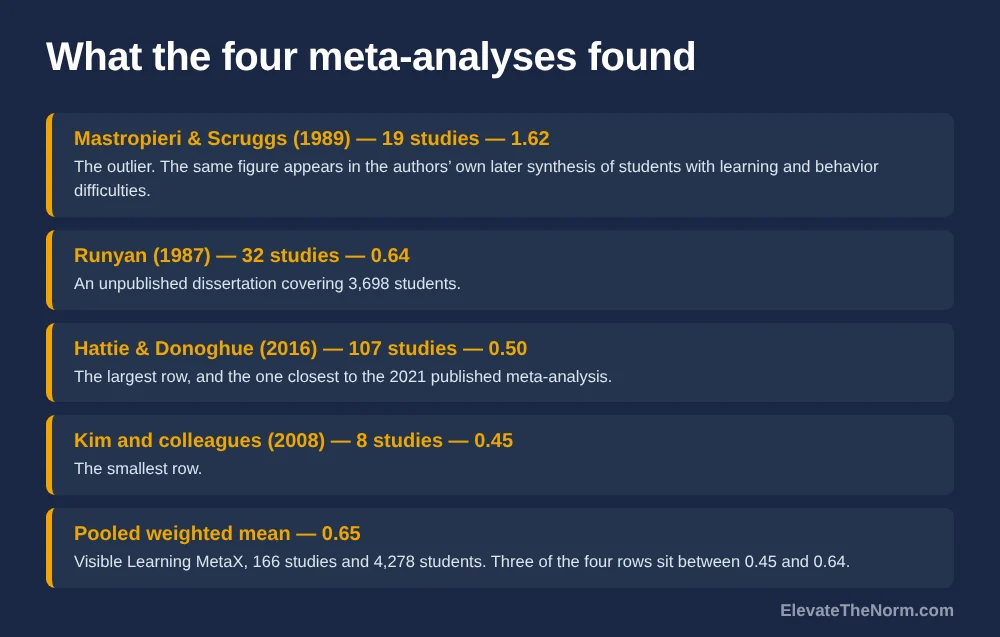
Strip the outlier out and you get a technique that moves the needle somewhere around half a standard deviation on the tasks it suits. That is still a real effect. It is just not magic, and it is not the number on the poster.
Which kind of mnemonic should I use?
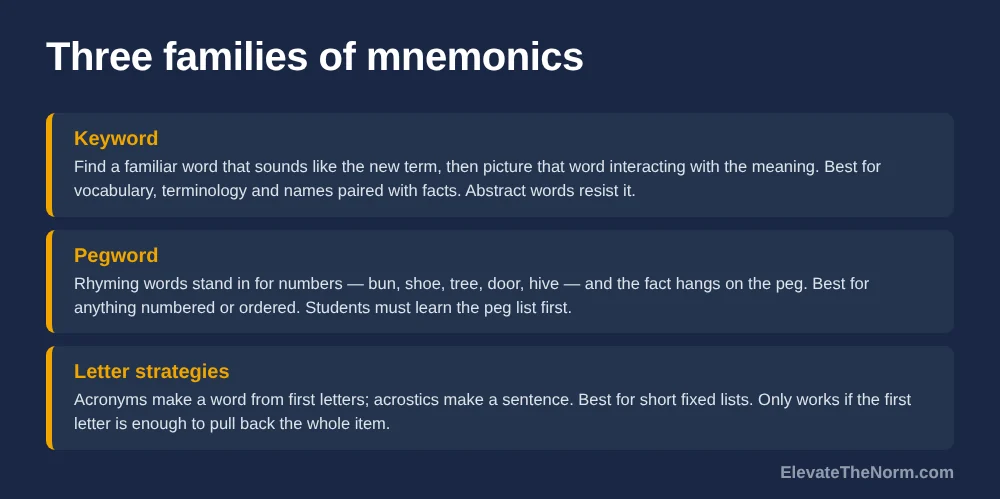
There are three well-studied families, and they do different jobs. The Access Center, a project funded by the U.S. Department of Education and run by the American Institutes for Research, puts it simply: “There are at least three distinct methods for teaching mnemonics: keyword, pegword, and letter strategies.” Pick by the shape of what students have to remember, not by what sounds fun.
| Family | How it works | Best for | Grades 6–12 example | Main drawback |
|---|---|---|---|---|
| Keyword | Find a familiar word that sounds like the new term, then picture that word interacting with the meaning | Vocabulary, terminology, names paired with facts | Catapult as a cat pole-vaulting over a castle wall in a medieval unit | Needs a term that sounds like something concrete. Abstract words resist it |
| Pegword | Rhyming words stand in for numbers — bun, shoe, tree, door, hive — and the fact hangs on the peg | Anything numbered or ordered: dates, ranks, sequences | Sugar Act 1764, Stamp Act 1765, Townshend Acts 1767 pegged to bun, shoe and tree | Students must learn the peg list first, which is itself memorizing |
| Letter strategies | Acronyms make a word from first letters. Acrostics make a sentence from them | Short fixed lists where order matters | HOMES for the Great Lakes. FACE for the treble clef spaces | Only works if the first letter is enough to pull back the whole item |
One detail in the keyword method is not optional and gets skipped constantly. Mastropieri and Scruggs are explicit that the keyword and the meaning must be doing something together in the picture: “It is important that these two things actually interact and are not simply presented in the same picture.” A bear arguing a case is a keyword mnemonic for barrister. A bear standing next to a lawyer is a drawing.
Letter strategies carry an assumption worth saying out loud, because it is where acronyms fail. The same authors note that “most acronyms assume that a name of something will be remembered when the first letter is retrieved.” HOMES works because a student who gets an H can produce Huron. An acronym for five causes of a war does not work, because no student recovers “economic nationalism” from the letter E.
What are mnemonics good at, and what are they not?
Mnemonics are good at holding arbitrary information in place. They are not good at building understanding, and the people who have studied them longest say so without hedging. Mnemonic instruction, in Mastropieri and Scruggs’ words, consists of “memory strategies, and not comprehension strategies.”
They add the sentence that should end most staffroom arguments about this. Students trained in mnemonics do often score better on comprehension tests — “but that is generally because they remember more information.” The mnemonic put the facts within reach. The thinking still had to happen somewhere else.
The meta-analytic evidence points the same direction from a different angle. Donoghue and Hattie’s 2021 review in Frontiers in Education pooled 242 studies, 1,619 effects and 169,179 participants across ten learning techniques, for an overall mean of 0.56. Their stated limitation is the part a teacher needs: “A major limitation was that the majority of studies … were based on surface or factual outcomes,” and they caution that the findings should be applied carefully to “deeper and more relational outcomes.”
So the honest statement of what a mnemonic buys you is narrow and useful: it reduces the cost of holding facts so that working memory has room for the actual task. That is the same argument cognitive load theory makes about everything else you do to clear a student’s desk before asking them to think.
And it is also why a mnemonic is not a study plan. If a student’s whole preparation is acronyms, they have memorized the labels on a map they cannot read. The techniques that actually build durable learning — spacing, retrieval, mixing problems up — are covered in what actually works when students study and in the case for mixing practice up.
Why do mnemonics sometimes make students forget faster?
Because a cue that works on Friday can be gone by the unit test, and because building the cue can substitute for the practice that would have made the material stick. This is the single most important finding in the mnemonics literature and it is almost never repeated in teacher-facing content.
Dunlosky, Rawson, Marsh, Nathan and Willingham reviewed ten learning techniques for Psychological Science in the Public Interest and rated each one for classroom utility. The keyword mnemonic — the best-studied mnemonic there is — landed in the low group, alongside summarizing, highlighting and rereading. Their reason, in full: the keyword mnemonic “is difficult to implement in some contexts,” and “it appears to benefit students for a limited number of materials and for short retention intervals.”
The durability problem has teeth. The review reports that when researchers equated the groups properly, “performance on the delayed test was significantly better for the rote-repetition group than for the keyword-mnemonic group,” and draws the conclusion directly: “These data suggest that the keyword mnemonic leads to accelerated forgetting.” Plain repetition beat the clever technique once you waited.
Two more results from the same review belong on the same page as the enthusiasm:
- The material has to cooperate. The review notes that “the vast majority of the research on the keyword mnemonic has involved materials that afforded its use,” and that even proponents acknowledge benefits “may be limited to keyword-friendly materials.” In one study of English definitions that did not lend themselves to keywords, a control group outperformed the keyword group — even when the keywords were handed to them.
- It has already failed with older students once. In the classroom studies the review describes, fifth graders learning keyword-friendly Spanish vocabulary did substantially better than controls — while for high school language students the mnemonic “did not benefit recall.” That is the age band this site writes for, and it is a miss, not a win.
None of that makes mnemonics useless. It makes them a tool with a short handle. Use one to get a list into reach, then make students do something with the list.
Should students build their own mnemonic, or should I give them one?
Give them one when the content is hard or the clock is short, and let them build their own when you can afford the time. The evidence does not favour student-generated mnemonics the way teacher instinct does, and that is an uncomfortable finding for anyone who believes students should always do the work themselves.
Dunlosky and colleagues report the results on self-generated keywords as genuinely mixed: sometimes students’ own keywords work as well as the ones researchers supply, and sometimes they do not. For complex material, the review notes, some students struggle to generate a usable keyword even after extensive training.
Mastropieri and Scruggs are blunter about the cost: when students create their own, “instruction may proceed at a much slower rate,” and their performance may come in lower than when the teacher supplies the strategy. The Access Center points at a middle-school study of 18th–20th century inventions in which students “had difficulty using mnemonic strategies independently,” and concludes the teacher may simply do better providing the keyword.
There is also an access point hiding in here. The review notes that students who have trouble generating mental images benefit from the keyword method only when the keyword and the interactive image are supplied for them. Not every student pictures things on demand, and that is a difference in how people think rather than a deficit. Handing the picture over removes a barrier that has nothing to do with whether the student knows the content.
The practical read for grades 6–12: hand students the mnemonic for the content that has to be in place by Thursday, and let them build their own when the point of the exercise is engagement with the vocabulary rather than coverage. Building one is a decent vocabulary activity in its own right. It is just a slow way to get thirty kids to the same place.
How do I teach a mnemonic in a grades 6–12 classroom?
Teach it as a five-minute routine, not a lesson. The content the mnemonic covers is usually worth about five minutes of direct attention, and the rest of the period should be spent using what the mnemonic made available.
- Decide whether the content is arbitrary. If a student could reason their way to the answer, skip the mnemonic and teach the reasoning. Mnemonics are for pairs with no logic in them — terms and definitions, dates, ranks, ordered lists.
- Pick the family that fits the shape. Ordered or numbered content takes a pegword. A term that sounds like something concrete takes a keyword. A short fixed list whose first letters are recoverable takes an acronym or acrostic.
- Make the image interact. Say the keyword, say the meaning, and describe them doing something together in one sentence. If you cannot describe the interaction, the mnemonic is not finished.
- Make them retrieve it the same day, without looking. This is the step that answers the accelerated-forgetting problem. The mnemonic gets the pair into memory; retrieval is what keeps it there. One cold question at the end of the period costs nothing.
- Come back to it after the unit moves on. Put the item in a warm-up two weeks later. If the mnemonic has decayed, you have found that out while it is still cheap to fix.
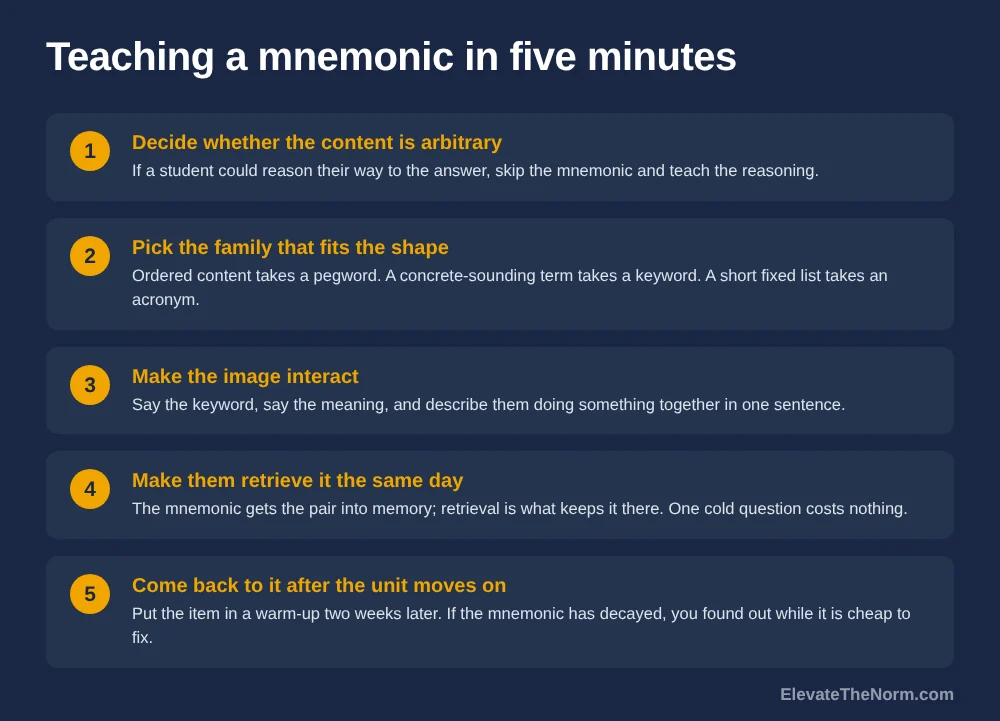
Steps four and five are the ones that convert a party trick into learning, and they are the ones most mnemonic advice leaves out entirely. A mnemonic without retrieval behind it is the kind of pleasant, fluent-feeling study that students rate highly and perform badly on — the pattern described in telling a difficulty that pays from one that just costs.
When should I skip the mnemonic entirely?
Skip it whenever the content has its own logic, whenever the term resists a concrete image, and whenever building the device would cost more class time than the fact is worth. Run the list below before you spend a period on one.
- The content is explainable. Causes, mechanisms and arguments are not arbitrary pairs. A mnemonic for them hides the reasoning you wanted students to do.
- The term is abstract. If nothing about the word suggests a picture, the keyword method is the wrong family — and forcing one can leave students worse off than straight practice.
- The acronym cannot be unpacked. If a student who recovers the letter still cannot recover the item, the acronym is decoration.
- There is no plan to retrieve it later. Without that, you are building something designed to be forgotten on a predictable schedule.
- It is doing the job a better tool already does. For word learning specifically, a structured format like the Frayer model asks students to handle meaning, not just retrieve a label.
What Clay thinks mnemonics are worth
They are worth about five minutes and no more, and the reason to use them is respect for students’ time rather than enthusiasm for the technique.
Here is the judgment, offered as a judgment and not as a finding. Secondary students are asked to memorize a fair amount of genuinely arbitrary material. Pretending otherwise does not help them; it just means they memorize it badly, late, and alone the night before. A mnemonic is an honest admission that part of the content is arbitrary, paired with an efficient way to deal with it so the class can get on to the part that is not.
What I would not do is let a mnemonic stand in for the work. Mastropieri and Scruggs, who have every reason to oversell their own field, instead write that mnemonic strategies “do not represent an educational panacea.” When the people who built the research say that, the sensible response is to believe them. A room full of students who can recite an acrostic and cannot explain what the items mean has learned a sentence, not a subject — and they will know the difference before you do.
Treat teenagers as people who can hear the distinction. “This part is arbitrary, here is a trick for it, now let’s do the thinking” is a sentence a fifteen-year-old respects. It is also true.
One warning for anyone thinking about this at a scale larger than one classroom. The largest measured effects in this literature come from studies of students with learning and behavior difficulties, and that is exactly the result most likely to get misread. It would be easy to turn mnemonics into the standard intervention menu for the students who are already furthest behind — which would hand them memory tricks while their classmates get the reasoning. The finding is that these students respond well to a memory aid. It is not a finding that a memory aid is what they need instead of the content.
Where to start
Pick one list in your next unit that students always lose — the one you reteach every year and still see missed on the test. Decide which of the three families fits its shape. Build the mnemonic yourself, teach it in five minutes, and ask for it cold at the end of the period and again two weeks later. If it survives the second ask, you have found a permanent five-minute saving. If it does not, you have learned that the list needs practice rather than a trick, which is worth knowing too.
Frequently Asked Questions
What is a mnemonic device?
A mnemonic device is a deliberate memory aid that links hard-to-recall information to a cue that is easy to picture or say. HOMES for the Great Lakes is one. So is picturing a bear arguing a case to remember that a barrister is a lawyer. The device supplies a connection that the content itself does not provide.
Do mnemonic devices really work?
Yes, for a narrow job. The Visible Learning database pools four meta-analyses into a weighted mean effect size of 0.65 across 166 studies. Three of the four sit between 0.45 and 0.64, and the fourth, a 1.62 from 19 studies, comes from research on students with learning and behavior difficulties. Treat half a standard deviation as the realistic figure.
What are the three main types of mnemonic devices?
Keyword, pegword and letter strategies. Keyword mnemonics attach a term to a familiar word that sounds like it and then picture the two interacting. Pegword mnemonics use rhyming stand-ins for numbers, such as bun, shoe and tree, to hold ordered or numbered content. Letter strategies build an acronym or an acrostic from the first letters of a short fixed list.
Do mnemonics help students understand material, or only remember it?
Only remember it. Mastropieri and Scruggs, who studied mnemonic instruction for decades, describe them as memory strategies and not comprehension strategies. Trained students do often score better on comprehension tests, but as those authors put it, that is generally because they remember more information. The understanding has to be built somewhere else in the lesson.
How long does a mnemonic last?
Often not as long as teachers assume. Dunlosky and colleagues report that in a study where groups were properly equated, delayed-test performance was significantly better for a rote-repetition group than for a keyword-mnemonic group, and they conclude the mnemonic leads to accelerated forgetting. A mnemonic needs retrieval practice behind it or the cue decays.
Are mnemonics too childish for high school students?
The format can be, the technique is not. Acting out a rhyme reads as babyish to a sixteen-year-old; being told plainly that part of the content is arbitrary and here is an efficient way to hold it does not. Name what you are doing and why. Teenagers object to being talked down to, not to being handed a shortcut that works.
Should students create their own mnemonics or should the teacher supply them?
Supply them when the content has to be in place quickly. The evidence on self-generated keywords is mixed, and Mastropieri and Scruggs note that when students build their own, instruction may proceed at a much slower rate and performance may be lower. One middle-school study found students had difficulty using mnemonic strategies independently. Let students build their own when the building is the point.
Are mnemonics just rote memorization under another name?
They are a more efficient form of it, and that is the honest description. The useful question is not whether memorizing is good, but whether a particular fact is arbitrary. Dates, terms and ordered lists have no internal logic to reason from, so a memory aid is the efficient route. Anything explainable should be explained instead.
Sources
- Dunlosky, J., Rawson, K. A., Marsh, E. J., Nathan, M. J., & Willingham, D. T. (2013). Improving Students’ Learning With Effective Learning Techniques: Promising Directions From Cognitive and Educational Psychology. Psychological Science in the Public Interest, 14(1), 4–58. Full text. Source of the low-utility rating, the “limited number of materials and … short retention intervals” wording, the rote-repetition delayed-test result and the accelerated-forgetting conclusion, the keyword-friendly materials caveat, the English-definitions study in which a control group outperformed the keyword group, the fifth-grade Spanish result, the high-school language result, and the mixed findings on self-generated keywords. Sections 5.1 to 5.4 were read; the section’s own overall-assessment paragraph could not be retrieved, so the rationale quoted here is the one given in the paper’s introduction.
- Donoghue, G. M., & Hattie, J. A. C. (2021). A Meta-Analysis of Ten Learning Techniques. Frontiers in Education, 6, 581216. Full text. Source of the 242 studies / 1,619 effects / 169,179 participants counts, the overall mean of 0.56, the 65 percent undergraduate and 11 percent secondary participant breakdown, and the authors’ stated limitation about surface and factual outcomes. No mnemonic-specific effect size is quoted from this paper here, because the figure appears in a portion of the page that could not be read verbatim; the closely matching 0.50 is attributed below to the database row that reports it.
- Visible Learning MetaX, Mnemonics (version 1.4, updated February 2026). Database entry. Source of the weighted mean of 0.65, the four meta-analyses, the 166 studies and 4,278 students, the “potential to considerably accelerate” rating, and the four individual rows: Hattie & Donoghue (2016) 107 studies at 0.50, Runyan (1987) 32 studies at 0.64, Mastropieri & Scruggs (1989) 19 studies at 1.62 and Kim and colleagues (2008) 8 studies at 0.45. This is an aggregation database, not a study. The four underlying meta-analyses were not read for this article and are not cited as if they had been.
- Scruggs, T. E., & Mastropieri, M. A. (2000). The effectiveness of mnemonic instruction for students with learning and behavior problems: An update and research synthesis. Journal of Behavioral Education, 10(2), 163–173. Abstract. Source of the 1.62 figure and the “unusually large effect for treatment” wording. Only the abstract could be retrieved, so the study count, sample sizes and stated limitations are not reported here. The abstract gives the population as students with learning and behavior difficulties and gives no age or grade breakdown.
- Mastropieri, M. A., & Scruggs, T. E. Enhancing School Success with Mnemonic Strategies. LD OnLine, an educational service of public television station WETA. Article. Source of the keyword-interaction requirement, the acronym first-letter assumption, the pegword list, the memory-strategies-not-comprehension-strategies distinction, the “remember more information” explanation, the “educational panacea” line and the slower-instruction finding on student-generated mnemonics. This is a practitioner article and the page carries no publication date; its newest reference is from 1997, and some disability terminology in the original is now outdated and is not reproduced here.
- The Access Center (American Institutes for Research, under a cooperative agreement funded by the U.S. Department of Education, Office of Special Education Programs). Using Mnemonic Instruction to Facilitate Access to the General Education Curriculum. LD OnLine. Article. Source of the three-family taxonomy and its wording, the Sugar Act / Stamp Act / Townshend Acts pegword example, the catapult keyword example, and the middle-school inventions study in which students “had difficulty using mnemonic strategies independently.” The page reports no effect sizes and carries a disclaimer that its views do not necessarily represent Department of Education policy.
- What is not cited, and why. Putnam’s 2015 review Mnemonics in Education: Current Research and Applications is the obvious modern overview of this topic and is not cited here, because no copy of it could be opened from this session — one host rate-limited the request and the publisher’s site refuses automated access. The four meta-analyses listed inside the Visible Learning entry were likewise not opened and are named only as that database reports them. No number in this article comes from a source that was not read.