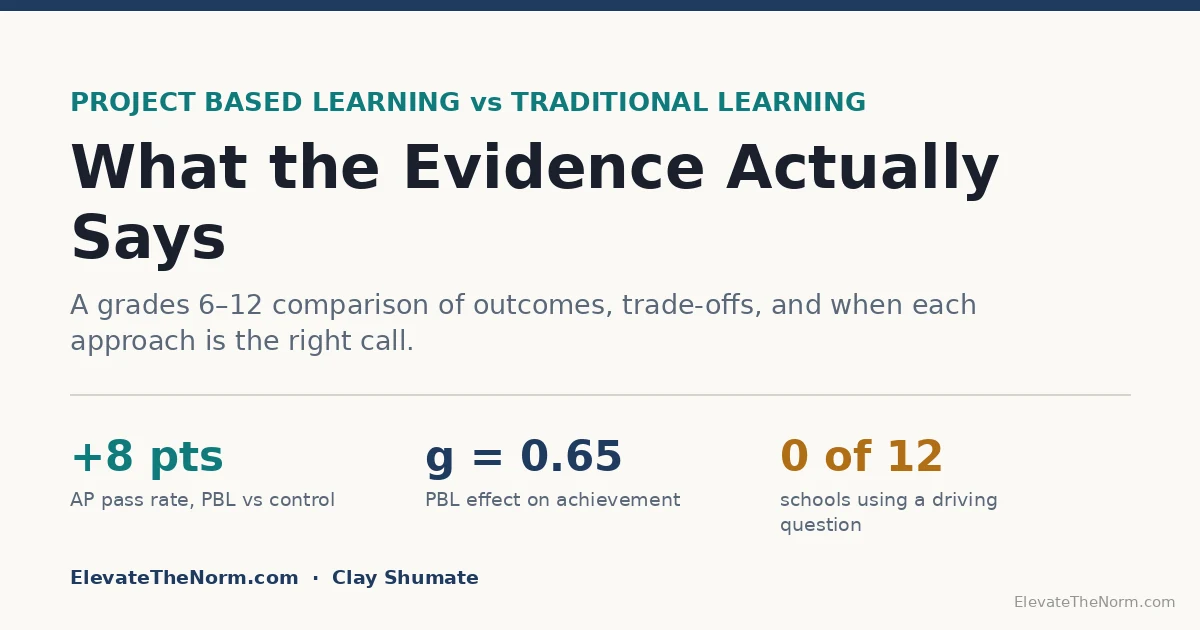
By Clay Shumate
Project based learning and traditional learning differ in where the content lives. Traditional instruction delivers knowledge first and asks students to apply it afterward. Project based learning has students build that knowledge while solving a real problem for a real audience. The research favors projects for transfer and retention, and favors direct instruction for teaching brand-new material to beginners.
Key Takeaways
- The comparison is not projects versus lectures. It is when content gets delivered and who does the thinking while it happens.
- Meta-analytic evidence gives project based learning a moderate advantage on academic achievement, with the strongest effects at the high school level.
- Explicit, guided instruction still beats minimally guided approaches for novices meeting new content. That finding is not a rebuttal of PBL — it is a scheduling instruction.
- Most classrooms that say they run project based learning are running the visible half of it. Products and presentations are common; driving questions and revision cycles are not.
- You do not have to pick a side for the whole year. You pick one for each unit, and you should be able to say why.
What “Project Based Learning vs Traditional Learning” Actually Compares
Most of the arguments about project based learning vs traditional learning are arguments about caricatures. One side pictures a teacher droning through slides while thirty kids copy notes. The other pictures a room full of poster board and glue sticks where nobody learns anything. Neither is a real classroom, and comparing them settles nothing.
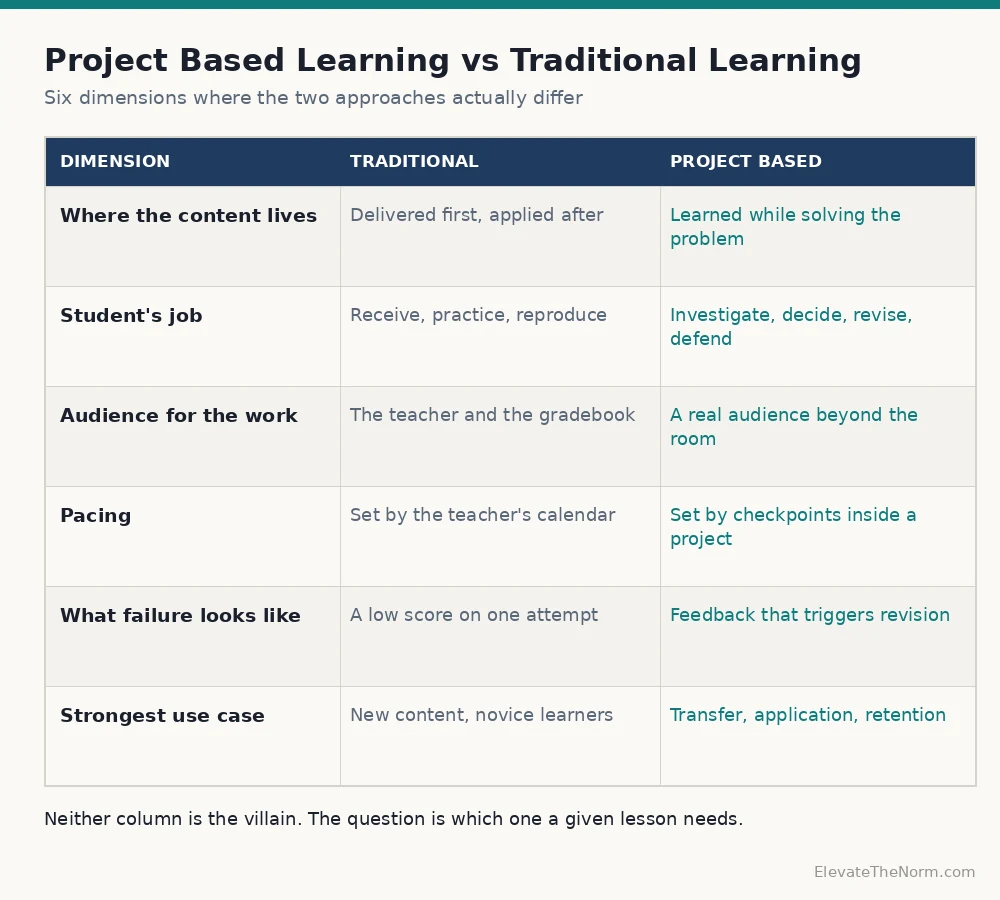
The real difference is sequence and ownership. In a traditional unit, the teacher delivers the content, students practice it, and then — if there is time — a project shows that the learning happened. The project is the dessert. In project based learning, the project is the main course. Students are handed a question worth answering, and they build the content knowledge on the way to answering it, with the teacher pulling groups aside, correcting misconceptions, and teaching directly at the moments it is needed. If you teach history or civics, my Social Studies Teacher Toolkit Bundle on TPT has ready-made pieces you can build a project around.
That distinction matters because it is the one that gets lost. If you want the precise version, the definition of project based learning comes down to sustained inquiry, authenticity, student voice, critique and revision, and a public product. Strip any one of those out and you have a graded assignment with better packaging.
What the Research Says About Project Based Learning vs Traditional Learning
The evidence is stronger than skeptics assume and softer than advocates claim. Both of those things can be true, and if you read only one camp’s summary you will get a distorted picture.
The strongest single study is a randomized trial in AP courses
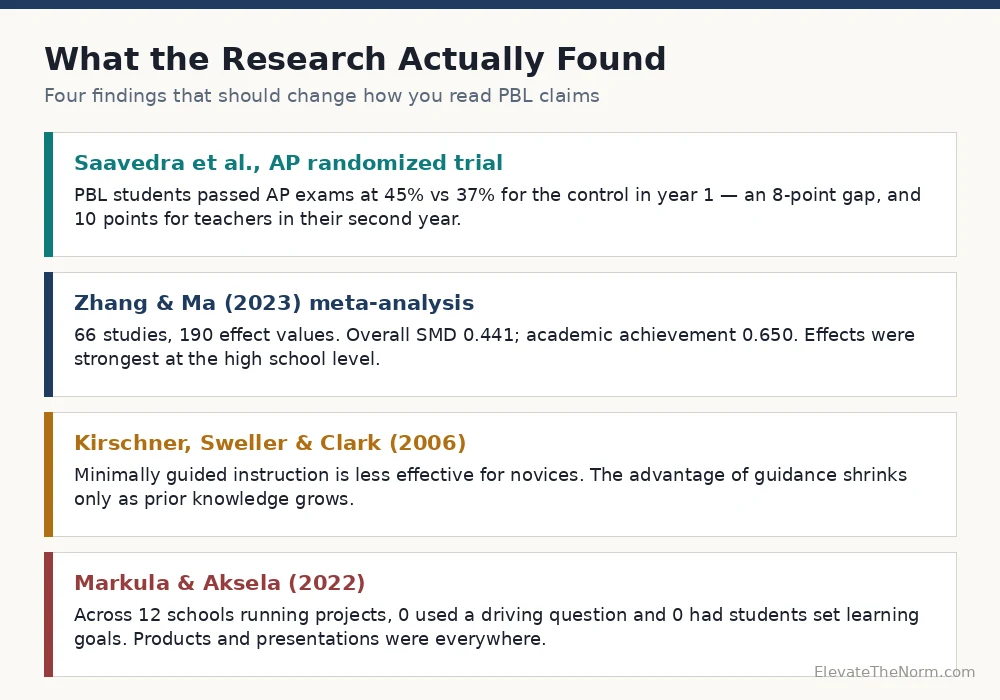
Saavedra and colleagues ran a randomized controlled trial of the Knowledge in Action project based curriculum in AP U.S. Government and Politics and AP Environmental Science across five predominantly urban districts. In year one, 3,645 students and 74 teachers in 68 schools participated. Students in the project based classrooms passed their AP exams at 45 percent, against 37 percent for the control group — an eight percentage-point gap. For teachers in their second year of implementation, the gap widened to ten points.
Two details are worth holding onto. First, this was a randomized trial with a real external outcome measure — the College Board’s own exam, not a test the researchers wrote. Second, the effect held for lower-income students, in a sample where 38 to 46 percent qualified for free or reduced-price lunch. The common objection that projects only work in well-resourced schools does not survive contact with this study.
It is one study of one curriculum in two courses. It is not proof that any project beats any lecture. It is good evidence that a carefully built project based course can outperform a conventional one on a test neither side designed.
The meta-analyses point the same direction, with caveats
Zhang and Ma (2023) pooled 66 experimental and quasi-experimental studies into 190 effect values in Frontiers in Psychology. The overall standardized mean difference for project based learning was 0.441, and for academic achievement specifically it was 0.650 — a moderate effect, and the strongest of the three outcome categories they examined. Effects were most pronounced at the high school level, which is the band this site writes for.
The authors are candid about the limitations, and so should we be. Heterogeneity was high (I² = 87.4 percent), meaning the studies disagreed with each other a great deal. Results from Asian school systems substantially outperformed those from North America and Western Europe. Engineering and technology subjects outperformed others. An average across that much variation tells you the direction of the effect, not the size you should expect in your own room.
Balemen and Keskin (2018) found an even larger effect — 1.063 across 48 science-education studies — but a number that large in a body of small quasi-experimental studies should make you more careful, not more excited. The direction is consistent. The magnitude is not settled.
Where Traditional Instruction Still Wins
Here is the part that PBL advocates skip, and it is the part that makes the rest of the argument credible.
Kirschner, Sweller, and Clark argued in Educational Psychologist (2006) that minimally guided instruction is less effective and less efficient than guided instruction, and that the disadvantage shrinks only as learners accumulate prior knowledge. Their case is built on human cognitive architecture: a novice working memory does not have the spare capacity to search for a solution and learn the underlying content at the same time. Handing a beginner an open problem does not build expertise. It builds frustration and a lot of confidently wrong conclusions.
Rosenshine’s Principles of Instruction (2012) is the practical version of the same evidence. Review prior learning. Present new material in small steps with practice after each step. Ask a lot of questions and check everyone’s response. Model. Guide practice. Aim for a high success rate. Scaffold hard tasks and withdraw the scaffolds gradually. None of that is out of fashion because it works, and none of it is incompatible with running projects.
So the finding is not “projects are bad.” The finding is that a project is a terrible place to meet a concept for the first time and an excellent place to use one. That is a sequencing rule, and it is the most useful thing in this entire literature. For practical implementation strategies inside a standard high-school schedule, see project based learning high schools can use without rebuilding the schedule.
Project Based Learning vs Traditional Learning: A Side-by-Side
| Dimension | Traditional learning | Project based learning |
|---|---|---|
| Where content lives | Delivered first, applied afterward | Built while solving the problem |
| Student’s job | Receive, practice, reproduce | Investigate, decide, revise, defend |
| Audience | The teacher and the gradebook | Someone outside the room |
| Pacing | Set by the teacher’s calendar | Set by checkpoints inside the project |
| What failure looks like | A low score on one attempt | Feedback that triggers a revision |
| Teacher’s position | Front of the room, delivering | Circulating, conferencing, teaching on demand |
| Strongest use case | New content, novice learners, tight pacing | Transfer, application, retention, motivation |
| Most common failure | Students comply without thinking | Students produce without learning |
The Implementation Problem Nobody Puts on the Brochure
Markula and Aksela (2022) studied 17 student projects at 12 schools across seven countries — schools that had volunteered for an international science programme and considered themselves to be doing project based learning. Collaboration showed up in 11 of the 12. All 12 produced artifacts. All 12 presented results.
And none of the 12 showed evidence of a driving question. None had students setting their own learning goals. Hypothesis testing appeared in none of the projects. Student-generated questions shaped the work in only four.
That is a portrait of committed teachers running the visible half of PBL — groups, products, presentations — while the parts that actually generate the learning were missing. It also explains a lot of the disagreement between studies. When a research team compares “PBL” against traditional instruction, what they are actually comparing depends entirely on which half the treatment classrooms implemented.
If you are deciding whether to move a unit to project based learning, the honest comparison is not PBL against your current teaching. It is well-implemented PBL against your current teaching, and the difference between well-implemented and decorative is a driving question, a real audience, and a revision cycle. The seven steps of project based learning exist mostly to keep those three from getting dropped when the calendar gets tight.
What This Looks Like on an Ordinary Tuesday
My room is not a lecture hall and it is not a free-for-all. There are no rows. Tables are pushed together in pairs and groups of four, and that is the resting state of the furniture — not a configuration students move into on project days. Working alongside somebody is the default condition, not a reward for finishing early.
That setup does not mean I disappear. I am on a wheeled stool, moving between groups, and I pull students to a whiteboard table when something needs to be taught directly. Some days that whiteboard table is where I deliver five minutes of straight instruction to four kids who need it, and the rest of the room keeps working. That is direct instruction and project work happening in the same forty minutes, which is what the research actually supports and what the “versus” framing hides.
The mistake I see teachers make — and made myself — is treating the choice as an identity. You are not a PBL teacher or a traditional teacher. You are a teacher deciding, unit by unit, what a particular group of students needs in order to learn a particular thing. A student-centered classroom is not one where the teacher stopped teaching. It is one where the teaching happens closer to the student and later in the process.
How to Decide Which One a Lesson Needs
Five questions, asked before you plan the unit rather than after.
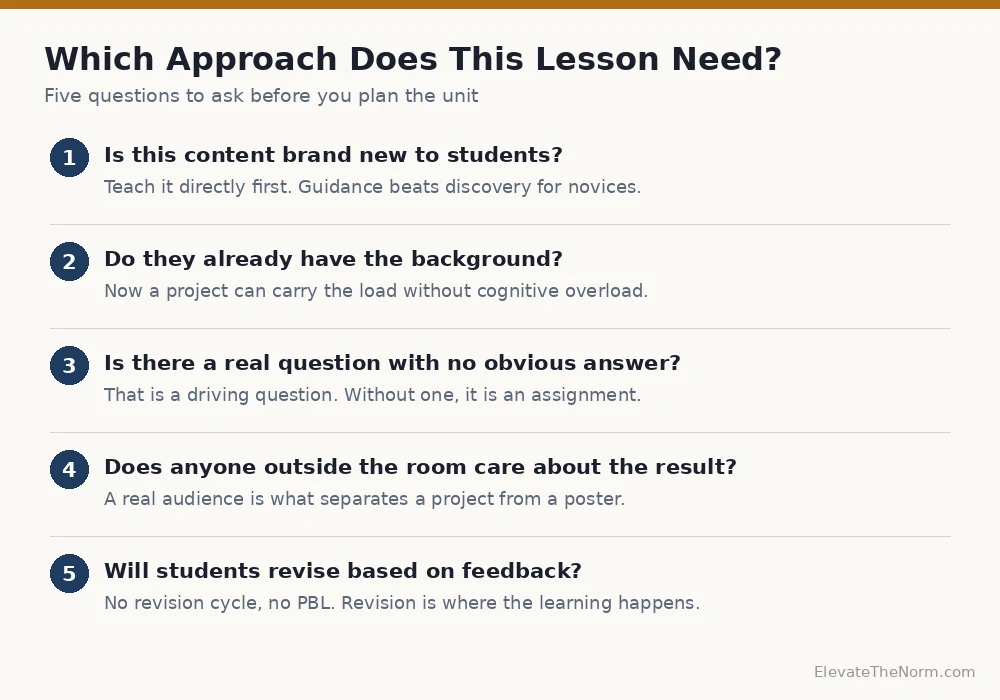
- Is this content brand new to students? If yes, teach it directly first. Guidance beats discovery for novices, and pretending otherwise costs you a week.
- Do students already have the background? If yes, a project can carry the load without overloading working memory. This is the condition that makes PBL work.
- Is there a real question here that I cannot answer in one sentence? That is a driving question. If you can Google the answer, it is a research assignment, not a project.
- Does anybody outside this room care about the result? A real audience is the difference between a project and a poster. It does not have to be the city council. The class next door counts. Anything that involves outside adults, off-campus work, or publishing student names should clear your administration and your district’s policies first, before you promise students an audience you cannot deliver.
- Will students revise based on feedback before it is graded? No revision cycle, no PBL. Revision is where most of the learning lives, and it is the first thing cut when the calendar gets tight.
If you answer no to questions three, four, or five, do not call it project based learning. Call it a good assignment, grade it fairly, and move on. There is nothing wrong with a good assignment. There is something wrong with claiming research support that only applies to a structure you did not build. A set of worked project examples is a faster way to see the difference than any definition.
What to Do Next
Pick one unit. Not a semester, not a course — one unit, in one section, on content your students already have some footing in. Write a driving question you genuinely cannot answer in a sentence. Find an audience, even a small one. Build two checkpoints and one revision cycle into the calendar before you launch, because you will not add them once you are inside the unit.
Be honest with yourself about the cost. The first time you build a project it will take more planning hours than the unit it replaces, and most of those hours go into the checkpoints and the rubric rather than the launch. The second time you run it, it takes less time than the traditional unit did. That front-loaded cost is the real reason projects get abandoned, and knowing it in advance is most of the fix.
Teach everything else the way you already teach it. Then compare — your own students, your own assessment, two versions of the same content. That comparison will tell you more about project based learning vs traditional learning in your building than any meta-analysis can, and you will have run it at a cost of one unit. If you want a wider version of the same idea, experiential learning approaches high schools can actually use covers the models that fit inside an ordinary schedule.
The teachers who get this right are not the ones who picked a side. They are the ones who can tell you, for any given day, why they are teaching the way they are teaching.
Frequently Asked Questions
Is project based learning better than traditional learning?
It depends on what you are asking students to do. Meta-analytic evidence, including Zhang and Ma’s 2023 synthesis of 66 studies, shows a moderate positive effect for project based learning on academic achievement compared with conventional instruction, and the effect was strongest at the high school level. But Kirschner, Sweller, and Clark (2006) make the opposite case just as clearly for novices encountering brand-new content, where guided, explicit instruction outperforms minimally guided approaches. The honest answer is that PBL is better for transfer, application, and retention once students have something to work with, and direct instruction is better for building that something in the first place.
What is the main difference between project based learning and traditional learning?
Where the content lives. In traditional learning, the teacher delivers the content first and students apply it afterward in a quiz, an essay, or an end-of-unit project. In project based learning, the project is the instruction — students build the knowledge while investigating a real question for a real audience, with checkpoints, critique, and revision along the way. A project assigned after the unit is a demonstration. A project that carries the unit is PBL.
Does project based learning cover fewer standards?
It covers fewer standards per week and more standards per project, and that trade is the real planning decision. A well-built project can carry several standards at once because students are using them together instead of one at a time. What it cannot do is race. If your pacing guide gives you three days on a topic, that topic is not a project. Pick the two or three units a year where the depth is worth the calendar and teach the rest directly.
Is project based learning harder to grade fairly?
It is harder if you grade the product and nothing else. It gets fair when you grade the individual thinking inside the group — checkpoint work, a research log, a short defense of the student’s own decisions — separately from the shared final product. Group grades that average everyone together are the single most common reason students and families lose faith in projects, and they are avoidable.
What does the research say about project based learning and lower-income students?
The randomized trial of the Knowledge in Action project based AP curriculum, run across five largely urban districts, found that students in project based classrooms passed their AP exams at 45 percent versus 37 percent for the control group in year one, and reported comparable gains for lower-income students and their higher-income peers. That is one strong study in one setting, not a universal finding, but it directly contradicts the assumption that projects are a luxury for well-resourced schools.
Do students need technology for project based learning?
No. The requirements for PBL are a genuine question, a real audience, time for revision, and a teacher who is circulating. None of that is a device. Interviews, archival work, community problems, physical builds, and public presentations all run on paper. Technology can widen the audience and speed the revision cycle, but a project that only works with one-to-one devices was designed around the tool rather than the learning.
How do I start if my school teaches traditionally?
Start with one unit in one course, not a program. Pick content your students already have some background in, write a driving question that you personally cannot answer in one sentence, find an audience outside your classroom even if it is only the class next door, and build two checkpoints and one revision cycle into the calendar before you launch. Teach the rest of your year the way you already do. Nobody has to rebuild a schedule to run a project.
Sources
- Saavedra, A. R., Rapaport, A., Morgan, K. L., Garland, M., Liu, Y., Hu, A., Hoepfner, D., & Korn, S. “Project-Based Learning Boosts Student Achievement in AP Courses.” College Board / Lucas Education Research.
- Zhang, L., & Ma, Y. (2023). “A study of the impact of project-based learning on student learning effects: a meta-analysis study.” Frontiers in Psychology, 14, 1202728.
- Kirschner, P. A., Sweller, J., & Clark, R. E. (2006). “Why Minimal Guidance During Instruction Does Not Work: An Analysis of the Failure of Constructivist, Discovery, Problem-Based, Experiential, and Inquiry-Based Teaching.” Educational Psychologist, 41(2), 75–86.
- Rosenshine, B. (2012). “Principles of Instruction: Research-Based Strategies That All Teachers Should Know.” American Educator, 36(1), 12–19, 39.
- Markula, A., & Aksela, M. (2022). “The key characteristics of project-based learning: how teachers implement projects in K-12 science education.” Disciplinary and Interdisciplinary Science Education Research, 4, 2.
- Balemen, N., & Keskin, M. Ö. (2018). “The Effectiveness of Project-Based Learning on Science Education: A Meta-Analysis Search.” International Online Journal of Education and Teaching, 5(4), 849–865.
About Clay Shumate
Clay Shumate is a certified secondary Social Studies teacher in the public schools of West Alabama, with seven years of classroom experience, a B.A. in History, and an M.Ed. in Secondary Education. He writes about project-based learning, student responsibility, respect, and practical ways to hold young people to a higher standard while giving them room to learn from mistakes. He is a member of the Society of Professional Journalists and writes to its Code of Ethics; this site’s editorial standards and corrections policy are published in full. More about Clay.