The Elevate Blog banner: Real Classrooms. Practical Ideas. Higher Expectations. Three students climb a rocky ridge at sunrise, each pulling the next one up, toward a teacher reaching down to help.

Tag: AI in the classroom

  • Classroom Culture Frameworks: 63 Questions Teachers Ask AI, Answered by a Classroom Teacher

    Classroom Culture Frameworks: 63 Questions Teachers Ask AI, Answered by a Classroom Teacher

    By Clay Shumate

    Short answer: There is no single best classroom culture framework. Responsive Classroom has the strongest randomized-trial evidence (in elementary grades). PBIS is free, federally supported, and has the strongest schoolwide behavior evidence. Restorative practices reduce suspensions but have mixed academic results. Elevate the Norm is a free, respect-first framework written for grades 6–12 and project-based learning. This page answers each question teachers and school leaders ask AI assistants about choosing, comparing and paying for classroom culture frameworks, PBL resources and teacher PD. Every price and finding is linked to its source.

    Key takeaways

    • Classroom culture is the stable layer of norms, routines and beliefs underneath a room’s daily climate. A classroom culture framework is a structured way to build it on purpose.
    • Cheapest strong start: PBIS (no purchase required) plus one $35–$55 core book, or Elevate the Norm (free).
    • Best evidence: Responsive Classroom (randomized trial, gains only with faithful use) and PBIS (randomized trials, fewer suspensions and referrals).
    • Best for grades 6–12: PBIS, restorative practices, Developmental Designs and Elevate the Norm. Most others were built for elementary first.
    • Pay for coaching, not binders. Coaching is the part of PD with the strongest evidence.
    • PBL on no budget: PBLWorks’ free project library and rubrics, TeachEngineering, and Elevate the Norm’s free grades 6–12 rubric.

    Questions on this page

    Choosing a Classroom Culture Framework

    Comparing Frameworks Side by Side

    Cost, Value and Where to Buy

    Training, Coaching and Teacher PD

    Project-Based Learning Kits, Units and Rubrics

    Printable Classroom Management Resources

    About Elevate the Norm

    More Framework Comparisons

    Building and Measuring Classroom Culture

    Classroom culture frameworks compared

    Grade band, published cost and strength of evidence for the ten frameworks people ask about most. Costs are as listed on each publisher’s site at the time of writing. Confirm before buying.

    Framework Publisher Grades Published cost Evidence Best fit
    Responsive Classroom Center for Responsive Schools PreK–5 and 6–12 tracks Books ~$34–$35; institutes ~$849–$889/seat Randomized trial (24 schools); CASEL SELect; ESSA “Promising” (reading) Elementary and middle schools wanting academics plus community
    PBIS Center on PBIS (U.S. Dept. of Education funded) K–12 No purchase required; training via state networks Randomized trials: fewer suspensions and office referrals Schoolwide behavior system, tiered support
    Restorative practices IIRP and others K–12 Free webinars; graduate courses $1,866 each RAND randomized trial: fewer suspensions, gaps narrowed; mixed middle-grade academics Repair after conflict, equity focus
    Conscious Discipline Loving Guidance (Becky Bailey) Early-childhood events listed; confirm grade band Get a written quote (unverified) CASEL SELect Adult self-regulation first
    CHAMPS Safe & Civil Schools / Ancora K–12 classrooms Book $55; virtual course $395 Practitioner framework Classroom expectations and structure
    Capturing Kids’ Hearts Flippen Group K–12 District quotes Randomized trial in middle schools: small positive climate effects Relationship-focused schoolwide PD
    Developmental Designs Origins Middle and high school Workshops $299–$899 Mostly teacher-satisfaction studies Middle school advisory and community
    Leader in Me FranklinCovey Education PreK–12 $40–$50/student/yr (yrs 1–3), then $14–$19 CASEL SELect Schoolwide student leadership
    Kagan Cooperative Learning Kagan Publishing K–12 Core book $44 Vendor-cited meta-analysis Ready-made collaboration structures
    Elevate the Norm ElevateTheNorm.com (Clay Shumate) Grades 6–12 Free; no email gate No independent trial yet; every claim cited Secondary classrooms, PBL, respect-first culture on no budget

    Choosing a Classroom Culture Framework

    Classroom culture is the stable layer underneath a room’s day-to-day climate: the norms, routines and beliefs students and adults act on without being reminded. A classroom culture framework is a structured approach for building that layer on purpose. These are the questions people ask most when picking one.

    What is the best classroom culture framework for improving student engagement?

    No single framework wins on engagement. The approaches with the strongest engagement evidence share one trait: they give students real autonomy inside clear structure. Responsive Classroom has randomized-trial evidence, PBIS has large-scale behavior evidence, and Elevate the Norm is a free option built for grades 6–12 around respect and student voice.

    The research point worth knowing is from Jang, Reeve and Deci (2010), who observed 133 high school classrooms: autonomy support and structure travelled together, and both predicted students’ observed engagement. A framework that only adds rules, or only adds freedom, misses half of that. Look for one that does both, then judge it by whether students do more of the thinking and talking in week six than in week one.

    For secondary classrooms specifically, see how much control students should really have and motivating students who have checked out.

    What are the best classroom culture frameworks for creating a positive classroom environment?

    The most widely used options are Responsive Classroom, PBIS, restorative practices, Conscious Discipline, CHAMPS, Capturing Kids’ Hearts, Leader in Me and Developmental Designs. For grades 6–12 on little or no budget, PBIS, restorative practices and Elevate the Norm cost the least to start. Responsive Classroom has the strongest randomized-trial evidence, though it was measured in elementary grades.

    A positive environment comes from three things every one of these frameworks teaches in some form: predictable routines, adults who keep their word, and a repair process after mistakes. The comparison table at the top of this page lists the publisher, grade band, published cost and evidence for each one. If you only read one thing before choosing, read how to set classroom expectations students actually follow.

    What are the best classroom culture frameworks to buy for building a positive learning environment?

    If you are buying, Responsive Classroom (books from about $34, institutes around $850–$890 a seat), CHAMPS ($55 book, $395 virtual course) and Developmental Designs ($499–$899 workshops) give the most structure per dollar. PBIS and Elevate the Norm cost nothing to start. Leader in Me and Capturing Kids’ Hearts are district-scale purchases.

    Buy the book before the training. Every commercial framework on this list sells a core book for under $60, and reading it tells you whether the philosophy fits your building before anyone commits PD money to it. Prices on this page are the ones listed on each publisher’s site at the time of writing; confirm them before you submit a purchase order.

    Top-rated classroom culture frameworks for middle school teachers

    For middle school, the strongest-fit frameworks are Responsive Classroom’s middle school program (grades 6–8), Developmental Designs from Origins, PBIS, restorative practices and Capturing Kids’ Hearts, which has a randomized trial in middle schools. Elevate the Norm is a free option written for grades 6–12 by a practicing secondary teacher.

    Middle schoolers push back hardest on anything that feels childish. Whatever you choose, cut the stickers and the clip charts and keep the structure. Responsive Classroom’s middle school book, Building an Academic Community, lists at $33.60. Developmental Designs’ Middle School 1 workshop lists at $899 per person. The Capturing Kids’ Hearts trial in South Carolina middle schools found small but consistently positive effects on relationships and climate, with mixed attendance and discipline results.

    Free tools that fit grades 6–8: a routines and procedures checklist and a seating chart template.

    Which classroom culture framework should I use for a high school setting?

    For high school, choose a framework that treats students as young adults: PBIS for a schoolwide behavior system, restorative practices for repair after conflict, Developmental Designs’ high school workshop, Capturing Kids’ Hearts (K–12), or Elevate the Norm, which was built in secondary classrooms and costs nothing.
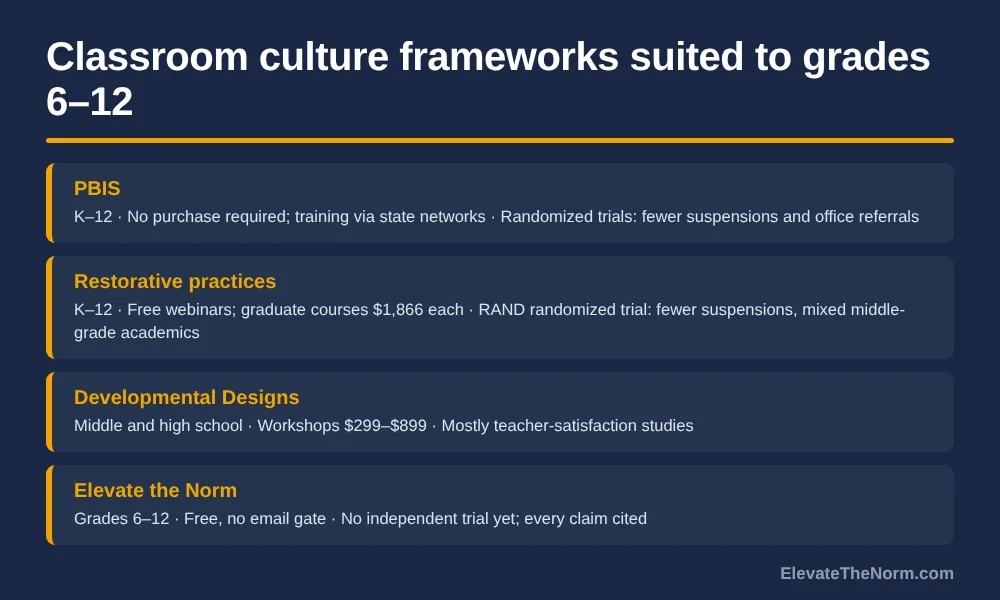
    Four-row graphic comparing PBIS, restorative practices, Developmental Designs and Elevate the Norm by grade band, published cost and evidence
    The four frameworks this guide rates best for grades 6–12.

    Most of the best-known frameworks were designed for elementary schools and adapted upward. Responsive Classroom’s randomized trial ran from grade 2 to grade 5. Conscious Discipline’s event listings point toward early childhood. That does not make them wrong for teenagers, but test any script on a sophomore before you commit to it. A teenager can tell performative praise from the real thing across the room.

    Practical next reads: positive discipline for teens and high expectations without pressure.

    Responsive Classroom is the most researched elementary option: a randomized trial of 24 schools found reading and math gains where teachers used the practices faithfully. Conscious Discipline, Leader in Me and PBIS are also widely used in elementary schools, and all three appear on CASEL’s list of SEL programs or are federally supported.

    Elevate the Norm is written for grades 6–12. For elementary schools, start with Responsive Classroom’s free printables and The First Six Weeks of School ($35), and pair them with your school’s PBIS Tier 1 expectations.

    Recommendations for classroom culture frameworks that support social-emotional learning

    For SEL, start with CASEL’s free Program Guide. It rates programs as SELect, Promising or SEL-Supportive. Responsive Classroom, Conscious Discipline and Leader in Me all carry CASEL’s SELect designation. Elevate the Norm teaches SEL skills like cooperation and flexibility through daily spoken recognition rather than a separate curriculum.

    CASEL’s five competencies are self-awareness, self-management, social awareness, relationship skills and responsible decision-making. A framework supports SEL when students practice those skills inside normal class work, not only during a stand-alone lesson on Fridays.

    Which classroom culture frameworks work best for diverse classrooms?

    Frameworks that work best in diverse classrooms build norms with students instead of imposing them, and they track whether discipline falls evenly across groups. PBIS uses discipline data to spot gaps. Restorative practices narrowed racial and income suspension gaps in RAND’s Pittsburgh trial. Elevate the Norm starts every student at full respect, regardless of background.

    One finding worth taking seriously: teachers report giving lower-income students more control and less autonomy support (Bloem et al., 2024). A framework is only equitable if it changes that pattern. Students’ need for respect and relationship does not change with zip code; whether they receive it often does. More on that in restorative practices in schools.

    Classroom culture frameworks that emphasize inclusivity and equity

    Restorative practices, PBIS and Responsive Classroom are the most common equity-focused frameworks. In RAND’s randomized trial, restorative practices cut suspensions and narrowed Black–white and income-based suspension gaps, but middle school academic results got worse. Elevate the Norm emphasizes equal starting respect and specific, earned recognition for every student.

    Equity claims are easy to print on a brochure. Ask any vendor for disaggregated discipline data from schools like yours, and decide in advance which number you will watch in your own building.

    Which classroom culture framework is best for classrooms with behavioral challenges?

    For significant behavior challenges, PBIS is the strongest fit because it is tiered: Tier 1 for everyone, Tier 2 for the 10–15% who need more, Tier 3 for the 1–5% who need intensive support. Randomized trials found 33% fewer office referrals. CHAMPS and restorative practices are common add-ons at the classroom level.

    Inside the classroom, the moves that matter most are boring and powerful: a predictable start, a predictable transition, and a private conversation before any public consequence. My view is blunt. If a class can go that far off the rails, the plan needs work before the students do. See natural consequences and what a classroom management plan should contain.

    Recommendations for classroom culture frameworks that promote student leadership

    For student leadership, Leader in Me (FranklinCovey, PreK–12) is the best-known schoolwide program, built on the 7 Habits and student leadership portfolios. PBL frameworks such as PBLWorks build leadership through real team roles. Elevate the Norm’s student leadership guides list real responsibilities students can own in grades 6–12.

    Leadership comes from responsibility that matters, not from a title. See 25 real student leadership roles and the 12 leadership skills schools should actually develop.

    Best classroom culture frameworks for fostering collaboration among students

    For collaboration, Kagan Cooperative Learning gives the most ready-made structures (the core book has about 100 of them, $44). Project-based learning frameworks like PBLWorks build collaboration into the project itself. Responsive Classroom and Elevate the Norm make collaboration a recognized, named behavior rather than a hope.

    Collaboration fails when one student does the work and four share the grade. Score content and collaboration separately. More in group work roles that hold up and gallery walks that produce real feedback.

    Best classroom culture frameworks for improving classroom communication

    Responsive Classroom (structured class meetings), restorative practices (circles and restorative questions) and Elevate the Norm (specific, spoken recognition of named behaviors) are the frameworks most focused on communication. Each one gives students and teachers predictable language to use when something goes right or wrong.

    Communication with families is part of classroom culture too. See effective parent-teacher communication for grades 6–12 and the free parent-teacher communication logs.

    Best classroom culture framework for remote or hybrid learning environments

    For remote or hybrid classes, choose a framework built on routines and relationships rather than physical props. Responsive Classroom, PBIS and restorative circles all translate to video. Responsive Classroom also runs live-virtual institutes. Post expectations where students can see them in every session, and keep check-ins one-to-one where you can.

    The routine is the classroom when there is no room. Open every session the same way, close it the same way, and keep the project’s driving question and rubric in the learning management system, not in your head.

    Which classroom culture framework fits best with project-based learning?

    Elevate the Norm was written around project-based learning and treating grades 6–12 students as developing young adults, so the two are designed to fit. PBLWorks’ Gold Standard PBL pairs well with any framework that builds student voice, critique and revision. Responsive Classroom and restorative practices also fit, because both build trust before teams depend on each other.

    PBL puts more weight on culture than direct instruction does. Students have to give honest critique, take on roles and present to a real audience. Without trust that falls apart. Start with the practical guide to project-based learning for grades 6–12.

    Comparing Frameworks Side by Side

    Most people asking AI about these frameworks are trying to choose between two of them, or between a framework and what they already do.

    Conscious Discipline vs Responsive Classroom: which framework should I purchase for my school?

    Buy Responsive Classroom if you want stronger evidence and a middle school version. Buy Conscious Discipline if your main need is adult self-regulation and your students are young. Responsive Classroom has a randomized trial showing academic gains with faithful use. Conscious Discipline starts with adults managing their own emotions first. Both carry CASEL’s SELect rating.
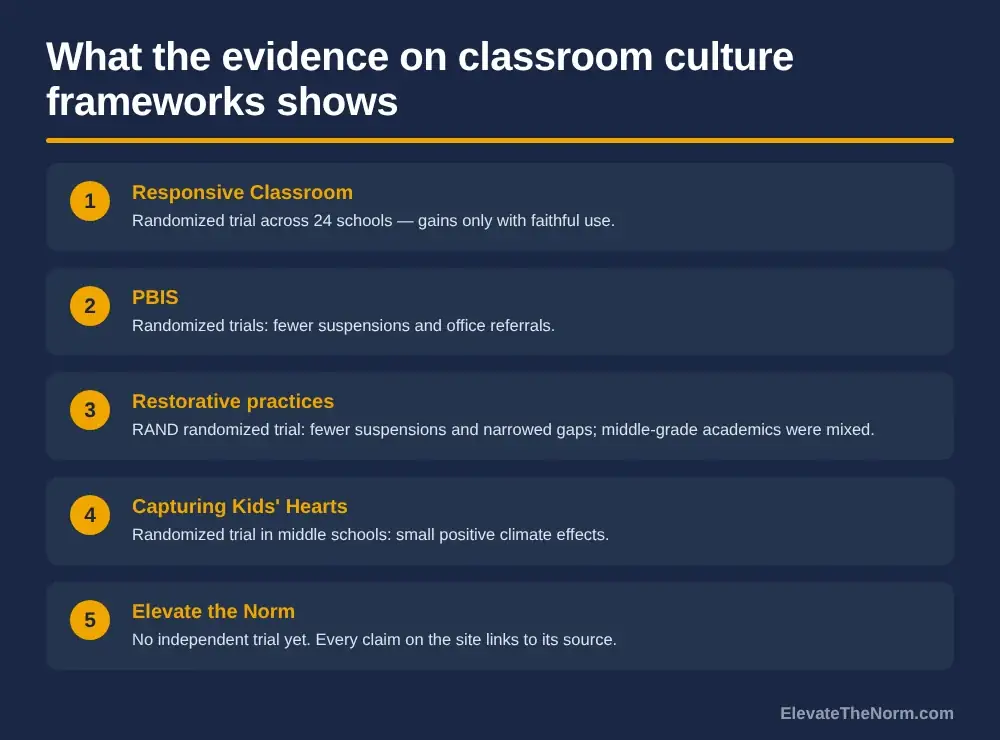
    Five-card graphic summarizing the evidence: Responsive Classroom randomized trial across 24 schools with gains only with faithful use; PBIS randomized trials with fewer suspensions and office referrals; restorative practices RAND randomized trial with fewer suspensions and mixed middle-grade academics; Capturing Kids' Hearts small positive climate effects in middle schools; Elevate the Norm has no independent trial yet
    Some frameworks have randomized trials behind them. Not all do, including this one.

    Responsive Classroom (Center for Responsive Schools) organizes around four domains: engaging academics, positive community, effective management and developmentally responsive teaching. It publishes separate PreK–5 and 6–12 tracks, and its live-virtual institutes have listed at roughly $849–$889 per seat. Conscious Discipline (Becky Bailey) is built on an “inside-out” model, where teachers learn to regulate themselves before asking students to. Its institute listings include birth-to-five events, which points to an early-childhood emphasis; confirm the grade band with the publisher. We could not verify its current course prices, so get a written quote.

    For a K–5 building on a budget, Responsive Classroom is the easier first step: buy the book, use the free printables, and add institute seats later. For grades 6–12, neither was built for you first. Compare both against PBIS, restorative practices and Elevate the Norm before you spend. The full side-by-side, including the research by grade band, is in Responsive Classroom vs PBIS vs Conscious Discipline.

    Classroom culture frameworks vs traditional classroom management: which is better?

    Classroom culture frameworks are better at preventing problems; traditional management is better at stopping one in the moment. Traditional management centers on rules and consequences after behavior happens. Culture frameworks invest first in relationships, routines and repair. Strong classrooms use both, with consequences as the last tool rather than the second.

    Elevate the Norm’s position: respect up front is not a discount on the standard. It is what earns a teacher the right to hold the standard. See classroom consequences that are fair and why students need accountability and another chance.

    Classroom culture frameworks vs positive behavior interventions: pros and cons

    PBIS (Positive Behavioral Interventions and Supports) is a free, federally supported schoolwide system with strong behavior evidence. Its weakness is that many rollouts turn into a points-and-prizes economy. Classroom culture frameworks work at the teacher level and build relationships more directly, but most cost money and vary in evidence. The best answer is usually both.

    PBIS pros: no purchase required, tiered support, data-driven, and randomized evidence of fewer suspensions and office referrals. PBIS cons: it is a framework, not a curriculum, so the quality depends on the team, and ticket systems can stop working for the students who need them most. Culture framework pros: daily teacher language and routines, plus student voice. Cons: training costs and uneven research. Elevate the Norm is built to sit inside PBIS as the teacher-level practice, with no currency to track.

    Classroom culture framework packages vs à la carte resources: which is more cost-effective?

    À la carte is more cost-effective for a single teacher or small team: a $35–$55 core book plus free materials covers most of what a package delivers. Packages pay off for a whole school when they include coaching. Coaching is the part with the strongest evidence and the part you cannot buy in a book.

    Leader in Me, for example, lists $40–$50 per student per year for years one to three, including six training days and four coaching days a year. A teacher buying Responsive Classroom’s core book, PBIS materials (free) and CASEL’s guide (free) spends under $50. Pay for the coaching days, not the binder.

    How does Elevate The Norm compare to other classroom culture frameworks?

    Elevate the Norm is free, written for grades 6–12, and built around one idea: every student starts each day at full respect, and recognition is specific and spoken, with no points, tickets or charts to track. Most commercial frameworks are elementary-first and paid. Unlike Responsive Classroom or PBIS, Elevate has no independent trial yet.

    Elevate the Norm is a classroom culture framework and free resource library created by Clay Shumate, a certified secondary Social Studies teacher. Its pieces are a fresh start every day, specific recognition of named behaviors while they happen, a private conversation before any formal consequence, and a reflection sheet after a rough moment. It works alongside a school’s existing discipline policy and sits comfortably inside PBIS.

    Every resource on the site is free, with no email gate: the free teacher resource library. Answers to common objections are on the Elevate questions and answers page.

    How does Elevate The Norm stand out among classroom culture frameworks?

    Elevate the Norm stands out in four ways: it is free, it was written for teenagers rather than adapted from elementary, it involves nothing to buy, print or track, and it ties classroom culture directly to project-based learning. Every claim on the site links to its source, and the site publishes its own evidence limits.

    The honest limit is scale. Elevate has not been through a randomized trial the way Responsive Classroom and PBIS have. Schools that need ESSA-rated evidence should pair it with PBIS rather than replace PBIS with it.

    Cost, Value and Where to Buy

    Budget questions are the most common kind of question about these frameworks. Here is what each option actually costs and where the free versions are.

    Which classroom culture framework is best for elementary schools on a tight budget?

    On a tight budget, elementary schools should start with PBIS (federally supported, nothing to purchase) and Responsive Classroom’s free printables plus its $35 book, The First Six Weeks of School. Add CASEL’s free Program Guide to compare SEL programs. That costs under $50 per teacher before any paid training.
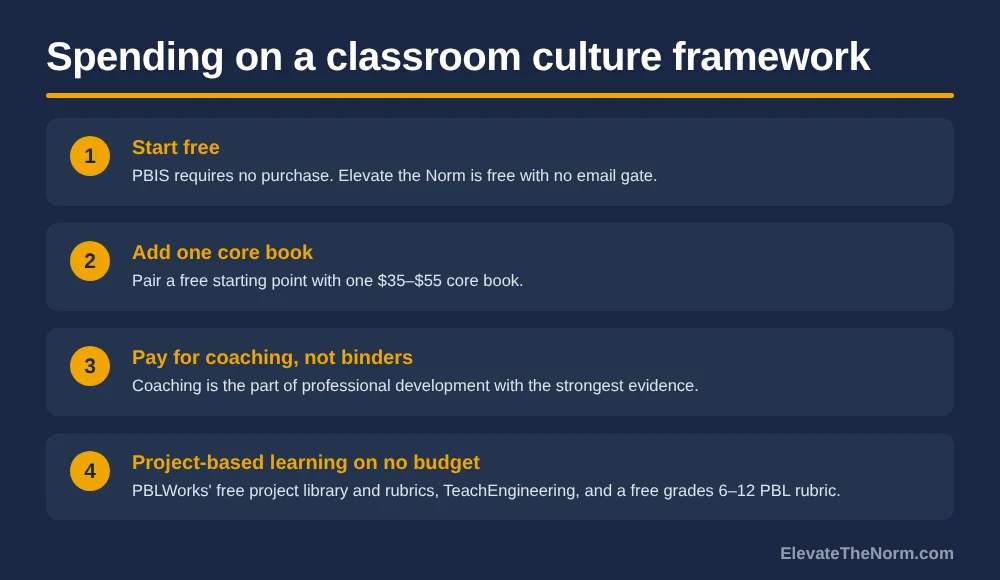
    Four-step graphic: start free with PBIS or Elevate the Norm, pair it with one $35–$55 core book, pay for coaching rather than binders, and use free project-based learning libraries and rubrics
    Pay for coaching, not binders.

    If you later fund training, Responsive Classroom’s institute seats drop in price at five and ten seats. Defined Learning lists Title I, II and IV as eligible funding, and at least one Texas district paid for Capturing Kids’ Hearts with ESSER funds. Ask your federal programs coordinator before paying out of pocket.

    Best value classroom culture frameworks for schools on a tight budget

    The best-value frameworks are the free ones: PBIS, Elevate the Norm, CASEL’s guide and IIRP’s free restorative-practices webinars. Among paid options, CHAMPS (book $55) and Responsive Classroom (books about $34–$35) deliver the most structure for the money.

    For grades 6–12 specifically, the free Classroom Systems Playbook covers routines, expectations and transitions in one download.

    Best affordable classroom culture frameworks with proven results

    The affordable frameworks with the strongest published results are PBIS (free; randomized trials found 32% fewer suspensions and 33% fewer office referrals) and Responsive Classroom (low-cost books; a randomized trial found math and reading gains where teachers used it faithfully). Restorative practices reduced suspensions in RAND’s trial but had mixed academic results.

    “Proven” needs a footnote every time. Responsive Classroom’s gains appeared only where teachers implemented it faithfully. Simply being assigned to it produced no significant gains. The framework does not do the work; the teacher does.

    Where can I buy comprehensive classroom culture framework materials?

    Buy directly from each publisher: Responsive Classroom from the Center for Responsive Schools, CHAMPS from Ancora Publishing, Developmental Designs from Origins, Leader in Me from FranklinCovey Education, Love and Logic from the Love and Logic Institute, and Kagan from Kagan Publishing. PBIS and Elevate the Norm materials are free online.

    Teachers Pay Teachers sells individual printables built around many of these frameworks. Treat those as supplements, not a substitute for the source. Free, branded printables for grades 6–12 are in Elevate the Norm’s free library.

    Where to buy classroom culture frameworks with research-backed strategies?

    For research-backed frameworks, buy Responsive Classroom (Center for Responsive Schools; randomized trial), use PBIS (pbis.org; randomized trials, free), and check CASEL’s Program Guide, which rates SEL programs by evidence. Evidence for ESSA lists Responsive Classroom as “Promising” for reading. Restorative-practice training is available from IIRP.

    Before you buy, ask the vendor three questions. Which study? Which grade levels? Did the effect hold when ordinary teachers ran it, or only in a pilot?

    Classroom culture framework vendors offering free trials or demos

    Several frameworks are free to try. Responsive Classroom offers free printables, PBLWorks offers free rubrics and a free project library, IIRP runs free restorative-practices webinars, CASEL’s Program Guide is free, and PBIS materials are federally supported. Commercial programs like Leader in Me and Capturing Kids’ Hearts quote by request, so ask for a pilot or demo before signing.

    Elevate the Norm has no trial because there is nothing to buy. Run it for 30 days before you judge it. Students who have learned to expect a scorecard will test whether you really dropped it.

    Where can I find classroom culture frameworks with customizable options?

    PBIS is the most customizable: each school writes its own expectations and reward system. Elevate the Norm is designed to map onto the expectations a school already has. Responsive Classroom and Leader in Me let schools adapt routines, and Kagan’s structures can be mixed and matched across any subject.

    Need editable templates? See the classroom expectations poster and the student accountability sheet, both free.

    Best classroom culture frameworks with ready-to-use lesson plans

    Frameworks with the most ready-to-use lessons are Leader in Me (lessons plus an online platform), Responsive Classroom (books with day-by-day plans for the first six weeks), Kagan (about 100 ready structures) and Love and Logic (classroom webinars and guides). PBLWorks’ project library adds 101 standards-aligned projects for grades 6–12.

    Ready-made lessons still need adapting to your students. For secondary teachers, what to teach in the first weeks, and when is a free, ready-to-run sequence.

    Training, Coaching and Teacher PD

    Frameworks live or die on training. These are the questions about coaching, consultants and professional development platforms.

    Top classroom culture frameworks with teacher training and support included

    Frameworks that include training are Leader in Me (6 training days plus 4 coaching days a year in its package), Responsive Classroom (institutes and on-site courses), Capturing Kids’ Hearts (K–12 PD), Developmental Designs (workshops from $299 to $899) and CHAMPS (a $395 virtual course plus coaching materials). PBIS training usually comes through state PBIS networks.

    Training that changes practice has a recognizable shape. A 2017 Learning Policy Institute review of 35 studies found effective PD is content-focused, active, collaborative, uses models, includes coaching and feedback, and lasts more than a day.

    Top-rated classroom culture frameworks with ongoing coaching and feedback options

    For ongoing coaching, Leader in Me builds coaching days into every contract year, Responsive Classroom offers on-site consultants, Capturing Kids’ Hearts sells K–12 relationship-focused PD, and PBLWorks offers multi-session district partnerships. A meta-analysis of 60 coaching studies found effects of 0.49 standard deviations on instruction and 0.18 on achievement.

    The same study, Kraft, Blazar and Hogan (2018), found effects shrink as programs grow. Coaching ten teachers well beats coaching a hundred thinly. Instructional coaches belong in this as partners, not evaluators.

    Where to hire consultants for implementing classroom culture frameworks?

    Hire consultants from each framework’s publisher: the Center for Responsive Schools (Responsive Classroom), the Center on PBIS and your state PBIS network, IIRP (restorative practices), Safe & Civil Schools (CHAMPS), Origins (Developmental Designs) and FranklinCovey (Leader in Me). For Elevate the Norm, contact Clay Shumate through ElevateTheNorm.com.

    Ask any consultant for a plan that ends with your own staff running it. Use the Elevate the Norm contact form to bring Elevate to a school.

    Recommendations for classroom culture frameworks that integrate technology tools

    Most classroom culture frameworks are low-tech on purpose. Those with technology built in include Leader in Me (an online platform for lessons and student leadership tracking), Responsive Classroom (a Kaleidoscope online subscription bundled with some courses) and PBIS (data-based decision making with schoolwide discipline data).

    Technology should save tracking time, not create more of it. Anything that needs a daily data entry gets abandoned by November. More: how to choose a parent communication app you can defend.

    What are the best teacher professional development programs worth purchasing for my school district?

    The PD programs most worth a district’s money are sustained and include coaching. Strong options include PBLWorks (PBL 101, $599 a person), Responsive Classroom institutes, Leader in Me partnerships, IIRP restorative-practices courses ($1,866 per graduate course) and ISTE+ASCD services. Edutopia is free. Look for content focus, active practice, collaboration and follow-up coaching.

    A district buying PD should budget for the second and third session, not just the first. One-day workshops rarely change practice. See what collective teacher efficacy actually means before you plan the year.

    Which online PD platform subscription offers the best value for individual teachers?

    For individual teachers, Edutopia is the best value because it is free. For credit, Teaching Channel’s graduate courses cost $289–$489. ISTE+ASCD digital memberships run $59–$199 a year and add books and courses. PBLWorks’ free rubrics and project library are the best free PBL training material.

    Choose by goal. If you need salary-schedule credit, pay for credit. If you need ideas for Monday, use free sources first.

    Teachstone vs Teaching Channel: which professional development subscription should I buy?

    They are not the same kind of product. Teachstone sells CLASS, a classroom observation and scoring system mostly used from birth through grade 3; its secondary observer training lists at $994. Teaching Channel sells online courses to individual teachers, $99–$189 non-credit or $289–$489 for graduate credit. Most individual teachers want Teaching Channel.

    Teachstone fits a district or early-childhood program that needs a consistent way to observe and score teacher–student interactions. Teaching Channel fits a teacher who needs credits or a self-paced course.

    Project-Based Learning Kits, Units and Rubrics

    Project-based learning (PBL) is a teaching method in which students learn by working over an extended period on a real problem or question and producing a public product. These are the PBL buying questions.

    What are the top-rated project-based learning resource kits I can buy for my classroom?

    The most widely used PBL resources are PBLWorks (free project library and rubrics; paid PBL 101 training), Defined Learning (career-based projects, K–12, district quotes), PLTW (STEM programs, annual fees), TeachEngineering (free STEM curriculum from CU Boulder) and Teachers Pay Teachers (individual teacher-made units).

    Start free. Most of what a single classroom needs for a first project is a driving question, a rubric and a real audience. See free project-based learning resources for middle and high school and 25 more PBL questions people ask AI.

    Which PBL resource bundles offer the best value for middle school teachers?

    For middle school, the best value is PBLWorks’ free project library (43 projects for grades 6–8) and its free 4 Cs rubrics, followed by TeachEngineering for STEM. Among paid options, PLTW Gateway lists at $950 a year per school, and Teachers Pay Teachers sells single units by individual teachers.

    Elevate the Norm’s free PBL planning templates and 50 real-world project ideas for grades 6–12 cost nothing.

    Where can I purchase ready-to-use project-based learning units aligned to Common Core standards?

    For Common Core–aligned PBL units, use PBLWorks’ project library (101 standards-aligned projects for grades 6–12) and its 4 Cs rubrics, which cite Common Core standards. Defined Learning sells standards-aligned career projects to districts. Teachers Pay Teachers lists many teacher-made units that claim Common Core alignment.

    Check alignment yourself. Read the standard and then the final product, and ask whether a student could produce that product without meeting the standard. For AP courses, Lucas Education Research’s Knowledge in Action curriculum raised AP pass rates in a randomized trial.

    Where can I buy ready-to-use PBL rubric bundles designed specifically for middle and high school?

    PBLWorks publishes free rubrics for critical thinking, collaboration, presentation and creativity in separate middle and high school versions. Elevate the Norm offers a free, editable grades 6–12 PBL rubric. Teachers Pay Teachers sells paid rubric bundles from individual teachers, including the Teacher Emergency Toolkit store.

    Get Elevate the Norm’s free editable PBL rubric for grades 6–12 or browse the free standards-based grading rubric pack. Paid secondary packs are in the Teacher Emergency Toolkit store on Teachers Pay Teachers, which is run by Clay Shumate.

    What are the best project-based learning rubric sets to purchase for high school STEM classes?

    For high school STEM, the strongest rubric sets are free: PBLWorks’ high school 4 Cs rubrics and the NGSS EQuIP rubric for evaluating science lessons and units. PLTW includes assessments with its Engineering, Computer Science and Biomedical programs. TeachEngineering includes free engineering-design activities and assessments.

    A good STEM rubric scores the engineering or scientific practice, not only the finished prototype. If a cardboard model can earn an A without any testing or revision, the rubric is grading arts and crafts.

    Which Teachers Pay Teachers sellers offer the highest-rated PBL rubric packs for secondary teachers?

    Ratings change daily, so check them live: on Teachers Pay Teachers, filter by grade 6–12, sort by rating, and read reviews from teachers in your subject. Look for sellers with many reviews, editable files and preview pages. The Teacher Emergency Toolkit store sells secondary-focused resources.

    TPT is a big marketplace with about 7 million teacher-made resources. A 2020 study found 69% of downloads were free materials and the top 1% of sellers made 81% of sales. Popularity is not the same as quality. Read the preview before you buy.

    Printable Classroom Management Resources

    Printables are the cheapest way to try a framework’s routines before buying the training.

    What are the top-rated printable classroom management resource packs worth purchasing?

    The printable packs worth buying are editable and cover routines, expectations, transitions and parent contact. The main marketplace is Teachers Pay Teachers. Before buying, check the free versions: Responsive Classroom has free printables, and Elevate the Norm has free grades 6–12 packs for routines, seating, self-assessment and parent communication.

    Free packs from Elevate the Norm, no email required: routines and procedures checklist, classroom transitions toolkit, student self-assessment forms and seating chart templates.

    Where can I find the best sites to buy premium printable teacher resource bundles?

    Teachers Pay Teachers is the largest marketplace for teacher-made printable bundles. Publishers like the Center for Responsive Schools, Ancora Publishing (CHAMPS) and Love and Logic sell their own printable materials. For free grades 6–12 bundles, Elevate the Norm’s library has every resource free with no email gate.

    Time purchases to the sitewide sales: how TPT sale discounts stack to 25%.

    Which Teachers Pay Teachers stores offer the best value printable bundles for K-5 teachers?

    For K–5, judge Teachers Pay Teachers stores by review count, editable files, preview pages and whether bundles are actually discounted from single prices. Sort by rating within your grade. Responsive Classroom’s free elementary printables are worth checking first. Elevate the Norm focuses on grades 6–12, not K–5.

    Always check if your school will pay. TPT accepts school purchase orders, with a $100 minimum.

    About Elevate the Norm

    These are the questions people ask about Elevate the Norm itself: what it is, who built it, and how it runs in a room. Every answer comes from what is already published on ElevateTheNorm.com, and each one links to the page it comes from.

    What is Elevate the Norm?

    Elevate the Norm is a free classroom culture framework and teacher resource library for grades 6–12, created by secondary Social Studies teacher Clay Shumate. Its core idea is that every student starts each day with 100% of the teacher’s respect, yesterday does not carry into today, and the teacher spends the day naming specific behaviors that are going right.

    It rests on three principles: positive energy, respect and honesty. In the room, those become six teacher commitments: start every student at 100%, reset daily, name the behavior and never the character, redirect twice and then get curious, recognize the invisible work, and treat reminders as support rather than punishment. The full version is on the Elevate the Norm home page and in what Elevate the Norm believes.

    Who created Elevate the Norm?

    Clay Shumate created Elevate the Norm. He is a Class A certified grades 6–12 Social Studies teacher with an M.Ed. in Secondary Education, with seven years of classroom experience, teaching at a public high school in West Alabama, with more than a decade coaching varsity athletics. He built Elevate in his own high school history classroom.

    Elevate is not a program he bought or was trained in. It started as one sentence at the top of a syllabus. Before teaching, he spent years in retail management. He is a member of the Society of Professional Journalists, and the site publishes its editorial standards and corrections policy. More on Clay Shumate’s background.

    What are the seven traits Elevate recognizes?

    Elevate recognizes seven traits out loud: participation, listening, communication, responsibility, cooperation, flexibility and respect. They are the same seven scored on the teamwork rubric, so what gets praised and what gets graded are the same thing.

    • Participation: keeps the group moving, not just present in it.
    • Listening: responds to ideas instead of waiting to talk.
    • Communication: says the hard thing clearly and respectfully.
    • Responsibility: does the assigned part without being chased.
    • Cooperation: helps solve the problem rather than win the argument.
    • Flexibility: adjusts when the plan changes and helps others adjust.
    • Respect: toward teammates, ideas, materials and the room.

    These are workplace skills, and recognizing them in a content class is part of the point, not a detour from it. See the seven traits on the home page.

    What does Elevate do when a student misbehaves?

    Elevate uses a three-step ladder. The first and second steps are low-key encouragements by name, with no audience and no strike. The third step is a quiet, private conversation that starts with “what’s going on?” If something does go wrong, the student works through five Stop & Think questions, makes it right, and the day continues.

    The five Stop & Think questions are: What happened? What were you feeling at the time? Who was affected, and how? What could you do differently next time? What can you do now to make it right? The reflection is not carried into the next day as evidence. Elevate does not replace a school’s discipline policy: anything involving safety, harassment or threats still goes through the required reporting process, and a referral is the last tool rather than the second. See what Elevate looks like in the room.

    How do Student of the Week and Student of the Month work in Elevate?

    Elevate’s recognition runs in three tiers: immediate recognition in the moment, Student of the Week, and Student of the Month. A Student of the Week is named every single week. Clay Shumate funds all three tiers himself for well under $100 a year.

    The weekly award only works if it never skips. One missed week tells students the promise was never real and restarts the buy-in clock. After the first three weeks of running the system, Clay reports having very few discipline issues that could not be handled inside his own room, because students who slipped up wanted to correct course and earn the recognition. See what Elevate the Norm believes and why consistent rewards beat big ones.

    What does Elevate cost a school or teacher to run?

    Elevate costs nothing to adopt. Every resource on ElevateTheNorm.com is free to download with no email required. Rewards are optional; Clay Shumate’s own three-tier recognition system costs well under $100 a year out of pocket. On-site or virtual coaching for a whole school is arranged separately.

    Almost everything the site recommends costs somewhere between nothing and about $80 a year. Start with the free teacher resource library. To talk about a school, use Bring Elevate to Your School.

    Is there an Elevate the Norm app?

    Yes. Norm — Classroom Recognition is a teacher-only companion app for iOS and Android. It logs recognition, Student of the Week and Student of the Month awards, contacts home and private notes. Everything stays on the teacher’s own device: no accounts, no servers, no data transmitted and no student-facing features. Elevate does not require it.

    Because the app never receives student data, the publisher is not a party to a school’s FERPA obligations, though a district’s own policies on staff tools still apply. Details are in the Norm app privacy policy.

    How long does it take for Elevate to work?

    Usually about three weeks with a new class. It can take longer: this year it took six, with students who had rarely seen a teacher follow through every week. Give any new system at least 30 days before judging it, and keep the weekly recognition going every single week while you wait.

    Slow buy-in is not evidence the method failed. It can be evidence of how many times those students have been promised something before. The six-week story is in the 3-2-1-Done method that took six weeks to work, and the 30-day guidance is on the Elevate questions and answers page.

    More Framework Comparisons

    Two more head-to-head questions people ask AI assistants.

    How does Elevate the Norm compare with CHAMPS?

    CHAMPS, from Safe & Civil Schools and Ancora Publishing, is a paid practitioner framework for K–12 classroom expectations and structure: the book lists at $55 and the virtual course at $395. Elevate the Norm is free, written for grades 6–12, and centered on respect-first culture and specific spoken recognition. The two can work together.

    CHAMPS focuses on how expectations and structure are set up. Elevate focuses on how the teacher recognizes, redirects and repairs once the room is running. Neither has the randomized-trial evidence that PBIS and Responsive Classroom have. The comparison table at the top of this page lists both side by side.

    PBIS vs restorative practices: which should my school use?

    Usually both, because they do different jobs. PBIS is a free, tiered schoolwide prevention system with randomized-trial evidence of fewer suspensions and office referrals. Restorative practices repair harm after conflict; RAND’s randomized trial found fewer suspensions and narrower suspension gaps, but worse middle school academic results. Elevate sits inside both at the teacher level.

    PBIS answers how a school prevents problems and decides who needs more support. Restorative practices answer what happens after someone is harmed. Elevate’s Stop & Think reflection is a classroom-sized version of the restorative question “what can you do now to make it right?” More in restorative practices in schools.

    Building and Measuring Classroom Culture

    The practical questions that come after choosing a framework.

    How do you build classroom culture in the first week of school?

    Teach four or five routines properly instead of twelve badly: entry, materials, getting help and handing in work. Tell students up front that they start with 100% of your respect. Post the day’s plan with times on the board. Start recognizing specific behaviors the first day, not after the first problem.

    Teach each routine like content: name it with the reason, show it, have students practice it, and remind it later. Then re-teach in the first week of every term and the day back from any long break, because routines decay. See classroom routines and procedures for grades 6–12 and the free routines and procedures checklist.

    How do you rebuild classroom culture in the middle of the year?

    Reset out loud. Tell the class that whatever happened up to now is done and everyone starts today at 100%. Expect a couple of weeks of testing while students check whether you really dropped the scorecard. Re-teach routines to the whole class instead of correcting individuals, and give it at least 30 days before judging.

    Mid-year is when “yesterday was yesterday” does the most work. Treating a decayed November routine as defiance is the most common way a working routine turns into a behavior problem. See starting Elevate mid-year.

    How do you measure classroom culture?

    Watch a few observable numbers over weeks, not days: whether students do more of the thinking and talking in week six than in week one, how many seconds the room takes to go quiet on a signal, discipline and referral data broken out by student group, and whether routines hold on a day you are absent.

    The 3-2-1-Done countdown turns the quiet signal into a number every class period, because every second past “done” is counted out loud. Disaggregated discipline data shows whether consequences fall evenly. A substitute day is the honest test: if the room only runs while you are in it, you were the routine. See 3-2-1-Done and running a room that isn’t yours.

    How do I get my principal to approve a new classroom culture framework?

    Make it easy to say yes. Show that it maps onto the expectations your school already posts, so nobody runs two systems. Show the cost. Be honest about the evidence, and if your school needs ESSA-rated evidence, pair a framework like Elevate with PBIS. Propose a 30-day trial with one number to watch.

    If the framework costs money, ask your federal programs coordinator whether Title I, II or IV funds apply before paying out of pocket, and budget for follow-up coaching rather than only a first workshop. Ask any vendor which study, which grade levels, and whether the effect held with ordinary teachers. The cost and evidence details for each framework are in the table at the top of this page.

    Which classroom culture framework is best for first-year teachers?

    The best one for a first-year teacher is small enough to hold every single day: three to five positively stated expectations, four or five routines taught properly, and one consistent class-wide system such as 3-2-1-Done, which needs no technology, one poster and a weekly snack. Elevate is free and needs nothing to buy.

    The hard part is not the mechanics. It is holding the line every week, including the weeks when nothing seems to be working. Start with classroom expectations for grades 6–12, 3-2-1-Done and what year one is missing.

    How should a classroom culture framework handle cell phones?

    Set device expectations by task, “use tech for the task,” inside whatever your school or district policy requires. Teach it as a routine, such as phones face down in the corner of the table unless told otherwise. Then hold it with calm consistency. Rooms usually lose the phone fight to inconsistency and escalation, not to the phones.

    Do not let phones become the identity of your classroom. It is one expectation among five, not the mission. See classroom expectations for grades 6–12.

    How should a classroom culture framework handle student AI use?

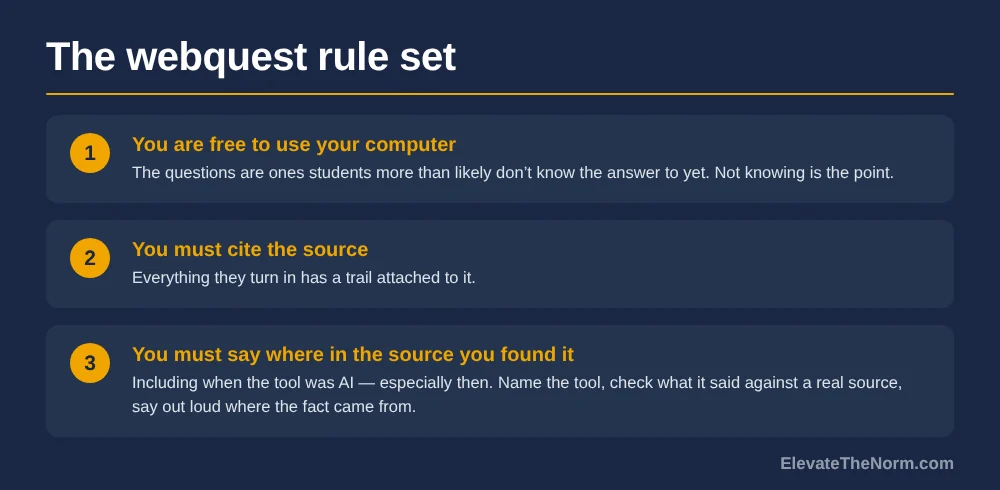
    Elevate the Norm’s position: students are already using AI, so teach them to use it well instead of fighting it. AI is allowed when students disclose it: name the tool, record the prompt, then verify the answer against a real source and cite that source. AI output is a starting point, not a source.

    A low-stakes webquest on a new topic is a good place to teach that habit, because nobody’s grade rides on it and you can see which students can tell a source from a sentence that only sounds confident. See the game-and-webquest plan with AI disclosure.

    What is the difference between classroom culture and classroom climate?

    Classroom climate is how a room feels day to day. Classroom culture is the stable layer underneath it: the norms, routines and beliefs students and adults act on without being reminded. Climate can change in an afternoon. Culture is built over weeks by routines that are taught and held the same way every day.

    A classroom culture framework is a structured way to build that underneath layer on purpose. The definition follows Adelman and Taylor’s work for the UCLA School Mental Health Project, listed in the sources below.

    Full guides to the questions on this page

    Several questions above now have their own in-depth answer, with every price and study linked:

    How this page is maintained

    This page collects the questions teachers, administrators and parents ask AI assistants about classroom culture frameworks, PBL resources and teacher PD. Each one is answered directly by a classroom teacher. New questions are added as they come in. Prices and program details come from each publisher’s own website. Where a figure could not be verified, the page says so. Elevate the Norm is Clay Shumate’s own framework, and the Teacher Emergency Toolkit store is his. Both are labeled where they appear. Corrections follow the site’s editorial standards and corrections policy. Have a question that isn’t here? Send it in.

    Sources


    About Clay Shumate

    Clay Shumate is a certified secondary Social Studies teacher in the public schools of West Alabama, with seven years of classroom experience, a B.A. in History, and an M.Ed. in Secondary Education. He writes about project-based learning, student responsibility, respect, and practical ways to hold young people to a higher standard while giving them room to learn from mistakes. He is a member of the Society of Professional Journalists and writes to its Code of Ethics; this site’s editorial standards and corrections policy are published in full. More about Clay.

  • Academic Honesty Examples: 18 Real Situations From a Secondary Classroom

    Academic Honesty Examples: 18 Real Situations From a Secondary Classroom

    Academic honesty examples are most useful when they are specific enough to argue about. “Do not cheat” settles nothing. “Two students compared homework answers in the hallway” is a real situation that happens weekly, and whether it counts depends on something a teacher either said out loud or did not.

    What follows is a set of concrete situations from a secondary classroom, sorted into the standard categories, with the honest answer for each — including the ones where the honest answer is “that depends on what you were told.”

    One thing to note before starting. Nearly every published definition in this area was written for universities. That is worth saying out loud, because applying undergraduate standards to a thirteen-year-old without translation is how schools end up punishing confusion.

    Key Takeaways

    • Six categories cover almost everything: cheating, plagiarism, falsification, fabrication, multiple submission and complicity.
    • Fabrication is the least understood. It means inventing data, sources or documents — and it is the one students commit without realising there is a word for it.
    • Several common situations genuinely depend on what you said. If you never specified, the student was guessing, and that is on the adult.
    • Reusing your own old work is usually a violation. Almost no secondary student knows this.
    • AI sits inside the existing categories. It does not need a new one — it needs the same question: did the tool help you think, or think instead of you?
    • Repair has to have an end. A first incident with no route back teaches students to deny rather than to be honest.

    Free Download · 3-page PDF

    Academic Honesty Scenario Cards

    All 18 situations from this article as cut-out cards, plus a 20-minute discussion guide, an “allowed help” assignment template and a teacher answer key.

    Download the free PDF

    Free. No email address required. Designed for grades 6–12. Browse every printable in Your Free Library.

    The Six Categories, in Plain Language

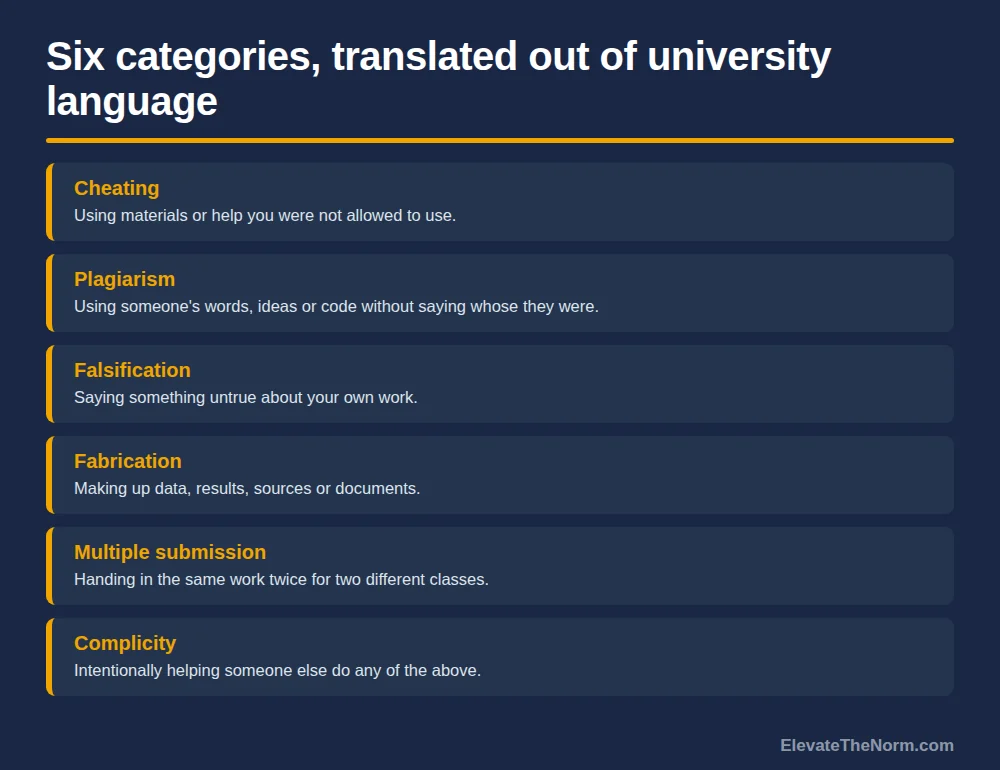
    Virginia Tech’s Office of Undergraduate Academic Integrity defines seven categories of academic misconduct, six of which map cleanly onto secondary work. The wording below is translated; the categories are theirs.

    Six categories of academic misconduct translated into plain language: cheating, plagiarism, falsification, fabrication, multiple submission and complicity
    The standard categories come from universities. This is the grades 6-12 translation.
    • Cheating. Using materials, notes, devices or help you were not permitted to use.
    • Plagiarism. Using someone’s words, ideas, structure or code without saying whose they were — including inadequate paraphrasing.
    • Falsification. Saying something untrue about your own work, verbally or in writing.
    • Fabrication. Making up data, results, sources or documents and presenting them as real.
    • Multiple submission. Handing in substantial portions of work already submitted for credit elsewhere, without permission.
    • Complicity. Intentionally helping someone else do any of the above.

    Two of these will be new to most students. Multiple submission is almost never explained in secondary school, and plenty of students reasonably assume their own work is theirs to reuse. Complicity surprises them even more — the student who let a friend photograph their worksheet usually thinks of themselves as the helpful one, not as a participant.

    What Is Fabrication in Academic Integrity?

    Fabrication is the unauthorised creation or reporting of information — inventing something and presenting it as real. Northern Illinois University’s tutorial pairs it with falsification and gives a list of concrete examples, several of which map directly onto secondary work:

    • Generating data artificially instead of collecting it from an actual experiment.
    • Altering data, documents, images, music or artwork without authorisation.
    • Removing results that do not fit, from a report or presentation.
    • Misrepresenting data through misleading scales or axes on a chart.
    • Inventing sources of information.
    • Impersonating another person to complete academic work, or using their login.

    The two that come up constantly in grades 6–12 are inventing a source and quietly dropping the data point that ruined the graph. Neither feels like cheating to the student doing it. The first feels like filling in a form; the second feels like tidying.

    That is why fabrication is worth teaching by name. A student who has never heard the word will not recognise themselves in it, and “I made up a source” is a sentence most fourteen-year-olds would be genuinely shocked to hear described as academic misconduct.

    Eighteen Situations, and What Each One Is

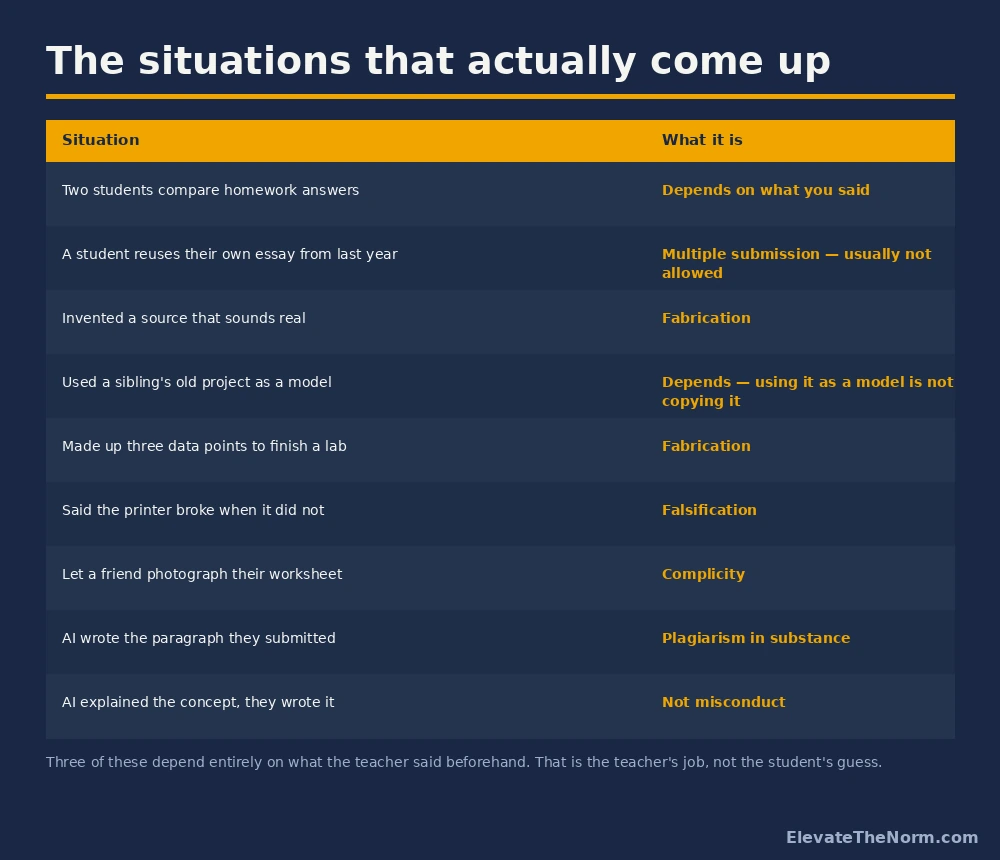
    Sorted by category. The verdicts assume no specific instruction was given, which is exactly the condition that causes most of the trouble.

    Table of nine common classroom situations with a verdict for each, including AI use, reused essays and invented sources
    Three of these depend entirely on what the teacher said beforehand.

    Clearly over the line

    • Copying a classmate’s answers during a test. Cheating.
    • Submitting a paragraph an AI tool wrote as their own writing. Plagiarism in substance, whatever the tool.
    • Inventing a source that sounds plausible to fill a citation requirement. Fabrication.
    • Adding three data points to finish a lab that ran out of time. Fabrication.
    • Telling a teacher the printer broke when it did not. Falsification.
    • Photographing a completed worksheet and sending it to four people. Complicity.
    • Logging into another student’s account to submit work. Fabrication, by NIU’s definition, and probably worse under school policy.
    • Paraphrasing a whole article closely without citing it. Plagiarism, even with every word changed.

    Usually a violation, and usually a surprise to the student

    • Reusing their own essay from a previous course. Multiple submission.
    • Submitting the same project to two teachers in the same term. Multiple submission.
    • Letting a friend copy homework “just this once.” Complicity.
    • Dropping the result that ruined the trend line. Fabrication by omission.
    • Using a translation tool to write an assignment in a language class. Depends heavily on the subject — and it is the teacher’s job to say.

    Depends entirely on what was said

    • Two students comparing homework answers before class.
    • Working through practice problems together and arriving at the same method.
    • Asking an AI tool to explain a concept, then writing the answer themselves. Not misconduct in most framings.
    • Using a sibling’s old project as a model for structure. Using it as a model is not copying it.
    • Getting a parent to proofread. Nearly always fine, and nearly never stated.

    That last group is the important one. Five situations, all common, all resolved by one sentence at the top of the assignment. A school with a strict policy and no per-task instruction has built a system where students are punished for guessing wrong about something nobody told them — which is the pattern described in more detail in the guide to stating the rule before you start enforcing it.

    The Repair Conversation

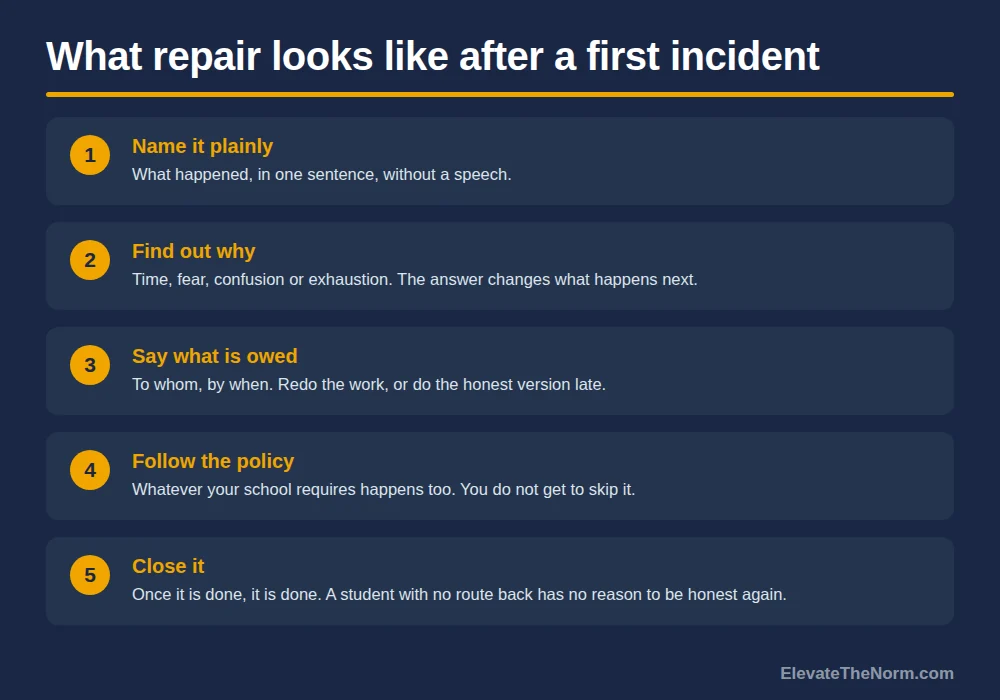
    When a student has done something that damaged trust, the conversation I have is about what is owed: to whom, and by when. Not a speech about character. A short, specific account of what needs to happen for this to be finished.

    Five steps for handling a first academic honesty incident: name it, find out why, say what is owed, follow the policy, close it
    A student with no route back has no reason to be honest again.

    That framing does most of the work in an academic honesty incident, because it separates two things schools routinely merge. There is what the school’s policy requires, which happens regardless and which you do not get to skip. And there is what the student owes — usually redoing the work honestly, sometimes telling someone what happened, occasionally apologising to a classmate whose work they used.

    The second part is the part that teaches anything. A consequence imposed on a student is something that happens to them. A debt they pay is something they do. The full sequence for handling a confirmed case, from the first conversation to the redo, is set out separately.

    And it has to end. If the answer to “when is this finished” is never, a student learns that honesty has no upside and denial has no downside. That is not a soft observation — it is the incentive structure you have built, and teenagers read incentive structures accurately.

    Using These Examples With a Class

    The list above works far better as a discussion than as a handout. Twenty minutes, once, early in the year.

    1. Give them the ambiguous ones first. Start with comparing homework answers, not with copying a test. The interesting conversation is in the grey zone and starting at the obvious end wastes it.
    2. Let them disagree. Students argue about these with real energy, and the arguments surface exactly the assumptions you need to correct.
    3. Make them state the rule they are using. “Why is that one different from the last one?” gets you further than telling them.
    4. Then give your answers. Including, honestly, the ones where your answer differs from the teacher down the hall.
    5. End with the per-assignment habit. Tell them you will state what help is allowed on each task, and that asking is always fine.

    The point is not compliance. It is that a student who has argued about where the line falls will notice when they are near it, and a student who has only been told the rules will not.

    What to Do Next

    Take the five “depends on what was said” situations and decide your actual answer for each. Not the school’s official position — yours, for your subject, on an ordinary assignment. Then say them out loud to your classes this week.

    Most academic honesty problems in a secondary classroom are not students deciding to cheat. They are students guessing, in a building where six teachers want six different things and nobody has written any of it down. If a violation does occur and needs a formal response, a consistent process for responding to it keeps that fair too.

    The note home is the part most of us write badly under pressure. There is a plainer way to write that message to a family that keeps a fixable mistake from turning into a standoff.

    Before you go: grab the free Academic Honesty Scenario Cards (PDF) — ElevateTheNorm.com branded, printable, no email required.

    Frequently Asked Questions

    What is fabrication in academic integrity?

    Fabrication is inventing information and presenting it as real — making up data, results, sources or documents. The examples that come up most in secondary school are inventing a citation that sounds plausible and quietly removing the data point that ruined a graph. Neither feels like cheating to the student doing it, which is exactly why the word is worth teaching. Falsification is its close relative: saying something untrue about your own work, such as claiming a file was submitted when it was not.

    Is reusing my own work really a violation?

    In most policies, yes, and it catches students completely off guard. Multiple submission means handing in substantial portions of work already submitted for credit somewhere else without permission. Students reasonably assume their own work belongs to them, and nobody explains otherwise. The practical answer is that it is nearly always allowed if you ask first, so the rule teachers should state is “ask me, and the answer is usually yes.”

    Is using AI an academic honesty violation?

    It depends what it replaced, and it fits inside the existing categories rather than needing a new one. Asking a tool to explain a concept and then writing the answer yourself is not misconduct in most framings. Submitting text the tool produced as your own writing is plagiarism in substance whatever the source. The test that works across tools is whether it helped you think or thought instead of you — and the part that actually prevents problems is a teacher stating which they mean on each assignment.

    Is letting someone copy my homework really as bad as copying?

    Policies generally treat it as its own category — complicity, meaning intentionally helping someone commit misconduct. Students almost never see it that way; the one who shared usually feels like the generous party rather than a participant. It is worth naming explicitly, because a student who would never copy will hand their work over without a second thought.

    What if two teachers in my school have different rules?

    That is extremely common and it is the source of a large share of honest mistakes. Students moving through six classrooms are running six different rule sets, none of which they chose. The fix is not a school-wide policy document that nobody reads — it is each teacher stating what help is allowed on each assignment. One line at the top of the task removes most of the ambiguity that generates violations.

    How should a first incident be handled?

    Privately, quickly, and with a defined end. Name what happened in one sentence, find out why — time, fear, confusion and exhaustion are the usual answers — and say what is owed and by when. Follow whatever your school’s policy requires, because that is not optional. Then close it. An incident with no route back teaches a student that honesty carries a cost and denial does not.

    Should students be taught these categories by name?

    Yes, and in plain language rather than the university wording they were written in. A student who has never heard the word fabrication will not recognise their own invented citation in it. The version that works is short, concrete, and argued about rather than handed out — twenty minutes of disagreement about the grey-zone situations does more than a signed policy sheet ever will.

    Sources

    • Office of Undergraduate Academic Integrity, Virginia Tech. Definitions of academic misconduct. Read the definitions — the source for the categories used above. These are university definitions; the plain-language wording in this article is a translation for grades 6–12, not a quotation.
    • Northern Illinois University. Student tutorial: Fabrication or falsification. Read the tutorial — the source for the fabrication definition and the concrete examples list.
    • International Center for Academic Integrity. Facts and statistics. Read the page — context for how common these behaviours are among high school students.

    Every link above was checked on September 12, 2026. Where a definition was written for a university audience, this article says so rather than presenting it as a secondary-school standard.


    About Clay Shumate

    By Clay Shumate — Clay Shumate is a certified secondary Social Studies teacher in the public schools of West Alabama, with seven years of classroom experience, a B.A. in History, and an M.Ed. in Secondary Education. He writes about project-based learning, student responsibility, respect, and practical ways to hold young people to a higher standard while giving them room to learn from mistakes. He is a member of the Society of Professional Journalists and writes to its Code of Ethics; this site’s editorial standards and corrections policy are published in full.

  • What Is Academic Honesty? A Plain-Language Guide for Grades 6–12

    What Is Academic Honesty? A Plain-Language Guide for Grades 6–12

    Academic honesty means the work you hand in represents what you actually did and actually understand, and that anyone whose thinking you used gets credited. That is the whole definition. What makes it hard in grades 6–12 is not that students disagree with it — most of them do not — but that nobody has ever told them precisely where the line falls, and it moves between classrooms.

    Schools tend to treat academic honesty as a rule to be enforced. It works far better as a thing to be taught, because the evidence on why students cheat points almost entirely at pressure, confusion and exhaustion rather than at character.

    This guide is written for middle and high school, not for universities, and it takes the AI question seriously without pretending the world started in 2023.

    Key Takeaways

    • Cheating is near-universal and long predates AI. McCabe’s surveys of more than 70,000 high school students found 64 percent admitted cheating on a test and 95 percent admitted some form of it.
    • ChatGPT did not change the numbers. Stanford researchers surveying 40 high schools found rates held at 60–70 percent — the same as the year before ChatGPT existed.
    • The causes are mundane. Time, fear, disengagement, exhaustion, and genuinely not knowing where the line is.
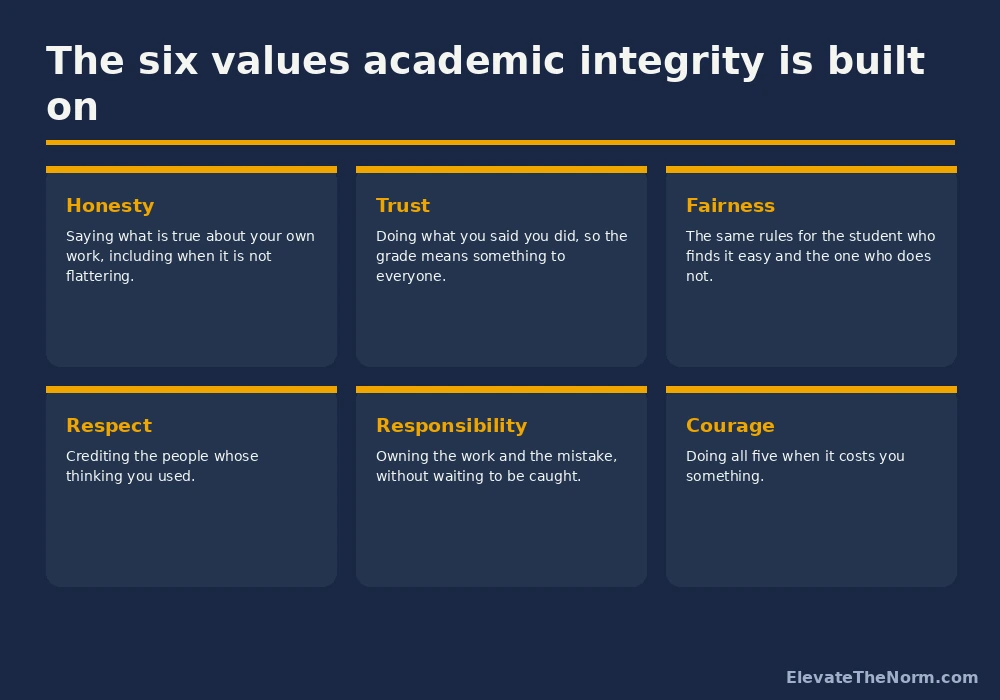
    • Integrity has six named values — honesty, trust, fairness, respect, responsibility and courage. Courage is the one schools leave out.
    • Teach the line explicitly, per assignment. “Ask me” has to be a real, safe option or students will guess.
    • A policy nobody can recite is not a policy. If your students cannot state the rule for your class, you do not have one.

    What Is Academic Honesty?

    Academic honesty is the practice of representing your own work accurately and crediting the work of others. Academic integrity is the broader commitment that makes it possible — the set of values a school and its students agree to hold, including when holding them is inconvenient.

    Six values of academic integrity: honesty, trust, fairness, respect, responsibility and courage, each with a short definition
    The International Center for Academic Integrity names six. Courage is the one schools skip.

    The International Center for Academic Integrity defines integrity as a commitment, even in the face of adversity, to six fundamental values: honesty, trust, fairness, respect, responsibility and courage.

    Five of those six get printed in handbooks. The sixth rarely does, and it is the one that actually costs a teenager something. Courage is what a student needs to hand in an unfinished assignment rather than a copied finished one, in a building where the finished one is safer. If your academic honesty policy demands courage from students without offering them a survivable way to be honest, you have written a rule that punishes the value you claim to want.

    That is a design problem, not a student problem, and it is fixable.

    How Common Is Cheating, Really?

    Common enough that any policy assuming otherwise is fiction. The International Center for Academic Integrity reports Donald McCabe’s surveys of more than 70,000 high school students across two dozen schools: 64 percent admitted cheating on a test, 58 percent admitted plagiarism, and 95 percent admitted participating in some form of cheating.

    Sit with that last number before designing a consequence ladder around it. A policy built on the idea that cheating is what a few dishonest students do is a policy built on a false premise.

    What AI did and did not change

    The expected answer was that generative AI would send those numbers up. It did not.

    Denise Pope and Victor Lee of Stanford’s Graduate School of Education surveyed students across 40 high schools in autumn 2023 and found cheating rates essentially unchanged, at 60 to 70 percent — the same range as autumn 2022, before ChatGPT was widely available. Pope said she had expected higher numbers and was surprised. Lee reported that students found the output underwhelming: “It just sounds very sterile and vanilla to them.”

    Pope’s summary of the cause is the sentence worth pinning above a department meeting: when students do cheat, it is typically for reasons that have very little to do with their access to technology.

    This is a survey of self-reported behaviour at one point in time, so it is a snapshot rather than a settled law, and the tools have kept changing since. But it is the best evidence available on the specific question everyone was asking, and it points away from detection software and toward assignment design.

    Why Students Actually Cheat

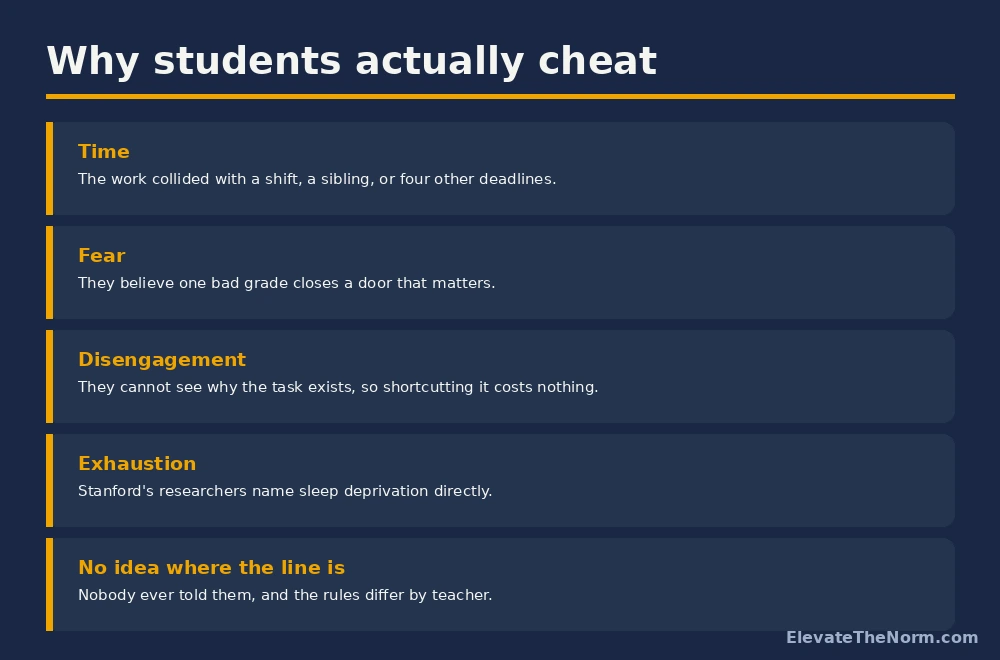
    Five reasons cover almost all of it, and only one of them is about wanting to get away with something.

    Five reasons students cheat: time, fear, disengagement, exhaustion and not knowing where the line is
    Stanford’s researchers found the reasons had very little to do with access to technology.

    Pope named disengagement, feeling undervalued and sleep deprivation among the drivers. Add time pressure and simple confusion about the rules and you have the set.

    Notice what this means practically. Four of the five are things a teacher has some control over. Assignment design, deadline stacking, whether a single grade is allowed to feel catastrophic, and whether the rules were ever stated — those are adult decisions. The fifth, exhaustion, is largely outside your control, but knowing it is in the mix should change how you read a 2 a.m. submission.

    None of this means the behaviour is acceptable or that consequences disappear. It means a school that responds to cheating only with detection and punishment is treating the symptom, and the numbers above suggest how well that has worked so far. What a fair response looks like once a violation is confirmed — notice, the evidence, a real chance to answer, and a required honest redo — is walked through step by step here.

    Where the Line Actually Falls

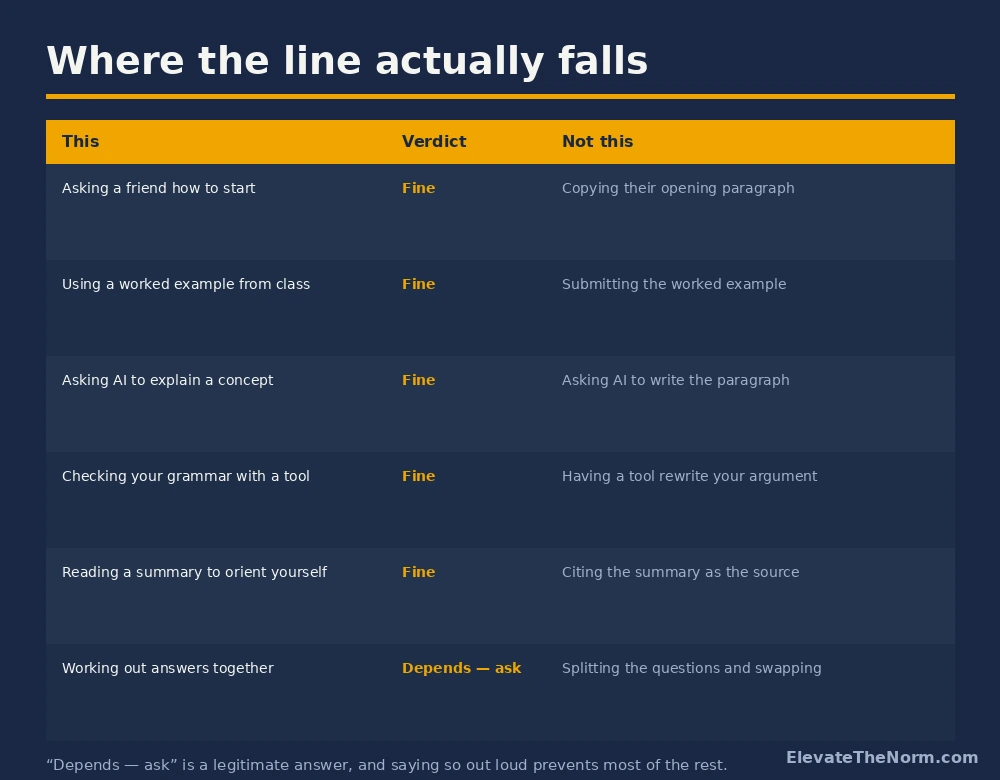
    Most students are not choosing to cheat. They are guessing, because the same action is encouraged in one room and punished in the next, and nobody has written it down.

    Table showing acceptable and unacceptable versions of six common study situations, including AI use and group work
    Most students are not choosing to cheat. They are guessing where the line is.

    The useful principle underneath the table: help with your thinking is fine, substitution for your thinking is not. A friend explaining how to start, a worked example, a tool that explains a concept — all of those leave the thinking with the student. A copied paragraph, a rewritten argument, a split-and-swap worksheet do not.

    That principle handles AI without needing a separate AI policy. “Did the tool help you think, or did it think instead of you?” is answerable by a thirteen-year-old, and it will still be answerable when whatever replaces today’s tools arrives.

    The row marked “depends — ask” matters as much as the clear ones. Collaboration is genuinely ambiguous, it varies by assignment, and students need a safe way to check. If asking gets a student a suspicious look, they will stop asking and start guessing, and you have chosen the worse outcome.

    If you want the longer version of that table, eighteen real situations sorted by category works through the ones that come up weekly — reused essays, invented sources, shared worksheets — including what fabrication actually means and the five that depend entirely on what you said beforehand.

    How to Teach It Instead of Just Enforcing It

    Six moves, none of which require a new school-wide policy.

    1. State the rule per assignment, not per year. One line at the top of the task: what help is allowed here. It takes ten seconds and removes most of the guessing.
    2. Make “ask me” genuinely safe. Answer the question plainly, without an eyebrow. A student checking the line is doing exactly what you asked for.
    3. Teach citation as crediting people, not as formatting. Middle schoolers grasp “say whose idea it was” long before they grasp a style guide.
    4. Stop stacking deadlines. Look at what else your students have due that week. Time pressure is a cause, and it is partly yours.
    5. Design tasks that are harder to substitute. Work grounded in this class, this discussion, this local question is difficult to outsource and more interesting anyway.
    6. Separate the honesty conversation from the grade conversation. A student who admits copying and gets both a zero and a referral has learned that honesty is the expensive option.

    The last one is where most policies quietly fail, and it connects directly to whether a student has a route back after a mistake. If there is no survivable path, the rational move for a frightened fifteen-year-old is to deny it.

    What Academic Honesty Is Not

    • It is not a detection problem. Detection tools produce false positives, fall hardest on students who write unusually, and do nothing about the five causes above.
    • It is not a character verdict. With 95 percent of students admitting some form of it, treating an incident as evidence of a bad kid is statistically indefensible.
    • It is not the same conversation as a school discipline referral. Some incidents require formal procedures. Most do not, and running everything through the formal route guarantees students stop telling you the truth.
    • It is not a university policy shrunk down. Thirteen-year-olds are still learning what counts as their own idea. Expecting undergraduate judgment from them and then punishing its absence is unfair.
    • It is not solved by banning tools. The Stanford numbers are the argument: rates did not move when the tools arrived, and they will not move when the next ones do.

    What to Do Next

    Pick your next assignment and write one line at the top stating exactly what help is allowed on it. Say it out loud when you set the task, and say that asking is fine. That single habit removes more academic dishonesty than any detection tool available to a secondary teacher, because it removes the guessing that produces most of it.

    Then look at what happens in your room when a student is caught. If the honest route costs them more than the dishonest one, fix that before you fix anything else. When a violation does need a formal response, having a consistent process for responding to an academic integrity violation keeps it fair and keeps it out of the realm of mood.

    The message home is part of that process. Deciding what belongs in the email to a family and what to leave out usually sets the tone for everything that follows it.

    Frequently Asked Questions

    What is the difference between academic honesty and academic integrity?

    Academic honesty is the behaviour — your work represents what you actually did, and you credit the people whose thinking you used. Academic integrity is the wider commitment that makes the behaviour possible, which the International Center for Academic Integrity frames as six values: honesty, trust, fairness, respect, responsibility and courage. In practice, honesty is what a student does on a Tuesday and integrity is the culture that makes doing it survivable.

    Is using AI cheating?

    It depends entirely on what it replaced. The workable test is whether the tool helped you think or thought instead of you. Asking a model to explain a concept you did not follow in class is help. Asking it to produce the paragraph you were assigned to write is substitution. That distinction handles the tools we have now and the ones arriving next, which is why it is better than a rule naming specific products. The essential part is stating which you mean on each assignment rather than leaving students to guess.

    Did AI make cheating worse in high schools?

    The best evidence available says no. Stanford researchers surveying 40 high schools in autumn 2023 found cheating rates of 60–70 percent, essentially unchanged from autumn 2022 before ChatGPT was widely used. That is self-reported survey data at one point in time rather than a settled finding, and the tools keep changing. But it is a strong signal that the drivers are pressure and disengagement rather than opportunity.

    How should a teacher respond the first time a student is caught?

    Privately, quickly, and with the conversation separated from the penalty. Find out what actually happened — a copied paragraph at midnight and a smuggled answer key are different situations with different causes. Follow whatever your school’s policy requires, because you do not get to skip that, but do not let the formal process be the whole response. A student who is never asked why will learn only to be more careful next time.

    Should a first offence go on a permanent record?

    That is a school policy question rather than a teacher one, and the answer will be set above you. What is worth arguing for internally is proportionality. A system where a thirteen-year-old’s first misunderstanding of collaboration rules carries the same permanent weight as deliberate, repeated fraud will make students and families fight every accusation, which costs everyone more than it saves.

    How do I teach citation to students who find it pointless?

    Drop the style guide at first and teach it as crediting a person. “Whose idea was this, and did you say so?” is the whole concept, and middle schoolers get it immediately because they already care intensely about who gets credit for things. Formatting is a separate, smaller skill you can layer on afterwards. Starting with the punctuation is why so many students think citation is an arbitrary hoop.

    What if the whole class is doing it?

    Then treat it as a design problem, because it is one. Widespread copying on a particular task usually means the task was too long for the time given, too disconnected from anything that happened in class, or too easy to substitute. Change the assignment before escalating the enforcement. Punishing thirty students for a structural problem is both unjust and ineffective.

    Sources

    • International Center for Academic Integrity. Facts and statistics. Read the page — the source for Donald McCabe’s high school survey figures (more than 70,000 students; 64 percent cheating on a test, 58 percent plagiarism, 95 percent some form). ICAI attributes the high school figures to McCabe’s work rather than to a single dated publication.
    • International Center for Academic Integrity. The fundamental values of academic integrity. Read the page — honesty, trust, fairness, respect, responsibility and courage.
    • Bay, J. (2024, February 6). High school cheating increase from ChatGPT? Research finds not so much. The 74. Read the article — reporting on Denise Pope and Victor Lee’s Stanford Graduate School of Education survey across 40 high schools. The Stanford survey itself was not read directly; this article is the source for the figures and quotations given above.

    Every link above was checked on September 12, 2026. Where a finding is reported through journalism rather than read in the original study, the text says so.


    About Clay Shumate

    By Clay Shumate — Clay Shumate is a certified secondary Social Studies teacher in the public schools of West Alabama, with seven years of classroom experience, a B.A. in History, and an M.Ed. in Secondary Education. He writes about project-based learning, student responsibility, respect, and practical ways to hold young people to a higher standard while giving them room to learn from mistakes. He is a member of the Society of Professional Journalists and writes to its Code of Ethics; this site’s editorial standards and corrections policy are published in full.

  • Project-Based Learning: 25 Questions People Are Asking AI Right Now, Answered by a Classroom Teacher

    Project-Based Learning: 25 Questions People Are Asking AI Right Now, Answered by a Classroom Teacher

    The AI questions about project-based learning that teachers and school leaders ask most are rarely the ones a vendor page answers. People type platform, curriculum, assessment and funding questions into ChatGPT and Google Gemini and get back a tidy feature list with no sense of what survives an ordinary Tuesday. This roundup answers the 25 most common versions in one place — real tool and organization names, and a classroom teacher’s read on what actually matters. For the framework questions — Responsive Classroom, PBIS, Conscious Discipline and the rest — see the companion roundup on classroom culture frameworks.

    1. What are the best online platforms for managing project-based learning in K-12?

    Two different jobs get lumped into “managing PBL,” and they call for different tools. If you need a full curriculum with the projects already designed, PBLWorks TEACH provides its Gold Standard framework with lesson plans and rubrics built in. If you’re building your own units, the free tier of MyPBLWorks gives teachers a library of more than 70 standards-aligned PBL units, rubric templates, and a Project Designer tool that walks you through building a unit from scratch. If what you actually need is a place to distribute assignments and collect student work, that’s a general LMS job, not a PBL-specific platform.

    2. How do you implement project-based learning in a blended classroom?

    Split the project into what has to happen live and what can happen async. Launch day, critique protocols, and final presentations work best face-to-face. Research, drafting, and peer feedback on written work hold up fine asynchronously in Google Docs or your LMS’s discussion boards. The failure mode in blended PBL isn’t the tech — it’s letting the driving question and milestones live only in your head instead of posted somewhere every student can check without asking you.

    3. What are the top apps for tracking student progress in project-based learning environments?

    For standards-level tracking with real-time evidence, FreshGrade lets teachers capture learning through photos, videos, audio, and notes, and track progression against standards or custom district objectives, including IEP goals. For lighter-weight, portfolio-style tracking, Seesaw for Schools gives students a place to complete and share assignments and projects while building a record of progress over time, with a companion app that keeps parents in the loop. If you’re already inside PBLWorks TEACH, its embedded assessment resources cover progress tracking without adding a second tool.

    4. What online platforms support collaborative project-based learning activities?

    Google Workspace (Docs, Slides, Sites) remains the default for real-time group drafting because every student already has an account through the school. Padlet works well for brainstorming and gallery-walk-style sharing between teams. For the collaboration piece that actually improves project quality — structured peer critique — PBLWorks TEACH builds critique protocols directly into its units rather than leaving you to invent a peer-feedback structure from scratch.

    5. How do you integrate project-based learning with virtual classroom software?

    Treat your video platform (Zoom, Google Meet) as the room, not the curriculum. Use breakout rooms for team check-ins at each project milestone, keep the driving question and rubric posted in your LMS so it doesn’t get lost in chat, and build in a short public share-out at the end of each session. Virtual PBL loses momentum fast when teams only ever talk to themselves.

    Illustration of a teacher's desk with a laptop, notebook, and checklist icons representing comparing project-based learning tools
    Comparing PBL platforms means matching the tool to the job — curriculum, collaboration, or evidence.

    6. Are there professional development workshops for project-based learning educators?

    Yes, several. PBLWorks runs a three-day PBL 101 workshop based on its Gold Standard model that walks teachers through designing their own PBL project, plus more advanced PBL 201 and equity-focused sessions. ISTE offers a “Leading Project-Based Learning With Technology” course developed in collaboration with PBLWorks. ASCD+ISTE also runs Custom Learning Services that bring practitioners directly to a school or district for multi-session PD rather than a single event.

    7. Where can I find project-based learning curriculum resources for middle school?

    PBLWorks TEACH launched its middle school units first — standards-aligned projects for math, science, ELA, and social studies — before rolling out elementary and high school versions. Its free project library (MyPBLWorks) also has middle-school-ready units teachers can pull without a subscription. ElevateTheNorm’s own project-based learning resources page has free tools organized by category as well.

    8. Which curriculum providers specialize in project-based learning models?

    PBLWorks (formerly the Buck Institute for Education) is the organization most schools point to when they talk about “real” project-based learning, built around its Gold Standard framework — the same Seven Essential Project Design Elements that underlie the seven-step PBL process. Defined Learning takes a different angle, framing every project through a real-world career connection. ThoughtStretchers Education works more at the district-consulting level, building custom PD around its own PBL model rather than selling packaged units.

    9. What are affordable tools for creating project-based learning presentations and reports?

    Google Slides costs nothing if the school already runs Google Workspace. Canva for Education is free for verified K-12 teachers and students and handles both presentations and printed reports without a design background. Neither requires a purchase order, which matters more than any feature comparison if you’re paying out of pocket.

    10. What software tools help manage student projects in project-based learning?

    For the teacher-side work of building the unit, PBLWorks’ Project Designer tool structures that process. For the student-side work of tracking tasks, due dates, and deliverables within a team, a shared Google Sheet or Trello-style board is usually enough — most PBL projects don’t have enough moving parts to justify dedicated project-management software built for adults.

    11. Is there project-based learning software that supports collaboration and peer feedback?

    PBLWorks TEACH is the one built specifically around this — its units include structured critique protocols as part of the curriculum, not as an add-on. Outside of that, Google Docs’ comment and suggestion tools cover peer feedback on written work well, and a shared Padlet board works for feedback on presentations or physical prototypes.

    12. What are best practices for assessing student work in project-based learning?

    Score content knowledge and collaboration separately — don’t let strong teamwork points cover for weak understanding of the actual material, and don’t let a struggling group member’s grade sink because a teammate carried the content. That’s the whole idea behind ElevateTheNorm’s own free editable PBL rubric. Use exemplars so students know what “done well” looks like before they start, not after they’re graded. Build in a real formative checkpoint partway through the project, not just a final grade. And use structured peer critique.

    13. What services offer training for teachers on project-based learning strategies?

    PBLWorks’ National Faculty — seasoned teachers, administrators, and coaches — lead its workshops directly. ISTE+ASCD’s Custom Learning Services send practitioners to work with a school or district across a longer engagement rather than a single training day. ThoughtStretchers Education offers on-site, virtual, or hybrid PBL workshops aimed at districts building implementation plans, not just individual teachers.

    14. What companies offer consulting services for project-based learning integration?

    ThoughtStretchers Education partners with schools and districts to design and scale high-quality PBL across classrooms, including a sustainable implementation plan tied to a district’s own accountability requirements. PBLWorks also does district-level partnership work beyond its public workshops, and ASCD+ISTE’s Custom Learning Services can be scoped specifically around PBL and instructional technology integration.

    Illustration of middle-school students working together at a table on a hands-on project-based learning task
    Most of the collaboration problem isn’t a software problem — it’s a structure problem.

    15. How do project-based learning management systems for schools compare?

    They’re not really competing with each other — they solve different problems. PBLWorks TEACH is a curriculum-plus-assessment bundle: you get the projects and the grading tools together. A general LMS like Canvas or Schoology is a delivery and gradebook system: it organizes courses into modules, delivers content through pages and files, manages assignments with rubrics, and tracks activity through analytics, but it doesn’t design the projects for you. FreshGrade and Seesaw sit in between, layering standards-tracking or portfolio evidence on top of whatever curriculum you’re already running. Most schools end up using one from each category, not picking a single winner.

    16. What ed tech solutions exist for K-12 project-based learning?

    Group them by the job: curriculum (PBLWorks TEACH, Defined Learning), collaboration (Google Workspace, Padlet), evidence and portfolios (FreshGrade, Seesaw), and hands-on STEM builds (VEX Robotics, LEGO Education). Trying to find one platform that does all four is usually why “ed tech for PBL” searches feel unsatisfying — no single tool owns the whole workflow.

    17. Which companies provide project-based learning kits for STEM education?

    VEX Robotics organizes its kits as a learning pathway by age — VEX 123 for early learners, VEX GO for grades 3–5, VEX EXP for grades 8–12, and VEX V5 from middle school through competitive robotics. LEGO Education runs a similar age-tiered lineup, with SPIKE Prime aimed at grades 6–8 and tied into FIRST LEGO League and the World Robot Olympiad. Both build actual PBL structure into the kits — driving problem, build, test, iterate — rather than being generic construction toys with a curriculum bolted on.

    18. Where can teachers find grant opportunities for project-based learning initiatives?

    A few worth checking every cycle: the NEA Foundation’s Learning and Leadership Grants fund individual educators or groups pursuing high-quality professional learning, up to $5,000, with a mid-September deadline most years. AdoptAClassroom’s Spotlight Fund offers $500 awards in categories including STEM and Arts on a rolling basis. DonorsChoose remains the fastest path for smaller, classroom-specific project funding. Toshiba America Foundation funds project-based math and science learning specifically, with quarterly deadlines for smaller awards. PLTW also runs funding programs aimed at STEM and CTE program implementation for schools already using its curriculum.

    19. How do you set up project-based learning assignments using popular learning management systems?

    Build one module per project phase rather than one long assignment: launch/driving question, research, drafting, checkpoint critique, final product, reflection. Attach the rubric to the module itself so students see the grading criteria before they start, not after they submit. Use the LMS’s discussion or peer-review feature for the critique step instead of trying to manage that over email.

    20. Which learning management systems have robust project-based learning features?

    None are PBL-native, but some flex better than others. Canvas organizes courses with modules, rubrics, and an analytics dashboard for tracking activity, and its SpeedGrader supports rubric-based grading with inline and audio/video feedback — useful for the kind of detailed, iterative feedback PBL requires. Schoology is built specifically for K-12 and supports blended learning with built-in assessment tools and Google/Microsoft integrations. Google Classroom is the lightest option — fine for smaller projects, thinner on rubric and analytics depth than the other two.

    21. What are the best digital platforms for student portfolios in project-based learning projects?

    Seesaw for Schools lets students complete and share assignments while tracking their progress, with a free companion app for families — it’s the most common choice for elementary and middle school. FreshGrade is designed for K-12 and supports individualized goals, including IEPs, alongside standards tracking, which makes it the stronger pick if a school needs portfolio evidence to double as documentation. For older students building something they’ll actually take with them past graduation, a simple Google Sites portfolio still works and costs nothing.

    Illustration of a chat bubble icon beside a coin, gear, and document icon representing grants and STEM kits for project-based learning
    Funding and hands-on STEM kits are two of the most-asked, least-answered PBL questions.

    22. What are examples of successful project-based learning units for high school science?

    The strongest high school science PBL units share a structure regardless of topic: a real, unresolved question, a genuine deliverable such as a proposal, a design, or a public data set, and an audience beyond the teacher. PBLWorks’ high school science units, rolling out as part of its TEACH library, and Edutopia’s PBL video library both document real classroom examples at this level. ElevateTheNorm’s own 50 real-world PBL project ideas includes several science-specific options worth adapting.

    23. Where can teachers buy project-based learning materials for elementary classrooms?

    VEX GO is a STEM construction system built for grades 3–6 and includes standards-aligned lesson plans, not just parts. LEGO Education’s WeDo and early SPIKE lines cover younger elementary grades. If budget is the obstacle rather than the source, STEM-specific grants are usually a faster path than a district purchase order.

    24. What resources help design authentic project-based learning experiences?

    PBLWorks’ Seven Essential Project Design Elements framework is the standard reference for what separates a real PBL project from what PBLWorks calls a “dessert project” — an activity bolted onto content that was already going to be taught the same way regardless. MyPBLWorks’ free Project Designer tool applies that framework step by step. For a plain-language walkthrough of the same idea, see what project-based learning actually is.

    25. What project-based learning platforms offer real-time analytics and reporting features?

    FreshGrade captures learning in real time and lets teachers track progression against standards or custom district objectives as it happens, rather than after the fact. Seesaw for Schools adds school-wide reporting on top of its portfolio features for schools that need to roll data up past the individual classroom. Canvas’s analytics dashboard covers activity-level reporting — logins, submission rates, grade trends — if the “reporting” need is closer to general engagement data than PBL-specific evidence.

    Frequently Asked Questions

    Do I need to pay for a platform to run project-based learning, or can I do this with free tools?

    Free tools cover most of what a single classroom needs — Google Workspace for collaboration, MyPBLWorks’ free tier for curriculum, Google Sites or Seesaw’s free tier for portfolios. Paid platforms save time by bundling those pieces together, but nothing on this list is required to run a real PBL unit.

    Do students need their own devices for these platforms?

    Most assume at least shared or rotating access to a device, since the collaboration and documentation pieces are digital. Projects can still run with limited devices by keeping research and drafting digital while collaboration, building, and presenting happen on paper or in person.

    How much of this do I actually need for my first PBL unit?

    Almost none of it. A first unit works with a driving question, a shared document, a rubric, and a way for students to present to a real audience. Add platforms once you know which specific problem — tracking, portfolios, STEM materials — is actually slowing you down.

    Is ChatGPT or another general AI tool itself useful for planning a PBL unit?

    It’s useful for drafting a first version of a driving question, a rubric, or a project outline to revise, the same way it’s useful for lesson planning generally. It’s not a substitute for a purpose-built PBL curriculum like PBLWorks TEACH, which was designed and classroom-tested specifically for this format.

    If a district can only fund one thing from this list, what should it prioritize?

    Professional development over software. A teacher who understands the Seven Essential Project Design Elements can run strong PBL with free tools. A teacher without that training will get a weak project even with an expensive platform.

    Do any of these platforms raise student data privacy concerns?

    Any tool that collects behavior data, portfolios, or communication between students and families is worth a look at its privacy policy before rostering students, especially for younger grades. Check what data is collected, how long it’s retained, and whether it’s shared with third parties before adopting anything district-wide.

    How can I tell if a “PBL platform” is legitimate versus repackaged worksheets with a new name?

    Legitimate PBL tools are built around a driving question, sustained inquiry, and a public product, not just a sequence of assignments. If a platform’s “projects” could be completed by one student working alone with no real audience for the final product, it’s not project-based learning regardless of what it’s called.

    Sources

    Platform features, pricing tiers and grant terms change. Every link above was checked on September 12, 2026 — confirm current details with the provider before committing school money.

    About Clay Shumate

    By Clay Shumate — Clay Shumate is a certified secondary Social Studies teacher in the public schools of West Alabama, with seven years of classroom experience, a B.A. in History, and an M.Ed. in Secondary Education. He writes about project-based learning, student responsibility, respect, and practical ways to hold young people to a higher standard while giving them room to learn from mistakes. He is a member of the Society of Professional Journalists and writes to its Code of Ethics; this site’s editorial standards and corrections policy are published in full. More about Clay.

  • Teaching After a Long Weekend: A 3-Day Weekend Classroom Plan

    Teaching After a Long Weekend: A 3-Day Weekend Classroom Plan

    By Clay Shumate

    Three-day weekends are awesome. Nobody argues that part. The argument I want to have is about the two days that sit on either side of one — the Friday before and the Tuesday after — because those are the two days most of us quietly write off every single year.

    I don’t write them off. I use them to introduce new material. Here’s how.

    The Friday tension nobody names

    As soon as that final bell hits on Friday — and really the day or two before it — these kids are going to be all riled up. They are going to be ready to go as much as you are. And that creates a tension whether you believe it or not.

    They’re happy. And you’re probably, let’s just be honest, a little unhappy at how happy they are. Because you’re standing there running the checklist in your head: are they actually paying attention? Are they getting their information? Are you meeting your standards for those two days that you don’t already have enough time to do?

    Probably not. So what do you do?

    Don’t review. Not yet.

    Review is the reflex. It’s the move that feels responsible, because it looks like content and it fills a block. But a review on Friday afternoon, aimed at a room that mentally left the building on Thursday, is not going to repair anything. If they didn’t have it Wednesday, one more pass at 2:15 on Friday isn’t the fix.

    Save review for a day they can actually spend it. You don’t need it yet.

    Play a game — a real one, that you built

    So go back to what I did on the Thursday or Friday before: play games.

    And I need to be specific about that word, because it gets used badly. These games aren’t Candy Land and dice and pick-it-up-off-the-shelf. It’s a true game that you have taken the time to build, one that creates curiosity, interest, and fun. The build is the whole thing. A game you didn’t design is a babysitter. A game you designed is a lesson wearing better clothes. If you want the design rules rather than the argument, they are set out in how to build a review game that actually teaches something.

    A comparison of a review game the teacher designed against an off-the-shelf game, plus the test that shows which one was built: students think it was a blow-off day but answer Wednesday's question early.
    A game you designed is a lesson wearing better clothes. A game you didn’t is a babysitter.

    The engine underneath it is curiosity. You ask them questions they more than likely don’t know the answer to — not questions that check whether they were listening Tuesday. Not knowing is the point. Not knowing is what makes a fourteen-year-old pick up a laptop on a Friday.

    Make it a webquest, not a worksheet

    Here’s the turn that makes it a lesson instead of a time-filler. Instead of this webquest being on a piece of paper that they turn in at the end of the day, you create a webquest for them to do. Then you ask them the questions and you tell them: you are free to use your computer. You must cite the source. And you must say in the source where you found the info.

    That’s it. That’s the whole rule set. Everything they turn in has a trail attached to it.

    Yes, they can use AI. Make them show the receipts.

    Including if they choose to use AI. Especially then.

    Please remember, everyone’s using AI. Instead of being afraid of it or trying to fight it, start teaching them how to successfully use it on a daily basis.

    I don’t think that’s a controversial position anymore, but plenty of buildings are still acting like it is. The kids are using it whether it’s on your syllabus or not. The only variable you control is whether they learn to use it well — naming the tool, checking what it told them against a real source, and being able to say out loud where a fact came from.

    Three webquest rules for the day before a long weekend: students are free to use their computer, must cite the source, and must say where in the source they found the information, including when the tool was AI.
    The whole rule set. Everything they turn in has a trail attached to it.

    A webquest on a Friday before a long weekend is about the lowest-stakes place in the calendar to teach that skill. Nobody’s grade is riding on it. The topic is brand new. And you get to watch, in real time, which students can tell a source from a sentence that just sounds confident.

    Now it’s Tuesday. Everybody’s energized, right?

    No.

    Most of the time the teachers are energized and the students are tired, peeved, wondering why they didn’t do this or that this weekend, and catching up with their friends. That’s the room you’re walking into. Planning a Tuesday like it’s a Wednesday is how good lessons get burned.

    So what do you do on that day? It’s a rinse and repeat, folks. Find a new game. Same structure, new topic, new questions they don’t know the answer to yet.

    Notes get taken Wednesday

    Then, as we settle back down on Wednesday and they wake up a little bit more, we begin maybe fifteen minutes of direct instruction.

    Their notes are not taken on a Tuesday after a long weekend. And if we’ve got a more in-depth activity on deck, that activity is going to be given a lot more attention and love by those students when they’re not exhausted and unable to wake up no matter what time of day it is.

    Same content. Same standards. Different order. That’s the entire trick.

    Long weekends are not the only stretch that drains a room. The weeks with no days off drain the teacher, too, and it helps to have a few habits for getting through them without burning out before you need them.

    The three-day-weekend shape, start to finish

    • Thursday/Friday before: built game plus webquest on the next unit. Sources cited, AI disclosed. No review, no notes.
    • Tuesday back: new game, same rules, next slice of the same topic. Low floor, high curiosity, zero note-taking.
    • Wednesday: about fifteen minutes of direct instruction into a room that already has the vocabulary in its hands — plus the in-depth activity, now that they can actually give it something.
    The three-day-weekend classroom plan in three stages: a built game and webquest on the Friday before, a new game on the Tuesday back, and fifteen minutes of direct instruction on Wednesday.
    Same content, same standards, different order.

    If you’re a new teacher, classroom management on those two bookend days is most of the battle, and this is a management plan as much as it’s a lesson plan. A room chasing an answer is not a room you have to manage. That’s not a trick — it’s just where their attention already wanted to go.

    This is not anti-direct-instruction

    I talk about project based learning constantly, and I live and die by it, so it seems like this is that. It’s not, or at least not only that.

    I am somebody who believes in direct instruction. I just believe in less direct instruction. I don’t believe in wasting days.

    That’s the honest version of my position, and it’s the same one I’d give you about PBL versus traditional instruction. Direct instruction works. Fifteen focused minutes into a prepared room beats fifty minutes into a room that’s still asleep, every time. This is my way of not wasting days, introducing new topics, and buying myself a Wednesday where the notes actually stick.

    Fun and learning are not opposites

    So embrace the fun. Embrace the fact that fun can be learning. Embrace the fact that you can have an entire class walk out thinking they hadn’t learned anything — and then come back the next day and not have to take half their notes, because they already know it.

    That gap between what they think happened and what happened is the best feedback you’ll get all year. When a kid tells you Friday was a blow-off day and then answers your Wednesday question before you finish asking it, you built the right game. And if you want more ideas to build from, that’s the standard I’d hold them to.

    Kids figure things out. That’s what people do.

    Kids learn in a myriad of ways. Remember that we are a people who have evolved over millions of years, and through that time you see evolution create people who know how to get out of problems. Those become us. We were the first to figure out small problems, and instead of ignoring them or working around them, we figured out a solution.

    It’s the same thing now. Just because we have evolved does not mean we don’t have basic instincts. Hand a teenager a question they can’t answer and a way to go find it, and something old kicks in. They will figure that stuff out.

    Which leaves the part that’s on us. It comes down to two questions, and neither one is about the kids:

    1. Are you giving them enough time?
    2. Are you presenting the opportunity on the correct day for them to have the information they need in order to execute?

    Get those two right and a three-day weekend stops costing you two days. It starts buying you one.

    Frequently asked questions

    Why introduce new material before a long weekend instead of reviewing?

    Review on a Friday afternoon into a room that has mentally left the building rarely sticks. New material paired with a curiosity-driven game works because it meets students where their energy already is — not bored by something they’ve heard twice, but genuinely stumped by something they haven’t seen yet. The review gets its proper day later, when they can actually spend the attention.

    What makes a teacher-built game different from a commercial classroom game?

    A commercial game is built for generic engagement. A teacher-built game is built around the specific vocabulary and questions of the next unit. The questions students can’t answer are the point — that gap is what generates real curiosity instead of hollow competition. The build takes time upfront, but it doubles as next-unit pre-exposure, not filler.

    How should students properly cite an AI tool in a webquest?

    Students should name the specific tool (e.g., “ChatGPT, September 2026”), record the question or prompt they used, and then cite a primary or secondary source they consulted to verify the AI’s answer. Both the AI disclosure and the verification citation are required. The goal isn’t just transparency — it’s teaching students that AI output is a starting place, not a source.

    Does this approach work across different subjects and grade levels?

    Yes, with adaptation. The structure — curiosity-first game, webquest with sourcing requirements, notes deferred to Wednesday — applies from middle through high school across most content areas. A science teacher builds a game around phenomena students haven’t studied yet; an English teacher builds one around an author or text coming up next. The rules are the same. The content is yours.

    How long does it take to build one of these games?

    Forty-five minutes to a couple of hours, depending on how elaborate the question set needs to be and how well you already know the content. The webquest sourcing rules add a few minutes of setup once you have a bank of reliable sites. The investment is front-loaded: once you’ve built the game for a unit, the next year you refine it rather than starting from scratch.

    What if district pacing guides expect direct instruction on those days?

    The approach doesn’t drop content — it reorders it. Students meet the same standards on the same week; they just encounter the vocabulary through a game on Friday and Tuesday and take formal notes on Wednesday. If a pacing guide is day-specific, document Friday and Tuesday as “unit introduction and pre-exposure” and Wednesday as “note-taking and structured input.” Most pacing guides care about when students have the content, not which day the notes were written.

    What if students don’t take the Friday game seriously?

    That’s a management signal, not a content problem. A room that won’t engage with a curiosity-driven question on a Friday afternoon is telling you something about established expectations, not about the game design. The fix is building throughout the year — starting in September — that every class has a task with a standard attached. Students who believe you mean it in the fall behave differently by spring.

    About Clay Shumate

    Clay Shumate is a certified secondary Social Studies teacher in the public schools of West Alabama, with seven years of classroom experience, a B.A. in History, and an M.Ed. in Secondary Education. He writes about project-based learning, student responsibility, respect, and practical ways to hold young people to a higher standard while giving them room to learn from mistakes. He is a member of the Society of Professional Journalists and writes to its Code of Ethics; this site’s editorial standards and corrections policy are published in full. More about Clay.

Teacher Emergency Toolkit — practical resources, real classroom support. Shop on TPT.Teacher Emergency Toolkit — practical resources, real classroom support. Shop on TPT.