By Clay Shumate
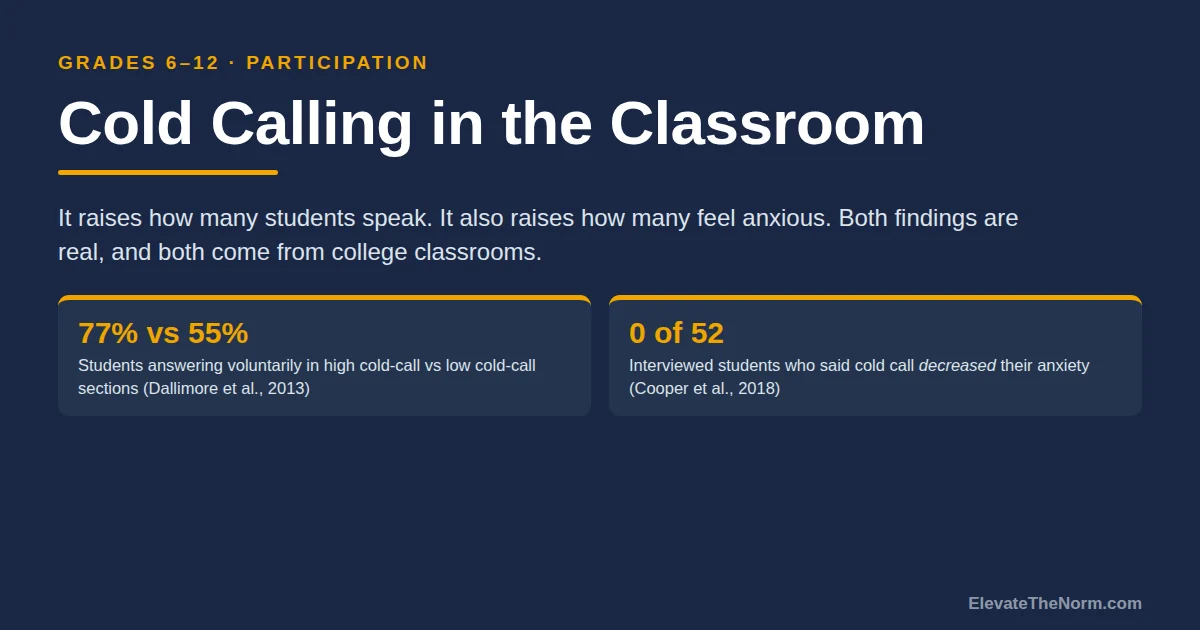
Cold calling in the classroom means calling on a student who did not raise a hand. The research says it works: more students answer voluntarily in classes where it is normal, and the gap between who speaks and who stays quiet narrows. The same research says it makes students anxious. Both are true, and the second one is the part most teaching advice leaves out.
What follows is what the studies actually measured, who they measured it on, and the version of cold calling that holds a high standard without turning a question into a punishment.
Key Takeaways
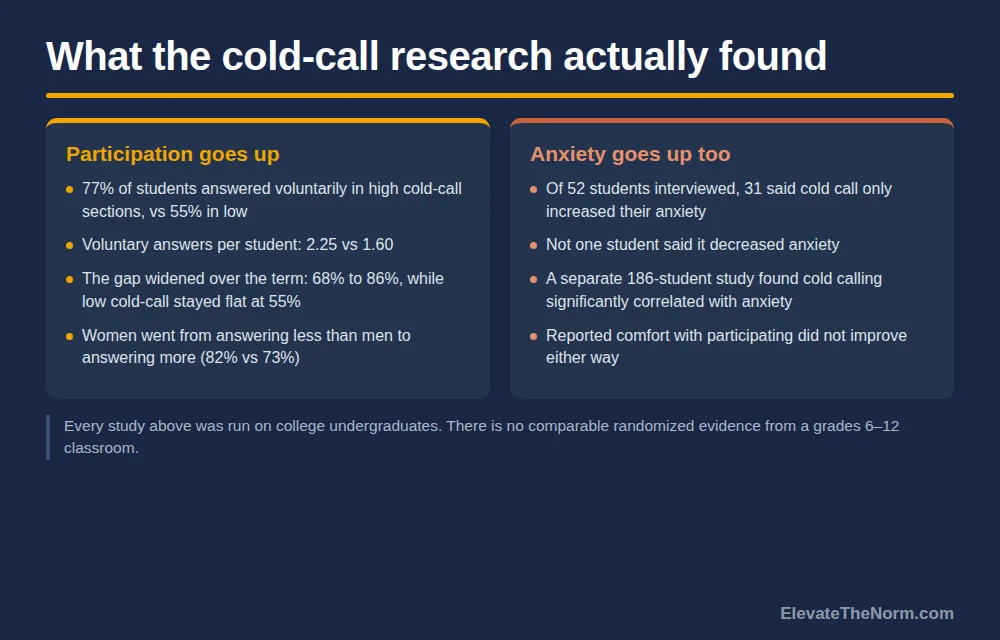
- Cold calling raises voluntary participation, and the effect is not small. 77% of students answered voluntarily in high cold-call sections, against 55% in low cold-call sections — and it grew over the term rather than wearing off.
- It closes a gender gap in who talks. Women answered less often than men in low cold-call classes and more often than men in high cold-call classes.
- It also makes students anxious, reliably. Of 52 students interviewed about active-learning practices, 31 said cold call only increased their anxiety. Not one said it decreased it.
- Every one of those studies was run on college undergraduates. There is no comparable randomized evidence from a grades 6–12 classroom, and anyone who tells you there is has not read the papers.
- The design decisions are what separate the two outcomes. Rehearsal time, three seconds of silence, visible randomness and a return path cost nothing and change what the practice feels like from a seat.
Free Download · PDF
The Cold Call Card and Participation Log (2 pages)
Page 1 is the six moves, the sentence to say out loud in week one, and what to do about a flat refusal, a student newer to English, and a documented accommodation. Page 2 is a five-day log for finding the names that never speak.
Free. No email address required. Designed for grades 6–12. Browse every printable in Your Free Library.
What Is Cold Calling in the Classroom?
Cold calling is asking a question and then naming a student who did not volunteer. That is the whole definition. It is not a discipline move, it is not a pop quiz, and it is not the thing where you catch the kid who was looking out the window.
The confusion matters because the two versions produce opposite results. A question asked of a class, followed by silence, followed by a name, is an instructional move. The same name said to a student who has stopped paying attention, with a question attached as the consequence, is a correction wearing a question’s clothes. Students can tell the difference in about half a second, and so can anyone watching.
Hands-up questioning has an obvious problem that cold calling is meant to solve. If you only call on raised hands, you learn what your four most confident students think. Everyone else gets to opt out of thinking, because they know in advance that nothing will be asked of them. That is not a participation problem. It is an information problem — you are teaching a room you cannot see.
Which means the answer has to be worth collecting. If a student says something that reveals half the room is stuck on the same step and you carry on to the next slide anyway, you have not run a check, you have run a performance. The point of hearing from the students who were not going to volunteer is that they are the ones most likely to tell you something you did not already know.
Does Cold Calling Actually Increase Participation?
Yes, and the increase is larger and more durable than I expected when I went looking for the numbers.
The most careful study on this is Dallimore, Hertenstein and Platt (2013), published in the Journal of Management Education. They tracked 632 undergraduate sophomores across 16 sections of a required accounting course, with seven different instructors. Observers sat in classrooms twice per section and recorded every answer and whether it was volunteered or cold-called. Sections were then sorted into high cold-call and low cold-call environments.
The results, in the order that matters:
- 77% of students in high cold-call sections answered at least one voluntary question, against 55% in low cold-call sections.
- Voluntary answers per student: 2.25 in high cold-call sections, 1.60 in low.
- The effect grew. High cold-call sections went from 68% at the first observation to 86% at the second. Low cold-call sections sat at 55% both times and did not move.
That last line is the one worth sitting with. The usual objection to cold calling is that students will participate only under threat and will shut down the moment you stop. The observed pattern is the opposite — voluntary participation climbed as the term went on. The students in those rooms were not being dragged into speaking. They were getting used to it.
And it narrows a gap in who speaks
The same research team published a follow-up in 2019 looking specifically at gender. In low cold-call sections, 52% of women answered voluntarily against 57% of men, and men answered more questions each (1.78 against 1.33). In high cold-call sections that flipped: 82% of women answered voluntarily against 73% of men, and the per-student difference disappeared. The rate of increase for women was statistically significant.
If you have ever looked at a discussion and thought the same six boys are carrying this, that is the finding that speaks to it. The quiet half of a room is not quiet because it has nothing to say. It is quiet because volunteering is a social risk, and it is a bigger social risk for some students than others. Taking volunteering out of the equation changes who is heard.
Does Cold Calling Make Students Anxious?
Yes, and this is the part of the literature that rarely makes it into a staff meeting.
Cooper, Downing and Brownell (2018), in the International Journal of STEM Education, interviewed 52 students in large active-learning biology courses about which practices raised or lowered their anxiety. Cold call was the single most negative practice they studied. Thirty-two students brought it up unprompted. Thirty-one of them said it only increased their anxiety. One said it had no effect. Zero students said it decreased their anxiety. The driver students named was fear of being evaluated badly in front of a large group.
That is not an isolated finding. A 2024 study of 186 students at a Chinese university found cold calling significantly and positively correlated with anxiety, and the authors recommended using it with caution for exactly that reason.
And here is the uncomfortable detail: in the Dallimore work, students’ self-reported comfort with class participation did not significantly improve in high cold-call sections either. Participation went up. Comfort did not follow it. Those are two different things and the studies measured both.
So the honest summary is that cold calling makes more students speak and makes some of them feel worse while doing it. Anyone who tells you it is a free win is selling something.
Does Any of This Apply to a Grades 6–12 Classroom?
Not directly, and this is the biggest caveat on the page.
Every study above was conducted on university undergraduates — accounting sophomores, biology majors, design students. Teenagers in a required course they did not choose, in a building where they will see the same classmates for four years, are not undergraduates. The social cost of being wrong in front of people is higher in a high school than in a 300-seat lecture hall, and the floor on it is lower. A fourteen-year-old who gets laughed at in October remembers it in May.
What transfers is the mechanism, not the number. The mechanism is that when answering is optional, most students opt out of thinking, and when it is not optional, they do not. That is about how attention works, not about how old you are. The specific percentages do not transfer, and I would not quote them at a faculty meeting as if they did. If you want the broader picture of what counts as real evidence that a class understood something, that is a separate question with its own answer.
Why Three Seconds of Silence Changes What You Get Back
Most teachers wait about one second between asking a question and doing something else. That measurement comes from Mary Budd Rowe’s wait-time research, and it is one of the few findings in education that has survived essentially unchallenged for fifty years.
When Rowe trained teachers to extend that pause to three to five seconds, the changes were not subtle. Average student response length went from 8 words to 27. Failures to respond dropped from 7 to 1. Unsolicited appropriate responses rose from 5 to 17. Students the teachers had described as slow started contributing.
The caveat, stated plainly: Rowe’s classrooms were primary grades. That is elementary science, not a ninth-grade room, and this site does not pretend elementary findings are secondary findings. But the mechanism behind it — that a one-second pause only has time to surface an answer that was already sitting there, and three seconds has time to produce a new one — is not age-specific. The reason to believe it for teenagers is that it describes thinking, and the reason to be careful about it is that nobody has run Rowe’s study on a high school.
Put together with a cold call, the sequence is: ask, wait three seconds, say a name, wait three more seconds. The first pause is for the class. The second is for the student. Filling either one is the most common way a well-intentioned cold call turns into an interrogation.
How Do You Cold Call Without Making It a Gotcha?
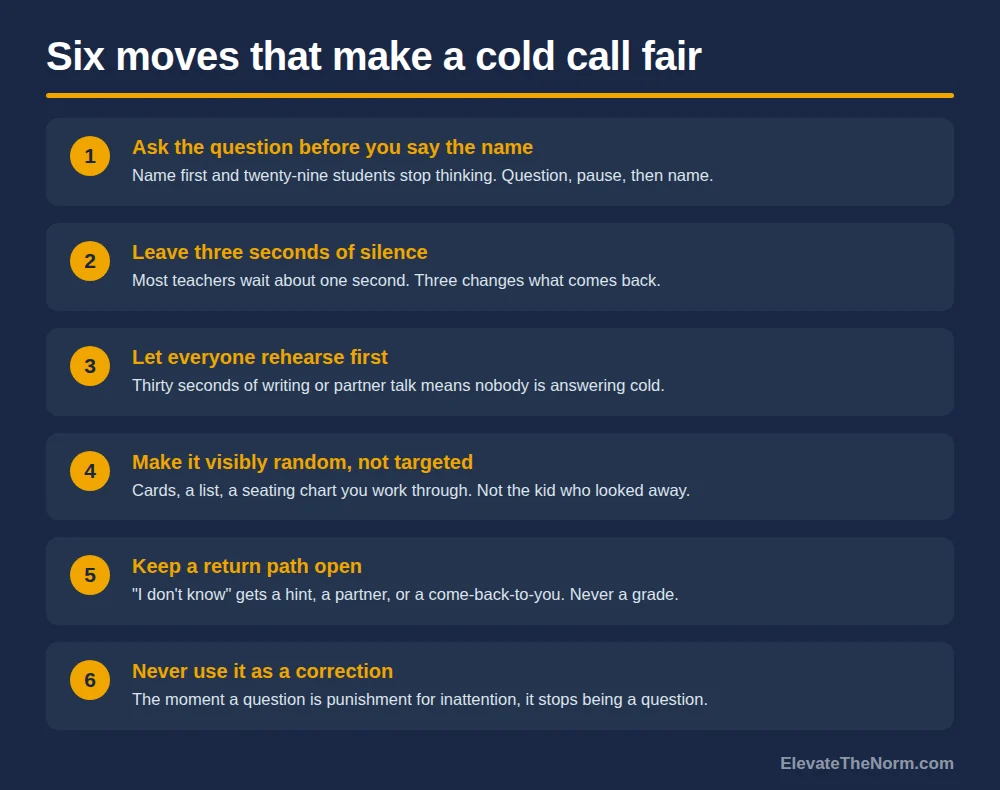
You make it predictable, you let everyone rehearse, and you make sure no student can lose by being called on. Six moves, in the order you would use them.
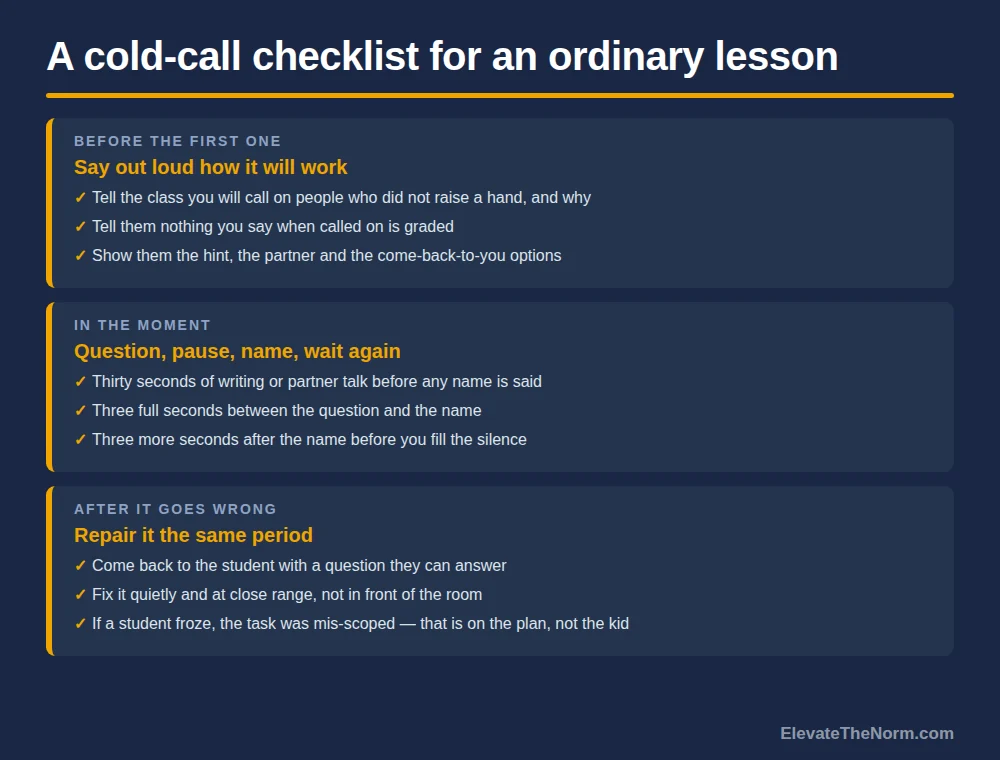
1. Ask the question before you say the name. Say the name first and twenty-nine students stop thinking, because the question is now somebody else’s problem. Question, pause, name. That order is the entire difference between a cold call that teaches the room and one that teaches one kid.
2. Leave three seconds of silence. Covered above, and it is the move teachers find hardest. Three seconds is longer than it sounds when you are standing up in front of people.
3. Let everyone rehearse first. Thirty seconds of writing, or thirty seconds of turning to a partner, before any name is said. Now nobody is actually answering cold — every student has already produced something and is being asked to read it out. This single change removes most of what the anxiety research is describing, because the fear is not of speaking, it is of having nothing to say.
4. Make it visibly random, not targeted. Name cards, a list you work down, a seating chart you move through. The point is not fairness in the abstract. The point is that a student who gets called on knows it was not about them. The moment the selection looks like judgment, you have the gotcha back.
5. Keep a return path open. “I don’t know” has to lead somewhere other than embarrassment — a hint, permission to ask a partner, or a straight “I’ll come back to you,” followed by actually coming back with a question they can answer. The return is the part people skip, and it is the part that makes the whole thing safe.
6. Never use it as a correction. The moment a question is the consequence for inattention, it stops being a question and the class learns that your questions are weapons. Handle the off-task student the way you would handle anything else — quietly, at close range, and not as a performance for the room.

What About the Student Who Genuinely Cannot Answer?
If a student freezes badly enough to matter, the task was mis-scoped, and that is on the plan rather than the kid.
I believe this about classrooms generally. A student cannot screw up that badly in a well-planned room. If they can, the question was wrong, the scaffolding was missing, or the adult was not paying attention. The honest fix after a cold call goes wrong is not to stop cold calling and it is not to apologise at length in front of everyone. It is to come back to that student inside the same period with something they can answer, and to look at why the first question had no entry point.
This is also where the anxiety research should change your practice rather than end it. Students in those interviews were not afraid of being asked things. They were afraid of being evaluated badly in public. Those are separable. You can ask a student something hard and make it structurally impossible for the answer to count against them — nothing said out loud is graded, “I don’t know” is a legitimate answer, and the return path exists. Do that and you have kept the demand while removing most of the threat.
Respecting students is not complicated, and it mostly comes down to doing exactly what you said you would do, every time. If you tell a class that nothing they say when called on is graded, that has to be true in week fourteen as well as week one.
Two groups need a decision made in advance rather than in the moment. A student who is newer to English, or who stammers, or who has a documented anxiety accommodation, should not be finding out mid-lesson what your rules are. For the first two, written rehearsal time does most of the work and a quiet “would you rather read what you wrote or tell me after?” does the rest. For the third, the plan governs, not the technique — if a 504 or IEP says the student is not called on without warning, that is the end of the discussion and no research finding overrides it.
And occasionally a student will simply refuse. Not freeze — refuse, flatly, in front of everyone. Take it at face value, move on without comment, and deal with it later and privately, because a standoff in front of thirty people is a fight you cannot win and should not be having. Nine times out of ten the refusal is about something that happened before the bell.
Organization to the Minute, and Then the Pause
The hardest part of all of this is the silence, and I have an expensive data point about silence.
I once waited over five minutes. It was one of the most awkward moments of my life. That section finished nine minutes behind my other classes, and it is the only time I have ever assigned homework — I do not otherwise assign it at all. That is the price tag, and most advice about waiting students out does not come with one.
What I would take from it, applied to a three-second pause rather than a five-minute one: the silence works, and it costs something, and you should know what it costs before you spend it. Three seconds is cheap. Three seconds times forty questions is two minutes of a lesson. That is a trade worth making. Standing there for five is a different decision, and you should make it on purpose.
My room runs as a workshop — tables in pairs and fours, nobody sitting in a row facing front, me on a wheeled stool moving between groups. Cold calling in a room like that is less of an event than it is in a lecture hall, because students are already talking to each other all period. That is part of why the rehearse-first move matters so much. In a room where partner talk is the default condition rather than a treat, “say what you just told your partner” is barely a cold call at all.
Where Cold Calling Goes Wrong
- Using it to catch people. The fastest way to poison it. One targeted question in front of thirty people and every subsequent question in your room reads as a threat.
- Grading it. Participation points attached to cold-call answers convert a thinking task into a performance task, and the students who most need to practise speaking are the ones who will now dread it most.
- Skipping the rehearsal. Cold calling without think time is the version the anxiety studies describe. With think time, it is a different practice wearing the same name.
- Filling the silence. Rephrasing your own question after two seconds, which teachers do constantly, resets the clock and tells the room you did not mean it.
- Doing it inconsistently. If it happens twice a month, it is an event, and events are frightening. If it happens every day, it is the weather.
- Only cold calling the strong students. It feels safe and it defeats the purpose. The information you need is from the students who were not going to volunteer.
What to Do Next
Pick one class. Tomorrow, before the first question, say out loud how it is going to work: you will call on people who did not raise a hand, nothing said out loud is graded, and “I don’t know” gets you a hint and a second try. Then run the sequence — thirty seconds of writing, ask, three seconds, a name off a list, three more seconds.
Do it for two weeks before you judge it. The Dallimore data showed the effect growing between the first observation and the second, which means a first week that feels awkward is not evidence of anything. Then look at who is talking and compare it to your memory of September.
It is also worth putting one line in a newsletter or a back-to-school email: this class expects everyone to answer questions, nothing said out loud is graded, and no student is ever stuck with no way out. A parent who hears about cold calling first from an upset teenager will assume the worst. A parent who heard it from you in August usually does not.
If you want this inside a wider system of checks rather than as a single technique, the full list of formative assessment strategies puts cold call alongside the other moves that tell you what a room actually understands, and a structured seminar is what this turns into once students are used to being expected to speak. Both work better once the expectations you set in the first week have made being asked a question an ordinary event rather than a surprise.
Before you go: grab the free The Cold Call Card and Participation Log (2 pages) (PDF) — ElevateTheNorm.com branded, printable, no email required.
Frequently Asked Questions
Is cold calling in the classroom bad for anxious students?
It raises anxiety for a lot of students — in one interview study, 31 of 52 said cold call only increased theirs, and none said it decreased it. But the thing students named as the cause was fear of being evaluated badly in public, not being asked a question. You can remove most of that while keeping the demand: give everyone thirty seconds to write or talk to a partner first, say out loud that nothing spoken aloud is graded, and make sure "I don’t know" leads to a hint rather than an audience. A student with a documented anxiety accommodation should be handled through that plan, not through a classroom technique.
Does cold calling actually work, or does participation just drop again when you stop?
In the best study available, it did not drop — it grew. Dallimore, Hertenstein and Platt tracked 632 undergraduates across 16 sections and found 77% of students in high cold-call sections answered voluntarily, against 55% in low cold-call sections, and the high cold-call figure rose from 68% at the first observation to 86% at the second while the low cold-call sections stayed flat. That pattern is the opposite of compliance wearing off.
Is there any research on cold calling in middle or high school?
Not of the same quality, and that is worth saying plainly. The participation studies were run on college sophomores in an accounting course, the anxiety study on undergraduate biology students, and a third on university design students. There is no comparable randomized evidence from a grades 6–12 classroom. The mechanism — that optional answering lets most students opt out of thinking — is about attention rather than age, so it is reasonable to expect it to transfer. The specific percentages are not yours to quote.
How is cold calling different from putting a student on the spot?
Order and intent. A cold call asks the question first, pauses so the whole class thinks, then names someone from a list or a set of cards. Putting a student on the spot names the student first, usually because they were not paying attention, and attaches a question as the consequence. The first is an instructional move that happens to land on one person. The second is a correction, and the room reads it as one immediately.
Should I tell students in advance that I am going to cold call?
Yes, and it costs you nothing. Surprise is not the active ingredient — the active ingredient is that answering is not optional, and students can know that in advance. Telling them the rules, including that nothing said aloud is graded and that there is always a way back from "I don’t know", converts the practice from an ambush into a routine. Routines are not frightening. Events are.
How long should I wait after asking the question?
Three seconds before you say a name, and three more after. Mary Budd Rowe’s wait-time research found teachers typically wait about one second; extending the pause to three to five seconds raised average response length from 8 words to 27 and cut failures to respond from 7 to 1. That work was done in primary-grade science classrooms rather than secondary ones, so treat the mechanism as transferable and the exact numbers as not yet tested on teenagers.
Does cold calling help close participation gaps between boys and girls?
The one study that looked directly at this found that it did. In low cold-call sections, 52% of women answered voluntarily against 57% of men, and men answered more questions each. In high cold-call sections it reversed: 82% of women against 73% of men, with the per-student gap gone. The authors are clear this was a single institution and a single discipline, so read it as a reason to try it rather than a settled result.
What do I do when a student freezes and cannot answer at all?
Give the return path immediately — a hint, permission to ask a partner, or "I will come back to you" followed by actually coming back with a question they can answer inside the same period. Then look at the question itself. If a student froze badly enough that it mattered, the task was mis-scoped or the scaffolding was missing, and that is a planning problem rather than a student problem. Fix the entry point, not the student.
Sources
- Dallimore, Elise J., Julie H. Hertenstein, and Marjorie B. Platt. “Impact of Cold-Calling on Student Voluntary Participation.” Journal of Management Education, vol. 37, no. 3, 2013, pp. 305–341. 632 undergraduate sophomores, 16 sections, 7 instructors, two classroom observations per section; high cold-call sections 77% voluntary participation vs 55% low; 2.25 vs 1.60 voluntary answers per student; high cold-call rose 68% to 86% across observations while low cold-call held at 55%; no significant effect on self-reported comfort in the main analysis. Authors note the single-course design limits generalizability. https://journals.sagepub.com/doi/abs/10.1177/1052562912446067
- Dallimore, Elise J., Julie H. Hertenstein, and Marjorie B. Platt. “Leveling the Playing Field: How Cold-Calling Affects Class Discussion Gender Equity.” Journal of Education and Learning, vol. 8, no. 2, 2019, pp. 14–24. Low cold-call: women 52% / men 57% voluntary participation, 1.33 vs 1.78 questions per student (p < .01). High cold-call: women 82% / men 73%, per-student difference not significant; women’s rate of increase significant at p = 0.004. No significant effect on comfort ratings. Single institution, single discipline. https://files.eric.ed.gov/fulltext/EJ1207291.pdf
- Cooper, Katelyn M., Virginia R. Downing, and Sara E. Brownell. “The Influence of Active Learning Practices on Student Anxiety in Large-Enrollment College Science Classrooms.” International Journal of STEM Education, vol. 5, no. 1, 2018, article 23. Interviews with 52 undergraduates in large active-learning biology courses; 32 raised cold call, 31 reported it only increased anxiety, 1 reported no effect, 0 reported decreased anxiety; fear of negative evaluation in front of large groups named as the driver. Exploratory interview design. https://link.springer.com/article/10.1186/s40594-018-0123-6
- Yang, Hongze, Bo Li, Jiajing Yu, and Lichen Sun. “Impact of Active Learning Instruction in Blended Learning on Students’ Anxiety Levels and Performance.” Frontiers in Education, vol. 9, 2024, article 1332778. 186 students at a Chinese university, 80.6% undergraduate; cold calling significantly positively correlated with anxiety (SE = 0.632, p < 0.001); authors recommend cautious use. https://www.frontiersin.org/journals/education/articles/10.3389/feduc.2024.1332778/full
- Rowe, Mary Budd. Wait-Time and Rewards as Instructional Variables: Their Influence on Language, Logic, and Fate Control. ERIC ED061103, presented at the National Association for Research in Science Teaching, April 1972. Over 300 initial recordings plus 84 further tapes; baseline teacher wait time averaged about one second; extending to 3–5 seconds raised mean response length from 8 to 27 words, cut failures to respond from 7 to 1, and raised unsolicited appropriate responses from 5 to 17. Primary-grade science classrooms — not a secondary sample. https://files.eric.ed.gov/fulltext/ED061103.pdf