By Clay Shumate
Summarizing strategies teach students to cut a text down to what matters: delete what repeats, delete what does not carry the argument, replace lists with the category they belong to, and state the main idea in a sentence. The research scores this skill at 0.82 and at 0.44 depending on which question it asks, and both numbers are honest.
Key Takeaways
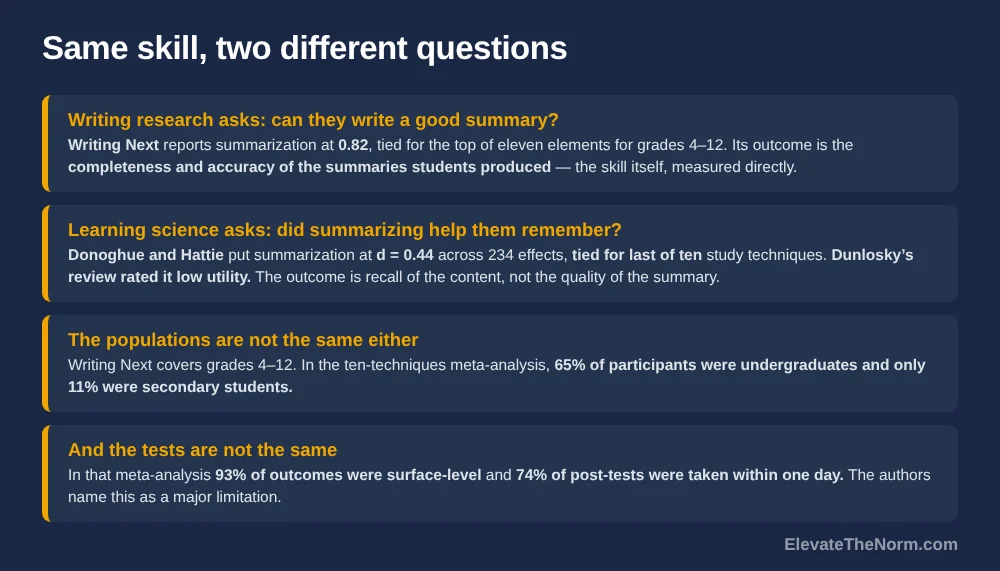
- The two research literatures on summarizing disagree, and the disagreement is the useful part. Writing Next puts summarization at an effect size of 0.82, tied for the top of its eleven elements for grades 4–12. A meta-analysis of ten study techniques puts it at d = 0.44, tied for last.
- They are measuring different outcomes. Writing Next measured the “completeness and accuracy of summaries” — whether students got better at the skill. The study-technique reviews measured whether summarizing helped students remember the content afterwards. A student can improve sharply at one while the other barely moves.
- The low rating comes with an admission. One of the review’s own authors wrote that whether summarization works is “difficult to answer, as it has been implemented in many different ways”. That is a verdict on a messy literature, not on the skill.
- Almost none of the study-technique evidence is about teenagers. In that ten-technique meta-analysis, 65% of participants were undergraduates and only 11% were secondary students — and 93% of the outcomes were surface-level, with 74% of post-tests taken within a day.
- Summarizing is not one of the well-studied elements even in the writing research. Writing Next says only four of its eleven elements rested on ten or more studies, and summarization is not one of them. Its own authors warn that many of the effect sizes “differ only minimally.”
What are summarizing strategies?
Summarizing strategies are the taught procedures a student uses to reduce a text to its essential content in their own words. The common rule-governed version has four moves: delete information that repeats, delete information the main point survives without, replace a list of items with the category that covers them, and state the main idea in a sentence — using the text’s own topic sentence if it has one, and writing one if it does not.
Writing Next describes the instructional approaches in this element as ranging from explicitly teaching summarization strategies to progressively “fading” models of a good summary, and notes that students can learn to write better summaries from either a rule-governed or a more intuitive approach. The four moves above are the standard rule-governed form. They are widely taught and widely attributed to a single early study; that paper sits behind a paywall and was not read for this article, so no citation for them appears here.
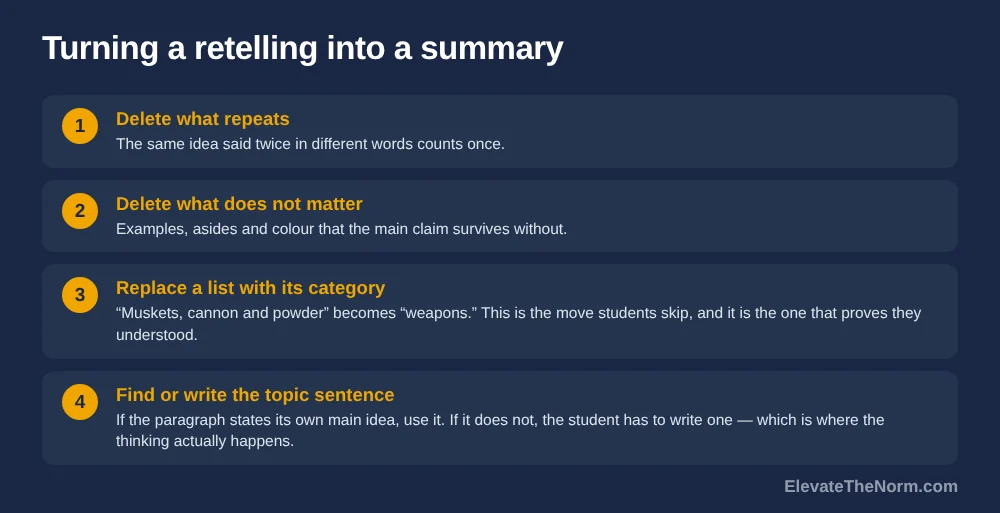
The third move is the one worth watching. Deleting is easy and students will happily cut until a paragraph is three words long. Replacing “muskets, cannon and powder” with “weapons” requires a student to know what those three things have in common, which is a content judgment dressed up as a literacy skill. A student who can do it has understood the passage. A student who cannot will copy the list.
Why does the research on summarizing disagree with itself?
Because the two bodies of research are asking different questions and reporting the answers under the same word. One asks whether instruction makes students better at writing summaries. The other asks whether the act of summarizing makes students remember a text better. Those are separate claims and they have separate answers.
This matters because teachers get handed one number or the other depending on which professional-development deck they are sitting in. The literacy coach has the 0.82. The cognitive-science enthusiast down the hall has the low-utility rating. Both are quoting real research accurately, and the argument between them is not resolvable until somebody says out loud what each number measures.
What does Writing Next actually say about summarization?
That explicit summarization instruction produced a consistent, strong, positive effect on students’ ability to write good summaries, at an effect size of 0.82, in a meta-analysis of writing instruction for students in grades 4 through 12. That is the whole claim, and it is a solid one.
Three pieces of context the 0.82 usually travels without. First, it is tied, not first: writing strategies instruction also scored 0.82, and the report orders the elements by average effect while warning that many of them differ only minimally. Second, the outcome measured was the completeness and accuracy of the summaries students produced — not their comprehension scores, not their retention, not their overall writing quality. Third, summarization was not among the four elements that yielded ten or more studies. Those were strategy instruction, word processing, the process writing approach, and writing-to-learn activities.
None of that is a reason to discount it. It is a reason to quote it correctly: teaching adolescents to summarize reliably makes them better at summarizing, on a modest evidence base, by the report’s own accounting.
What do the learning-science reviews say?
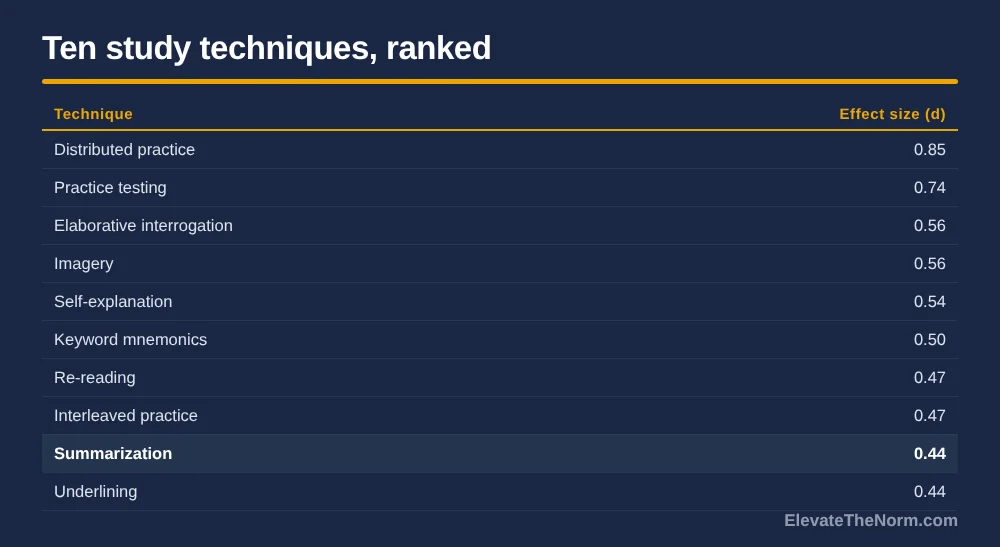
That summarizing is one of the weakest of the common study techniques for remembering content. The widely cited review of ten techniques rated summarization low utility, and the meta-analysis that followed it up put the number at d = 0.44 across 234 effects — tied for last with underlining.
The reasoning behind the low rating is worth reading rather than repeating. Writing for a general audience, one of the review’s authors said whether summarization works is “difficult to answer, as it has been implemented in many different ways”, and that it is unknown whether summarizing small pieces or large chunks of a text works better, or whether the length, readability or organization of the material matters. That is not a finding that summarizing fails. It is a finding that the studies were too heterogeneous to say.
The follow-up meta-analysis adds the conditions. Summarization works better when assessments are performance-based or generative rather than closed or multiple choice, it “can require extensive training to use optimally,” and younger and less able students are not as good at it. Its headline finding across all ten techniques — that effects were much greater for lower than higher ability students — cuts in an interesting direction for a secondary classroom.
And the limitation the authors name themselves is the one that should govern how any of this gets used: the majority of studies rested on surface or factual outcomes, with 93% of outcomes coded as surface-level and 74% of post-tests taken within a single day. They urge caution in applying the findings to deeper and more relational outcomes. A technique that looks weak on a next-day factual quiz has not been tested on the thing a history or science teacher actually wants.
Does summarizing help students remember what they read?
On short-delay factual tests, less than practice testing or spaced practice does. That comparison is the fair one and summarizing loses it. If the goal is retention of facts for a quiz, a retrieval activity is the better use of ten minutes.
But the comparison most teachers are actually making is not summarizing versus retrieval practice. It is summarizing versus reading the chapter and hoping. On that comparison, d = 0.44 against a control is a real effect, and the same meta-analysis puts re-reading at 0.47 and underlining at 0.44 — which means summarizing is roughly as good at content recall as the two things students do by default, while also building a skill they are assessed on directly.
The honest position: do not teach summarizing as a memory technique. Teach it as a comprehension and writing skill, and use spaced and mixed practice or retrieval when the goal is remembering. Different jobs, different tools, and a department that argues about which one is “evidence-based” is arguing about nothing.
How do you teach summarizing in grades 6–12?
Teach the moves on a paragraph before you ask for a page. Most summarizing instruction fails because students are handed a chapter and a word limit, which tests a skill nobody taught them. Seven steps, spread across a unit rather than a period.
- Start with one paragraph and a hard word limit. Fifteen words. The constraint does the teaching, because at fifteen words a student has to decide, and deciding is the skill.
- Model the deleting out loud, crossing lines out on the projector and saying why each one goes. A student who has never heard an adult reason through a cut assumes the right answer is to shorten everything evenly.
- Teach the category move on its own. Give three lists from the text and ask for the one word that covers each. This is the move that separates a summary from a retelling, and it deserves its own ten minutes.
- Show a bad summary and a good one side by side without saying which is which, and make students argue it. Writing Next describes progressively fading models of a good summary as one of the approaches in this element.
- Move from a paragraph to a section, then a chapter, raising the word limit proportionally. Expect the quality to drop each time the text gets longer; that is the skill being stressed, not lost.
- Make them summarize something they disagree with. A student who can restate an argument they reject has done the work that structured disagreement depends on, and the summary stops being a compliance exercise.
- Give the summary a reader. A summary written for a partner who missed class, who then has to answer a question from it, gets a quality of attention that a summary written for the teacher never gets.
Budget more time than feels reasonable. The meta-analysis is explicit that summarization can require extensive training to use well, and a single lesson on it is the version of this that does not work.


Why do students write retellings instead of summaries?
Because a retelling is what you produce when you do not know what the point was. Writing down everything in order is the safe move for a student who cannot tell which parts matter, and it looks like effort, which is why it survives so long without being corrected.
The tell is sequencing language: and then, after that, next. A summary is organized by importance; a retelling is organized by the order things appeared. When a student’s summary tracks the text paragraph by paragraph at a fixed ratio, they are compressing, not summarizing, and no amount of “make it shorter” fixes it.
The fix is upstream. A student who cannot name the main idea cannot summarize, so the problem is comprehension wearing a writing costume. Go back to the text, ask what the author is arguing, and sort that out before asking for a summary at all. Reciprocal teaching runs summarizing as one of four rotating roles for exactly this reason — it puts summarizing next to questioning and clarifying rather than treating it as a standalone task.
Which summarizing strategy is worth your time?
The one matched to what you are actually assessing. A gist sentence builds the skill fastest; a one-sentence-per-section outline supports studying; a written paragraph is the only one that produces something you can grade against a writing standard.
| Strategy | What students do | Time | Best for | Main drawback |
|---|---|---|---|---|
| Gist sentence | One sentence, hard word limit, per paragraph | 2–3 min | Building the skill from scratch | Too small to assess as writing |
| Section outline | One sentence per section of a chapter | 10–15 min | A study artifact students keep | Slides into compressing rather than summarizing |
| Written summary paragraph | A paragraph in their own words, under a word cap | 20–30 min | Assessing against a writing standard | Slow to grade; needs a rubric |
| Headline and subhead | Write the text a news headline and deck | 5 min | Forcing a judgment about importance | Rewards cleverness over accuracy |
| Summarize for a partner | Write for someone who missed it, who then asks a question | 10 min | Getting real effort | Needs a class that will tell the truth |
How do you grade a summary?
Against the two things the research actually measured: completeness and accuracy. Did the summary include everything essential, and is everything in it true to the text? Those two questions carry almost all the useful information and they are fast to apply.
Add a third only if you are assessing writing rather than reading: is it in the student’s own words? Lifted phrasing is the most common way a summary looks complete and accurate while demonstrating nothing. Mark it, but mark it as a separate line, because a student can genuinely understand a passage and still default to the author’s wording. A single-point rubric handles this well — three criteria, one column of expectations, and your comments in the margins on either side.
What not to grade: length. A word cap is an instructional constraint, not a standard. A student who nailed it in eleven words when you asked for fifteen has done the thing better, not worse.
What goes wrong when you teach summarizing?
- It gets taught once. The meta-analysis says the technique can require extensive training to use optimally, and the usual treatment is a single mini-lesson in September followed by eight months of being asked to do it.
- The text is too long too early. A chapter summary is the final assessment of this skill, not the practice for it.
- It is sold as a memory strategy. It is not a strong one, the research says so, and students find out quickly that summarizing the chapter did not help them on the quiz. That costs you credibility you need for the strategies that do work.
- The category move never gets taught. Deleting is intuitive and superordinating is not, so students get the easy half of the skill and plateau there.
- Nobody reads the summaries. A summary with no reader is a worksheet, and teenagers calibrate their effort to the audience accurately.
Clay’s take: stop arguing about the number
This is the clearest case I have run into of two honest research literatures being used to have a dishonest argument. One side quotes 0.82 and calls summarizing a high-impact strategy. The other quotes a low-utility rating and calls it a waste of a period. Neither side is misreporting. They are just answering different questions and not saying which.
What I would want a department to agree on is narrower than either slogan. Teaching students to summarize makes them better at summarizing, on an evidence base the authors themselves describe as modest. Summarizing is a weak way to memorize content, on evidence that is mostly undergraduates taking factual tests the next day. Both of those can be true on a Tuesday, and they point to the same practical conclusion: teach it as a reading and writing skill, assess it as one, and use something else when the goal is retention.
The part I would not give up is the category move. Making a fifteen-year-old find the one word that covers a list is a comprehension check disguised as a literacy exercise, it takes ninety seconds, and it tells you more about whether they followed the passage than a page of questions does. No meta-analysis has isolated that move, so that is my judgment rather than a finding, and it should be read as one.
What to do next
Pick one paragraph from the text you are teaching this week and run the fifteen-word gist. Model one, do one together, then let them try one alone, and spend the time you were going to spend on the rest of the lesson arguing about which cuts were right. Then do it again next week on a paragraph from a different section, because once is not instruction.
If you are already teaching summarizing and it is not landing, check the category move before you change anything else. Give students three lists from the reading and ask for the covering word. If they can do that, the problem is the length of the texts you are assigning. If they cannot, the problem is comprehension, and no summarizing strategy will fix it.
Frequently Asked Questions
What are the main summarizing strategies?
The standard rule-governed set has four moves: delete information that repeats, delete information the main point survives without, replace a list of items with the category covering them, and state the main idea in a sentence, using the text’s topic sentence if it has one and writing one if it does not. Classroom formats include gist sentences, section outlines, and written summary paragraphs.
Is summarizing an effective learning strategy?
It depends on what you want from it. For getting better at writing summaries, the Writing Next meta-analysis reports an effect size of 0.82 across grades 4 to 12. For remembering content, a meta-analysis of ten study techniques puts it at d = 0.44, tied for last, and Dunlosky’s review rated it low utility. Teach it as a literacy skill, not a memory technique.
Why do researchers disagree about summarizing?
Because they measure different outcomes. Writing Next assessed the completeness and accuracy of the summaries students wrote. The study-technique reviews assessed whether summarizing improved recall of the content, mostly on surface-level tests taken within a day, with 65 percent of participants being undergraduates. Both results are accurate answers to different questions.
What is the difference between a summary and a retelling?
A summary is organized by importance; a retelling is organized by the order things appeared in the text. The giveaway is sequencing language such as and then, after that, next. A retelling compresses everything at a fixed ratio, while a summary makes judgments about what can be cut and what categories cover which details.
How long should a student summary be?
Short enough to force a decision. Start at a hard fifteen-word limit on a single paragraph and raise the cap proportionally as the text gets longer. The constraint is what teaches the skill, because at fifteen words a student cannot include everything and has to decide what matters. Do not grade length itself.
How do you grade a summary in middle or high school?
Grade completeness and accuracy, which are the two things the research itself measured: does the summary contain everything essential, and is everything in it true to the text? Add a separate line for whether it is in the student’s own words if you are assessing writing rather than reading. Do not grade word count.
Does summarizing work for struggling readers?
The meta-analysis of ten techniques found effects were much greater for lower than higher ability students across the board, which is encouraging. But it also notes that younger and less able students are not as good at summarization, and that the technique can require extensive training to use well. Both can be true: they gain more and they need more instruction.
Sources
- Graham, S., & Perin, D. Writing Next: Effective Strategies to Improve Writing of Adolescents in Middle and High Schools. A Report to Carnegie Corporation of New York. Alliance for Excellent Education, 2007. Full text (PDF); ERIC record ED517367. Source of the 0.82 effect size for summarization (p. 16) and the identical 0.82 for writing strategies (p. 15), the grades 4–12 range, the statement that the outcome assessed was the “completeness and accuracy of summaries,” the description of approaches ranging from explicit strategy teaching to fading models, the note that only four elements yielded ten or more studies and that summarization was not among them, the warning that many effect sizes “differ only minimally” (p. 12), and the totals of 176 effect sizes with 41 (23%) involving low-achieving or disabled students (p. 25).
- Donoghue, G. M., & Hattie, J. A. C. A Meta-Analysis of Ten Learning Techniques. Frontiers in Education, Vol. 6 (2021), 581216. Full text. Source of the summarization figure of d = 0.44 (SEM 0.055, 234 effects), the full ranking of the ten techniques, the participant breakdown of 65% undergraduate and 11% secondary, the finding that 93% of outcomes were surface-level and 74% of post-tests were taken within one day, the statement that summarization works better on performance or generative assessments than closed or multiple-choice tests and “can require extensive training to use optimally,” the note that younger and less able students are less good at it, the abstract’s finding that effects were much greater for lower than higher ability students, and the confirmation that Dunlosky and colleagues categorised summarization as “low” support. The paper’s own grade-level moderator table could not be read reliably, so no secondary-specific effect size from it is quoted here.
- Willingham, D. T. What Works, What Doesn’t. Scientific American, SA Special Editions Vol. 23, No. 5s, p. 40. Article. A popular write-up by one of the authors of the ten-techniques review, read in place of the 2013 monograph in Psychological Science in the Public Interest, which was not reachable. Source of summarization’s placement among the low-utility techniques, the definition of it, and the authors’ reasoning that whether it works is “difficult to answer, as it has been implemented in many different ways,” with the open questions about summary length and text organization.
- A source deliberately not cited. The four summarizing moves in this article are usually credited to a single early study of summarization macrorules. Three routes to that paper were tried and all were blocked, so its rule list, sample and age range could not be checked. The moves are presented here as the standard rule-governed approach, without a citation, rather than attributed to a study nobody on this end has read.