By Clay Shumate
A service learning project links classroom curriculum to a community need students help meet, with structured reflection built in. That reflection is what separates it from volunteering. The National Youth Leadership Council publishes eight quality standards for K–12 practice, and a meta-analysis of 62 controlled studies found a small average benefit across five outcome areas.
Key Takeaways
- Reflection is the dividing line. A food drive is community service. A food drive that students plan against a standard, carry out, and then analyse in writing is a service learning project. Remove the reflection and you have removed the learning half of the name.
- There are eight published quality standards, and most projects meet three or four. The National Youth Leadership Council names meaningful service, link to curriculum, reflection, diversity, youth voice, partnerships, progress monitoring, and duration and intensity.
- The average effect is real but small. Celio, Durlak and Dymnicki pooled 62 controlled studies and found a mean effect size of 0.28 overall, with academic achievement at 0.43 from only 17 studies. Two-thirds of the students in that pool were college undergraduates.
- The evidence specific to middle and high school is thin. A systematic review of adolescents found only ten studies that met its criteria, two of them randomised, and most relied on student self-report.
- Service does not have to mean a field trip. Four recognised types — direct, indirect, advocacy, and research — mean a project can run entirely from your room if transport and permission slips are the obstacle.
Most of what gets called service learning in a middle or high school is a canned food drive with a sign-up sheet. Students collect, somebody counts, a photo goes in the newsletter, and nobody can say which standard it met. That is community service, and there is nothing wrong with it. It is just not the thing the research is about.
This guide covers what separates a service learning project from a service activity, the eight published standards that define quality practice, what the evidence does and does not support for students aged 11 to 18, the four types of service a project can take, and a planning sequence that fits one semester. The steps and timings are compiled from the sources at the end and from the structures those sources describe. Read them as recommendations, not as a record of any one classroom.
What Is a Service Learning Project?
A service learning project is an instructional strategy in which students meet a real community need and are deliberately taught through doing it. Barbara Jacoby defines service-learning as experiential education in which students engage in activities that address human and community needs, with structured reflection built in.
Writing in Faculty Focus, Jacoby names reflection and reciprocity as the two elements that distinguish the method, and calls reflection “the bridge, like a hyphen, that connects the two.” Her definition is written for higher education, so treat it as a definition rather than as evidence about teenagers. The point it makes still travels: learning comes from reflecting on an experience, not from having had one.
Reciprocity matters just as much and gets skipped more often. A project is reciprocal when the community partner gets something they actually asked for. A project where a class decides what a shelter needs, delivers it, and leaves is a project with a service shape and a one-way relationship.
How service learning differs from the things it gets confused with
| Approach | Who sets the goal | Tied to a standard? | Reflection required? | Who it is meant to benefit |
|---|---|---|---|---|
| Service learning project | Students and the community partner together | Yes, by definition | Yes, ongoing | Both the student and the community |
| Community service | The school or an outside organiser | No | No | The community |
| Volunteering | The student, on their own time | No | No | The community |
| Internship or work placement | The host organisation | Sometimes | Sometimes | Mainly the student |
| Experiential learning task | The teacher | Usually | Yes, in most models | Mainly the student |
If what you want is the wider question of how to make school work feel like it matters outside the building, that is a different page: real world learning covers it. If you want a bank of shorter hands-on tasks that do not need a community partner at all, experiential learning activities is the list. Service learning is the narrower thing with a partner, a need, and a reflection requirement.
What Are the Eight K–12 Service-Learning Standards?
The National Youth Leadership Council publishes eight K–12 Service-Learning Standards for Quality Practice: meaningful service, link to curriculum, reflection, diversity, youth voice, partnerships, progress monitoring, and duration and intensity. They were published in 2008 and are the closest thing the field has to a shared definition of quality.
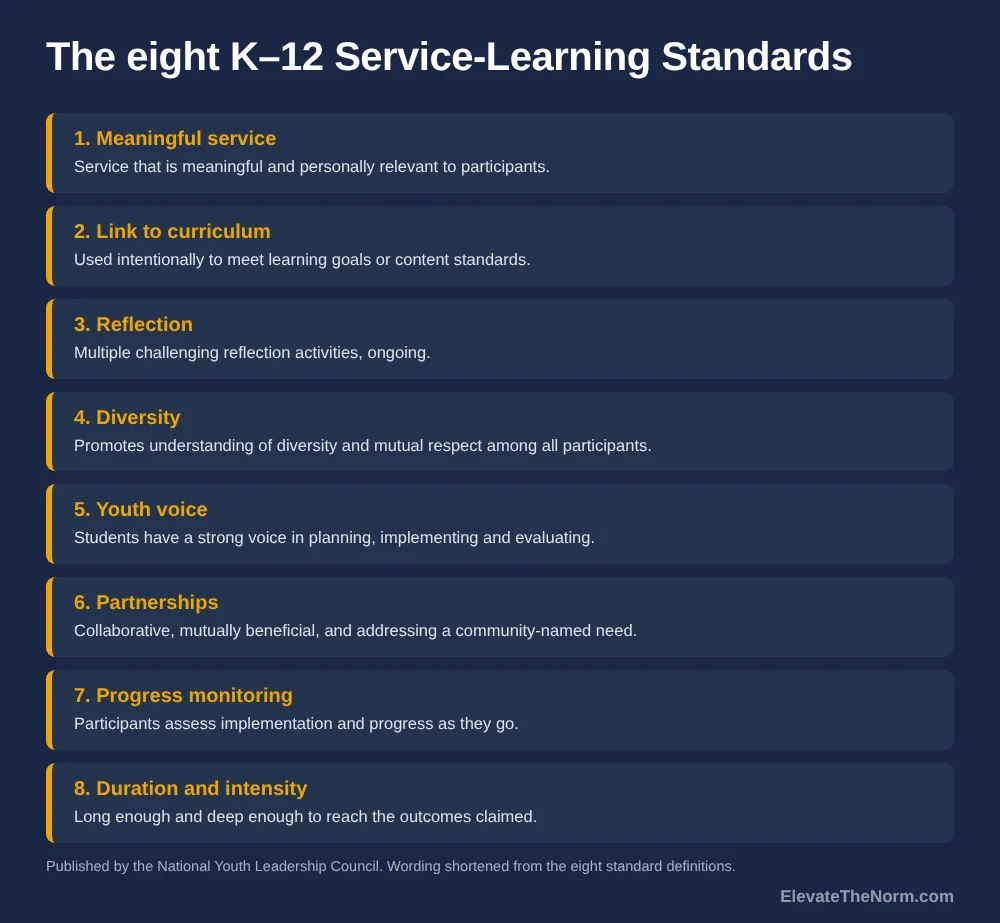
The council’s own page describes them as representing best practices for high-quality experiences, and the Wisconsin Department of Public Instruction reproduces each standard with its one-sentence definition. The wording below is theirs, shortened only where a standard runs to two clauses.
- Meaningful service. The work actively engages participants in service that is meaningful and personally relevant. A task students find pointless fails this standard even if the community benefits.
- Link to curriculum. The project is used intentionally as an instructional strategy to meet learning goals or content standards. This is the standard that turns a drive into a unit.
- Reflection. Multiple challenging reflection activities, ongoing, prompting deep thinking about oneself and one’s relationship to society. Note the plural and the word ongoing.
- Diversity. The project promotes understanding of diversity and mutual respect among all participants, which includes the people being served.
- Youth voice. Students have a strong voice in planning, implementing and evaluating the project, with guidance from adults.
- Partnerships. The partnership is collaborative, mutually beneficial, and addresses a need the community itself names.
- Progress monitoring. Participants assess the quality of implementation and progress toward goals as they go, and use the results to improve.
- Duration and intensity. The project lasts long enough and goes deep enough to address the need and reach the outcomes claimed for it.
One honest caveat. Celio and colleagues wanted to test whether following these standards predicts better outcomes and could only analyse four of the eight, because the studies did not report enough detail to code the other four. They also note the standards are not clearly operationalised. So the eight are a credible professional consensus about quality, not eight separately validated levers.
Does Service Learning Actually Improve Academic Results?
Modestly, and the strongest number comes from the smallest set of studies. In a meta-analysis of 62 controlled studies, academic achievement showed a mean effect size of 0.43, but only 17 of the 62 studies measured achievement at all. The overall average across five outcome areas was 0.28.
Those figures come from Celio, Durlak and Dymnicki (2011) in the Journal of Experiential Education, pooling 62 studies and 11,837 students. Every included study had a control group, which is better than this literature’s reputation suggests. The five domains came out as follows.
| Outcome domain | Studies | Mean effect size | 95% confidence interval |
|---|---|---|---|
| Academic achievement | 17 | 0.43 | 0.29 to 0.58 |
| Social skills | 28 | 0.30 | 0.18 to 0.38 |
| Attitudes toward self | 36 | 0.28 | 0.18 to 0.38 |
| Attitudes toward school and learning | 12 | 0.28 | 0.12 to 0.43 |
| Civic engagement | 28 | 0.27 | 0.16 to 0.38 |
| Overall | 62 | 0.28 | 0.21 to 0.34 |
Now the caveats, because they change how you should read the table. Sixty-eight percent of the students were college undergraduates. Sixteen percent were high school and six percent were middle school. This is not a secondary-school result; it is a mostly-college result with a secondary minority inside it. Only 19 of the 62 studies randomised. And 87 percent of the outcomes were student self-report, which the authors flag themselves as vulnerable to social desirability.
One finding does cut cleanly in favour of doing the work properly. Studies whose programmes used all four of the codeable recommended practices — linking to curriculum, youth voice, community involvement and reflection — averaged 0.35. Studies using none of them averaged 0.17. The effect did not climb steadily with each practice added, so this is not a dose-response curve. But the gap between all four and none is roughly double.
For evidence on students in the actual age band this site writes for, the picture is thinner. Fernández-Martín and Ayllón-Salas screened 4,342 records for their systematic review of service-learning among adolescents and found ten studies that qualified, covering roughly grades 7 to 10, with samples from 28 to 359 students. Two were randomised controlled trials, four were quasi-experimental with a control group, and four had no control group at all. Only three of the ten had at least 30 participants per group, and only four reported an effect size.
What they found: all four studies measuring academic outcomes reported significant improvement, eight of nine measuring socioemotional outcomes found gains on at least one indicator, and all five measuring civic outcomes found positive change on at least some indicators. The one study measuring community-level outcomes found nothing significant. The authors describe the cognitive effects as small and the academic effects as inconsistent, and they did not run a risk-of-bias assessment. Ten studies, mostly small, mostly self-report, is a reason for cautious optimism and not for a staff meeting slide.
What Kinds of Service Learning Projects Are There?
Four: direct service done in the presence of the people or place being helped, indirect service done away from them, advocacy that speaks for or against an issue, and research that produces information to inform action. Three of the four need no bus and no field-trip form.
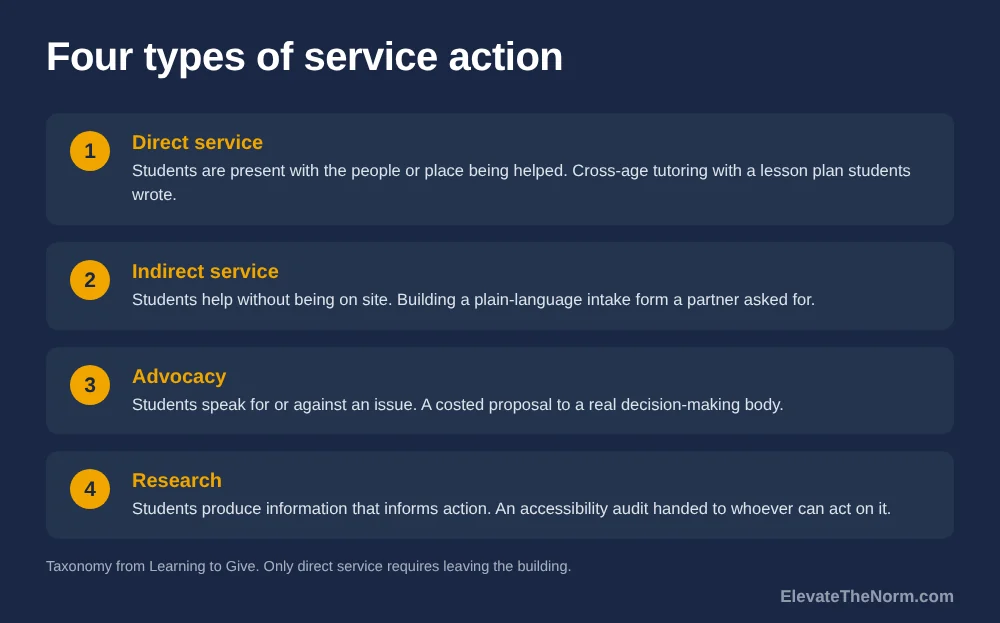
The four-type taxonomy comes from Learning to Give. It is the most useful planning tool in this whole article, because the reason most secondary service learning dies is transport, liability and the master schedule — and only one of the four types requires leaving the building. The project ideas below are grouped by type and written for grades 6–12.
Direct service — students are present with the people or place
- Cross-age tutoring with a planned curriculum. Older students teach a specific skill to younger ones, with a lesson plan they wrote and a pre- and post-check they designed.
- Restoring a neglected space on the grounds. A courtyard, a pollinator strip, a weather station plot. Measured before, planted, maintained on a schedule students keep.
- Running a community information night. Students plan, staff and present the whole event, from the agenda to the room setup to the follow-up.
Indirect service — students help without being on site
- Building something a partner organisation asked for. A plain-language intake form, a translated flyer, a reading-level-appropriate guide. The partner names the gap; students build to spec and revise after feedback.
- A supply drive with a brief students wrote. Students survey the partner, decide what is actually needed, set a target, and report variance against it. The analysis is the assignment.
- A how-to archive for a specific local audience. Short written or recorded guides for a need a partner identifies, kept somewhere the partner can actually reach.
Advocacy — students speak for or against something
- A proposal to a real decision-making body. Student council, a school board, a city committee. Researched, costed, delivered in the format that body actually accepts.
- An awareness campaign on a named local issue. Not a poster about kindness. A specific issue, a specific audience, and a way to tell whether the audience heard it.
- A written public comment on a live policy question. Students read the actual document, find the clause, and write a submission in the register the process expects.
Research — students produce information that informs action
- Collecting environmental data and reporting it back. The Learning to Give example is water sampling shared with the community to prompt action; air quality, noise and tree canopy work the same way.
- An accessibility or safety audit of a public space. Students build the instrument, walk the route, record findings, and hand the report to whoever can act on it.
- An oral history or local records project. Students gather and organise material a local institution says it is missing, and deposit it there in a usable form.
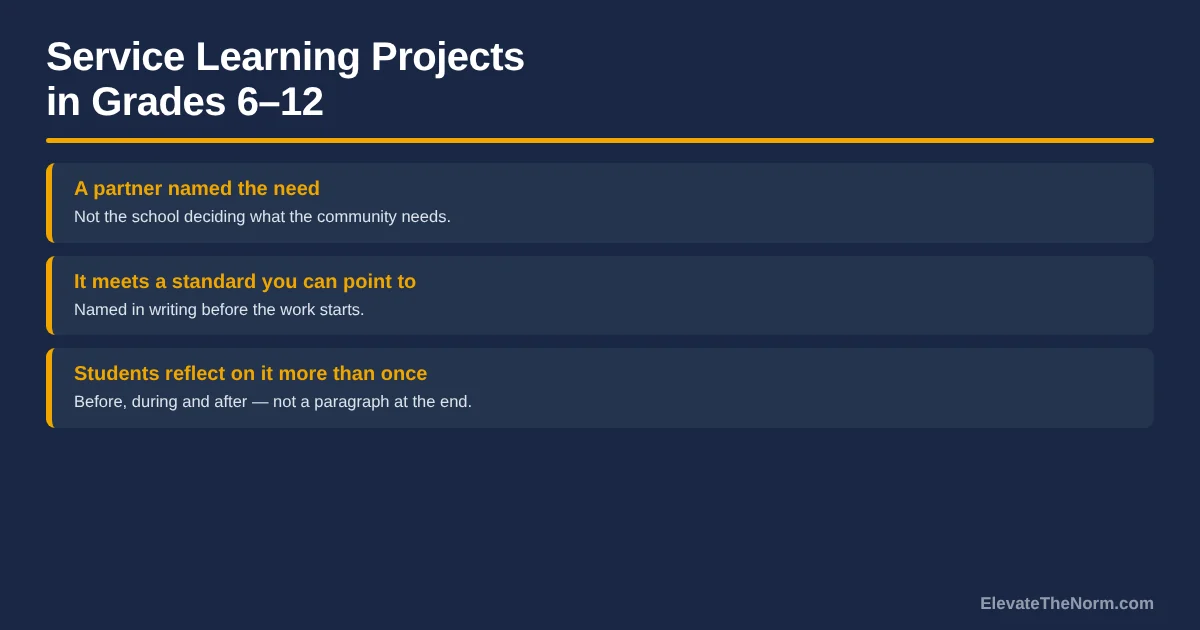
Two of those overlap with ordinary project-based work, which is fine. The test is not novelty. It is whether a partner named the need, whether the work meets a standard you can point to, and whether students reflect on it more than once. For the assessment half, building a rubric for project-based learning covers the mechanics, and student voice and choice covers how much of the planning to actually hand over.


How Do You Plan a Service Learning Project in One Semester?
Start from the standard, not the service. Pick the content standard first, find a need a partner will confirm in writing, let students scope the work, build reflection into three fixed points, then run it. The sequence below spreads over about sixteen weeks without taking over the course.
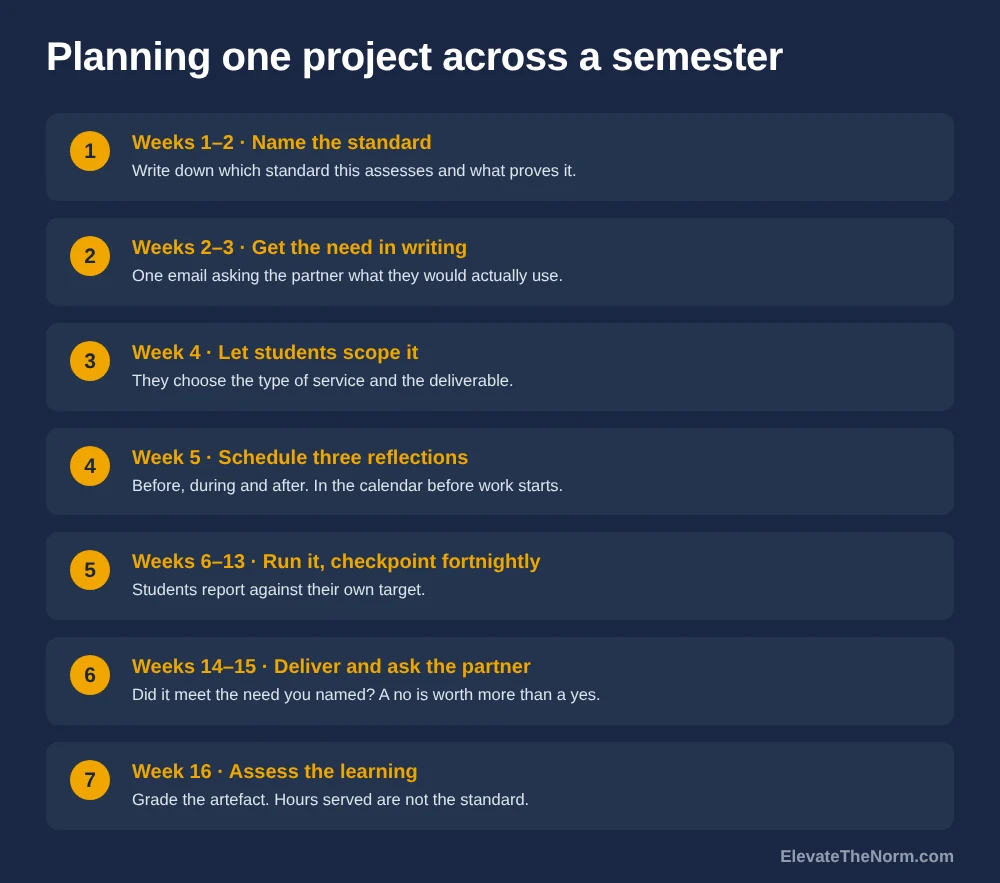
- Weeks 1–2: name the standard and the evidence. Write down which content standard this project assesses and what a student will produce that proves it. If you cannot write that sentence, you have a service activity. Standard two of the eight is the one most projects fail.
- Weeks 2–3: get the need from the partner, in their words. One email or one call asking what they would actually use. Keep the reply. This is the partnerships standard and it takes about twenty minutes.
- Week 4: let students scope it, inside your constraints. Give them the standard, the partner’s stated need, the calendar and the budget, and let them choose the type of service and the deliverable. That is the youth voice standard, and it is the cheapest of the eight to meet.
- Week 5: set the three reflection points now. Before, during and after — the pattern Jacoby’s 4 C’s calls continuous. Put them in the calendar before the work starts, because a reflection you schedule later is a reflection that gets cut.
- Weeks 6–13: run it, with a visible checkpoint every two weeks. Students report progress against their own target, not against your impression of how it is going. This is progress monitoring, and it is also how you find out in week eight rather than week thirteen.
- Weeks 14–15: deliver, and close the loop with the partner. Hand over the work and ask the partner whether it met the need they named. A no here is worth more than a yes, and it is the only honest test of reciprocity.
- Week 16: assess the learning, separately from the service. Grade the evidence you named in week one. Hours served, bags collected and photos taken are not the standard and should not be in the grade. And this assessment replaces a unit’s assessment rather than sitting on top of it — if the project is extra work bolted onto a full course, students are right to resent it.
Sixteen weeks sounds enormous until you notice how little of it is class time. Steps one, two, four, five and seven are planning and assessment you would do for any unit. The duration and intensity standard is about the project having enough runway to matter, not about surrendering a semester of instruction to it.
How Do You Build the Reflection That Makes It Learning?
Use Eyler, Giles and Schmiede’s 4 C’s: reflection should be continuous, connected, challenging and contextualised. In practice that means reflection before, during and after the work, tied to course content, with questions hard enough that a student cannot answer them from goodwill alone.
Jacoby’s account of the 4 C’s is the clearest short version. Continuous means before, during and after, not a paragraph at the end. Connected means the reflection links course content, the student’s own thinking and what they saw firsthand. Challenging means the questions balance challenge with support rather than inviting a feel-good summary. Contextualised means the format suits the setting and what is actually going on in students’ lives.
The failure mode is predictable. “How did this project make you feel?” produces a page of sentiment that no rubric can grade and no standard can claim. The questions that work name the content: what did the partner’s constraint teach you about the problem, which of your assumptions turned out wrong and what evidence changed it, what would you do differently with the same budget.
Reflection was also the most commonly used of the four recommended practices in the Celio pool, present in 74 percent of programmes, while community involvement appeared in only 26 percent. Read that as a warning rather than reassurance: the easiest standard to claim is the one almost everybody claims, and it is the partnership half that most projects are quietly missing.
Where Do Service Learning Projects Go Wrong?
Four failure modes account for most of it: no curriculum link, a need nobody outside the building named, reflection bolted on at the end, and a grade built on hours instead of learning. Each has a fix that costs under an hour.
- The project is not linked to anything you teach. It runs in advisory, or on a Friday, or as an extracurricular with a teacher sponsor. Fix: name the standard in writing before week two, or run it as community service and call it that honestly.
- The school decided what the community needs. This is the most common and the least discussed. Fix: one email to the partner asking what they would use, and keep the answer. If the partner’s answer is boring, build the boring thing.
- Reflection happens once, at the end. Which makes it a report, not reflection. Fix: three scheduled points, written into the calendar in week five.
- The grade measures compliance. Hours logged, items collected, attendance at the event. Fix: grade the artefact you named in week one and let the service be ungraded. Students notice very quickly which one you actually count.
- Participation depends on a family’s resources. Transport, weekend availability, a parent who can drive. Fix: choose indirect, advocacy or research service, which run inside the school day, and never make the out-of-school version the only route to the grade. The same check applies to students with an IEP or 504 and to English learners: if the only full-credit route requires a skill the plan says to accommodate, the project is grading the accommodation.
- The partner goes quiet in week nine. Staff turnover, a funding change, a missed email. It happens often enough to plan for. Fix: get the need in writing at the start, keep a second partner on the list, and build the deliverable so a redirected version still meets the standard you named.
- Nobody cleared the permissions. Direct service is the only one of the four types that routinely needs supervision ratios, transport approval, and sometimes a check on the adults students will be working alongside. Fix: ask an administrator before students start scoping, not after they have chosen. A project a principal has to stop in week six costs more than the one you did not run.
Two of those deserve more than a bullet. A project that quietly requires a car is a project that grades family circumstance; the four-type taxonomy exists partly to solve exactly this, and student leadership activities covers the related problem of who ends up with the visible roles when adults pick.
The other is the dignity of the people being served, which almost no planning template asks about. Photographs are where this goes wrong fastest. A picture of students handing something to an identifiable person who is having a hard week is a picture taken for the school, not for them, and the person in it rarely got a real choice about it. The diversity standard is partly about this: mutual respect among all participants includes the people on the receiving end. Ask the partner what they are comfortable with, default to photographing the work rather than the recipients, and tell families plainly at the start what the project is, what will be published, and what is actually being graded.
Is a Service Learning Project Worth the Trouble?
Worth it for one unit a year, run properly, rather than as a schoolwide initiative. The effect sizes are small and the secondary-specific evidence is thin, so the honest case for service learning is not that it raises test scores. It is that it makes one unit’s work real and gives students something to be accountable to besides a grade.
Clay’s take, as a grades 6–12 teacher: the number worth paying attention to in all of this is not 0.43. It is the 0.35 against 0.17 gap between programmes that used all four recommended practices and programmes that used none. That gap is about whether the adult running the project did the unglamorous parts — naming the standard, asking the partner, scheduling the reflection — and those parts are free. A school that announces service learning and skips them has bought the 0.17.
And the thing teenagers detect fastest is a project that exists for the photo. If the partner did not ask for it, they know. If the reflection questions are about feelings, they know. Treating students as people capable of hearing “the organisation said they do not need what we planned, so we are starting over” is most of what separates a project that teaches something from a drive with a banner.
If you want the structural version of this — how to run the planning cycle for any project, not just a service one — the seven steps of project-based learning is the sequence.
Sources
- Celio, C. I., Durlak, J., & Dymnicki, A. (2011). A meta-analysis of the impact of service-learning on students. Journal of Experiential Education, 34(2), 164–181. 62 studies, 11,837 students, all with control groups; 68% college undergraduates, 16% high school, 6% middle school; 19 of 62 randomised; 87% of outcomes were student self-report. Read in full.
- Fernández-Martín, F. D., & Ayllón-Salas, P. (2026). Impact of service-learning among adolescents: A systematic review. Adolescents, 6(1), 10. Ten studies, roughly grades 7–10, samples of 28 to 359; only 2 randomised controlled trials and 4 with no control group; a narrative review, not a meta-analysis, with no risk-of-bias assessment. Read in full.
- National Youth Leadership Council. K–12 Service-Learning Standards for Quality Practice. The publisher’s own page; it names the eight standards but does not list the indicators or a year. Read in full.
- Wisconsin Department of Public Instruction. K–12 Service-Learning Standards for Quality Practice. A state education agency’s reproduction of the eight standards with each one-sentence definition, attributed to the National Youth Leadership Council and dated 2008. Used here for the wording. Read in full.
- Jacoby, B. What makes service-learning unique: Reflection and reciprocity. Faculty Focus. Source of the working definition and of Eyler, Giles and Schmiede’s 4 C’s of critical reflection. Written for higher education, not K–12, and it is a practitioner article rather than a study. Read in full.
- Learning to Give. The four types of service action. Source of the direct, indirect, advocacy and research taxonomy and its examples. A curriculum organisation’s framework, not a research finding. Read in full.
What is a service learning project in simple terms?
Classwork where students help meet a real community need and are taught through doing it. Three things have to be true: it is tied to something you teach, a community partner named the need, and students reflect on it more than once. Take away the reflection and the curriculum link and you have community service instead.
What is the difference between service learning and community service?
Community service meets a need. Service learning meets a need and teaches a standard, with structured reflection connecting the two. A food drive is community service. A food drive students scope against a standard, run, and then analyse in writing is a service learning project. The reflection is the dividing line, not the amount of work.
Does service learning raise test scores?
Not dramatically. The largest meta-analysis found a mean effect size of 0.43 for academic achievement, but only 17 of its 62 studies measured achievement, and about two-thirds of the students were college undergraduates. A review focused on adolescents found only ten qualifying studies and described the academic effects as inconsistent.
Can you run a service learning project without leaving the school?
Yes. Of the four recognised types of service action, only direct service requires being present with the people or place being helped. Indirect service, advocacy and research can all run from a classroom, which also removes the transport and permission barriers that make projects depend on a family’s resources.
How do you grade a service learning project?
Grade the learning, not the service. Name in advance what a student will produce that proves the standard, and grade that artefact. Hours served, items collected and event attendance are compliance measures, not evidence of learning, and students work out very quickly which one actually counts toward their grade.
What if no community partner will work with my class?
Start with an organisation already connected to the school and ask one question: what would you actually use. Research and advocacy projects also need a far lighter partnership than direct service, because the deliverable is information or a submission rather than labour. A partner who only confirms the need is still a partner.
What permissions do you need, and what about student and community privacy?
Direct service is the type that triggers supervision ratios and transport approval, so clear it with an administrator before students scope the project rather than after. On images, default to photographing the work instead of the people receiving help, ask the partner what they are comfortable with, and tell families at the start what will be published.
What if a student does not want to be visible, or objects to the cause?
Give them a route that earns full credit without a public role. Research, writing and planning work are all genuine contributions, and the graded artefact should be the learning rather than the appearance. A student who disagrees with the cause can often do the strongest work on it, because disagreement forces them to engage with the evidence.