By Clay Shumate
A capstone project is a long, student-chosen project that ends in a finished product and a defense in front of people who can ask hard questions. The capstone project ideas that hold up start with a question one search cannot answer, name an adult who agreed to meet the student on a schedule, and end in something real. Scope it smaller for eighth graders and larger for seniors, and the same structure works for both.
Key Takeaways
- A capstone is a structure, not a topic. Ohio’s senior capstone toolkit requires four parts: a proposal, an anchor experience, a culminating portfolio and a presentation to a panel. A list of topics with none of those parts is just a research assignment with a bigger deadline.
- The evidence is promising, not proven. MDRC’s review of project-based learning research describes the evidence as “promising but not proven,” and Education Week’s report on Oakland’s capstone offers qualitative support rather than controlled outcome data. Adopt capstones for the ownership and the defense, not for a promised test-score gain.
- Scope by grade, or the project eats the student. Poly Prep ends its middle school capstone with a Capstone Night for eighth graders; Oceana High School asks seniors for a 15- to 30-page paper and a 20- to 30-minute presentation. Those are not the same job and should not be handed out as one.
- Mentors and checkpoints are what keep a long project alive. Ohio’s toolkit asks students to meet an advisor and a mentor at least twice per semester. Without scheduled check-ins, a capstone is a long assignment with a due date at the end.
Most lists of capstone project ideas are lists of topics. “Do a project on climate.” “Research a career.” A topic is not a capstone, and a student handed a topic and a six-month calendar will spend five of those months deciding what to do and the sixth panicking. The ideas below are written as questions and deliverables instead, because that is what a student can actually start on Monday.
This guide covers what a capstone project is, what makes an idea hold up, how to scope the same project for an eighth grader and a twelfth grader, fifteen ideas in three groups, and how mentors, checkpoints and grading work. The scope and timings are recommendations compiled from the programs and sources listed at the end. Read them as recommendations, not as a record of any one classroom.
What Is a Capstone Project, and How Is It Different From a Regular Project?
A capstone project is a culminating, student-designed project that pulls learning together over a long stretch, anywhere from a semester to a full year, and ends with a product and a presentation to an audience that can question it. It differs from a regular project in three ways: it runs much longer, the student owns the question, and there is a defense at the end.
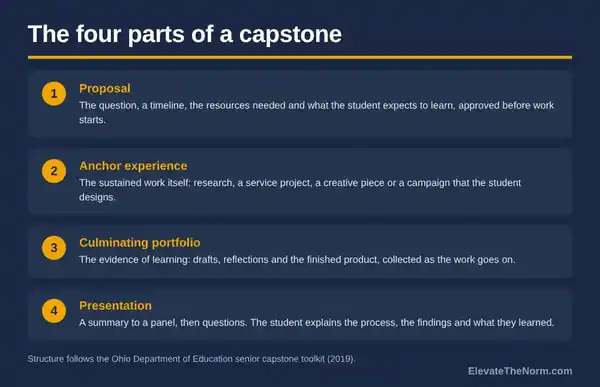
The clearest written structure comes from Ohio’s Senior Capstone Toolkit (May 2019), issued under the state’s EachChildOurFuture plan. It names four required parts. The proposal states the objective, the timeline, the resources needed and what the student expects to learn. The anchor experience is a student-designed learning experience such as an internship, a research project, a public service project or a creative work. The culminating portfolio collects the documents, deliverables and reflections that show what was learned. The presentation is a summary delivered to a panel, followed by questions. The toolkit does not set a required number of hours, which tells you something: the state cares that the four parts exist, and leaves the size to the school.
Three real programs, three very different sizes
Oakland, California’s Graduate Capstone Project, reported by Education Week in 2019, is a yearlong assessment built around a student-developed research question on a social issue. Students draft essays, do field research through focus groups, expert interviews or surveys, and present to their school, then answer questions from a panel of teachers. The district has required a serious research project or exhibition to graduate since 2005, and for the class of 2018 two-thirds of graduating seniors completed the full project. The article is candid that most of its support is qualitative, and it says plainly that the individual pieces are not unusual. What stands out is how they are knit together.
Oceana High School’s senior exhibition, described in a Learning Policy Institute profile, is a graduation requirement with a 15- to 30-page research paper on a student-chosen essential question, followed by a 20- to 30-minute presentation and a question period. The research runs a year, and students spend about six weeks preparing the presentation. Smaller exhibition-style projects happen in tenth and eleventh grades, which matters later in this guide.
At the other end, Poly Prep’s middle school capstone is the culminating project of a history course for eighth graders. Students write research questions, research with primary and secondary sources, and build a final product, which can be a paper, a website, a game or a short documentary, that teaches peers and parents about the topic. Panels at an annual Capstone Night in May show the work. The page does not say how long the project takes or who mentors it, so I am not going to guess at either.
What Makes a Capstone Project Idea Hold Up?
A capstone project idea holds up when it passes four tests: the question cannot be answered with one search, a real audience can disagree with the result, there is a finished product a stranger could use, and one adult has agreed in writing to meet the student on a schedule. An idea that fails any of the four tends to stall long before the defense.
- The question resists a single search. “Sharks” is a topic. “What would it take for our town to cut its stormwater runoff?” needs sources, interviews and a judgment call. The same test applies to driving questions for project-based learning, and the examples there transfer.
- A real audience can disagree. A teacher grading a paper is not an audience. A panel that includes a person from outside the school, or a decision-maker who could act on a recommendation, is.
- There is a finished product. Something a stranger could read, watch, play, use or visit. The product is what turns research into work with consequences.
- One adult agreed to meet. Ohio’s toolkit has the mentor sign a pledge after reading the proposal, and the timeline must list check-ins with the advisor and the mentor. That signature is the cheapest piece of structure in the whole design.
None of this is proven to raise achievement. The MDRC literature review of project-based learning, by Condliffe and colleagues (2017), rates the evidence as promising rather than proven, notes that evaluation designs often leave open the possibility that something other than the project caused the result, and says the wide variation in how project-based learning is done makes general conclusions hard. The Oakland coverage is honest in the same way: no controlled outcome data, plenty of teacher and student testimony. So the case for a capstone is not a research finding. It is that the parts are sensible, each one is cheap to check, and a student who defends a year of work to adults who can question it has done something a worksheet cannot ask of them.
How Should You Scope a Capstone Project for Eighth Grade Versus Twelfth Grade?
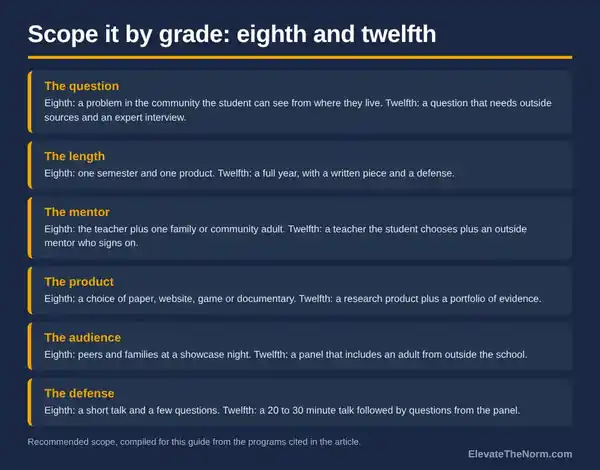
Keep the same four parts but change the size of every one. An eighth-grade capstone is one semester, one product and a short talk to peers and families; a twelfth-grade capstone is a full year with an outside mentor, a research product plus a portfolio, and a longer defense in front of a panel that includes someone from outside the school.
| Element | Eighth grade | Twelfth grade |
|---|---|---|
| The question | A problem in the community the student can see from where they live | A question that needs outside sources and an expert interview |
| The length | One semester and one product | A full year, with a written piece and a defense |
| The mentor | The teacher plus one family or community adult | A teacher the student chooses plus an outside mentor who signs on |
| The product | A choice of paper, website, game or documentary | A research product plus a portfolio of evidence |
| The audience | Peers and families at a showcase night | A panel that includes an adult from outside the school |
| The defense | A short talk and a few questions | A 20 to 30 minute talk followed by questions from the panel |
The right-hand column borrows from two programs: the length of the talk and the outside evaluator come from Oceana’s senior exhibition, and the portfolio comes from Ohio’s toolkit. The left-hand column borrows from Poly Prep’s structure of research questions, a choice of product that teaches an audience, and a public night. What I added is the scaffolding between them.
The scaffolding matters because of what the Oakland reporting found. Students there initially found it too much to master research, writing and presenting in senior year, and one teacher argued that students need to practice those skills every year. That is the argument for the middle of the sequence. An eighth-grade capstone is the first repetition. A ninth-through-eleventh-grade version, a one-semester project with an outside audience, is where the interview, the survey and the revision get practiced before a student carries them alone. Oceana does something similar with its smaller exhibitions in tenth and eleventh grades. A first-ever capstone in the spring of senior year is the version most likely to feel like an ambush.
Grade level is also a judgment about respect. A fourteen-year-old can run a real project with a real audience, and the best thing a teacher can do is expect it and then build the supports. A school that treats older students as capable but gives them no practice is asking for performance without preparation. The guide to student voice and choice covers how much of the decision to hand over at each stage.
What Are 15 Capstone Project Ideas That Hold Up?
Here are fifteen ideas in three groups: research and argument, build and make, and serve and advocate. Each is written as a deliverable rather than a topic, and each can be scaled down for eighth grade by trimming the sources and the audience, or up for twelfth grade by adding an outside mentor and a harder evidence requirement.
If you need smaller, unit-sized ideas rather than semester-long ones, the guide to ideas for project-based learning and the list of history project ideas fit that size better. These fifteen are built for the long haul.
Research and argument
- Local history with a living source. Interview people in the community about a change in the town, then write the history that only those interviews can support. Eighth grade: one interview and a short documentary. Twelfth grade: three interviews checked against archival records.
- A policy brief for a real decision. Pick a decision someone actually faces, such as a bell schedule, a phone policy or a crosswalk, and write a recommendation that weighs the evidence on both sides. A decision-maker reads it and responds.
- Does the claim hold? Take a popular claim about study habits, sleep or nutrition, and test it against primary research. Report what the evidence supports, what it does not, and which populations the studies actually covered.
- Two interpretations, one verdict. Collect two sources that disagree about the same event, explain why they disagree, and defend which reading the evidence favors. The defense is the whole point.
- A data investigation from the school or town. Gather public data a student can actually get, such as monthly attendance or local weather readings, show a trend, and state the limits of what the numbers can say.
Build and make
- Design, prototype and test a fix. Pick a real problem in the building, a hallway bottleneck or a long lunch line, prototype a change, test it with the people affected, and report what happened.
- A teaching resource for younger students. Build a lesson, game or tutorial on a subject the student knows deeply, try it with real learners, and revise from what they got wrong.
- A documentary or podcast series. Several short episodes on one question, with sources named on air. The finished series has to hold up for a listener who knows nothing about the topic.
- A working tool for a real client. A website, app or spreadsheet system for a club, a team or a local organization that will actually use it. A named client who can say what is wrong with it is the entire test.
- A creative work with a written defense. A short story collection, a composition, a mural or a one-act play, paired with a defense that explains the choices and the influences.
Serve and advocate
- A service project with a measurable result. Plan, run and measure a drive, clean-up or repair against a stated goal, and write up what the plan got wrong.
- A needs assessment and a pilot. Survey and interview a defined group, identify a need, and pilot a response on a small scale. Spend real time on the survey wording. Oakland’s account notes that survey data are limited by how the questions are framed.
- A career shadow with analysis. Shadow a professional for a set number of hours, then analyze the path to that career: training, cost, alternatives and what the person wishes they had known. Ohio lists an internship as one acceptable anchor experience.
- An awareness campaign with a before-and-after measure. Run a campaign on a topic that matters locally, measure the change with a short pre- and post-survey, and report honestly if nothing moved.
- A peer tutoring or mentoring program. Design a small program, run a pilot with a handful of students, track what happened, and recommend whether to keep, change or end it.
Notice what the strongest ideas share. Each has a person outside the student’s head who can say whether the work is any good: an interviewee, a decision-maker, a client, a younger learner. That person is the real rubric, and the rubric on paper is only a record of what that person would say.


How Do Mentors, Checkpoints and the Defense Work?
A mentor is an adult outside the grading relationship who agrees to meet the student on a schedule and react to real drafts. Checkpoints are dated moments when the student shows evidence, not intentions. The defense is a public presentation followed by questions from adults who did not write the assignment.
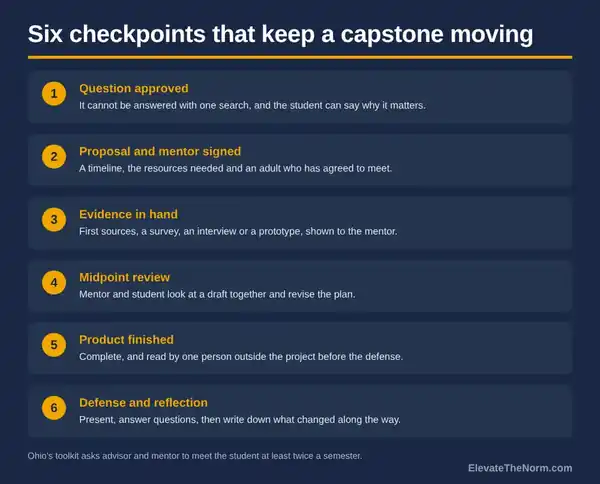
Ohio’s toolkit sets the floor: the student meets with an advisor and a mentor a minimum of twice per semester to review drafts and get guidance, and the timeline must list those check-ins. Six checkpoints is a reasonable shape for a year-long version, and a semester version can compress them:
- Question approved. It cannot be answered with one search, and the student can say why it matters.
- Proposal and mentor signed. A timeline, the resources needed and an adult who has agreed to meet.
- Evidence in hand. First sources, a survey, an interview or a prototype, shown to the mentor.
- Midpoint review. Mentor and student look at a draft together and revise the plan.
- Product finished. Complete, and read by one person outside the project before the defense.
- Defense and reflection. Present, answer questions, then write down what changed along the way.
Oceana shows what the defense looks like when a school takes it seriously. A mentor teacher and a community evaluator, who may be a former student, a parent, a teacher or a local volunteer, each score every presentation. Community evaluators complete a 2.5-hour training and may score up to six presentations in one day. Each session runs about an hour, covering the talk, the question period, the evaluators’ private discussion and the time spent sharing results with the student.
You do not need Oceana’s infrastructure to borrow the principle. One outside adult in the room changes how a student prepares, because the audience is no longer someone who already knows how the semester went.
Two practical limits belong on the proposal form before any student contacts anyone. Outside mentors and any work off campus need approval under your school’s own policies, so route the first contact through the teacher and follow your district’s rules on volunteer screening and student safety. And send families the one-page proposal, the checkpoint dates and the defense date at the start, so nobody learns the schedule from a surprise email in April. Parents then know what the student committed to, and the student can point to it.
How Do You Grade a Capstone Fairly?
Score the paper or product and the presentation on separate rubrics, put at least two adults on the scoring, and build in a revision level so a weak first attempt becomes a second draft rather than a failure. Grade what every student can control, and never charge a student for materials.
Oceana scores its paper on nine areas, such as introduction, context, claims, interview research and library and internet research, and scores the presentation on a shared eight-area rubric used by the mentor and the community evaluator. Both rubrics use four levels: revisit, approaching, proficient and advanced. A “revisit” on the paper sends the student back to revise; a “revisit” on the presentation means presenting again, usually in a smaller, private setting. The profile reports that in 2015–16 fewer than five students failed either project.
Oakland takes a different but compatible approach. Drafts are shared among faculty, and final versions are blind-scored by at least two educators, with three sets of scoring guidelines (paper, field research, presentation) and teacher training on them. If you are building from scratch, start with the rubric for project-based learning and the presentation rubric, then add one row for the thing unique to your capstone, such as the quality of the interview or the evidence from the prototype test.
Two guardrails matter more than any rubric language. First, grade the process alongside the product. A student whose prototype fails but whose testing was honest and whose reflection is specific has done the work. Second, remember that a polished product is partly a measure of resources at home. Supply the materials, offer a second route to an audience for students whose families cannot attend a showcase night, and score the evidence, not the budget.
What Goes Wrong With Capstone Projects?
The common failures are predictable: the first capstone arrives in senior year, field research stalls on logistics, access to mentors is uneven, and the teacher keeps directing instead of coaching. All four can be designed around if you name them before the project starts.
- It is the first time. The Oakland reporting says students found it too much to learn research, writing and presenting all in senior year. Fix it by building smaller versions in earlier grades.
- Field research stalls. The same article notes that focus groups are hard to schedule and that many students were nervous about interviews because few had ever done one. Teach the interview request and the survey draft as skills, with a practice run, before students need them.
- Mentor access is uneven. A student whose family knows a professional may land a better mentor than a student whose family does not. Build a pool of volunteer mentors at the school level, so access does not depend on who the student already knows. Oakland’s district reported uneven access to in-depth research before the requirement was refined, sometimes within one school.
- Group conflict. If students work in teams, plan for it. The MDRC review reports that in one set of project classes it describes, 37 of 53 surveyed groups reported conflict, and it identifies classroom norms for group work as a promising strategy. Individual capstones avoid this; team capstones need norms written down first.
- The teacher keeps directing. The MDRC review says teachers must shift from director to facilitator, tolerate more noise and ambiguity, and that adaptations can undermine the model. In one study it describes, teacher-led demonstrations replaced student investigations, and students who did the investigations themselves learned more. Coach the question; do not hand over the answer.
Capstone Project Ideas: Where to Start This Month
Start small and dated. Pick one grade, write the four parts on a single page, and fix the defense date on the calendar before anything else. Then work backward to the checkpoints.
- Choose the size. Use the table above: a semester and a showcase night for the first run, a full year for seniors.
- Recruit two or three outside adults to serve as mentors or panel members.
- Hand students the fifteen ideas as questions, not topics, and require a one-page proposal that names the audience and the mentor.
- Schedule the six checkpoints before the project begins, and run the first one in week two.
- Send families the proposal and the dates at the start, along with who to contact if the student gets stuck.
- Run the defense, then debrief, and change one thing before the next cohort starts.
The best capstone project ideas are the ones a student will still be arguing about six months later. If a student can defend the work to a stranger, the project did its job, whatever the rubric says.
Sources
- EachChildOurFuture, Ohio’s strategic plan for education. (2019, May). Senior Capstone Toolkit. Read in full via a school district’s hosted copy. Source of the four required parts and the twice-per-semester advisor and mentor meeting minimum. The toolkit specifies no required number of hours.
- Education Week. (2019, February). Can ‘capstone projects’ deepen learning for high school seniors? Read in full. A news report on Oakland’s program; it offers qualitative support and no controlled outcome data.
- Learning Policy Institute, California Performance Assessment Collaborative. Performance assessment profile: Oceana High School. Read in full. A program profile, not an evaluation; the figure on students who did not pass (fewer than five in 2015–16) is the profile’s own report.
- Poly Prep. Middle School Capstone. Read in full. A school’s own description; it states no duration and names no mentor, and this guide does not supply either for Poly Prep.
- Condliffe, B., et al. (2017). Project-based learning: A literature review. MDRC. The copy I could read was cut off partway through the section on teacher practice, so the sections on student outcomes and recommendations were not read. Claims here rest on the abstract and the earlier sections only.
What is a capstone project in high school?
A capstone project is a long, student-designed project that ends with a finished product and a presentation to an audience that can ask questions. Ohio’s senior capstone toolkit names four required parts: a proposal, an anchor experience, a culminating portfolio and a presentation.
How long should a capstone project take?
Programs vary. Oceana High School’s senior exhibition runs a year, with about six weeks spent preparing the presentation. Ohio’s toolkit sets no required hours. A reasonable recommendation is one semester for an eighth-grade version and a full year for seniors.
Can eighth graders do a capstone project?
Yes. Poly Prep runs a middle school capstone as the culminating project of a history course for eighth graders, ending in an annual Capstone Night. Keep it smaller than the senior version: one semester, one product and a short talk.
Does a capstone project improve student outcomes?
Nobody has shown that it does. Education Week’s report on Oakland’s program offers qualitative support and no controlled outcome data, and MDRC’s literature review calls project-based learning evidence promising but not proven. The case for a capstone rests on student ownership and the defense, not on a measured test-score gain.
Do students need an outside mentor?
It helps, and Ohio’s toolkit requires one, with the mentor signing a pledge after reading the proposal. If outside mentors are hard to find, a teacher advisor plus one family or community adult is a workable eighth-grade version. A school-level pool of volunteer mentors keeps access from depending on a student’s family connections.
How do you grade a capstone project fairly?
Use separate rubrics for the product and the presentation, put at least two adults on the scoring, and include a revision level. Oceana scores on four levels including a revisit that sends the student back to revise or present again. Never charge students for materials, and score the evidence rather than the polish.
What if a student’s capstone question is too big or too small?
Reject the question, not the subject. If it can be answered with one search, ask for a harder version by a set date. If it needs a year of fieldwork, narrow it to one population, one place or one decision. Treat it as a revision note, the same move you would make on a weak thesis.