By Clay Shumate
Classroom attention getters are the signals a teacher uses to move a room from talking to listening: a countdown, a call-and-response, a raised hand, a chime. The one I use with grades 6–12 is 3-2-1-Done — the countdown every kid learned in kindergarten, with a weekly class-versus-class competition attached. The countdown is simple. Getting teenagers to believe in it is not. This year, that took six weeks.
Key Takeaways
- The signal is not the problem. Secondary students ignore attention getters that cost them nothing to ignore. The fix is giving the class a stake in answering, not finding a cleverer chant.
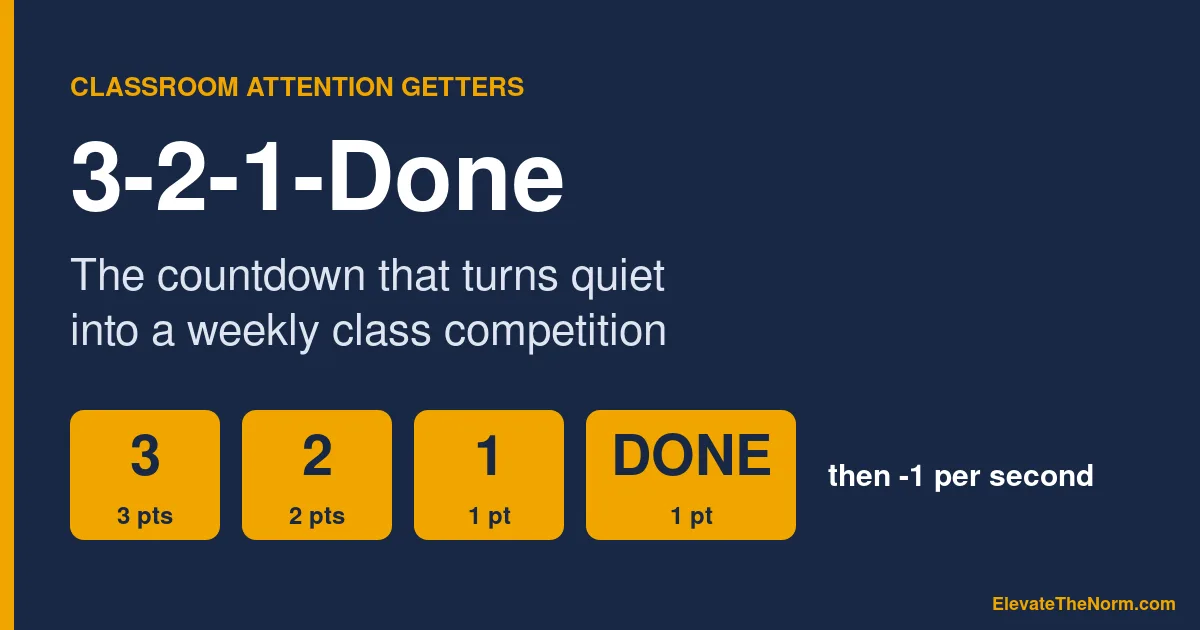
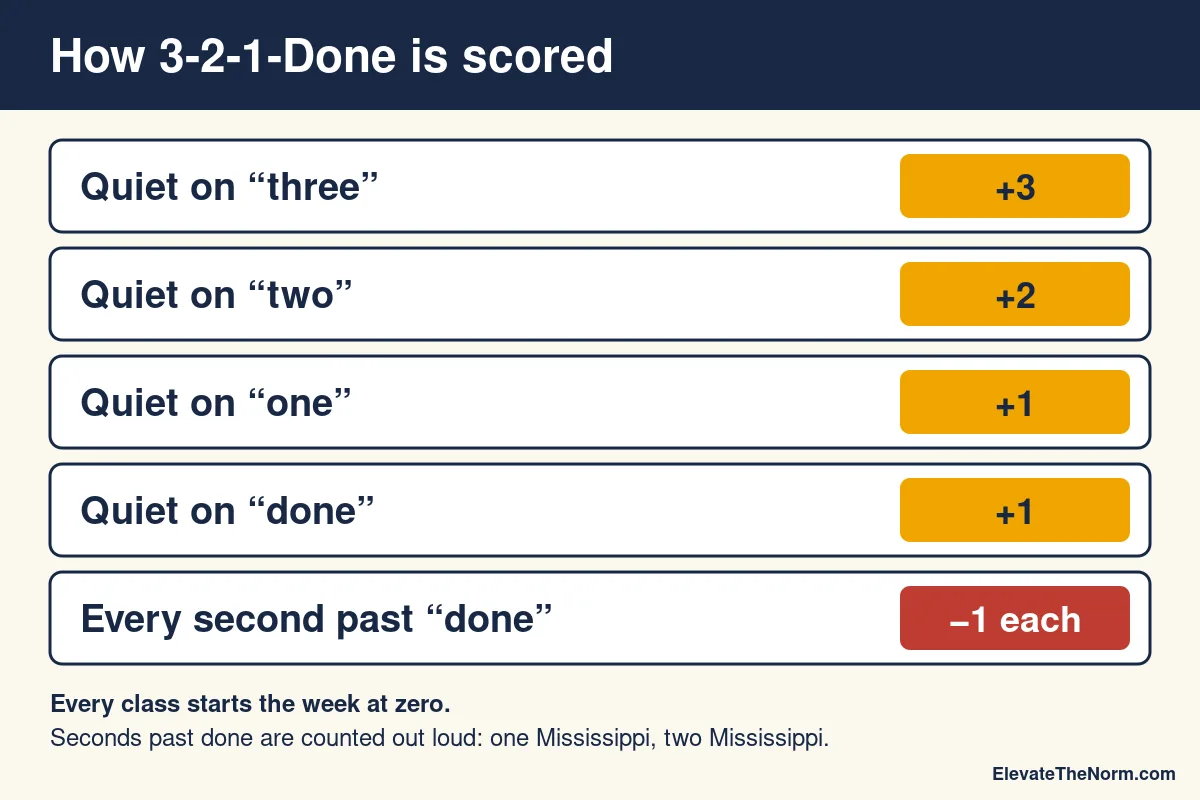
- 3-2-1-Done is scored. Quiet on three earns 3 points, two earns 2, one earns 1, and done earns 1. Every second past done costs a point. Every class starts the week at zero.
- It is an old, well-studied idea. Class-wide team scoring is the core of the Good Behavior Game, studied since 1969. The evidence is solid, and smaller in randomized trials than in the headline numbers.
- The reward has to be consistent before it has to be good. A bag of chips every single week beats a pizza party that might happen.
- Buy-in can take twice as long as you expect. Students who have learned not to trust school will test whether you mean it. Keep going.
Free Download · PDF
3-2-1-Done Weekly Scoreboard
A one-page printable scoreboard with the point values, a row for every class period, a bonus column, and a line for the weekly winner. Print it, post it, fill it in daily. No email required.
Free. No email address required. Designed for grades 6–12. Browse every printable in Your Free Library.
Why Most Classroom Attention Getters Stop Working After Elementary School
In second grade, “class, class” gets “yes, yes” because the adult asked. By ninth grade, that is no longer reason enough. A fourteen-year-old weighing whether to finish a sentence to a friend or go quiet for a teacher is doing a small cost-benefit calculation, and most attention getters put nothing on the scale.
So the signal escalates. The chant gets louder, then the teacher does, and the room learns that the real signal is the third, angriest repetition. That is the pattern behind why yelling manufactures order instead of restoring it: it works for a moment, and it teaches students to wait for it.
The fix is not a better chant. It is giving the whole class a reason to answer the first one.
The 3-2-1-Done Method, Step by Step
Everybody already knows the countdown: three fingers up, three, two, one, done. What changes is that every count is worth something, and every class is keeping score against every other class.
- Every class starts the week at zero. Monday is a clean slate for every period, no matter how last week went.
- Count down out loud with fingers up. Three, two, one, done.
- Award points for when the room goes quiet. Quiet on “three” is 3 points. On “two,” 2 points. On “one,” 1 point. On “done,” also 1 point.
- Past done, count the seconds out loud. One Mississippi, two Mississippi, three Mississippi. Every second is a point off.
- Post the board. Every class sees every other class’s running total. That visibility is where the competition comes from.
- Name a winner every week. Highest total on Friday gets the reward. No skipped weeks.
Yes, “one” and “done” are both worth a point. That is on purpose: the class gets two chances to earn something before anything is taken away. I would rather drive a room with points it can still earn than with points it is losing. Plenty of teachers skip that and just keep counting — four, five, six — with no second chance at “done.” That works too. Pick one version and hold it all year.
Other ways to earn and lose points
The countdown does not have to be the only thing on the board. A class can earn points when every student turns in the day’s work, and lose them for tardies. Add what fits your room, and add it at the start of a week, never in the middle of one.
Lean on positives or on negatives?
Both work. I keep negatives as low as I can and give out positives sparingly, so a point means something. I have also seen it run almost entirely on negatives, where the class closest to zero at the end of the week wins. The version matters less than two rules: the scoring never changes midweek, and you are honest about every point. If you shave a point off one class because you are annoyed with them, every class will know by lunch.
Why It Works: An Old Idea in a New Coat
Nothing here is new. Scoring a whole class as a team, so that students have a reason to manage each other’s noise rather than just their own, is the core of the Good Behavior Game. Barrish, Saunders and Wolf first described it in 1969, and researchers call the mechanism an interdependent group contingency: the group earns or loses together.
The research base is large. Bowman-Perrott and colleagues (2016) pooled 21 single-case studies covering 1,580 students from pre-kindergarten through grade 12 and found a large effect: a Tau-U of 0.82, meaning problem behavior dropped substantially and prosocial behavior rose.
The honest caveat: single-case studies follow a small number of classrooms very closely, and they tend to produce big numbers. When Smith and colleagues (2021) pooled seven randomized controlled trials covering about 4,700 children, the effects were real but modest — Hedges’ g between 0.09 and 0.32, depending on the outcome. Most of that research is also in elementary classrooms, not high schools.
So the defensible claim is this: class-wide team scoring is one of the better-supported classroom management tools out there, and it will not transform a room overnight. 3-2-1-Done aims it at one behavior — getting quiet on a signal — that happens many times a day. That is exactly the kind of small, repeated moment a modest effect is useful for.
The Part Nobody Warns You About: Buy-In Took Six Weeks
A lot of the students I have this year came up through classrooms that were mostly bookwork — worksheets in, worksheets out, next period. They know what that feels like from the student side.
“Students know when you’re doing that, just like when you’re overstaying your welcome at somebody’s house. They feel it.”
“Why in the heck would we want a student to feel like they are not wanted or needed somewhere? In a school.”
So when I told them there would be a Student of the Week every week, and a winning class from 3-2-1-Done every week, they did not believe me. Nobody had ever told them that and then followed through. The first winner did not convince them. Neither did the second.
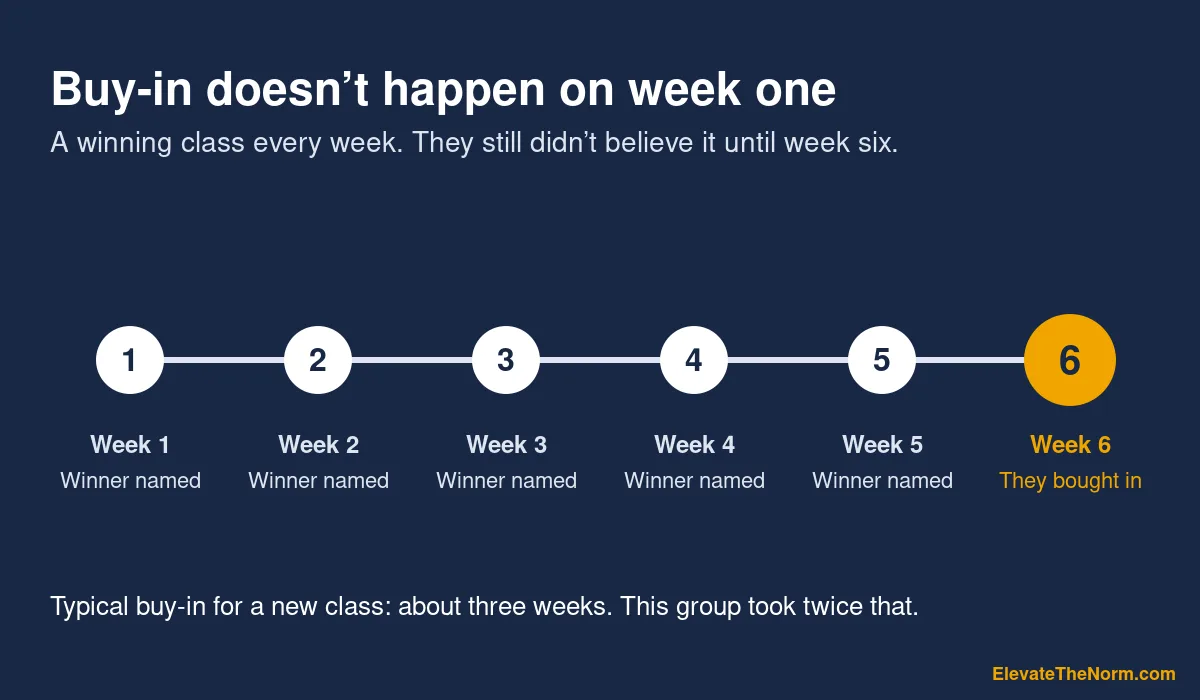
“They didn’t believe it. Even after it happened once. And twice. And three, four, five, six times. And then guess what? They bought in.”
Six weeks is about twice as long as buy-in usually takes me with a new class. But it came, and it came all the way: every student wants the win now, and kids who walked in expecting another year of worksheets enjoy coming to social studies. Who would have thought history wasn’t boring.
“Sometimes the three weeks is six weeks. Sometimes it’s nine weeks. Sometimes it’s 12, sometimes it’s never.”
If you are in week three and nothing has moved, that is not evidence the method failed. It may be evidence of how many times these students have been promised something before.
The Reward: Consistent Beats Big
My weekly reward is a can of Pringles, a water, and fifteen to twenty minutes of the class’s own time — as long as they stay seated and keep the room at what I call a low murmur. Some teachers give a few minutes of free time. Some do something else entirely. There are plenty of ways to run it.
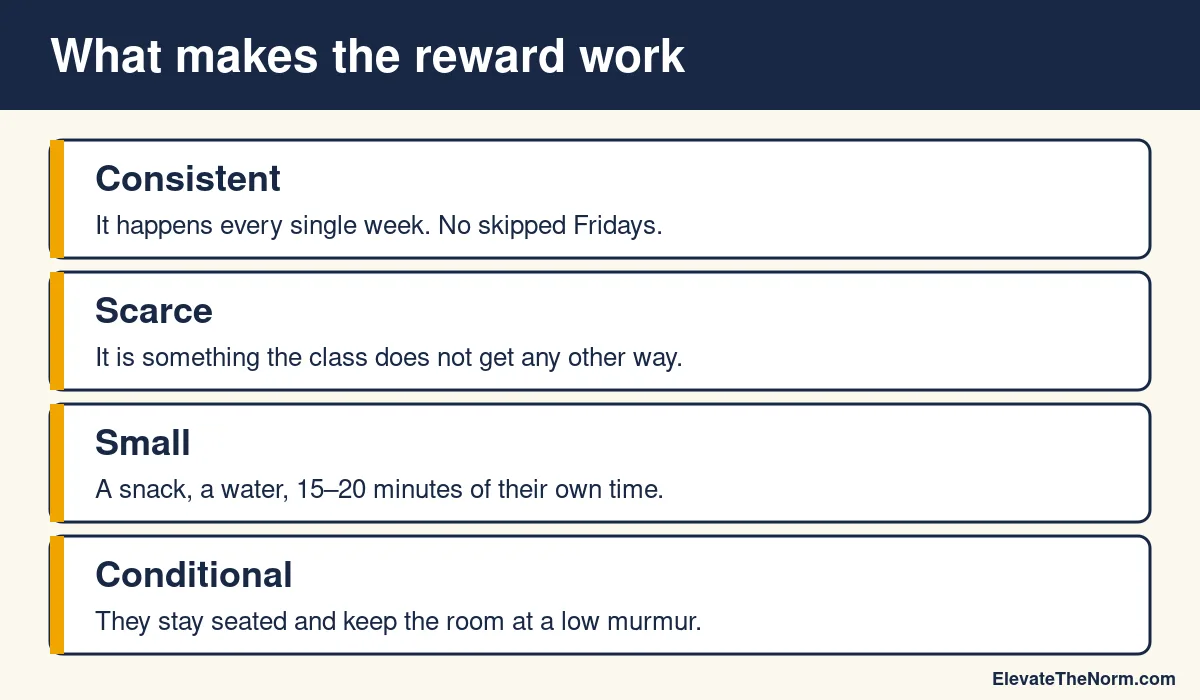
What you are after is a consistent reward. A modest reward that arrives every single Friday does more than a big one that might happen. When the class can count on it, they start to believe you — and that belief is the thing you are actually building. The weekly reward is just the proof.
Two practical checks before you buy snacks. Ask about food allergies and have a non-food swap ready, like extra free time or choosing the seating for a day. And check whether your school has a policy on food rewards or free time; some do, and it is easier to ask first.
Honesty Is the Whole System
For a minute, stop calling them students.
“You can be a student at any age.”
When I taught at a community college, some of my students were 65 and 70 years old. Nobody would talk to them the way some adults talk to a room of 14- to 17-year-olds, because we assume their maturity is higher. Maybe it is. Maybe it is not. The same is true in a ninth-grade classroom: a 15-year-old might walk in with the maturity of a 10-year-old or of a 19-year-old, and you do not know what either one has had to live through to get there.
“Children are like rubber bands. They can snap back. But eventually they’re going to break if you snap them too much.”
That is why the honesty matters more than the scoring. Every point you award or take has to be real. Every winner has to be earned. Every reward has to show up. The countdown is just the part students can see.
“Once you can gain trust, you better sure as heck not lose it.”
Keep that trust and you can get a class to buy into more and more of what you need from them. That is how a countdown turns into a classroom management plan that actually runs.
Common Mistakes With 3-2-1-Done
- Skipping a week. One missed Friday tells students the promise was never real, and you start the buy-in clock over.
- Changing the rules midweek. New point sources start on Monday, announced ahead of time.
- Counting in your head. Say the seconds out loud. If students cannot hear the count, the score feels arbitrary.
- Turning the countdown into a threat. Keep your voice level. The points carry the weight so your tone does not have to.
- A reward they can get anyway. If free time is available every day, it is not a reward on Friday.
- Quitting at week three. Some groups need twice as long. See the section above.
If you want a second signal for moments when you cannot use your voice, pair the countdown with visual cues students can actually see. And for classes that respond to competition, the same team energy powers classroom review games.
What It Looks Like When It Works
Keep a positive attitude through the weeks when nothing seems to move. Keep elevating them. Show them the norm is not bookwork and negative thoughts — it is positive, soft-skill-driven, standards-driven work.
“They are learning about life as they are learning about history.”
Or whatever your subject is. That is a win. It is also the whole idea behind positive reinforcement classroom management: the countdown gets the room quiet, and the consistency gets the room to trust you.
Before you go: grab the free 3-2-1-Done Weekly Scoreboard (PDF) — ElevateTheNorm.com branded, printable, no email required.
Frequently Asked Questions
What are the best classroom attention getters for high school?
The ones students have a reason to answer. High schoolers will ignore a chant, a chime, or a raised hand if ignoring it costs nothing. A plain countdown attached to a class score, like 3-2-1-Done, works because the whole class has a stake in going quiet fast. The specific signal matters much less than consistency and a visible payoff.
Isn’t a 3-2-1 countdown too babyish for teenagers?
On its own, maybe. With points, a public scoreboard, and a weekly winner, it stops being a kindergarten routine and becomes a competition. Teenagers who would roll their eyes at a chant will go quiet on three when their class is two points behind the period after them.
Why are ‘one’ and ‘done’ both worth one point?
It gives the class two chances to earn something before anything is taken away, which keeps the system driven by what students can gain rather than what they are losing. Some teachers skip that and simply keep counting past one. Either version works as long as you choose one and never change it midyear.
How long does it take for students to buy in?
Usually about three weeks with a new class, in my experience. This year it took six, because many students did not believe a teacher would actually follow through every week. Some classes take longer. Keep naming a winner every single week; consistency is what eventually convinces them.
What should the weekly reward be?
Something small, scarce, and completely consistent. Mine is a snack, a water, and 15 to 20 minutes of the class’s own time as long as they stay seated at a low murmur. Check for food allergies and any school policy on food rewards first, and have a non-food option ready.
Does class-wide team scoring actually have research behind it?
Yes. It is the core of the Good Behavior Game, studied since 1969. A 2016 meta-analysis of 21 single-case studies found large reductions in problem behavior, while a 2021 meta-analysis of randomized trials found smaller but real effects. Most of that research is in elementary classrooms, so treat it as a well-supported tool rather than a guaranteed fix for older students.
Is this a good strategy for new teachers?
It is one of the easiest systems a first-year teacher can run. It needs no technology, no budget beyond a weekly snack, and one poster. The hard part is not the mechanics; it is holding the line every single week, including the weeks when nothing seems to be working yet.
Sources
- Barrish, Harriet H., Muriel Saunders, and Montrose M. Wolf. “Good Behavior Game: Effects of Individual Contingencies for Group Consequences on Disruptive Behavior in a Classroom.” Journal of Applied Behavior Analysis, vol. 2, no. 2, 1969, pp. 119–124. https://doi.org/10.1901/jaba.1969.2-119
- Bowman-Perrott, Lisa, Mack D. Burke, Samar Zaini, Nan Zhang, and Kimberly Vannest. “Promoting Positive Behavior Using the Good Behavior Game: A Meta-Analysis of Single-Case Research.” Journal of Positive Behavior Interventions, vol. 18, no. 3, 2016, pp. 180–190. https://eric.ed.gov/?id=EJ1104009
- Smith, Stephanie, Kimberly Barajas, Brandi Ellis, Christina Moore, Spencer McCauley, and Brian Reichow. “A Meta-Analytic Review of Randomized Controlled Trials of the Good Behavior Game.” Behavior Modification, vol. 45, no. 4, 2021, pp. 641–666. https://doi.org/10.1177/0145445519878670