By Clay Shumate
Brain breaks for high schoolers are short, deliberate pauses — usually two to ten minutes — that interrupt sustained work before attention falls apart. The evidence at this age is thinner than the advice suggests: a review limited to 13- to 16-year-olds found only three studies. What support exists points at classroom behaviour, not test scores.
That is the honest version, and it is worth starting there, because almost everything written about brain breaks was researched on nine-year-olds and then handed to people teaching sixteen-year-olds. The practices can transfer. The evidence does not automatically come with them, and a teenager can tell the difference between a break designed for them and one borrowed from a third-grade classroom.
Key Takeaways
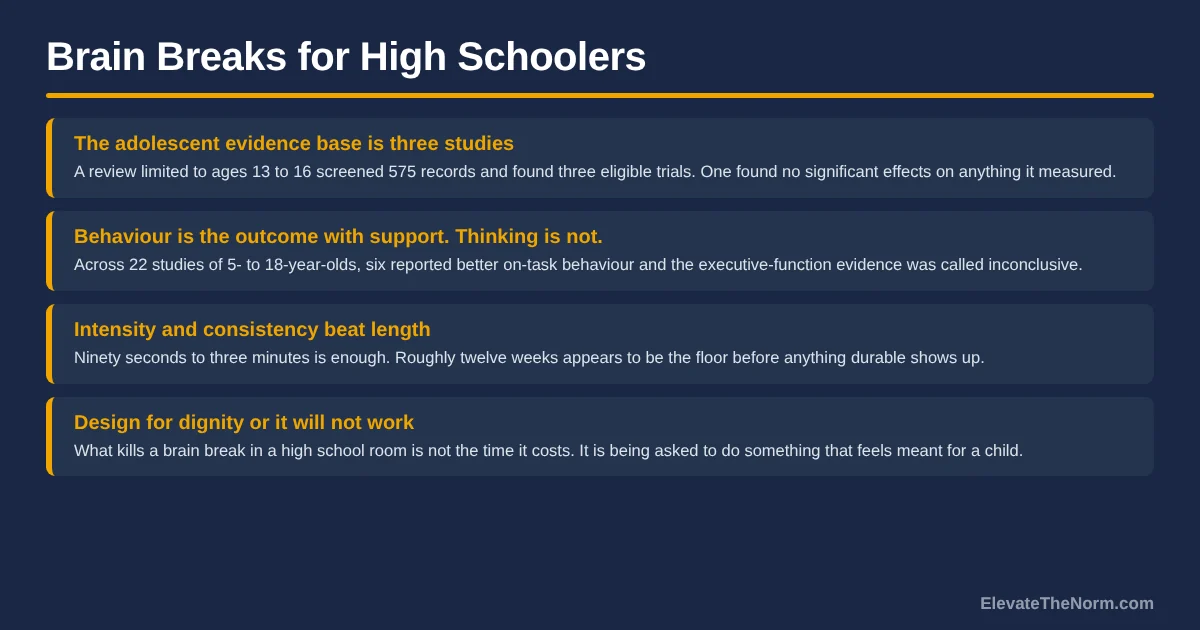
- The adolescent evidence base is three studies. A 2022 systematic review restricted to secondary and high school students aged 13 to 16 screened 575 records and found three eligible trials. One of the three found no significant effects on anything it measured.
- The strongest single result is recent, large and heavily caveated. A cluster-randomised trial of 529 Italian adolescents averaging 14.3 years found a large gain on a standardised concentration test after four months of two ten-minute active breaks a day. The authors list baseline imbalance, possible contamination and no pre-planned sample-size calculation among the limits.
- Behaviour is the outcome with support. Thinking is not. Across 22 studies of 5- to 18-year-olds, six reported improved on-task behaviour, five reported executive-function gains the reviewers called inconclusive, and most of the studies were rated poor or fair quality.
- The famous “brief diversions” lab finding did not replicate. A 498-participant study testing it directly found the same attention decline in every group, with the statistics favouring the null.
- Design for dignity or it will not work. The thing that kills a brain break in a high school classroom is not the time it costs. It is being asked to do something that feels like it was meant for a child.
What Are Brain Breaks for High Schoolers?
A brain break is a short, planned interruption to sustained cognitive work — a change of posture, task or physical state — taken before students stop being able to work, not after. In the research literature the term usually means an active break: a few minutes of movement inside the lesson, distinct from a physically active lesson where the content itself is taught through movement.
Two things separate a break from an interruption. A break is scheduled or triggered by something you decided in advance, and it has a defined end. A class that drifts for four minutes because the teacher lost the room has had an interruption. A class that stands up for ninety seconds at a planned point and sits back down has had a break. The difference is entirely about who called it.
The grade level matters more here than almost anywhere else on this site. In most studies the participants are primary-aged, the activity is a dance video or an animal-themed movement sequence, and the measured outcome is on-task behaviour. None of that is useless, but a room of fifteen-year-olds will refuse the format long before they refuse the idea.
Do Brain Breaks Actually Work for Teenagers?
The evidence says probably, mostly for classroom behaviour, and there is much less of it than the volume of advice would suggest.
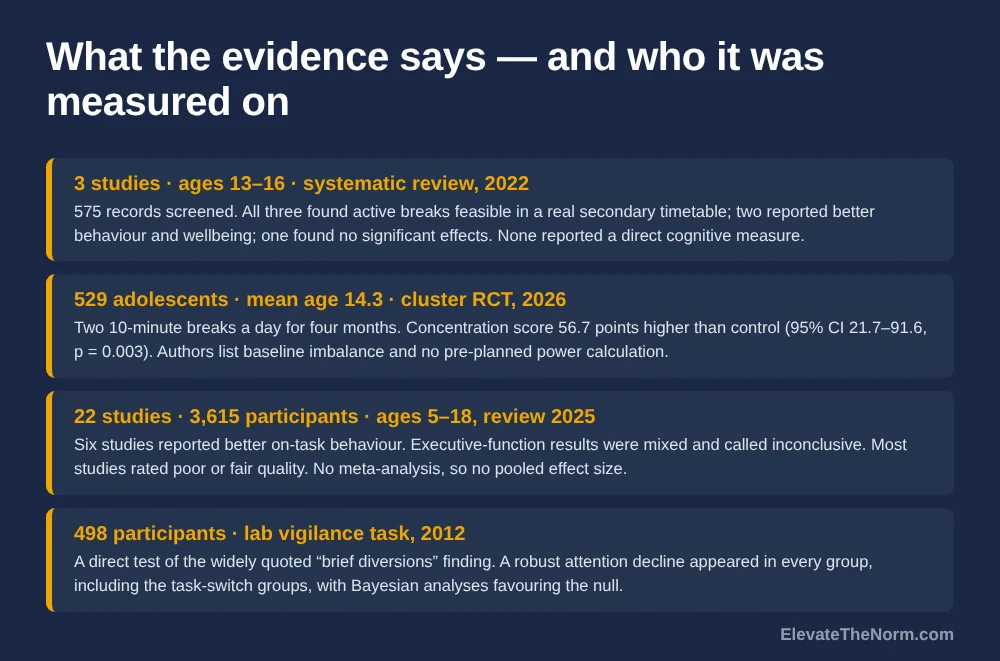
A 2022 systematic review set out to answer exactly this question and restricted itself to pre-adolescent and adolescent students in secondary and high schools. It screened 575 records. After title, abstract and full-text screening, three studies met the criteria — one in Norway, one in the UK, one in Australia, with participants aged 13 to 16 and samples from 97 to 447. Most of what was excluded was primary-school research.
What those three found, honestly:
- All three reported the breaks were feasible and acceptable in a real secondary timetable. That is not nothing — feasibility is where most classroom interventions die.
- Two reported improvements in classroom behaviour and in vitality or quality of life.
- One found no significant effects on physical activity, sedentary time, behaviour or wellbeing.
- None of the three reported a direct cognitive measure, even though cognitive function was named in the review’s own aims.
Study quality was rated poor, fair and good — one each. The reviewers urged caution interpreting three heterogeneous studies and noted that around twelve weeks appears to be the minimum duration before anything durable shows up. That last point is the one most likely to matter to you: nobody has shown that a brain break on Tuesday improves anything on Tuesday.
The broader picture across all school ages is consistent with that. A 2025 systematic review of 22 studies covering 3,615 participants aged 5 to 18 found six studies reporting positive effects on classroom behaviour, mostly on-task behaviour, with moderate-to-vigorous activity appearing more beneficial. On executive functions — inhibitory control, cognitive flexibility, working memory — five studies reported improvements and the reviewers called the overall evidence inconclusive. Physical fitness results were unclear. Most included studies were rated poor or fair quality, and the review pooled nothing, so there is no overall effect size to quote.
What Does the Best Secondary Study Show?
A large concentration gain, in a well-run trial, with a limitations section long enough to take seriously. It is the single most relevant result available and it deserves to be read properly rather than reduced to a headline.
Martone and colleagues ran a cluster-randomised controlled trial across four upper secondary schools in Campania, in southern Italy. Thirty-nine classes were allocated — 20 intervention, 19 control — covering 529 adolescents with a mean age of 14.3 years. The intervention was two ten-minute active breaks every school day for four months, in the second and fifth lesson periods: mobilisation, stretching, strengthening, coordination and balance, run from one of twelve music-based videos on the interactive whiteboard with a teacher present. Fidelity was high — 180 of 192 scheduled breaks delivered, about 94% attendance — and in a subsample of 150 students the mean heart rate during a break was 155 beats per minute, which the authors describe as moderate-to-vigorous at group level.
Attention was measured with the Italian d2-R test. After four months the adjusted concentration score was 151.3 in the intervention group against 94.7 in the control group — a difference of 56.7 points (95% CI 21.7 to 91.6), p = 0.003, holding at 54.7 points in a fully adjusted model. Exploratory checks found no significant moderation by sex, sport participation, sleep, smartphone use or diet.
Now the caveats the authors themselves list, because they change how much weight this carries. Randomisation was not stratified, and the groups differed at baseline on age, weight, baseline concentration score, sleep and smartphone use. Intervention and control classes sat in the same schools, so contamination is possible. No a priori sample-size calculation accounting for clustering was done, and no standardised effect size is reported for the main result. Repeated testing may have produced a practice effect. There was no long-term follow-up, teacher acceptability was not assessed, and the impact on instructional time was not measured — which, for a school giving up twenty minutes a day, is the question an administrator will ask first.
None of that makes the finding worthless. It makes it one good trial in one region, pointing in a direction the weaker evidence also points. Treat it as encouraging rather than settled, and notice what the design required: twenty minutes a day, every day, for four months, with specialists involved. That is not “a quick stretch when they get restless.”
What About the “Brief Diversions” Study Everyone Cites?
It did not replicate, and the replication attempt was four times the size. This one is worth knowing because it turns up constantly in professional development on attention, usually as a hard number about how long focus lasts.
The original is Ariga and Lleras (2011), in Cognition. Participants did a long visual vigilance task while holding digits in memory. Those who recalled the digits only at the end showed a steep decline in performance over time; those asked to recall them sporadically during the task did not. The authors argued that briefly deactivating and reactivating the task goal prevents the drop-off — the result that got written up as brief diversions dramatically improving focus.
In 2012, Helton and Russell published a direct test in Experimental Brain Research with 498 participants, pitting that goal-habituation account against two rivals. They found a robust vigilance decrement in every group, including the task-switch groups. Self-reported workload and task-unrelated thoughts did not differ. Bayesian analyses favoured the null hypothesis.
Two honest conclusions follow. First, if someone tells you research proves attention resets after a short diversion, the strongest direct test of that claim says otherwise. Second — and this is the part worth holding onto — neither study was run in a classroom on teenagers. A lab vigilance task is not a fourth-period lesson. The case for brain breaks in a high school room does not rest on that literature and should not be made from it.
How Long Should a High School Brain Break Be?
Short enough to come back from, long enough to change physical state: ninety seconds to three minutes for a routine break, ten if you are running something structured. There is no validated number, and the honest answer is that duration has not been isolated as a variable in the adolescent research.
What you can take from the evidence is the shape rather than the figure. The Italian trial used ten minutes twice a day and got its result over four months. The adolescent review found interventions ranging from 14 to 60 minutes, two to six times a week, over 11 weeks to 12 months, and suggested roughly twelve weeks as the floor for anything lasting. The across-ages review found moderate-to-vigorous intensity looked more useful than gentle movement.
So the practical reading is: intensity and consistency matter more than length. Ninety seconds of actually standing up and moving beats five minutes of sitting and chatting, and doing it most days for a term beats doing it brilliantly for a fortnight.
What Brain Breaks Actually Work With 14- to 18-Year-Olds?
The ones that do not require a teenager to perform enthusiasm. That is the whole selection rule. A high schooler will do almost anything that has a point and almost nothing that makes them look like a child in front of people whose opinion they care about.
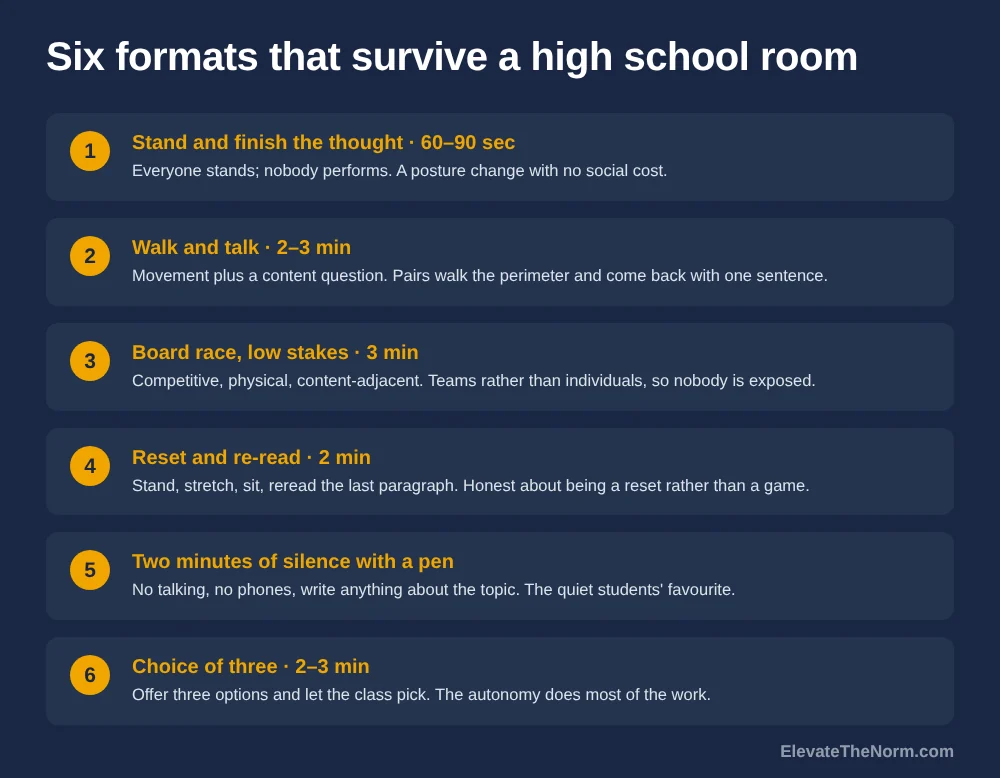
| Break | Length | Why it survives a high school room |
|---|---|---|
| Stand and finish the thought | 60–90 sec | Everyone stands; nobody performs. Posture change with no social cost |
| Walk and talk | 2–3 min | Movement plus a content question. Pairs walk the perimeter and come back with one sentence |
| Board race, low stakes | 3 min | Competitive, physical, content-adjacent. Teams, not individuals, so nobody is exposed |
| Reset and re-read | 2 min | Stand, stretch, sit, reread the last paragraph. Honest about being a reset rather than a game |
| Two-minute silence with a pen | 2 min | No talking, no phones, write anything about the topic. The quiet students’ favourite |
| Choice of three | 2–3 min | Offer three options and let the class pick. Autonomy does most of the work |
Notice that four of the six involve standing and two involve talking about the content. That is deliberate. A break does not have to be empty to be a break — a change of posture and a change of task is enough, and tying it loosely to the lesson makes it far easier to defend and far easier to restart from. If you want the talking version to carry real weight, the same two minutes can be run as student-to-student discourse about the content rather than as filler.
What Should You Never Do?
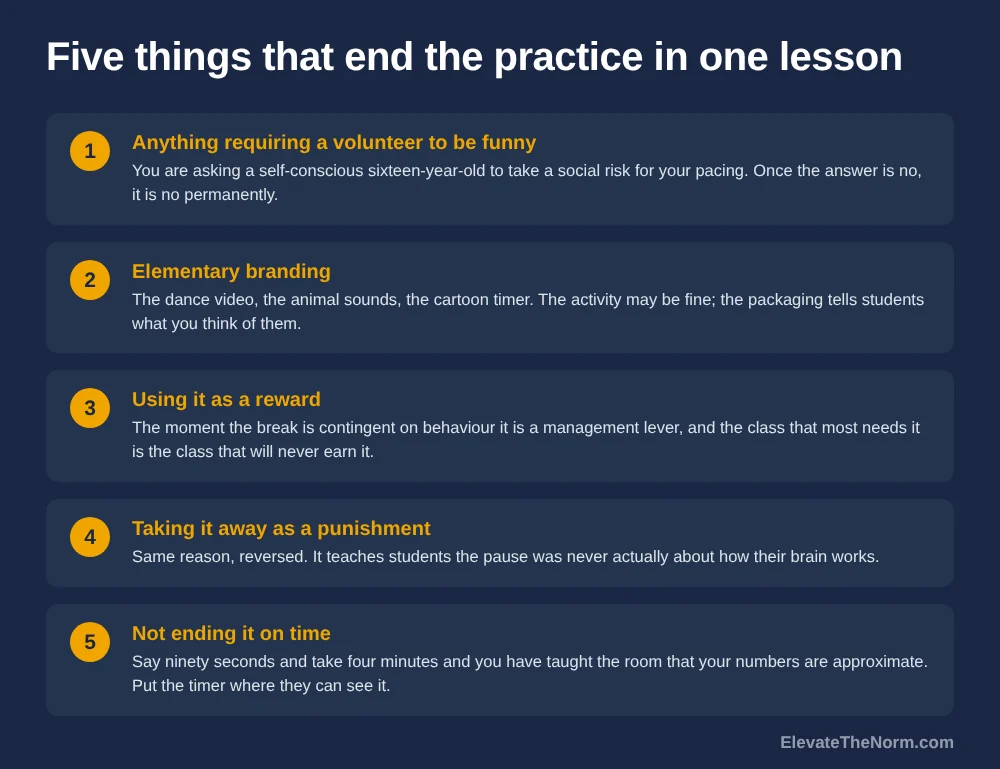
Four things, each of which ends the practice in one lesson.
- Anything that requires a volunteer to be funny in front of the class. You are asking a self-conscious sixteen-year-old to take a social risk for your pacing. The answer will be no, and after it is no once it is no permanently.
- Elementary branding. The dance video, the animal sounds, the cartoon timer. The activity may be fine; the packaging tells students what you think of them.
- Using it as a reward. The moment the break is contingent on behaviour, it is a management lever, not a break — and the class that most needs it is the class that will never earn it.
- Taking it away as a punishment. Same reason, reversed, and it teaches students that the pause was never actually about how their brain works.
There is a fifth that is less obvious: not ending it on time. If you say ninety seconds and take four minutes, you have taught the room that your numbers are approximate, and the next one will be harder to end. Standing by your word is the mechanism here, same as everywhere else. Set a timer where students can see it.
How Do You Run One Without Losing the Room?
You make the start and the end routine, and you never improvise either one. A break goes wrong in exactly two places: getting them out of the work and getting them back into it. Both are procedure problems and both are solvable in advance.
- Name it before it starts. “Ninety seconds. Stand up. Timer is on the board.” Students who know the shape of the next ninety seconds do not need to test it.
- Use a visible countdown. Not your watch. On the board, where every student can see how much is left, so nobody has to ask.
- Use one consistent signal to return. Whatever you already use — a signal the class already responds to works better than a new one invented for breaks.
- Give the first thirty seconds back a defined task. The return is harder than the break. “Sit down, read the question on the board, start writing” beats “okay, where were we.” This is the same principle that makes transitions between activities cost less time than they usually do.
- Do it at the same points for two weeks. A break at a predictable moment becomes a routine. A break at a random moment stays an event, and events need managing every time.
If getting the room back is the part that worries you, build the break into a structure you already run well. A planned pause between two parts of a lesson, landing on an established routine, is a much smaller risk than a break dropped into open work time.


When Does a Class Actually Need One?
Before the attention goes, not after. Once a class has lost focus, a break reads as a reward for drifting and you have to rebuild from further back. The skill is spotting the slide early.
Three reliable signals, in the order they appear: pen-stopping — the proportion of students writing drops while the proportion looking at the board stays the same; question quality falling — questions turn procedural, about format and length rather than content; and ambient noise rising at a constant task. Any two of those at once and you are past the point where pushing on gains you anything.
And let students call it. A class that can request a break — one per period, by a signal rather than a speech, with the teacher keeping the right to say “finish this paragraph first” — will use it about as often as you would have, and will use it at better moments, because they can feel the slide before you can see it. It also changes what the break is: a tool a young adult is trusted to reach for rather than something administered to them. If that feels risky, cap it at one and try it for a fortnight. The classes that abuse it are usually the classes that were never told what it was for.
The honest caveat: no study has validated those signals. They are the sort of thing experienced teachers watch for, and the research cannot tell you when to call a break because it has not studied that question. What the research does say is that consistency over about twelve weeks is what produced measurable change, which argues for a scheduled break most days rather than a reactive one on bad days.
What Do You Tell an Administrator Who Walks In?
What you are doing, why it is scheduled, and what the evidence does and does not support. That conversation goes much better if you have decided the honest version in advance.
The defensible claim is narrow: short activity breaks have been found feasible in real secondary timetables, and the outcome with the most consistent support across school ages is on-task classroom behaviour. The claim to avoid is that brain breaks raise test scores — the adolescent studies did not measure cognition directly, and the executive-function evidence across ages is inconclusive. One cluster-randomised trial of 529 adolescents found a large concentration gain over four months, and its own authors list baseline imbalance and no pre-planned power calculation among the limits.
On equity, there is one useful data point and it is worth having ready. The Italian trial ran exploratory checks on whether the concentration effect differed by sex, sport participation, sleep duration, smartphone use or diet, and found no significant interaction on any of them after correction for multiple testing. The authors label those analyses exploratory, so it is a weak finding rather than a strong one. It points the same way as everything else on this site: the benefit did not turn out to belong to the students who were already doing well.
On safety and space, decide before the first break whether your room can actually hold it. Thirty-two desks in a room built for twenty-eight means standing in place rather than moving around, and a walk-and-talk needs a route that does not run between a bag and a chair leg. A student with a mobility limitation, an injury or a reason they have not shared should never have to say anything to sit one out — which is why the written version exists and why it is offered to the whole class rather than to individuals.
On instructional time, do the arithmetic before you are asked. Ninety seconds twice a period is three minutes out of fifty — six percent. The Italian trial spent twenty minutes a day, which is a real cost and was a school-level decision rather than a teacher’s. If the claim is that the remaining 94% of the period is more productive, say that is the claim, and say nobody has measured it in your subject.
What Should Families Know?
That it is scheduled, it is brief, and it is not a reward or a punishment. Worth saying plainly, because “we did a brain break” can sound to a parent like a period went missing.
Three things are fair to promise. It is not graded and it is not tied to behaviour — nobody loses a break for a bad day and nobody earns one for a good one. Participation is movement-optional; a student who cannot or does not want to move can stand, or stay seated and do the written version, and no explanation is owed. And the time is accounted for — a few minutes a period, scheduled, with the lesson built around it rather than interrupted by it.
If a family asks whether it helps, the accurate answer is that the evidence supports better classroom behaviour and does not yet support better grades, and that most of the research was done on younger students. That is a less exciting answer than the one on most school newsletters, and it is the one that will still be true next year.
What to Do This Week
Pick one class and one slot. Do not roll this out across a timetable.
Choose the moment first. Find the point in that period where the pens reliably stop — most teachers already know it — and put the break three or four minutes before it.
Pick one format and keep it. Ninety seconds, standing, timer on the board. Do not vary it for two weeks; you are building a routine, not entertaining anybody.
Define the first thirty seconds back. Write the return task on the board before the break starts, so coming back is reading rather than deciding.
Count one thing. How many students are writing five minutes after the break compared with five minutes before it. One number, twice a week. It will not prove anything, and it will tell you whether to keep going.
And if the first week is awkward, that is the normal result rather than a verdict. The research that found anything durable ran for twelve weeks or more. A format that feels forced on Tuesday and ordinary three weeks later is working exactly as the evidence says it should. If you want a lower-stakes place to start, the same ninety seconds slots neatly into the routines around how a period opens and around what students do when they finish early, both of which you are probably already running.
Frequently Asked Questions
What are brain breaks for high schoolers?
Short, planned interruptions to sustained work — usually ninety seconds to ten minutes — that change a student’s posture, task or physical state before attention falls apart. In the research they are usually called active breaks: a few minutes of movement inside the lesson, as distinct from a physically active lesson where the content itself is taught through movement. The two things that make it a break rather than an interruption are that you called it in advance and that it has a defined end.
Do brain breaks actually work for teenagers?
Probably, mostly for classroom behaviour, and the evidence is thinner than the advice suggests. A 2022 systematic review restricted to students aged 13 to 16 screened 575 records and found only three eligible studies; all three reported the breaks were feasible, two reported improved behaviour and wellbeing, one found no significant effects on anything, and none measured cognition directly. Across all school ages, a 2025 review of 22 studies found six reporting better on-task behaviour and called the executive-function evidence inconclusive.
How long should a brain break be in high school?
Ninety seconds to three minutes for a routine break, up to ten if you are running something structured. There is no validated number — duration has not been isolated as a variable in the adolescent research. What the evidence does suggest is that intensity and consistency matter more than length: moderate-to-vigorous movement looked more useful than gentle movement, and roughly twelve weeks appears to be the minimum before anything durable shows up.
What brain breaks work with older students?
The ones that do not require a teenager to perform enthusiasm. Stand and finish the thought (60–90 seconds). Walk and talk in pairs with a content question (2–3 minutes). A low-stakes team board race (3 minutes). Stand, stretch, sit and reread the last paragraph (2 minutes). Two minutes of silence with a pen and no phones. Or offer three options and let the class choose — the autonomy does most of the work. Four of those six are just a change of posture, which is enough.
What should you avoid with high school brain breaks?
Four things end the practice in one lesson: anything requiring a volunteer to be funny in front of the class; elementary packaging like dance videos and cartoon timers; using the break as a reward, which makes it a management lever and means the class that needs it most never earns it; and taking it away as a punishment. A fifth is quieter — not ending it on time. If you say ninety seconds and take four minutes, you have taught the room your numbers are approximate.
Do brain breaks improve test scores?
There is no good evidence that they do, and claiming it will not survive scrutiny. The three studies in the adolescent-only review reported no direct cognitive measure at all. Across ages, executive-function findings were called inconclusive by the reviewers. One cluster-randomised trial of 529 Italian adolescents did find a large gain on a standardised concentration test after four months of two ten-minute breaks a day — but its own authors list baseline imbalance, possible contamination between groups and no pre-planned sample-size calculation among the limitations. The defensible claim is about classroom behaviour, not grades.
Does the research say attention resets after a short break?
Not reliably. The widely quoted finding is Ariga and Lleras (2011), who reported that briefly switching tasks during a long vigilance task prevented the usual decline in performance. In 2012 Helton and Russell tested that account directly with 498 participants and found a robust decline in every group, including the task-switch groups, with Bayesian analyses favouring the null. Both studies were lab vigilance tasks rather than classrooms, and neither was run on teenagers, so the case for brain breaks in a high school room should not be built on either one.
Should a brain break be earned?
No. The moment it is contingent on behaviour it stops being a break and becomes a management lever, and the class most likely to need a reset is the class least likely to earn one. The same logic rules out removing it as a punishment. A better move in the other direction is letting students request one — capped at one per period, by a signal rather than a speech, with the teacher keeping the right to say “finish this paragraph first.” They can usually feel the slide before you can see it.
Sources
- Martone, D., Vitucci, D., Gillo, A., Dei, S., Cosco, L. F., Valerio, G., Ghirelli, R., Alfieri, A., Mancini, A., and colleagues (2026). Classroom Active Breaks Effects on Attention and Concentration Performance Among Adolescents Attending Upper Secondary Schools in Southern Italy. Sports, 14(9), 404. Cluster-randomised controlled trial in four upper secondary schools in Campania; 39 classes allocated (20 intervention, 19 control), 529 adolescents, mean age 14.3 ± 0.9 years; two 10-minute active breaks per school day for four months in the second and fifth lesson periods, run from music-based videos with a teacher present; fidelity 180 of 192 scheduled breaks (93.8%) and about 93.1% attendance; mean heart rate 155 ± 5.3 bpm in a 150-student subsample. Outcome was the Concentration Performance score of the Italian d2-R Test of Attention. Adjusted post-intervention CP 151.3 (95% CI 127.1–176.0) intervention versus 94.7 (68.3–121.0) control; adjusted between-group difference 56.7 points (95% CI 21.7–91.6), F(1, 34.6) = 10.16, p = 0.003, and 54.7 points (19.5–89.8, p = 0.004) fully adjusted. Exploratory moderator analyses found no significant interactions after Holm correction. The authors’ own limitations include possible contamination between intervention and control classes in the same schools; unstratified randomisation with baseline differences in age, weight, baseline CP, sleep and smartphone use; no a priori sample-size calculation accounting for clustering; no standardised effect size reported; a possible practice effect from repeated d2-R testing; no assessment of teacher acceptability or impact on instructional time; and no long-term follow-up. Read in full. mdpi.com
- Systematic review of school-based physical activity “active break” interventions in pre-adolescent and adolescent students (2022). Canadian Journal of Public Health. PRISMA-guided, PROSPERO-registered, five databases searched March 2021; described by its authors as the first review limited to this age group. 575 records identified; three studies met the criteria — Schmidt et al. (2020, Norway), Gammon et al. (2019, UK) and Mavilidi et al. (2021, Australia) — two randomised controlled trials and one quasi-experimental RCT, ages 13 to 16, samples of 97 to 447, sessions of 14–60 minutes, 2–6 times weekly, over 11 weeks to 12 months. All three reported feasibility and acceptability in secondary settings; two reported improved classroom behaviour and vitality or quality of life; Gammon found no significant effects on physical activity, sedentary time, behaviour or wellbeing. Study quality was rated poor, fair and good respectively. Cognitive function was named in the review’s aims but none of the included studies reported a direct cognitive measure. The review cites roughly 12 weeks as a minimum duration for meaningful change, and its authors urge caution given only three heterogeneous studies. Note: the review’s own text is internally inconsistent on the Gammon intervention length, giving 11 weeks in the results and “only 3 weeks” in the discussion; that discrepancy is reported here rather than resolved. link.springer.com
- Reyes-Amigo, T., Mota, J., and colleagues (2025). Effectiveness of School-Based Active Breaks on Classroom Behavior, Executive Functions and Physical Fitness in Children and Adolescent: A Systematic Review. Frontiers in Public Health, 13. 22 studies from 145 records, 3,615 participants aged 5 to 18 (35 to 512 per study); 15 randomised controlled trials, five controlled trials, two repeated crossover studies. Six studies reported positive effects on classroom behaviour, mainly on-task behaviour, with moderate-to-vigorous activity appearing more beneficial. Five studies reported executive-function improvements but results were mixed across inhibitory control, cognitive flexibility and working memory, and the authors describe that evidence as inconclusive. Only two reported fitness increases, with unclear results. No meta-analysis was performed and no effect sizes are reported — the review counted significant outcomes. Most included studies were rated poor or fair on the PEDro scale, and the authors say findings should be interpreted cautiously. frontiersin.org
- Ariga, A., & Lleras, A. (2011). Brief and Rare Mental “Breaks” Keep You Focused: Deactivation and Reactivation of Task Goals Preempt Vigilance Decrements. Cognition, 118(3), 439–443. Observers performed a visual vigilance task while holding digits in memory; those who recalled the digits only at the end showed a steep decline in performance over time, while those asked to recall them sporadically during the task did not. The authors argue the vigilance decrement comes from the cognitive control system failing to keep the task goal active, which they call goal habituation. A laboratory vigilance task, not a classroom study. Cited from the PubMed record, which was read; that record does not state the sample size or participant population and neither is claimed here. pubmed.ncbi.nlm.nih.gov
- Helton, W. S., & Russell, P. N. (2012). Brief Mental Breaks and Content-Free Cues May Not Keep You Focused. Experimental Brain Research, 219, 37–46. 498 participants. A direct test of the goal-habituation account above against mindlessness and resource theories, inserting brief task switches into a visual vigilance task. A robust vigilance decrement was found in every group, including the cue and task-switch groups, measured by declining perceptual sensitivity and slowing response times; self-reported workload and task-unrelated thoughts did not differ across groups; Bayesian analyses favoured the null hypothesis, consistent with resource theory and contradicting the prediction that a brief task switch eliminates the decrement. Cited from the published abstract and record, which were read; the full text is paywalled, so no effect sizes are quoted. Like the study it tests, this is a laboratory vigilance experiment rather than classroom research. link.springer.com