
By Clay Shumate
Classroom culture frameworks vs PBIS comes down to scale. PBIS is a free schoolwide system with three tiers of support, a leadership team and data. A classroom culture framework, like Responsive Classroom, CHAMPS or Elevate the Norm, shapes one teacher’s daily routines. Most schools get the best results running both: PBIS as the system, a classroom approach inside it.
Key Takeaways
- PBIS is a free schoolwide framework, not a curriculum: Tier 1 serves every student, Tier 2 about 10–15% and Tier 3 about 1–5%.
- In a randomized trial of 37 elementary schools, students in PBIS schools were 33% less likely to get an office discipline referral, but suspensions didn’t differ significantly.
- A classroom culture framework can start in days and tells a teacher exactly what to say and do, but it has no built-in Tier 2 or Tier 3 support.
- A classroom framework only works when it’s used every day: Responsive Classroom’s three-year trial found gains only where teachers used the practices faithfully.
- If your school runs PBIS, use its expectations as your classroom expectations and run a classroom framework inside it.
Below are the pros and cons of each level and how to run them together without stepping on each other. For the full list of frameworks, see the classroom culture frameworks hub.
What’s the difference between a classroom culture framework and PBIS?
PBIS (Positive Behavioral Interventions and Supports) is a schoolwide framework that organizes a whole building; a classroom culture framework is a set of daily practices that organizes one teacher’s room. The Center on PBIS describes PBIS as a tiered framework, not a curriculum or product: Tier 1 supports every student, Tier 2 adds targeted help for about 10–15%, and Tier 3 gives individualized support to about 1–5% (Center on PBIS). It runs on a leadership team, shared expectations and data.
A classroom culture framework is a set of daily practices one teacher uses: how to open class, teach routines, praise, redirect and recognize. Examples include Responsive Classroom, CHAMPS, Teach Like a Champion and, on this site, Elevate the Norm. Restorative practices can work at either level but is usually adopted schoolwide.
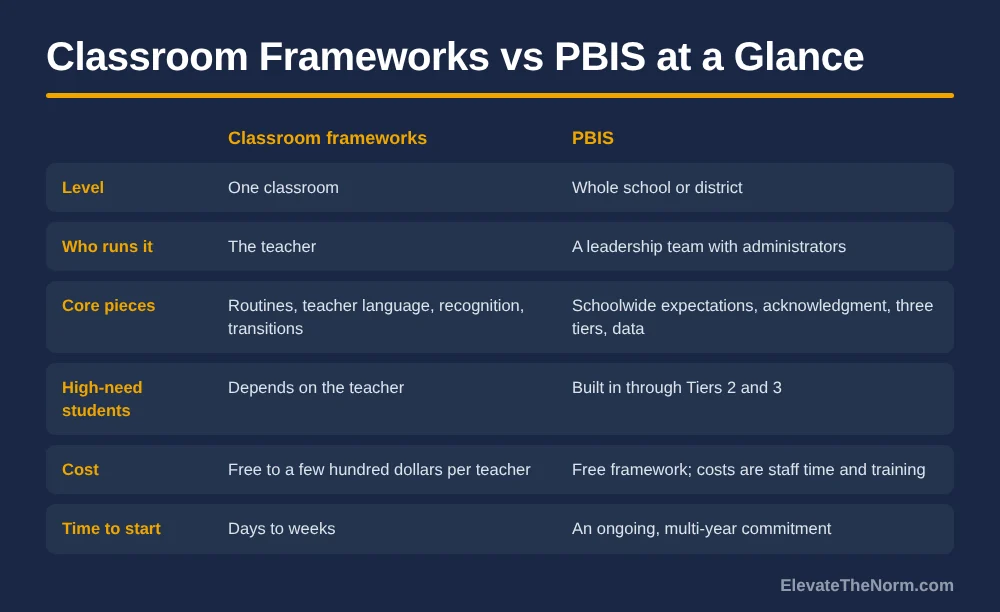
| Classroom culture frameworks | PBIS | |
|---|---|---|
| Level | One classroom | Whole school or district |
| Who runs it | The teacher | A leadership team with administrators |
| Core pieces | Routines, teacher language, recognition, transitions | Schoolwide expectations, acknowledgment, three tiers, data |
| Support for high-need students | Depends on the teacher | Built in through Tiers 2 and 3 |
| Cost | Free to a few hundred dollars per teacher | Free framework; costs are staff time and training |
| Time to start | Days to weeks | An ongoing, multi-year commitment |
What are the pros and cons of PBIS?
PBIS is free, consistent across a building and backed by randomized trials, but it needs a functioning team, takes sustained effort, and is often run with token rewards.
| Pros of PBIS | Cons of PBIS |
|---|---|
| Free framework and materials from the Center on PBIS | Not a one-day training; requires teams, data, coaching and ongoing commitment |
| Students hear the same expectations in every hallway and room | Depends on staff buy-in; one disengaged team can stall it |
| Built-in Tier 2 and Tier 3 support for students who need more | Often run as a ticket or points economy, which some educators see as extrinsic |
| Randomized trial: 33% lower odds of office referrals | Same trial found no significant difference in suspensions |
| Dedicated high school guidance, including student voice and freshman support | Strongest trials were run in elementary schools |
The evidence: in 37 elementary schools and 12,344 children, students in schoolwide PBIS schools were 33% less likely to receive an office discipline referral and showed small improvements in disruptive behavior, concentration, prosocial behavior and emotion regulation. Suspensions didn’t differ significantly (Bradshaw, Waasdorp & Leaf, Pediatrics, 2012). For high schools, the Center on PBIS reports that faithful implementation is associated with fewer referrals, tardies and suspensions and better attendance (High School PBIS), though we didn’t find a high school randomized trial.
On rewards, PBIS doesn’t require tokens. The Center on PBIS recommends equitable acknowledgment systems and advises against clip charts (Classroom PBIS). The token criticism is about how many schools run it, not what the framework demands.
What are the pros and cons of classroom culture frameworks?
Classroom culture frameworks are fast, detailed and under the teacher’s control, but they don’t give struggling students a schoolwide safety net and only work when the teacher uses them faithfully.
| Pros of classroom frameworks | Cons of classroom frameworks |
|---|---|
| One teacher can start this week without a committee | No built-in Tier 2 or Tier 3 support or data system |
| Tell you exactly what to say and do in a lesson | Students may face different rules in every room |
| Some have strong classroom-level evidence (CHAMPS in middle school) | Results depend on faithful daily use |
| Can be matched to your grade band and teaching style | Several are paid, and some are elementary-only |
| Raise praise and engagement directly, where behavior happens | A strong teacher’s system can disappear when that teacher leaves |
The evidence cuts both ways. A randomized study of 102 middle school teachers found CHAMPS teachers praised more and gave more chances to respond, and their students spent more time on task (IES). But Responsive Classroom’s three-year trial in grades 2–5 found no overall achievement difference between schools; gains showed up only where teachers used the practices faithfully (Rimm-Kaufman et al., 2014). Adopting a framework does nothing on its own; doing it daily does.
Cost ranges widely. Elevate the Norm is free. Responsive Classroom books list at $28.60–$35.00 (publisher bookstore), and Teach Like a Champion 3.0 lists at $37.00 (retail listing). Training costs more; confirm current prices before budgeting.
Does PBIS or a classroom culture framework have better research?
PBIS has the stronger schoolwide evidence; classroom-level practices like specific praise have some of the clearest middle school evidence. In 28 middle school classrooms, teachers who moved from reprimanding four to nine times more than praising to at least one praise per reprimand saw class-wide on-task behavior rise 60–70% (BYU, Journal of Positive Behavior Interventions). That’s a classroom practice, and it fits inside either approach.
Restorative practices, which can run at either level, sits between PBIS and classroom frameworks. Pittsburgh’s randomized trial found larger drops in suspensions and better teacher-rated climate, but academics didn’t improve and declined in grades 6–8 (RAND, 2018). More in restorative practices in schools.
When should a school use a classroom culture framework and PBIS together?
A school that runs PBIS should almost always pair it with a classroom framework: PBIS sets the schoolwide floor, and a classroom framework fills in the daily detail. The Center for Responsive Schools says many districts use PBIS for schoolwide systems and data while using Responsive Classroom for classroom practice, and that the differences “do not have to be contradictions” (Center for Responsive Schools). The Center on PBIS’s own Classroom PBIS guidance exists because the schoolwide layer alone doesn’t tell a teacher what to do at 10:14 on a Tuesday.
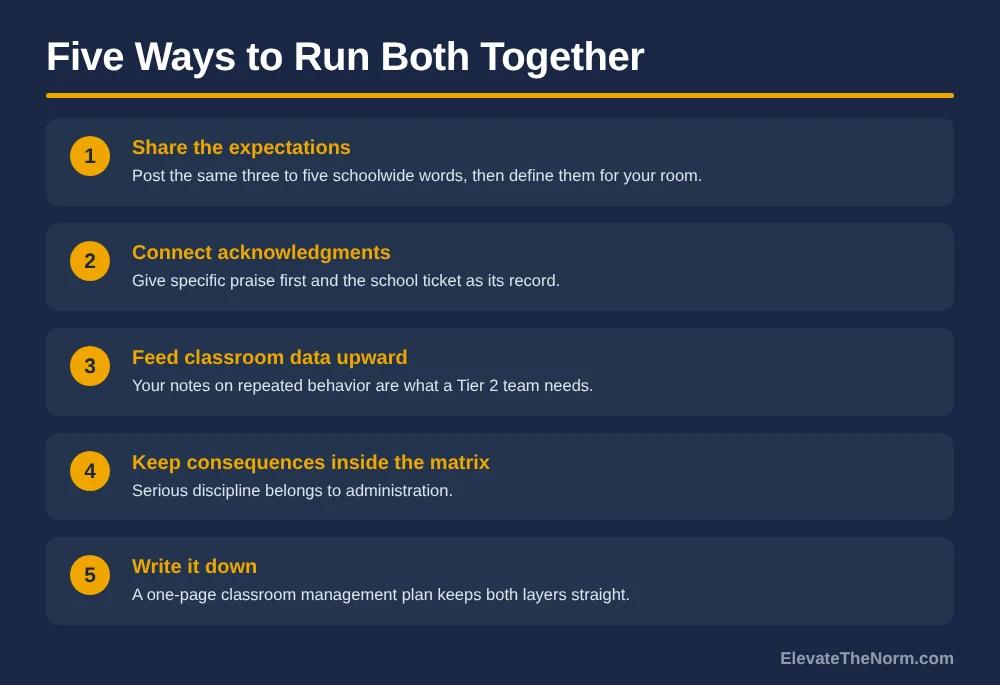
To make the two fit:
- Use the schoolwide expectations as your classroom expectations. Post the same three to five words, then define what they look like in your room. See classroom expectations.
- Decide how acknowledgments connect. If the school uses tickets, give specific praise first and the ticket as its record.
- Feed classroom data upward. Your notes on repeated behavior are what a Tier 2 team needs.
- Keep classroom consequences inside the school matrix. Serious discipline belongs to administration. More in classroom consequences.
- Write it down. A one-page classroom management plan keeps both layers straight.


Is a classroom framework or PBIS ever enough on its own?
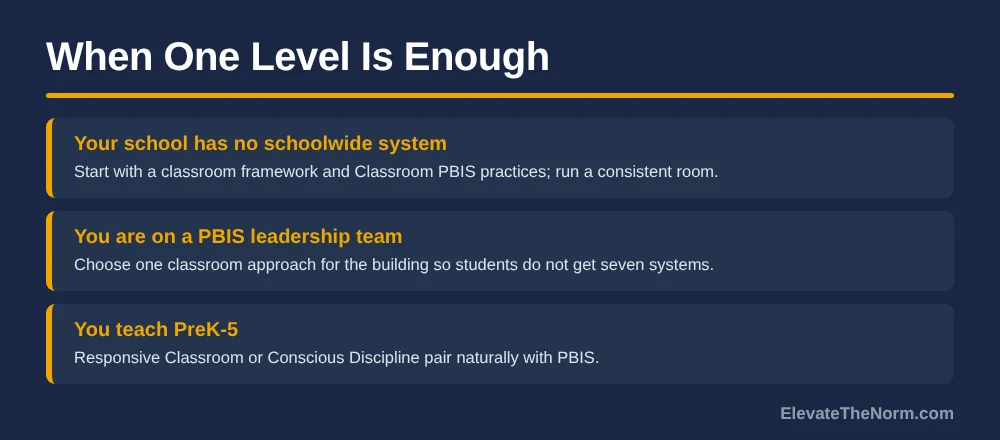
A classroom culture framework alone makes sense when a school has no schoolwide system; PBIS alone is rarely enough at the classroom level, because the schoolwide layer doesn’t tell a teacher what to do minute to minute.
- Your school has no schoolwide system: start with a classroom framework and Classroom PBIS practices. You can’t build Tier 2 by yourself, but you can run a consistent room.
- You’re on a PBIS leadership team: choose or recommend one classroom approach for the building so students don’t get seven different systems.
- You teach PreK–5: Responsive Classroom or Conscious Discipline pair naturally with PBIS. Compare them in Responsive Classroom vs PBIS vs Conscious Discipline.
Clay’s take: As a grades 6–12 classroom teacher, Clay lands where this page does. If your school runs PBIS, don’t fight it: use its expectations and run your classroom approach inside it. If your school has no system, don’t wait on a committee to run a consistent room.
Where does Elevate the Norm fit next to PBIS?
Elevate the Norm is a free grades 6–12 classroom framework, so it sits on the classroom side, not the schoolwide side, and can run inside a school’s PBIS system. Disclosure: it’s this site’s own framework, built by Clay Shumate, a certified 6–12 social studies teacher, and it hasn’t been independently evaluated. Its three recognition tiers (immediate recognition, Student of the Week, Student of the Month) can serve as a classroom acknowledgment system under PBIS, and its 3-2-1-Done point system handles transitions. It has the same classroom-level limits listed above: no tiers, no data team. Materials are free on the resource library. For how it stacks up against other frameworks, see Elevate the Norm vs other frameworks; for the reasoning behind its design, see what makes Elevate the Norm different.
Frequently Asked Questions
Is PBIS a classroom management program?
No. PBIS is a schoolwide framework with three tiers of support, run by a leadership team that uses data. Classroom PBIS applies its practices inside one room, but most teachers still need a classroom-level approach for daily routines like opening class, teaching procedures, transitions, praise and redirection.
Can I use a classroom framework if my school uses PBIS?
Yes. Many districts pair PBIS with a classroom approach such as Responsive Classroom, using PBIS for schoolwide systems and data and the classroom approach for daily practice. Use the schoolwide expectations as your classroom expectations, and decide how your own recognition connects to the school’s acknowledgment system so students hear one message.
What is the biggest downside of PBIS?
PBIS needs sustained effort from a functioning team, including data, coaching and staff buy-in, and one disengaged team can stall it. Many schools also run PBIS as a ticket or points economy, which critics say leans too heavily on outside rewards, even though the Center on PBIS doesn’t require tokens and advises against clip charts.
What is the biggest downside of classroom-only frameworks?
A classroom-only framework gives students who need more help no schoolwide safety net, because it has no Tier 2 or Tier 3 support and no data team. Results also depend on each teacher using the framework faithfully every day, and a strong teacher’s system can disappear when that teacher leaves the building.
Is PBIS free?
The PBIS framework and the Center on PBIS materials are free. The real costs are staff time, training, coaching and whatever a school spends on acknowledgments. PBIS is an ongoing, multi-year commitment rather than a one-day training, so the biggest cost is the time a leadership team spends meeting and reviewing data.
Does PBIS work in middle and high school?
The strongest PBIS randomized trial was run in 37 elementary schools, and we didn’t find a high school randomized trial. For high schools, the Center on PBIS reports that faithful implementation is associated with fewer referrals, tardies and suspensions and better attendance. That’s encouraging, but it’s an association, not the proof the elementary trial gives.
How long does it take to start PBIS or a classroom culture framework?
A classroom culture framework can start in days to weeks, because one teacher can launch it without a committee. PBIS is an ongoing, multi-year commitment that needs a leadership team, shared expectations, data and coaching before it runs well. That’s why many teachers run a consistent classroom routine while the school builds its system.
Does running both mean students face two sets of rules?
It shouldn’t. When a classroom framework runs inside PBIS, the classroom uses the same three to five schoolwide expectations and simply defines what they look like in that room. Students hear one set of rules in every hallway and class, and classroom consequences stay inside the school’s discipline matrix, with serious discipline handled by administration.
Sources
- Center on PBIS — What Is PBIS?
- Bradshaw, Waasdorp & Leaf — Effects of School-Wide PBIS on Child Behavior Problems, Pediatrics
- Center on PBIS — High School PBIS
- Center on PBIS — Classroom PBIS
- Institute of Education Sciences — Evaluation of a Classroom Management Training Program for Middle School Teachers (CHAMPS)
- Rimm-Kaufman et al. — Efficacy of the Responsive Classroom Approach, AERA summary
- Responsive Classroom — publisher bookstore
- Porchlight Books — Teach Like a Champion 3.0 listing
- BYU News — praise and on-task behavior in middle school classrooms
- RAND — Can Restorative Practices Improve School Climate and Curb Suspensions?
- Center for Responsive Schools — Responsive Classroom and PBIS
How is this page kept accurate?
Prices come from publisher or retailer listings, and study figures come from the original papers or official summaries linked inline and listed under Sources. Elevate the Norm is labeled as this site’s own framework wherever it appears. Corrections follow the editorial standards and corrections policy.