By Clay Shumate
Fun history facts for students work best as short, surprising openers: one fact, one question, four minutes. Below are 55 fun facts for students in grades 6–12, grouped by era from the ancient world to the space station. Every fact links to the source it was checked against, and 9 of them bust a myth students probably already believe.
If you searched for “facts of fun” or “fun facts for students,” this is the history version, built for teachers. Each fact comes with an opinion question, so it works as a bell ringer, a discussion starter or a quick brain break. There is a free printable card set below, with no email required.
Key Takeaways
- 55 facts across six eras, mixing world and U.S. history.
- Every fact has a named source. The source is linked here and printed on each card, so students can check it themselves.
- 9 myth-busting facts correct stories students think they know, like horned Viking helmets and George Washington’s wooden teeth.
- Each fact has a discussion question that asks for an opinion and a reason, not a definition.
- Four minutes, four steps: read the fact, ask the question, take two answers, check the source.
How to use fun history facts as bell ringers
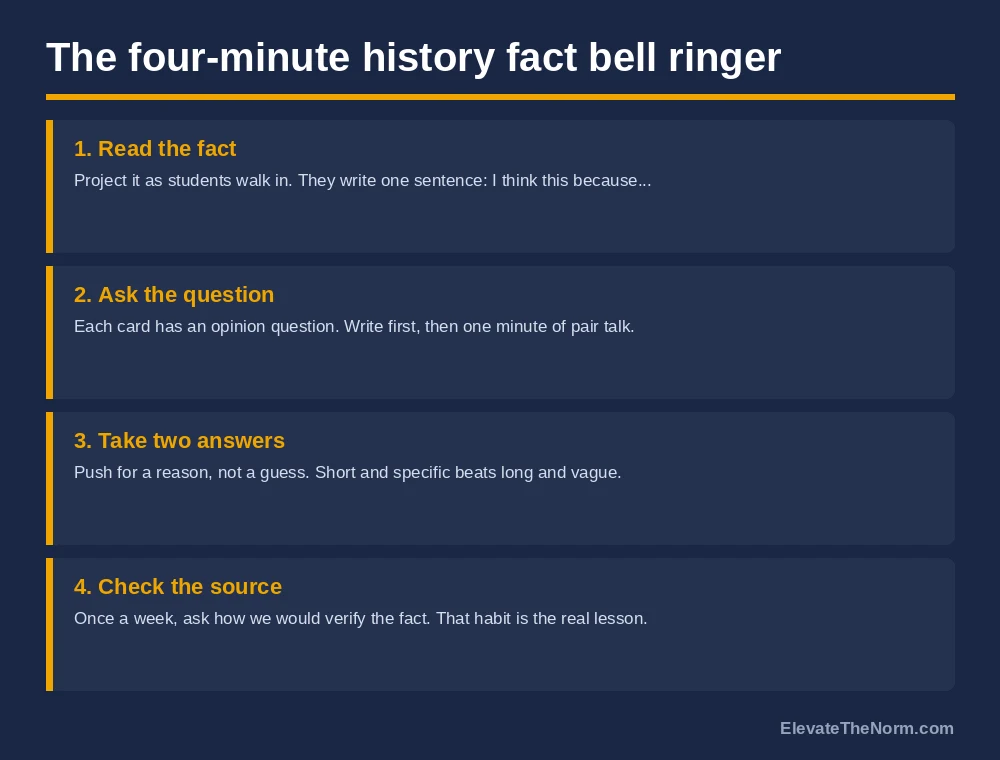
The fact gets attention, and the question does the teaching. A surprising fact on the board gives students a reason to look up when they walk in. The opinion question that follows asks them to explain, compare or predict, which is the thinking a history class runs on. Here is the four-minute routine:
- Read the fact. Project it or read it as students sit down. Each student writes one sentence that starts with “I think this because…”
- Ask the question. Students answer in writing first, then talk with a partner for one minute.
- Take two answers. Call on two students. Push for a reason, not a guess.
- Check the source. At least once a week, point to the source and ask, “How would we check this?”
That last step is the one that pays off all year. A class that gets used to asking where a fact came from is a class that is ready for primary sources, research projects and the history projects that ask students to build an argument from evidence. For more warm-up formats, see our full list of bell ringer ideas. When the class needs to talk rather than write, 105 classroom-safe would-you-rather prompts, sorted into icebreaker, history, thinking and funny sets run on the same kind of five-minute routine.
Why the myth-busting facts matter most
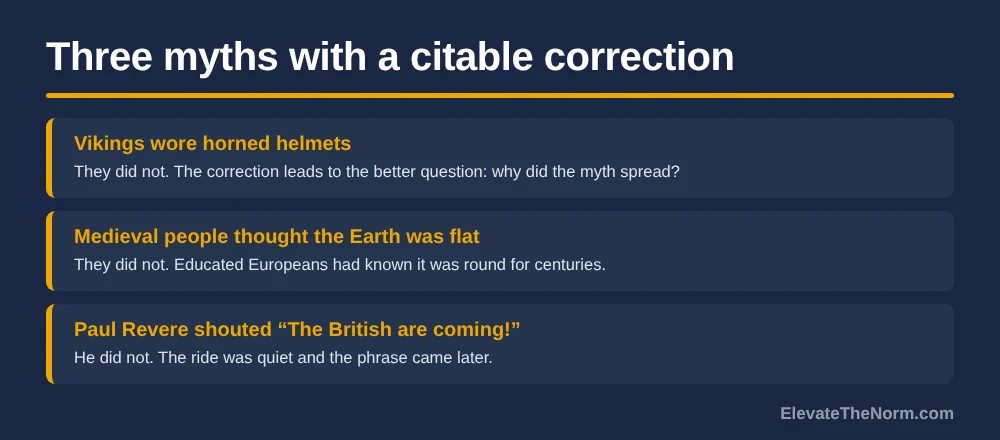
The myth-busting facts teach the most important habit in a history class: a story everyone repeats is not the same as a story someone checked. Students arrive believing that Vikings wore horned helmets, that medieval people thought the Earth was flat, and that Paul Revere shouted “The British are coming!” Each of those has a clear, citable correction, and each correction leads to a better question: why did the myth spread in the first place?
Use one in the first week of school and then come back to the idea all year. When a student later repeats something from a video or social media, “Is this a horned-helmet fact?” becomes a quick shared shorthand for checking it.
Free download: 55 fun history fact bell ringer cards
Fifteen pages. Page 1 is the four-minute routine. The rest are 55 cards, four per page, each with the fact, an opinion question and the source it was checked against. Numbered to match this article.
Free. No email address required. Built for grades 6–12.
Fun history facts: Ancient World (to 500 CE)
Pyramids, pirates and a Greek machine with gears. These work well in the first unit of a world history course, or any time students think ancient people were simple.
- For about 3,800 years, the Great Pyramid of Giza was the tallest human-made structure on Earth. Discuss: Why do you think people in ancient Egypt put so much time and effort into building something so huge? (Britannica – How long did the Great Pyramid of Giza hold the record as the tallest man-made structure in the world?)
- Evidence suggests the Egyptian pyramids were built by paid laborers, not by slaves as many people believe. Discuss: Why do you think the myth that slaves built the pyramids has lasted so long? (History.com – 11 Things You May Not Know About Ancient Egypt)
- Cleopatra came from a family of Greek Macedonians, but she was the first ruler in her family line to learn the Egyptian language. Ancient writers said she may have known as many as a dozen languages. Discuss: How do you think speaking many languages helped Cleopatra as a ruler? (History.com – 10 Little-Known Facts About Cleopatra)
- When pirates captured a young Julius Caesar and demanded a ransom of 20 talents, Caesar laughed at them and said he was worth at least 50. Discuss: Was Caesar being brave or just showing off? Explain your thinking. (Britannica – The Time Julius Caesar Was Captured by Pirates)
- The month of July was first called Quintilis, Latin for 'fifth month.' It was renamed to honor Julius Caesar in 44 BCE. Discuss: If you could rename a month after someone from history, who would you choose and why? (Britannica – July)
- Some ancient Roman concrete can heal its own cracks: reactive chunks of lime in the mix help seal tiny cracks before they spread. Rome's Pantheon, dedicated in 128 CE, still has the world's largest unreinforced concrete dome. Discuss: Why do you think modern builders are now studying ancient Roman concrete? (MIT News – Riddle solved: Why was Roman concrete so durable?)
- The Rosetta Stone, found in 1799, has the same decree carved in three scripts: Egyptian hieroglyphs, demotic, and ancient Greek. It helped scholars finally learn to read hieroglyphs. Discuss: Why do you think having the same message in three scripts made the Rosetta Stone so valuable? (Britannica – Rosetta Stone)
- Divers pulled the Antikythera mechanism, sometimes called an 'ancient Greek computer,' from a shipwreck in 1900–1901. Its gears could track the Sun, Moon, and planets, predict eclipses, and show when the Olympic Games would happen. Discuss: Why do you think nothing this advanced appeared again for more than a thousand years? (Smithsonian Magazine – What Is the Antikythera Mechanism, the World's First Computer?)
- In 1974, farmers digging a well in China found China's Terracotta Army. Archaeologists have since found about 8,000 life-size clay soldiers, and each one appears to have its own unique face. Discuss: Why do you think an emperor wanted an army of clay soldiers buried near his tomb? (History.com – 5 Things You May Not Know About the Terracotta Army)
Fun history facts: Medieval World (500–1450)
This set is heavy on myths students already believe, which makes it a strong set for teaching how to question a story everyone repeats.
- Myth busted: Vikings almost certainly did not wear horned helmets. The horned look became popular in the 1870s, when a costume designer created horned helmets for an opera by Richard Wagner. Discuss: Why do you think movies and costumes keep the horned-helmet myth alive? (History.com – Did Vikings really wear horned helmets?)
- Scientists proved Vikings were cutting down trees in Newfoundland, Canada, in the year 1021, using a solar storm signal locked inside tree rings. That is more than 470 years before Columbus sailed in 1492. Discuss: Why do you think Columbus is remembered more than the Vikings who reached North America first? (Smithsonian Magazine – New Dating Method Shows Vikings Occupied Newfoundland in 1021 C.E.)
- In 1324, Mansa Musa, king of Mali, traveled to Mecca with a huge caravan carrying hundreds of pounds of gold. He spent and gave away so much gold in Egypt that its value dropped, and the economy took 12 years to recover. Discuss: Can being too generous ever cause problems? Explain using Mansa Musa as an example. (History.com – This 14th-Century African Emperor Remains the Richest Person in History)
- Myth busted: Educated people in the Middle Ages knew the Earth was round. The idea that they believed in a flat Earth was largely made up in 1828 in a popular biography of Columbus by Washington Irving. Discuss: Why do you think a made-up story can become 'common knowledge'? (History.com – Christopher Columbus Never Set Out to Prove the Earth Was Round)
- Myth busted: The image of medieval people as dirty and unwashed is false. Bathing and handwashing were common and were treated as important routines. Discuss: Why do you think people today often imagine the past as dirtier or less advanced than it really was? (National Geographic – What life in medieval Europe was really like)
- The computer word 'algorithm' comes from the name of al-Khwarizmi, a Muslim scholar who lived in the 800s, through a Latin translation of his math book. Discuss: Why do you think so many science and math words come from other languages and cultures? (Britannica – Algorithm)
- At its peak in the late 1200s, the Mongol Empire covered about 9 million square miles, making it the largest connected land empire in history. Discuss: What challenges do you think came with ruling such a huge empire? (History.com – What Were the Biggest Empires in History?)
- Explorer Marco Polo was one of the first Europeans to see an Asian rhinoceros, and he thought the horned animals were unicorns. Discuss: Why do you think Marco Polo compared the rhino to something he already knew about from stories? (History.com – 11 Things You May Not Know About Marco Polo)
- The famous Bayeux Tapestry is not actually a woven tapestry. It is a strip of linen about 230 feet (70 meters) long with scenes embroidered on it. Discuss: Why do you think people told history through pictures like this instead of only in writing? (Britannica (Compton's) – The Bayeux tapestry is not a woven tapestry)
- Only four original copies of the 1215 Magna Carta still exist today. It was sealed by King John at Runnymede, England. Discuss: Why do you think a document from 1215 still matters to people today? (Library of Congress – Lincoln Magna Carta (Magna Carta: Muse and Mentor exhibit))
Fun history facts: Early Modern / Age of Exploration & Revolutions (1450–1800)
Explorers, revolutions and the founders, including several things American students are usually taught wrong.
- Ferdinand Magellan's 1519 voyage set out with about 240 men on five ships, but only 18 men made it back to Spain in 1522. Magellan himself died in the Philippines before the trip was finished. Discuss: Why do you think explorers were willing to take such huge risks? (National Geographic – 240 men started Magellan's voyage around the world. Only 18 finished it.)
- Tomatoes were first grown in Mexico and came to Europe in the 1500s. For a long time, many Europeans thought tomatoes were poisonous, and tomato sauce did not become a regular part of Italian cooking until the late 1700s. Discuss: Why do you think people are sometimes afraid to try new foods? (Smithsonian Magazine – A Passion for Tomatoes)
- In January 1610, Galileo used a homemade telescope to discover four moons circling Jupiter. Astronomers still call them the Galilean moons. Discuss: Why do you think Galileo's discovery upset people who believed everything circled the Earth? (NASA – 415 Years Ago: Astronomer Galileo Discovers Jupiter's Moons)
- During the Dutch 'tulip mania' of the 1630s, one rare tulip bulb sold for more than the cost of a mansion in Amsterdam. Historians now say the famous 'crash' was overblown and few people were ruined. Discuss: Why do you think people pay huge amounts for things that are popular or rare? (Smithsonian Magazine – There Never Was a Real Tulip Fever)
- Isaac Newton served in Parliament, but he reportedly spoke only once—to ask an usher to close a window because it was chilly. Discuss: Can someone be a genius in one area and quiet or unsure in another? Explain. (History.com – 9 Things You May Not Know About Isaac Newton)
- Congress voted for independence on July 2, 1776. The Declaration of Independence is dated July 4, but it was not actually signed until August 2. Discuss: Why do you think Americans celebrate July 4 instead of July 2? (National Archives – Did You Know… Independence Day Should Actually Be July 2?)
- Myth busted: Paul Revere almost certainly did not shout 'The British are coming!' on his 1775 ride. Most colonists still thought of themselves as British, and he most likely warned that 'the regulars are coming out.' Discuss: Why do you think the more dramatic version of the story became so popular? (Paul Revere House – Revisit the Ride: What Did Paul Revere Actually Say?)
- Myth busted: Benjamin Franklin never officially proposed the turkey as America's national bird. He did write a letter to his daughter calling the bald eagle a bird of 'bad moral character' and the turkey 'a much more respectable bird.' Discuss: Which animal do you think best represents the United States, and why? (The Franklin Institute – Did Benjamin Franklin Want the National Bird To Be A Turkey?)
- Myth busted: George Washington's false teeth were never made of wood. His dentures used materials like tin, gold, lead, and human teeth; staining over time made them look like wood grain. Discuss: Why do you think people like to tell surprising (but false) stories about famous leaders? (George Washington's Mount Vernon – Wooden Teeth Myth)


Fun history facts: 19th Century (1800–1900)
Inventions, purchases and one very loud volcano. Good openers for U.S. history units on expansion and industry.
- Former presidents John Adams and Thomas Jefferson died within hours of each other on July 4, 1826—exactly 50 years after the Declaration of Independence. Discuss: Is this just a coincidence, or does it feel like something more? Explain your opinion. (Thomas Jefferson's Monticello – John Adams)
- The oldest surviving photograph from a camera was made in 1827 by Joseph Nicéphore Niépce. It showed the view from his window and took several days of sunlight to capture. Discuss: How would life be different if taking a photo still took days? (Harry Ransom Center, University of Texas at Austin – The Niépce Heliograph)
- Ketchup most likely began centuries ago as a fermented fish sauce, similar to sauces found in Southeast Asia. The first published recipe for tomato ketchup did not appear until 1812. Discuss: What other everyday foods do you think might have surprising origins? (Smithsonian Magazine – A Brief (But Global) History of Ketchup)
- Abraham Lincoln is the only U.S. president to hold a patent. In 1849 he patented a device that used inflatable air chambers to lift riverboats over sandbars. Discuss: Why do you think problem-solving skills are useful for a president? (Smithsonian Magazine – Abraham Lincoln Is the Only President Ever to Have a Patent)
- Myth busted: Napoleon was not unusually short. He was probably about 5 feet 6 or 7 inches—average or taller for a Frenchman of his time—but British cartoonists drew him as tiny. Discuss: How can cartoons and media shape the way people see a leader? (Britannica – Was Napoleon Short?)
- The Pony Express mail service started in April 1860 but lasted only about 18 months. The new transcontinental telegraph made it outdated in October 1861. Discuss: What modern technology do you think will become outdated as fast as the Pony Express did? (Smithsonian National Postal Museum – Pony Express)
- In 1867, the United States bought Alaska from Russia for $7.2 million. Critics mocked the deal as 'Seward's Folly,' but a later gold discovery proved it was a smart buy. Discuss: Have you ever made a choice others doubted that turned out well? How is that like the Alaska purchase? (U.S. Department of State, Office of the Historian – Purchase of Alaska, 1867)
- The 1883 eruption of the Krakatoa volcano in Indonesia is considered the loudest sound in modern history. People heard it as far as 3,000 miles away. Discuss: How do you think people 3,000 miles away explained a sound they could not see the cause of? (Britannica – What's the Loudest Sound in History?)
- The Statue of Liberty was not always green. Its copper skin, only about as thick as two pennies, slowly reacted with the air and formed a green layer called a patina that protects the metal. Discuss: Do you think the statue looks better green or would it look better copper-colored? Why? (National Park Service – Frequently Asked Questions About the Statue of Liberty)
Fun history facts: 20th Century (1900–1945)
World wars, famous landmarks and a stolen painting. Several of these lead straight into a lesson on how ordinary people shaped big events.
- The teddy bear is named after President Theodore Roosevelt. In 1902 he refused to shoot a bear that had been tied to a tree on a hunting trip, and a toy maker soon sold a stuffed 'Teddy's Bear.' Discuss: Why do you think this story made Roosevelt more popular with Americans? (National Park Service – The Story of the Teddy Bear (Theodore Roosevelt Birthplace))
- The Wright brothers' first powered flight on December 17, 1903, lasted just 12 seconds and went 120 feet. Pieces of their airplane later traveled to the Moon with Neil Armstrong and to Mars on NASA's Ingenuity helicopter. Discuss: Why do you think astronauts and NASA chose to carry pieces of the Wright Flyer into space? (NASA – 120 Years Ago: The First Powered Flight at Kitty Hawk)
- In 1911, the Mona Lisa was stolen from the Louvre by Vincenzo Peruggia, a former handyman there, who hid it in his Paris apartment for about two years. The theft actually made the painting far more famous. Discuss: Why do you think a crime made the Mona Lisa more famous instead of less? (History.com – The Heist that Made the Mona Lisa Famous)
- On Christmas Day 1914, during World War I, some British and German soldiers met in 'No Man's Land' between the trenches, exchanged gifts, and played informal games of football (soccer). Discuss: What does the Christmas Truce tell us about the soldiers on both sides? (Imperial War Museums – The Real Story of the Christmas Truce of 1914)
- Jeannette Rankin of Montana became the first woman elected to Congress in 1916—nearly four years before the 19th Amendment gave women across the U.S. the right to vote. Discuss: How do you think Rankin felt serving in Congress when most American women still could not vote? (Library of Congress (Picture This blog) – Jeannette Rankin: First Woman Elected to Congress)
- Almost 400 men and women worked on carving Mount Rushmore from 1927 to 1941, and despite the dangerous conditions, no one died during the carving. Discuss: What do you think made it possible for such a dangerous project to have no deaths? (National Park Service – The Workers (Mount Rushmore National Memorial))
- The top of the Empire State Building was built as a docking port for dirigibles (giant airships), but strong winds at the top made docking nearly impossible. Discuss: Why do you think people in the 1930s imagined airships would be the future of travel? (History.com – 10 Surprising Facts About the Empire State Building)
- During World War II, the U.S. 'Ghost Army,' a unit full of artists and designers, fooled the enemy with 93-pound inflatable tanks and loudspeakers playing recorded troop sounds. Its records stayed secret until 1996. Discuss: Do you think creativity can be as important as strength in a conflict? Why? (Smithsonian Magazine – The Ghost Army of World War II Used Art to Deceive the Nazis)
- The code created by Navajo Code Talkers in World War II was never broken. Because Navajo had no word for 'submarine,' they used 'besh-lo,' meaning 'iron fish.' Discuss: Why do you think a code based on a spoken language was so hard for the enemy to crack? (The National WWII Museum – American Indian Code Talkers)
Fun history facts: Cold War & Modern (1945–present)
Satellites, space and the end of the Cold War, through the invention of the web. Students tend to find this era closest to their own lives.
- Sputnik 1, the world's first artificial satellite, was launched by the Soviet Union on October 4, 1957. It was about the size of a beach ball and circled Earth about every 98 minutes. Discuss: Why do you think a satellite the size of a beach ball worried so many Americans? (NASA – Sputnik and The Dawn of the Space Age)
- In 1960, six-year-old Ruby Bridges helped integrate New Orleans schools, walking to school with federal marshals. Her teacher, Barbara Henry, taught her as her only student for an entire year. Discuss: What do you think gave a six-year-old the courage to keep going to school every day? (History.com – Who Is Ruby Bridges?)
- Myth busted: The Cold War 'hotline' between Washington and Moscow, set up in 1963 after the Cuban Missile Crisis, was never a red telephone. It used teletype machines that sent typed messages. Discuss: Why do you think written messages might have been safer than phone calls in a crisis? (Smithsonian Magazine – There Never Was Such a Thing as a Red Phone in the White House)
- Myth busted: NASA did not invent Velcro or Tang. Velcro is a Swiss invention from the 1940s, and Tang was made by General Foods in 1957; astronauts just made them famous. Discuss: Why do you think people give NASA credit for inventions it did not create? (NASA – Tang, Teflon, Velcro)
- The Voyager Golden Record, sent into space aboard NASA's Voyager probes, carries greetings in 55 languages along with pictures, music, and sounds from Earth. Discuss: If you could add one sound or song to represent Earth, what would it be and why? (NASA Science – Golden Record Greetings)
- In 1980, the World Health Organization declared smallpox eradicated. It is still the only human disease that has been completely wiped out. Discuss: Why do you think it has been so hard to eradicate other diseases the way smallpox was? (World Health Organization – History of smallpox vaccination)
- Tim Berners-Lee invented the World Wide Web in 1989 while working at CERN in Switzerland. The world's first website was at the address info.cern.ch. Discuss: How would your daily life be different without the World Wide Web? (CERN – A short history of the Web)
- The Berlin Wall opened on November 9, 1989, partly because of a mistake: East German official Günter Schabowski announced new travel rules would start 'immediately,' though they were meant to begin the next day. Crowds rushed to the border. Discuss: Can one mistake change history? What other examples can you think of? (History.com – 10 Things You May Not Know About the Berlin Wall)
- People have lived on the International Space Station without a break since November 2000. The station circles Earth 16 times a day, so its crew sees 16 sunrises and sunsets every 24 hours. Discuss: Would you want to live on the space station for six months? Why or why not? (NASA – International Space Station Facts and Figures)
Turning a fun fact into a full lesson
Some of these facts are big enough to carry a whole class period. A few that grow well:
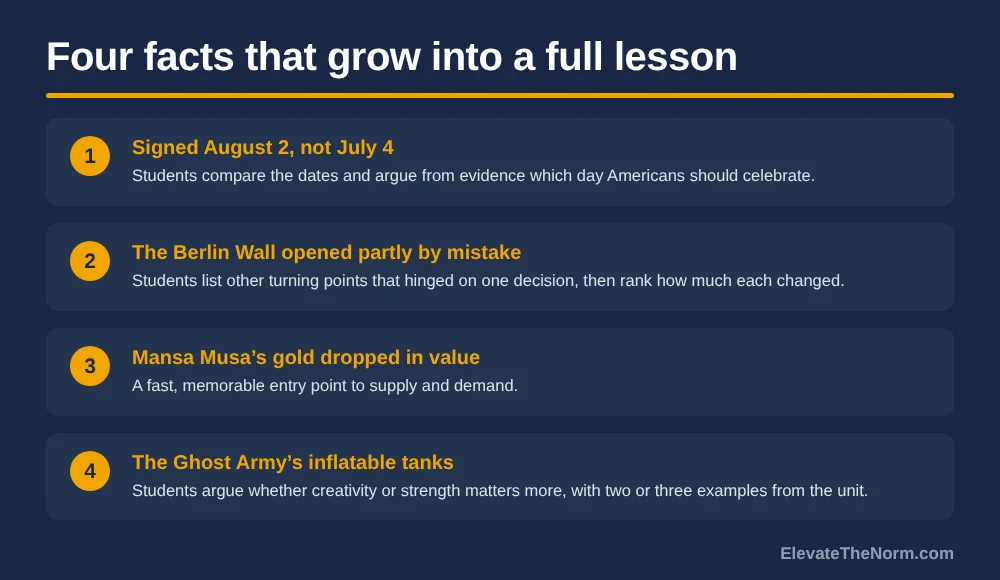
- The Declaration was signed August 2, not July 4. Students compare the dates and decide which day Americans should really celebrate, using evidence. It pairs with our civics project ideas.
- The Berlin Wall opened partly because of a mistake. Students list other turning points that hinged on one decision, then rank how much each one changed.
- Mansa Musa spent so much gold that its value dropped. A fast, memorable entry point to supply and demand in a world history or economics class.
- The Ghost Army fooled the enemy with inflatable tanks. Students argue whether creativity or strength matters more, using two or three examples from the unit.
To review a whole era at the end of a unit, mix a few of these facts into one of the classroom review games that actually review, or use them as true-or-false rounds where students must name the source to earn the point.
How these facts were checked
Every fact on this page was checked against the page it links to, and the wording was adjusted when a source did not fully support it. The sources include Britannica, CERN, George Washington’s Mount Vernon, Harry Ransom Center, University of Texas at Austin, History.com, Imperial War Museums, Library of Congress, MIT News, NASA, NASA Science, National Archives, National Geographic, National Park Service, Paul Revere House, Smithsonian Magazine, Smithsonian National Postal Museum, The Franklin Institute, The National WWII Museum, Thomas Jefferson’s Monticello, U.S. Department of State, Office of the Historian, and World Health Organization. Several popular “fun facts” were left out because no reliable source supported them. If you find an error, the site’s corrections policy explains how to report it.
Frequently Asked Questions
What are some fun history facts for students?
A few favorites: the Great Pyramid of Giza was the tallest human-made structure on Earth for about 3,800 years; the Declaration of Independence was not signed until August 2, 1776; Abraham Lincoln is the only U.S. president to hold a patent; and Vikings almost certainly did not wear horned helmets. Each fact on this page links to the source it was checked against.
What does “facts of fun” mean?
People who search for “facts of fun” are usually looking for fun facts: short, surprising true statements. This page collects fun facts about history for students in grades 6 to 12, each with a discussion question and a source.
How do you use fun facts as bell ringers?
Show one fact as students arrive, have them write one sentence about it, ask an opinion question, take two answers out loud, and once a week ask how the class could check the source. The whole routine takes about four minutes.
Are these history facts true?
Each fact was checked against the reputable source it links to, such as the Smithsonian, the National Archives, the Library of Congress, NASA, the National Park Service or Britannica. Popular facts that could not be verified were left out.
What grade level are these fun facts for?
They are written for grades 6 to 12, at roughly a middle school reading level, so they work in middle school social studies and in high school world history and U.S. history.
What are some history myths students believe?
Common ones include that Vikings wore horned helmets, that medieval people believed the Earth was flat, that George Washington had wooden teeth, that Napoleon was unusually short, and that Paul Revere shouted “The British are coming!” This page includes the correction and the source for each.
Is there a printable version?
Yes. All of the facts come as free printable bell ringer cards in a PDF, with the discussion question and source on each card. It downloads directly with no email or sign-up.