By Clay Shumate
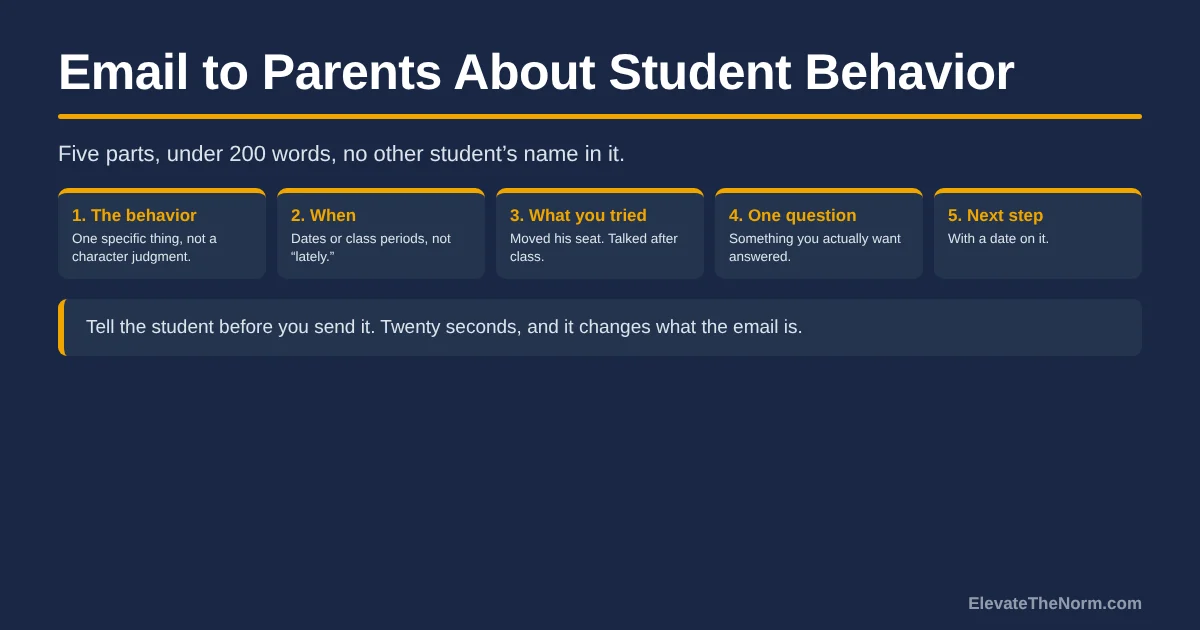
An email to parents about student behavior should name one specific behavior, say when it happened, state what you have already tried, ask one question, and propose a next step. Keep it under 200 words, leave every other student’s name out of it, and send it before the pattern hardens.
Key Takeaways
- In a randomized field experiment, weekly teacher-to-parent messages raised the share of high school students earning credit by 6.5 percentage points — what the authors describe as a 41 percent reduction in students failing to earn credit — at an estimated cost of about $13 per student-course.
- Messages about what a student needed to improve outperformed positive-only messages, 8.8 percentage points against 4.5. The authors say they lacked the statistical power to call that difference significant, so treat it as a lean, not a law.
- About 84 percent of improvement messages in that study were actionable. About 8.5 percent of positive messages were. That gap is the most useful finding in the research for a teacher writing an email tonight.
- FERPA generally prohibits nonconsensual disclosure of information derived from education records, which is the clearest reason never to name another student in a behavior email. What you personally witnessed is treated differently from what a record says.
- The same research reports a cost: students in the treated groups rated their own effort lower, and teachers rated their relationships with those students lower. Contact works. It is not free.
Most behavior emails fail in the first two sentences. They open with a paragraph of throat-clearing, bury the actual incident in the middle, end with “please speak with your child at home,” and arrive after the fourth occurrence instead of the first.
The fix is not warmer language. It is a shorter email with a specific ask in it. Below is the structure, three samples you can copy and adapt for free, the list of things that should never appear in one, and the honest research on whether any of it works — including the part that says it costs you something with the student.
What should an email to parents about student behavior actually say?
Five things, in this order: the specific behavior, when it happened, what you already tried, one question for the parent, and one next step. Everything else is padding. A parent reading on a phone between shifts needs the behavior and the ask in the first three lines.
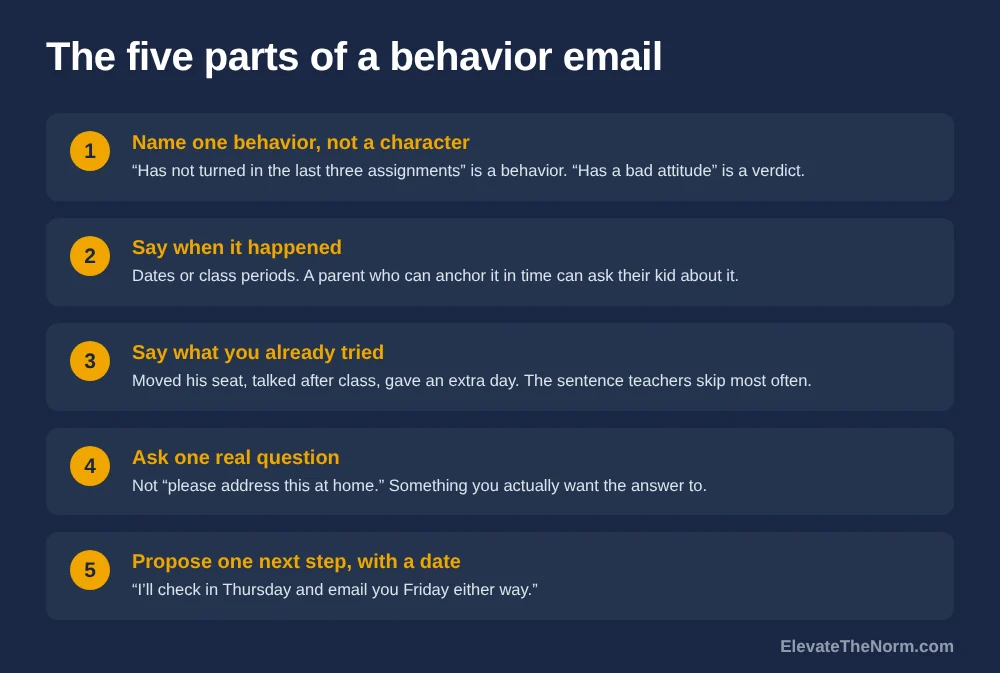
- Name one behavior, not a character. “Marcus has not turned in the last three assignments” is a behavior. “Marcus has a bad attitude” is a verdict, and it is the sentence that makes a parent defensive before they reach the second line.
- Say when. Dates or class periods. A parent who can anchor the behavior in time can ask their kid about it; a parent who gets “lately” cannot.
- Say what you already did. Moved his seat, talked to him after class, gave an extra day. This is the sentence that tells a parent you are not outsourcing the problem, and it is the one teachers skip most often.
- Ask one real question. Not “please address this at home.” Something you actually want the answer to: is anything going on I should know about, does this happen in other classes, what works at home when he shuts down.
- Propose one next step with a date on it. “I’ll check in with him Thursday and email you Friday either way.” A next step with a date is the difference between a complaint and a plan.
Under 200 words. If it runs longer than that, the thing you actually need is a phone call or a meeting, and the email should be two lines asking to schedule one.
Tell the student before you send it
This is the step that gets skipped and it is the one that matters most for grades 6–12. A 15-year-old who finds out at dinner that you emailed home has learned that you go around them. A 15-year-old you told at the end of class — “I’m emailing your mom tonight about the missing work, here’s what I’m going to say” — has been treated like somebody with standing in their own life.
It costs about twenty seconds and it changes what the email is. It also tends to improve the email, because saying the sentence out loud to the person it is about is a good test of whether it is fair.
Two practical notes on load and access. You cannot do this for 120 students, so triage: contact home for the students where an early, small email prevents a large problem later, and accept that the rest gets handled in the room. And check how the family actually receives information before assuming email is it — some households do not read email, some need the message in a language other than English, and most districts have a translation route or a phone option through the student information system. An email nobody opens is not communication, it is documentation.
Does emailing parents about behavior actually change anything?
Yes, measurably, and by more than most teachers expect. The best evidence comes from a randomized field experiment in a five-week summer credit recovery program, where teachers wrote brief weekly messages home about high school students.
Kraft and Rogers randomized 435 consenting students into three groups — positive messages, improvement messages, or no messages — and sent parents four weekly messages. The pooled treatment raised the share of students earning credit by 6.5 percentage points against a control pass rate of 84.2 percent, which the authors describe as a 41 percent reduction in students failing to earn credit.
Almost all of that came from students not dropping out rather than from students passing who would have failed. Treatment cut the dropout rate by 6.1 percentage points. Absence fell from 12 percent to 9.5 percent. The estimated cost was about $13 per treated student-course, which the authors put at under a tenth of the district’s usual cost per credit.
Now the caveats, because this is the kind of result that gets quoted without them. The setting was summer credit recovery, where the students are already in trouble and the stakes are visible — that is a long way from a regular October Tuesday. Only 435 of 1,417 enrolled students consented, so the sample is not the whole program. And the study found two costs worth knowing about: students in the treated groups rated their own effort and engagement lower than control students did, and teachers rated their relationships with treated students lower.
That last part is not a reason to stop emailing. It is a reason to be deliberate about which students get contacted and how often, because the contact is doing something to the relationship as well as to the credit.
One caveat that applies to both of the randomized studies cited in this article: they ran in summer programs, four and five weeks long, with teachers who had been asked to write home as a condition of the research. Neither tested what happens when a teacher with a full roster does this across a nine-month year. The direction of the evidence is encouraging and the dose is not the one you will be working at.
Should the email be positive or focused on what needs to improve?
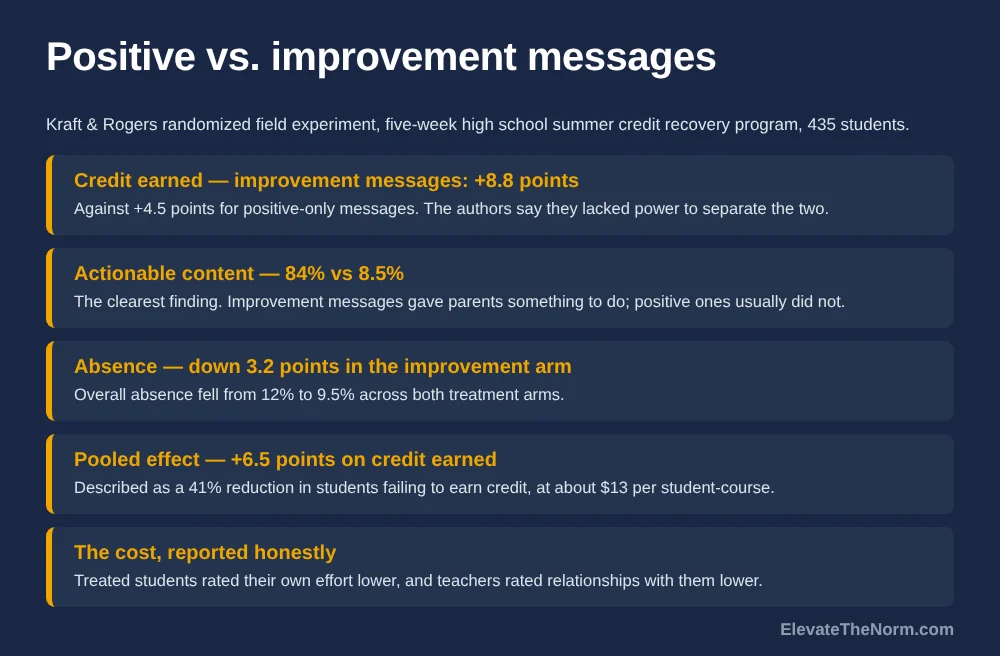
Improvement-focused, if you have to pick one. In the same experiment the improvement arm gained 8.8 percentage points on credit earned while the positive arm gained 4.5, though the authors are explicit that they could not statistically separate the two estimates.
The mechanism is clearer than the headline number, and it is the part worth acting on.
| Positive messages | Improvement messages | |
|---|---|---|
| What the message said | What the student was doing well | What the student needed to work on |
| Gain in credit earned | +4.5 points (p = .236) | +8.8 points (p = .016) |
| Share of messages that were actionable | About 8.5 percent | About 84 percent |
| Effect on absence | Smaller | −3.2 percentage points |
| Parent–child conversations about improving | No measured difference | More frequent (odds ratio 1.63) |
Look at the actionable row. Eight and a half percent against eighty-four. That is the real finding. A positive message usually has nothing in it a parent can do anything with — “she had a great week” is pleasant and inert. An improvement message almost always contains a thing: a missing assignment, a study habit, a deadline.
Which means the useful rewrite of a positive email is not to make it negative. It is to make it actionable. “She had a great week” becomes “she rewrote her thesis after the first round of feedback, and if she does that on the next two drafts she is in good shape for the unit grade.” Same tone, now a parent has something to reinforce.
Worth adding one piece of contrary context before anyone concludes that more parent contact is always better. A 2014 meta-synthesis of nine meta-analyses summarizing Hill and Tyson’s middle school work reports that academic socialization had the most significant impact on achievement, while homework assistance did not — and in some instances was negatively correlated with achievement. Not all parent involvement is the same thing, and asking a parent to sit on their fourteen-year-old through homework is the kind that research supports least.
What should never go in an email about student behavior?
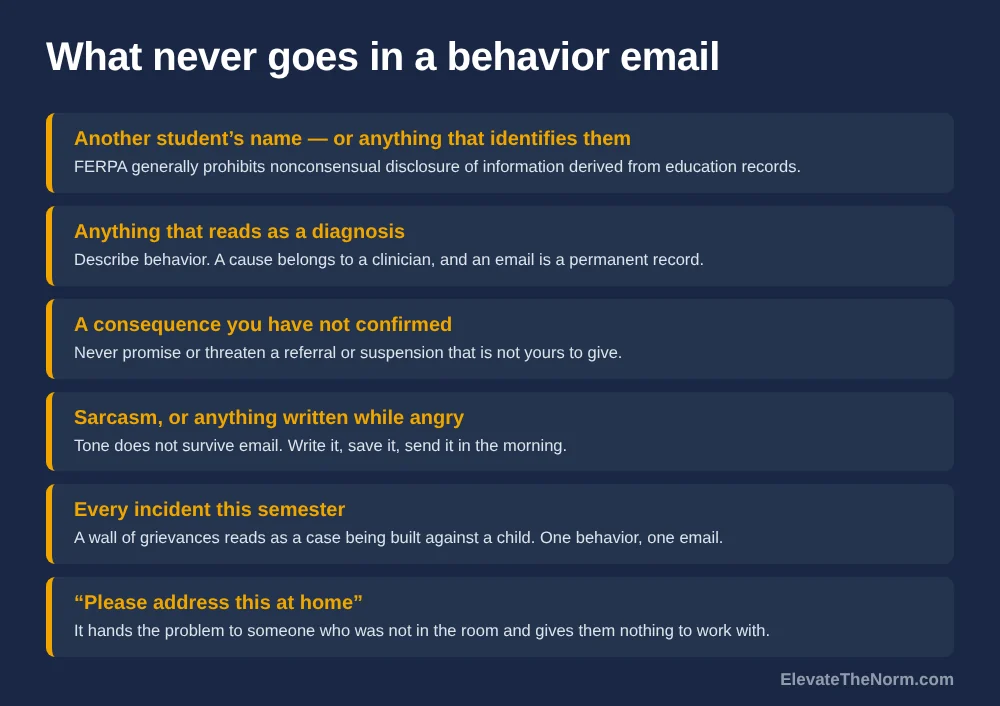
Another student’s name is the first one, and it is the one with legal weight behind it. The U.S. Department of Education states that FERPA generally prohibits the nonconsensual disclosure of information derived from education records, and a behavior email that names who else was involved can put you on the wrong side of that line.
The Department also notes that FERPA does not prohibit a school official from releasing information about a student that came from the official’s personal knowledge rather than from education records. That distinction is narrower than it sounds and it varies by district policy, so the practical rule stands: describe what the student you are writing about did, and refer to everyone else as “another student.”
- Other students’ names, initials, or descriptions that identify them. “The boy who sits behind him” identifies a child to any parent who has seen the seating chart.
- Anything that reads as a diagnosis. You can describe behavior. You cannot suggest a cause that belongs to a clinician, and an email is a written record that will outlive your memory of writing it.
- A consequence you have not confirmed with an administrator. Never promise or threaten a referral, a suspension, or a removal from an activity that is not yours to give.
- Sarcasm, or anything written while you are still angry. Tone does not survive email. Write it, save it, send it in the morning.
- A list of every incident this semester. A wall of grievances reads as a case being built against a child. One behavior, one email.
- “Please address this at home.” It hands the problem to someone who was not in the room and gives them nothing to work with.
One more that is procedural rather than legal: send it from your school account, not a personal one, log the contact wherever your school logs it, and assume every word could be forwarded to your principal, because sometimes it is. That is not a reason to be bland. It is a reason to be accurate.
And the necessary disclaimer, because this section touches law: none of the above is legal advice. FERPA interpretation is fact-specific, districts layer their own policy on top of it, and some states add student-privacy statutes of their own. If a situation is serious enough that you are weighing what you are allowed to write, that is the moment to ask an administrator rather than an article.
Sample emails to parents about student behavior
Three templates, free to copy and adapt. Each follows the five-part structure above and each stays under 200 words. Replace the bracketed parts and delete anything that is not true of your situation.
1. First contact, low-level pattern
Subject: Quick note about [student] in [course]
Hi [name] — nothing serious, but I wanted you to hear this from me early rather than at report cards.
Over the past two weeks [student] has been talking during independent work often enough that he is not finishing it in class. It happened Monday, Wednesday and today. I moved his seat last Thursday and talked with him after class on Friday, and both helped for about a day.
Is there anything going on I should know about? And is this showing up in his other classes, or just mine?
Here is what I will do: I will check in with him Thursday about the independent work specifically, and I will email you Friday either way — good news or not.
Thanks, [your name]
2. A pattern that has not responded to what you tried
Subject: [student] — asking for your help with a plan
Hi [name] — I emailed two weeks ago about [student] leaving the room during class without asking. It has happened four more times since, most recently today.
What I have tried: a private conversation, a signal we agreed on so she could step out without asking, and a check-in at the start of class. The signal worked for about a week.
I would rather build something with you than keep writing these. What works at home when she needs a break?
Can we talk for ten minutes this week? I am free [two specific times]. If neither works, send me a time and I will make it work.
Thanks, [your name]
3. A single serious incident already reported to an administrator
Subject: [student] — incident in [course] today, [date]
Hi [name] — I am writing so you hear this from me today rather than secondhand.
During fourth period, [student] and another student had a verbal argument that I had to stop. Nobody was hurt. I have reported it to [administrator], who will contact you about anything that follows on the school’s side, and I am not the person who decides consequences.
What I want you to know from me is that [student] is welcome back in my room tomorrow and I am not holding this over him. We will deal with the work he missed.
If you want to talk about what I saw, I am available [time].
Thanks, [your name]
Notice what the third one does not contain: the other student’s name, a description of what the other student did, or any statement about what will happen to anyone. That is deliberate, and it is the template most likely to get a teacher in trouble if it is written in the ten minutes after the incident.
Before sending anything like template 3, check whether your school wants to make first contact. Many do, particularly when an incident involves more than one student or may lead to a consequence, and a teacher email that lands before the administrator’s call can cut across a process and put the family’s first impression in the wrong hands. Ask, then send — or ask the administrator to tell you when they are done.
Is a phone call better than an email?
A call is better for anything complicated and worse for anything you need a record of. Calls also frequently fail to connect. In one randomized study of daily home contact, only 54.9 percent of prescribed calls actually reached a parent or guardian.
That study — Kraft and Dougherty’s four-week experiment with 140 incoming 6th and 9th graders — combined daily calls with daily texts or written notes. Its one result significant at the conventional threshold was class participation, up 15 percent (p = .03). Homework completion rose about 40 percent in odds and redirections fell about 25 percent, but both of those sat at p < .10, which the authors themselves label suggestive rather than established.
It also found something that cuts against the “call home more” advice: broken out by grade, the participation effect was strongly positive for 6th graders and slightly negative for 9th graders. The authors flag that subgroup result as underpowered and exploratory, so it is not a finding so much as a caution. Still, a 14-year-old and an 11-year-old do not experience a call home the same way, and the research is not reassuring that what works for one works for the other.
The honest answer for a secondary teacher with 120 students: email for the record and the routine contact, call when the email has not worked twice or when the subject is serious enough that tone matters more than documentation. If you want a system rather than a reflex, the one-page communication plan is built for exactly this load, and what actually works in grades 6–12 covers the wider ground.
Clay’s take: send it earlier and make it smaller
The failure mode I see most often is not a badly written email. It is a correctly written email sent three weeks late, after the behavior has become the student’s reputation in your head and your frustration is doing the typing.
An email after the second incident is a small, boring, fixable thing. The same email after the tenth is a confrontation, and the parent can hear in it that you have already decided who their kid is. Teenagers can hear it too, because parents forward these.
The other thing I would push back on is the staffroom belief that positive emails are the kind that build relationships and improvement emails are the kind that damage them. The research does not support that cleanly, and the actionable-message gap suggests the opposite: a parent who gets a specific, useful note about something their kid can fix has been treated as a partner. A parent who gets “great week!” has been managed.
And one line I would keep in every behavior email, somewhere near the end: that the student is welcome back tomorrow. Grades 6–12 students carry these conversations into the next class period. Saying plainly that the room is not closed to them costs nothing and changes what they walk in expecting.
What to do next
Pick the one student whose behavior has been bothering you longest and write the first template tonight. Keep it under 200 words, make sure there is one real question and one dated next step in it, and reread it once for any name that is not the student’s.
Then decide what you want the rest of the year to look like, because a reflex is not a system. If the behavior is a repeating pattern rather than an incident, a behavior contract written with the student is the next step up from an email. If the question underneath is what happens after the email, consequences that teach instead of humiliate is the piece to read. And if the next contact is a conference rather than a message, these are the questions worth asking in it. Everything on this site is free and nothing asks for your email address.
Frequently Asked Questions
How do you write an email to a parent about student behavior?
Name one specific behavior, say when it happened, state what you already tried, ask one real question, and propose one next step with a date on it. Keep the whole thing under 200 words. If it runs longer, what you actually need is a phone call, and the email should be two lines asking to schedule one.
Should a behavior email be positive or focused on problems?
Focused on something the parent can act on. In a randomized experiment, improvement-focused messages gained 8.8 percentage points on credit earned against 4.5 for positive messages, though the authors could not separate the two statistically. The clearer finding was that 84 percent of improvement messages were actionable versus 8.5 percent of positive ones.
Can you name another student in an email to a parent?
No. The U.S. Department of Education states that FERPA generally prohibits nonconsensual disclosure of information derived from education records, and naming another child in a behavior email risks exactly that. Describe only the student you are writing about and refer to anyone else as another student, including in follow-up replies.
How long should an email to parents about student behavior be?
Under 200 words. Parents frequently read these on a phone, so the behavior and the ask both need to appear in the first three lines. A longer email usually means the situation has outgrown email, in which case the message should simply request ten minutes on the phone and offer two specific times.
When should a teacher email home about behavior?
After the second occurrence, not the tenth. An early email is small and fixable; the same email sent three weeks later reads as a case being built, and the parent can hear that the teacher has already decided who their child is. Early contact also keeps your own frustration out of the writing.
Does contacting parents about behavior actually improve anything?
The evidence says yes, with caveats. Weekly messages home raised credit earning by 6.5 percentage points in a summer credit recovery experiment, mostly by reducing dropout, at about $13 per student-course. The same study found treated students rated their own effort lower and teachers rated relationships with them lower, so the contact is not costless.
Is a phone call better than an email about student behavior?
A call is better when tone matters and worse when you need a record. In one randomized study of daily home contact, only 54.9 percent of prescribed calls actually reached a parent or guardian. For a secondary teacher with 120 students, email handles routine contact and a call is the escalation when two emails have not worked.
What should you do if a parent replies angrily to a behavior email?
Answer the factual parts, decline the argument, and move to a call. Keep the reply short, correct anything you got wrong, and avoid defending a characterization you should not have written in the first place. If the exchange is escalating or a consequence is involved, loop in an administrator before you reply again.
Sources
- Kraft, M. A., & Rogers, T. (2015). The underutilized potential of teacher-to-parent communication: Evidence from a field experiment. Economics of Education Review, 47, 49–63. Five-week summer credit recovery program, large urban Northeastern district; 435 of 1,417 enrolled students consented and were randomized into positive (n = 146), improvement (n = 136) and control (n = 153) groups. The authors state they lacked power to distinguish the positive and improvement estimates from each other.
- Kraft, M. A., & Dougherty, S. M. (2013). The effect of teacher-family communication on student engagement: Evidence from a randomized field experiment. Journal of Research on Educational Effectiveness. Four-week mandatory summer academy, 140 incoming 6th and 9th graders in 14 class groups, cluster-randomized. Only the class-participation effect reached p < .05; homework completion and redirections sat at p < .10 and the authors label them suggestive.
- U.S. Department of Education, Student Privacy Policy Office. FERPA Frequently Asked Questions. The quoted language on nonconsensual disclosure and on personal knowledge comes from this page. FERPA interpretation is fact-specific and districts add their own policy on top of it; this article is not legal advice.
- Wilder, S. (2014). Effects of parental involvement on academic achievement: A meta-synthesis. Educational Review. A synthesis of nine meta-analyses. The Hill & Tyson (2009) findings on academic socialization and homework assistance are cited here as Wilder reports them, because Wilder is the document that was read for this article rather than the original meta-analysis.