By Clay Shumate
The best ideas for student led conferences in grades 6–12 are formats, not decorations. Pick one thing the student has to defend — a single piece of work, a growth pair, a data pattern, a goal that failed — and build the conference around it. Sixteen formats are below, sorted by what the student defends, how long each takes, and when to use it.
Key Takeaways
- A format is a decision about evidence. Every idea on this page answers one question: what does the student have to put on the table and explain?
- Ten minutes is not enough when the student is talking. Budget twenty. A student who has never defended their own work needs room to be slow.
- Pick the format that survives your calendar, not the one that looks best in a staff meeting. Stations, advisory slots, recordings, and rolling conferences all work; a ninety-minute evening event for 140 students does not.
- The research supports the parts, not the package. Self-assessment has a small, real effect on self-regulated learning and a larger but probably inflated effect on self-efficacy. Nobody has run a large randomized trial of the conference itself.
- Half of high school families will not come. Federal survey data puts high school conference attendance at 54%. A format that only works in person is a format that reaches half your roster.
Free Download · Student-Led Conference Toolkit
The readiness checklist, portfolio planner, student script and follow-up agreement
Four printable parts that work with any format on this page. Use the checklist and planner for prep, then let the student choose which format they are ready to run.
Free. No email address required. Designed for grades 6–12. Browse every printable in Your Free Library.
What are some good ideas for student led conferences?
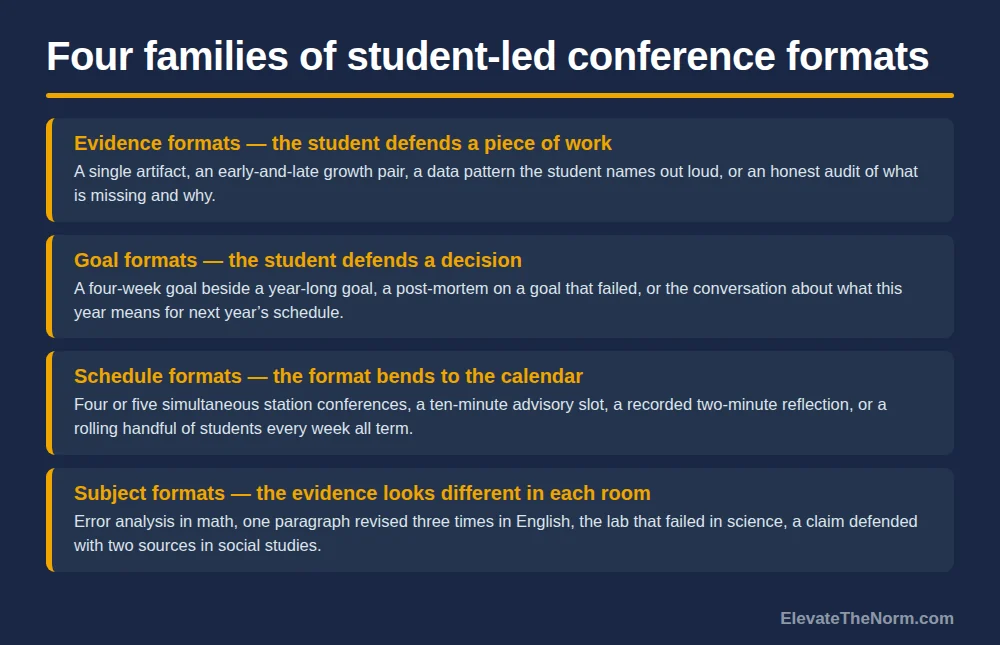
Good ideas for student led conferences fall into four families: evidence formats, where the student defends a piece of work; goal formats, where the student defends a decision; schedule formats, which bend the event to fit a real calendar; and subject formats, which change what counts as evidence depending on the room. Almost every conference idea you will find online is a variation inside one of those four.
That framing matters because it stops you from shopping for activities. The question is not “what cute thing can students do at the conference.” The question is what the student has to be able to explain out loud to an adult who is not their teacher. Everything else — the binder, the slides, the sign-in sheet — is packaging around that one moment. If you want the full case for why the event works and where it comes from, that is covered in the main guide to student-led conferences. This page is the catalogue of formats.
Sixteen ideas for student led conferences, by what the student defends
Each format below lists what the student brings, roughly how long it runs, and the situation it is built for. None of them require a schoolwide program. Most can be run by one teacher in one course.
Evidence formats: the student defends a piece of work
- The single-artifact defense. One assignment. Three questions: what is this, what does it show about what you can do, and what would you change. Ten to fifteen minutes. This is the format to start with if you have never done this before, because it fails gracefully — a student who freezes still has the paper in front of them.
- The growth pair. The earliest and latest version of the same skill, side by side. The student names the specific difference, not “it got better.” Fifteen minutes. Works best in a course with recurring tasks — writing, problem sets, lab reports, studio work.
- The data walk. The student reads their own assessment data out loud and names the pattern in it before any adult does. Fifteen to twenty minutes. This is the most uncomfortable format and the most honest one. It also requires that your gradebook actually shows patterns rather than a single running average, which is its own argument for grading by standard. Do not run this one in a station setup — a student reading their own failing scores aloud within earshot of three other families is not a format, it is an exposure.
- The missing-work audit. The student accounts for what is not there. Peter Neeves, a middle school principal writing in Edutopia in December 2025, describes exactly this: for incomplete assignments, students write a reflection and build an “assistance plan” for finishing. Fifteen minutes. Use it when the gap between a student’s ability and their grade is mostly a gap in turned-in work.
Goal formats: the student defends a decision
- The four-week goal beside the year goal. The Missouri State Teachers Association’s practical guide recommends a four-week goal, a year-long goal, and one “whole-self” goal. The four-week goal is the useful one, because it is close enough to check. Fifteen minutes.
- The goal autopsy. The student revisits a goal they set and did not hit, and says why — not as an apology, as a diagnosis. Twenty minutes, because this one takes real talking. Use it at the second conference of the year, never the first.
- The next-course conversation. An eleventh or twelfth grader explains what this year’s evidence means for next year’s schedule, and what they would need to be true to take the harder course. Twenty minutes, and worth pulling a counselor in if you can.
Schedule formats: the format bends to the calendar
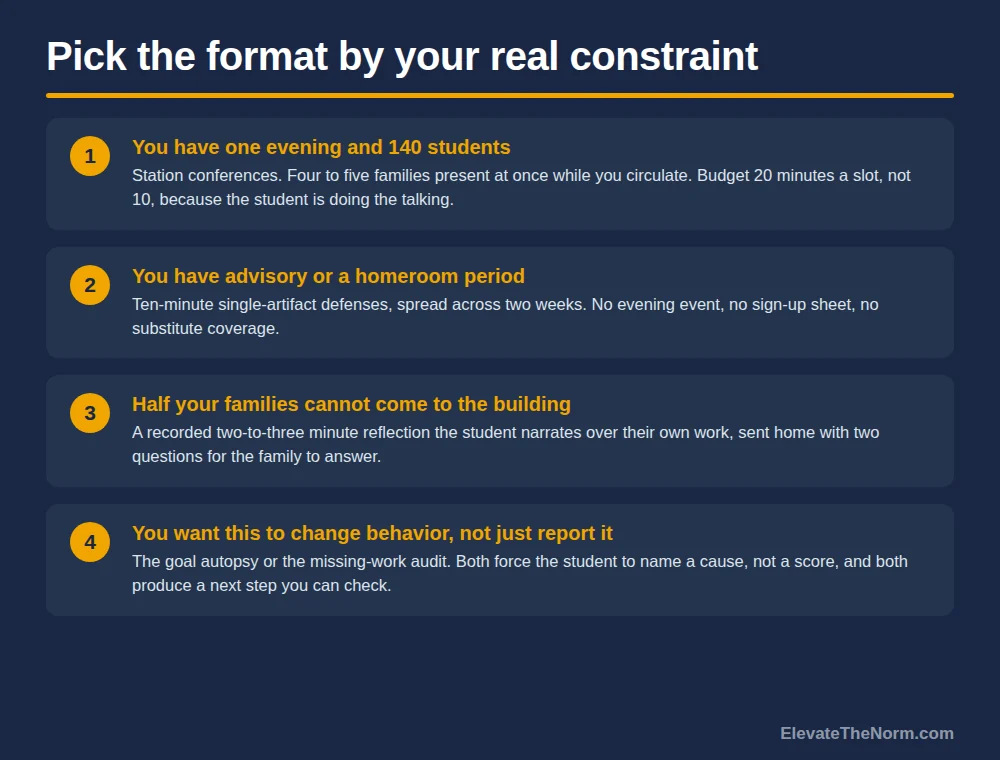
- Station conferences. Four or five families present simultaneously in one room while you circulate. This is the standard secondary workaround and the MSTA guide describes it directly. Twenty-minute slots. The trade-off is privacy: anything a family might not want overheard has to happen somewhere else.
- The advisory conference. Ten-minute single-artifact defenses run during advisory or homeroom across two weeks. No evening event, no coverage, no sign-up system. The weakest format on the list and the one most likely to actually happen.
- The recorded conference. A two-to-three minute screen recording in which the student narrates their own work, sent home with two questions for the family to answer and return. The MSTA guide lists this as an option; it is also the only format on this page that reaches a family working a second shift. Three practical guardrails: use whatever recording tool your district has already approved, make sure no other student appears or is named in the recording, and give a student with no reliable device at home a written narration or a phone-audio version instead. The format is the point, not the video.
- The rolling conference. Four or five students a week, every week, all term. Nobody schedules an event. By May every student has defended their work twice. This is the format that changes a course culture rather than adding a night to the calendar.
Subject formats: the evidence looks different in each room
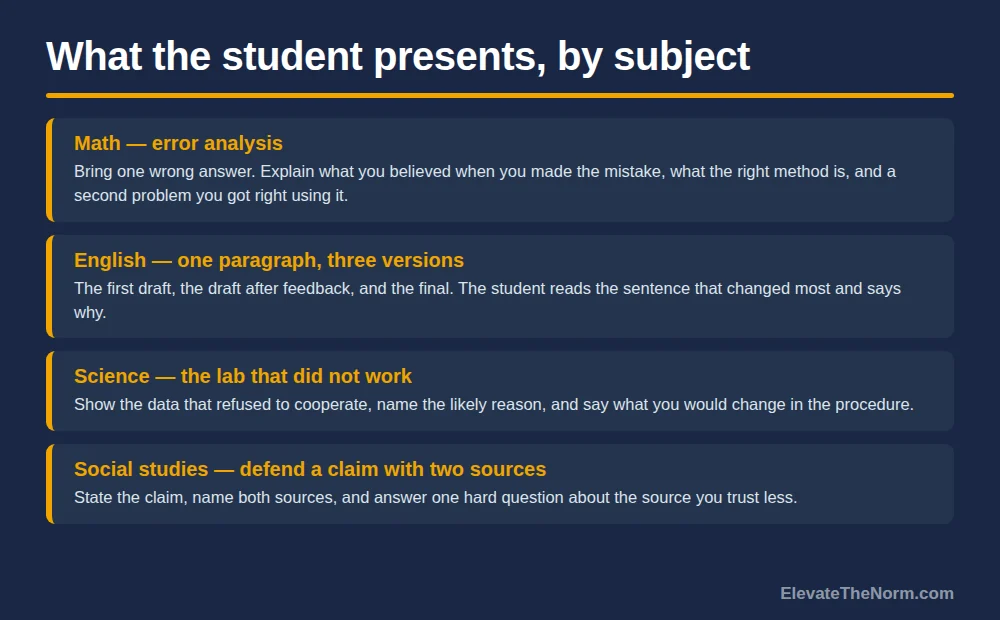
- Math — error analysis. The student brings one wrong answer, explains what they believed when they made the mistake, states the correct method, and shows a second problem they got right using it. Fifteen minutes. This format does more for a math student than any portfolio of correct work.
- English — one paragraph, three versions. First draft, post-feedback draft, final. The student reads the sentence that changed the most and explains the change. Fifteen minutes.
- Science — the lab that did not work. Data that refused to cooperate, the likely reason, and what the student would change in the procedure. Fifteen minutes, and it teaches more about science than a poster of a successful experiment.
- Social studies — defend a claim with two sources. The student states a claim, names both sources, and answers one hard question about the source they trust less. Twenty minutes.
One more, for the hardest case
- The repair conference. After an integrity incident or a serious behavior problem, the student explains to their family what happened, who it affected, and what they are doing about it — with you in the room and the school’s formal process already finished, not instead of it. Twenty to thirty minutes. This one is not for everybody and it is not a substitute for required procedure. It is voluntary for the student and the family, it never replaces a mandated report or a discipline process, and your administrator should know it is happening before it happens. It works when a student has already accepted responsibility and needs a way to come back from the mistake rather than carry it. If any of those conditions are missing, skip it.
Do student-led conferences actually do anything?
The short answer: the parts have evidence behind them and the package does not. Self-assessment and goal-setting — the two things a student-led conference forces — have been studied. The conference as an event has not been tested at scale, and anyone telling you otherwise is stretching. The goal-setting half is worth reading on its own terms too: what the evidence does and does not support about student goal setting is more mixed than most professional development admits.
The best available evidence on the underlying mechanism is Panadero, Jonsson and Botella’s 2017 set of four meta-analyses in Educational Research Review. Across 2,305 students with a mean age of 17.5, self-assessment interventions produced a small effect on self-regulated learning (d = 0.23) and a large effect on self-efficacy (d = 0.73). Ten of the studies were in secondary schools, so this is not elementary research being stretched upward. But read the authors’ own caution: they state plainly that for self-efficacy “there might exist some over-estimation of the magnitude of the effect” because of publication bias, and that the studies do not clarify the mechanism. A d of 0.73 that the authors themselves flag as probably inflated is not a number to build a school improvement plan on.
On the conference itself, the most-cited piece of research is Sherri Nauss’s 2010 study in the ERIC database, covering 90 students in grades 6–8, 90 parents and six teachers. It reports that 59 of 90 students said the conferences “consistently” or “usually” made them take responsibility for their learning, and 64 of 90 said the conferences helped them focus on grades. Those are real numbers, and they are also self-reported survey responses from a single school, from students in a narrow 2.5–3.5 GPA band, with no achievement data and no data from families who did not participate. Nauss says all of that herself in the limitations section. It is a useful signal. It is not proof.
So the honest version is this: if you run one of these formats, you are on solid ground saying that it makes students assess their own work, and reasonable ground expecting that to help a little with how they manage their learning. You are not on solid ground promising a grade bump. Say the first thing to your administrator and skip the second.
Which format should you pick?
Pick by constraint, not by preference. The format that fits your worst scheduling problem is the one that will still be running in March.
| If this is your situation | Use | Time per student |
|---|---|---|
| One evening, 140 students | Station conferences (#8) | 20 min |
| You have advisory or homeroom | Advisory conference (#9) | 10 min |
| Families work shifts or lack transport | Recorded conference (#10) | 2–3 min of video |
| You want a culture change, not an event | Rolling conference (#11) | 15 min, 4–5 a week |
| First time ever doing this | Single-artifact defense (#1) | 10–15 min |
| The problem is missing work, not ability | Missing-work audit (#4) | 15 min |
| Second conference of the year | Goal autopsy (#6) | 20 min |
| Juniors and seniors picking courses | Next-course conversation (#7) | 20 min |
Whatever you choose, the preparation is the same shape: the student selects evidence, annotates it, and rehearses. The free conference template pack has the readiness checklist and portfolio planner that do that work, and the self-assessment guide explains why the annotation step is the part you cannot skip.
What do you do about the families who do not come?
Plan for roughly half of them, and build a format that does not require a body in a chair. This is not pessimism. It is the federal data.
The National Center for Education Statistics tracks this in the National Household Education Surveys Program. In the 2018–19 survey, the share of parents who attended a regularly scheduled parent-teacher conference was 90% in kindergarten through second grade, 88% in grades 3–5, 72% in grades 6–8, and 54% in grades 9–12. The drop is not a failure of any one school. It is what happens when a child goes from one teacher to seven and the conference stops feeling like the only channel. The 2023 survey puts overall conference attendance across all grades at 72%.
Three things follow from that. First, a recorded conference is not the consolation prize; for half a high school roster it is the primary format. Second, the family who does not come is often the family you most need to hear from, which is an argument for the short, regular, individual contact that actually has trial evidence behind it. Third, do not grade the student on whether an adult showed up. That is the one design mistake that turns a good idea into a punishment for being poor.
What about students and families who need accommodations?
Every format on this page assumes a student can talk about their work for fifteen minutes, and that assumption is wrong for some of your students. Fix it before the conference, not during it.
For a student with a communication-related disability, the defense is a mode, not a speech. A written narration read by the student, a slide deck the student points to, a recorded version, or a peer-supported walkthrough all satisfy the same purpose. Check the IEP or 504 plan first and follow it — this is an instructional activity, and accommodations apply to it the same way they apply to a presentation in any other class. For an emergent bilingual student, let the conference happen in the language the family speaks, and request the interpreter through whatever process your school already has for conferences. If your school does not have one, that is worth raising before you pick a format, because a conference the family cannot follow is worse than the form letter it replaced.
Five ways these ideas go wrong
- The student reads a script and nobody learns anything. A script is scaffolding for a nervous kid, not the product. If a student can deliver the whole thing without looking up, you have built a performance.
- Only the successful work goes in the folder. A portfolio of A’s is a brag book. The growth pair, the missing-work audit and the error analysis all exist to prevent this.
- The time slot assumes an adult is talking. Ten minutes is a teacher-led conference. A fifteen-year-old explaining their own reasoning to their mother takes longer, and the silences are part of it.
- It becomes an eighth grading event. Grade the preparation if you must grade something. Do not put a number on how convincingly a teenager talked about themselves in front of their parent.
- Nobody follows up. A goal named in October that nobody mentions again in November teaches students that the conference was theater. Put the four-week check on your own calendar before the conference happens.
What to do next
Pick one format and one class period. Not the department, not the grade level — one section. The single-artifact defense (#1) run during advisory (#9) is the lowest-risk combination on this page, and it takes one week of prep: students choose the artifact on Monday, annotate it Tuesday, rehearse with a partner Wednesday, and defend it Thursday and Friday.
Then write down what actually happened — who could explain their own work and who could only describe it. That distinction is the whole point of the exercise, and it is the thing you will want in front of you the next time someone asks whether this is worth the class time. It is. But argue it with what your students did, not with a number from a study that was run somewhere else.
Before you go: grab the free Student-Led Conference Toolkit (PDF) — ElevateTheNorm.com branded, printable, no email required.
Frequently Asked Questions
What are some good ideas for student led conferences in middle and high school?
Start with a format rather than an activity. The four that work best in grades 6-12 are the single-artifact defense (one assignment, three questions), the growth pair (earliest and latest version of the same skill side by side), the missing-work audit (the student accounts for what is not there and writes an assistance plan), and the goal autopsy (the student explains why a goal they set did not happen). Each runs in ten to twenty minutes and none of them require a schoolwide program.
How long should a student-led conference be?
Budget twenty minutes, not ten. Ten minutes is the length of a teacher-led conference, where an adult who has said the same thing six times that night is doing the talking. A fifteen-year-old explaining their own reasoning to their parent is slower, and the pauses are part of the work. If your schedule only allows ten, use the single-artifact defense, which is built to fit.
Do student-led conferences improve grades?
There is no good evidence that they do, and you should not promise it. What has been studied is self-assessment, the mechanism underneath the conference. Panadero, Jonsson and Botella’s 2017 meta-analyses found a small effect on self-regulated learning (d = 0.23) and a larger effect on self-efficacy (d = 0.73) across 2,305 students with a mean age of 17.5 – but the authors themselves warn that the self-efficacy figure is probably inflated by publication bias. The most-cited study of the conference itself, Nauss (2010), is 90 students in one middle school reporting on themselves, with no achievement data at all.
What if the parent disagrees with how the student assessed their own work?
That disagreement is useful, and it is one of the few things a student-led conference produces that a traditional conference does not. Let it happen, then anchor it to the evidence on the table: the paper, the data, the two drafts. Your job is not to referee who is right about the student’s character. It is to point at the artifact and ask what it shows. If the conversation is heading somewhere a student should not have to sit through, end the conference and schedule a separate one with the adults.
How do you handle families who do not come to conferences?
Assume about half of them will not, and build a format that does not require attendance. Federal survey data from 2018-19 puts parent attendance at regularly scheduled conferences at 54% in grades 9-12 and 72% in grades 6-8, down from 90% in the earliest elementary grades. The recorded conference – a two- to three-minute narration the student makes over their own work, sent home with two questions for the family to answer – is the format built for this, and for half a high school roster it is the primary format, not a backup. Never grade a student on whether an adult showed up.
Should student-led conferences be graded?
Grade the preparation if you need a grade: the artifact selection, the annotation, the written reflection. Do not put a number on how convincingly a teenager talked about themselves in front of their parent. That turns a format built on honesty into a performance, and the students who most need to say something uncomfortable are exactly the ones a grade will silence.
Do these formats work for students with IEPs or students learning English?
Yes, with the accommodations those students already have. The defense is a purpose, not a speech: a written narration the student reads, a slide deck the student points to, a recorded version, or a peer-supported walkthrough all satisfy it. Check the IEP or 504 plan and follow it, the same as you would for any presentation. For a family that speaks another language, request an interpreter through the process your school already uses for conferences, and hold the conference in the language the family actually speaks.
How is this different from a regular parent-teacher conference?
In a traditional conference the teacher reports and the family listens. In a student-led conference the student presents evidence of their own learning and the adults ask questions about it. The teacher is still in the room and still responsible for accuracy – this is not the teacher stepping out. What changes is who has to be able to explain the work, which is the entire point.
Sources
- McQuiggan, Meghan, and Mahi Megra. Parent and Family Involvement in Education: Results from the National Household Education Surveys Program of 2019 (NCES 2020-076). National Center for Education Statistics, U.S. Department of Education, 2019. Conference attendance by grade band appears in Table 2. Full report (PDF).
- Parent and Family Involvement in Education: 2023 (NCES 2024-113). National Center for Education Statistics, U.S. Department of Education, 2024. Sample of 19,562 students; overall conference attendance 72%. Summary (PDF). This edition does not disaggregate by grade band, which is why the 2019 report is cited for that figure.
- Panadero, Ernesto, Anders Jonsson, and Juan Botella. “Effects of self-assessment on self-regulated learning and self-efficacy: Four meta-analyses.” Educational Research Review, vol. 22, 2017, pp. 74–98. Journal listing; open-access author copy at the Universidad Autónoma de Madrid repository (PDF), which is the version read for this article.
- Nauss, Sherri A. Student Led Conferences: Students Taking Responsibility. 2010. ERIC document ED516784. Full text (PDF). 90 students in grades 6–8 with GPAs between 2.5 and 3.5, self-reported survey data, no achievement measures — limitations stated by the author.
- Neeves, Peter. “How to Successfully Institute Student-Led Conferences at Your School.” Edutopia, George Lucas Educational Foundation, 3 December 2025. Article.
- “A Practical Guide to Student-Led Conferences.” Missouri State Teachers Association. Guide.
A note on the evidence. Two of the six sources are federal survey reports, one is a peer-reviewed set of meta-analyses, and one is a small single-school study whose limitations are stated in the text above rather than buried. The two practitioner sources are cited for format details, not for outcomes. Nobody has run a large randomized trial of student-led conferences at the secondary level, and this article does not pretend otherwise.