By Clay Shumate
A classroom expectations poster for middle and high school students should do one thing: give teenagers a clear, honest statement of what this room stands for and what you expect from them. It should not look like a kindergarten behavior chart. It should not list everything a student might ever do wrong. And it should not hang untouched on the wall for nine months while everyone quietly ignores it. A good secondary poster is short, specific, adult in tone, and introduced in a way that gives it weight.
Key Takeaways
- A poster designed for teenagers should use adult language, not elementary slogans like “Be Safe, Be Kind, Be Responsible.”
- Secondary expectations should address preparation, effort, respect, collaboration, and accountability — not just behavior compliance.
- Posting it without teaching it means students will treat it as decoration. The introduction matters as much as the content.
- Five to six concrete expectations are enough. More than that, and nothing gets remembered.
- The poster works best as a reference point, not a threat — something you return to when expectations need reinforcing.
Why Most Classroom Expectations Posters Miss the Mark in Secondary School
Walk into most middle or high school classrooms and you will find one of two things: a bare wall with no expectations posted at all, or a poster designed for a seven-year-old. “Be Respectful. Be Responsible. Be Ready.” Those three-word phrases were written for elementary cafeterias. They communicate nothing useful to a fourteen-year-old who already knows what respect means — or thinks she does.
The problem is not the concept. Research consistently shows that students in grades 6–12 benefit from explicit, clearly taught behavioral expectations. The IRIS Center at Vanderbilt University, citing a base of positive behavioral interventions and supports research, notes that effective classroom expectations are “positively stated, specific, and taught — not just posted.” The issue is that most secondary teachers either skip the poster entirely or borrow materials built for a different developmental stage.
Adolescents are not small children who need to be told not to run in the halls. They are developing young adults who respond to being treated as such. When the expectations on the wall look like they belong in a first-grade classroom, students notice — and the message the poster sends is not the one you intended.
A well-designed secondary expectations poster does the opposite. It names real behavior in real language. It acknowledges that this room has standards and that the students in it are capable of meeting them. And it signals from day one that the teacher takes the social contract of this classroom seriously.
What Belongs on a Classroom Expectations Poster for Grades 6–12
Secondary expectations should cover the behaviors that actually determine how well a classroom runs: preparation, contribution, respect, accountability, and communication. That covers nearly every situation you will face without turning into a rulebook.
Here is what each expectation needs to do in order to work:
State a behavior, not a value. “Be responsible” is a value. “Come to class with your materials, ready to work when the period starts” is a behavior. Students can observe, perform, and be held to behaviors. Values are harder to enforce fairly.
Use complete sentences, not slogans. Single-word or three-word expectations (“Respect. Responsibility. Readiness.”) sound professional from a distance and mean nothing up close. Write out what you mean.
Stay positive. List what students should do, not what they should not do. “Come prepared” is easier to remember and easier to reinforce than “don’t come without your materials.”
Match the developmental stage. A fourteen-year-old reading “Keep your hands to yourself” will feel condescended to. The same idea written as “Respect the space and the people in it” lands differently — same principle, adult register.
Keep it to five or six items. Research on working memory and behavioral learning consistently points toward manageable, memorable sets of expectations. The PBIS framework — supported by the Institute of Education Sciences — recommends three to five positively stated expectations at the schoolwide level. In a classroom, where you have more specific context, five to six gives you enough room to cover the full range of what matters without overwhelming students or yourself.
The Complete Classroom Expectations Poster — Ready to Adapt
Below is a complete, print-ready set of classroom expectations for grades 6–12. These are not sacred text — adapt the language to fit your course, your students, and your own voice. What matters is that the expectations are honest, specific, and ones you can actually enforce.
Classroom Expectations — Room [Your Number]
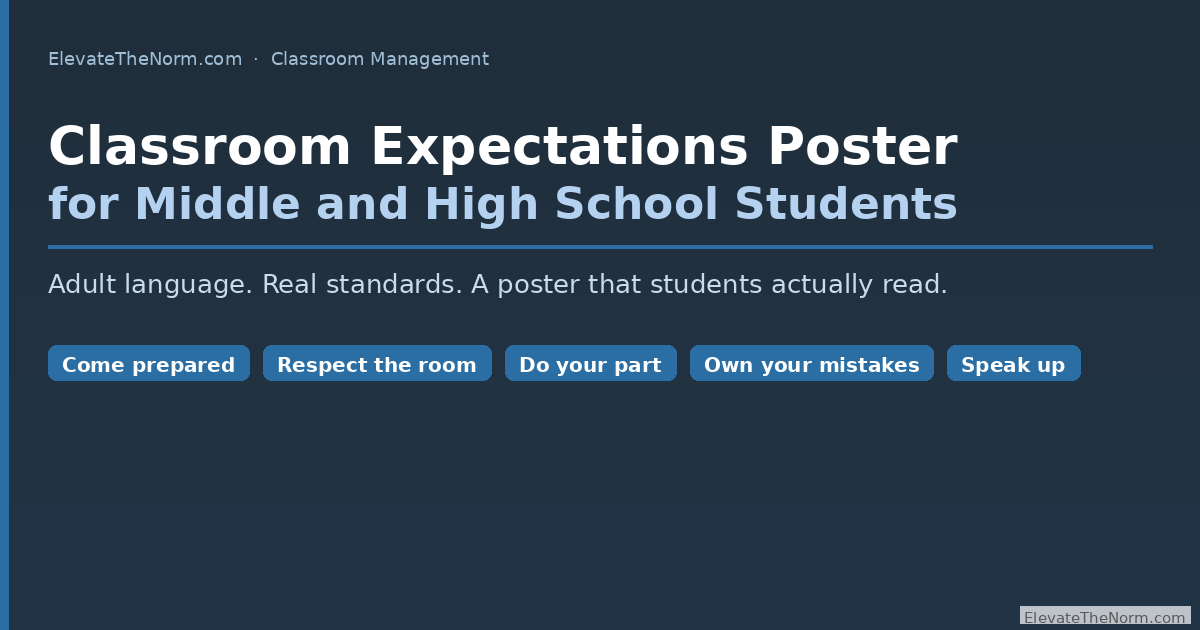
- Come prepared. Bring your materials. Do the work. If you are behind, tell me — do not disappear.
- Respect the room and the people in it. That means your peers, your workspace, and yes — the furniture.
- Do your part. In group work and on your own. Your effort is visible, and it matters.
- Own your mistakes. Everyone makes them here. What counts is what you do next.
- Speak up. Ask questions. Push back respectfully. Let me know when something is not working. I cannot help if I do not know.
- Finish what you start. Follow through on commitments to the group, to yourself, and to the work.
— [Teacher Name], [Course Name]
A few notes on the design. Each expectation above addresses a real, recurring classroom situation. “Come prepared” covers materials and readiness. “Respect the room and the people in it” covers interpersonal behavior and property without listing every possible offense. “Do your part” covers collaboration accountability. “Own your mistakes” connects to repair rather than hiding. “Speak up” actively invites communication — which middle and high school students often do not do because they do not know they are allowed to. “Finish what you start” addresses follow-through, which is where a lot of secondary students struggle in project and group work.
You will notice there is nothing on this poster about phones, about hall passes, or about bathroom policy. Those are procedures, not expectations. Procedures go in a different place — a syllabus, a classroom handbook, a first-day walkthrough. Mixing procedures and expectations on one poster dilutes both.
Download it: A print-ready PDF of the poster below is available in 11×17, letter, and PNG, with blanks for your room number, name, and course. It is free on the teacher resources page — no email required.
How to Design the Poster Itself
The visual design of a classroom expectations poster matters more than teachers usually think — not because teenagers are visually illiterate, but because a poorly designed poster communicates “I printed this from a clip-art site in three minutes” before anyone reads a word.
Readable from across the room. The primary text should be legible from the back row. Use a clean sans-serif font at a size that actually works at distance. Test it by standing at the back of the room before you hang it.
No cartoon characters, no elementary-school imagery. Animals, mascots, and illustrated smiley faces read as condescending at the secondary level. A clean, professional design — similar to what a workplace or studio might use — signals that you take the room seriously.
Your school’s color palette, or a neutral one. The poster should look like it belongs in your building. If your school has a color scheme, work within it. Black text on white or ivory with one or two accent colors is clean and always works.
Your name or course name at the bottom. Ownership matters. A nameless poster could belong to any room. Your name on it says: I wrote these, I mean them, and I am the person who holds them.
The recommended final size is 11×17 for desk-level reading or 18×24 for wall mounting with full visibility across a standard classroom. Print it at a copy shop if the school printer cannot handle the size or quality you want.
How to Introduce the Poster So It Actually Means Something
Hanging the poster before students arrive is the easy part. Introducing it well is what determines whether students treat it as information or wallpaper.
The First-Day Launch
Do not start class by pointing at the poster and reading it aloud while students zone out. Instead, give students the list on paper — on day one, before the poster even comes up. Ask them to mark the one expectation they predict will be hardest for them personally, and the one they think the class will struggle with most.
Share those responses without calling out individuals. You will learn more about your students in that ten minutes than in a week of name-tags and icebreakers. Then reveal the poster as the room’s standing version of what they just discussed. It goes from a pronouncement to a shared reference.
That sequence — reflection first, poster second — is consistent with what self-determination theory research identifies as autonomy-supportive classroom practice. Niemiec and Ryan’s 2009 work in Theory and Research in Education found that students who understand the rationale behind classroom requirements show stronger internalization of those expectations and better self-regulatory behavior over time. You are not just posting rules. You are giving students a reason to buy in.
When Expectations Slip Mid-Year
Every classroom hits a stretch in October or February when the room’s standards start to drift. Work quality drops, group dynamics get irritable, or participation dries up. The poster gives you a way to address it without singling out individuals or delivering a lecture.
You can simply pause at the start of a class period, walk to the poster, and say: “I want to check in on these. Which one are we doing well? Which one do we need to recover?” Running it as a quick conversation — two or three minutes — resets the room without creating a confrontation or making any one student the problem.
This is one of the things a visual reference does well. It depersonalizes the conversation. The poster is the standard; you are enforcing the standard; no one is being singled out.
What This Looks Like in a Workshop Room
In my room, the expectations poster hangs near the front, visible from the whiteboard table where I pull small groups. Students know it is there. Most of them could probably recite it by November without looking at it — not because I made them memorize it, but because I return to it consistently.
I had a group last year deep into a project on regional economic history. They had been working together for a few weeks, and the collaboration had started fraying. One student in the group was doing most of the research and getting increasingly frustrated; the other two were contributing ideas but not documentation. When I pulled the three of them over to the whiteboard table for a check-in, I did not start by describing the problem. I asked each of them: looking at expectation five — “Do your part” — how would you rate where the group is right now?
That question changed the whole conversation. Instead of me telling them something was wrong, they were each reading the expectation and deciding for themselves whether they were meeting it. The student carrying most of the load said “five out of ten.” One of the others said “seven.” That gap opened up a productive conversation about what “doing your part” actually looked like in this project — not as a lecture from me, but as something they worked out together at the table.
The poster was the frame. The check-in was the conversation. The expectation gave us shared language that made the harder feedback possible without it becoming personal.
Connecting the Poster to Consequences
An expectations poster without consequences attached is just decoration. Students need to know — early, clearly, and honestly — what happens when an expectation is not met. This is not about threat. It is about transparency.
You do not need to list consequences on the poster itself. But in the first-day launch, after you have introduced the expectations, it is worth being direct: “These are what I expect. When one of them is not happening, here is how I will handle it — first, a conversation at the table or in the hall; second, I contact home; third, I loop in the office. I will always start with a conversation. I will never embarrass you in front of the room.”
That sequence — conversation first, escalation as needed, dignity protected throughout — is consistent with what the research on logical consequences supports. Consequences that are predictable, proportionate, and connected to the behavior produce better outcomes than unpredictable or humiliating responses. More importantly, it matches what most teenagers actually want: to know what the rules are and to be treated fairly when they break them.
The poster anchors all of this. It is the reference point for every consequence conversation: “You committed to coming prepared. What happened today?” That framing puts the student’s own stated agreement in the conversation rather than making it feel arbitrary. For a closer look at why classroom expectations are important beyond the poster itself — including how they protect instructional time and reduce student anxiety — that article walks through the research.
Frequently Asked Questions
Is a classroom expectations poster actually necessary for high school?
Yes — and arguably more necessary than in elementary school, because secondary teachers often assume students already know the expectations without ever stating them explicitly. Research from the IRIS Center at Vanderbilt confirms that explicitly taught expectations reduce problem behavior and improve learning time at all grade levels, including high school. The form of the poster matters: it needs to match the developmental stage. A well-designed secondary poster is a standing reference, not a behavior-chart throwback.
How many expectations should be on the poster?
Five to six is the right range for secondary classrooms. Three is probably too few to cover the behaviors that actually matter in a grades 6–12 setting. More than six, and no one will remember them, including you. The PBIS framework recommends three to five at the schoolwide level; classrooms can add one or two subject- or course-specific expectations on top of that if needed.
Should students help create the classroom expectations?
Student input on expectations is worth using, but it is not required — and the research on co-creation is more nuanced than the “always co-create” advice you often hear. What matters most is that students understand the rationale behind the expectations, not necessarily that they wrote them. A teacher who explains clearly why each expectation exists will see stronger compliance than one who holds a half-hearted committee meeting. If you use student input, use it genuinely — incorporate specific language they suggested, or address expectations they raised that you did not include.
What is the difference between classroom rules and classroom expectations?
Rules are typically prohibitions: “No phones during direct instruction.” Expectations describe positive, proactive behavior: “Use technology for the task at hand.” The more useful distinction for secondary teachers is between expectations (the standing standards for how the room operates) and procedures (the specific steps for specific situations — how to enter, what to do when absent, how to turn in work). Procedures go on a separate document. Expectations go on the poster.
How do I enforce expectations without embarrassing students?
Keep the first response private and close. A quiet conversation at the student’s table, a quick pull into the hall, or a check-in at the whiteboard table is almost always more effective than a public correction — and research on adolescent dignity consistently shows that public shaming increases resistance rather than compliance. State the expectation, describe what you observed, give the student a chance to respond, and agree on what happens next. Save escalation for situations where a private response has already been tried and failed, or where safety is at stake.
Should the poster be printed professionally or is a regular printer fine?
A regular printer handles 8.5×11 adequately, but that is often too small to read from across a classroom. For visibility from the back row, 11×17 or 18×24 is more effective — both of which usually require a copy shop. The investment is minor; a professionally printed poster also signals that you take the standards seriously, which affects how students read the room on day one.
How do I reintroduce expectations mid-year without it feeling like a lecture?
Return to the poster as a conversation, not a correction. At the start of a class period, ask students to identify which expectation the class is meeting well and which one needs work. Keep it two to three minutes, collective, and impersonal — the poster is the standard, not the teacher’s opinion. This works much better than a speech delivered in frustration, and it signals that expectations are a living agreement the room owns, not a one-time announcement.
Conclusion
A classroom expectations poster is not a decoration and it is not a behavior chart. At the secondary level, it is a public commitment — yours to the room and the room’s to itself. The five or six expectations on that poster say: this is what we are doing here, this is what I expect from you, and this is what you can expect from me.
That is worth putting on the wall. More importantly, it is worth introducing with enough care that students actually read it, think about it, and can refer back to it when the room needs a reset. If you want to start somewhere, adapt the poster template above to your course and voice. Print it large enough to read from the back row. Introduce it on day one as a conversation, not a reading assignment. And make it one of the things you return to throughout the year — not as a threat, but as the standing answer to the question every student is quietly asking: what do you actually expect here?
For more on setting standards that treat teenagers as young adults, see Classroom Expectations: A Practical Framework for Grades 6–12, Respect in the Classroom: Why It Must Go Both Ways, and Classroom Consequences That Teach Instead of Humiliate.
Sources
- IRIS Center, Vanderbilt University. “Page 4: Rules.” Behavior Management: Strategies for Secondary Students. Peabody College. https://iris.peabody.vanderbilt.edu/module/beh2_sec/cresource/q2/p04/
- Niemiec, C. P., & Ryan, R. M. (2009). “Autonomy, competence, and relatedness in the classroom: Applying self-determination theory to educational practice.” Theory and Research in Education, 7(2), 133–144. https://journals.sagepub.com/doi/10.1177/1477878509104318
- Institute of Education Sciences, REL Northwest. “Positive Behavioral Interventions and Supports.” U.S. Department of Education, January 2025. https://ies.ed.gov/rel-northwest/2025/01/positive-behavioral-interventions-and-supports
- IRIS Center, Vanderbilt University. “Understanding Behavior Expectations and Rules.” Early Childhood Behavior Management. Peabody College. https://iris.peabody.vanderbilt.edu/module/ecbm/cresource/q1/p02/
- Midwest Teachers Institute. “From Classroom Rules to Expectations: The Shift.” https://www.midwestteachersinstitute.org/from-classroom-rules-to-expectations-the-shift/
- Guay, F. (2022). “Applying Self-Determination Theory to Education: Regulation Types, Psychological Needs, and Autonomy Supporting Behaviors.” Canadian Journal of School Psychology, 37(1), 75–92. https://journals.sagepub.com/doi/10.1177/08295735211055355
- Panorama Education. “15 Classroom Rules and Expectations.” Panorama Ed Blog. https://www.panoramaed.com/blog/classroom-rules-and-expectations
- Visible Learning. “Hattie Effect Size List — 256 Influences Related to Achievement.” https://visible-learning.org/hattie-ranking-influences-effect-sizes-learning-achievement/
Before you print anything, it is worth reading the wording against several other rooms. These examples of classroom expectations show how the same standard gets written differently for a lab, a seminar, a gym, and a one-to-one device classroom—and how to rewrite a vague expectation into one two adults would agree on.
About Clay Shumate
Clay Shumate is a Class A certified Social Studies and History teacher for grades 6–12, now in his seventh year in the classroom, with an M.Ed. in Secondary Education and a B.A. in History. He teaches 9th grade World History and writes about project-based learning, student responsibility, and classroom culture. He is a member of the Society of Professional Journalists and writes to its Code of Ethics; this site’s editorial standards and corrections policy are published in full. More about Clay.