By Clay Shumate · Updated October 24, 2026
Student responsibility is a student’s capacity to own their choices, meet their obligations, and make things right when they fall short. It covers academic responsibility—showing up, completing work honestly, asking for help—behavioral responsibility like following class agreements and accepting consequences without deflecting, and interpersonal responsibility: being someone your peers can count on when it matters. Responsibility grows through practice, not through lectures about why it matters.
Key Takeaways
- Student responsibility has four overlapping dimensions: academic, behavioral, interpersonal, and community
- Responsibility is not the same as obedience—obedience asks students to comply; responsibility asks them to own
- Responsibility develops through meaningful choice, honest feedback, proportionate consequences, and a genuine path back after failure
- Schools and families each control distinct pieces of the picture—neither can do this alone
- Students trusted with real responsibility tend to rise to it; students denied any meaningful responsibility often check out
What Is Student Responsibility?
Student responsibility, at its core, is a student’s ability to manage their own behavior and obligations without constant adult supervision. It is not perfectionism. A responsible student is not one who never makes mistakes—it is one who owns their mistakes, faces the consequence that was promised, and does not wait for an adult to notice and solve every problem for them.
Damon (1995) distinguishes between compliance and genuine responsibility, arguing that adolescents develop real responsibility only when they internalize the values behind expectations—not when they follow rules out of fear of punishment. That distinction shapes how schools should approach this: punishing non-compliance produces compliance. Building structures where students experience ownership and consequences produces responsibility.
The Collaborative for Academic, Social, and Emotional Learning (CASEL) places responsible decision-making as one of five core competencies in social-emotional learning, defining it as the ability to make caring and constructive choices about personal behavior and social interactions (CASEL, 2023). This is not a soft skill—it is a teachable, measurable set of practices.
What Are the Four Dimensions of Student Responsibility?
Responsibility is not one thing. Students can be responsible in some dimensions and not others—and understanding which dimension is the problem is the first step to addressing it.
Academic Responsibility
Academic responsibility includes completing assigned work, meeting deadlines, submitting honest work, and asking for help when confused instead of guessing or copying. It also includes managing study time independently and advocating for yourself when you do not understand something.
Academic responsibility does not mean students work alone all the time. It means that when they work together, they each contribute. A student who coast through group work—contributing nothing while taking credit—is not being academically responsible, even if their final grade does not show it.
Behavioral Responsibility
Behavioral responsibility means following class agreements even when the teacher is not watching, accepting consequences proportionately without deflecting blame onto others, and owning mistakes directly. A student who accepts a consequence and then moves on is demonstrating behavioral responsibility. A student who spends more energy disputing the consequence than they spent on the behavior that caused it is not. If you want a think sheet that treats students like young adults, my Behavior Reflection Sheets on TPT come in two levels.
Interpersonal Responsibility
Interpersonal responsibility means showing up for group work when you said you would, communicating honestly when something is wrong rather than disappearing, and holding yourself accountable to your peers without waiting for adult intervention. This is where student responsibility in the classroom becomes most visible—and most difficult—because teenagers are still developing the relational skills that make peer accountability possible.
Community Responsibility
Community responsibility extends beyond the individual: caring for shared classroom materials, leaving shared spaces as you found them, contributing to class culture rather than just extracting from it. This dimension is often underdeveloped in schools that treat responsibility purely as a compliance matter. A student who only does what serves themselves and ignores what their behavior costs the people around them has not developed full responsibility.
| Dimension | What it looks like |
|---|---|
| Academic | Completing work, meeting deadlines, submitting honest work, asking for help instead of guessing or copying |
| Behavioral | Following class agreements when no one is watching, accepting consequences without deflecting blame, owning mistakes |
| Interpersonal | Showing up for group work, communicating honestly when something is wrong, being accountable to peers |
| Community | Caring for shared materials, leaving shared spaces as you found them, contributing to class culture |
What Is the Difference Between Responsibility and Obedience?
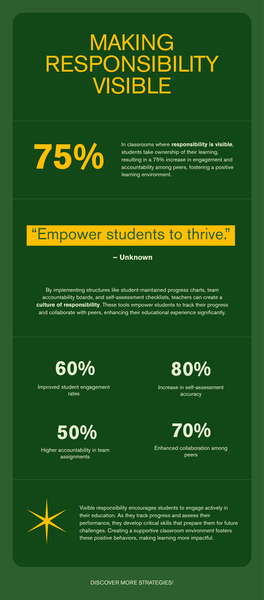
Obedience asks: Do it because I said so. Responsibility asks: Do it because you understand why it matters.
A student who only acts responsibly when supervised has learned obedience—or at least its performance. A student who checks their own work before turning it in, admits to the group member that they did not pull their weight, and asks the teacher for an extension before missing a deadline rather than after: that student is practicing responsibility. I use the forms in my Makeup Work System on TPT so absent students know exactly what they missed and when it is due.
This distinction shapes discipline. Teachers who confuse the two often escalate consequences trying to produce responsibility when what they are getting is compliance or its absence. More pressure can produce more compliance—but it rarely produces more ownership. And once a student is under enough pressure, it produces neither.
For classroom approaches that build genuine responsibility rather than managed compliance, see positive discipline for teens and natural consequences in the classroom.
How Do Students Develop Responsibility?
Ryan and Deci (2000), whose self-determination theory has been among the most replicated frameworks in educational psychology, identify three basic psychological needs that support self-regulation: competence (feeling capable), autonomy (having real choices with real consequences), and relatedness (belonging to a community that cares how you act). Responsibility develops when students experience all three.
A student who has no choices in class and no voice in outcomes has no reason to develop responsibility—they are compliant at best, resistant at worst. The conditions for responsibility must be built before you can expect students to demonstrate it.
Through Meaningful Choice
Students cannot develop responsibility for choices they are never allowed to make. This does not mean every class decision is put to a vote. It means giving students real choices within clear boundaries: how they organize their notes, which of three article prompts to respond to, how they divide group roles. Choices with low stakes but genuine consequences—where the student experiences the results of their own decisions—are the practice ground for larger responsibility.
Through Honest Feedback
Vague praise tells students nothing useful. “Good work” does not tell a student what to repeat or what to change. Specific, honest feedback—”your argument on page two is clear; the evidence in the third paragraph does not quite support the claim you are making”—gives students something to act on. Feedback that helps students understand the gap between what they did and what was expected builds the self-awareness that responsibility requires.
Through Proportionate Consequences
Consequences need to match the behavior and be ones the student can actually learn from. A student who forgets homework and gets a zero learns to hide it next time. A student who forgets homework and has a brief, direct conversation about why—followed by a realistic plan for finishing it—learns something about responsibility. See natural consequences in the classroom for a practical framework for getting this right.
Through Repair After Failure
A student who makes a mistake and finds no path back learns to hide mistakes. A student who makes a mistake, owns it, repairs what can be repaired, and still faces the consequence that was agreed upon—that student is learning something real. The repair matters as much as the consequence. Schools that skip repair leave students with the message that once you mess up, you are just in trouble. Schools that include repair leave students with the message that responsibility includes fixing what you broke.
For a first-person account of letting a consequence stand while keeping the path back open, see Clay’s essay What I Learned the Year I Let Kids Fail, published at The Educator’s Room.
What Schools Control vs. What Families Control
Schools control: the structure of the day, the expectations communicated, the consistency with which those expectations are applied, how teachers respond to failure, whether students have any meaningful voice in class decisions, and what happens after a student falls short. Schools decide whether consequences teach something or just punish. They decide whether students get a path back or are simply in trouble.
Families control: routines at home, how parents model handling their own mistakes, how they talk about school, and whether they support students through consequences or work to eliminate them. A parent who calls in every morning a student misses homework and negotiates the grade is teaching that responsibility is negotiable when someone with enough leverage intervenes. A parent who lets the consequence stand and helps the student think through what went wrong is doing something very different.
A school that expects families to deliver responsible students and does nothing to build responsibility at school is not doing its job. A family that expects school to do it all while rescuing students from every consequence is not doing theirs either. Responsibility is built in both places—or it struggles in both places.
Common Misunderstandings About Student Responsibility
Responsible students do not make mistakes. They do. The goal is not a student who never falls short—it is a student who owns it when they do. Responsibility is about response, not perfection. A student who admits they did not study for a test and accepts the grade is more responsible than a student who argues about why the test was unfair.
You either have it or you do not. Decades of developmental psychology disagree. Responsibility is a practiced skill that grows through experience, feedback, and appropriately scaled opportunities to make real decisions. Weissberg and colleagues (2015) document clear evidence that social-emotional competencies, including responsible decision-making, are teachable and develop across childhood and adolescence with the right supports.
Students from low-income or high-poverty backgrounds are less capable of responsibility. This assumption is refuted by the same evidence that shows all students respond to autonomy support and clear, consistent expectations. The conditions that support responsibility—clarity, trust, meaningful choices, and a path back after failure—matter regardless of what a student brings from home. The need is universal. The circumstances that make building it harder are sometimes not.
How Do You Build a Responsible Classroom Culture?
A responsible classroom is built on four things: clear expectations that students help shape, consistent follow-through when those expectations are not met, a genuine path back after failure, and enough trust to give students real responsibility rather than scripted tasks. Battistich (2008) argues that character development—including responsibility—requires students to experience themselves as genuine contributors to a community that cares, not just as rule-followers in an institution.
Giving students real responsibility does not mean lowering supervision. It means giving them decisions that actually matter and letting the consequences of those decisions be real. A student who manages a class library, chairs a Socratic seminar, or leads a project checkpoint is practicing responsibility in a way that a worksheet about the importance of responsibility simply cannot replicate.
For activities that build these skills, see activities for teaching responsibility. For how high expectations connect to student responsibility, see high expectations for students. For a concrete tracking tool, the student accountability sheet templates put individual student commitments in writing — four versions covering academic work, group responsibility, behavior, and restoration.
What to Do Next
Start with one dimension of responsibility and one concrete practice. If academic responsibility is the gap—deadlines, honesty, asking for help—start with a class conversation about what following through actually looks like and what happens when it does not happen. If interpersonal responsibility is the problem, build a team contract the next time students work in groups and actually enforce it.
Responsibility does not happen through announcements. It happens through the thousands of small decisions students make each day—and whether the classroom is designed to let them own those decisions, or structured in a way that makes those decisions irrelevant before they ever get a chance to practice.
Frequently Asked Questions
What are examples of student responsibility?
Examples across the four dimensions: turning in honest work on time and asking for help instead of copying (academic); following class agreements when the teacher is not watching and owning mistakes (behavioral); showing up for group work and speaking up when something is wrong (interpersonal); and caring for shared materials and leaving shared spaces as you found them (community).
Why is student responsibility important?
Responsibility lets students manage their behavior and obligations without constant adult supervision, which is the difference between ownership and compliance. CASEL lists responsible decision-making as one of five core social-emotional competencies. Students trusted with real responsibility tend to rise to it, while students denied any meaningful responsibility often check out.
Is student responsibility the same as student obedience?
No. Obedience means following a rule because someone told you to. Responsibility means understanding why the expectation exists and meeting it because you have internalized what is at stake. A student who behaves only when supervised has learned obedience. A student who meets obligations consistently—including when no one is watching—is practicing responsibility. Schools often confuse the two and end up managing compliance rather than building ownership.
At what age should schools start building student responsibility?
As early as possible, in age-appropriate ways. By grades 6–12, students are developmentally ready for real responsibility—meaning real choices with real consequences, not just classroom jobs with no stakes. Adolescents who are given meaningful responsibility and supported through mistakes tend to develop stronger self-regulation than those who are either denied responsibility or given it without any guidance or follow-through.
Can a student be responsible in one area but not another?
Yes, and this is common. A student might be highly responsible academically—completing every assignment, meeting every deadline—but struggle with interpersonal responsibility: not showing up reliably for group work or deflecting when something goes wrong in a team setting. Recognizing which dimension is the gap helps teachers intervene specifically rather than broadly labeling a student as responsible or irresponsible.
How can families support responsibility without doing homework for their kids?
By letting consequences happen. When a student forgets their project at home and a parent drives it to school, the student learns that someone else will fix it. When the student faces the consequence of turning it in the next day—and lives through it—they learn something about ownership. Families can also model responsibility directly: acknowledging their own mistakes, following through on what they say they will do, and talking about how they handle problems honestly.
What do I do when a student genuinely cannot meet a responsibility?
Distinguish between cannot and will not—and between a skill gap and a motivation gap. A student who does not know how to manage their time needs direct instruction in time management, not just consequences for missing deadlines. A student who knows how but is not doing it needs a different conversation. In both cases, the next step should include a specific plan, not just a punishment. Responsibility grows when students have a path forward, not just a record of what went wrong.
How do teachers make responsibility visible rather than just assumed?
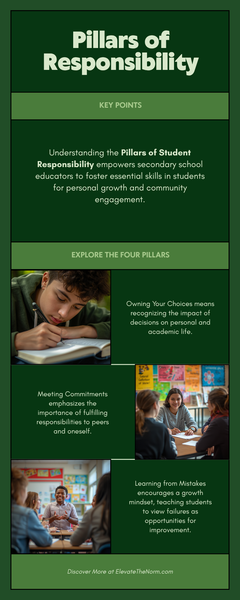
By building structures that make it observable. Team contracts, revision trackers, self-assessment forms, and student-led conferences all make responsibility visible because they create records of what students committed to and what they actually did. When responsibility is only implied—show up, try hard, be good—students cannot develop it systematically. When it is made concrete and specific, students know what it looks like and teachers can respond to it clearly.
Sources
- Ryan, R. M., & Deci, E. L. (2000). Self-determination theory and the facilitation of intrinsic motivation, social development, and well-being. American Psychologist, 55(1), 68–78.
- Damon, W. (1995). Greater expectations: Overcoming the culture of indulgence in our homes and schools. Free Press.
- Collaborative for Academic, Social, and Emotional Learning (CASEL). (2023). Fundamentals of SEL. CASEL.
- Weissberg, R. P., Durlak, J. A., Domitrovich, C. E., & Gullotta, T. P. (Eds.). (2015). Social and emotional learning: Past, present, and future. In J. A. Durlak, C. E. Domitrovich, R. P. Weissberg, & T. P. Gullotta (Eds.), Handbook of social and emotional learning: Research and practice. Guilford Press.
- Battistich, V. A. (2008). Character education, prevention, and positive youth development. In L. Nucci & D. Narvaez (Eds.), Handbook of moral and character education. Routledge.
About Clay Shumate
Clay Shumate is a certified secondary Social Studies teacher in the public schools of West Alabama, with seven years of classroom experience, a B.A. in History, and an M.Ed. in Secondary Education. He writes about project-based learning, student responsibility, respect, and practical ways to hold young people to a higher standard while giving them room to learn from mistakes. He is a member of the Society of Professional Journalists and writes to its Code of Ethics; this site’s editorial standards and corrections policy are published in full. More about Clay.