By Clay Shumate
Vocabulary instruction is the explicit teaching of word meanings and of strategies for figuring out unfamiliar words. In grades 6–12 it reliably improves comprehension of the text that carries the taught words, and barely moves standardized reading scores. The version that works is one or two essential words per text, taught through use, not a weekly list of ten.
Key Takeaways
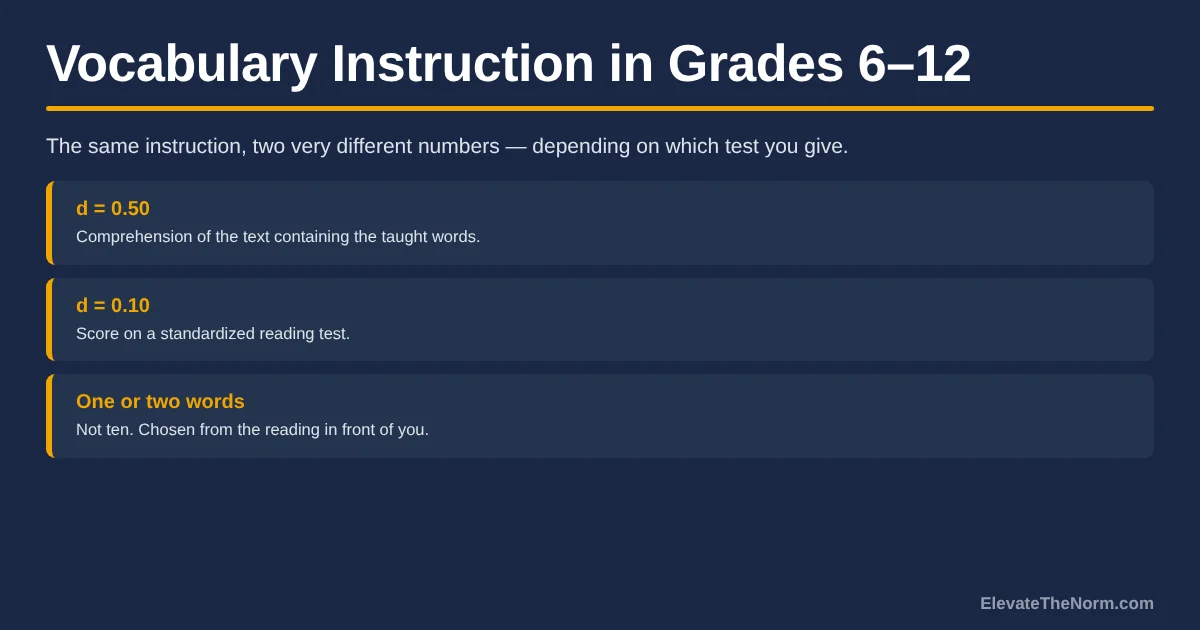
- The same vocabulary instruction produces two very different numbers depending on which test you give. Across 37 studies, Elleman and colleagues found an effect of d = 0.50 on comprehension measures built for the study and d = 0.10 on standardized reading tests.
- Students who struggle with reading gain the most. On those study-built measures, controlling for method variables, students with reading difficulties gained d = 1.23 against d = 0.39 for students without — more than three times as much — while gains on the vocabulary tests themselves were similar for both groups.
- The federal practice guide for grades 4–9 tells you to teach one or two essential words before a text, not a list. Its comprehension recommendation carries a strong evidence rating on 34 studies.
- A school-randomized trial of academic vocabulary across 28 schools and 1,554 students in grades 6–8 moved the taught words (g = 0.25) and did nothing measurable to general vocabulary. What it moved most was the quality of classroom discussion (d = 0.62).
- Teaching one or two word-attack strategies is the part with the least support. A review of 36 studies found no empirical evidence that it improves general comprehension. Context clues as a standalone unit is the weakest thing on most vocabulary plans.
Walk into most secondary classrooms the week before a unit test and you will find a vocabulary list. Ten words, definitions copied, sentences written, quiz Friday. It is the most common literacy practice in grades 6–12 and it is mostly a waste of a class period.
That is not an argument against teaching words. The research on vocabulary is better than the research behind most things teachers are told to do. It is an argument against the format and the promise attached to it.
What is vocabulary instruction?
Vocabulary instruction is the deliberate teaching of word meanings and of strategies for working out unfamiliar words, as opposed to leaving students to pick up words from reading and talk alone. It splits into two things researchers treat separately: direct teaching of specific word meanings, and teaching generalizable word-learning strategies like using context or breaking a word into parts.
That distinction matters more than any brand-name routine, because the two halves have very different track records. Direct teaching of specific words has a good one; strategy teaching on its own does not. Most programs sell both in the same box.
You will also hear words sorted into tiers — Tier 1 everyday, Tier 2 high-utility academic words that cross subjects, Tier 3 technical words belonging to one discipline. That comes from Isabel Beck and Margaret McKeown’s work and it is a useful way to triage a reading. It is a sorting scheme, not a finding: no effect size attaches to it.
Does vocabulary instruction actually improve reading comprehension?
It improves comprehension of the passage containing the taught words, consistently and by a lot. It barely improves performance on a standardized reading test. Elleman and colleagues meta-analyzed 37 vocabulary intervention studies from pre-K through grade 12 and found d = 0.50 on comprehension measures designed for the study and d = 0.10 on standardized measures.
Read those two numbers together and the field makes sense. Teaching a student mercantilism helps that student read a passage about mercantilism. It does not make them a better reader of a passage about tide pools.
| What you measure | Effect of vocabulary instruction | What that means for your Monday |
|---|---|---|
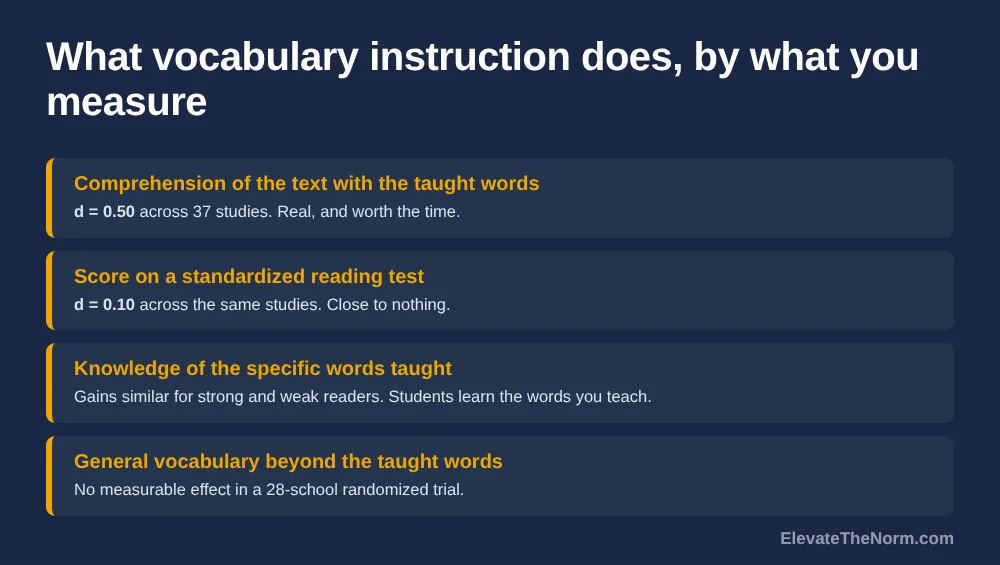
| Comprehension of the text containing the taught words | d = 0.50 across 37 studies | Real and worth the time. This is the claim to make. |
| Score on a standardized reading test | d = 0.10 across the same studies | Close to nothing. Do not promise this to an administrator. |
| Knowledge of the specific words taught | Gains similar for strong and weak readers | Reliable. Students learn the words you teach. |
| General vocabulary beyond the taught words | No measurable effect in a 28-school randomized trial | Word lists do not grow a student’s overall word stock. |
Wright and Cervetti’s 36-study review lands in the same place from a different direction: teaching word meanings supported comprehension of the texts containing those words in almost every study, while evidence for generalized comprehension was — in their words — very limited, even in long interventions covering many words. They also could not determine how much instruction per word is enough, which is worth noticing in a field full of six-step routines.
So the defensible claim is narrow and still useful: vocabulary instruction is how you make a hard text readable, not a lever on reading ability. Which leaves a procurement question worth asking out loud. If a program’s own evidence rests on measures it built, the claim you can hold it to is students understand assigned texts better, measured on your own unit assessments. That is a real, checkable commitment. A state-test target written into a vocabulary plan is a commitment the published evidence says will not be met, and writing it down anyway sets up the teachers delivering it to take the blame.
How many vocabulary words should you teach per week?
Far fewer than most schedules assume. The federal practice guide for grades 4–9 recommends selecting one or two essential words to teach before a reading — words that are critical to the passage and likely to be hard — then giving quick meanings for other important words as they come up, so reading is not interrupted.
One or two. Not ten. And run the arithmetic from the student’s side before defending the list: a seventh grader with six teachers who each assign ten words is handling sixty words a week, none of which were chosen with the others in mind. No adult in the building carries that load. The reasoning is not that students cannot learn ten words; it is that deep instruction on two words costs about as much class time as shallow instruction on ten and produces something students can actually use. Wright and Cervetti found that instruction involving active processing generally beat definitions and dictionary work for understanding the text, which is precisely what a ten-word list has no room for.
You will see other credible guidance say three or four, and the difference is worth naming rather than hiding. Elsewhere on this site, the digital reading routine budgets two minutes for three or four pre-taught words, because a screen reading loses the edges a printed page gives for free and the words are part of what a Lexile measure is detecting. The practice guide is stricter because it is describing deep instruction on an essential word, not a quick gloss. Both can hold at once: one or two words get the full treatment, and another two or three get five seconds each. What nobody’s evidence supports is fifteen.
That guide’s broader comprehension recommendation is rated strong on 34 studies, 23 of which met What Works Clearinghouse standards without reservations. One caveat worth stating: the guide covers grades 4–9, so the top half of a secondary teacher’s roster sits outside its range. Nothing in it is implausible for grades 10–12, but it has not been tested there.
There is also a reason not to despair about the arithmetic. Hiebert, Goodwin and Cervetti mapped a core vocabulary of 2,451 morphological families containing 11,298 words, and found those families account for about 89 percent of the words in texts pitched at grade 11 and college readiness. By middle school roughly 20 percent of the distinct words in a text sit outside that core; in high school it is about 25 percent. That is the real size of the problem. It is not an infinite list, and it is not two words either.
Those two numbers are in open tension and the honest thing is to say so. If a quarter of the distinct words in a high school text sit outside the core vocabulary, teaching one or two words per reading cannot possibly close that gap. Both claims are still true, because they answer different questions. The one-or-two rule is about the words that block comprehension of this passage, which is a problem instruction can solve this week. The long-run size of a student’s word stock is a different problem, and the evidence above does not show that any amount of word-list instruction solves it — the 28-school trial found exactly nothing on general vocabulary after a full year. Anyone who tells you a vocabulary curriculum closes the word-gap is going beyond what has been measured.
Which words should you choose for instruction?
Choose the words that carry the meaning of this text and that students will meet again. A word qualifies if removing it would break a student’s understanding of the passage. That test does more work than any tier chart, because it is answered by the reading in front of you rather than by a list someone else made.
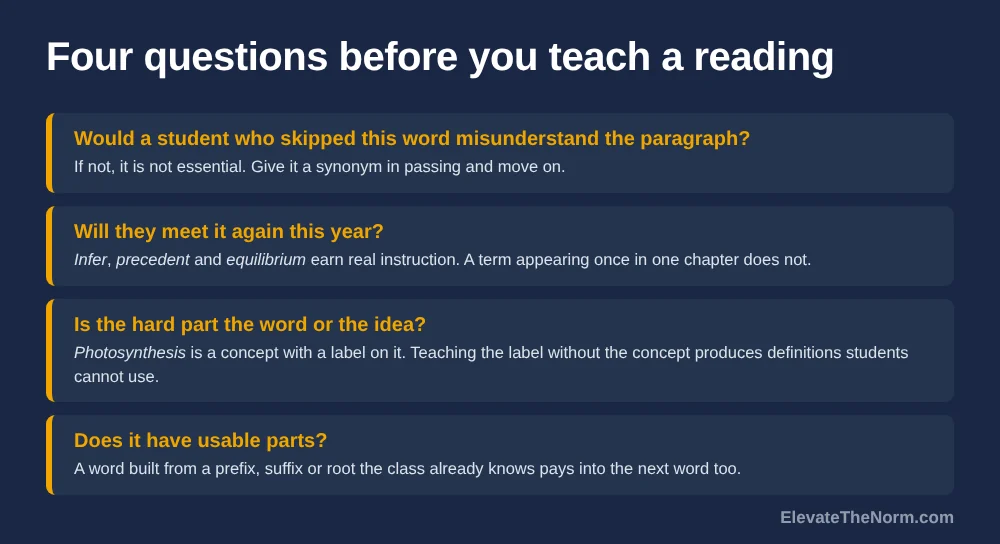
Four questions to run over a reading before you teach it:
- Would a student who skipped this word misunderstand the paragraph? If not, it is not essential. Give it a synonym in passing and move on.
- Will they meet it again this year? Infer, precedent and equilibrium earn real instruction. A term appearing once in one chapter does not.
- Is the hard part the word or the idea? Photosynthesis is a concept with a label on it. Teaching the label without the concept is how students write definitions they cannot use.
- Does it have usable parts? A word built from a prefix, suffix or root the class already knows is worth teaching twice over, because it pays into the next word too.
The guide’s sequence on word parts is worth keeping: common prefixes and suffixes first, then Latin and Greek roots, using word maps. Prefixes and suffixes are regular and few. Roots are neither.
What does vocabulary instruction look like in a grades 6–12 content classroom?
It looks like about four minutes before the reading, a few seconds during it, and one short task a week after it. Here is the routine the practice guide describes, written as steps you can run tomorrow in history, biology, algebra or English.
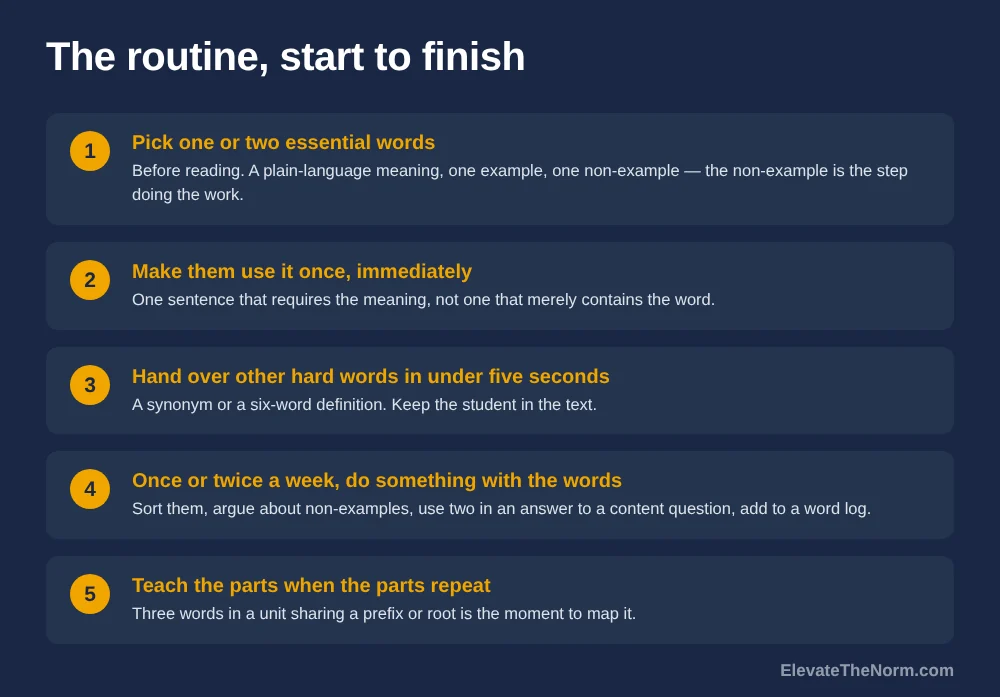
- Before reading, pick one or two essential words. Give a student-friendly meaning in plain language — not the dictionary entry. Then give one example and one non-example, because the boundary is where the meaning lives. A precedent is an earlier decision that sets a pattern for later ones. The first state to lower a voting age sets a precedent. A state that lowers it afterward is following one. The non-example is the step teachers skip and it is the one doing the work — a student who can tell you what does not count has the boundary, and a student with only the definition usually does not.
- Make students use it once, immediately, out loud or in writing. One sentence that requires the meaning, not one that merely contains the word. “Name something in this chapter that set a precedent and say what followed it” works. “Use precedent in a sentence” produces “The precedent was very important.”
- During reading, hand over other hard words in under five seconds. A synonym or a six-word definition. The point is to keep the student in the text, not to teach a second word.
- Once or twice a week, make them do something with the words. Sort them, argue about non-examples, use two in an answer to a content question, add them to a running word log. This is the active processing that the reviews found outperforms definitions.
- Teach the parts when the parts repeat. When three words in a unit share a prefix or a root, stop and map it. That is the only point at which strategy instruction has an argument behind it.
On prep cost: the only real labor here is reading the text as a student would and marking the words that would stop one. That takes about ten minutes the first time you teach a reading and nothing at all afterwards, provided you keep the marked copy. If you teach six sections of two courses, you are marking two readings, not twelve.
Notice what is missing: the quiz. Keep one if your gradebook needs it, but do not confuse it with the instruction — matching ten words to ten definitions on Friday demonstrates the one thing the research says transfers least. So collect different evidence. The question worth answering is whether a student can answer a content question that cannot be answered without the word. “Which of these decisions set a precedent, and what followed from it?” tells you something a matching quiz cannot. That is also the easiest thing for a coach or an administrator to look for in a ten-minute walkthrough: not whether words are posted, but whether a student had to use one on the content inside the first fifteen minutes.
If you already run regular checks on understanding, this folds into them rather than adding a system. The same logic drives formative assessment strategies for reading: find out what the text actually cost students before you move past it. And when a class spans a wide range of reading levels, the word-choice question above is one of the cleanest places to differentiate instruction without writing two lesson plans.
Do word-learning strategies like context clues and roots actually work?
Teaching one or two word-attack strategies has the weakest evidence in the whole field. Wright and Cervetti’s review of 36 studies found no empirical evidence that teaching one or two strategies for working out word meanings improves generalized comprehension. That is a null result on the practice most schools spend the most instructional time on.
This deserves care, not a victory lap: null evidence for a narrow version of a practice is not proof the practice is useless. What the reviewers found promising was the fuller version — teaching students to monitor whether they understand a word and move flexibly among several strategies rather than drilling one. They call that a promising direction for future research, which means nobody has shown it works yet either.
The practical read: a September context-clues unit that never comes back is the unsupported version. Prefixes and roots taught at the moment three words in a unit share them, repeatedly across a year, is the version with an argument. One is a week of lessons. The other is thirty seconds, forty times.


Why doesn’t vocabulary instruction raise standardized reading scores?
Because a standardized reading test samples the whole language while your instruction samples your unit. Teach forty words well in a semester and a student knows forty more words, against a test drawing from tens of thousands. The signal is real and it is swamped.
The Word Generation trial shows this cleanly. Lawrence, Crosson, Paré-Blagoev and Snow randomly assigned schools within matched pairs across two districts — 28 schools, 1,554 students in grades 6–8 with pre- and posttest, one full school year, delivered by whole grade-level teams. A significant effect on the taught academic words (Hedges’ g = 0.25), and no significant effect on general vocabulary on the Gates–MacGinitie, estimated at roughly −0.01.
The most interesting finding there was not about words. Discussion quality improved substantially in treatment schools — d = 0.62 overall and d = 1.13 in math — and mediated about 14 percent of the effect on word learning. A vocabulary program’s most visible consequence was that students argued about ideas more often.
The authors are candid about the study’s weaknesses, and they matter: posttest completion was 49 percent in treatment schools and 35 percent in control schools, treatment schools started with higher vocabulary scores, observers could not be blinded, and the word test covered only 36 of the 120 words taught. Attrition at that level can bend a result in either direction. Read g = 0.25 as a reasonable estimate rather than a settled number.
Which students gain the most from vocabulary instruction?
Students who struggle with reading, by a wide margin. In Elleman’s meta-analysis, looking only at the study-built comprehension measures and controlling for method variables, students with reading difficulties gained d = 1.23 against d = 0.39 for students without reading problems. More than three times the benefit from the same instruction.
Two qualifications. That contrast comes from the custom measures, the generous end of the evidence. And gains on the vocabulary tests were similar regardless of reading ability — both groups learned the words. The difference was in what the words did for comprehension, which points at word knowledge being the binding constraint for the weaker readers and not the stronger ones. Across studies reporting both outcomes the correlation between vocabulary effects and comprehension effects was r = 0.43 — modest. Learning the words helps; it is not the only thing in the way.
What about English learners, and classes where reading levels vary widely?
The honest answer on English learners is that this article cannot give you one. It is one of the most common things teachers ask about vocabulary. Neither review above reports results for English learners as a subgroup, and no English-learner-specific source was read for this article, so nothing here is an evidence claim about them. If somebody hands you a vocabulary program marketed on its results for English learners, ask which studies and which measures — and expect the custom-versus-standardized gap to show up there too.
For a class with a wide spread of reading levels, word selection is the cheapest lever you have: the same two words serve everybody while the amount of support varies. That is the logic behind differentiated instruction strategies generally: change the scaffold, not the destination.
And there is a real risk attached to the finding that weaker readers gain most, worth naming before a district acts on it. “Front-load vocabulary where reading is hardest” is a sound instructional read. “Those classes do words while the honors classes do ideas” is how that read turns into a lower-rigor track, and nothing in this evidence supports it. Elleman’s finding is that word knowledge was the binding constraint for those readers on the taught text — remove it and they are reading the same text about the same ideas. The whole point of clearing the word is to get to the argument.
If a parent asks why the weekly list went away, the one-sentence version is: the list taught words for a Friday quiz, and we would rather spend that time making sure the reading itself is understandable. For what a parent can do at home, the truthful answer is that no source in this article tests home vocabulary work, so treat any specific routine as a guess. Talking about what a kid read, in ordinary language, is a reasonable thing to do and is not a studied intervention.
Clay’s take: the list is a ritual, and rituals are hard to kill
The ten-word Friday list survives for reasons that have nothing to do with learning: easy to assign, easy to grade, easy to show a parent, and it produces a number in the gradebook every week. Those are real problems. None of them is comprehension. The honest version is smaller and harder to show off. Two words taught properly before a hard reading. A few seconds of definition handed over during it so nobody stalls. One short task a week using the words on content. That is the whole thing, and it fits in the margins of a lesson you were already teaching.
Where I would push back: the standardized-test number gets used to argue vocabulary work does not matter, and that is a misreading. A d of 0.10 on a test of everything is perfectly compatible with a d of 0.50 on the text in front of the student — and the text in front of the student is the job. A student who can read today’s document can participate in today’s class, and participation is not a consolation prize. It is the condition for everything else.
And the thing I would not do is use a vocabulary gap as an explanation for a student’s behavior or ceiling. The evidence says word knowledge was the binding constraint for weaker readers on the taught text. It says nothing about what those students can do. Treat the gap as a thing you remove from in front of them, not as a description of them. Students hear the difference immediately. A room where hard words get handed over without comment is a room where asking is normal; a room where not knowing a word is treated as a finding about you is a room where students stop asking and start guessing.
What to do next
Pick the hardest reading on next week’s plan. Read it as a student would and mark every word that would stop one. Cut the list to the one or two that carry the paragraph, write a plain-language meaning plus one non-example for each, and plan the thirty seconds where students have to use them. Keep a word log for the unit and spend five minutes on Friday making students do something with it other than recite.
If you want the rest of the system this sits inside, the list of formative assessment strategies covers how to find out what a text cost before you move on, digital reading strategies for students deals with the screen-reading problem that makes hard words easier to skip, and formative assessment strategies for listening covers the half of comprehension that never gets checked. And if the hardest readings in your course are documents rather than textbook pages, primary source analysis covers how to excerpt and frame them so the words are not the obstacle. Everything on this site is free and nothing asks for your email address.
Frequently Asked Questions
What is vocabulary instruction?
Vocabulary instruction is the deliberate teaching of word meanings and of strategies for working out unfamiliar words, rather than leaving students to absorb words from reading alone. Researchers split it into direct teaching of specific word meanings and teaching generalizable word-learning strategies. The two halves have very different evidence behind them, with direct teaching of specific words faring much better than strategy instruction.
How many vocabulary words should I teach per week?
The federal practice guide for grades 4-9 recommends selecting one or two essential words to teach before a reading, then giving quick meanings for other important words as they appear so reading is not interrupted. One or two taught deeply costs about the same class time as ten taught shallowly and leaves students with something they can use. Add one short word task once or twice a week.
Does vocabulary instruction improve reading comprehension?
It improves comprehension of the text containing the taught words. Across 37 studies, Elleman and colleagues found d = 0.50 on comprehension measures built for the study and only d = 0.10 on standardized reading tests. So vocabulary instruction is a reliable way to make a specific hard text readable, and a weak lever on general reading ability.
Which words should I choose for vocabulary instruction?
Choose words that carry the meaning of the passage and that students will meet again. The working test is whether a student who skipped the word would misunderstand the paragraph. High-utility academic words that cross subjects, such as infer, precedent or equilibrium, earn real instruction. A technical term that appears once in one chapter usually does not.
Do context clues and root words actually work?
A review of 36 studies found no empirical evidence that teaching one or two strategies for working out word meanings improves generalized comprehension. The version with more promise, which the reviewers call a direction for future research rather than a finding, teaches students to monitor their own understanding and move flexibly among several strategies. A one-off context-clues unit is the weakest part of most vocabulary plans.
Which students benefit most from vocabulary instruction?
Students who struggle with reading. On study-built comprehension measures, controlling for method variables, students with reading difficulties gained d = 1.23 against d = 0.39 for students without reading problems. Both groups learned the taught words at similar rates, so the difference was in what knowing the words did for their comprehension of the passage.
Is Marzano’s six-step vocabulary process evidence-based?
Treat named routines carefully. The reviews find that instruction involving active processing beats definitions and dictionary work for understanding the text, which supports the general shape of multi-step routines. What the research does not establish is how much instruction per word is enough, or that any specific branded sequence outperforms another. Wright and Cervetti say so directly.
Will a vocabulary program raise our state reading scores?
Probably not measurably. A school-randomized trial across 28 schools and 1,554 students in grades 6-8 found a significant effect on the academic words taught and no significant effect on general vocabulary. A standardized test samples the whole language while your instruction samples your unit. Promise better comprehension of assigned texts instead.
Sources
- Elleman, A. M., Lindo, E. J., Morphy, P., & Compton, D. L. (2009). The impact of vocabulary instruction on passage-level comprehension of school-age children: A meta-analysis. Journal of Research on Educational Effectiveness, 2(1), 1–44. 37 studies, pre-K through grade 12. d = 0.50 custom comprehension measures, d = 0.10 standardized; reading difficulties d = 1.23 vs. d = 0.39 on custom measures controlling for method variables; r = 0.43 between vocabulary and comprehension effects. Read at ERIC abstract level — the full article is paywalled, so no figure beyond those reported in the abstract is quoted here, and the grade distribution across the 37 studies is not reported.
- Wright, T. S., & Cervetti, G. N. (2017). A systematic review of the research on vocabulary instruction that impacts text comprehension. Reading Research Quarterly, 52(2), 203–226. 36 studies. Teaching word meanings supported comprehension of texts containing the taught words in almost all cases; active processing beat definitions and dictionary use; evidence for generalized comprehension very limited; no evidence that teaching one or two word-solving strategies improves generalized comprehension; amount of instruction needed indeterminate. Read via the ERIC record and the University of Michigan Deep Blue repository record; the Wiley full text is paywalled.
- Institute of Education Sciences / What Works Clearinghouse (2022). Providing Reading Interventions for Students in Grades 4–9 (WWC 2022007). Recommendation 3 (“Routinely use a set of comprehension-building practices”) rated strong on 34 studies, 23 meeting WWC standards without reservations and 11 with reservations. Part A specifies selecting one or two essential words before reading, brief meanings during reading, word work once or twice a week with a word log, and prefixes and suffixes before Latin and Greek roots. Covers grades 4–9; grades 10–12 are outside its tested range. Full guide read.
- Lawrence, J. F., Crosson, A. C., Paré-Blagoev, E. J., & Snow, C. E. (2015). Word Generation randomized trial: Discussion mediates the impact of program treatment on academic word learning. American Educational Research Journal, 52(4), 750–786. Schools randomized within matched pairs in two districts; 28 schools, 1,554 students grades 6–8 with pre- and posttest, one school year. Taught academic vocabulary g = 0.25 (p < .01); general vocabulary (Gates–MacGinitie) not significant; discussion quality d = 0.62 overall and 1.13 in math; discussion mediated about 14 percent of the effect. Authors’ stated limitations include posttest completion of 49 percent (treatment) and 35 percent (control), higher treatment-school pretest scores, unblinded observers, and a word test covering 36 of 120 taught words. Full text read.
- Hiebert, E. H., Goodwin, A. P., & Cervetti, G. N. (2018). Core vocabulary: Its morphological content and presence in exemplar texts. Reading Research Quarterly, 53(1). 2,451 morphological families containing 11,298 words; coverage of 97.1 percent of tokens in grades K–1 exemplar texts falling to 89.1 percent at grade 11/college-and-career-ready, and 95.6 percent to 74.9 percent for unique words; roughly 20 percent of unique words outside the core by middle school and 25 percent in high school. Read as the authors’ pre-copyedit manuscript posted by TextProject.
- Tier 1/2/3 word classification is attributed to Beck and McKeown’s work on robust vocabulary instruction and is described above as a sorting framework rather than an evidenced intervention. No effect size is claimed for it here, and no source above tests it against an alternative.
- The four word-selection questions and the example wording for precedent are written for this article to illustrate the practice guide’s criteria. They are worked examples, not findings, and not a report of any teacher’s classroom.