By Clay Shumate
Formative assessment strategies for listening are quick, ungraded checks that reveal what students actually took from something they heard — a lecture, a video, a classmate’s argument, a podcast. They work the same way a reading check does: ask for a specific response, read it fast, and change the next ten minutes based on what you see.
Listening is the one language skill almost every secondary standards document asks for and almost no secondary gradebook contains. This page gives seven checks that fit a real class period, the honest size of the research behind them, and where that research runs out.
Key Takeaways
- A listening check has to ask for something only a listener could produce. “Any questions?” is not a check. “Write the speaker’s strongest piece of evidence and the weakest one” is, because a student who tuned out cannot fake it.
- The standards already require it. The Common Core speaking and listening standards for grades 9–10 ask students to integrate information from diverse media “evaluating the credibility and accuracy of each source” and to evaluate a speaker’s “point of view, reasoning, and use of evidence and rhetoric.” Those are listening tasks with no listening assessment attached in most courses.
- 🔴 The honest effect size for formative assessment is around 0.20, not the 0.4 to 0.7 people quote. That comes from a meta-analysis of 13 studies, and a published erratum later corrected its subject-level numbers after eight science studies were found miscoded as reading.
- 🔴 The English language arts figure everyone cites rests on four effect sizes. After correction, the meta-analysis reports ELA at 0.32 from n = 4, mathematics at 0.17 from n = 19, and science at 0.19 from n = 17. Four is not a strong basis for a subject-level claim and should not be treated as one.
- The best listening-instruction evidence is not from a secondary content classroom. The strongest single study taught second-language learners how to listen and found less-skilled listeners gained most. That is a real result and it is not a grades 6–12 social studies result.
Free Download · PDF
Listening Check Planner
A two-page printable: all seven checks with what each one reveals, a decision-rule worksheet to fill in before you collect anything, the three-pile sort, and the three access decisions to make in advance.
Free. No email address required. Designed for grades 6–12. Browse every printable in Your Free Library.
What Are Formative Assessment Strategies for Listening?
A formative assessment strategy for listening is any low-stakes task that makes a student’s comprehension of spoken input visible while you can still do something about it. The input is the thing that distinguishes it: not a text the student can re-read, but speech that happened once.
That constraint is the whole design problem. A reading check can always send the student back to the page. A listening check cannot, which means two things. The task has to be answerable from what was heard rather than from what can be looked up, and it has to come close enough to the listening that the student still has it. Ten minutes later you are assessing memory.
Everything else is the same machinery you already use for reading checks and writing checks: a prompt narrow enough to read in seconds, a decision rule for what you do with each kind of answer, and no grade attached.
Why Does Listening Go Unassessed in Most Secondary Classrooms?
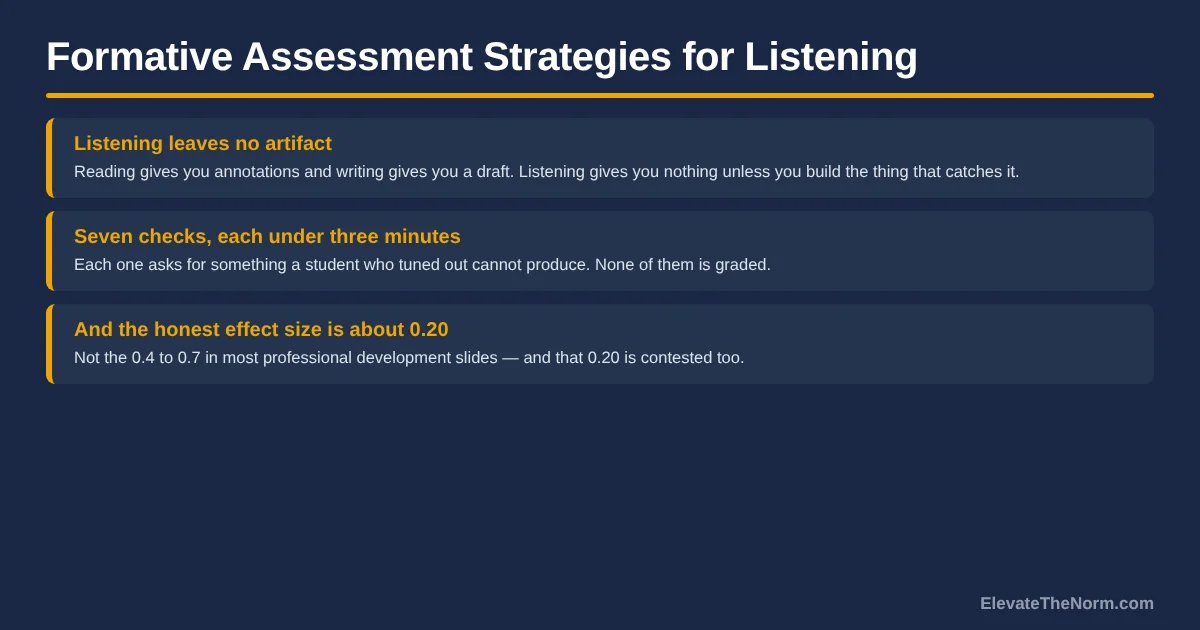
Because listening has no artifact. Reading produces annotations, writing produces a draft, and both leave something a teacher can collect. Listening produces nothing unless the teacher builds the thing that catches it, and nobody is required to.
The standards do ask for it. The grades 9–10 speaking and listening standards, as published in state implementation documents including the New Mexico Public Education Department’s standards breakdown, include:
- SL.9-10.2 — “Integrate multiple sources of information presented in diverse media or formats” while “evaluating the credibility and accuracy of each source.”
- SL.9-10.3 — “Evaluate a speaker’s point of view, reasoning, and use of evidence and rhetoric, identifying any fallacious reasoning or exaggerated or distorted evidence.”
Read SL.9-10.3 again as a teacher. That is a hard analytical task, performed in real time, on speech. It appears on no common assessment I have seen, in no benchmark, and in no gradebook category. It gets taught when a teacher happens to run a debate and assessed when a teacher happens to notice.
Clay’s take: the gap is not laziness, it is accounting. Teachers assess what gets reported, and listening does not get reported. If you want it to exist in your room, you have to decide it exists and build four or five checks that take under three minutes. Nobody is coming to require it of you, and the students who most need the practice — the ones who can decode a page but go blank in a discussion — are invisible until you look.
Which Seven Listening Checks Fit a Real Class Period?
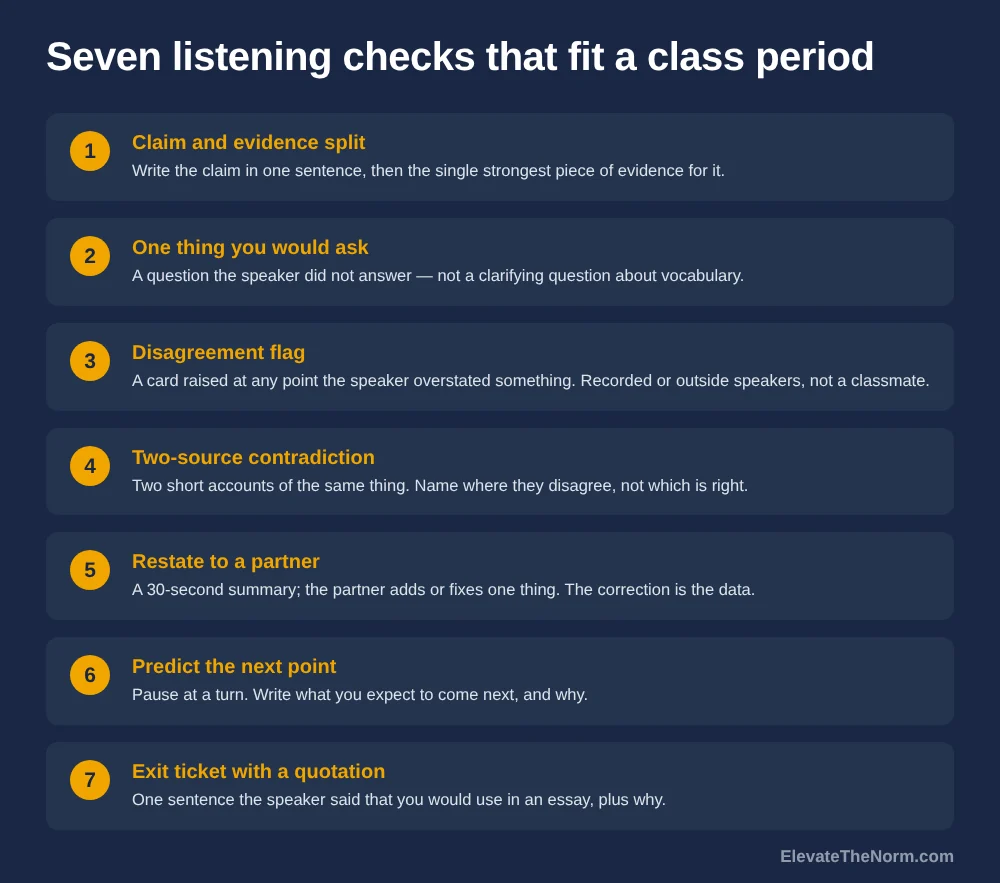
Seven checks, each under three minutes, each asking for something a non-listener cannot produce. None of them is graded.
| # | The check | What it actually reveals | Time | What it costs you |
|---|---|---|---|---|
| 1 | Claim and evidence split. After a speaker or clip: write the claim in one sentence, then the single strongest piece of evidence for it. | Whether the student separated an argument from its support, or heard one undifferentiated block | 2 min | Nothing to prepare; you must read fast |
| 2 | One thing you would ask the speaker. A question the speaker did not answer, not a clarifying question about vocabulary. | Whether the student tracked the argument well enough to find its hole | 90 sec | Students default to clarifying questions until you model the difference twice |
| 3 | Disagreement flag. Students raise a card at any point they think the speaker overstated something, then two of them say why. Run this on recorded or outside speakers, not on a classmate presenting. | Real-time evaluation — the SL.9-10.3 skill — rather than after-the-fact recall | Live, 0 extra min | Needs a norm set in advance; aimed at a student presenter it is a public critique, not a check |
| 4 | Two-source contradiction. Play or read two short accounts of the same thing. Students name where the two disagree, not which is right. | SL.9-10.2 directly; also exposes students who assume all sources agree | 3 min | You need two genuinely conflicting short sources ready |
| 5 | Restate to a partner, partner corrects. Student A summarizes in 30 seconds; Student B adds or fixes one thing; you listen to three pairs. | Gaps you would never see on paper, because the correction is the data | 2 min | A spot check, not coverage — and it makes one student’s gap visible to another, so pair deliberately |
| 6 | Predict the next point. Pause a lecture or clip at a turn and have students write what they expect to come next and why. | Whether the student is following a structure or collecting facts | 60 sec | You have to know your own material’s structure well enough to pick the pause |
| 7 | Exit ticket with a quotation. One sentence the speaker said that the student would use in an essay, plus why. | Attention to language, and it doubles as evidence collection for later writing | 2 min | Students paraphrase instead of quoting unless you insist on the actual words |
Pick two. Run them until they are routine, then add a third. Seven at once is a project, and projects get abandoned in October.
Start with 1 and 7. Both are written, individual, and require no new norms, so you can run them tomorrow without teaching a procedure first. Checks 2 and 6 need one round of modelling, because students will produce clarifying questions and plot guesses until they see what you are actually after. Checks 3, 4 and 5 need a norm or a prepared source and belong in week three, not week one.
Grade band changes the prompt more than the check. In grades 6–8 the claim-and-evidence split works better as two separate questions asked one at a time, and 30 seconds of partner restatement is plenty. By grades 11–12 you can hand students check 4 with two conflicting sources and no framing at all, which is closer to what SL.9-10.2 is actually describing.
What About Students Who Cannot Access the Listening?
Design the access in before you run the check, because a listening task assesses hearing and language processing along with comprehension, and you will not be able to tell the three apart afterwards.
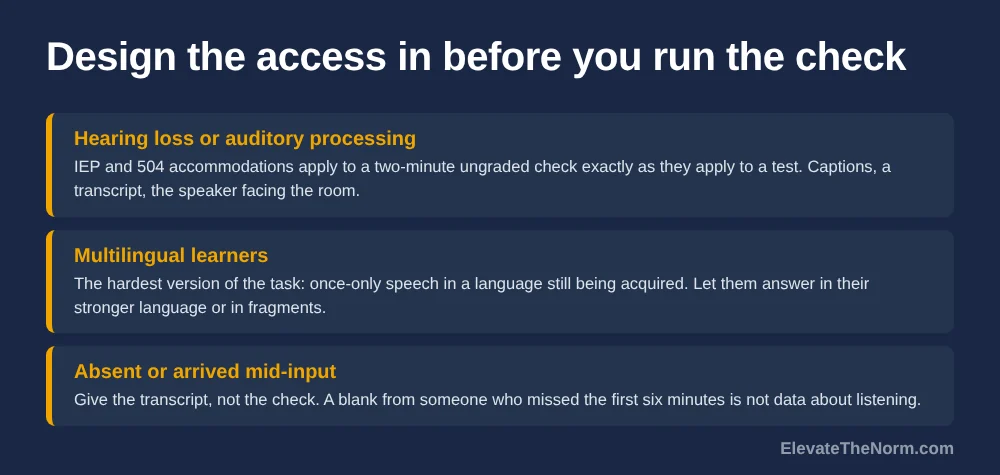
Three groups need a decision made in advance rather than improvised. Students with hearing loss or auditory processing needs have accommodations in an IEP or 504 plan, and those apply to a two-minute ungraded check exactly as they apply to a test — captions on anything recorded, a transcript available, preferential seating, and the live-speech checks run with the speaker facing the room. Multilingual learners are being asked to do the hardest version of the task: comprehend once-only speech in a language they are still acquiring. Let them write the response in their stronger language or in fragments, and judge the content rather than the English. Students who were absent or arrived mid-input should be given the transcript rather than the check; a blank from someone who missed the first six minutes is not data about listening.
None of that costs prep time if you decide it once. All of it is invisible if you do not, and the students it affects will land in the “missed it” pile for reasons that have nothing to do with attention.
Does Formative Assessment Actually Raise Achievement?
Modestly, and the real number is smaller than the one in most professional development slides. The widely quoted range of 0.4 to 0.7 standard deviations does not come from a meta-analysis. The best available meta-analytic estimate is about 0.20.
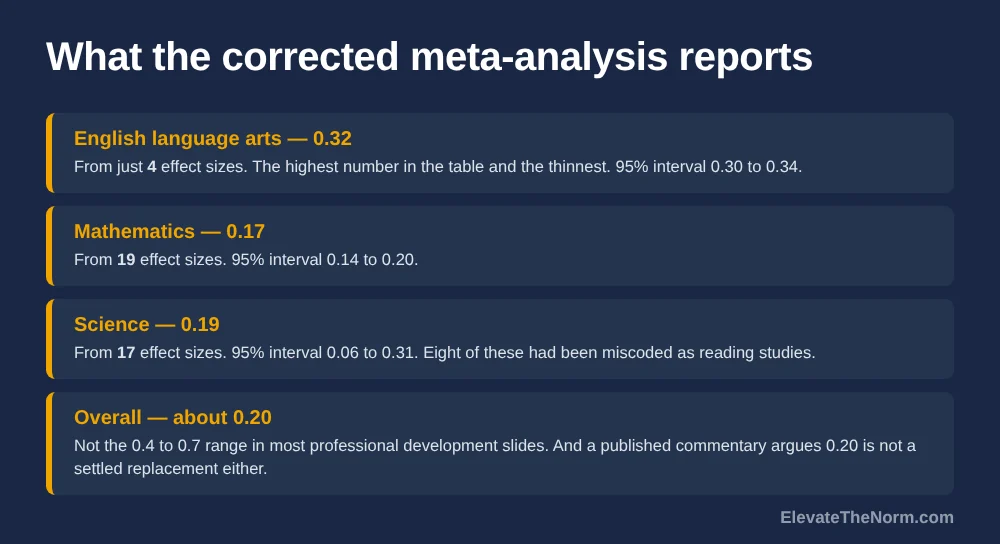
That figure comes from Kingston and Nash’s meta-analysis in Educational Measurement: Issues and Practice, which found a median effect of 0.25 and a random-effects mean of 0.20 across 42 effect sizes drawn from just 13 studies. Then it got more interesting. A published erratum in the same journal reported that eight science studies had been miscoded as reading studies — an error the erratum credits Paul Black with catching. The corrected subject-level table is worth reading carefully:
| Subject | Effect sizes (n) | Corrected mean effect | Corrected 95% interval |
|---|---|---|---|
| English language arts | 4 | 0.32 | 0.30 to 0.34 |
| Mathematics | 19 | 0.17 | 0.14 to 0.20 |
| Science | 17 | 0.19 | 0.06 to 0.31 |
Two things follow, and both matter for anyone planning to assess listening in an English or social studies room. First, the ELA figure rests on four effect sizes. It is the highest number in the table and the thinnest. Anyone citing “formative assessment works best in ELA” is citing four studies. Second, the correction changed the comparison: before it, ELA ran about three times science; after it, science sits at 0.19 against ELA’s 0.32. The erratum states that both of the original article’s main conclusions still hold — an overall effect of about 0.20, and a need for more and better research.
And there is a serious methodological challenge to the 0.20 itself. A commentary by Briggs, Ruiz-Primo, Furtak, Shepard and Yin argued the search strategy was not replicable, that the inclusion criteria were applied inconsistently — two studies meeting the stated criteria were left out, one of them reporting 0.88 — and that mixing effect-size formulas across studies shifted the estimates. Their conclusion is the one to carry into a staff meeting: the 0.4 to 0.7 range is overstated, and 0.20 should not be treated as a settled replacement, because “considerable uncertainty remains.”
That is not a reason to skip the checks. A 0.20 effect from a two-minute routine that costs no prep is a good trade. It is a reason not to promise anyone a transformation.


What Does the Research Say About Teaching Students to Listen?
The strongest single finding is that explicitly teaching the listening process helps, and helps weaker listeners most — but the study was run on second-language learners, not on content-area secondary students, and that distinction has to travel with the finding.
Vandergrift and Tafaghodtari, in Language Learning, worked with 106 learners of French as a second language in six intact course sections taught by the same teacher, 59 in the experimental group and 47 in the control. Over one semester the experimental group was walked through the listening process itself — predicting, monitoring, evaluating, problem-solving — while the control group heard the same texts the same number of times without that guidance. The experimental group significantly outperformed the control on the final comprehension measure, and the less-skilled listeners in the experimental group gained more than their stronger peers. The published record for the study reports no effect size, only that the difference was significant, so treat the size of it as unknown.
Read the population honestly. These were second-language learners being taught to listen in a language they were still acquiring. That is the group with the most room to move, and it is not a tenth grader listening to a lecture in their first language. What transfers is the mechanism — naming the process, giving students something to do while listening rather than after — not the magnitude.
The broader evidence is also softer than it looks. The Education Endowment Foundation rates oral language interventions at an average of +6 months of additional progress from 188 identified studies, with evidence security rated high. Four caveats come straight off that page and all four matter here: the impact is measured mainly through reading comprehension tests rather than listening; more of the studies sit in early years and primary than in secondary; the topic lost a padlock because many studies were not independently evaluated and provider-run evaluations tend to report larger effects; and the EEF says plainly that the listening-only evidence base is smaller, while noting it may be particularly effective. “May be” is the operative phrase and it is theirs, not mine.
How Do You Run These Without Reading 120 Responses?
You do not read them all. A formative check is a sample you act on in the next ten minutes, not a set you grade. Five rules keep the workload at zero.
- Sort into three piles, do not score. Got it, partly, missed it. Count the piles, look at two from the middle, move on. If you are writing comments you have turned a check into an assignment.
- Read a sample, not a class. In my experience eight responses pulled from across the room usually tell you what you need before the next ten minutes — that is a working rule of thumb, not a sampling result, and I am not going to dress it up as one. If the eight disagree with each other, read eight more; that disagreement is itself the finding.
- Decide the decision rule before you collect. Write down in advance what you will do if a third of the room misses it, and what you will do if two students do. Without that, you read the responses and teach the same lesson anyway.
- Keep it off the gradebook. The moment a listening check is worth points, students write for credit instead of writing what they heard, and the data stops being about listening.
- Let students read each other’s. Check 5 is built on this, and it is the only one of the seven that gives you comprehension data without you reading anything.
If you want the general version of this workload argument, it is in the piece on checking for understanding, and the full menu of checks across every subject is in the list of formative assessment strategies.
Where Does the Evidence Run Out?
Earlier than the slides suggest. No study could be found that tests these specific listening checks against a control group in a grades 6–12 content classroom and reports an effect on listening. That is the honest state of it.
It is worth saying out loud on a site that cites its sources, because the alternative is to let the reader assume a body of evidence that does not exist.
What exists is three separate bodies of work pointing the same direction: meta-analytic evidence that formative assessment generally produces a modest gain, around 0.20 and contested; experimental evidence that teaching the listening process works, in a second-language population; and a large but primary-weighted body of oral language intervention research measured mostly through reading outcomes. Nobody has joined those three up in a high school history room.
So the defensible claim is narrow: these checks make student listening visible, visibility is the precondition for responding to it, and formative response has a modest evidence base. The indefensible claim is that running seven listening checks will move a test score. Do not let a professional development deck tell you otherwise, and do not tell your department it will.
What to Do Next
Pick checks 1 and 7 and run them this week on spoken input you already use — a video you always show, your own ten-minute explanation. Write your decision rule down before you collect anything.
Then look at who ends up in the “missed it” pile and ask whether those are the same students who struggle on paper. Often they are not, and that is the finding worth having. It is also the one that will change what you do with the next unit, which is the only reason to run a formative check at all.
For the subject-specific versions of this, the science checks handle the problem of assessing reasoning about evidence, and questions for a Socratic seminar is where listening assessment and discussion structure meet most naturally in a secondary room.
Want this as a printable? The seven checks, the decision-rule worksheet, the three-pile sort and the access list, on two printable pages. Download the free PDF — no email address required.
Frequently Asked Questions
What are formative assessment strategies for listening?
They are quick, ungraded checks that make a student’s comprehension of spoken input visible while you can still act on it. The input is what makes them different from reading checks: speech that happened once and cannot be re-read. A good listening check asks for something only a listener could produce, such as the speaker’s strongest piece of evidence, rather than a yes-or-no about understanding.
Should listening checks be graded?
No. The moment a listening check is worth points, students write for credit instead of writing what they actually heard, and the responses stop being data about listening. Keep them off the gradebook, sort them into three piles rather than scoring them, and decide in advance what you will do with each pile. The value is in changing the next ten minutes, not in the record.
How is a listening check different from a reading check?
A reading check can always send the student back to the page. A listening check cannot, because the input happened once. That changes two things about the design: the task has to be answerable from what was heard rather than from what can be looked up, and it has to come close enough to the listening that the student still has it. Ten minutes later you are assessing memory.
Does the research show listening assessment improves achievement?
Not directly. No study was found that tests specific listening checks against a control group in a grades 6-12 content classroom. What exists is meta-analytic evidence that formative assessment generally produces a modest gain of about 0.20 standard deviations, which is itself contested, plus experimental evidence that teaching the listening process helps second-language learners. Nobody has joined those together in a secondary content room.
How do I run a listening check for a student with hearing loss?
Use the accommodations already written into the student’s IEP or 504 plan, because they apply to a two-minute ungraded check exactly as they apply to a test. In practice that means captions on anything recorded, a transcript available on request, preferential seating, and running the live-speech checks with the speaker facing the room. Decide this once rather than improvising it when a response comes back blank.
What should I do about multilingual learners on a listening check?
Let them respond in their stronger language or in fragments, and judge the content rather than the English. A listening check in an acquired language is the hardest version of the task, because the student is decoding once-only speech while still building the language. If you score the English, you will record a language gap as a comprehension gap, and the check will have told you nothing useful.
What does a student get out of a listening check?
A reason to listen for structure rather than for facts, and some evidence about their own comprehension that nobody usually gives them. Students who read well but go blank in discussions rarely find that out until something makes it visible. A student is entitled to ask what the check is for and what you will do with the results, and the honest answer is that it changes the next ten minutes of teaching.
Sources
- Common Core State Standards for English Language Arts, Speaking and Listening, grades 9–10 (SL.9-10.1 through SL.9-10.6). Read in the state implementation breakdown hosted by the New Mexico Public Education Department; the document itself names no publishing organization on its face. Source for the SL.9-10.2 and SL.9-10.3 wording quoted above. ped.state.nm.us (PDF)
- Kingston, N., & Nash, B. (2011). “Formative Assessment: A Meta-Analysis and a Call for Research.” Educational Measurement: Issues and Practice, 30(4), 28–37. 13 studies, 42 effect sizes, median 0.25, random-effects mean 0.20. The publisher’s full text could not be reached from this session, so every figure attributed to it here is taken from the published erratum and the Briggs et al. commentary below, both of which were read in full.
- Erratum to Kingston & Nash. Educational Measurement: Issues and Practice, Summer 2015, 34(2), p. 55. Reports that eight science studies were miscoded as reading studies, credits Paul Black with catching it, and publishes the corrected subject table: English language arts n = 4 at 0.32 (0.30–0.34), mathematics n = 19 at 0.17 (0.14–0.20), science n = 17 at 0.19 (0.06–0.31), total n = 40. States that the original article’s two main conclusions still hold. ncme.org (PDF)
- Briggs, D. C., Ruiz-Primo, M. A., Furtak, E., Shepard, L., & Yin, Y. (2012). “Meta-Analytic Methodology and Conclusions about the Efficacy of Formative Assessment.” Educational Measurement: Issues and Practice; pre-print read in full. Source for the search-strategy and inclusion-criteria criticisms, the excluded study reporting 0.88, the effect-size formula objection, and the conclusion that “considerable uncertainty remains.” colorado.edu (PDF)
- Vandergrift, L., & Tafaghodtari, M. H. (2010). “Teaching L2 Learners How to Listen Does Make a Difference: An Empirical Study.” Language Learning, 60(2), 470–497. 106 learners of French as a second language in six intact sections taught by the same teacher, 59 experimental and 47 control, over one semester; less-skilled listeners in the experimental group gained more. No effect size, test statistic or p-value appears in the published record, and the full text was not reachable; read via the ERIC record EJ883421. eric.ed.gov
- Education Endowment Foundation. “Oral Language Interventions,” Teaching and Learning Toolkit. +6 months of additional progress on average from 188 identified studies, evidence security rated high after losing one padlock because many studies were not independently evaluated. Source also for the four caveats quoted: impact measured mainly through reading comprehension, more studies in early years and primary than secondary, provider-run evaluations reporting larger effects, and a smaller listening-only evidence base. educationendowmentfoundation.org.uk