By Clay Shumate
Restorative circles are structured conversations where everyone sits in a circle and speaks one at a time, holding a talking piece. Most should be proactive, building relationships before anything goes wrong; a smaller share respond to harm. They are cheap and learnable, and the one randomized trial found the gains sat in elementary schools.
Key Takeaways
- Most circles should not be about anything going wrong. San Francisco Unified says proactive circles “ideally should account for no less than 80 percent of all circles a student experiences,” and RestorativeDC puts the split at 80 / 20.
- The randomized trial is good news for elementary schools and bad news for ours. In RAND’s two-year trial across 44 schools, days lost to suspension fell 36 percent in treatment schools against 18 percent in the others — but the effect “was driven by lower rates in PERC elementary schools,” and in grades 6–8 academic outcomes “actually worsened” with no reduction in suspensions.
- A circle is short. Researchers who observed 180 of them recorded an average of 15 minutes and 19 participants.
- Speaking is never required, and that is not a softness. It is what separates a circle from a public shaming. RestorativeDC is explicit that students may opt out “if they are feeling anxious, overwhelmed, unsafe, or insecure.”
- None of the three district guides I read says when a circle is the wrong tool. That silence is the most important thing in this article, and it is why the judgment stays with you and your school’s own policy.
What is a restorative circle?
A restorative circle is a structured conversation in which participants sit facing each other with nothing in the middle, and only the person holding the talking piece speaks. New York City’s implementation guide puts the purpose in two halves: circles give students a way “to share their feelings, ideas, and experiences in order to establish relationships and develop social norms on a non-crisis basis,” and “when there is wrongdoing, circles play an active role in addressing the wrong and making things right.”
The circle is one rung on a ladder, not the whole approach. New York City lists the continuum as affective statements, restorative questions in impromptu dialogue, proactive circles, responsive circles, and then restorative meetings or conferences. The bottom rung takes seconds and no setup — that is the lowest-effort move on the restorative continuum, and most teachers should get good at it before they convene anybody. The circle is what you reach for when the thing you need is the group, not one student. And the whole ladder sits inside the wider restorative approach and its evidence base, which is a bigger argument than this page.
The same guide draws the boundary cleanly: “if a student is receiving a consequence or punishment specifically for breaking the rules then that is a traditional, punitive approach to discipline.” A circle run to deliver a punishment is not a circle.
What is the difference between a proactive and a responsive circle?
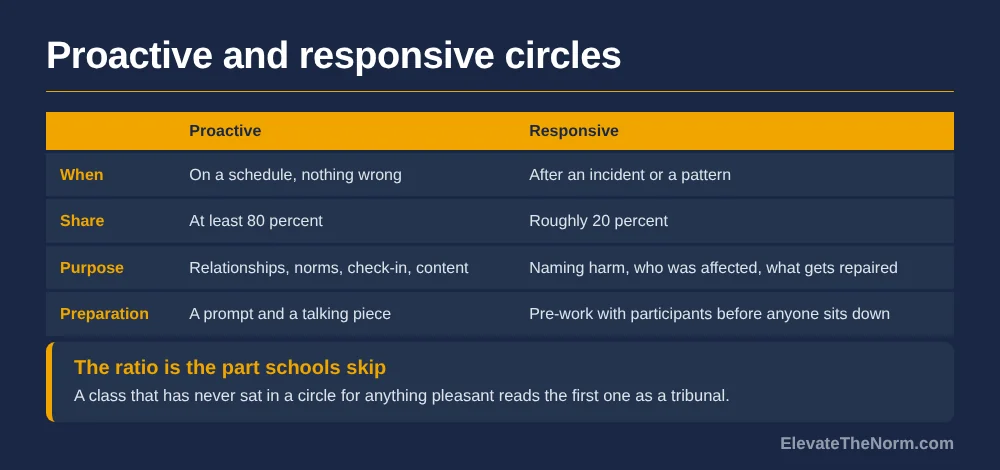
A proactive circle is held when nothing is wrong, to build the relationships and norms you will need later. A responsive circle is held after something has happened. San Francisco’s guidance is blunt that proactive circles “are NOT held in response to an incident or problem,” and both it and RestorativeDC put the target split at roughly 80 percent proactive.
That ratio is the part schools skip. A class that has never sat in a circle for anything pleasant will read the first one as a tribunal, because that is the only context they have for it.
| Proactive circle | Responsive circle | |
|---|---|---|
| When | On a schedule, when nothing is wrong | After an incident or a pattern |
| Share of the total | At least 80 percent | Roughly 20 percent |
| Typical purpose | Relationships, norms, a shared check-in, curriculum content | Naming harm, hearing who was affected, agreeing what gets repaired |
| Who is there | The whole class, by default | Those involved and those affected — San Francisco’s version addresses class-level issues with the whole class |
| Preparation | Choose a prompt and a talking piece | Pre-work with participants before anyone sits down |
How do you actually run a circle?
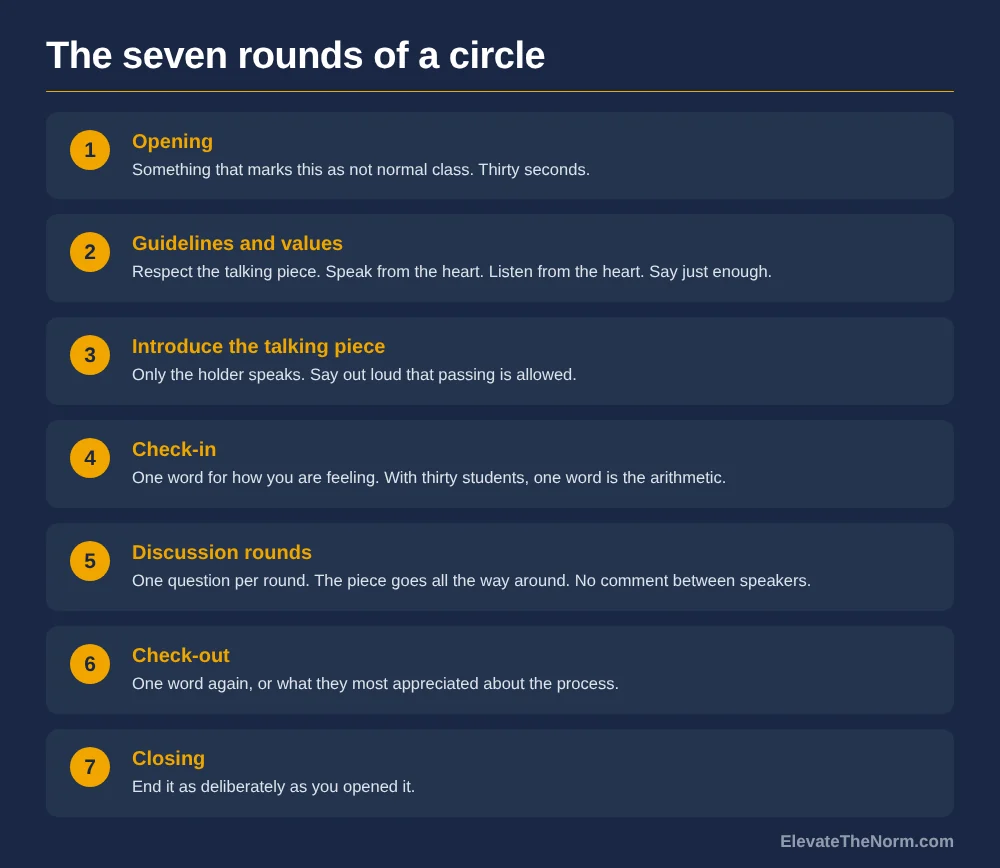
Chairs in a circle with nothing in the middle, a talking piece that moves one way around, and a fixed sequence of rounds. San Francisco’s general format is seven steps: opening, guidelines and values, introduction of the talking piece, check-in, discussion rounds, check-out, closing. RestorativeDC’s version adds an opening and closing ceremony at either end.
- Set the room. New York’s guide specifies “chairs situated in a large circle for all participants (preferably no furniture in the middle).” The seating, RestorativeDC says, is “designed to communicate equity and visibility for all participants.”
- Open it deliberately. A reading, a question, a moment — something that marks this as not-normal-class. It takes thirty seconds and it does most of the work of setting the tone.
- Name the guidelines before the first round, every time. New York’s are short enough to say from memory: respect the talking piece, speak from the heart, listen from the heart, trust you will know what to say, say just enough. San Francisco warns that skipping this round is tempting and that you should not.
- Introduce the talking piece and what it means. Only the person holding it speaks, and everyone else listens. Say out loud that passing is allowed.
- Check in with one round, kept short. San Francisco’s prompt is a single word for how you are feeling; New York caps an introduction round at fifteen seconds a person. With a class of thirty, that arithmetic is the reason to keep it to a word.
- Run the discussion rounds. One question per round, the piece goes all the way around, and you do not comment between speakers. RestorativeDC describes this part as storytelling and guiding questions, and uses small groups of three to five students when the circle is large.
- Check out, then close. One word again, or what they most appreciated about the process. Then end it as deliberately as you opened it.
The person running it is a keeper, not a facilitator: New York says the keeper’s job “is not to facilitate the circle, but to act as guide that introduces the circle prompts and ensures that the circle remains a safe space.” San Francisco adds that keepers “are participants in the circle, not observers” — you answer your own prompts — and gives the reason to keep your hands off: “as soon as you intervene in a more directive way, participants become less accountable for their actions and decisions.” For a teacher used to running the room, that is the hardest instruction on this page.
The talking piece is not a gimmick either. San Francisco says its purpose is “to create an equitable environment for sharing” where “everyone gets a chance to speak or have the right to pass.” In a room where four students normally do the talking, an object that has to physically reach you is a cheap fix for a hard problem.
Do restorative circles actually work?
They reduce suspensions and improve how teachers see their schools. They have not been shown to improve academic outcomes, and in one randomized trial they made them worse for middle-grade students. Both halves of that sentence come from the same study, and most writing about circles only quotes the first.
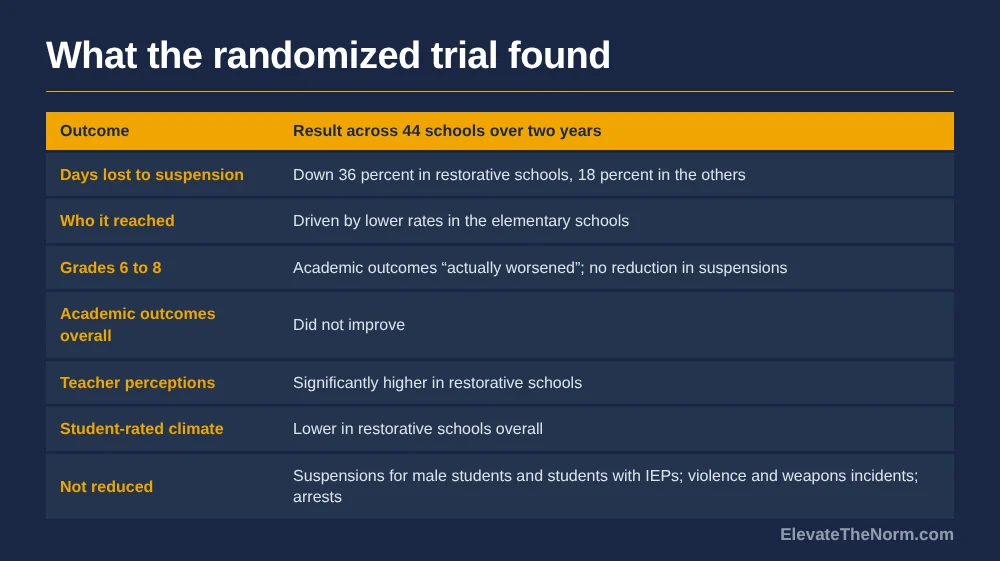
The strongest evidence is RAND’s evaluation for the National Institute of Justice, by Catherine Augustine and colleagues: a genuine randomized controlled trial of 44 schools in one mid-sized urban district, 22 running a two-year whole-school restorative programme and 22 carrying on as before, paired and assigned at random. Researchers observed 180 circles in case-study schools — 130 proactive, 28 responsive — averaging 15 minutes and 19 participants, and 69 percent of staff reported using proactive circles often or always.
What improved: days lost to suspension fell 36 percent in the restorative schools against 18 percent in the comparison schools, and by the final year 13 percent of students in restorative schools were suspended against 15 percent elsewhere. Suspension rates fell for African American students, low-income students and female students, which the authors describe as shrinking the disparities. On the teacher survey the authors report “strong evidence that PERC had positive effects on teachers’ perceptions,” with significantly higher ratings for conduct management and school leadership.
What did not. Suspensions did not fall for male students, for students with IEPs, or for violence and weapons incidents, and arrests were not reduced. Student-rated classroom climate “were lower in PERC schools overall” — the students’ own ratings went the wrong way while their teachers’ went the right way. And the authors state plainly: “despite fewer suspensions, academic outcomes did not improve in PERC schools.”
Two caveats. The published materials I could read report no effect sizes for these outcomes, so the percentages above are figures as stated rather than modelled estimates. And the authors’ own limits are real: two years “may be insufficient,” and “we do not know how many or which students experienced restorative practices.”
Other evidence points more positively but is weaker in design. A Learning Policy Institute study of 485 California middle schools and roughly two million students found exposure “improved standardized test performance in both English language arts and mathematics” and reduced the probability of suspension, with a larger ELA association for Black students than White students. It controls for student and school characteristics rather than randomizing, so it cannot carry the causal weight the trial can, and the same report warns outcomes over time are “U-shaped,” with short-term declines before long-term gains. A companion policy brief sums the field up fairly: restorative practices “can reduce schools’ reliance on exclusionary discipline,” while “evidence of the effects of RPs on academic outcomes is mixed.”
Why did the middle grades go backwards?
Nobody knows, and the honest answer matters more to this site’s readers than anything else in the trial. In RAND’s words: “at the middle grade level (grades 6–8), academic outcomes actually worsened in the treatment schools.” And: “neither did we find fewer suspensions in middle grades.” The suspension win that gets quoted everywhere “was driven by lower rates in PERC elementary schools.”
The authors offer one careful sentence of explanation — “it could be that it is more challenging for restorative practices to positively affect middle grade students” — and add “at least within a two-year time frame.” That is as far as the data goes, and anyone extending it further is guessing.
What the same study does tell you is that dosage dropped as grade level rose: high school staff reported significantly less use than elementary staff, and the biggest barrier teachers named was lack of time. A secondary teacher sees five or six groups a day for under an hour each; an elementary teacher has one group all day. That is not an excuse for the result, but it is a difference nobody should ignore when a district rolls one programme out across all three levels and expects the same answer.
So the defensible reading for a secondary building: circles are worth running, and anybody promising they will lift test scores in grades 6–8 is contradicted by the best study we have.


How do you run a circle after something has gone wrong?
With preparation before anyone sits down, and with participation that is genuinely optional. San Francisco’s script for a circle to repair harm runs seven rounds: introductions and why each person is there; the facts; who was affected; how people feel; what needs to happen; who agrees to what; and a closing agreement naming who is responsible for following through.
Three details carry most of the weight. The facts round is prepared in advance — the guidance says to ask two people who know the facts whether they are willing to share them, and that “it is important that they only share the facts and leave their personal feelings out.” The agreement round is concrete: “which of these do you want to agree to and who is responsible for following through with repairing the harm?” And New York’s restorative questions are the spine of the middle rounds: what happened and what were you thinking at the time; who has been affected and in what way; what do you think you need to do to make things as right as possible.
Now the part that is easy to get wrong, and it is a safety question rather than a technique question. A circle is not a device for extracting an admission. New York’s guide describes a formal conference as one where those “who have acknowledged causing harm” meet those they have harmed — the acknowledgement comes first, before anybody is convened. If a student is still denying it, or the facts are contested, you do not have a circle, you have an investigation, and those are different rooms.
The opt-outs are not soft touches either. RestorativeDC is explicit that “speaking is not required” and that students can opt out “if they are feeling anxious, overwhelmed, unsafe, or insecure.” It gives two concrete escape hatches: a student who needs to leave the conversation is “invited to turn their chair to face outwards,” and a student who does not want to speak aloud “can write down responses and invite a neighbor to share it aloud for them.” It also says questions can be given to students in advance so they can prepare. In a responsive circle those provisions are what separate repair from a performance of remorse in front of an audience.
One modification of my own, and I am labelling it as mine rather than as guidance: ask those two fact-sharers privately, let them say no without anyone knowing they were asked, and be ready to read the facts yourself if nobody wants the job. Being the student who told, in front of the people it was about, is a cost the script does not price.
When is a circle the wrong tool?
The honest answer is that the guidance I read does not say, and that is worth knowing before you convene one. The New York City, San Francisco and RestorativeDC documents all describe how to run circles in detail, and none of them states a case in which a circle should not be used — not serious harm, not a safety concern, not a power imbalance between participants, not a situation that triggers mandatory reporting. That is an absence in three specific documents, not proof that no such guidance exists anywhere. But it is the gap a teacher falls into.
Two things in those documents do bear on it. New York’s acknowledgement requirement rules out contested facts. And San Francisco’s planning guide asks the keeper to decide in advance whether the questions are “high or low risk” and holds that “the health of each member of the circle is always to be strongly considered.” That is a real instruction, and a very thin one to be carrying this much weight.
So the rule here is procedural rather than evidential: before a responsive circle, check your school’s own discipline policy and your reporting obligations, and talk to an administrator. The RAND trial found restorative practices did not reduce violence or weapons incidents, which is the clearest signal in any of this that some categories of harm belong somewhere other than a circle.
What does it cost a school to do this properly?
More than a binder. The district RAND studied gave staff four days of professional development — two required, two voluntary — plus books, videos, monthly professional learning groups, and a coach for each principal visiting “at least twice during each school year.” RAND’s own judgment on that dosage is the useful number: “the ideal number of coaching visits is unknown, but it is likely that two per year is insufficient.” The policy brief puts it more sharply still — “book-and-hope” approaches “do not lead to staff and student exposure to widespread, supported” practice, and a training that “lacks coaching and follow-up support” will not shift what teachers do. Read alongside the U-shaped finding, that is an argument for either committing properly or not starting.
One implementation finding deserves daylight because it is about fairness rather than logistics: the brief notes that “educators may exercise discretion in ways that encourage them to use” restorative practices “when engaging with certain students.” A practice applied at the teacher’s discretion can be applied unevenly, and the students on the wrong end of that will notice long before the data does.
Clay’s take: run the cheap ones first
I have not run restorative circles, and I am not going to write this page as though I had. What I do run is the one-on-one version — the conversation after a mistake about what is owed, to whom, and by when. That is not a circle; it is one teacher and one student, and it takes four minutes in a hallway. If the evidence above makes you cautious about a whole-school rollout, that conversation is still available to you tomorrow and costs nothing. Same instinct as giving students room to repair a mistake rather than just absorbing a penalty for it.
What I would do with circles, reading all of this: start proactive and stay there a long time. A class that has sat in a circle a dozen times for something ordinary will handle a hard one very differently from a class meeting the format for the first time on its worst day. Fifteen minutes and a question is the whole investment.
What I would not do is let a circle become the thing that happens instead of a consequence. Repair and consequence are not opposites — a student can owe an apology and still owe the work, and pretending otherwise teaches a lesson nobody intended, so what follows a decision in a secondary classroom still has to mean something. And if what you want is a regular structured class meeting rather than a response to harm, class meetings and problem-solving with teenagers cover much of the same ground with less freight attached.
The thing I would hold hardest is the opt-out. A fifteen-year-old asked to say how they feel in front of twenty-eight classmates is being asked for something real, and the ones who need it most are usually the ones least able to perform it on cue. If passing is only theoretically allowed, students work that out in one circle and give you the safe answer forever after. Make it obvious, make it boring, and let somebody use it early so the room sees that nothing happens to them.
What to do next
Run one proactive circle. Fifteen minutes, chairs in a circle, one object, one question worth answering, and passing allowed out loud. Do it four or five more times before you use the format for anything that has gone wrong — and before you use it responsively, read your school’s discipline policy and talk to an administrator about where a circle stops and a referral starts. Restorative circles are cheap to try and expensive to get wrong, and that order protects you from the second thing.
Frequently Asked Questions
What is a restorative circle?
A restorative circle is a structured conversation where participants sit facing each other with nothing in the middle and only the person holding the talking piece speaks. New York City’s implementation guide describes circles as a way for students to share feelings, ideas and experiences on a non-crisis basis, and as a way of addressing wrongdoing and making things right when harm has occurred.
What is the difference between a proactive and a responsive circle?
A proactive circle is held on a schedule when nothing is wrong, to build relationships and norms. A responsive circle follows an incident or a pattern. San Francisco Unified states that proactive circles are not held in response to a problem and should make up at least 80 percent of the circles a student experiences, a split RestorativeDC also uses.
How long does a restorative circle take?
Shorter than most teachers expect. Researchers who observed 180 circles in a randomized trial recorded an average of about 15 minutes with 19 participants. San Francisco’s guidance says circles can run from as little as 10 minutes up to an entire class period, depending on the purpose. A weekly check-in circle fits inside a normal secondary period.
What is a talking piece used for?
It controls who speaks and guarantees everyone a turn. Only the person holding it talks, and it passes one way around the circle. San Francisco Unified says its purpose is to create an equitable environment for sharing in which everyone gets a chance to speak or has the right to pass. In a room where a few students dominate, that is a cheap structural fix.
Do restorative circles reduce suspensions?
In the strongest study available, yes, but unevenly. RAND’s two-year randomized trial across 44 schools found days lost to suspension fell 36 percent in restorative schools against 18 percent elsewhere, with reductions for Black students, low-income students and female students. Suspensions did not fall for male students, students with IEPs, or violence and weapons incidents.
Do restorative circles improve academic outcomes?
The evidence does not support that claim, and one trial found the opposite. RAND reported that academic outcomes did not improve in the restorative schools overall and that in grades 6 to 8 they actually worsened. A large California study found positive associations with test scores, but it is correlational rather than randomized, so it cannot settle the question.
Do students have to speak in a restorative circle?
No, and that is structural rather than a courtesy. RestorativeDC states that speaking is not required and that students may opt out if they feel anxious, overwhelmed, unsafe or insecure. It offers two concrete alternatives: turning a chair outward to step back from the conversation, and writing a response for a neighbour to read aloud instead.
When should a restorative circle not be used?
The district guidance reviewed here does not say, which is itself worth knowing. What those documents do establish is that a formal conference involves someone who has already acknowledged causing harm, so contested facts belong in an investigation instead. Check your own school’s discipline policy and reporting obligations with an administrator before convening a circle about serious harm.
Sources
- Augustine, C. H., Engberg, J., Grimm, G. E., Lee, E., Wang, E. L., Christianson, K., & Joseph, A. A. (2018). Can Restorative Practices Improve School Climate and Curb Suspensions? An Evaluation of the Impact of Restorative Practices in a Mid-Sized Urban School District. RR-2840-DOJ, RAND Corporation, sponsored by the National Institute of Justice. Report and research brief. Source of the randomized design and school counts, the 180 observed circles and their 15-minute, 19-participant average, the suspension figures, the subgroups where suspensions did and did not fall, the lower student-rated climate, the grades 6–8 academic result, the training and coaching dosage, and the stated limitations. The chapter containing the adjusted causal estimates was not readable for this article, so no effect sizes are quoted here and the percentages above are the figures as the report and brief state them.
- San Francisco Unified School District. Circles. Overview document. Source of the seven-step circle format, the keeper role, the talking-piece purpose and the right to pass, the 80 percent proactive guidance, the 10-minute-to-a-period range, the seven-round script for a circle to repair harm including the prepared facts round and the agreement round, and the planning-guide questions. No publication date is stated on the document, and it carries no research citations of its own — it is practice guidance, not evidence.
- SchoolTalk / RestorativeDC (2022). Facilitating Safer & More Inclusive Proactive Circles. Guide. Source of the proactive/responsive distinction and the 80/20 split, the circle element sequence, the talking-piece definition, the seating rationale, the three-to-five small-group size, the advance provision of questions, and the opt-out provisions including turning a chair outward and writing a response for a neighbour to read. It covers proactive circles only and states no restrictions on when a circle is inappropriate.
- New York City Department of Education, Office of Safety and Youth Development. Restorative Practices Whole School Implementation Guide. Guide. Source of the restorative continuum, the two-part description of what circles are for, the keeper definition, the five circle guidelines, the seating specification, the three restorative questions, the statement that a punishment delivered for rule-breaking is a punitive approach rather than a restorative one, and the description of a conference as involving those who have acknowledged causing harm. No publication date is stated, and the document says its contents were modified from San Francisco Unified’s guide, so the two are not independent sources. Roughly the first third was readable in full for this article.
- Darling-Hammond, S. (2023). Fostering Belonging, Transforming Schools: The Impact of Restorative Practices. Learning Policy Institute. Report. Source of the 485-middle-school, roughly two-million-student California finding on test performance and suspension probability, the larger English language arts association for Black students, the U-shaped outcomes caveat, the warning that programmes often fail to shift practice, and the opt-in professional development point. The design controls for student and school characteristics rather than randomizing, so it does not carry causal weight, and roughly the first third of the report was readable for this article.
- Darling-Hammond, S., & Gregory, A. (2023, February). Measuring Restorative Practices to Support Implementation in K–12 Schools. Policy Analysis for California Education. Brief. Source of the summary that restorative practices can reduce reliance on exclusionary discipline while academic evidence is mixed, the community-building circle definition, the “book-and-hope” warning, the point that training without coaching will not shift practice, and the observation about discretionary use with certain students. Roughly the first half was readable in full.
- Not cited as evidence, because they could not be opened for this article: the cluster randomized trial of restorative practices and out-of-school suspensions indexed at PubMed Central, which returned an automated-access challenge; and the International Institute for Restorative Practices page defining the restorative continuum. The continuum described above is therefore New York City’s wording rather than the IIRP’s own.