Tag: restorative practices

  • Student Accountability Sheet: A Free, Non-Childish Classroom Template

    Student Accountability Sheet: A Free, Non-Childish Classroom Template

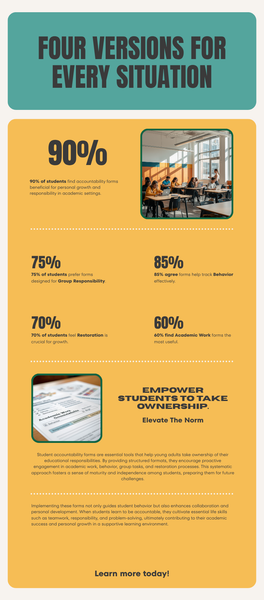
    A student accountability sheet is a short, structured form a student completes after something went wrong — a missed deadline, a group conflict, a behavior that affected the room. Done right, it takes about five minutes and produces a useful conversation. Done wrong, it is busywork that teaches students nothing except how to fill out busywork. This guide explains the difference, offers a free template in four versions, and shows exactly how to use it in a secondary classroom without humiliating anyone or generating a paper trail for things that do not belong on one.

    Key Takeaways

    • An accountability sheet supports a conversation — it is not a punishment, a replacement for a school referral, or a way to document a student for later.
    • Four versions cover the situations teachers actually face: academic work, group responsibility, behavior, and restoration after a conflict.
    • Students complete the sheet themselves. That is the point. If the teacher is doing the writing, the tool is being used incorrectly.
    • The sheet is not a file. Unless a required school procedure calls for documentation, it lives with the student or gets recycled after the conversation.
    • Any teacher can use this the first week of school. No program, no training, and no administrator approval required.

    What Most Accountability Sheets Get Wrong

    Most accountability sheets found in schools — and most of the printables circulating on teacher resource sites — were designed for elementary students and scaled up by changing the font. They ask students to write “what I did wrong” in a box, then “how I will do better next time” in another box, and they expect that sequence to produce insight. It rarely does, because the sequence assumes the student already has a clear picture of what happened and why. They often do not.

    The other common design flaw is that the sheet exists only as a record. A teacher hands it to a student, the student fills it out, the teacher collects it and puts it in a folder. Nothing happens as a result. The student learns that accountability means paperwork, not change — which is exactly the wrong lesson.

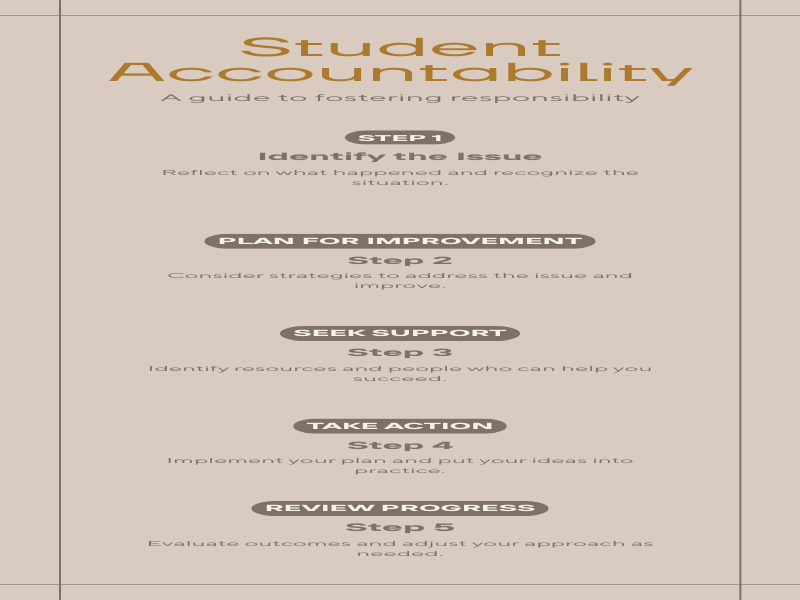
    A well-designed student accountability sheet for grades 6–12 does three things that most forms skip. It separates facts from interpretations, so students can describe what actually happened without being led toward a particular framing. It identifies who, specifically, was affected — not just “the class” in the abstract. And it generates a next step the student can actually take, not a vague commitment to “try harder.”
    Classroom accountability sheet template on a student desk in a secondary classroom with warm lamp lighting
    An accountability sheet is a tool for a five-minute conversation, not a substitute for one.

    When to Use an Accountability Sheet

    There are four situations where a short accountability sheet is useful in a secondary classroom. Understanding the difference between them matters, because each version of the sheet asks slightly different questions.

    Academic Work

    A student missed a deadline, submitted incomplete work, or disengaged from a task. The goal of the sheet in this case is not to assign blame but to figure out what actually got in the way. Sometimes the answer is workload. Sometimes it is confusion about the assignment. Sometimes it is something happening at home. The sheet creates space to say so without the conversation becoming a confrontation.

    Group Responsibility

    A student did not hold up their part of a group project. Or a group is in conflict about who did what. The group version of the sheet is filled out individually by each member before the group meets together — which means every voice is already on paper before anyone starts defending themselves out loud. This simple sequencing change reduces the volume of these conversations significantly.

    Behavior

    Something happened in the room — a comment that landed wrong, a refusal, an outburst — that the teacher needs to address before moving on. This version is short by design, because a behavior conversation does not benefit from extended written reflection in the moment. The sheet gives the student a minute to collect their thoughts before speaking, which is often all that is needed to de-escalate the temperature.

    One important note: if the behavior requires a school referral, disciplinary report, or any documentation under your district’s required procedures — do that. The accountability sheet is a classroom tool, not a substitute for mandated process. If you are unsure whether a situation requires official documentation, assume it does and act accordingly. The sheet goes with the student afterward, not instead of the referral.

    Restoration

    Something happened between students — a conflict, an unkind comment, a damaged trust — and the class needs to move forward. The restoration version is the most conversational of the four. It is the one most closely aligned with restorative approaches, and it works best when both students complete their own version before sitting down together. For more on restorative approaches in a school context, see restorative practices in schools.

    The Templates

    Each template below is designed to be reprinted, typed into a shared document, or read aloud and answered verbally depending on the student and the situation. The fields are short. The language is direct. None of it is condescending.
    Four versions of student accountability sheet side by side showing academic work group responsibility behavior and restoration fields
    Four distinct versions of the sheet cover the situations teachers actually face in grades 6–12.

    Version 1 — Academic Work

    Student name: _______________ Date: _______________

    The assignment or task: _______________

    What was supposed to happen? (Describe the expectation — due date, format, what “complete” looked like.)

    What actually happened? (Facts only. Not reasons yet.)

    What got in the way? (This is where reasons belong. Be honest — including “I didn’t prioritize it” is a valid answer.)

    What is one thing you can do in the next 48 hours to move this forward?

    What support, if any, do you need from me?

    Version 2 — Group Responsibility

    Student name: _______________ Project or task: _______________ Date: _______________

    What was your agreed-upon role or task in this group?

    What did you actually complete?

    What did your group expect from you that you did not deliver?

    What happened from your perspective? (State facts and reasons separately.)

    What do you owe the group at this point?

    What is your next step, and when will it be done?

    Version 3 — Behavior

    Student name: _______________ Date: _______________ Period/class: _______________

    Describe what happened. (What you said or did — not what someone else did first.)

    Who was affected by it? (Name the people, not just “everyone.”)

    What do you want those people to know?

    What is one thing you will do differently?

    Note to the teacher: this version is designed for classroom-level situations. If the incident requires a disciplinary referral, complete your school’s required documentation first. This sheet is a follow-up conversation tool, not a replacement for required procedures.

    Version 4 — Restoration

    Student name: _______________ Date: _______________

    What happened between you and the other person? (Your account of it — not what they did, what happened between you.)

    What did the other person lose or experience because of the situation? (This is a perspective-taking question. Answer it honestly even if it is uncomfortable.)

    What do you want to be different going forward?

    Is there something specific you are willing to do or say to move toward that?

    What do you need from me or from the other person to make this work?
    Teacher and student sitting together at a whiteboard table reviewing an accountability sheet in a secondary classroom
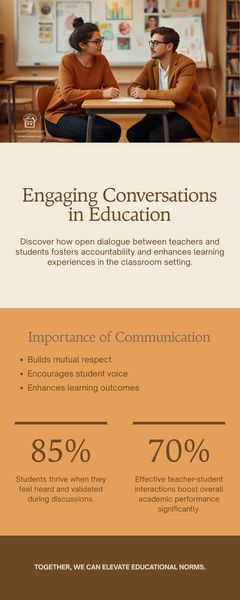
    The sheet starts the conversation — it does not replace it. Five minutes at the whiteboard table is worth more than a folder full of completed forms.

    How to Use the Sheet

    The sheet is not the conversation. It is the preparation for one. A student who fills it out in silence and hands it in has not been held accountable — they have completed a writing assignment. The point of the form is that it gives the teacher and the student a shared document to look at together, which is significantly less confrontational than looking at each other across a desk.

    The sequence that works: hand the student the sheet and give them three to five minutes to complete it, without hovering. Sit down together to review it — ideally somewhere that is not the center of the room. Read it together, ask one or two follow-up questions, and agree on the next step before the student returns to work. That is the whole procedure. If it is taking longer than ten minutes, either the situation is more serious than this tool was designed for, or the conversation has turned into a lecture. Stop the lecture.

    The anchor question in every version is some variation of “what is your next step?” That is the question that determines whether the sheet produced anything useful. A vague next step (“I’ll try harder,” “I’ll be better”) is not a next step. Push for something specific and time-bound: “I’ll finish the introduction section by Thursday,” or “I’ll ask Morgan what I can do to address what happened.” Specificity is what makes accountability concrete rather than performative.

    A Classroom Anchor: Authority Handed and Held

    The accountability sheet works best when students already understand that authority in the room is real and is held to. A clearly visible classroom expectations poster does much of this work passively — it gives students a reference point before anything goes wrong, so the accountability sheet’s first question (“what was supposed to happen?”) lands with specificity rather than guesswork. In my workshop room — where students are almost always working alongside somebody, and I move between groups rather than lecture from the front — the sheet tends to come up most often around group work, and specifically around moments where a student was trusted with a role and did not follow through on it.

    When that happens, I do not announce it to the room. I slide the Version 2 sheet to the student at their table and give them four or five minutes while I circulate. Then I pull them to the whiteboard table — my small-group conferencing area with a rug, better chairs, and a lower lamp, where students know they are being seen carefully and not put on display — and we work through their answers together.

    The conversation is not about catching them in something. It is about naming what happened clearly enough that we can figure out what comes next. Students who have been given real authority over something — their section of a project, their role in a group, a decision that affects others — understand why the accounting matters. It matches the weight of the responsibility they were given. What does not match it is a form that feels like it was designed for a third-grader. The template above is written at the level the student is actually operating at. That is the difference between accountability and humiliation, and it matters.

    This approach connects directly to what student responsibility looks like in the classroom — real responsibility includes real accounting when things go wrong, not manufactured consequences or empty apologies. For the broader case for high expectations paired with the room to learn from mistakes, see high expectations for students.

    What Happens When a Student Doesn’t Follow Through

    A student completes the sheet, agrees to a next step, and then does not take it. This happens. Here is the important thing: that outcome does not mean the sheet failed. It means you now have a second conversation with more information than you had before. You know what the student said they would do. You know they did not do it. The conversation gets more specific, not more punitive.

    The escalation path in this case depends on what the situation actually requires. Some students need more support than a single conversation provides — academic, social, or something else entirely. The sheet is not a substitute for identifying that need and addressing it. If a pattern emerges across multiple sheets and conversations, that is information that may need to go to a counselor, an interventionist, or a parent. At that point the sheet is one piece of a larger picture, not the whole solution.

    For students whose accountability issues involve ongoing behavior challenges, the positive discipline framework for teenagers provides a more structured approach that pairs well with the sheet. For situations involving harm between students, the natural consequences framework and the restoration version of the sheet work together. And for the broader question of how to build a classroom where students actually want to hold themselves accountable, see the site’s overview of student responsibility as a developmental skill, not a character judgment.

    The Research Behind It

    Self-regulated learning research has consistently found that students who can reflect on their own performance — identify what went wrong, name contributing factors, and plan a corrective action — outperform students who receive only external evaluation (Zimmerman, 2002). The accountability sheet is applied self-regulated learning: it scaffolds a reflective process that students build over time.

    Self-determination theory (Deci & Ryan, 2000) adds an important dimension: students are far more likely to take a next step they chose than a consequence that was imposed on them. Every version of the sheet ends with the student naming a next step. That ownership matters for what actually happens afterward. Hattie’s (2009) meta-analysis of over 800 studies identified student self-assessment — including structured reflection on what went wrong — as one of the highest-leverage interventions available to teachers. The accountability sheet is a low-cost, no-training version of exactly that.

    Research on restorative approaches in schools (Morrison & Vaandering, 2012; Skiba & Peterson, 2000) supports the same conclusion from the discipline side: punitive responses to student misbehavior consistently underperform restorative ones on measures of recurrence, school climate, and relationship repair. A sheet that asks students to identify who was affected and what they are willing to do to repair it is grounded in that same framework, without requiring a school-wide program or a trained facilitator.

    Printables for this

    Two of mine on TPT, both built for this. Behavior Documentation Forms are the other half of the picture — the ABC data and MTSS logs you keep when a pattern does need a record, which the sheet above deliberately is not. The Makeup Work System handles the follow-through on the academic version, so “what is your next step” has a process behind it.

    Frequently Asked Questions

    Is a student accountability sheet the same as a disciplinary referral?

    No. A disciplinary referral is a formal school document that enters a student’s record, triggers review by an administrator, and may carry consequences under district policy. An accountability sheet is a classroom tool — a short form that supports a private conversation and a next step. It is not filed, not sent to the office, and not part of the student’s disciplinary record unless you deliberately attach it to a referral as supporting documentation. If a situation requires a referral, complete the referral. The accountability sheet is for situations that do not — which is the majority of what happens in a classroom on any given day.

    What if the student doesn’t fill it out honestly?

    Some students will write what they think you want to hear. That is useful information, too. If the sheet reads like a performance rather than a reflection, say so directly and ask one specific follow-up question: “When you wrote you would try harder — what does that look like for you on Monday?” Most students will either give a more honest answer or reveal that they actually do not know. Both are starting points for a real conversation. The sheet is not a truth test. It is a structure for a conversation, and the conversation is where the real work happens.

    Does this go in the student’s permanent file or record?

    No — not unless your school’s procedures specifically require it for a given type of incident. For most classroom-level situations, the sheet lives with the student or gets recycled after the conversation. If you are using it as part of a required disciplinary process, follow your school’s documentation requirements for that process. Do not create an informal file of completed accountability sheets. That is not what this tool is for, and it can create problems if the file is ever requested.

    Can parents request to see these sheets?

    Parents can request records their child’s school maintains about them under FERPA. If you are collecting and storing completed accountability sheets in any systematic way, you should treat them as education records and handle them accordingly. The simplest way to avoid this issue is to not store them: use the sheet, have the conversation, and let the student keep it or discard it. A brief note in your own records of the conversation and the agreed-upon next step is sufficient documentation for your own use.

    What should I do if the student refuses to fill it out?

    A student who refuses to engage with the sheet is telling you something about their state in that moment. Do not escalate over the sheet itself. Give them a minute, check in quietly, and decide whether this is a moment of genuine distress, a test of your authority, or something else. If it is a test, name what you see calmly: “I’m going to give you two more minutes. I’ll come back.” If it is distress, the sheet can wait. If refusal becomes a pattern, that is a separate conversation — about engagement and trust, not about a form.

    At what grade level does this work best?

    The templates above are designed for grades 6–12. The language is appropriate for middle school and can be used as-is with most high school students. Students in grades 6–8 may need more scaffolding during the conversation — they often have the self-awareness but not yet the vocabulary to name what happened clearly. The teacher’s role in those grades is slightly more coaching than questioning. High school students can generally complete the sheet more independently, though the conversation afterward is equally important at both levels.

    How do I use the group responsibility version fairly when students blame each other?

    Have each student complete their own version of the sheet before anyone talks. This is non-negotiable: if students start talking first, they immediately start building a shared story that may not reflect what each person actually experienced. Once each student has answered the questions in writing, bring them together. Start with what each person wrote about their own contribution — not the other person’s failures. The sheet’s structure forces that sequence because the questions are framed around the student’s own actions. It does not eliminate conflict, but it changes the opening move from accusation to accounting.

    Sources

    • Zimmerman, B. J. (2002). Becoming a self-regulated learner: An overview. Theory Into Practice, 41(2), 64–70. https://doi.org/10.1207/s15430421tip4102_2
    • Deci, E. L., & Ryan, R. M. (2000). The “what” and “why” of goal pursuits: Human needs and the self-determination of behavior. Psychological Inquiry, 11(4), 227–268. https://doi.org/10.1207/S15327965PLI1104_01
    • Hattie, J. (2009). Visible Learning: A Synthesis of Over 800 Meta-Analyses Relating to Achievement. Routledge.
    • Morrison, B. E., & Vaandering, D. (2012). Restorative justice: Pedagogy, praxis, and discipline. Journal of School Violence, 11(2), 138–155. https://doi.org/10.1080/15388220.2011.653322
    • Skiba, R. J., & Peterson, R. L. (2000). School discipline at a crossroads: From zero tolerance to early response. Exceptional Children, 66(3), 335–346. https://doi.org/10.1177/001440290006600303
    About Clay Shumate

    By Clay Shumate — Clay Shumate is a certified secondary Social Studies teacher in the public schools of West Alabama, with seven years of classroom experience, a B.A. in History, and an M.Ed. in Secondary Education. He writes about project-based learning, student responsibility, respect, and practical ways to hold young people to a higher standard while giving them room to learn from mistakes. He is a member of the Society of Professional Journalists and writes to its Code of Ethics; this site’s editorial standards and corrections policy are published in full. More about Clay.

  • Learning From Mistakes: Why Students Need Accountability and Another Chance

    Learning From Mistakes: Why Students Need Accountability and Another Chance

    By Clay Shumate

    Learning from mistakes means a student faces honest feedback, takes responsibility for what went wrong, completes a meaningful repair, and gets a genuine second chance. It does not mean pretending mistakes don’t matter, and it does not mean one bad decision defines a student permanently. Schools that get this right hold both: accountability that teaches something and a clear path forward.

    For more on how natural consequences function in secondary classrooms—and when they fall short—see natural consequences in the classroom.

    Key Takeaways

    • Mistakes are neurologically productive — errors activate stronger learning pathways than getting it right the first time.
    • Accountability without a path forward is just punishment wearing a different label.
    • Grace without accountability teaches students that standards don’t apply to them.
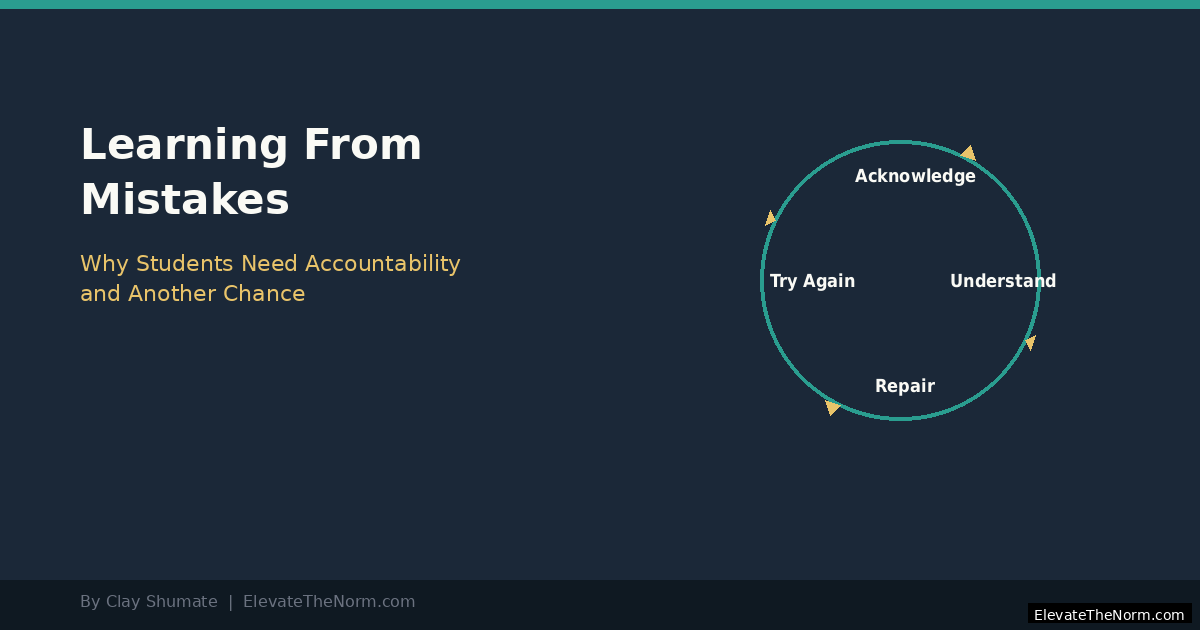
    • A workable process for any mistake: acknowledge it, understand its impact, repair the harm, and try again with the standard still in place.
    • Teachers control the conditions that determine whether a mistake becomes learning or shame.

    What Learning From Mistakes Actually Requires

    Learning from mistakes sounds simple until you try to do it in a room full of teenagers who would rather pretend the mistake never happened.

    Here is what the phrase actually demands: the student has to know the mistake happened, understand why it matters, feel the weight of it without being crushed by it, and then do something different. That is a sequence, not a slogan. Skip any step and the learning doesn’t happen.

    The student who never hears honest feedback repeats the mistake. The student who hears feedback but faces no consequence learns that standards are optional. The student who faces a consequence but gets no second chance learns that effort is pointless. And the student who gets a second chance without accountability learns that mistakes cost nothing.

    Every one of those failures is a teacher problem, not a student problem. The student is responding rationally to the system they’re in. Teaching responsibility means building a system worth responding to.

    The Two Extremes That Fail Students

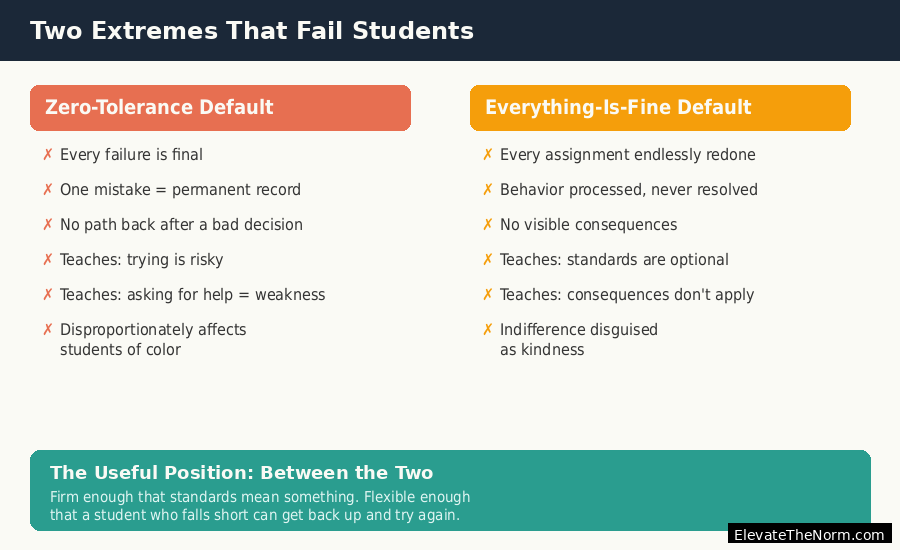
    Most schools land on one of two bad defaults.

    The Zero-Tolerance Default

    Some schools treat every failure like a final answer. A missed deadline is a zero. A behavioral mistake is an office referral. A bad decision in October follows a student through June. The logic sounds clean: actions have consequences, and students need to learn that.

    The problem is that students do learn it — they learn that trying is risky, that asking for help is an admission of weakness, and that the safest move is to disengage. Research from the American Psychological Association consistently shows that exclusionary discipline — suspensions, expulsions, zero-tolerance policies — does not improve behavior and disproportionately affects students of color and students with disabilities (American Psychological Association, 2008).

    A system with no path back is not holding a high standard. It’s holding a grudge.

    Infographic comparing zero-tolerance and everything-is-fine approaches to learning from mistakes in the classroom
    Two extremes that fail students: zero-tolerance rigidity vs. consequence-free flexibility

    The Everything-Is-Fine Default

    Other schools swing the other direction. Every assignment can be redone indefinitely. Behavioral issues get processed through empathy circles but never produce a visible consequence. Students learn quickly that the stated standard isn’t real.

    This is not grace. Grace with no accountability is indifference dressed up as kindness. A student who never faces the honest weight of a mistake has been denied one of the most important experiences in adolescent development: realizing that what they do affects other people, and that fixing it is their job.

    The useful position is between these two extremes: firm enough that standards mean something, flexible enough that a student who falls short can get back up and try again with the standard still in place.

    Why Mistakes Strengthen Learning — What the Research Says

    The case for learning from mistakes is not just philosophical. It is neurological.

    When a student gets something right the first time, the brain registers a small confirmation. When a student gets something wrong, catches the error, and corrects it, the brain fires differently. Research by Jason Moser and colleagues at Michigan State University found that the brain shows two distinct responses to errors: an initial automatic response and a secondary, conscious response associated with paying attention to the mistake. Students who showed a stronger secondary response — meaning they attended to the error — performed better on subsequent tasks (Moser et al., 2011).

    Manu Kapur’s research on productive failure takes this further. Across multiple studies, students who attempted complex problems before receiving instruction — and failed — outperformed students who received direct instruction first. The struggle itself activated prior knowledge, exposed gaps, and made the eventual correct solution more meaningful and durable (Kapur, 2008; Sinha & Kapur, 2021).

    The critical condition: the failure had to be followed by explicit teaching. Struggle without resolution is not productive failure — it is just failure. This distinction matters in every classroom. A teacher who lets students sit with confusion indefinitely is not building resilience. A teacher who catches the misconception, sits down with the group, and asks the right questions is.

    When I’m circulating and I overhear a group building an argument on a faulty premise, I don’t stop the room. I pull up a chair. I ask them to walk me through it. Most of the time, they find the break in their own reasoning once someone asks the right question at the right moment. That is a mistake caught while it’s still useful — and the correction sticks because they did the thinking, not me.

    Academic Mistakes: Feedback, Revision, and Standards

    Academic mistakes — wrong answers, weak arguments, incomplete work, misunderstood concepts — are the easiest category to handle well and the one schools most often handle badly.

    What Works

    Targeted feedback, not blanket correction. Research consistently shows that students learn more from feedback focused on specific learning objectives than from papers returned covered in red marks (Hattie & Timperley, 2007). Mark the two things that matter most. Ignore the rest until those two are fixed.

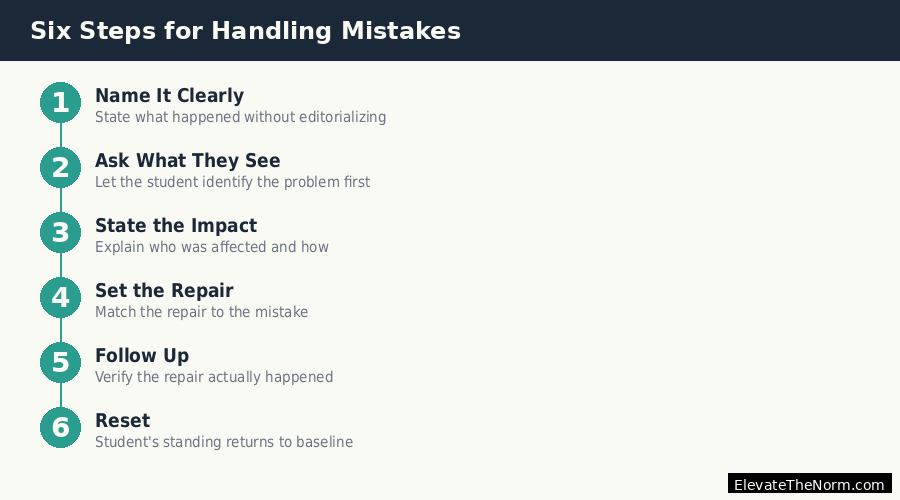
    Six-step framework for handling student mistakes: name it, ask what they see, state impact, set repair, follow up, reset
    Six steps for turning a mistake into learning instead of shame

    Revision as the expectation, not a favor. When a student turns in weak work, the response is not a zero and not a pat on the back. The response is: “This isn’t there yet. Here’s what needs to change. Bring it back.” The standard stays the same. The timeline adjusts.

    Distinguishing mistakes from errors. A mistake is careless — a missing period, a misread question. An error comes from a gap in understanding and tends to recur. The correction strategy is different for each. Mistakes need attention to detail. Errors need reteaching, which is why the way a correction assignment is structured decides whether it teaches anything.

    What Doesn’t Work

    Unlimited redos with no deadline. Late policies that reduce a grade by ten percent per day until the work is worthless. Averaging a zero with later scores so the math never recovers. Accepting work that doesn’t meet the standard just to avoid the conversation.

    The goal is a system where the standard is visible, the feedback is specific, the revision is expected, and the consequence of not revising is real — but not permanent.

    Behavioral Mistakes: Consequences, Repair, and Trust

    Behavioral mistakes are harder than academic ones because they involve other people. A student who disrupts a class, disrespects a peer, or breaks a commitment hasn’t just missed a standard — they’ve affected someone.

    The Difference Between Consequences and Punishment

    A consequence is connected to the behavior, proportionate, and designed to teach. A punishment is designed to make the student uncomfortable enough to stop. The distinction is not semantic. It determines whether the student learns anything or just learns to avoid getting caught.

    If a student damages a relationship, the consequence should involve repairing it. If a student wastes class time, the consequence should involve making it up. If a student breaks trust, the consequence should involve rebuilding it — through action, not a forced apology.

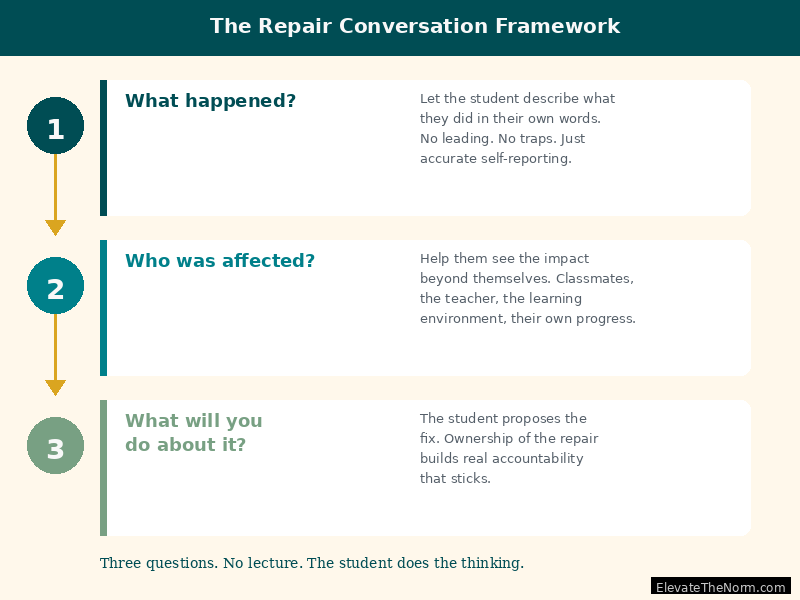
    Restorative accountability, when done honestly, asks three questions that traditional discipline skips: What happened? Who was affected? What are you going to do about it? (Edutopia, 2023). The student designs the repair, not the adult. The adult holds the standard for whether the repair is sufficient.

    When Consequences Are Non-Negotiable

    Some mistakes require immediate, firm consequences regardless of the context. Safety violations, threats, harassment, and violations of law or school policy are not opportunities for a restorative circle. They require the consequence that policy demands and the follow-up that the student needs. Both. Not one or the other.

    The mistake schools make here is treating these categories as an either/or: either we do restorative practices or we enforce policy. In reality, a student can face a mandatory consequence and still go through a repair process afterward. The consequence addresses the rule. The repair addresses the person.

    When Trust Is Damaged: The Harder Conversation

    The hardest mistakes to recover from are the ones that damage trust. A student who cheats, lies to a teacher, lets a group down, or betrays a peer’s confidence has done something that “I’m sorry” cannot fix.

    Cheating in particular is worth separating from the others, because the research on why it happens points at time pressure, fear and confusion far more than at character. What academic honesty actually means for grades 6–12 covers where the line falls, what AI did and did not change, and why a policy that makes honesty the expensive option produces more lying, not less. The worked examples of academic honesty and dishonesty are the version to put in front of a class, because most of the eighteen are arguable and the argument is the lesson.

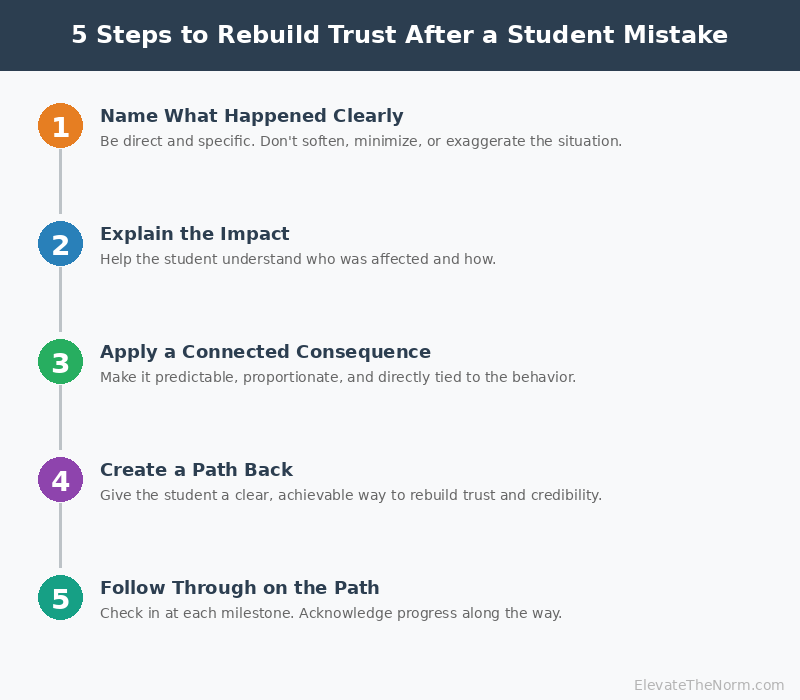
    Trust repair takes time and visible action. The process looks like this:

    1. Acknowledge specifically what happened. Not “I messed up” but “I copied the answers and turned them in as my own work.”
    2. Name who was affected and how. The teacher who trusted the work was real. The classmates who did their own. The student’s own credibility.
    3. Propose a repair. The student — not the teacher — suggests what they will do to make it right. The teacher evaluates whether the proposal is sufficient.
    4. Follow through and be watched. Trust comes back through consistent behavior over time, not through one conversation. The student earns closer attention for a while. That is not punishment — that is the natural result of breaking trust.

    This process is uncomfortable. It should be. Discomfort is not the same as humiliation. The student should feel the weight of what happened without feeling like a permanently broken person.

    What Teachers Control — and What They Don’t

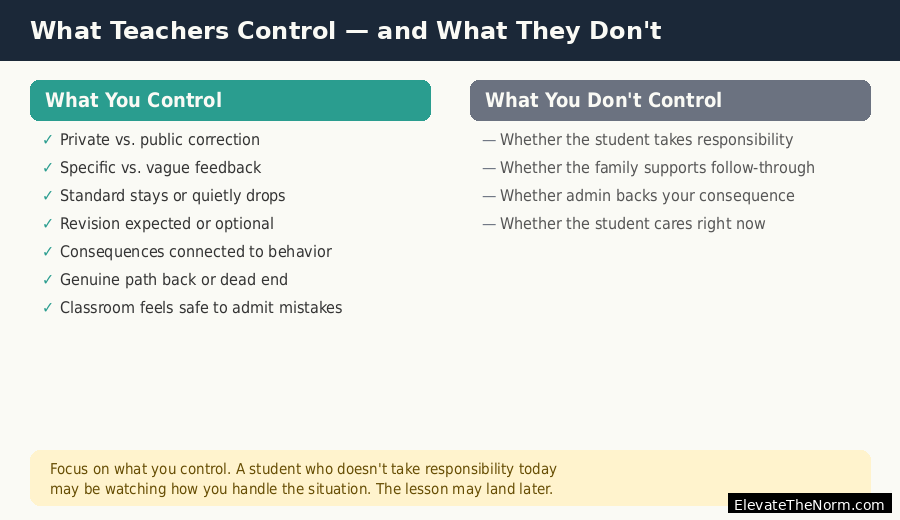
    Comparison graphic showing what teachers control versus what they do not control when students make mistakes
    What teachers control about mistakes — and what they don’t

    Teachers cannot control whether a student makes a mistake. They can control almost everything that happens afterward.

    What you control:

    • Whether the mistake is addressed privately or publicly
    • Whether feedback is specific or vague
    • Whether the standard stays in place or quietly drops
    • Whether revision is expected or optional
    • Whether consequences are connected to the behavior or disconnected from it
    • Whether the student gets a genuine path back or a dead end
    • Whether the classroom feels safe enough to admit a mistake in the first place

    What you don’t control:

    • Whether the student takes responsibility
    • Whether the family supports the follow-through
    • Whether administration backs your consequence
    • Whether the student cares right now

    The temptation is to focus on what you don’t control and use it as a reason to give up. Don’t. A student who doesn’t take responsibility today may be watching how you handle the situation. The lesson may land later. Your job is to make sure the system is worth learning from. And if you want to understand what genuine student responsibility looks like when it works, that picture starts with the same conditions: clear expectations, real consequences, and a standard the student believes applies to them.

    A Practical Framework for Handling Mistakes in Grades 6–12

    This framework works for academic and behavioral mistakes. Adjust the scale to match the weight of the situation.

    Step 1: Name It Clearly

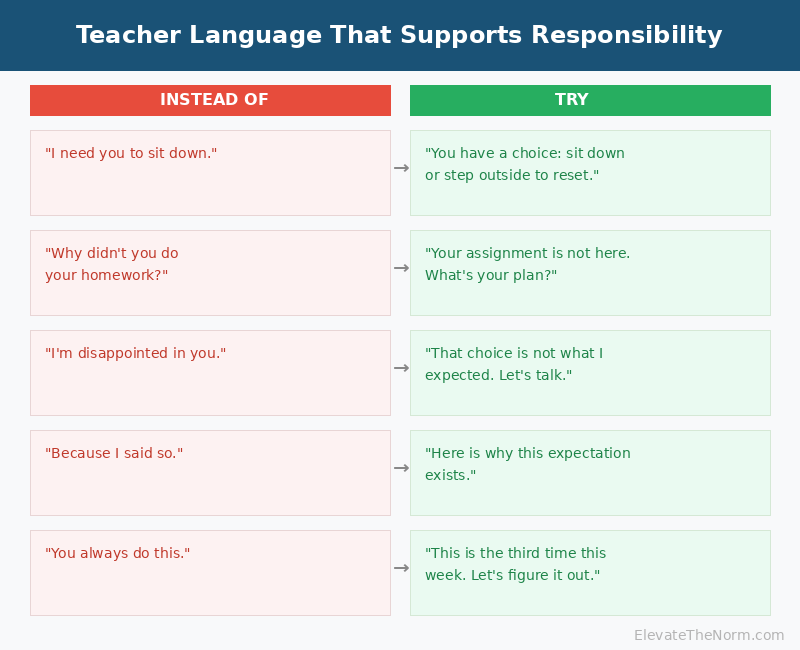
    Tell the student what happened, without editorializing. “You turned this in without the source analysis we discussed” is better than “You clearly didn’t try.” Clarity is respect. Vagueness leaves room for denial and defensiveness.

    Step 2: Ask What They See

    Before explaining the impact, ask: “What do you think happened here?” or “Walk me through your thinking.” Students often know more than they let on. Giving them the chance to name it first preserves their dignity and gives you information about whether the problem is understanding, effort, or something else.

    Step 3: State the Impact Honestly

    “When you don’t finish the research, your partner has to carry both parts” is more useful than “You need to be more responsible.” Specifics teach. Generalizations lecture.

    Step 4: Set the Repair

    The repair should match the mistake. Academic mistakes: revise and resubmit by a specific date. Behavioral mistakes: a conversation, a written reflection, direct restitution, or a plan the student proposes. The student should do the repair, not just agree to it. If you want a think sheet that treats students like young adults, my Behavior Reflection Sheets on TPT come in two levels.

    Step 5: Follow Up

    Check that the repair happened. A framework with no follow-through is a suggestion. If the student completed the repair, acknowledge it clearly — not with exaggerated praise, but with honest recognition that they did what was needed.

    Step 6: Reset

    After the repair is complete, the student’s standing resets. They are not on probation. They are not labeled. They are back where they started, with the standard still in place. This is what grace looks like when it’s backed by accountability. For ten specific activities for teaching responsibility that build this kind of repair into daily classroom practice, that article walks through each one. For a ready-to-use tool on this, see a printable standards-based grading starter pack. For a ready-to-use tool on this, see a fair academic integrity violation response process.


    Does letting students redo work lower the standard?

    Not if the standard stays the same. A student who submits weak work, receives specific feedback, and revises until the work meets the standard has actually done more rigorous work than the student who got it right the first time. The standard is the standard. The timeline is the variable.

    How do you hold students accountable without humiliating them?

    Handle it privately whenever possible. State what happened without adding a character judgment. Focus on the behavior and its impact, not on the student as a person. A student who hears “this work isn’t at the standard yet” will respond differently than one who hears “you obviously don’t care.”

    What about students who keep making the same mistake?

    A repeated mistake is usually a signal, not a character flaw. It may mean the student doesn’t understand the expectation, doesn’t have the skill to meet it, or is dealing with something outside the classroom. Before escalating consequences, ask whether the conditions for success are actually in place.

    Should teachers accept late work?

    Late work should come with a real consequence — a required conversation, a revision, or a temporary loss of flexibility — but not a consequence so severe it makes the work pointless. A student who turns in work two days late and gets a zero has been taught that the work doesn’t matter. A student who turns in work two days late, explains why, and completes it to the standard has been taught responsibility.

    How do you rebuild trust after a student lies or cheats?

    Through specific acknowledgment, a student-proposed repair plan, follow-through, and time. Trust is rebuilt by consistent behavior, not by a single apology. The student should expect closer attention for a while. Frame that attention as what naturally happens after trust breaks — not as punishment.

    Can a student really learn from a mistake if there is no consequence?

    Not usually. Consequences provide the friction that makes a mistake register. Without any consequence, the student learns that the mistake costs nothing. The key is that the consequence teaches rather than merely punishes — it is connected to the behavior, proportionate, and followed by a genuine chance to do better.

    What if parents push back on consequences?

    Explain the process: what happened, how it was addressed, what the student is expected to do, and what the path forward looks like. Most parents will support a consequence when they can see that it is fair, proportionate, and designed to help their child improve rather than just to punish.


    Sources

    1. American Psychological Association. (2008). Are Zero Tolerance Policies Effective in the Schools? An Evidentiary Review and Recommendations. https://www.apa.org/pubs/reports/zero-tolerance
    2. Moser, J. S., Schroder, H. S., Heeter, C., Moran, T. P., & Lee, Y.-H. (2011). Mind your errors: Evidence for a neural mechanism linking growth mind-set to adaptive posterror adjustments. Psychological Science, 22(12), 1484–1489. https://journals.sagepub.com/doi/10.1111/j.1467-9280.2011.02363.x
    3. Kapur, M. (2008). Productive failure. Cognition and Instruction, 26(3), 379–424. https://onlinelibrary.wiley.com/doi/10.1111/j.1551-6709.2008.01003.x
    4. Sinha, T., & Kapur, M. (2021). When problem solving followed by instruction works: Evidence for productive failure. Review of Educational Research, 91(4), 823–861. https://journals.sagepub.com/doi/10.3102/00346543211019105
    5. Hattie, J., & Timperley, H. (2007). The power of feedback. Review of Educational Research, 77(1), 81–112. https://journals.sagepub.com/doi/10.3102/003465430298487
    6. Edutopia. (2023). Building accountability with restorative practices. https://www.edutopia.org/article/building-accountability-restorative-practices/
    7. Narciss, S., & Lippold, M. (2025). Learning from errors and failure in educational contexts: New insights and future directions. British Journal of Educational Psychology. https://bpspsychub.onlinelibrary.wiley.com/doi/10.1111/bjep.12716
    8. González-Villora, S., et al. (2017). Program to promote personal and social responsibility in the secondary classroom. Frontiers in Psychology, 8, 809. https://www.frontiersin.org/journals/psychology/articles/10.3389/fpsyg.2017.00809/full

    About Clay Shumate
    Clay Shumate is a certified secondary Social Studies teacher in the public schools of West Alabama, with seven years of classroom experience, a B.A. in History, and an M.Ed. in Secondary Education. He writes about project-based learning, student responsibility, respect, and practical ways to hold young people to a higher standard while giving them room to learn from mistakes. He is a member of the Society of Professional Journalists and writes to its Code of Ethics; this site’s editorial standards and corrections policy are published in full. More about Clay.

  • Classroom Consequences That Teach Instead of Humiliate

    Classroom Consequences That Teach Instead of Humiliate

    Classroom Consequences That Teach Instead of Humiliate

    By Clay Shumate

    Classroom consequences are the responses a teacher uses when a student’s behavior or choices fall below the standard. Good consequences are predictable, proportionate, connected to the behavior, and respectful enough that the student can still learn from the experience. Bad consequences punish the person instead of addressing the problem. Here is how to design consequences that teach—and how to avoid the ones that just make teenagers resentful.

    Key Takeaways

    • Consequences and punishment are not the same thing. Consequences aim to teach; punishment aims to hurt enough to stop the behavior.
    • Effective classroom consequences are related, respectful, and realistic—often called the three R’s.
    • Natural consequences happen without teacher intervention. Logical consequences require teacher design.
    • Humiliation, public shaming, and disproportionate responses damage the teacher-student relationship and make future behavior worse.
    • Repair after a consequence is where real learning happens. The conversation matters more than the penalty.

    Free Printable: Classroom Consequence Planning Sheet

    A one-page teacher reference with the 3 R’s checklist, a behavior-response planner you fill in for your own class, and the three-question repair conversation framework. Print it and keep it at your desk.

    Download Free Planning Sheet (PDF)

    The Difference Between Consequences and Punishment

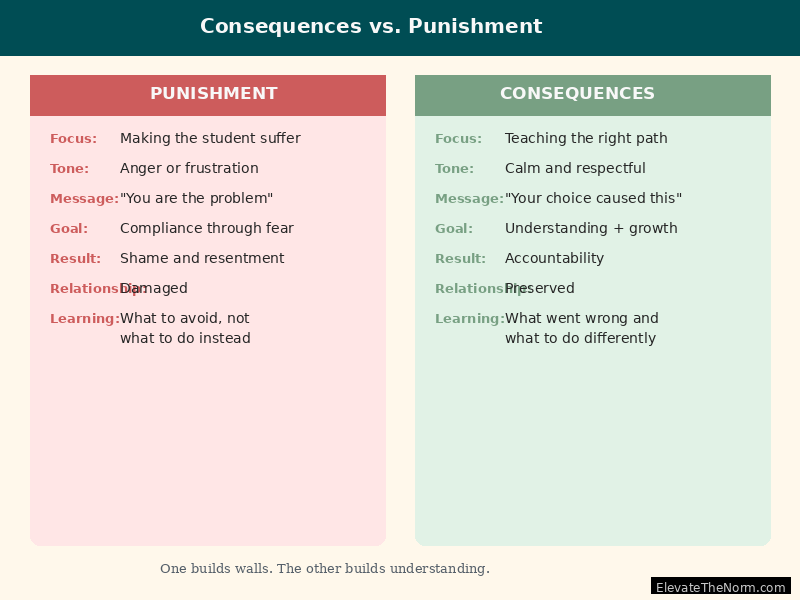
    Side-by-side comparison showing how classroom consequences differ from punishment in focus, tone, message, goal, and result
    One builds walls. The other builds understanding.

    This is where most classroom discipline goes wrong. Teachers use the word “consequences” but deliver punishment. The difference is not semantic. It changes what the student learns.

    Punishment is designed to cause enough discomfort that the student stops the behavior. It focuses on the adult’s power and the student’s suffering. A student who talks during instruction gets assigned a 500-word essay on respect. A student who is late gets locked out of the classroom. A student who forgets materials sits with nothing to do for the entire period. The message is: you made a mistake, and now you pay. A consequence that teaches needs something written down and owed back, which is what a repair-and-return sheet is for.

    Consequences are designed to help the student understand the impact of their behavior and take responsibility for repairing it. A student who talks during instruction has a brief private conversation about what they missed and what the expectation is. A student who is late makes up the missed work on their own time. A student who forgets materials uses a loaner set and brings their own the next day. The message is: you made a mistake, and here is what you do about it. If you want the exact words for that follow-up talk, my Restorative Conversation Scripts on TPT give you a script for each step.

    The Responsive Classroom framework describes effective logical consequences as fundamentally different from punishment in purpose: punishment enforces compliance through external controls, while consequences develop “internal understanding, self-control, and a desire to follow the rules”—the foundation of genuine student responsibility (Responsive Classroom, 2023).

    That distinction matters because of what the research shows about punishment. A 2026 meta-analysis in Frontiers in Psychology, synthesizing 18 studies and over six million students, found a statistically significant negative association between teacher punishment and student academic achievement (r = −0.183, p < 0.001). Punitive approaches did not improve outcomes. They made them measurably worse (Wang et al., 2026).

    Types of Classroom Consequences

    Not all consequences work the same way. Understanding the categories helps teachers choose the right response instead of defaulting to the most convenient one.

    Natural consequences

    These happen without any teacher intervention. A student who does not study performs poorly on the assessment. A student who does not participate in the group project has nothing to present. A student who does not bring supplies to class falls behind on the day’s work.

    Natural consequences are powerful because they come from reality, not from an adult’s decision. The student cannot argue with them, resent the teacher for imposing them, or claim the system is unfair. The work simply did not get done, and the result is what the result is.

    For a deeper look at how natural consequences work—and when they do not—see natural consequences in the classroom.

    But natural consequences have limits. They only work when the natural outcome is safe, timely, and genuinely experienced by the student. A student who runs in the hallway might fall—but you do not wait for that to happen. A student who cheats might not get caught until the consequences are permanent. And some natural consequences fall hardest on students who already have the fewest resources, which is not teaching—it is neglect.

    Logical consequences

    These are teacher-designed responses that connect directly to the behavior. They are the backbone of effective classroom discipline in grades 6–12.

    The Responsive Classroom approach identifies three types of logical consequences:

    1. Loss of privilege. The student temporarily loses access to something related to the misuse. A student who misuses a laptop loses laptop access for the rest of the period. A student who abuses the freedom to choose a seat returns to an assigned seat.
    2. Break it, fix it. The student repairs the damage they caused. A student who makes a mess cleans it up. A student who damages a relationship makes a direct apology. A student who disrupts a lesson contributes positively to the next one.
    3. Space and time. The student takes a brief break from the activity to reset. This is not punishment—it is a cooling-off period, and the student returns to the group when they are ready to re-engage.

    The test for whether a logical consequence is actually logical: can you explain the connection between the behavior and the response in one sentence? If the student talked during instruction and the consequence is copying dictionary definitions, you cannot explain that connection—because there is none.

    Restorative consequences

    These go beyond fixing the immediate problem to repairing the relationship. They ask the student to consider who was affected, what the impact was, and what they owe.

    Research from Chicago Public Schools found that schools implementing restorative practices saw an 18% decline in suspension days and a 19% decrease in student arrests over four years. The effects were strongest for Black students, who had faced the starkest disciplinary disparities before implementation. Importantly, the changes did not negatively impact academic outcomes for other students in the classroom (Brookings, 2022).

    Restorative consequences are not a replacement for accountability. They add a step: after the consequence, you have a conversation. What happened? Who was affected? What can you do about it? When will you do it? Schools that formalize this into a program are practising something with a real research base and real limits; the guide to accountability without empty punishment lays out what the randomized evidence does and does not support.

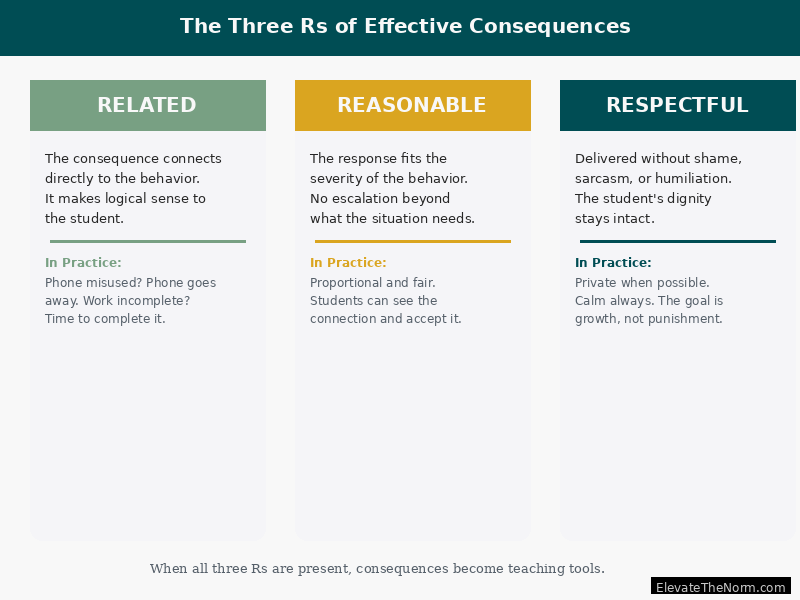
    The Three R’s: Related, Respectful, Realistic

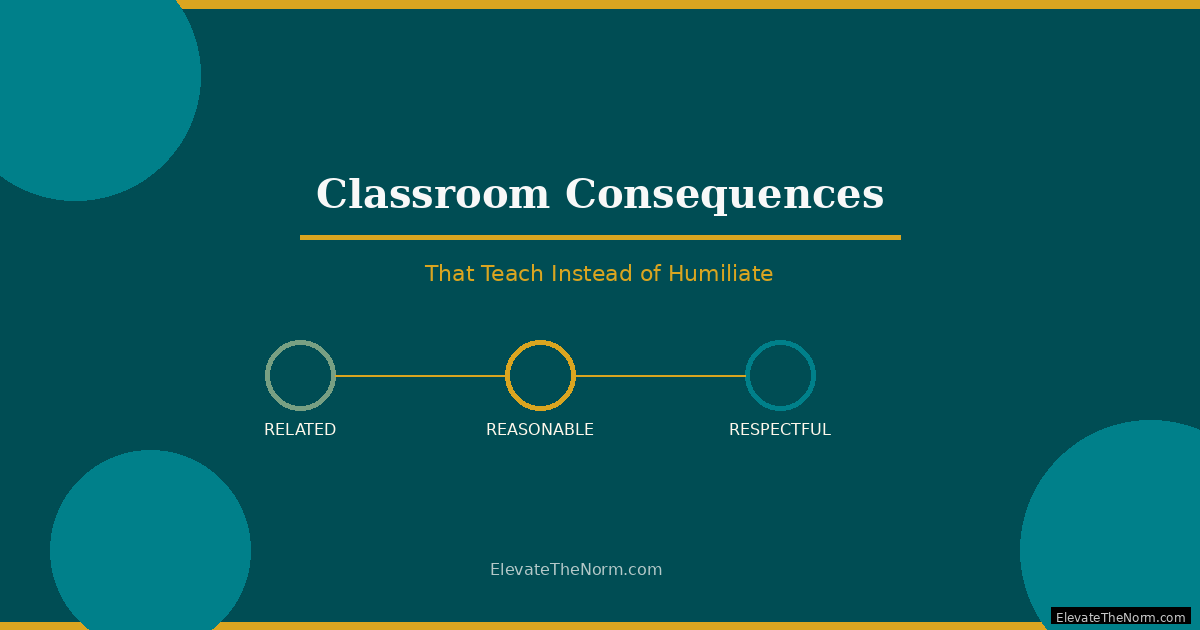
    Three cards showing the three Rs of effective consequences: Related connects to behavior, Reasonable fits severity, Respectful preserves dignity
    When all three Rs are present, consequences become teaching tools.

    This framework, drawn from the work of Rudolf Dreikurs and adapted by the Responsive Classroom and Positive Discipline traditions, gives teachers a quick test for any consequence they are considering.

    Related. The consequence connects logically to the behavior. A student who wastes class time makes up the time. A student who is disrespectful to a peer makes a direct apology. A student who turns in poor work revises the work.

    Respectful. The consequence addresses the behavior without attacking the student’s character. (For a deeper look at why this matters, see Respect in the Classroom.). “You need to redo this section because it doesn’t meet the standard” is respectful. “I guess you didn’t think this was worth your time” is not.

    Realistic. The consequence is something the teacher can actually enforce and the student can actually complete. Assigning a lunch detention every day for a week sounds firm. It also means the teacher has to show up every day for a week, and the student misses the only unstructured time they have. If a consequence is unsustainable, it will collapse—and when it does, the student learns that the teacher’s word does not hold.

    If a consequence fails any one of the three R’s, it is probably punishment dressed up as a consequence.

    A Practical Response Ladder for Common Problems

    This is not a rigid escalation chart. It is a guide for proportionate responses. Skip steps when the situation requires it. Start lower than you think you need to.

    Before you reach for any of it, check whether the behavior is a broken rule or an untaught procedure. A class that packs up early or crowds the door is usually failing a routine that was announced but never actually taught, and a consequence will not fix that. Most of this work sits upstream of the ladder entirely, which is why prevention comes first on any honest list of what works.

    BehaviorFirst ResponseIf It ContinuesIf It Escalates
    Off-task (phone, talking, zoning out)Proximity + quiet redirectBrief private conversation; remove the distractionLoss of privilege for the period; contact home if pattern develops
    Disrespect toward a peerImmediate, private correctionRestorative conversation between the students with teacher presentSeparate the students; parent contact; administrative referral if repeated
    Refusal to workCheck in privately: “What do you need to get started?”Offer modified entry point; document the patternParent contact; team conference; check for underlying issues
    Late to classNote it; do not interrupt instruction to address itBrief private conversation about the patternMake up missed time; parent contact if chronic
    Incomplete or missing workState the deadline and ask for a planRequire revision or completion before new privilegesParent contact; academic intervention plan
    Cheating or plagiarismPrivate conversation; require honest resubmissionParent contact; academic consequence per school policyAdministrative referral per school policy
    Physical aggression or safety threatImmediate administrative referralFollow school safety protocolFollow school safety protocol

    Notice what is not on this list: writing lines, public humiliation, removing the student’s chair, making students stand in the hallway, or assigning unrelated busywork. Those are punishments. They do not teach anything except that the teacher has more power than the student, which the student already knew.

    The Repair Conversation: Where Real Learning Happens

    Three-step repair conversation framework: What happened, Who was affected, What will you do about it - showing the process for accountability after classroom consequences
    Three questions. No lecture. The student does the thinking.

    The consequence is not the end. It is the setup. The real teaching happens in the conversation that follows.

    In my classroom, when a student and I have gotten through whatever happened—the disruption, the missed deadline, the moment that went sideways—we have a conversation. Not a lecture. A conversation. I pull the student aside, usually at the whiteboard table where the lighting is low and the chairs are better, and we talk through three questions:

    1. What happened? Not “what did you do wrong.” What happened. Let them describe it. Often their version is different from yours, and the difference is where the real issue lives.
    2. Who was affected, and how? This is the question that turns a behavior correction into a moral education moment. When a student can name who was affected—their group partner lost ten minutes of work time, the class lost focus, the teacher had to stop instruction—they are learning something consequences alone cannot teach.
    3. What are you going to do about it, and by when? This is where accountability lives. Not “what will you never do again,” which is a promise teenagers cannot keep. What will you do about this specific situation? Apologize to the partner. Turn in the revised work by Thursday. Show up on time for the next three days. Something concrete, something measurable, something the student commits to with a date attached.

    That conversation takes four minutes. It does more than any detention I could assign.

    Consequences Teachers Should Stop Using

    Some consequences survive in secondary classrooms not because they work but because they are easy, familiar, or satisfying in the moment. Here are the ones that consistently backfire.

    Public call-outs

    Naming a student’s misbehavior in front of the class. (This is a close cousin of yelling at students—both use volume and audience as weapons.) This forces the student to choose between backing down (humiliating) and pushing back (escalating). There is no good outcome for either party.

    Writing lines or copying text

    Writing “I will not talk in class” fifty times teaches the student exactly one thing: that their time means nothing to the teacher. It has no connection to the behavior and no instructional value.

    Group punishment

    Punishing the entire class because one or two students misbehaved. This destroys trust, breeds resentment among the students who did nothing wrong, and teaches the class that individual accountability does not exist in this room.

    The one genuine edge case is an environmental change that takes nothing away from anybody and reverses within a day or two — turning the overhead lights back on in a lamp-lit room is the version I use. It still affects students who did nothing, so it still has to be rare, never aimed at one student, and named out loud rather than left to be guessed at.

    Removal as a first resort

    Sending a student out of the room should be a last step, not a first one. A meta-analysis of 40 studies and 274 effect sizes found that exclusionary discipline—suspensions, expulsions, and removals—is “an important and meaningful predictor of increased delinquency.” Students who are removed do not improve. They disengage further (Novak, 2021). Understanding what actually motivates students makes it clear why removal does the opposite.

    Delayed or disproportionate consequences

    A consequence that arrives days after the behavior loses its connection to the event. A consequence that is wildly out of proportion to the offense—three weeks of detention for one late assignment—teaches the student that the system is arbitrary, not fair.

    Consequences disguised as questions

    “Do you think that was a good choice?” is not a real question. It is a humiliation ritual. The student knows the answer. The teacher knows the answer. The only purpose is to make the student say it out loud for the teacher’s satisfaction.

    When School Policy Requires a Specific Response

    Teachers do not operate in a vacuum. School policies, district codes, and state laws dictate certain responses for certain behaviors. Fights may require an automatic suspension. Drugs or weapons may require an automatic referral. Bullying may trigger a mandated investigation.

    In those situations, the teacher’s role is clear: follow the policy. Do not try to handle a legally mandated situation with a classroom consequence. The liability is too high, the situation is too serious, and the student may need supports the teacher cannot provide.

    But following the policy does not mean abandoning the student. After the formal process runs its course, the teacher can still have a repair conversation. The teacher can still welcome the student back without a grudge. Building relationships with students means staying in their corner even after the hard moments. The teacher can still be the adult who says: “We need to talk about what happened, and I still expect good things from you.”

    The American Psychological Association’s 2008 Zero Tolerance Task Force review is still relevant here. The task force concluded that zero-tolerance policies have “not been shown to improve school climate or school safety” and that schools with higher suspension rates actually reported lower overall climate ratings (APA, 2008). Mandatory does not mean effective. And a teacher who adds humanity to a rigid process is not undermining the policy—they are making the policy survivable for the student on the other end of it.

    How to Make Consequences Consistent Without Being Rigid

    Consistency does not mean identical. It means predictable. Students need to know that certain behaviors will always produce a response—but the specific response can and should account for context.

    A student who is late for the first time gets a different response than a student who is late every day. A student who snaps at a classmate during a terrible week gets a different response than a student who routinely bullies peers. A student with an IEP or a 504 plan may have specific behavioral supports that modify the standard consequence.

    None of this is favoritism. It is professional judgment. Doctors do not give every patient the same prescription. Teachers should not give every student the same consequence. What stays consistent is the standard—not the response.

    Document when you flex. If a parent or administrator asks why Student A received a different consequence than Student B, you need to be able to explain the reasoning. Flexibility without documentation becomes inconsistency, and inconsistency erodes trust.

    Building a Consequence System That Lasts

    A consequence system that collapses by October was never a system. It was a list of threats. Here is what makes a system durable:

    1. Keep it simple. Three to five clear expectations with predictable responses. Consequences only read as fair when students already know the standard, which is why naming expectations out loud does so much of the work. If you need a flowchart to explain your consequence system, it is too complicated for you to enforce and too complicated for students to follow.
    2. Teach it explicitly. Do not assume students know what will happen when they miss a deadline or disrupt a class. Tell them on day one. Revisit it in week three. Refer to it every time you use it.
    3. Use it early. A teacher who lets small violations slide for two weeks and then suddenly cracks down is not being patient—they are building a credibility problem. Address small things early, calmly, and consistently. This is one of the most important habits for new teachers building classroom management skills.
    4. Follow through. If you say the consequence is losing laptop access for the period, take the laptop. If you say you will call home, call home — which is easier when you have already decided in advance who you contact, through which channel, and at what point. Every time you do not follow through, you teach students that your words are suggestions.
    5. Pair consequences with repair. The consequence addresses the immediate behavior. The repair conversation addresses the relationship and the learning. You need both.

    Conclusion

    Classroom consequences are not about making students suffer for their mistakes. They are about helping students understand what went wrong, take responsibility for the impact, and do something concrete to make it right. When consequences are related, respectful, and realistic—and when they are followed by a genuine conversation—they teach more than any lecture on behavior ever could. I hand students a page from my Behavior Reflection Sheets on TPT so the reflection is written down before we talk.

    The alternative is punishment: public, disproportionate, disconnected from the behavior, and designed to make the student feel bad enough to stop. Decades of research confirm what experienced teachers already know—punishment does not fix behavior. It suppresses it temporarily and damages the relationship permanently.

    Hold the standard. Address the behavior. Have the conversation. That is how consequences teach.

    Free Printable: Classroom Consequence Planning Sheet

    A one-page teacher reference with the 3 R’s checklist, a behavior-response planner you fill in for your own class, and the three-question repair conversation framework. Print it and keep it at your desk.

    Download Free Planning Sheet (PDF)

    Frequently Asked Questions

    When consequences are connected to the behavior and followed by a genuine second chance, students can learn from mistakes rather than just survive the punishment. A complementary framework is positive discipline for teens, which builds on the same idea that consequences should teach rather than humiliate.

    What is the difference between natural and logical consequences?

    Natural consequences happen without any teacher action—a student who does not study performs poorly on the test. Logical consequences are designed by the teacher to connect directly to the behavior—a student who misuses a tool loses access to the tool for the period. Both teach, but logical consequences give the teacher control over timing, safety, and proportionality.

    How do I keep consequences from feeling like punishment to students?

    Three things help. First, explain the connection between the behavior and the consequence so the student understands why this response and not something else. Second, deliver it calmly and privately, not in anger and not in front of an audience. Third, follow it with a brief conversation about what happened and what comes next. When students understand the reasoning, consequences feel like structure rather than retribution.

    What should I do when a student refuses to accept a consequence?

    Do not escalate in the moment. State the consequence clearly and move on. “The laptop is done for today. We can talk about it after class.” If the student continues to refuse, involve administration—that is what they are there for. A power struggle in front of the class has no winner.

    Are there consequences that work better for middle school than high school?

    The principles are the same, but the delivery shifts. Middle school students often need more explicit teaching of what consequences mean and why they exist. High school students respond better to brief, private, adult-to-adult conversations. The three R’s framework—related, respectful, realistic—works across both levels.

    Should consequences be the same for every student?

    The standard should be the same. The response can and should account for context. A student having a crisis week may need a different consequence than a student engaging in a repeated pattern. This is not favoritism—it is professional judgment. Document your reasoning so you can explain it if asked.

    How do I handle consequences when a student has an IEP or 504 plan?

    Follow the plan. Students with IEPs or 504 plans may have specific behavioral interventions, modified consequences, or positive behavior supports written into their documentation. Those provisions are legal requirements, not suggestions. Consult with the special education team before applying consequences that may conflict with the student’s plan.

    What role should parents play in classroom consequences?

    Parents should know your system, understand the expectations, and be informed when patterns develop. Do not call home after a single minor incident—that erodes trust and creates the impression that you cannot manage your own classroom. Do call home when a pattern emerges, when the behavior is serious, or when the student needs support you cannot provide alone. Frame the call as a partnership, not a complaint.

    Sources


    About Clay Shumate
    Clay Shumate is a certified secondary Social Studies teacher in the public schools of West Alabama, with seven years of classroom experience, a B.A. in History, and an M.Ed. in Secondary Education. He writes about project-based learning, student responsibility, respect, and practical ways to hold young people to a higher standard while giving them room to learn from mistakes. He is a member of the Society of Professional Journalists and writes to its Code of Ethics; this site’s editorial standards and corrections policy are published in full. More about Clay.

    Consequences work best as one section of something larger. Setting the whole thing down in writing is what keeps the response consistent on the days you are least inclined to be.

  • Teaching Responsibility Without Treating Teenagers Like Children

    Teaching Responsibility Without Treating Teenagers Like Children

    By Clay Shumate

    Teaching responsibility means giving students real ownership over their choices, holding them to clear expectations, and following through with honest consequences that teach when they fall short—without stripping them of their dignity in the process. It does not mean lecturing them about responsibility while making every decision for them. If you want students to act like responsible young adults, you have to treat them like developing young adults and then hold them to that standard. The hardest version of that is handing a student authority that is genuinely theirs and then not quietly taking it back.

    Key Takeaways

    • Responsibility is not the same thing as obedience. A student who follows orders without thinking is compliant, not responsible.
    • Teaching responsibility requires transferring real decision-making power to students—then holding them accountable for what they decide.
    • Adolescent brains are still developing the prefrontal cortex, which means teenagers need structured practice with responsibility, not excuses to avoid it.
    • The most effective consequences are connected to the behavior, preserve the student’s dignity, and include a clear path back.
    • Rebuilding trust after a student makes a serious mistake is part of the work, not an exception to it.

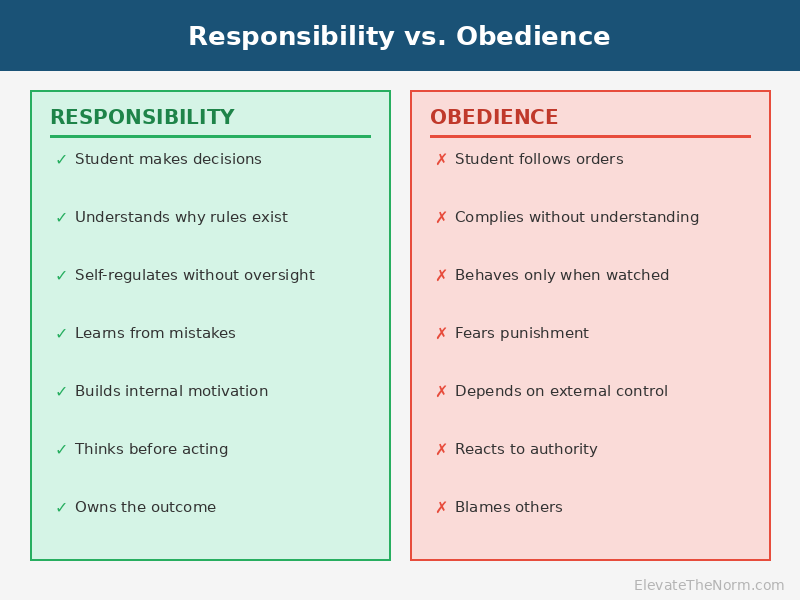
    Responsibility Is Not Obedience

    This distinction matters more than most educators realize. A responsible student makes thoughtful decisions, follows through on commitments, and accepts the consequences when things go wrong. An obedient student does what they are told.

    When mistakes happen — and they will — the question is whether the system turns them into learning. A clear process for learning from mistakes makes accountability productive instead of punitive.

    Those are not the same thing.

    Comparison chart showing the differences between teaching responsibility and demanding obedience in secondary classrooms
    Responsibility produces self-directed learners. Obedience produces students who behave only when watched.

    A classroom built entirely on obedience produces students who behave well when someone is watching and fall apart when no one is. A classroom built on responsibility produces students who can manage themselves, make reasonable choices under pressure, and recover from mistakes without an adult directing every step.

    Self-determination theory, developed by psychologists Edward Deci and Richard Ryan and applied to education by Niemiec and Ryan in a 2009 review published in Theory and Research in Education, identifies three basic psychological needs that drive human motivation: autonomy, competence, and relatedness. When teachers satisfy those needs—by offering meaningful choices, providing feedback focused on mastery, and building genuine relationships—students develop what the researchers call “autonomous self-regulation.” They do the right thing because they understand why it matters, not because they fear what happens if they do not.

    Obedience skips all three. It removes autonomy, ignores competence, and replaces relationship with compliance. That works for short-term control. It does not work for building the kind of young adults who can handle college, a job, a relationship, or the ordinary pressure of adult life.

    Why Adolescents Need Structured Practice, Not Speeches

    Here is what the brain science actually says—and what it does not.

    The American Academy of Child and Adolescent Psychiatry explains that the prefrontal cortex, the brain region responsible for reasoning, planning, and impulse control, continues developing well into early adulthood. Teenage decisions are guided more by the amygdala—the emotional, reactive part of the brain—and less by the prefrontal cortex.

    But the AACAP makes a critical clarification that too many educators skip: these brain differences “don’t mean that young people can’t make good decisions or tell the difference between right and wrong. It also doesn’t mean that they shouldn’t be held responsible for their actions.”

    The developing brain is not an excuse to lower expectations. It is a reason to provide more structured opportunities for students to practice making decisions, living with the results, and doing better next time. Teenagers get better at responsibility the same way they get better at algebra—through guided practice, honest feedback, and the chance to try again after getting it wrong.

    A longitudinal study published in Developmental Psychology by Wray-Lake, Syvertsen, and Flanagan found that social responsibility values actually decline from ages 9 to 16 before leveling off in later adolescence. The researchers identified ecological factors that predicted whether individual students bucked that trend: family compassion messages, democratic climates at home and school, community trust, and strong peer relationships. Every ecological asset they examined—except school democratic climate alone—predicted positive within-person change in responsibility.

    The takeaway is not that teenagers are naturally irresponsible. The takeaway is that responsibility does not develop automatically. The environments adults create—in classrooms, at home, in communities—determine whether adolescents practice responsibility or simply lose it during the years when they need it most.

    What Teaching Responsibility Actually Looks Like

    Teaching responsibility is not a single lesson. It is a set of daily practices built into how your classroom runs. Here is what it looks like in a secondary classroom where responsibility is taught, not just expected.

    Transfer Real Ownership

    Students cannot learn responsibility for decisions they never get to make. Start by identifying places where you currently make every choice—and hand some of them over.

    This does not mean chaos. It means structured choice within clear boundaries:

    • Let students choose how they demonstrate mastery—a paper, a presentation, a project, a recorded explanation—within your assessment criteria.
    • Give students deadlines with flexibility in how they manage their time across days, not minute by minute.
    • Allow students to set some of their own goals for a unit and explain why those goals matter to them.
    • Let students choose their own working groups for some assignments, with the understanding that they are responsible for the outcome.

    The key is that choices must come with accountability. If a student chooses to work alone and the result is weak, that is a conversation about planning and self-assessment—not a bailout. If a group chooses their members and the group falls apart, that is a conversation about collaboration and repair—not a teacher reassigning everyone. This kind of structured ownership is also foundational to project-based learning, where students manage real decisions throughout extended projects.

    Set Expectations That Respect the Age Group

    Expectations for middle and high school students should sound like what you would say to a young colleague, not to a kindergartner. Compare these:

    Sounds like elementary school: “We use kind words in this classroom. Put your name on your paper. Raise your hand before speaking.”

    Sounds like a secondary classroom: “Disagree with ideas, not people. Meet your deadlines or communicate in advance. If you damage something—a relationship, a piece of equipment, someone’s trust—you are responsible for repairing it.”

    The second set treats students as developing young adults. It assumes they can handle direct language, reasonable expectations, and the responsibility that comes with both.

    When you set expectations, teach them explicitly. Do not assume students know what “take responsibility” means in practice. Model it. Show what it looks like when you make a mistake—apologize, explain what you will do differently, and follow through. Students learn more about responsibility from watching how adults handle their own failures than from any poster on the wall. If you are new to teaching, setting these expectations early and consistently will save you from relying on control-based management later.

    Follow Through Every Time

    Inconsistent follow-through is the fastest way to destroy a responsibility-centered classroom. If you tell students they are responsible for meeting deadlines and then quietly accept late work without conversation, you have taught them that deadlines are suggestions. If you tell students they are responsible for respectful communication and then ignore disrespect because you are tired or the student is popular, you have taught them that respect is optional.

    Following through does not mean being harsh. It means being consistent:

    • When a student misses a deadline, have the conversation. Ask what happened. Ask what their plan is. Hold them to a next step.
    • When a student is disrespectful, address it directly and privately. Explain the impact. Expect repair.
    • When a student does something well—meets a commitment, helps a peer, follows through without being reminded—say so. Responsibility deserves recognition, not just correction.

    Consistency is what makes expectations real. Without it, your expectations are decoration.

    Use Consequences That Teach

    The Responsive Classroom framework identifies three types of logical consequences that maintain dignity while teaching responsibility:

    1. “You break it, you fix it.” If a student damages something—a relationship, a piece of equipment, another student’s work—they take direct action to repair it.
    2. Loss of privilege. If a student misuses a privilege—technology, independent work time, a flexible seating arrangement—they lose that specific privilege until they demonstrate they can handle it.
    3. Positive time-out. If a student needs to regain self-control, they move to a designated space to regroup—not as punishment, but as a skill.

    The common thread is that every consequence connects directly to the behavior. A student who disrupts a lab loses lab privileges until they demonstrate readiness. A student who plagiarizes rewrites the assignment and has a conversation about academic integrity. A student who damages a relationship writes or speaks a genuine apology and follows it with changed behavior.

    What does not work: consequences designed to humiliate, embarrass, or punish without teaching. Making a student stand in the hallway while the class watches teaches shame, not responsibility. Reading a student’s poor grade aloud teaches public failure, not reflection. Calling a parent in front of the class teaches distrust, not accountability. As we have discussed before, yelling does not restore order—it manufactures it temporarily while destroying the relationship that makes real accountability possible.

    Build Reflection Into the Routine

    Responsibility without reflection is just compliance that worked out. Students need regular opportunities to think about what they chose, what happened, and what they would do differently.

    Build reflection into your classroom routines:

    • Weekly self-assessment: Students rate their effort, preparation, and collaboration for the week and identify one specific thing to improve.
    • Post-project reflection: After completing a project, students answer: What did I do well? Where did I struggle? What would I change next time? What did I learn about working with others?
    • After-mistake reflection: When a student makes a poor decision, the reflection conversation replaces or accompanies the consequence: What happened? Who was affected? What will you do to repair it? What will you do differently?

    Don Hellison’s Teaching Personal and Social Responsibility (TPSR) model, developed for working with at-risk youth, structures responsibility into five progressive levels: respecting others’ rights and feelings, participation and effort, self-direction, helping others and showing leadership, and demonstrating responsibility outside the classroom. Students journal about their choices and use self-assessment to track their own growth. The model has been studied extensively with adolescents and consistently shows improvements in both personal and social responsibility when implemented with fidelity.

    Reflection turns experience into learning. Without it, students repeat mistakes not because they are irresponsible but because no one helped them think about what went wrong.

    Common Mistakes That Undermine Responsibility

    Even teachers who believe in student responsibility sometimes undermine it without realizing it. Here are the most common mistakes I have seen—and made.

    Rescuing Students From Consequences

    When a student forgets their materials, borrowing a pencil is reasonable. When a student chronically forgets materials and you supply everything every day without conversation, you are teaching them that someone will always cover for them. The same applies to deadlines, group responsibilities, and behavioral expectations.

    There is a difference between supporting a student who is struggling and protecting a student from the natural results of their choices. Support says, “Let’s figure out a plan so this does not keep happening.” Rescue says, “Don’t worry about it.”

    Confusing Accountability With Humiliation

    Accountability is a private conversation about what happened, what needs to change, and what happens next. Humiliation is a public performance designed to make a student feel bad enough to behave.

    Carl Pickhardt, writing in Psychology Today, frames the teaching of responsibility as helping adolescents understand the “choice/consequence connection”—recognizing that they make choices and are obligated to cope with the outcomes. He emphasizes non-evaluative correction: address the decision, not the character. “We disagree with the choice you made, and here is why” is accountability. “What is wrong with you?” is humiliation.

    When accountability feels safe, students are more likely to be honest about what happened. When accountability feels dangerous, students learn to lie, hide, and blame.

    Assigning Responsibility Without Teaching It

    Telling a student to “be more responsible” without showing them what that looks like is the same as telling a student to “write better” without teaching writing. Responsibility is a set of skills: planning, time management, self-assessment, communication, follow-through, and repair. Each one can be modeled, practiced, and improved.

    If your students are struggling with responsibility, the first question is not “What is wrong with these kids?” The first question is “Have I taught them what responsible behavior looks like, practiced it with them, and given them honest feedback?” Good checking for understanding applies here too—do not assume students understood the expectation just because you stated it once.

    Punishing the Whole Group for One Student’s Behavior

    Group punishment teaches one thing: resentment. It does not teach the offending student to take responsibility. It teaches every other student that fairness is not a priority in your classroom. Address individual behavior individually.

    Ignoring Executive Function Differences

    Some students struggle with responsibility not because they do not care but because executive function skills—planning, organizing, managing time, shifting between tasks—develop unevenly. Students with ADHD, learning disabilities, or trauma histories often need additional scaffolding: visual checklists, broken-down steps, shorter planning horizons, and more frequent check-ins. Scaffolding is not lowering the standard. It is building the ramp so the student can reach the standard. If you offer the same support to every student and call it fair, you have confused equality with equity.

    Working Outside Your School’s Existing Framework

    Responsibility-centered classroom practices work best when they align with your school’s broader behavior system—whether that is PBIS, MTSS, restorative justice, or a homegrown discipline framework. If your classroom expects repair conversations and your administration expects only referrals and suspensions, students receive conflicting messages. Talk with your administrator about how your approach fits the schoolwide structure. Where conflicts exist, advocate for alignment rather than working around the system.

    When to Handle It Yourself and When to Involve Administration

    Not every responsibility failure belongs in the classroom. As a general guide:

    Handle it yourself when the behavior is a normal adolescent mistake—missed deadlines, low-level disrespect, disorganization, minor conflict between students, failure to follow through on a commitment. These are teaching moments. Use them.

    Involve administration when safety is at risk, when the behavior violates school policy in ways that require formal documentation, when a pattern persists despite consistent classroom-level intervention, or when the situation involves harassment, threats, substance use, or any mandatory reporting obligation. Handling these alone is not brave—it is negligent.

    The line between classroom-level and administrative-level is not always clean. When in doubt, consult your administrator. A quick conversation about whether something warrants a referral is always better than finding out later that it did.

    How to Rebuild Trust After a Student Makes a Serious Mistake

    Five-step process for rebuilding trust after a student makes a serious mistake in the classroom
    Rebuilding trust follows a predictable sequence—from naming what happened to following through on the path back.

    Students will make serious mistakes. They will cheat. They will say something cruel. They will break a promise, damage property, or betray a peer’s confidence. How you handle those moments determines whether the student learns from the mistake or decides they are permanently defined by it.

    Rebuilding trust after a serious mistake follows a predictable sequence:

    Step 1: Name what happened clearly. Do not soften, minimize, or exaggerate. “You copied three paragraphs from a website and submitted them as your own work” is clear. “You kind of had some issues with the assignment” is not.

    Step 2: Explain the impact. Who was affected? How? “When you copy someone else’s work, you are lying about what you know. That hurts your credibility with me and cheats yourself out of learning.”

    Step 3: Apply the consequence. The consequence should be predictable, proportionate, and connected to the behavior. For plagiarism, rewriting the assignment and having a conversation about academic integrity makes sense. For a first offense, a failing grade on the assignment without the chance to rewrite teaches punishment, not responsibility.

    Step 4: Create a path back. This is where most systems fail. A student who is permanently labeled “cheater” after one incident has no incentive to improve. A student who rewrites the assignment, demonstrates understanding of academic integrity, and earns back the teacher’s trust has a reason to grow.

    Step 5: Follow through on the path. If you told a student they could rebuild trust by meeting three consecutive deadlines, check in at each one. Acknowledge progress. A path back means nothing if nobody notices when the student walks it. Strong student-teacher relationships make this follow-through natural rather than forced.

    Research on restorative practices from the Learning Policy Institute shows that approaches focused on repairing harm rather than merely punishing offenders reduce suspensions, decrease disciplinary disparities, improve school climate, and strengthen student-teacher relationships. A large-scale California study found that the more students experienced restorative practices, the more student behavior, mental health, and disciplinary outcomes improved—with stronger effects for Black and Latino students.

    Repair is not softness. It is accountability with a future attached.

    Starting Responsibility Practices: The First Two Weeks

    If you are introducing these practices to a class that has not experienced them, the first two weeks set the tone.

    Days 1–3: Explain your expectations in plain language. Do not read a list from a slide. Talk to students like people. Explain why each expectation exists. Ask students what they think is missing. Listen. This is not a negotiation—you are still setting the standards—but student input on the front end builds investment.

    Days 4–7: Practice the routines. Model the opening check-in. Walk through the self-assessment. Run a short reflection. Practice the repair protocol with a low-stakes hypothetical. This is the same approach a coach uses: you do not play the game on day one. You practice the plays.

    Week 2: Start holding students accountable with the system you taught. The first time a student misses a deadline, have the conversation. The first time a student is disrespectful, use the repair protocol. Consistency during week two teaches students that you meant what you said in week one.

    Expect resistance. Some students have spent years in classrooms where expectations were announced and never enforced. They will test whether you are serious. The answer is yes, every time, without anger and without exceptions.

    Classroom Routines That Build Responsibility Daily

    Responsibility is not a unit you teach in September and hope sticks. These daily and weekly routines keep it alive:

    Side-by-side examples of teacher language that undermines versus supports student responsibility
    The words you use shape how students understand responsibility. Address the behavior, not the person.

    Morning or class-opening check-in: Students identify their main goal for the period and what they need to accomplish it. This takes two minutes and builds the habit of intentional work.

    Assignment tracker: Students maintain a simple tracker—paper or digital—of their commitments, deadlines, and completion status. The teacher reviews it periodically, not to micromanage but to have informed conversations about patterns.

    End-of-week accountability conversation: Pairs of students spend three minutes discussing what they accomplished, what they did not, and what they will do differently next week. The teacher circulates and listens.

    Repair protocol: When conflict or harm occurs, the classroom has a clear process: name what happened, identify the impact, agree on repair, follow through. Students know this process because it has been taught and practiced.

    Student-led conferences: At least once per semester, students present their own work, progress, and goals to their families. The student runs the meeting. The teacher facilitates. This is one of the most powerful responsibility-building practices available because it requires students to own and explain their own learning.

    Teacher Language That Supports Responsibility

    The words you use shape how students understand responsibility. Here are phrases that work—and phrases that do not.

    Instead of: “I need you to sit down.”
    Try: “You have a choice: sit down and join the discussion, or step outside for a minute to reset. What works for you?”

    Instead of: “Why didn’t you do your homework?”
    Try: “Your assignment is not here. What happened, and what is your plan?”

    Instead of: “I’m disappointed in you.”
    Try: “That choice is not what I expected from you. Let’s talk about what happened and what comes next.”

    Instead of: “Because I said so.”
    Try: “Here is why this expectation exists, and here is what happens when people do not meet it.”

    Instead of: “You always do this.”
    Try: “This is the third time this week. Let’s figure out what’s making this hard and what you can change.”

    The pattern is consistent: address the behavior, not the person. Offer a choice when possible. Ask the student to think, plan, and commit to a next step. Treat the student as someone capable of improvement, because they are.

    Conclusion

    Teaching responsibility to teenagers is not complicated, but it is demanding. It requires you to transfer real decisions to students and then hold them to the results. It requires consequences that teach instead of humiliate. It requires rebuilding trust after failures instead of writing students off. And it requires daily routines that make responsibility a habit, not a lecture topic.

    The research is consistent: when adults provide structure, autonomy, honest feedback, and a genuine relationship, adolescents develop responsibility. When adults provide only control, students learn obedience—and obedience has an expiration date.

    Your students are developing young adults. Treat them that way. Hold them to a higher standard. Give them room to fail. And when they fail, show them how to get back up and do better. That is what teaching responsibility looks like. For specific classroom activities that put these principles into practice — from deadline choice contracts to repair letters to structured second chances — see activities for teaching responsibility in middle and high school.

    For a deeper look at what student responsibility actually looks like across seven observable domains—and the critical difference between responsibility and compliance—see student responsibility in the classroom on this site.


    One prerequisite worth naming: none of this works if students are guessing at the standard. If you’re building that foundation, start with a practical framework for classroom expectations — fewer, clearer, taught, and held the same way every day.

    Frequently Asked Questions

    What is the difference between teaching responsibility and just expecting it?

    Teaching responsibility means explicitly showing students what responsible behavior looks like, practicing it, providing feedback, and giving students structured opportunities to improve. Just expecting responsibility means announcing standards and then being frustrated when students do not meet them. If you have not taught it, practiced it, and followed up on it, you have not taught it—you have wished for it.

    How do I teach responsibility without giving up classroom control?

    Responsibility and classroom control are not opposites. You can offer students meaningful choices—how they demonstrate learning, how they manage their time, who they work with—while maintaining clear boundaries on safety, respect, and academic standards. The teacher still sets the expectations and enforces them. The difference is that students have genuine ownership over some decisions, which makes them more invested in the outcomes.

    What do I do when a student keeps making the same mistake?

    First, check whether the student has actually been taught a better alternative. Repeating a consequence without changing the support is unlikely to produce different results. Have a private conversation: “This keeps happening. Let’s figure out why and make a specific plan.” If the pattern continues despite genuine support, involve a counselor, administrator, or family member—not to escalate punishment, but to add resources.

    Should I let natural consequences do the work, or should I intervene?

    Use natural consequences when they are safe, timely, and proportionate. If a student does not study, a low test score is a natural consequence. If a student does not prepare for a presentation, an awkward moment in front of peers is a natural consequence. But intervene when a natural consequence would be dangerous, delayed so long that a student cannot connect it to their behavior, or so severe that it damages the student’s wellbeing beyond what the situation warrants.

    How do I handle parents who think I am being too strict—or too lenient?

    Communicate your system proactively. At the start of the year, explain your expectations, your approach to consequences, and your commitment to treating students as developing young adults. When a parent raises a concern, listen first. If you are being consistent, fair, and focused on teaching responsibility rather than punishment, most parents will support the approach once they understand it. If a parent insists on no consequences for their child, explain that accountability in a safe classroom is practice for the real world—and the real world does not offer that exemption.

    Is this approach realistic with 30 students in a classroom?

    Yes, because most of these practices are routines, not individual interventions. A two-minute opening check-in, a weekly self-assessment, a standard repair protocol—these work at scale because they are systematic. You are not having a 20-minute conversation with every student every day. You are building a classroom culture where responsibility is the norm, not the exception, and then intervening individually when a student struggles.

    What about students with ADHD or executive function challenges?

    Students with executive function difficulties often need more scaffolding to practice responsibility—not lower expectations. Break large assignments into smaller checkpoints with intermediate deadlines. Use visual checklists students can reference independently. Check in more frequently at the start, then gradually reduce support as the student builds capacity. The goal is the same standard with a more supported path to get there. If a student has an IEP or 504 plan, their accommodations should be integrated into your responsibility framework, not treated as exceptions to it.

    How can parents reinforce these practices at home?

    The core principles translate directly: give teenagers real decisions with real consequences, follow through consistently, address behavior without attacking character, and provide a clear path to rebuild trust after mistakes. If you know your child’s teacher uses a responsibility-centered approach, ask about it at conferences and use similar language at home. Consistency between school and home accelerates the learning.


    Sources


    About Clay Shumate
    Clay Shumate is a certified secondary Social Studies teacher in the public schools of West Alabama, with seven years of classroom experience, a B.A. in History, and an M.Ed. in Secondary Education. He writes about project-based learning, student responsibility, respect, and practical ways to hold young people to a higher standard while giving them room to learn from mistakes. He is a member of the Society of Professional Journalists and writes to its Code of Ethics; this site’s editorial standards and corrections policy are published in full. More about Clay.
Teacher Emergency Toolkit — practical resources, real classroom support. Shop on TPT.Teacher Emergency Toolkit — practical resources, real classroom support. Shop on TPT.