The Elevate Blog banner: Real Classrooms. Practical Ideas. Higher Expectations. Three students climb a rocky ridge at sunrise, each pulling the next one up, toward a teacher reaching down to help.

Tag: classroom culture

  • Restorative Circles: How to Run One, and What the Randomized Trial Found

    Restorative Circles: How to Run One, and What the Randomized Trial Found

    By Clay Shumate

    Restorative circles are structured conversations where everyone sits in a circle and speaks one at a time, holding a talking piece. Most should be proactive, building relationships before anything goes wrong; a smaller share respond to harm. They are cheap and learnable, and the one randomized trial found the gains sat in elementary schools.

    Key Takeaways

    • Most circles should not be about anything going wrong. San Francisco Unified says proactive circles “ideally should account for no less than 80 percent of all circles a student experiences,” and RestorativeDC puts the split at 80 / 20.
    • The randomized trial is good news for elementary schools and bad news for ours. In RAND’s two-year trial across 44 schools, days lost to suspension fell 36 percent in treatment schools against 18 percent in the others — but the effect “was driven by lower rates in PERC elementary schools,” and in grades 6–8 academic outcomes “actually worsened” with no reduction in suspensions.
    • A circle is short. Researchers who observed 180 of them recorded an average of 15 minutes and 19 participants.
    • Speaking is never required, and that is not a softness. It is what separates a circle from a public shaming. RestorativeDC is explicit that students may opt out “if they are feeling anxious, overwhelmed, unsafe, or insecure.”
    • None of the three district guides I read says when a circle is the wrong tool. That silence is the most important thing in this article, and it is why the judgment stays with you and your school’s own policy.

    What is a restorative circle?

    A restorative circle is a structured conversation in which participants sit facing each other with nothing in the middle, and only the person holding the talking piece speaks. New York City’s implementation guide puts the purpose in two halves: circles give students a way “to share their feelings, ideas, and experiences in order to establish relationships and develop social norms on a non-crisis basis,” and “when there is wrongdoing, circles play an active role in addressing the wrong and making things right.”

    The circle is one rung on a ladder, not the whole approach. New York City lists the continuum as affective statements, restorative questions in impromptu dialogue, proactive circles, responsive circles, and then restorative meetings or conferences. The bottom rung takes seconds and no setup — that is the lowest-effort move on the restorative continuum, and most teachers should get good at it before they convene anybody. The circle is what you reach for when the thing you need is the group, not one student. And the whole ladder sits inside the wider restorative approach and its evidence base, which is a bigger argument than this page.

    The same guide draws the boundary cleanly: “if a student is receiving a consequence or punishment specifically for breaking the rules then that is a traditional, punitive approach to discipline.” A circle run to deliver a punishment is not a circle.

    What is the difference between a proactive and a responsive circle?

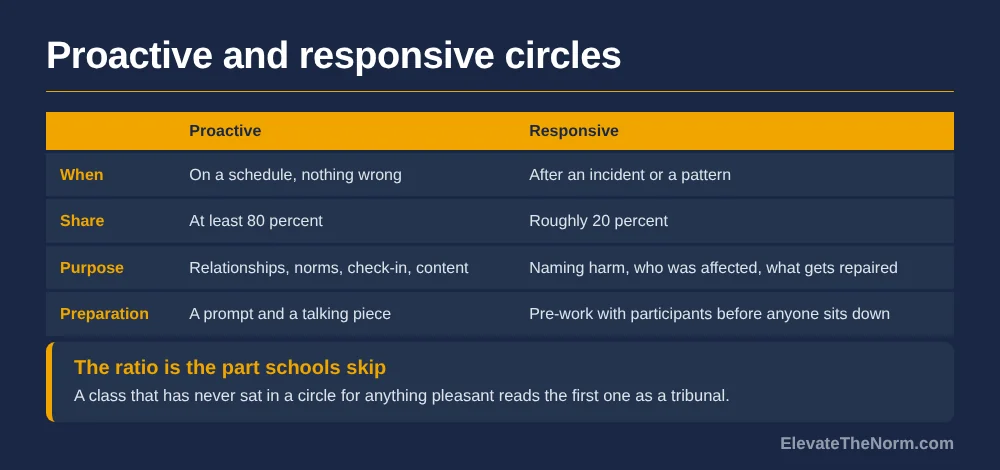
    A proactive circle is held when nothing is wrong, to build the relationships and norms you will need later. A responsive circle is held after something has happened. San Francisco’s guidance is blunt that proactive circles “are NOT held in response to an incident or problem,” and both it and RestorativeDC put the target split at roughly 80 percent proactive.

    That ratio is the part schools skip. A class that has never sat in a circle for anything pleasant will read the first one as a tribunal, because that is the only context they have for it.

     Proactive circleResponsive circle
    WhenOn a schedule, when nothing is wrongAfter an incident or a pattern
    Share of the totalAt least 80 percentRoughly 20 percent
    Typical purposeRelationships, norms, a shared check-in, curriculum contentNaming harm, hearing who was affected, agreeing what gets repaired
    Who is thereThe whole class, by defaultThose involved and those affected — San Francisco’s version addresses class-level issues with the whole class
    PreparationChoose a prompt and a talking piecePre-work with participants before anyone sits down
    The two circle types as San Francisco Unified and RestorativeDC describe them. The 80 / 20 split is their recommendation, not a measured optimum.
    Table comparing proactive and responsive restorative circles on when they are held, what share of circles they should be, their purpose, and the preparation each needs.

    How do you actually run a circle?

    Chairs in a circle with nothing in the middle, a talking piece that moves one way around, and a fixed sequence of rounds. San Francisco’s general format is seven steps: opening, guidelines and values, introduction of the talking piece, check-in, discussion rounds, check-out, closing. RestorativeDC’s version adds an opening and closing ceremony at either end.

    1. Set the room. New York’s guide specifies “chairs situated in a large circle for all participants (preferably no furniture in the middle).” The seating, RestorativeDC says, is “designed to communicate equity and visibility for all participants.”
    2. Open it deliberately. A reading, a question, a moment — something that marks this as not-normal-class. It takes thirty seconds and it does most of the work of setting the tone.
    3. Name the guidelines before the first round, every time. New York’s are short enough to say from memory: respect the talking piece, speak from the heart, listen from the heart, trust you will know what to say, say just enough. San Francisco warns that skipping this round is tempting and that you should not.
    4. Introduce the talking piece and what it means. Only the person holding it speaks, and everyone else listens. Say out loud that passing is allowed.
    5. Check in with one round, kept short. San Francisco’s prompt is a single word for how you are feeling; New York caps an introduction round at fifteen seconds a person. With a class of thirty, that arithmetic is the reason to keep it to a word.
    6. Run the discussion rounds. One question per round, the piece goes all the way around, and you do not comment between speakers. RestorativeDC describes this part as storytelling and guiding questions, and uses small groups of three to five students when the circle is large.
    7. Check out, then close. One word again, or what they most appreciated about the process. Then end it as deliberately as you opened it.
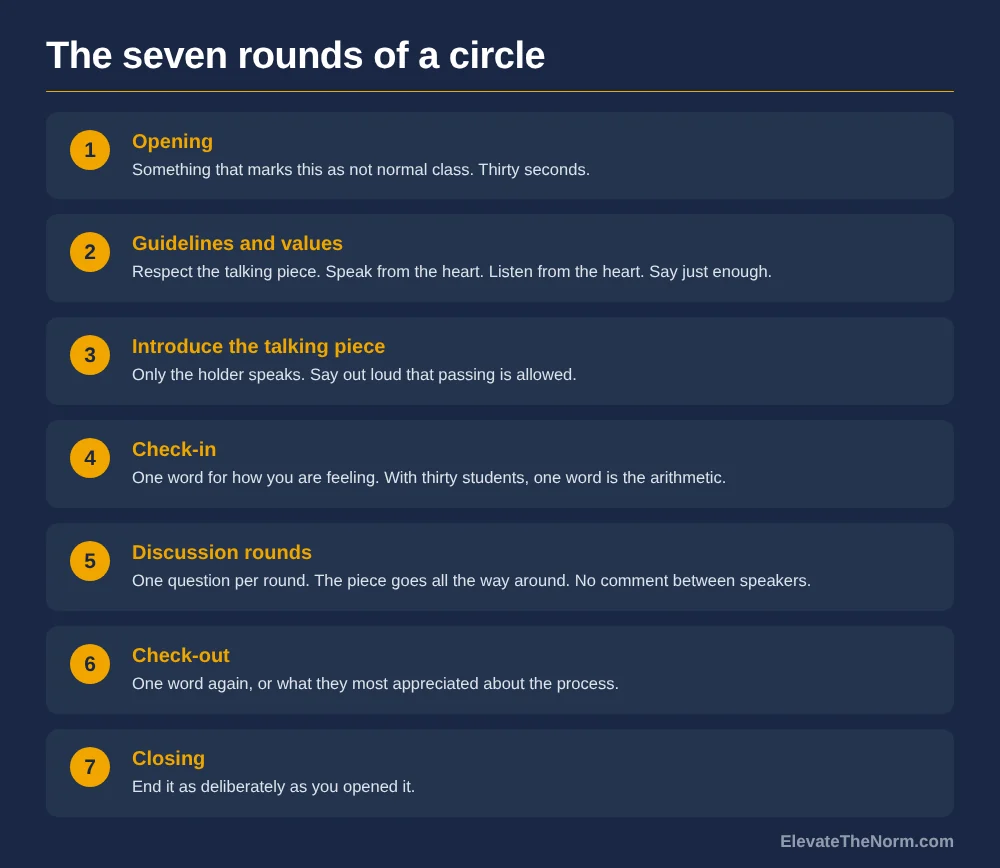
    Numbered list of the seven rounds of a restorative circle: opening, guidelines and values, introducing the talking piece, check-in, discussion rounds, check-out, and closing.

    The person running it is a keeper, not a facilitator: New York says the keeper’s job “is not to facilitate the circle, but to act as guide that introduces the circle prompts and ensures that the circle remains a safe space.” San Francisco adds that keepers “are participants in the circle, not observers” — you answer your own prompts — and gives the reason to keep your hands off: “as soon as you intervene in a more directive way, participants become less accountable for their actions and decisions.” For a teacher used to running the room, that is the hardest instruction on this page.

    The talking piece is not a gimmick either. San Francisco says its purpose is “to create an equitable environment for sharing” where “everyone gets a chance to speak or have the right to pass.” In a room where four students normally do the talking, an object that has to physically reach you is a cheap fix for a hard problem.

    Do restorative circles actually work?

    They reduce suspensions and improve how teachers see their schools. They have not been shown to improve academic outcomes, and in one randomized trial they made them worse for middle-grade students. Both halves of that sentence come from the same study, and most writing about circles only quotes the first.

    The strongest evidence is RAND’s evaluation for the National Institute of Justice, by Catherine Augustine and colleagues: a genuine randomized controlled trial of 44 schools in one mid-sized urban district, 22 running a two-year whole-school restorative programme and 22 carrying on as before, paired and assigned at random. Researchers observed 180 circles in case-study schools — 130 proactive, 28 responsive — averaging 15 minutes and 19 participants, and 69 percent of staff reported using proactive circles often or always.

    What improved: days lost to suspension fell 36 percent in the restorative schools against 18 percent in the comparison schools, and by the final year 13 percent of students in restorative schools were suspended against 15 percent elsewhere. Suspension rates fell for African American students, low-income students and female students, which the authors describe as shrinking the disparities. On the teacher survey the authors report “strong evidence that PERC had positive effects on teachers’ perceptions,” with significantly higher ratings for conduct management and school leadership.

    What did not. Suspensions did not fall for male students, for students with IEPs, or for violence and weapons incidents, and arrests were not reduced. Student-rated classroom climate “were lower in PERC schools overall” — the students’ own ratings went the wrong way while their teachers’ went the right way. And the authors state plainly: “despite fewer suspensions, academic outcomes did not improve in PERC schools.”

    Two caveats. The published materials I could read report no effect sizes for these outcomes, so the percentages above are figures as stated rather than modelled estimates. And the authors’ own limits are real: two years “may be insufficient,” and “we do not know how many or which students experienced restorative practices.”
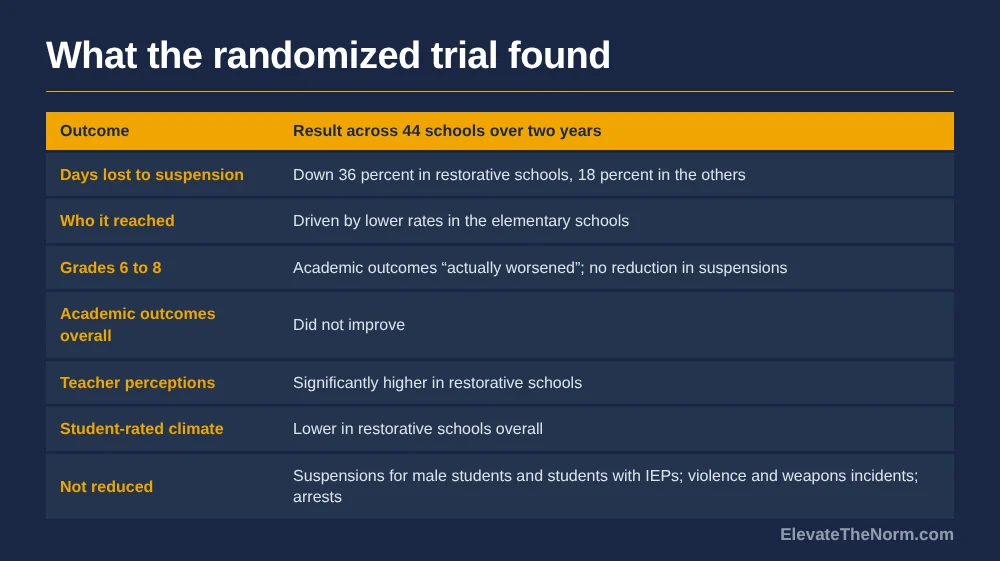
    Table of findings from a two-year randomized trial across 44 schools, including days lost to suspension falling 36 percent in restorative schools and academic outcomes worsening in grades 6 to 8.

    Other evidence points more positively but is weaker in design. A Learning Policy Institute study of 485 California middle schools and roughly two million students found exposure “improved standardized test performance in both English language arts and mathematics” and reduced the probability of suspension, with a larger ELA association for Black students than White students. It controls for student and school characteristics rather than randomizing, so it cannot carry the causal weight the trial can, and the same report warns outcomes over time are “U-shaped,” with short-term declines before long-term gains. A companion policy brief sums the field up fairly: restorative practices “can reduce schools’ reliance on exclusionary discipline,” while “evidence of the effects of RPs on academic outcomes is mixed.”

    Why did the middle grades go backwards?

    Nobody knows, and the honest answer matters more to this site’s readers than anything else in the trial. In RAND’s words: “at the middle grade level (grades 6–8), academic outcomes actually worsened in the treatment schools.” And: “neither did we find fewer suspensions in middle grades.” The suspension win that gets quoted everywhere “was driven by lower rates in PERC elementary schools.”

    The authors offer one careful sentence of explanation — “it could be that it is more challenging for restorative practices to positively affect middle grade students” — and add “at least within a two-year time frame.” That is as far as the data goes, and anyone extending it further is guessing.

    What the same study does tell you is that dosage dropped as grade level rose: high school staff reported significantly less use than elementary staff, and the biggest barrier teachers named was lack of time. A secondary teacher sees five or six groups a day for under an hour each; an elementary teacher has one group all day. That is not an excuse for the result, but it is a difference nobody should ignore when a district rolls one programme out across all three levels and expects the same answer.

    So the defensible reading for a secondary building: circles are worth running, and anybody promising they will lift test scores in grades 6–8 is contradicted by the best study we have.

    How do you run a circle after something has gone wrong?

    With preparation before anyone sits down, and with participation that is genuinely optional. San Francisco’s script for a circle to repair harm runs seven rounds: introductions and why each person is there; the facts; who was affected; how people feel; what needs to happen; who agrees to what; and a closing agreement naming who is responsible for following through.

    Three details carry most of the weight. The facts round is prepared in advance — the guidance says to ask two people who know the facts whether they are willing to share them, and that “it is important that they only share the facts and leave their personal feelings out.” The agreement round is concrete: “which of these do you want to agree to and who is responsible for following through with repairing the harm?” And New York’s restorative questions are the spine of the middle rounds: what happened and what were you thinking at the time; who has been affected and in what way; what do you think you need to do to make things as right as possible.

    Now the part that is easy to get wrong, and it is a safety question rather than a technique question. A circle is not a device for extracting an admission. New York’s guide describes a formal conference as one where those “who have acknowledged causing harm” meet those they have harmed — the acknowledgement comes first, before anybody is convened. If a student is still denying it, or the facts are contested, you do not have a circle, you have an investigation, and those are different rooms.

    The opt-outs are not soft touches either. RestorativeDC is explicit that “speaking is not required” and that students can opt out “if they are feeling anxious, overwhelmed, unsafe, or insecure.” It gives two concrete escape hatches: a student who needs to leave the conversation is “invited to turn their chair to face outwards,” and a student who does not want to speak aloud “can write down responses and invite a neighbor to share it aloud for them.” It also says questions can be given to students in advance so they can prepare. In a responsive circle those provisions are what separate repair from a performance of remorse in front of an audience.

    One modification of my own, and I am labelling it as mine rather than as guidance: ask those two fact-sharers privately, let them say no without anyone knowing they were asked, and be ready to read the facts yourself if nobody wants the job. Being the student who told, in front of the people it was about, is a cost the script does not price.

    When is a circle the wrong tool?

    The honest answer is that the guidance I read does not say, and that is worth knowing before you convene one. The New York City, San Francisco and RestorativeDC documents all describe how to run circles in detail, and none of them states a case in which a circle should not be used — not serious harm, not a safety concern, not a power imbalance between participants, not a situation that triggers mandatory reporting. That is an absence in three specific documents, not proof that no such guidance exists anywhere. But it is the gap a teacher falls into.

    Two things in those documents do bear on it. New York’s acknowledgement requirement rules out contested facts. And San Francisco’s planning guide asks the keeper to decide in advance whether the questions are “high or low risk” and holds that “the health of each member of the circle is always to be strongly considered.” That is a real instruction, and a very thin one to be carrying this much weight.

    So the rule here is procedural rather than evidential: before a responsive circle, check your school’s own discipline policy and your reporting obligations, and talk to an administrator. The RAND trial found restorative practices did not reduce violence or weapons incidents, which is the clearest signal in any of this that some categories of harm belong somewhere other than a circle.

    What does it cost a school to do this properly?

    More than a binder. The district RAND studied gave staff four days of professional development — two required, two voluntary — plus books, videos, monthly professional learning groups, and a coach for each principal visiting “at least twice during each school year.” RAND’s own judgment on that dosage is the useful number: “the ideal number of coaching visits is unknown, but it is likely that two per year is insufficient.” The policy brief puts it more sharply still — “book-and-hope” approaches “do not lead to staff and student exposure to widespread, supported” practice, and a training that “lacks coaching and follow-up support” will not shift what teachers do. Read alongside the U-shaped finding, that is an argument for either committing properly or not starting.

    One implementation finding deserves daylight because it is about fairness rather than logistics: the brief notes that “educators may exercise discretion in ways that encourage them to use” restorative practices “when engaging with certain students.” A practice applied at the teacher’s discretion can be applied unevenly, and the students on the wrong end of that will notice long before the data does.

    Clay’s take: run the cheap ones first

    I have not run restorative circles, and I am not going to write this page as though I had. What I do run is the one-on-one version — the conversation after a mistake about what is owed, to whom, and by when. That is not a circle; it is one teacher and one student, and it takes four minutes in a hallway. If the evidence above makes you cautious about a whole-school rollout, that conversation is still available to you tomorrow and costs nothing. Same instinct as giving students room to repair a mistake rather than just absorbing a penalty for it.

    What I would do with circles, reading all of this: start proactive and stay there a long time. A class that has sat in a circle a dozen times for something ordinary will handle a hard one very differently from a class meeting the format for the first time on its worst day. Fifteen minutes and a question is the whole investment.

    What I would not do is let a circle become the thing that happens instead of a consequence. Repair and consequence are not opposites — a student can owe an apology and still owe the work, and pretending otherwise teaches a lesson nobody intended, so what follows a decision in a secondary classroom still has to mean something. And if what you want is a regular structured class meeting rather than a response to harm, class meetings and problem-solving with teenagers cover much of the same ground with less freight attached.

    The thing I would hold hardest is the opt-out. A fifteen-year-old asked to say how they feel in front of twenty-eight classmates is being asked for something real, and the ones who need it most are usually the ones least able to perform it on cue. If passing is only theoretically allowed, students work that out in one circle and give you the safe answer forever after. Make it obvious, make it boring, and let somebody use it early so the room sees that nothing happens to them.

    What to do next

    Run one proactive circle. Fifteen minutes, chairs in a circle, one object, one question worth answering, and passing allowed out loud. Do it four or five more times before you use the format for anything that has gone wrong — and before you use it responsively, read your school’s discipline policy and talk to an administrator about where a circle stops and a referral starts. Restorative circles are cheap to try and expensive to get wrong, and that order protects you from the second thing.

    Frequently Asked Questions

    What is a restorative circle?

    A restorative circle is a structured conversation where participants sit facing each other with nothing in the middle and only the person holding the talking piece speaks. New York City’s implementation guide describes circles as a way for students to share feelings, ideas and experiences on a non-crisis basis, and as a way of addressing wrongdoing and making things right when harm has occurred.

    What is the difference between a proactive and a responsive circle?

    A proactive circle is held on a schedule when nothing is wrong, to build relationships and norms. A responsive circle follows an incident or a pattern. San Francisco Unified states that proactive circles are not held in response to a problem and should make up at least 80 percent of the circles a student experiences, a split RestorativeDC also uses.

    How long does a restorative circle take?

    Shorter than most teachers expect. Researchers who observed 180 circles in a randomized trial recorded an average of about 15 minutes with 19 participants. San Francisco’s guidance says circles can run from as little as 10 minutes up to an entire class period, depending on the purpose. A weekly check-in circle fits inside a normal secondary period.

    What is a talking piece used for?

    It controls who speaks and guarantees everyone a turn. Only the person holding it talks, and it passes one way around the circle. San Francisco Unified says its purpose is to create an equitable environment for sharing in which everyone gets a chance to speak or has the right to pass. In a room where a few students dominate, that is a cheap structural fix.

    Do restorative circles reduce suspensions?

    In the strongest study available, yes, but unevenly. RAND’s two-year randomized trial across 44 schools found days lost to suspension fell 36 percent in restorative schools against 18 percent elsewhere, with reductions for Black students, low-income students and female students. Suspensions did not fall for male students, students with IEPs, or violence and weapons incidents.

    Do restorative circles improve academic outcomes?

    The evidence does not support that claim, and one trial found the opposite. RAND reported that academic outcomes did not improve in the restorative schools overall and that in grades 6 to 8 they actually worsened. A large California study found positive associations with test scores, but it is correlational rather than randomized, so it cannot settle the question.

    Do students have to speak in a restorative circle?

    No, and that is structural rather than a courtesy. RestorativeDC states that speaking is not required and that students may opt out if they feel anxious, overwhelmed, unsafe or insecure. It offers two concrete alternatives: turning a chair outward to step back from the conversation, and writing a response for a neighbour to read aloud instead.

    When should a restorative circle not be used?

    The district guidance reviewed here does not say, which is itself worth knowing. What those documents do establish is that a formal conference involves someone who has already acknowledged causing harm, so contested facts belong in an investigation instead. Check your own school’s discipline policy and reporting obligations with an administrator before convening a circle about serious harm.

    Sources

    • Augustine, C. H., Engberg, J., Grimm, G. E., Lee, E., Wang, E. L., Christianson, K., & Joseph, A. A. (2018). Can Restorative Practices Improve School Climate and Curb Suspensions? An Evaluation of the Impact of Restorative Practices in a Mid-Sized Urban School District. RR-2840-DOJ, RAND Corporation, sponsored by the National Institute of Justice. Report and research brief. Source of the randomized design and school counts, the 180 observed circles and their 15-minute, 19-participant average, the suspension figures, the subgroups where suspensions did and did not fall, the lower student-rated climate, the grades 6–8 academic result, the training and coaching dosage, and the stated limitations. The chapter containing the adjusted causal estimates was not readable for this article, so no effect sizes are quoted here and the percentages above are the figures as the report and brief state them.
    • San Francisco Unified School District. Circles. Overview document. Source of the seven-step circle format, the keeper role, the talking-piece purpose and the right to pass, the 80 percent proactive guidance, the 10-minute-to-a-period range, the seven-round script for a circle to repair harm including the prepared facts round and the agreement round, and the planning-guide questions. No publication date is stated on the document, and it carries no research citations of its own — it is practice guidance, not evidence.
    • SchoolTalk / RestorativeDC (2022). Facilitating Safer & More Inclusive Proactive Circles. Guide. Source of the proactive/responsive distinction and the 80/20 split, the circle element sequence, the talking-piece definition, the seating rationale, the three-to-five small-group size, the advance provision of questions, and the opt-out provisions including turning a chair outward and writing a response for a neighbour to read. It covers proactive circles only and states no restrictions on when a circle is inappropriate.
    • New York City Department of Education, Office of Safety and Youth Development. Restorative Practices Whole School Implementation Guide. Guide. Source of the restorative continuum, the two-part description of what circles are for, the keeper definition, the five circle guidelines, the seating specification, the three restorative questions, the statement that a punishment delivered for rule-breaking is a punitive approach rather than a restorative one, and the description of a conference as involving those who have acknowledged causing harm. No publication date is stated, and the document says its contents were modified from San Francisco Unified’s guide, so the two are not independent sources. Roughly the first third was readable in full for this article.
    • Darling-Hammond, S. (2023). Fostering Belonging, Transforming Schools: The Impact of Restorative Practices. Learning Policy Institute. Report. Source of the 485-middle-school, roughly two-million-student California finding on test performance and suspension probability, the larger English language arts association for Black students, the U-shaped outcomes caveat, the warning that programmes often fail to shift practice, and the opt-in professional development point. The design controls for student and school characteristics rather than randomizing, so it does not carry causal weight, and roughly the first third of the report was readable for this article.
    • Darling-Hammond, S., & Gregory, A. (2023, February). Measuring Restorative Practices to Support Implementation in K–12 Schools. Policy Analysis for California Education. Brief. Source of the summary that restorative practices can reduce reliance on exclusionary discipline while academic evidence is mixed, the community-building circle definition, the “book-and-hope” warning, the point that training without coaching will not shift practice, and the observation about discretionary use with certain students. Roughly the first half was readable in full.
    • Not cited as evidence, because they could not be opened for this article: the cluster randomized trial of restorative practices and out-of-school suspensions indexed at PubMed Central, which returned an automated-access challenge; and the International Institute for Restorative Practices page defining the restorative continuum. The continuum described above is therefore New York City’s wording rather than the IIRP’s own.
    About Clay Shumate

    Clay Shumate is a certified secondary Social Studies teacher in the public schools of West Alabama, with seven years of classroom experience, a B.A. in History, and an M.Ed. in Secondary Education. He writes about project-based learning, student responsibility, respect, and practical ways to hold young people to a higher standard while giving them room to learn from mistakes. He is a member of the Society of Professional Journalists and writes to its Code of Ethics; this site’s editorial standards and corrections policy are published in full. More about Clay.

  • Affective Statements in Restorative Practices: What They Are and What the Evidence Shows

    Affective Statements in Restorative Practices: What They Are and What the Evidence Shows

    By Clay Shumate

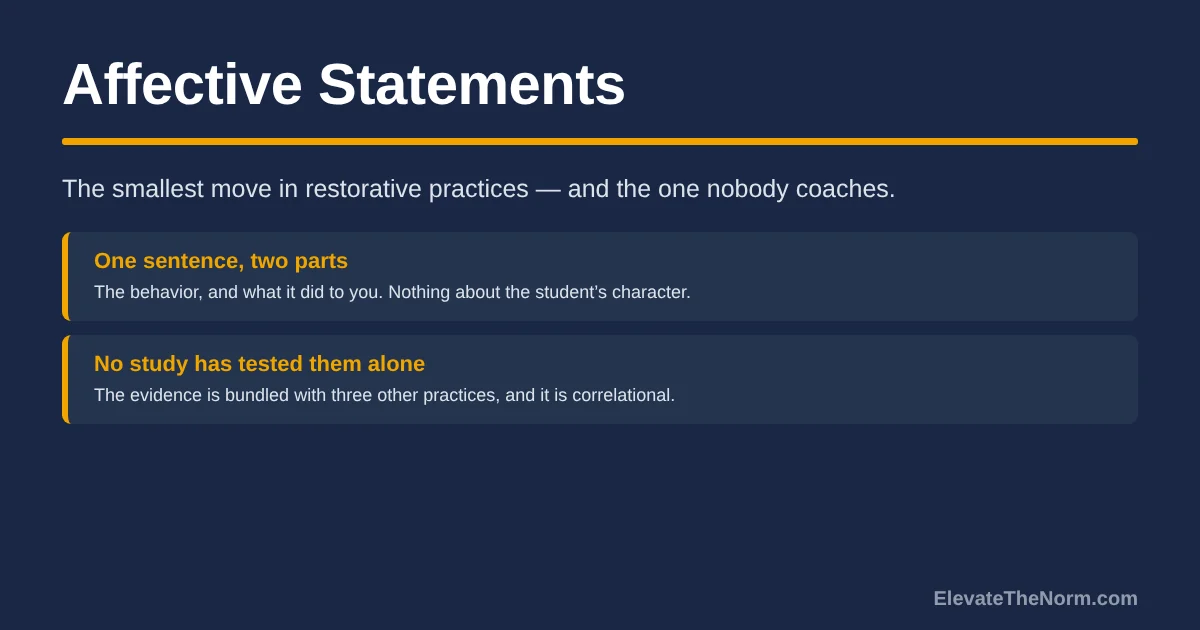
    Affective statements are the smallest move in restorative practices: one sentence naming how a specific behavior affected you, with no judgment of the student attached. They sit at the informal end of the restorative continuum, below questions, conversations, circles and conferences. No study has ever tested them on their own, so treat the evidence as bundled.

    Key Takeaways

    • An affective statement names a behavior and its impact, not a character trait. The example the practice’s own originators use is “I’m uncomfortable when I hear you tease Sandy” — a feeling, a specific action, nothing about the student as a person.
    • No study has measured affective statements by themselves. The study teachers cite for them combined four practices into a single score, and the affective-statement scale had a reliability of α = .59, which the authors themselves call only fair.
    • In 29 high school classrooms and 412 students, student-reported use of restorative practices predicted teacher respect (β = .12, p < .01) while teacher-reported use predicted nothing (β = .05, not significant) — and the two ratings were unrelated to each other. Teachers’ sense of how often they do this does not match what students notice.
    • In the same study, the racial referral gap was 1.69 versus 9.13 referrals for teachers using fewer restorative practices and 0.77 versus 2.92 for those using more. The gap narrowed. It did not close, and the design cannot show the practices caused the narrowing.
    • The one randomized district trial found suspensions fell 36 percent in restorative-practice schools against 18 percent in control schools — but in grades 6–8, suspension rates did not change and academic outcomes worsened. That result belongs in any honest middle-school conversation about this.

    Most restorative training starts at the circle. Twenty chairs, a talking piece, a ninety-minute block nobody has. Teachers leave the professional development impressed and implement none of it, because the smallest thing they were shown costs more than a class period.

    Affective statements are the opposite problem. They cost one sentence, they are the bottom rung of the whole framework, and almost nobody coaches them. Below: what they are, where they sit, what they sound like, what the research actually supports, and the middle-school finding that cuts against the sales pitch.

    What are affective statements in restorative practices?

    An affective statement is a short sentence in which an adult expresses their own emotional reaction to something a student did, naming the specific behavior and its impact rather than labeling the student. The International Institute for Restorative Practices describes the term as “another way of saying ‘expressing your feelings’ or ‘sharing impact’”.

    They work in both directions, which is the part people miss. The research definition covers reactions to “both positive and negative events”. A sentence naming what a student’s work did for the room is an affective statement too, and it is not the same thing as praise, for reasons worth being precise about further down.

    Where do affective statements sit on the restorative continuum?

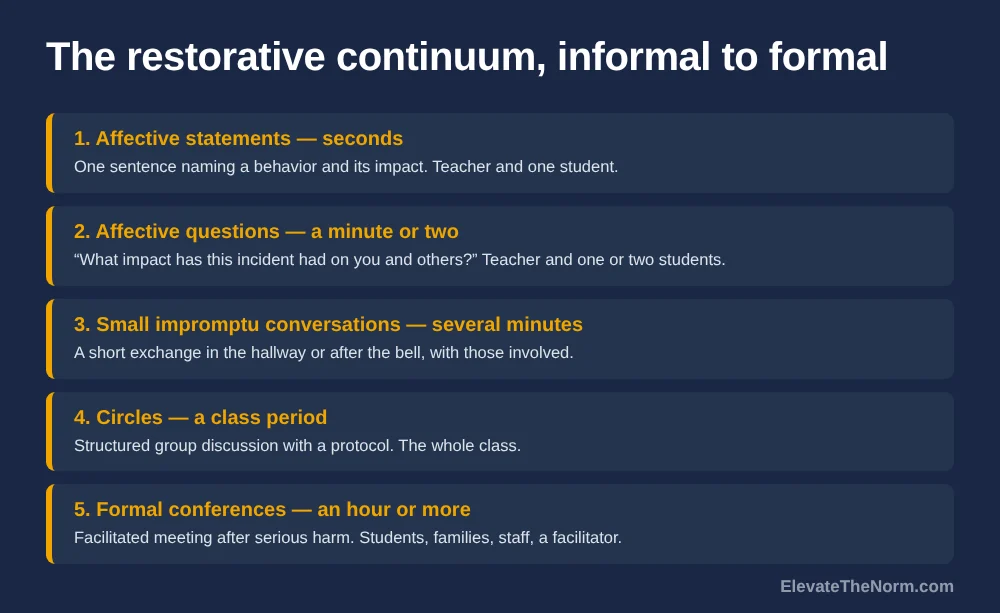
    Affective statements are the first and most informal element of the restorative practices continuum, which runs in five steps from a single sentence to a formal conference. Every step above them costs more time, more people, or both.

    ElementWhat it isTime it costsWho is involved
    Affective statementsOne sentence naming a behavior and its impactSecondsTeacher and one student
    Affective questionsQuestions that surface impact, such as “What impact has this incident had on you and others?”A minute or twoTeacher and one or two students
    Small impromptu conversationsA short exchange in the hallway or after the bellSeveral minutesTeacher and those involved
    CirclesStructured group discussion with a protocolA class periodThe whole class
    Formal conferencesFacilitated meeting after serious harmAn hour or more, plus schedulingStudents, families, staff, a facilitator
    The continuum as the IIRP sets it out, informal to formal.

    The structure explains the implementation failure. A school that trains only circles and conferences has trained the two most expensive items on the list, and the PACE implementation guidance names that exact pattern as a sticking point: some schools end up “implementing conflict-resolution practices only”. The cheap rung gets skipped because it does not look like a program.

    Graphic of the five-element restorative practices continuum from informal to formal: affective statements costing seconds, affective questions, small impromptu conversations, circles costing a class period, and formal conferences costing an hour or more.
    Five rungs. Schools train the top two and skip the bottom one.

    What does an affective statement actually sound like?

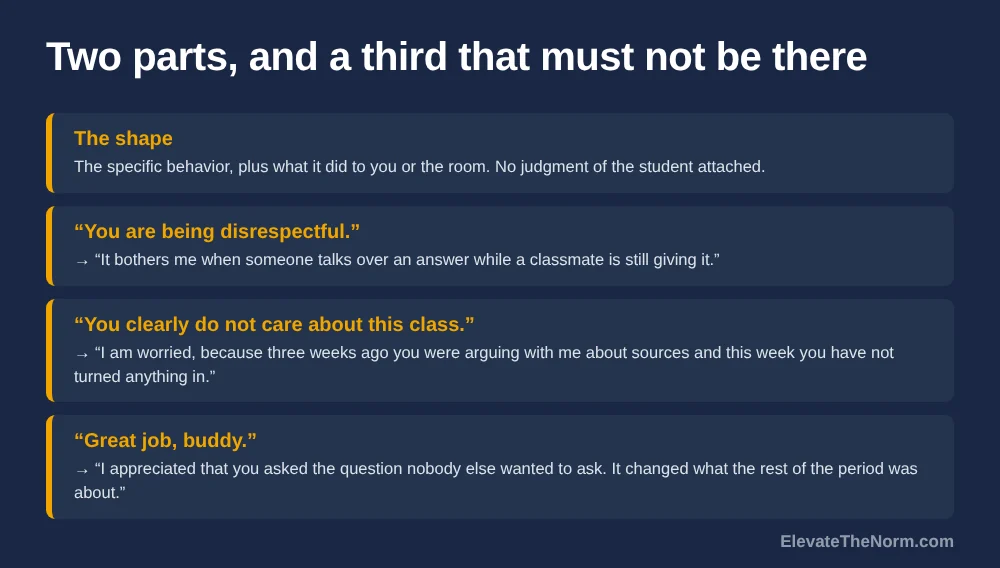
    An affective statement has two parts: the specific behavior, and what it did to you or to the room. It has no third part about the student’s character, motives or future. The IIRP’s own worked example — “I’m uncomfortable when I hear you tease Sandy” — contains exactly those two parts and nothing else.

    Here is the same pattern applied to five situations that actually happen in grades 6–12. The left column is the version that comes out when a teacher is tired. The right column keeps the standard identical and moves the subject of the sentence.

    What usually gets saidThe same moment as an affective statement
    “You are being disrespectful.”“It bothers me when someone talks over an answer while a classmate is still giving it.”
    “Why can’t you ever be ready?”“I get frustrated starting the same lesson twice because half the room is still finding a pencil.”
    “You clearly do not care about this class.”“I am worried, because three weeks ago you were arguing with me about sources and this week you have not turned anything in.”
    “Great job, buddy.”“I appreciated that you asked the question nobody else wanted to ask. It changed what the rest of the period was about.”
    “That is not how we treat people here.”“I felt uncomfortable hearing that comment, and I do not think the person it was about laughed.”
    Same standard, different subject. The behavior is still named.

    Two rules keep these from going wrong. First, name the behavior, not the person. “I am frustrated that you are so lazy” is an insult with the word “I” stapled to the front. Second, stop talking. The sentence is the whole intervention. A teenager given three seconds of silence usually fills it, and what they fill it with is more useful than anything else you had planned to say.

    Affective questions are the natural next rung when the statement is not enough. The IIRP treats any question that elicits feelings and addresses impact as a usable affective question, and offers forms like “What impact has this incident had on you and others?” That is the move when two students are involved and you do not yet know what happened.

    Graphic showing the two-part structure of an affective statement, the specific behavior plus its impact with no character judgment, followed by three before-and-after rewrites of common teacher lines.
    Two parts, and a third part that must not be there.

    What does the research on affective statements actually show?

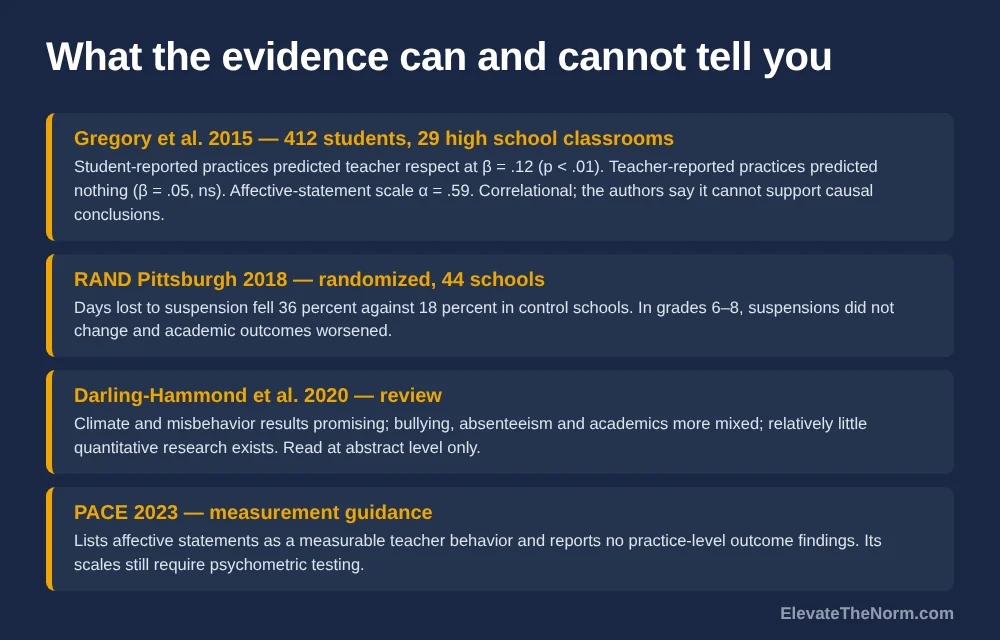
    There is no study of affective statements on their own. The study everyone cites bundled them with three other practices into one score, and it was correlational. Gregory, Clawson, Davis and Gerewitz surveyed 412 students in 29 high school classrooms across two large, diverse East Coast high schools in their first year of restorative implementation.

    Students and teachers both rated how often the teacher used four things: affective statements, restorative questions, proactive circles and fair process. Those four were combined into a single factor score per rater. So every number below describes the bundle, not the sentence.

    What it found. Student-reported use of the practices correlated with student-reported teacher respect at r = .58, p < .01, and held in a multilevel model at β = .12, p < .01, accounting for 17 percent of the between-teacher variance in respect. Teachers’ use of the practices also tracked the racial referral gap: for Latino and African American students, β = .44, p < .05. Across all 29 teachers, Asian and white students received an average of 1.28 referrals against 6.34 for Latino and African American students, t(29) = 3.63, p = .001. Split at the mean, teachers using fewer restorative practices issued 1.69 against 9.13; teachers using more issued 0.77 against 2.92.

    Now the three findings that should change how you read all of that.

    • Teacher self-report predicted nothing. Teacher-reported use of the practices came in at β = .05, not significant, and teacher ratings were not significantly related to student ratings at all. Only what students noticed mattered.
    • The affective-statement scale was the weakest one in the study. α = .59 for the student version, which the authors describe as fair; the teacher version reached .80. The scales were newly developed with no prior validation.
    • It cannot show causation and says so. The authors state the design “cannot support causal conclusions,” and flag shared method variance, because the same students rated both the practices and the respect. Students who like a teacher may simply report both more generously.

    The wider literature is no more settled. The broadest review of quantitative research on restorative justice in US K–12 schools concludes that “available evidence suggests that RJ programs can improve school climates and reduce student misbehavior and school discipline” while results for bullying, absenteeism and academic performance are “more mixed,” and that there is “still relatively little quantitative research regarding its effectiveness.” I read that review’s abstract and metadata; the full text sits behind a paywall, so I am citing it at that level and saying so.

    And the measurement guidance written for districts is blunt about the gap that matters most here. The PACE brief lists affective statements as a measurable teacher behavior — “Teachers using/modeling affective statements (‘I feel …’)” — and then declines to claim any practice-level result. It raises the question of which practices carry the effect and does not answer it, and notes the survey scales it recommends still “require future psychometric testing.”

    Does any of this improve achievement in middle school?

    In the one randomized district-wide trial, no — and in grades 6–8 the academic results went the wrong way. The RAND evaluation of restorative practices in Pittsburgh Public Schools randomized 44 of the district’s schools and ran for two years.

    Days lost to suspension fell 36 percent in the program schools against 18 percent in control schools, and the suspension gap between African American and white students narrowed. Teachers reported a safer environment and better conduct management. Then the part that gets left out of the slide deck: “Restorative practices did not improve academic outcomes, nor did they reduce suspensions for middle school students”, and in grades 6–8 academic outcomes “actually worsened in the treatment schools.” There was also no reduction in suspensions for violent offenses, for male students, or for students with IEPs.

    Read that carefully before you discount it or over-read it. The trial tested a two-year district rollout of a whole program, not a teacher using one sentence well. It does not show that affective statements lower test scores. What it does show is that the grade band this site writes for is the band where the program results are weakest, and that anyone promising a middle school both fewer suspensions and better scores is promising something this trial did not deliver.

    Four rows naming the evidence on affective statements and restorative practices and what each sample can and cannot show: Gregory and colleagues' 412 students in 29 high school classrooms, the RAND Pittsburgh randomized trial of 44 schools, the Darling-Hammond review read at abstract level, and the PACE measurement brief.
    Every sample named, including the middle-school result that cuts the other way.

    What are affective statements not?

    An affective statement is not a consequence, not a substitute for one, and not praise. Confusing it with any of the three is how the practice gets a bad reputation in a building within one semester.

    It is not a consequence because nothing happens to the student as a result of it. If a situation calls for a consequence that actually follows from the behavior, the sentence goes before the consequence and does not replace it. A school that tells teachers to use affective statements instead of their discipline ladder has not adopted restorative practices; it has removed a ladder. That distinction is also what you tell a parent who has heard that the teacher “just talked about their feelings” instead of handling something: the sentence was the opening, the consequence still applied, and here is what it was.

    And it is never the response to conduct that triggers a reporting duty or a safety protocol. Threats, harassment, weapons, anything that reaches a mandatory-reporting standard, anything involving suspected harm to a student — those follow your district’s procedure immediately and completely. An affective statement is a tool for the ordinary friction of a school day. Using one where a protocol applies is not restorative practice; it is a failure to report, and no framework on the continuum changes that.

    It is not praise because praise evaluates the student and an affective statement reports an effect. “You are such a strong writer” is a verdict. “Your second paragraph made me change my mind about the question” is information the student can do something with. The distinction matters more in grades 6–12 than it does with younger students, who have not yet learned to discount an adult’s verdict.

    It is also not a conversation-ender for serious harm. The continuum has four rungs above it for a reason, and the research on where restorative practice does and does not hold up is clear that a half-implemented version is barely different from none at all.

    How do you use affective statements without sounding fake?

    Say true things in your own words and keep them short. Teenagers detect scripted emotion instantly, and a sentence that sounds workshopped reads as manipulation rather than honesty. If you are not actually frustrated, do not say you are frustrated.

    Four things keep it credible. Use a feeling word you would use off the clock. Use them for the good events too, or the practice becomes a tell that someone is in trouble. Say it quietly and near the student rather than across the room, which is the same logic behind close-range private redirection with teenagers. And do not run three in a row on the same student in one period, because at that point you are not sharing impact, you are campaigning.

    There is one more thing the Gregory study implies and nobody says out loud: your own count does not matter. Teacher self-report predicted nothing in that data. The only version of this practice that showed up in the results was the version students noticed. If you want to know whether you are doing it, the people to ask are sitting in the room.

    Two honest objections, because they come up every time this gets presented to a staff. The first is that some students will mock it, and in grades 6–12 a few of them will. The answer is volume and setting: said quietly, to one student, about one specific thing, there is nothing to perform against. Said to a whole room as an announcement, it invites exactly the reaction teachers fear. The second is that not every adult wants to disclose feelings at work, and that is a legitimate position rather than a deficiency. The practice tolerates a narrow emotional range — “that bothered me,” “I appreciated that” — and does not require anyone to open a vein in third period.

    The line that matters most is the one between sharing impact and applying pressure. Telling a student once that something bothered you is information. Returning to your own disappointment repeatedly, with the same student, until they manage your feelings to get out of the conversation, is leverage. Teenagers are extremely good at spotting the difference, and the second version costs you the first one permanently.

    What should a school decide before putting this on a walkthrough form?

    Decide whether you are measuring a frequency or a relationship, because the evidence only supports the second. Counting affective statements during a twenty-minute observation measures the one informant whose rating predicted nothing in the research.

    Four practical cautions for anyone leading this. First, a scale built on a reliability of .59 is not an evaluation instrument; the PACE brief recommends its survey items for implementation support and says they still need psychometric testing. Second, if you are rolling this out in a middle school, go in holding the RAND result rather than discovering it later from a board member. Third, train the cheap rung first. A building where every adult can say one honest sentence about impact has more restorative capacity than a building with a circle protocol nobody uses, and the teachers who most need it are the ones with the hardest rosters. Fourth, be careful what you require. A district can require that staff name behavior rather than character; requiring an employee to disclose a feeling on demand is a different thing, and it is the version that produces the scripted sentences students see straight through.

    For a coach, the usable implication of the Gregory finding is a change of instrument rather than a change of effort. Tallying affective statements during an observation measures the informant whose ratings predicted nothing. Asking four students in that class whether their teacher talks to them about how things affect people, and whether they feel respected, measures the one that did. It is a harder data collection and it is the only one with a result attached.

    The cost argument is worth stating plainly to a board, because it is unusual. This is the only rung on the continuum with no budget line: no curriculum, no substitute coverage, no facilitator, no scheduling. That is a genuine advantage and it is also why it gets skipped, since a practice with no invoice attached is hard to point at in a board report.

    Clay’s take

    I think this is the most undersold item in the whole restorative toolkit, and the reason is unflattering to all of us. It cannot be turned into a program. There is nothing to purchase, no protocol to laminate, no two-day training to send four people to. It is one sentence, said honestly, by an adult who is willing to be a person in front of a sixteen-year-old.

    What I will not tell you is that it fixes a hard class. The evidence does not support that and the middle-school finding above argues against it. What it does is change what a correction is about. “You are disrespectful” is a claim about who a student is, and a teenager has to defend themselves against it. “That bothered me” is a fact about me, and there is nothing to defend against.

    And the finding I keep coming back to is that teacher self-report predicted nothing. That is a useful piece of humility to carry into any practice we are told to adopt.

    What to do next

    Pick one sentence you say often that starts with the word “you” and is really about how a behavior affects the room. Rewrite it once, on paper, into the two-part shape above. That is the entire first step, and it takes less time than reading this paragraph.

    Then use it for a week on the good events as well as the bad ones, and do not count how many times you did it, because that number does not predict anything. From here, the full picture of what restorative practice does and does not deliver is the next thing worth reading, and the consequence side is what this practice sits beside rather than replaces. Everything on this site is free and nothing asks for your email address.

    An affective statement is the cheapest rung on the continuum; the circle is several rungs up and costs real time. Most teachers should get fluent at the first before convening the second. When the thing you need is the group rather than one student, the seven rounds of a circle and the 80/20 split are the practical version, including when a circle is the wrong tool.

    Frequently Asked Questions

    What is an affective statement in restorative practices?

    An affective statement is one short sentence in which an adult names a specific behavior and the effect it had on them, without judging the student’s character. The International Institute for Restorative Practices describes it as expressing your feelings or sharing impact, and offers the example “I’m uncomfortable when I hear you tease Sandy.” It is the most informal element of the restorative continuum.

    What are some examples of affective statements for middle and high school?

    Keep two parts and drop the third. Instead of “you are being disrespectful,” try “it bothers me when someone talks over an answer while a classmate is still giving it.” Instead of “you clearly do not care,” try “I am worried, because three weeks ago you were arguing with me about sources and this week nothing has come in.” Use them for good events too.

    Is there research proving affective statements work?

    Not on their own. The study most often cited combined affective statements with restorative questions, proactive circles and fair process into one score across 412 students and 29 high school classrooms, and the affective-statement scale had a reliability of only .59. The design was correlational and the authors state it cannot support causal conclusions.

    Do restorative practices improve academic achievement?

    The randomized evaluation of a two-year district rollout in Pittsburgh found they did not. Suspensions fell 36 percent in program schools against 18 percent in control schools, but academic outcomes did not improve overall and in grades 6 through 8 they worsened. The broadest review of the research calls academic results mixed and the quantitative evidence base small.

    What is the difference between an affective statement and an I-statement?

    They share a grammar but not a purpose. An I-statement is a general communication technique for owning your own perspective in any conflict. An affective statement is specifically about sharing the impact of a behavior as the lowest rung of the restorative continuum, which runs upward through affective questions, impromptu conversations, circles and formal conferences.

    Do affective statements replace classroom consequences?

    No. Nothing happens to a student as a result of an affective statement, so it is not a consequence and cannot stand in for one. The sentence goes before a consequence that follows from the behavior, not instead of it. A school that tells teachers to use these in place of a discipline ladder has removed the ladder rather than adopted restorative practice.

    How do you know if you are actually using affective statements well?

    Ask students, not yourself. In the Gregory study, teacher-reported use of restorative practices predicted nothing, student-reported use predicted teacher respect, and the two ratings were not significantly related to each other. Your own count of how often you do this has no demonstrated relationship to whether students experience it.

    Sources

    • Gregory, A., Clawson, K., Davis, A., & Gerewitz, J. (2015). The promise of restorative practices to transform teacher-student relationships and achieve equity in school discipline. Journal of Educational and Psychological Consultation, 25, 1–29. 412 students, 29 teachers with one randomly selected focal classroom each, two large diverse East Coast high schools in their first implementation year. Affective statements measured as one of four combined scales (α = .59 student, .80 teacher). Student-reported practices and teacher respect r = .58, β = .12 (p < .01), 17 percent of between-teacher variance; teacher-reported practices β = .05, not significant, and unrelated to student ratings. Referral gap 1.28 vs 6.34 overall; 1.69 vs 9.13 (low use) and 0.77 vs 2.92 (high use). Correlational; the authors state it cannot support causal conclusions, and flag shared method variance, unvalidated scales and a small teacher sample.
    • Augustine, C. H., Engberg, J., Grimm, G. E., Lee, E., Wang, E. L., Christianson, K., & Joseph, A. A. (2018). Restorative practices help reduce student suspensions (RB-10051-DOJ; full report RR-2840-DOJ). RAND Corporation. Randomized controlled trial, 44 of 54 Pittsburgh Public Schools, K–12, June 2015 to June 2017. Days lost to suspension fell 36 percent in treatment schools against 18 percent in control schools; disparities narrowed; gains concentrated in elementary grades. Middle-grade suspension rates did not change and grades 6–8 academic outcomes worsened in treatment schools. No reduction for violent offenses, male students or students with IEPs. The brief reports no effect sizes.
    • Darling-Hammond, S., Fronius, T. A., Sutherland, H., Guckenburg, S., Petrosino, A., & Hurley, N. (2020). Effectiveness of restorative justice in US K-12 schools: a review of quantitative research. Contemporary School Psychology, 24(3), 295–308. Finds evidence that restorative programs can improve school climate and reduce misbehavior and discipline, with results on bullying, absenteeism and academic performance “more mixed,” and notes there is “still relatively little quantitative research regarding its effectiveness.” Read at abstract and metadata level only; the full text is paywalled, so study counts, designs and grade bands are not reported here.
    • Restorative practices in the classroom (Chapter 1 excerpt). International Institute for Restorative Practices. Sets out the five-element continuum from informal to formal: affective statements, affective questions, small impromptu conversations, circles, formal conferences. Source of the definition (“expressing your feelings” / “sharing impact”), the worked example “I’m uncomfortable when I hear you tease Sandy,” and the affective-question form “What impact has this incident had on you and others?” The excerpt does not state a publication year.
    • Darling-Hammond, S., & Gregory, A. (2023). Measuring restorative practices to support implementation in K–12 schools. Policy Analysis for California Education. Lists “teachers using/modeling affective statements (‘I feel …’)” as a measurable practice and supplies teacher and student survey items. Names the pattern of schools “implementing conflict-resolution practices only.” Reports no practice-level outcome findings and states its adapted scales “require future psychometric testing.”
    • Center for Dispute Resolution, University of Maryland Francis King Carey School of Law (2022). Restorative approaches lesson 9: affective statements and questions. Supports the point that these tools are for everyday interactions and that not every conflict requires a circle. Cited as practitioner training material; the page’s sample statements live in a slide deck that is not included, so no examples are quoted from it.
    • The before-and-after rewrites in the table are my own worked examples built on the two-part shape the IIRP excerpt demonstrates. They are not quotations from any source and are not transcripts of real classroom exchanges.

    About Clay Shumate

    Clay Shumate is a certified secondary Social Studies teacher in the public schools of West Alabama, with seven years of classroom experience, a B.A. in History, and an M.Ed. in Secondary Education. He writes about project-based learning, student responsibility, respect, and practical ways to hold young people to a higher standard while giving them room to learn from mistakes. He is a member of the Society of Professional Journalists and writes to its Code of Ethics; this site’s editorial standards and corrections policy are published in full. More about Clay.

  • Student Behavior Contract: How to Write One Students Actually Respect (Free Template)

    Student Behavior Contract: How to Write One Students Actually Respect (Free Template)

    By Clay Shumate

    A student behavior contract is a short written agreement between a student and a teacher that names two or three specific behaviors, what the student commits to, what the teacher commits to in return, how progress gets checked, and when the agreement ends. It works best when the student helps write it and both people sign it.

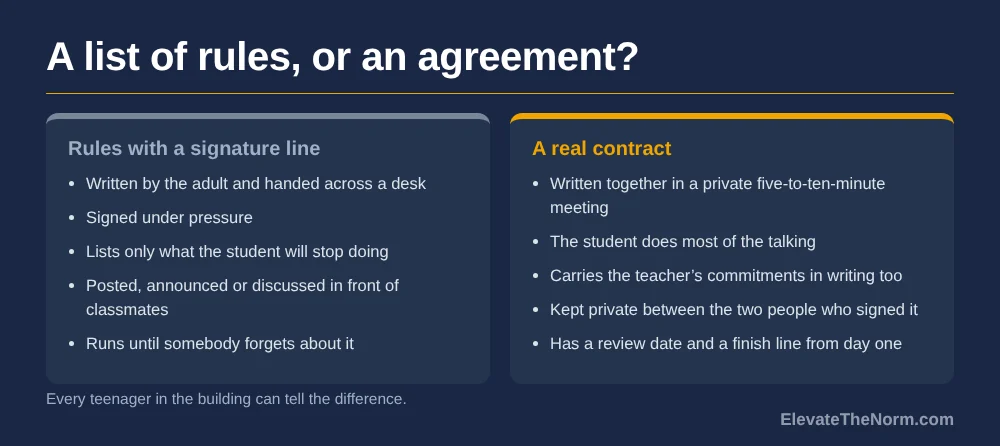
    Most behavior contracts fail for a reason that has nothing to do with the student. They are written by the adult, handed across a desk, and signed under pressure. That is not a contract. That is a list of rules with a signature line at the bottom, and every teenager in the building can tell the difference. A real agreement has two sides, and the teacher’s side is the part most templates leave out.

    Key Takeaways

    • Two sides or it is not a contract. The teacher’s commitments — a cue, a check-in, a seat change, a private signal — belong on the page in writing, right next to the student’s.
    • Three behaviors, maximum. Every behavior should be observable and stated as something the student will do, not something they will stop doing.
    • The evidence is real but modest. A meta-analysis of single-case studies found a moderate overall effect, with the strongest results for reducing problem behavior.
    • Keep it private. A contract that is posted, announced, or discussed in front of classmates stops being an agreement and becomes a public label.
    • Plan the ending on day one. A contract should have a review date and a finish line, not run forever.

    Free Download · PDF

    Student Behavior Contract Template for Grades 6–12

    A two-page printable: a contract with space for student and teacher commitments, plus a weekly check-in tracker with an end-of-week conversation guide. No email required.

    Download the free PDF

    Free. No email address required. Designed for grades 6–12. Browse every printable in Your Free Library.

    What is a student behavior contract?

    It is a planning document that both the student and the teacher agree to, describing specific behaviors, how they will be tracked, and what happens when the student meets them. The IRIS Center at Vanderbilt calls it “a simple positive-reinforcement intervention that is widely used by teachers to change student behavior,” and lists its core parts as the behaviors to increase or reduce, the conditions for earning recognition, and signature blocks for everyone involved (IRIS Center, “Behavior Contracts”).

    Notice the word agree. A student behavior contract is not a punishment and it is not a warning letter. It sits in the space between “a quick private conversation” and “a formal referral” — the point where a pattern has shown up, you have already talked about it, and you both want something more structured than another reminder.

    It is also not an IEP behavior plan or a formal Behavior Intervention Plan. Those are legal documents built by a team. A classroom contract can support one, but it never replaces one. If a student already has a plan, the plan wins and the contract has to match it.

    Two-column comparison of a list of rules with a signature line against a real behavior contract, covering who writes it, whether the teacher's commitments appear, privacy, and whether it has an end date.
    Every teenager in the building can tell the difference.

    Does a behavior contract actually work?

    The research says yes, moderately, and more reliably for reducing problem behavior than for building new habits. That is an honest answer, and it is better than the workshop version.

    The most useful summary is a meta-analysis of 18 single-case experiments covering 58 students between the ages of 5 and 21. It found an overall moderate effect (ES = .57, with individual studies ranging from .27 to 1.00) and concluded that behavior contracts were beneficial “regardless of grade level, gender, or disability status.” It also found contracts were more effective at reducing inappropriate behavior than at increasing appropriate behavior, and that they had positive effects on academic outcomes overall (Bowman-Perrott et al., 2015).

    Two caveats matter for a secondary classroom. First, 58 students is a small number, and single-case research tells you a strategy can work for individuals rather than how often it works across a whole school. Second, that age range starts at five. The finding that grade level did not change the result is encouraging for grades 6–12, but it is not a high school study. Treat a contract as a well-supported tool for one student at a time, not as a schoolwide system.

    When to use a student behavior contract (and when not to)

    Use one when a specific behavior keeps repeating after you have already had a real conversation about it. Not on the first incident, and not as the opening move with a new student.

    Good fits:

    • A student who keeps starting work late and has told you they want to fix it.
    • Repeated phone use after the classroom expectation has been taught and re-taught.
    • A pattern of leaving the room, side conversations during direct instruction, or missing materials that you have both noticed.
    • A student returning after a suspension or a restorative conference who wants a clear, written path forward.

    Poor fits:

    • A one-time incident. A single bad day deserves a conversation and a repair, not paperwork.
    • A safety issue. Threats, violence, and anything involving harm go through your administration and school policy, not a classroom agreement.
    • A behavior with an obvious outside cause. A student who sleeps in class because they work nights or care for siblings needs a counselor and a conversation, not a contract.
    • A whole class. If eight students have the same problem, the problem is probably the procedure. Fix the routine; do not write eight contracts.

    Before any contract, the groundwork is usually clear classroom expectations that have actually been taught. A contract cannot hold a student to a standard nobody ever explained.

    What goes in a student behavior contract

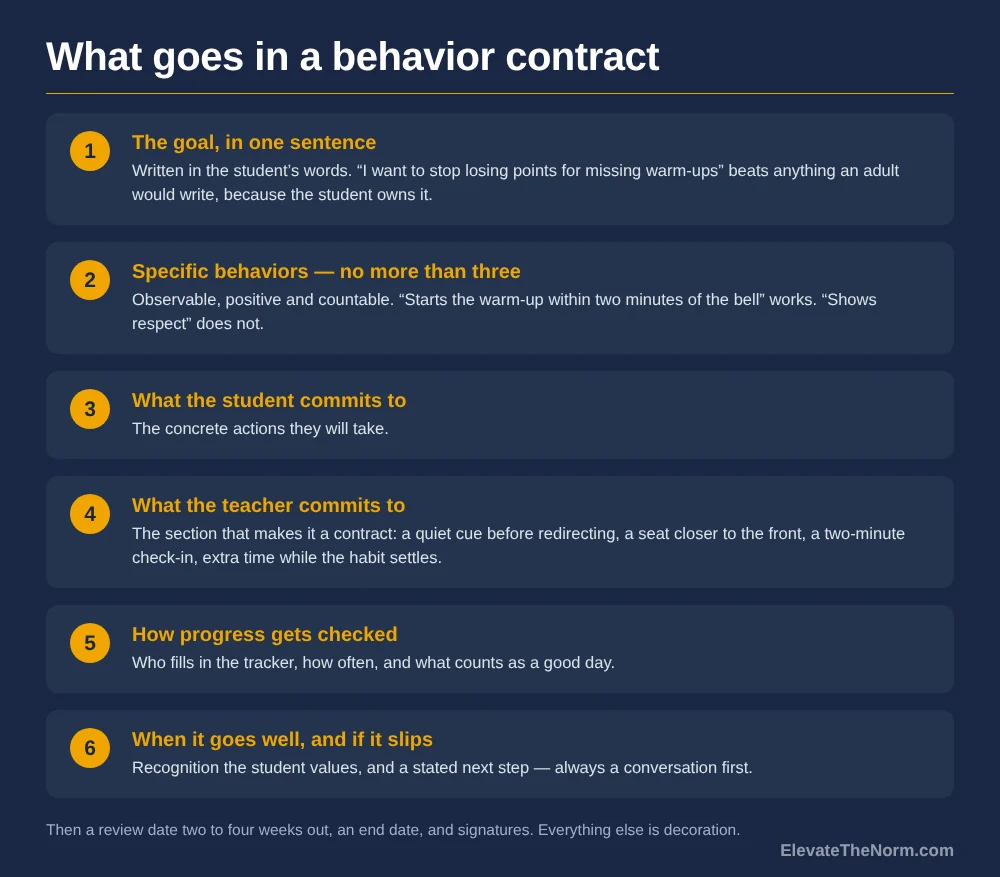
    Six parts: a goal, specific behaviors, the student’s commitments, the teacher’s commitments, a check-in plan, and what happens next. Everything else is decoration.

    1. The goal, in one sentence. Written in the student’s words. “I want to stop losing points for missing warm-ups” is better than anything an adult would write, because the student owns it.
    2. Specific behaviors — no more than three. Observable, positive, and countable. “Starts the warm-up within two minutes of the bell” works. “Shows respect” does not, because nobody can agree on whether it happened.
    3. What the student commits to. The concrete actions they will take.
    4. What the teacher commits to. This is the section that makes it a contract. A quiet cue before redirecting. A seat closer to the front. A two-minute check-in at the end of class. Extra time on one assignment while the habit settles.
    5. How progress gets checked. Who fills in the tracker, how often, and what counts as a good day.
    6. When it goes well, and if it slips. Recognition the student actually values, and a stated next step if things slide — always a conversation first.

    Add a review date two to four weeks out and an end date. Then signatures. A family signature is useful when the family wants to be involved, but it should be optional; a contract between a teacher and a young adult should be able to stand on the student’s word.

    Six numbered parts of a student behavior contract: the goal in one sentence, no more than three specific behaviors, the student's commitments, the teacher's commitments, how progress gets checked, and what happens when it goes well or slips.
    The six parts. Everything else is decoration.

    How to write a behavior contract with a student, step by step

    Write it together, in a private five-to-ten-minute meeting, with the student doing as much of the talking as possible. The IRIS Center names minimal student input as one of the common problems that keep a contract from working, and that matches what any teacher would predict.

    1. Start with what the student wants

    Ask what they want to be different. Not what you want — what they want. Most students already know exactly what is going wrong and are tired of hearing about it. Letting them name it first changes the whole meeting.

    2. Agree on the behaviors

    Translate the goal into two or three observable actions. If the student proposes something vague, ask the follow-up question: “What would I see you doing on a day when that went right?”

    3. Ask what would help

    Then ask the question most contracts skip: “What could I do that would make this easier?” Students will tell you. Sometimes it is a seat away from a friend. Sometimes it is a signal instead of being called out. Write their answer into the teacher section, as long as it is something you can really do every day.

    4. Decide how you will check in

    A daily two-minute rating works for most secondary students. Have the student rate first, then you rate, then compare. Our guide to student self-assessment of behavior covers why comparing ratings works better than correcting them.

    5. Set the review date and the finish line

    Two to four weeks is long enough to see a pattern and short enough to stay motivating. Decide now what “done” looks like — for example, eight good days out of ten.

    6. Sign it and keep it private

    Both of you sign. The student keeps a copy. It does not go on the wall, it is not mentioned in front of the class, and the tracker lives in a folder, not on a desk where classmates can read it.

    If a student is coming back from a conflict, a contract pairs naturally with the repair conversation in restorative practices in schools. If you want a scripted structure for that conversation, my Restorative Conversation Scripts lay out the follow-up talk word for word (see them here).

    A sample student behavior contract

    Here is what a filled-in middle school or high school contract can look like. The student and situation are illustrative, not a real student.

    SectionExample entry
    Goal“I want to stop getting zeros on warm-ups because I’m on my phone at the start of class.”
    Behavior 1Phone is in my bag before the bell rings.
    Behavior 2Warm-up started within two minutes of the bell.
    Student commits toPutting my phone away at the door and asking for help instead of waiting if I don’t understand the warm-up.
    Teacher commits toPosting the warm-up before students arrive, giving a quiet hand signal instead of a verbal reminder, and doing a 30-second check at the end of class.
    Check-inDaily 0–2 rating, student first. Friday five-minute conversation.
    Goes wellEight of ten days met: contract finishes, and a positive call or message home.
    If it slipsPrivate conversation first, then we revise the contract together.
    Review / endReview in two weeks. Ends after three weeks or when the goal is met.

    That “positive call home” line is worth keeping. My first call to any family is always a genuine compliment, and a call that says “your kid set a goal and hit it” is one of the best calls you will ever make. If you want a system for those calls, the parent-teacher communication plan walks through it.

    Tracking progress without turning it into surveillance

    Track the two or three behaviors on the contract and nothing else, for two minutes a day. The second page of the free template is a weekly tracker built for exactly that.

    The student rates each behavior 0, 1, or 2. You rate the same period. Then you compare. Where you disagree, ask why before you say anything else — sometimes the student saw something you missed. At the end of the week, use four questions: What went better than last week? Which day was hardest, and what was going on? Is there anything I should do differently? Do we keep the contract, adjust it, or finish it?

    That third question is not a formality. If the student says your quiet signal is not working, change the signal. A teacher who keeps their side of the agreement and adjusts when asked is teaching the most important thing a contract can teach: that commitments go both ways. The research on structure and student autonomy points the same direction — students engage more when expectations come with reasons and a real voice, which is the whole argument behind student voice and choice.

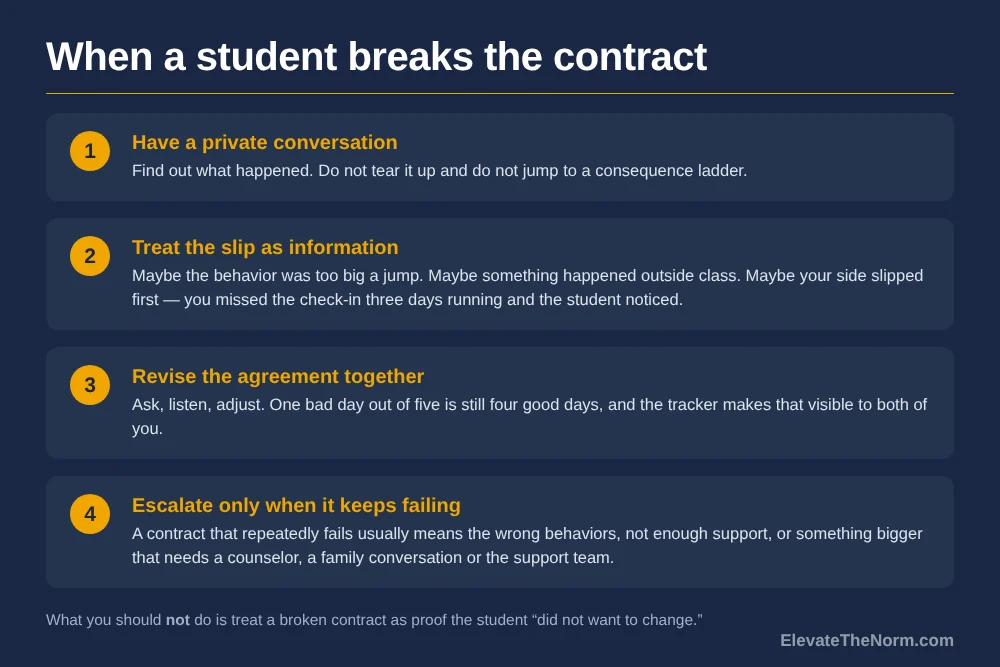
    Four numbered steps for when a student breaks a behavior contract: have a private conversation, treat the slip as information, revise the agreement together, and escalate only when it keeps failing.
    A slip is information, not proof the student did not want to change.

    What to do when a student breaks the contract

    Have a private conversation, find out what happened, and revise the agreement together. Do not tear it up and do not jump straight to a consequence ladder.

    A slip is information. Maybe the behavior was too big a jump. Maybe something happened outside class. Maybe your side of the contract slipped first — you forgot the check-in three days running, and the student noticed. Ask, listen, and adjust. One bad day out of five is still four good days, and the tracker makes that visible to both of you.

    What you should not do is treat a broken contract as proof the student “did not want to change.” If the same contract keeps failing, that usually means the behaviors were the wrong ones, the support was not enough, or something bigger is going on that needs a counselor, a family conversation, or a referral to your school’s support team. If you need a paper trail at that point, my Behavior Documentation Forms are built for MTSS-style logs (details here).

    Ending the contract on purpose

    Most student behavior contracts should finish, not renew forever. The point is for the habit to become the student’s, not to keep the student on paper for a semester.

    When the goal is met, say so plainly and mark it. Retire the tracker. Tell the student what you noticed. If it fits, make the positive call home. Then fade the support you added — the signal, the check-in — gradually, so the student is doing it without the scaffold. A student who finishes a contract should walk away with proof they can set a goal and meet it, which is a better outcome than three weeks of quieter mornings. For the bigger picture on building that kind of ownership, see positive discipline for teens.

    The student behavior contract, in one paragraph

    Write a student behavior contract with the student, not for them. Keep it to three observable behaviors, put your own commitments in writing next to theirs, check in for two minutes a day, keep it private, and decide on day one how it ends. The evidence supports contracts as a moderate, reliable tool for one student at a time. What makes them work in a secondary classroom is that they treat the student as someone capable of keeping their word — and they require the teacher to keep theirs. Download the free template and use it with the next student who tells you they want something to change.

    Sources

    1. Bowman-Perrott, L., Burke, M. D., de Marin, S., Zhang, N., & Davis, H. “A Meta-Analysis of Single-Case Research on Behavior Contracts: Effects on Behavioral and Academic Outcomes Among Children and Youth.” Behavior Modification, vol. 39, no. 2, 2015, pp. 247–269. Supports the moderate overall effect (ES = .57), the finding that results held regardless of grade level, gender, or disability status, and the stronger effect for reducing inappropriate behavior. Caveat: 18 single-case experiments with 58 participants aged 5–21; single-case designs show a strategy can work for individuals, not how often it works across a school, and the sample is not limited to secondary students. https://doi.org/10.1177/0145445514551383
    2. IRIS Center, Vanderbilt University. “Behavior Contracts” (information brief). Supports the definition of a behavior contract as a positive-reinforcement planning document, its core components, and the common failure points, including minimal student input. Caveat: a practitioner brief rather than a research study; it does not report effect sizes. https://iris.peabody.vanderbilt.edu/information-brief/behavior-contracts/

    Frequently Asked Questions

    Is a student behavior contract legally binding?

    No. A classroom behavior contract is a planning tool and a good-faith agreement, not a legal document. It does not change school policy, override a discipline code, or replace an IEP, a 504 plan, or a formal Behavior Intervention Plan. If a student already has one of those, the classroom contract has to match it, and the student’s case manager should see it before you use it.

    Should parents sign a student behavior contract?

    It helps when the family wants to be involved, but make it optional. The agreement is between you and the student, and a contract that only counts once an adult at home signs it tells a teenager their own word is not enough. Do let families know a contract exists and what it says. A short positive message when the student meets the goal is often the most useful part of the family connection.

    How long should a behavior contract last?

    Two to four weeks for the first review, with a clear end point written in from the start, such as eight good days out of ten. Long enough to show a pattern, short enough to stay motivating. A contract that runs all semester usually means the behaviors were too broad or the support was not working, and it is time to revise rather than renew.

    What rewards work for middle and high school students?

    Ask the student. Older students usually care less about prizes and more about things like a positive call or message home, a choice of seat, a pass on one homework assignment, or simply having the contract finished and off their record. Recognition they chose is worth more than a reward you picked. Keep it modest and keep it private.

    Isn’t a behavior contract unfair to the rest of the class?

    Fair means everyone gets what they need to meet the same standard, not identical treatment. The contract does not lower the expectation for one student. It adds structure and support so that student can meet the same expectation everyone else is held to. Because the contract is private, classmates generally never know it exists, which also protects the student’s dignity.

    How much time does a behavior contract take?

    About ten minutes to write it with the student, roughly two minutes a day to check in, and five minutes at the end of each week. That is far less time than repeated redirections, referrals, and parent phone calls about the same behavior. If you cannot commit to the daily check-in, do not write the contract yet, because a skipped check-in tells the student the agreement only goes one way.

    What if a student refuses to sign the contract?

    Do not force it. A signature given under pressure is meaningless. Ask what part they disagree with and whether they would change something about it. Often the objection is to wording that feels like a label, and rewriting it in their own words solves it. If they still decline, keep using your normal classroom procedures and offer again later. The offer itself tells them you think they can change.

    Can I use a behavior contract for a whole class?

    A whole-class version is really a set of classroom expectations or norms, and it works differently. Individual behavior contracts are built for one student and one specific pattern. If many students are struggling with the same thing, the fix is usually the routine or the procedure itself, not a stack of individual contracts.

    About Clay Shumate

    Clay Shumate is a certified secondary Social Studies teacher in the public schools of West Alabama, with seven years of classroom experience, a B.A. in History, and an M.Ed. in Secondary Education. He writes about project-based learning, student responsibility, respect, and practical ways to hold young people to a higher standard while giving them room to learn from mistakes. He is a member of the Society of Professional Journalists and writes to its Code of Ethics; this site’s editorial standards and corrections policy are published in full. More about Clay.

  • Classroom Management Styles: Find Your Default and What It Costs You

    Classroom Management Styles: Find Your Default and What It Costs You

    By Clay Shumate

    Classroom management styles are usually sorted into four types — authoritative, authoritarian, permissive, and indulgent or uninvolved — by crossing how much structure a teacher demands with how much warmth a teacher offers. The framework is borrowed from parenting research, and the high-structure, high-warmth style has the best support.

    I find this taxonomy genuinely useful and I want to be straight with you about what it is. It is a heuristic that came out of developmental psychology about parents, got carried into teacher education, and is now repeated in professional development as though someone measured it in classrooms. Mostly, nobody did. That does not make it worthless. It makes it a map rather than a measurement, and a map is still worth having if you know what it is.

    Key Takeaways

    • The four styles come from crossing two dimensions, not from four separate discoveries: how demanding you are and how responsive you are.
    • The framework is borrowed, not homegrown. It originates in research on parents, and the attempts to measure it on teachers have been small.
    • Authoritative — high structure, high warmth — has the strongest support, and the evidence for each half of it is better than the evidence for the typology itself.
    • Your style is a default under pressure, not a personality. What you do in week three when you are tired is your real style.
    • Two of the four styles fail the same way. Permissive and authoritarian rooms both end up unpredictable, just for opposite reasons.

    What are the four classroom management styles?

    They are four combinations of two things: how much you require and how much you respond. That is the whole framework, and once you see it as a grid rather than a list of four personalities, it gets much more useful.

    • Authoritative. High demands, high responsiveness. Clear non-negotiable expectations, explained reasoning, visible care, consequences that arrive as promised.
    • Authoritarian. High demands, low responsiveness. Rules without reasons, compliance as the goal, correction without relationship.
    • Permissive. Low demands, high responsiveness. Warm, liked, negotiable — and the floor moves depending on who is asking.
    • Indulgent or uninvolved. Low demands, low responsiveness. Work assigned, grades entered, nothing much required and nothing much offered.

    A note on vocabulary, because it trips people up. Different sources use “permissive” and “indulgent” as synonyms, and some use “uninvolved” or “neglectful” for the low-low cell. The names drift. The two dimensions do not, so when a PD slide confuses you, go back to the grid.

    Where the classroom management styles framework actually comes from

    It comes from Diana Baumrind’s research on parents, extended into a two-by-two grid by other researchers, and only later applied to teachers. Nobody set out to build a theory of classroom management.

    Baumrind’s longitudinal work followed children at ages 4, 9 and 15 and found that “authoritative parents who are highly demanding and highly responsive were remarkably successful in protecting their adolescents from problem drug use, and in generating competence” — while also noting that authoritative parenting was not the only route to a competent adolescent (Baumrind, 1991). That sample was 139 adolescents from an affluent, well-educated, predominantly white population. It is a real finding on a narrow group of families.

    The familiar four-cell version came later. As Nancy Darling’s summary of the literature puts it, “categorizing parents according to whether they are high or low on parental demandingness and responsiveness creates a typology of four parenting styles: indulgent, authoritarian, authoritative, and uninvolved,” a dimensional move credited to Maccoby and Martin in 1983 (Darling, “Parenting Style and Its Correlates”). So the four styles you have seen on a laminated handout are a grid built on top of a three-category typology about families, two steps removed from any classroom.

    Four rows naming the four classroom management styles with the level of structure and warmth each one combines.
    Four cells, two dimensions — not four separate theories.

    Is the parenting-to-teaching mapping measured, or just useful?

    Mostly useful. The direct attempts to measure it on teachers are small enough that you should treat the typology as a thinking tool and not as a finding.

    The clearest explicit attempt I can point you to applied demandingness and responsiveness to teaching practice and student engagement — and it studied three fifth-grade mathematics teachers and 45 of their students (Walker, 2008). Three teachers. Fifth grade. That is a thoughtful, honest study and it is not a basis for telling a high school teacher what their style does.

    So why keep the framework? Because the two dimensions have far better evidence than the four boxes do, and the boxes are a convenient way to talk about the dimensions. That is the position I would defend. Use the labels to locate yourself; use the dimensions to decide what to change.

    The two dimensions that actually matter

    Structure and warmth are each independently supported in classroom research, which is the real reason the authoritative cell wins.

    On the structure side, the review that screened classroom practices for genuine empirical support organized them into maximizing structure and predictability; posting, teaching, reviewing, monitoring and reinforcing expectations; actively engaging students; acknowledging appropriate behavior; and responding to inappropriate behavior along a continuum (Simonsen, Fairbanks, Briesch, Myers & Sugai, 2008). That is the demandingness axis, with practices attached.

    On the warmth side, a meta-analysis of 99 studies on teacher–student relationships found medium-to-large associations with student engagement and small-to-medium associations with achievement, and reported stronger effects in the higher grades (Roorda, Koomen, Spilt & Oort, 2011). Those are correlations, and students who are easier to teach are easier to like, which could generate some of the pattern on its own. Still, if you teach grades 6–12, the warmth axis is doing more work for you than it would in a second-grade room, not less.

    And warmth has a behavioral measure, not just a feeling. In 28 middle school classrooms, higher praise-to-reprimand ratios tracked linearly with better class-wide on-task behavior, and with more engagement, less disruption and better grades among students at risk for emotional and behavioral disorders (Caldarella, Larsen, Williams & Wills, 2023). Responsiveness is countable. That is how you know whether you have it.

    A self-diagnostic for your classroom management style

    Answer these about what you actually did last week, not about what you believe. Score each row 0, 1 or 2. Add the structure rows and the warmth rows separately, then find your cell.

    AxisStatement0 — rarely1 — sometimes2 — nearly always
    StructureA student who arrives late knows exactly what happens next without asking me.
    StructureI did this week what I said last week I would do, including the part I did not enjoy.
    StructureMy transitions have a procedure that students could run if I lost my voice.
    StructureThe same behavior gets the same response from me regardless of which student it was.
    StructureMy deadlines and my late-work rule held this week with no exceptions I did not announce in advance.
    WarmthI spoke to every student by name this week about something that was not their behavior or their grade.
    WarmthI explained the reason behind a rule when a student asked, instead of citing the rule.
    WarmthI acknowledged more often than I corrected, and I know that because I counted.
    WarmthA student who was struggling got a private conversation rather than a public one.
    WarmthI changed something this month because a student told me it was not working.

    Reading your score. Structure 7–10 and warmth 7–10 puts you in the authoritative cell. Structure 7–10 and warmth 0–6 is the authoritarian corner. Structure 0–6 and warmth 7–10 is permissive. Low on both is the uninvolved cell, and if you landed there and you are still reading, you are probably exhausted rather than indifferent — those look identical from the hallway and they are not the same problem.

    This is not a validated instrument and I am not pretending it is one. It is ten honest questions. Its only real virtue is that every item asks about an observable action from the past week, which is harder to flatter yourself about than “I have high expectations.” Run it again in six weeks. Our material on structured teacher reflection has a longer process if you want one.

    Five cards each posing a question a secondary teacher can answer about last week to identify their default management style.
    Ask about last week’s actions, not about your intentions.

    Authoritarian: high structure, low warmth

    The authoritarian room usually works in September and starts leaking in November. Compliance built entirely on your presence requires your presence, and you cannot be everywhere.

    The cost is specific. Students follow rules they do not understand only while they are being watched, so you spend the year watching. You also lose your best information source: a student who is afraid of you does not tell you when something is wrong, which means you find out about problems late. And the room runs on a fuel that depletes — your own vigilance.

    The fix is not loosening the structure. That is the mistake teachers make when they are told they are too strict. The fix is adding the reason and the relationship while the structure stays exactly where it is. That is the one-cell move, and it is the easiest of the four to make.

    Permissive: high warmth, low structure

    The permissive room feels good and quietly becomes unfair. It is the style I have the most sympathy for and the one I think costs students the most.

    Here is the mechanism. When the floor is negotiable, the students who get the extensions, the second chances and the benefit of the doubt are the students who are comfortable asking. The confident, the articulate, the ones whose parents taught them to advocate. The quiet student who also needed the extension does not get it, because she did not know she was allowed to ask. A permissive room distributes mercy by social skill. That is not kindness. A predictable floor is the more generous system even when it feels harsher, and it is the heart of what we argue in holding a standard without becoming a hardliner.

    The other cost is that warmth without structure is not actually experienced as respect. Teenagers read a teacher who requires nothing as a teacher who expects nothing of them, and they are not wrong to read it that way.

    Indulgent and uninvolved: the low-low cell

    Almost nobody chooses this cell, and plenty of good teachers end up in it temporarily. It is usually a symptom of being overwhelmed, not a philosophy.

    Four preps, a coaching duty, a hard roster, something going wrong at home: structure and warmth are both effortful, and when you are depleted you stop producing both. I would rather name that honestly than moralize about it. If a self-diagnostic put you here, the move is not to fix your style. It is to pick one axis, one class period, and one week, and rebuild from there. Trying to become authoritative across six periods on a Monday is how people quit.

    Four rows describing the single lowest-cost change a teacher can make from each of the four management style positions.
    One behavior, four weeks — not a new philosophy.

    Authoritative: high structure, high warmth

    This is the cell with the best support, and the mechanism is not warmth plus rules — it is that the warmth makes the structure believable and the structure makes the warmth credible.

    A student in an authoritative room knows two things at once: that you mean what you say, and that you are on their side. Those are not in tension. They reinforce each other. Expectations explained are expectations more likely to be internalized, which is also what the motivation literature predicts: in a meta-analysis of 144 studies and just over 79,000 participants with a mean age of 16.5, teacher autonomy support correlated .48 with intrinsic motivation and −.32 with amotivation, and students’ sense of competence (ρ = .58) and autonomy (ρ = .57) were the strongest predictors of self-determined motivation (Bureau, Howard, Chong & Guay, 2021). Autonomy support is not the absence of demands. It is demands with reasons, and some real choice inside them — which is the argument for giving students genuine choices inside a structure you set.

    One honest caveat. Baumrind herself noted that authoritative parenting was not the only path to competence, and the same is almost certainly true in classrooms. I have watched teachers who would score as authoritarian on any instrument run rooms students cared about, because the students were certain the teacher was fair. Fairness may be doing more of the work in this framework than warmth is.

    Can you change your classroom management style mid-year?

    You can add structure to a permissive room in about two weeks. Adding warmth to an authoritarian one takes a grading period, and it requires you to say out loud that you are changing.

    The asymmetry is worth knowing. Tightening up is a policy announcement: here is the new procedure, here is when it starts, here is what happens. Students adjust fast because the change is legible. Warming up is harder because every individual kind act gets read against the record. A student who has spent nine weeks being corrected does not trust a compliment in week ten. Tell the class plainly that you got something wrong and what you are changing, and then be boringly consistent about it for six weeks. That is the whole method. Our piece on what respect actually looks like in practice covers the day-to-day version.

    What your style looks like from a student desk

    Students do not perceive your style as warmth and structure. They perceive it as one question: is this teacher predictable and is this teacher fair?

    That reframing has done more for me than the taxonomy has. A student does not care where you sit on a grid. She cares whether the consequence she got on Tuesday is the consequence the loud kid gets on Thursday, and whether you did the thing you said you would do. Every style in the framework can be perceived as unfair, including the authoritative one, if your word and your actions come apart. The shortest route from any cell to a room that works is to do exactly what you said you would do, every time — a point we make at length in the companion piece on control, consistency and what students are actually reading.

    Using classroom management styles without turning them into a personality test

    Treat the classroom management styles grid as a diagnostic you run on your own behavior, not a label you wear. You are not an authoritarian teacher. You are a teacher who defaulted to low responsiveness in third period on Thursday when you were tired, and that is a fixable fact rather than an identity.

    So do this. Run the ten questions. Find your weaker axis. Pick one behavior on that axis — one — and do it for four weeks. If structure is weak, the highest-value item is holding one deadline exactly as written. If warmth is weak, the highest-value item is speaking to every student by name about something other than their work. Then run the questions again and see whether anything moved. For the concrete practices to build on either axis, our list of classroom management strategies ranked by payback is the practical companion to this article, and the piece on writing expectations that hold is where the structure axis starts. When you are ready to turn that weaker axis into something written down, the free Classroom Management Compass suggests a starting approach and gives you an editable first-week plan to adapt.

    Sources

    1. Baumrind, D. “The Influence of Parenting Style on Adolescent Competence and Substance Use.” The Journal of Early Adolescence, vol. 11, no. 1, 1991, pp. 56–95. Supports the origin of the authoritative category as high demandingness plus high responsiveness, and the finding that it was not the only route to adolescent competence. Caveat: 139 adolescents from an affluent, well-educated, predominantly white sample of families — a parenting study, not a classroom study. https://journals.sagepub.com/doi/10.1177/0272431691111004
    2. Darling, N. “Parenting Style and Its Correlates.” At Health, LLC, 23 October 2013. Supports the two-dimension grid and the attribution of the four-category typology to Maccoby and Martin (1983). Caveat: this is an authoritative literature summary rather than a primary study, and it is cited here as a summary. https://athealth.com/topics/parenting-style-and-its-correlates-2/
    3. Walker, J. M. T. “Looking at Teacher Practices Through the Lens of Parenting Style.” The Journal of Experimental Education, vol. 76, no. 2, 2008, pp. 218–240. Supports the claim that the parenting-style dimensions have been applied directly to teaching practice and student engagement. Caveat: the study involved three fifth-grade mathematics teachers and 45 students, which is far too small and too young to generalize to grades 6–12; linked via the ERIC record. https://eric.ed.gov/?q=%22Looking+at+Teacher+Practices+Through+the+Lens+of+Parenting+Style%22
    4. Roorda, D. L., Koomen, H. M. Y., Spilt, J. L., & Oort, F. J. “The Influence of Affective Teacher–Student Relationships on Students’ School Engagement and Achievement: A Meta-Analytic Approach.” Review of Educational Research, vol. 81, 2011, pp. 493–529. Supports the warmth dimension and the report of stronger effects in higher grades. Caveat: correlational; students who are easier to teach are easier to have positive relationships with, which could produce part of the association. https://research.vu.nl/en/publications/the-influence-of-affective-teacher-student-relationships-on-stude/
    5. Simonsen, B., Fairbanks, S., Briesch, A., Myers, D., & Sugai, G. “Evidence-Based Practices in Classroom Management: Considerations for Research to Practice.” Education and Treatment of Children, vol. 31, 2008, pp. 351–380. Supports the structure dimension and the five categories of evidence-based classroom practice. Caveat: linked as a full-text reproduction hosted by a university project rather than the journal of record. https://k12engagement.unl.edu/sites/unl.edu.cehs.special-ed-communic-disorders.student-engagement-project/files/media/file/Classroom%20Management%206-8-16.pdf
    6. Caldarella, P., Larsen, R. A. A., Williams, L., & Wills, H. P. “Effects of Middle School Teachers’ Praise-to-Reprimand Ratios on Students’ Classroom Behavior.” Journal of Positive Behavior Interventions, vol. 25, no. 1, 2023, pp. 28–40. Supports treating responsiveness as a countable behavior rather than a disposition. Caveat: 28 middle school classrooms; high school was not studied. https://journals.sagepub.com/doi/10.1177/10983007211035185
    7. Bureau, J. S., Howard, J. L., Chong, J. X. Y., & Guay, F. “Pathways to Student Motivation: A Meta-Analysis of Antecedents of Autonomous and Controlled Motivations.” Review of Educational Research, vol. 91, no. 3, 2021. Supports the correlations for teacher autonomy support, competence and autonomy with self-determined motivation. Caveat: 144 studies and 79,079 participants with a mean age of 16.55, but the relationships are correlational and both sides are usually measured by student self-report. https://selfdeterminationtheory.org/wp-content/uploads/2021/09/2021_PathwaystoStudentMotiv_BureaHowardEtal.pdf

    Frequently Asked Questions

    Can a teacher have more than one classroom management style?

    Most of us have several, sorted by class period and by how tired we are. That is normal and it is also the most useful thing the framework tells you. If you are authoritative in second period and authoritarian in sixth, the difference is almost never the students — it is your remaining energy and how the term has gone with that group. Track which periods pull you out of your intended style. The pattern usually points at a specific seam in the schedule rather than at a personality flaw.

    Is the authoritative style the same thing as being strict?

    No. Strictness is the structure axis only. Authoritative means high structure and high warmth at once: the deadline holds, and the student also knows you noticed they were struggling and why the deadline exists. A strict teacher with no warmth is in the authoritarian cell, which works while you are watching and leaks when you are not. The practical test is whether a student in trouble would come to you first or hide it from you. If they would hide it, you have structure without responsiveness.

    Is this framework fair to teachers in difficult schools with limited support?

    Only if it is used as a diagnostic rather than an evaluation, which is why I would push back hard on any observation rubric that scores teachers on a style label. Structure and warmth both cost energy, and a teacher with four preps, a duty and a hundred and sixty students has less of it than one with two preps. The low-low cell is usually a workload symptom. If a building has a lot of teachers landing there, that is a staffing and scheduling finding, not a teacher-quality finding.

    What should I do if my school’s discipline policy pushes me toward an authoritarian style?

    Follow the policy and change what the policy does not control, which is more than teachers assume. Mandated consequence ladders set what happens; they rarely set your tone, your explanation, whether you correct privately, or how often you acknowledge students. All of that is the warmth axis and it is yours. Where a policy genuinely requires something you think is harmful — public tracking, for example — document what you observe and raise it with your administrator as implementation feedback rather than declining to follow it.

    Does changing my style confuse students mid-year?

    Changing without announcing it does. Students notice inconsistency long before they notice improvement, so an unexplained shift reads as moodiness. Say it out loud: name what you are changing, when it starts, and why. Teenagers handle a teacher who admits a correction far better than most adults expect, and the admission buys you credibility you can spend later. Then be dull about it for six weeks, because a change you abandon in week three has cost you more trust than never changing at all.

    How does this apply to students with IEPs or behavior plans?

    An authoritative stance is compatible with individualized support and does not override it. High structure means the plan is followed precisely, not that every student receives identical treatment; a required accommodation is part of the structure, not an exception to it. Students and families sometimes read differentiation as favoritism, which is worth getting ahead of by explaining early that fair means everyone gets what they need to meet the same standard. If a plan conflicts with your usual response, the plan wins and the case manager hears about it.

    Will students respect me less if I explain my reasoning instead of just stating the rule?

    The opposite, in grades 6 to 12. Explaining a rule once is not negotiating it. The confusion comes from thinking reasons invite argument, when what actually invites argument is a rule that looks arbitrary. Give the reason, then hold the rule whether or not the student agrees with the reason. Students will accept a standard they think is pointless if they believe you are fair about applying it, and they will fight a standard they think is personal even when it is completely reasonable.

    How often should I re-check my style?

    Twice a semester is plenty, and the timing matters more than the frequency. Run it in the third or fourth week, once the honeymoon is over and before habits have set, then again a week or two after a long break, which is when structure quietly erodes. Checking it in the first week tells you about your intentions rather than your practice. Keep the scores somewhere you will find them, because the useful information is the direction of travel rather than any single number.

    About Clay Shumate

    Clay Shumate is a certified secondary Social Studies teacher in the public schools of West Alabama, with seven years of classroom experience, a B.A. in History, and an M.Ed. in Secondary Education. He writes about project-based learning, student responsibility, respect, and practical ways to hold young people to a higher standard while giving them room to learn from mistakes. He is a member of the Society of Professional Journalists and writes to its Code of Ethics; this site’s editorial standards and corrections policy are published in full. More about Clay.

  • Classroom Control Techniques That Work — and the Room You Actually Want

    Classroom Control Techniques That Work — and the Room You Actually Want

    By Clay Shumate

    The classroom control techniques that actually hold are quiet ones: proximity, a private word, a predictable consequence delivered exactly as promised, and a room structured so there is little to disrupt. Volume, public correction and removal buy you the current minute and cost you the next nine weeks.

    You probably typed the word “control” into a search bar, and I am not going to lecture you about it. You asked a real question and you deserve a real answer, so the techniques below come first. But I will make an argument along the way, because I think the thing you actually want is not control. It is a room that runs without you holding it up. Those are different goals and they need different work.

    Key Takeaways

    • Proximity and a quiet word handle most of it. The loudest tool available is almost never the right rung on the ladder.
    • Standing by your word is the whole mechanism. Doing exactly what you said you would do, every time, is what makes a room predictable — and predictability is what students read as fairness.
    • Escalation is expensive. Removal-based discipline has a poor evidence record: suspension predicts more future misbehavior, not less.
    • Volume and audience both backfire. Harsh verbal discipline was associated with worse adolescent outcomes in the parenting research, and warmth did not buffer it.
    • Control is scaffolding, not the goal. If the room only works while you are standing in it, you have not built anything yet.

    What are the most effective classroom control techniques?

    The effective ones are low-volume, early, and specific: scan and move, stand near, name the behavior quietly, offer a choice between two acceptable things, and deliver the consequence you already announced without adding a speech.

    That list is unglamorous on purpose. The most reliable classroom control techniques do not look like control from the back of the room, which is exactly why they work on teenagers. A fifteen-year-old will accept a correction and will not accept being made an example of in front of twenty-nine peers, and the difference between those two experiences is almost entirely volume and audience.

    The evidence-based practice reviews back the shape of this even where the specific tools are hard to isolate. The review that screened classroom practices for genuine empirical support sorted them into maximizing structure and predictability; posting, teaching, reviewing, monitoring and reinforcing expectations; actively engaging students; acknowledging appropriate behavior; and using a continuum of strategies to respond to inappropriate behavior (Simonsen, Fairbanks, Briesch, Myers & Sugai, 2008). The word continuum is doing a lot of work there. The technique is not the response; it is having five rungs and starting on the first one.

    Nine techniques, from cheapest to most costly

    Work down this list in order, and only go as far as you have to. The cost column is what the technique takes out of your relationship with the class, which is the currency people forget to count.

    RungTechniqueWhat it looks likeRelationship cost
    1Scan and moveYou are never in the same place for two minutes; your eyes reach every desk every minute.None
    2ProximityYou teach the next two sentences standing three feet from the problem, saying nothing about it.None
    3Nonverbal signalA look, a tap on the desk, a hand on a closed laptop. No words, no audience.Almost none
    4Private redirectSix words at the desk, naming the behavior and the next action. Then you walk away.Low
    5Two acceptable choices“You can work here quietly or at the table by the window. Your call.”Low
    6Doorway conversationThirty seconds in the hall, the class working, no raised voice, specific next step.Low to moderate
    7The announced consequenceThe thing you already told the class happens, happening, with no additional commentary.Low if it was announced; high if it was improvised
    8Contact homeA call before the referral, describing behavior rather than character.Moderate, and lower if you have called with good news before
    9Removal or referralOffice, in-school placement, suspension — the system takes over.High, and the evidence for it is poor

    Most teachers who feel out of control are skipping rungs one through five. That is not a character flaw; it is what stress does. But a room where every correction arrives at rung seven has taught students that nothing matters until it is serious, which guarantees you will spend your year at rung seven.

    Five rows listing graduated classroom response techniques from scanning the room through delivering a previously announced consequence.
    Most teachers who feel out of control are skipping the first four.

    Standing by your word is the whole mechanism

    Here is my actual position, stated as opinion rather than research: respecting students is easy, and the way you do it is by doing exactly what you said you would do, every single time.

    That is it. That is the technique the whole article is built around. Not consistency as a vague virtue — consistency as a literal practice. If you said the quiz is Friday, the quiz is Friday. If you said the next time it happens you call home, you call home, including on the day you are tired and the student is one you like. If you said you would read their draft by Monday, you read it by Monday. Students are keeping score on this far more carefully than on anything in your syllabus, and what they are really measuring is whether your words predict your actions.

    A teacher whose word is reliable does not need much else. The consequence does not have to be severe; it has to be certain. Certainty is what makes a room calm, because a student who knows what happens next does not have to test you to find out. Severity without certainty produces a room full of gamblers. Certainty without severity produces a room that mostly runs itself. Our longer argument about this is in the piece on consequences that are predictable rather than harsh, and the companion on letting the real consequence do the work.

    One thing I will not tell you is to let a student fail to teach them a lesson. If a student can wreck something badly enough in my room for that to be instructive, I planned the thing badly. Build the assignment so that the honest consequence of not doing the work is having to do the work, not a permanent mark on a transcript.

    What escalation actually costs

    Removal-based discipline has the weakest evidence record of any technique in common use, and the research on it is unusually clear for education research.

    The American Psychological Association’s task force review of zero tolerance concluded that after two decades of implementation, “data tended to contradict the presumptions made in applying a zero tolerance approach.” Suspension predicted higher future misbehavior rather than deterring it; there was a negative relationship between school use of suspension and expulsion and school-wide academic achievement; and suspended students showed higher dropout and lower graduation rates. The task force also made a developmental argument that matters for grades 6–12 specifically: adolescents are still immature in impulse control, risk perception and resistance to peer influence, so inflexible punishment can worsen the very behaviors it targets (Reynolds, Skiba, Graham, Sheras, Conoley & Garcia-Vazquez, 2008). They recommended graduated consequences matched to the severity of the infraction, prevention, restorative approaches, and better teacher preparation in classroom management.

    Two honest qualifications. First, that review is about school-level and district-level policy, not about whether you personally should write a referral — sometimes you should, and some behavior belongs with an administrator. Second, much of the underlying evidence is correlational: students who get suspended differ in many ways from students who do not. The directional consistency across the literature is what makes it persuasive, not any single study.

    Volume and audience are weapons, and they backfire

    Raising your voice works once. After that you have established that nothing in your room happens until an adult is shouting, and you have made yourself the loudest thing a student has to beat.

    The closest thing to hard evidence here comes from parenting research rather than classrooms, and I want to be careful about the gap. A two-year longitudinal study of 967 two-parent families found that harsh verbal discipline at ages 13 to 14 — defined as using psychological force to cause emotional pain or discomfort in order to correct behavior, ranging from yelling to insulting and humiliating language — was associated with increases in both depressive symptoms and conduct problems, including misbehavior at school. The relationship ran both ways: adolescents with conduct problems drew more harsh verbal discipline. And parental warmth did not buffer it; the researchers concluded harsh verbal discipline appeared detrimental regardless of the strength of the bond (Wang & Kenny, 2013, via the Society for Research in Child Development summary).

    Those were parents, not teachers, and the sample was mostly middle-class. You cannot read it as a measured finding about your sixth period. What it does do is undercut the most common defense of shouting at teenagers, which is that it is fine if they know you care about them. In that data, knowing you care did not help. We go further into this in our piece on what yelling actually buys a teacher.

    Audience is the other half. A public correction forces a student to choose between complying and keeping their standing with peers, and for a fourteen-year-old that is not a close call. You have manufactured a confrontation that did not need to exist. Almost every technique in rungs one through six exists to avoid exactly that choice.

    What to do instead of raising your voice

    Use a script. Not because scripts are elegant, but because your judgment is worse than usual at the exact moment you need it.

    Here is one that holds up. Say it quietly, at the desk, in under twenty seconds, and then leave.

    1. Name the behavior, not the person. “The phone is out.” Not “you always.”
    2. State the next action. “It goes in the bag until the bell.”
    3. Offer the exit. “Do that and we are done, nothing else happens.”
    4. Leave. Walk away before they respond. Standing there demands a reaction and the only one available to them is a performance.
    5. If it continues, go to the doorway, not to volume. “Step out with me for thirty seconds.”
    6. Close the loop later, privately. One sentence at the end of class that is not about the incident: “Good work on the second half. See you tomorrow.”

    Step six is the one people skip and it is the one that matters most. A correction that ends with the relationship intact can be repeated. A correction that ends with a grudge can only escalate. Our material on repair after a mistake is the longer version of step six.

    Five cards laying out a short script a teacher can use to redirect a student quietly without raising their voice.
    Use a script, because your judgment is worst exactly when you need it.

    Behaviour management strategies: what the search term gets right

    Teachers searching the British phrase “behaviour management strategies” are usually asking a better question than teachers searching for control, because management implies a system and control implies a contest.

    A system can be handed to a substitute, written down, taught to students, and repaired when it breaks. A contest can only be won or lost, and it has to be won again every period. If you take one framing away from this article, take that one. Everything that survives in a secondary classroom is a system: the entry routine, the materials procedure, the way late work is handled, the ladder in the table above. None of it depends on you being intimidating.

    The flip side is that a system you built and do not run is worse than no system, because it has told students your word is decorative. Fewer rules, held exactly, beats a comprehensive code enforced by mood.

    Does removing the student work?

    Sometimes it is necessary and it is almost never productive, which are two different claims and both are true.

    Necessary: a student who is unsafe, or who has escalated past the point where anything you say will land, needs to be somewhere else for a while. That is not a failure. Unproductive: removal does not teach the behavior you wanted, it costs instructional time the student usually could not afford, and at scale it correlates with the outcomes the APA review described. The practical test I would use is whether the removal has a plan attached. “Go to the office” is a transfer of custody. “Go cool off at the table in the back for five minutes, then come talk to me at the end” is a technique.

    Do restorative approaches work better?

    They are promising, they are not a cure, and the best-designed study of them produced a genuinely mixed result that I think teachers should know about.

    A randomized controlled trial of a whole-school restorative practices program in a mid-sized urban district found that participating schools had greater reductions in overall suspension rates, including for African American students and students from low-income families, which narrowed disparities, and that teacher ratings of school climate improved. It also found that academic outcomes did not improve — and actually worsened in grades 6 through 8 — and that arrest rates did not fall (Augustine et al., RAND Corporation, 2018).

    I would not use that to dismiss restorative work; I would use it to set expectations. The middle-grades academic result is a real finding and the honest interpretation is probably about implementation cost: a program that takes instructional time has to be worth the time it takes. Read our overview of restorative practices and where they fit alongside that caveat rather than instead of it.

    Four rows naming high-volume or removal-based responses alongside the specific cost each one carries in a secondary classroom.
    Each of these buys the current minute at the price of the next nine weeks.

    Class room control when you are new or covering someone else’s room

    With no history and no relationship, the only techniques available to you are structural ones — so use the structure and skip everything that depends on standing.

    Plenty of people search for class room control as two words, and a disproportionate number of them are substitutes, first-year teachers, or someone covering a planning period in a room they have never seen. If that is you: get the names, give a task that can start without instructions, stand at the door, state the two things you will hold and nothing else, and do not make a single threat you cannot personally carry out before the bell. The fastest way to lose a borrowed room is to announce a consequence you have no authority to deliver. Our guide for substitutes covers the hour-by-hour version.

    How do you regain control of a class you have already lost?

    You reset publicly, narrow what you are asking for, and then be relentlessly boring about the one or two things you chose.

    Say it out loud to the class: this has not been working, here is what I got wrong, here are the two things that change starting Monday, and here is exactly what happens when they do not. Then hold those two things for four weeks without adding a third. The temptation is to announce a complete overhaul, which fails because you cannot sustain it and the failure proves your word is unreliable all over again.

    Pair it with the two cheapest positive moves available. A randomized study in middle school classrooms found that teachers who greeted students positively at the door saw improved academic engaged time and reduced disruptive behavior, and rated the strategy as feasible and reasonable to run (Cook et al., 2018). And in 28 middle school classrooms, higher praise-to-reprimand ratios tracked linearly with better class-wide on-task behavior and with better engagement and grades among students at risk for emotional and behavioral disorders (Caldarella, Larsen, Williams & Wills, 2023). Both of those are free, both were measured in middle school, and both are the opposite of control.

    Why a room that runs itself beats a room you control

    Control is scaffolding. It is sometimes necessary and it is never the finished building, and the difference shows up the first day you are absent.

    There is also a motivational reason to aim past compliance. A meta-analysis of 144 studies with just over 79,000 participants, mean age 16.5, found teacher autonomy support correlated .48 with intrinsic motivation and −.32 with amotivation, and that students’ sense of competence (ρ = .58) and autonomy (ρ = .57) were the strongest predictors of self-determined motivation (Bureau, Howard, Chong & Guay, 2021). Those are correlations from self-report measures, so hold them loosely. But autonomy support is not permissiveness — it is demands with reasons attached and real choice inside them. A room built that way does not need as much controlling, which is the only durable solution to wanting control.

    Where to start with classroom control techniques this week

    Pick the lowest rung you are currently skipping, and pick one promise you will keep exactly. Those two things, together, are most of what people mean by classroom control techniques that work.

    Concretely: for one week, handle everything with proximity and a private word, and refuse to use volume at all. You will find out quickly how much of your room was running on noise. In the same week, choose one thing you have announced and been loose about — a deadline, a phone rule, a seat — and hold it precisely, with the student you least want to hold it with. That is the whole intervention. If you want the broader toolkit it sits inside, our ranked list of classroom management strategies for grades 6–12 is the place to go next, and the piece on identifying your own management style will tell you which rung you default to when you are tired.

    Sources

    1. Reynolds, C. R., Skiba, R. J., Graham, S., Sheras, P., Conoley, J. C., & Garcia-Vazquez, E. “Are Zero Tolerance Policies Effective in the Schools? An Evidentiary Review and Recommendations.” American Psychologist, vol. 63, no. 9, 2008, pp. 852–862. Supports the findings that suspension predicts higher future misbehavior, the negative relationship with school-wide achievement, the dropout and graduation findings, and the developmental argument about adolescents. Caveat: a policy-level review resting substantially on correlational evidence; it addresses district and school policy rather than individual referral decisions. https://www.scstatehouse.gov/CommitteeInfo/SchoolSafetyTaskForce/October282014Meeting/zero-tolerance.pdf
    2. Wang, M.-T., & Kenny, S. “Longitudinal Links Between Fathers’ and Mothers’ Harsh Verbal Discipline and Adolescents’ Conduct Problems and Depressive Symptoms.” Child Development, 2013. Supports the definition of harsh verbal discipline, the association with conduct problems and depressive symptoms at ages 13–14, the bidirectional relationship, and the finding that parental warmth did not buffer it. Caveat: this studied parents and not teachers, in 967 mostly middle-class two-parent families, and is cited here through the Society for Research in Child Development’s summary of the study rather than the paywalled article. https://www.srcd.org/sites/default/files/resources/pr_2013_09_04_wang.pdf
    3. Simonsen, B., Fairbanks, S., Briesch, A., Myers, D., & Sugai, G. “Evidence-Based Practices in Classroom Management: Considerations for Research to Practice.” Education and Treatment of Children, vol. 31, 2008, pp. 351–380. Supports the five categories of evidence-based practice and specifically the use of a continuum of responses to inappropriate behavior. Caveat: linked as a full-text reproduction hosted by a university project rather than the journal of record. https://k12engagement.unl.edu/sites/unl.edu.cehs.special-ed-communic-disorders.student-engagement-project/files/media/file/Classroom%20Management%206-8-16.pdf
    4. Augustine, C. H., Engberg, J., Grimm, G. E., Lee, E., Wang, E. L., Christianson, K., & Joseph, A. A. Can Restorative Practices Improve School Climate and Curb Suspensions? RAND Corporation, RR-2840-DOJ, 2018. Supports the suspension reductions, the narrowing of disparities, the improved teacher climate ratings, and the finding that academic outcomes did not improve and worsened in grades 6–8. Caveat: one randomized trial in one mid-sized urban district; the middle-grades academic result is a real negative finding and should not be omitted when the program is recommended. https://www.rand.org/pubs/research_reports/RR2840.html
    5. Cook, C. R., Fiat, A., Larson, M., Daikos, C., Slemrod, T., Holland, E. A., Thayer, A. J., & Renshaw, T. “Positive Greetings at the Door: Evaluation of a Low-Cost, High-Yield Proactive Classroom Management Strategy.” Journal of Positive Behavior Interventions, vol. 20, no. 3, 2018, pp. 149–159. Supports the door-greeting effects on academic engaged time and disruptive behavior in middle school classrooms. Caveat: a single randomized trial; the specific percentage figures widely quoted online do not appear in the published abstract and are not repeated here. https://experts.umn.edu/en/publications/positive-greetings-at-the-door-evaluation-of-a-low-cost-high-yiel/
    6. Caldarella, P., Larsen, R. A. A., Williams, L., & Wills, H. P. “Effects of Middle School Teachers’ Praise-to-Reprimand Ratios on Students’ Classroom Behavior.” Journal of Positive Behavior Interventions, vol. 25, no. 1, 2023, pp. 28–40. Supports the linear relationship between praise-to-reprimand ratios and on-task behavior, engagement and grades. Caveat: 28 middle school classrooms; high school classrooms were not studied. https://journals.sagepub.com/doi/10.1177/10983007211035185
    7. Bureau, J. S., Howard, J. L., Chong, J. X. Y., & Guay, F. “Pathways to Student Motivation: A Meta-Analysis of Antecedents of Autonomous and Controlled Motivations.” Review of Educational Research, vol. 91, no. 3, 2021. Supports the correlations between teacher autonomy support, competence, autonomy and self-determined motivation in a sample with a mean age of 16.55. Caveat: 144 studies and 79,079 participants, but correlational and largely self-reported on both sides. https://selfdeterminationtheory.org/wp-content/uploads/2021/09/2021_PathwaystoStudentMotiv_BureaHowardEtal.pdf

    Frequently Asked Questions

    Is wanting control of my classroom a bad thing to want?

    No. A room that is chaotic is a room where nobody learns and some students are genuinely unsafe, so the instinct is sound. The argument here is about the target, not the motive. Control is a means, and the kind you get by being intimidating has to be re-established every period and collapses the week you are absent. The kind you get from taught routines, a predictable response ladder and a reputation for keeping your word holds without you. Same goal, far cheaper to maintain.

    What if a student escalates after I use a quiet redirect?

    Then you stop trying to win the moment. Drop your volume rather than raising it, give the class something to do so they stop being an audience, and move the conversation to the doorway or defer it entirely: “We’ll talk at the bell.” A student who is escalated is not processing your reasoning, so reasoning harder makes it worse. If there is any safety concern, follow your building’s procedure immediately — de-escalation technique is not a substitute for a safety protocol, and no article should tell you otherwise.

    Doesn’t this just mean being soft on students who need firm boundaries?

    It means the opposite. Nothing here says to lower a standard; it says to deliver the standard quietly and without fail. The firmest thing in a classroom is not a raised voice — it is a consequence that arrives exactly as announced, including on the day you would rather not. Students experience certainty as firmness and volume as instability. If anything, this approach is harder on teachers than shouting is, because it requires you to follow through on days when nobody would blame you for letting it slide.

    How do I explain my approach to a parent who expects tougher discipline?

    Lead with predictability rather than philosophy. Tell them the sequence in order: expectations are taught in the first week, a problem gets a signal, then a private word, then a conversation with you, then a call home before anything is written up, and the same behavior gets the same response for every student. Most parents asking for toughness are really asking whether their child is safe and whether rules are applied evenly. Answer those two questions concretely and the disagreement about method usually disappears.

    What does this cost a school to implement?

    The classroom techniques cost nothing: proximity, private correction, a response ladder and keeping your word require no purchase and no release time. The real cost is coaching time, because teachers cannot see their own volume or their own praise-to-correction rate without someone counting. Twenty minutes of a colleague’s planning period does that. Whole-school restorative programs are a different financial question entirely, and the randomized evidence on those is mixed enough that a district should pilot before scaling.

    Does this work with students who have behavior plans or significant trauma histories?

    The low-rung techniques are generally a better fit for these students, not a worse one, because they reduce public exposure and surprise. Predictability and private correction are protective. What this article cannot do is replace an individualized plan: if a student’s IEP or behavior intervention plan specifies a response, that document governs, and you bring what you are observing to the case manager rather than improvising. Universal technique is the floor underneath individualized support, never a substitute for it.

    I teach five classes and I am exhausted. Where do I start?

    One period and one week. Choose the class that is hardest, and for five days handle every correction with proximity and a quiet word only — no volume, no public callouts. In the same week pick one promise you have been loose about and keep it exactly. That is two changes in one class, which is sustainable on a bad Tuesday. Trying to overhaul all five periods is the version of this that fails, and the failure costs you more credibility than never starting would have.

    What if my administrator wants to see me being stricter?

    Ask what observable behavior they want to see more of, because “stricter” usually turns out to mean something specific and achievable — fewer students out of seats, phones away, a faster start. Those are structure problems with structural solutions, and you can show progress on them without raising your voice once. Keep a short record of what you changed and what happened. An administrator watching a room start on time with everyone working is not going to insist you shout about it.

    About Clay Shumate

    Clay Shumate is a certified secondary Social Studies teacher in the public schools of West Alabama, with seven years of classroom experience, a B.A. in History, and an M.Ed. in Secondary Education. He writes about project-based learning, student responsibility, respect, and practical ways to hold young people to a higher standard while giving them room to learn from mistakes. He is a member of the Society of Professional Journalists and writes to its Code of Ethics; this site’s editorial standards and corrections policy are published in full. More about Clay.

Teacher Emergency Toolkit — practical resources, real classroom support. Shop on TPT.Teacher Emergency Toolkit — practical resources, real classroom support. Shop on TPT.