By Clay Shumate
Universal Design for Learning is a framework for planning a lesson up front so fewer students need a retrofit later, built on three principles: multiple means of engagement, representation, and action and expression. Federal law calls it a scientifically valid framework. The research is thinner than that sounds, and thinnest of all in grades 6 through 12.
Key Takeaways
- UDL is a planning stance, not a set of activities. CAST’s UDL Guidelines 3.0 asks you to design the lesson expecting variability, rather than build one version and adapt it when it fails.
- Congress called it “scientifically valid” in 2008, and that was a statutory label rather than a research finding. 20 U.S.C. § 1003(24) wrote the phrase into law, and four sections of the Every Student Succeeds Act reference UDL.
- The most-cited meta-analysis says the outcomes were not demonstrated. Capp’s 2017 meta-analysis concludes UDL improves the learning process and then states plainly that “the impact on educational outcomes has not been demonstrated.”
- At secondary level the base is 22 studies, two of them randomized. the systematic review of UDL at second level found all 22 were North American, none were longitudinal, and only five implemented the whole framework.
- The parts have better evidence than the bundle. Explicit vocabulary instruction, comprehension-strategy instruction and intensive intervention are all rated STRONG for these grades by the Institute of Education Sciences. The framework that packages them is not.
What is Universal Design for Learning?
Universal Design for Learning is a framework for designing instruction so that predictable differences between students are planned for in advance instead of handled as exceptions. The term comes from architecture, where a curb cut is built in rather than added after a complaint.
The education version is maintained by CAST, a nonprofit that has published the UDL Guidelines since the late 1990s. The current version, CAST’s UDL Guidelines 3.0, was released in July 2024. CAST states the goal as “learner agency that is purposeful & reflective, resourceful & authentic, strategic & action-oriented” — a fair example of why the framework needs translating before it reaches a department meeting.
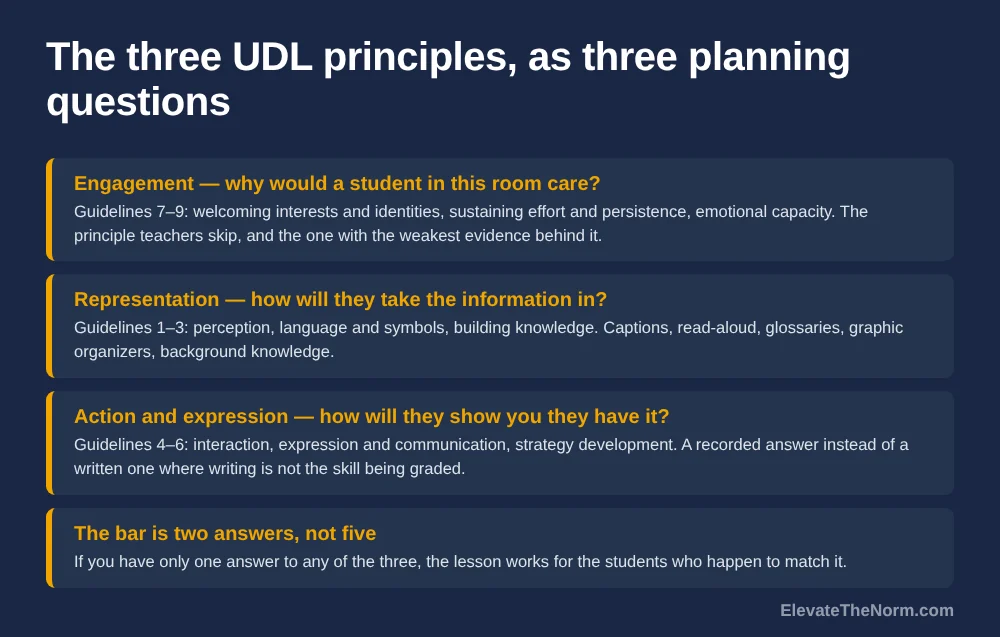
The plain-English version is shorter. Before you teach the lesson, ask three questions. Why would a student in this room care? How will they take the information in? How will they show me they have it? If you only have one answer to any of those, you have built a lesson that works for the students who happen to match it.
What are the three UDL principles?
The three principles are engagement, representation, and action and expression. CAST frames each as “design multiple means of” that thing. Under them sit nine guidelines, and under those sit the items that Guidelines 3.0 renamed from “checkpoints” to “considerations.”
- Engagement — guidelines 7 through 9: welcoming interests and identities, sustaining effort and persistence, and emotional capacity. This is the one teachers skip, and it is also the one with the weakest evidence behind it.
- Representation — guidelines 1 through 3: perception, language and symbols, and building knowledge. Captions, read-aloud, glossaries, graphic organizers, background knowledge.
- Action and expression — guidelines 4 through 6: interaction, expression and communication, and strategy development. Letting a student record an answer instead of writing it, or build the argument as a chart before writing a paragraph.
What changed in 3.0 is mostly framing. About Guidelines 3.0 describes the theme as “emphasizing identity as part of variability,” and says the revision “emphasizes addressing barriers rooted in biases and systems of exclusion.” CAST does not publish a side-by-side comparison with the previous version on that page. No new evidence claim arrived with the update.
Is UDL an evidence-based practice?
Not in the sense most teachers mean by that phrase. UDL is written into federal law as a “scientifically valid framework,” and a large body of research is attached to it. What it lacks is a reliable estimate of how much it moves achievement.
That gap is widest in middle and high school, which is the band this article is about. The two facts sit oddly together, and the people who noticed first were not critics. A peer-reviewed article in Educational Policy by researchers friendly to the framework is titled Universal Design for Learning: When Policy Changes Before Evidence. That is the whole problem in a title.
The legal side first. 20 U.S.C. § 1003(24), from the Higher Education Opportunity Act of 2008, defines UDL as “a scientifically valid framework for guiding educational practice” that “reduces barriers in instruction, provides appropriate accommodations, supports, and challenges.” The Every Student Succeeds Act adopted that definition and references UDL in four places, per CAST’s summary of UDL in the ESSA. Worth knowing: the language is permissive. Section 1005 asks states to apply UDL to assessment design “to the extent practicable.” It is an endorsement, not a mandate.
A phrase in a statute is not a finding. Congress wrote “scientifically valid” into the definition itself, which means every citation of the law reads as a citation of evidence. It is not one. CAST’s own research-evidence page lists foundational thinkers including Piaget, Vygotsky and Bloom, states that “neuroscience provides a solid foundation” for the framework, and acknowledges that “updating and expanding the research base is an ongoing process.” There is no strength-of-evidence rating per guideline.
What did the big UDL meta-analyses actually find?
They found a positive direction and almost no precision. The three most-quoted syntheses disagree by an order of magnitude, and the largest number in the literature comes from the weakest set of studies. Read the sentence after the headline in each one.
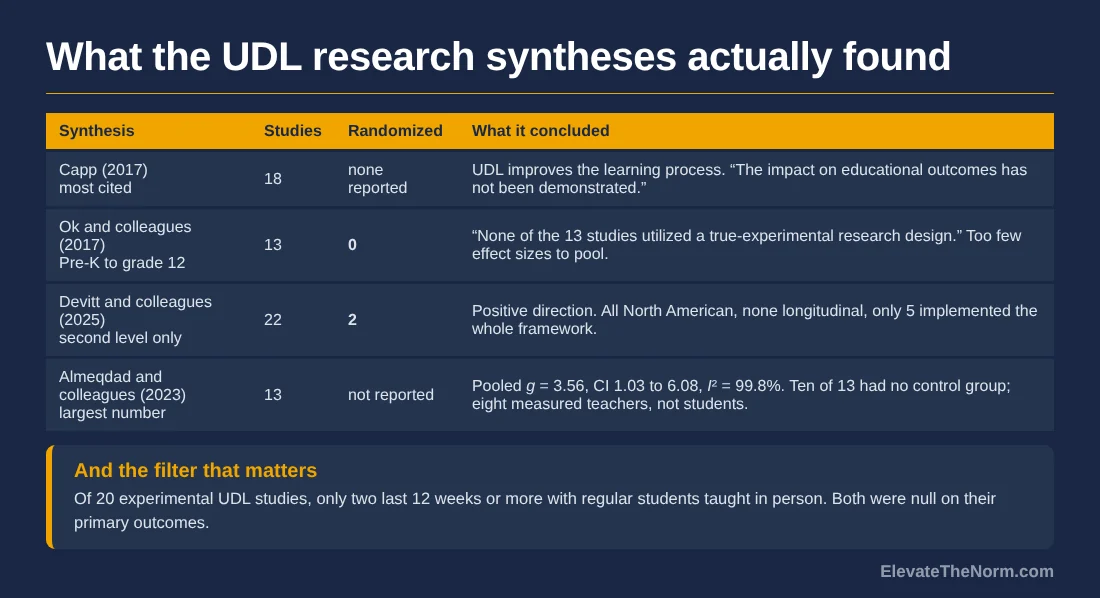
Capp’s 2017 meta-analysis reviewed 18 peer-reviewed studies from 2013 to 2016 and is the one most often cited as proof. It reports no single pooled effect size, and its participants run from preschoolers through university students. Its conclusion is that “UDL is an effective teaching methodology for improving the learning process for all students.” The next sentence is the one nobody quotes: “The impact on educational outcomes has not been demonstrated.” Capp also notes that his own positive findings “may be due to the lack of empirical evidence involving a pre- and post-test methodology.” Several of the largest effect sizes in his set measured teacher lesson planning or teacher motivation, not student learning.
One caution worth passing on: the copy of Capp’s paper that comes up first in a search carries an auto-generated summary claiming UDL “improves accessibility for 100% of students.” The paper says nothing of the kind. That is roughly how the UDL figures in a slide deck get there.
Almeqdad and colleagues (2023) is the source of the largest figure, a pooled Hedges’ g of 3.56. That is not a usable estimate and the authors say so: the 95 percent confidence interval runs from 1.03 to 6.08, individual study effects range from 0.33 to 13.18, and heterogeneity is I² = 99.8 percent. Of the 13 studies pooled, ten had no control group, and eight measured teachers rather than students. An I² that high means the studies are not measuring the same thing.
One distinction has to travel with all of this, because it is the one a district leader will reasonably press on. Thin evidence is not evidence that something does not work. Most of what is wrong with the UDL research is that the studies are short, small, rarely randomized and rarely implement the whole framework — which means the honest verdict is unproven at this grade level, not disproven. That is a real difference, and it cuts both ways: it is not grounds for dismissing the framework, and it is not grounds for a mandate either.
The most useful contrary work is Bissonnette’s reanalysis of a 2023 meta-analysis of 20 experimental UDL studies. He applied three ordinary filters — at least twelve weeks long, a regular student population, taught in person — and reports that “of the 20 studies in this meta-analysis, only two meet these criteria.” Both of those two were null on their primary outcomes. One, in fifth grade, “had no significant effect on overall reading comprehension.” The other, a full-year fourth-grade science study, “showed no statistically significant impact on academic performance or motivation” overall, though it found large positive effects of 0.82 to 1.01 for students with disabilities on curriculum-aligned measures that did not transfer to the national science test. Both studies are elementary, which matters for a grades 6 through 12 reader.
What does the evidence say about UDL in middle and high school?
At secondary level it is thin. the systematic review of UDL at second level is the only synthesis built specifically for this band, and it found 22 empirical studies. Two used randomized pre- and post-test designs. None were longitudinal, none were national in scale, and all 22 were North American.
The detail matters more than the count. Only five of the 22 were comprehensive UDL implementations, and three made no reference to specific principles at all. Coverage was lopsided toward the principle teachers control most easily: representation appeared in 14 studies, engagement in 13, action and expression in 11, self-regulation in four. Exactly one study measured student engagement as an outcome — a strange gap in a literature built on a principle of that name. The reviewers ran a quality-appraisal tool and did not report the results. Sixteen of 22 studies were positive or somewhat positive, four mixed, two found no effect.
The single hardest finding in the secondary set is King-Sears and colleagues (2015). Students in four co-taught high school chemistry classes were randomly assigned to a UDL treatment or a comparison condition, with a pre-test, a post-test and a four-week delayed post-test. The result: “there were no significant differences between conditions; however, there was an interaction effect between students with and without disabilities for post-tests.” When Capp recalculated that study, the effect was 0.97 for students with disabilities and −0.49 for students without them on the delayed test. The original authors call for “disaggregated learning outcomes” in future work, which is a polite way of saying a UDL package can help one group while not helping, or slightly costing, everyone else.
Widen it to all of Pre-K through 12 and it does not improve. Ok, Rao, Bryant and McDougall (2017) reviewed 13 studies covering 3,550 students, reported that “none of the 13 studies utilized a true-experimental research design,” and found six of the 13 never connected their intervention to UDL principles at all.
What is the difference between UDL, differentiation, and accommodations?
Timing and target. UDL designs the lesson before you meet the students. Differentiation adjusts it once you know them. An accommodation changes conditions for one named student because a legal document says so. The three are layers, not competitors.
| When it happens | Who it is for | What it changes | Is it optional? | |
|---|---|---|---|---|
| Universal Design for Learning | Before the lesson is taught | The whole class, by design | The materials, the task options and the routes into the content | Yes — a planning choice |
| Differentiated instruction | During the unit, in response to what you see | Groups or individuals you have identified | Pacing, grouping, questioning, the complexity of the task | Yes — a teaching choice |
| Accommodations | Whenever the plan says | A named student with an IEP or 504 plan | Conditions: time, setting, format, tools | No — legally required |
CAST’s own brief on UDL and differentiated instruction puts the first distinction this way: “UDL emphasizes proactive design of the environment and curricula while DI emphasizes responding the individual needs,” and calls it “a conceptual shift from thinking about ‘fixing the student’ to ‘fixing the curricula.’” In practice the line is softer than the brief makes it sound. Most of what the site already covers about adjusting a lesson once you already know who needs what overlaps heavily with what a UDL advocate would call good design, and deciding when to take a support away is a question both frameworks have to answer.
Does UDL replace an IEP or a 504 plan?
No. Nothing in the statute, the guidelines or the research supports dropping a required accommodation because a lesson was designed well. Federal law puts accommodations inside the definition of UDL rather than opposite it.
That is worth being precise about, because the claim drifts. 20 U.S.C. § 1003(24) says UDL “reduces barriers in instruction, provides appropriate accommodations, supports, and challenges.” Read it again: provides accommodations. The most defensible version of the stronger claim appears inside Lowrey, Classen and Sylvest (2019), quoting other authors describing UDL as “lessening the number of accommodations and modifications necessary for students with disabilities.” Fewer needed is not none required, and that sentence is a description of a hope rather than a measured result.
Good design makes an accommodation unremarkable, because everyone in the room has the same tool. It does not retire it. If anyone frames UDL as a way to reduce paperwork, that is the moment to ask which specific plan is being changed and who agreed to it.
The fairness objection is worth answering plainly, because families raise it and students feel it. If one student records an answer and another writes one, has the second been treated worse? No — both were asked the same question and graded against the same criteria. What changed is the delivery, not the standard. The version that would be unfair is a second format with a softer rubric attached, which is exactly what the step above is written to prevent.
Which parts of UDL have the strongest evidence?
The components, not the bundle. Several practices UDL packages have been evaluated on their own in these grade bands, and some carry federal STRONG ratings. The framework that assembles them has nothing comparable.
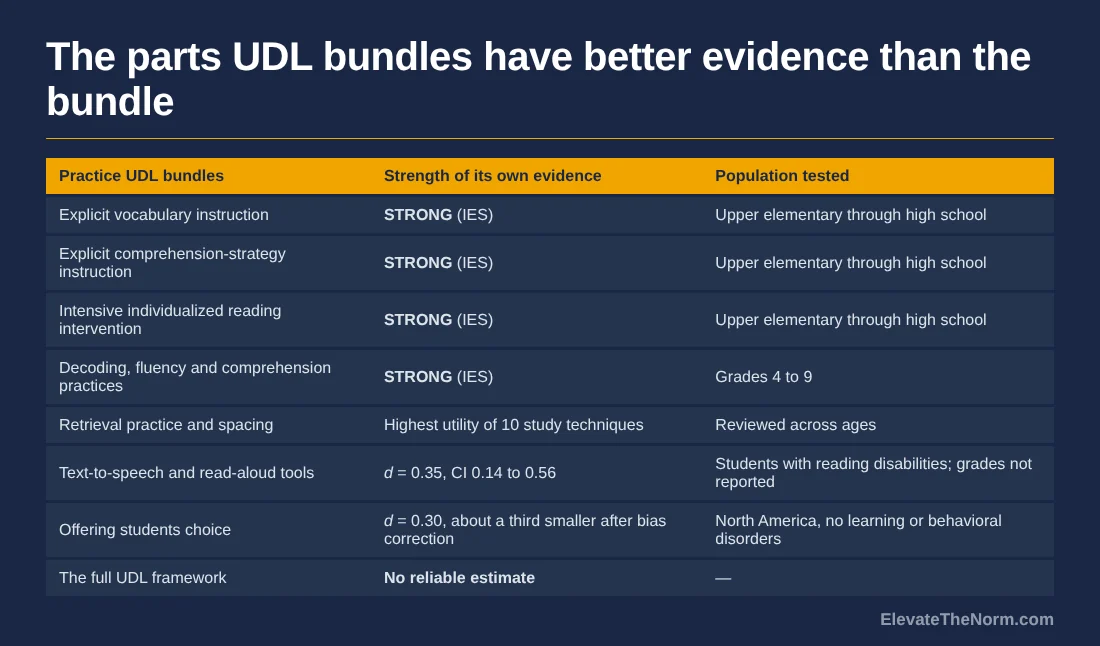
Reading and language come out best. the What Works Clearinghouse guide for grades 4–9 rates three recommendations STRONG for students in those grades: build decoding skills for multisyllabic words, provide purposeful fluency-building activities, and routinely use comprehension-building practices. the IES practice guide on adolescent literacy rates explicit vocabulary instruction, explicit comprehension-strategy instruction and intensive individualized intervention for struggling readers as STRONG, and makes an honest caveat on the first one: only some of the underlying studies showed effects on standardized reading comprehension rather than on vocabulary learning alone. On this site, teaching the words directly is the same recommendation written as a classroom routine.
Two specific UDL tools have their own numbers. a meta-analysis of text-to-speech tools for students with reading disabilities found an average weighted effect of d = 0.35 with a 95 percent confidence interval of 0.14 to 0.56 across 22 studies, and the authors still write that “it is not clear how effective text-to-speech is at improving reading comprehension.” The grade levels in that meta-analysis are not reported, so do not read it as a secondary finding. For strategy development, the review that rated practice testing and distributed practice highest out of ten study techniques points at retrieval practice and spacing, which is also what which study techniques hold up and which do not comes down to.
Choice is the interesting one, because it is the UDL move teachers reach for first and the evidence is more modest than the enthusiasm. Patall, Cooper and Robinson (2008) pooled 41 studies and found choice raised intrinsic motivation by d = 0.30 under fixed effects, shrinking by roughly a third after correcting for publication bias but staying positive. Two details should change what you build: the effect was strongest for instructionally irrelevant choices and weaker for the academically relevant ones teachers actually offer, and it was strongest with two to four successive choices rather than many. The samples were North American and excluded students with learning or behavioral disorders. So a real choice instead of a decorative one means three good options, not twelve — and three genuinely different ones. Students notice immediately when the three choices are three versions of the same essay, and a choice that is not really a choice buys none of the effect and costs you the credibility of offering it.


What does UDL look like in a grades 6 through 12 lesson?
It looks like one planning pass over a lesson you already have. You are not writing three versions. You are checking that each of the three principles has at least two answers, and adding the cheapest second answer where there is only one.
- Write the goal without the method in it. “Explain why the compromise failed” is a goal. “Write a five-paragraph essay explaining why the compromise failed” is a goal welded to one format. Separate them and the rest of the pass gets easier.
- Count the ways in. If the content arrives only as a lecture, add the text or the chart. If only as a text, add the three-minute explanation. Two routes is the bar, not five.
- Count the ways out. Pick one task where the format is not the skill being graded and allow a second format there. One task, not every task — two formats means two grading mental models, and across five sections that cost is real. Keep the rubric identical by writing its criteria about the thinking rather than the format: “uses evidence from at least two sources” works on a paragraph and on a three-minute recording. A criterion like “well-organized paragraphs” does not, and that is how a second format quietly becomes the easier option.
- Make one support available to everyone. Captions on, directions posted as well as spoken, word bank on the board. Nobody gets handed the visibly different sheet.
- Name the hard part out loud — then ask them. Say what the task is actually testing and which support is there for what; a support students do not understand is a support they will not use. Then take ninety seconds and ask the class which of your two formats they would pick and why. Every step above has you guessing from the front of the room at something the people at the desks could just tell you, and the framework’s own engagement principle is about their agency, not your planning.
- Check what you added. Options are not free: more choices mean more decisions for students who lose the assignment between hearing it and starting it. If a student spent the period choosing, the design failed.
Why does UDL implementation fail in real schools?
Because it is a whole-practice change delivered as a one-day workshop, and because fidelity collapses quietly. The implementation data are more consistent than the outcome data, and they point one way: most UDL that gets counted as UDL is a fraction of the framework.
The fidelity numbers from Bissonnette’s reanalysis are the clearest. In the full-year fourth-grade study, teachers logged into the platform an average of 9.63 days across the entire school year, and students completed 6.53 investigations. In the fifth-grade reading study, only 54 percent of the treatment group completed the program, averaging 6.96 of eight planned texts. Those are not tests of UDL. They are tests of a partial dose.
The practical reading of that is not that UDL is untrainable. It is that a one-day workshop is the wrong delivery for a change in how someone plans. The fidelity numbers describe people who were introduced to a framework and then left with it, and the studies that look best are the ones that ran twelve weeks or longer. If a building is going to do this, the honest version is one principle a semester with planning time attached, not three principles in an August in-service.
Training transfers badly too. Lowrey, Classen and Sylvest (2019) ran a UDL seminar with eight preservice teachers and found it “did not create a substantial overall change in the practice of planning and instruction.” Three of the eight increased their use of UDL guidelines in lesson plans and five decreased. Their plans still sorted students into high, average and low groups afterward. That is eight people and the authors call it preliminary, so take it as an illustration rather than a finding.
Two deeper criticisms are worth knowing, because they explain the thin evidence rather than just complain about it. Baglieri’s critical review calls UDL’s central claim “a loose and ambiguous claim” and observes that “in most cases, UDL seems to be practiced as an organizational solution for inclusion or as an intervention for disability” rather than a redesign. A framework defined loosely is hard to test, which is one reason 22 secondary studies produced no comparable outcome measure. And an annotated bibliography of UDL work from 2023 to 2025 records a finding that cuts against the enthusiasm directly: in one study “too much interactivity, particularly in group discussions, was sometimes overwhelming” for some neurodivergent students. More options is not automatically better for the students the framework is most often invoked for.
Clay’s take
UDL is a good habit with an oversold research file, and both halves of that sentence matter if you work in a building where it is being rolled out.
The habit is genuinely useful. Asking whether a lesson has more than one way in and more than one way out is a better question than most of what gets handed down in professional development, it costs a planning period rather than a budget line, and it tends to produce lessons that need fewer emergency adjustments on the day. Designing for the range you know is coming is just competent planning, and it is worth doing whether or not a meta-analysis ever lands on a number.
What is not defensible is how it gets sold. When a district quotes the law’s “scientifically valid framework” language as though it settles the evidence question, a statutory phrase is doing work research has not done. Teachers told a framework is proven, who try it faithfully and see nothing move on their assessments, reasonably conclude they were oversold — and then discount the next thing too, including the things that really do have strong evidence. That is how you spend credibility you will need later.
So: use the three questions, and spend the scarce hours on what has been tested on its own in these grades — explicit vocabulary and comprehension instruction, retrieval practice, and real intervention for students behind in reading. Treat the full framework as a sensible organizing idea, not an intervention with a known effect size.
What to do next
Take one lesson you are teaching this week and run the three questions over it. Not a unit, one lesson, and one you already consider good.
Strip the format out of the goal. Count the routes in and the routes out, and where either count is one, add the cheapest second option with an identical rubric. Then make a single support available to the whole room rather than only to the students who have it in writing. That is the pass, and it takes about twenty minutes once you have done it twice. If you would rather spend the hour on the practice with the strongest evidence behind it, start with the words themselves and leave the framework for later.
Frequently Asked Questions
What does UDL stand for in education?
UDL stands for Universal Design for Learning, a framework for planning instruction so that predictable differences between students are built into the lesson rather than handled as exceptions. It is maintained by the nonprofit CAST, which has published the UDL Guidelines since the late 1990s and released version 3.0 in July 2024. The term is borrowed from universal design in architecture.
Is UDL evidence based?
It depends what you mean. UDL is defined in federal law as a scientifically valid framework and has a large attached literature, but no reliable estimate of its effect on achievement, particularly in secondary grades. The most-cited meta-analysis states that the impact on educational outcomes has not been demonstrated. Several practices UDL bundles do have strong evidence on their own.
Is UDL the same as differentiation?
No. UDL is proactive and designed before you meet the students, aiming at the whole class by default. Differentiated instruction is responsive, adjusting pacing, grouping or task complexity once you know who needs what. CAST describes the difference as a shift from fixing the student to fixing the curriculum. In daily practice the two overlap heavily.
Does UDL work in high school?
The evidence does not say clearly. The only systematic review built for second-level education found 22 studies, only two of which used randomized designs, none longitudinal and all North American. One randomized study in high school chemistry classes found no significant difference between the UDL condition and the comparison condition, with different results for students with and without disabilities.
Can UDL replace an IEP or 504 accommodation?
No. Required accommodations stay required regardless of how well a lesson is designed. The statutory definition of UDL explicitly includes providing appropriate accommodations rather than replacing them. Good universal design can make an accommodation feel unremarkable because everyone has access to the same tool, but the legal obligation in a student’s plan is unchanged.
What are some UDL examples for middle and high school?
Posting directions in writing as well as saying them. Leaving captions on every video for the whole class. Allowing a recorded explanation instead of a written one where writing is not the skill being graded. Offering three task options rather than twelve. Providing a word bank everyone can use. Each is a second route in or out, not a separate lesson.
How long does it take to plan a UDL lesson?
Roughly twenty minutes per lesson once the habit is established, because it is a review pass over a lesson you already have rather than a rewrite. The failure mode is treating it as building several versions of everything. Implementation research suggests the real cost is sustained practice over a year, not the first planning session.
Why is the research on UDL so weak if it is in federal law?
Because the policy arrived first. Congress wrote the scientifically valid framework language into statute in 2008, and researchers friendly to UDL later published a paper titled Universal Design for Learning: When Policy Changes Before Evidence. Critics add that the framework is defined loosely enough to be hard to test, which is part of why studies rarely share an outcome measure.
Sources
- CAST. UDL Guidelines 3.0. Full guidelines and About Guidelines 3.0. Source of the three principles, the nine guidelines, the July 2024 release, the learner-agency goal statement and the stated themes of the revision. The framework’s publisher, not an independent evaluation.
- CAST. Research Evidence. Evidence page. Source of CAST’s neuroscience claim and of its own caveat that expanding the research base is ongoing. No per-guideline strength rating is published.
- United States Code. 20 U.S.C. § 1003(24), definition of universal design for learning, from the Higher Education Opportunity Act of 2008. Text. Source of the “scientifically valid framework” language and of the clause including accommodations. Read on a commercial reproduction of the U.S. Code rather than a government site.
- CAST. UDL in the ESSA, 2016. Summary. Source of the four Every Student Succeeds Act sections referencing UDL and of the “to the extent practicable” qualifier. No reference to UDL was found in IDEA.
- Capp, M. J. (2017). The effectiveness of universal design for learning: a meta-analysis of literature between 2013 and 2016. International Journal of Inclusive Education. doi:10.1080/13603116.2017.1325074. Full text. Source of the 18 studies, the learning-process conclusion, the “impact on educational outcomes has not been demonstrated” statement, and the recalculated King-Sears effects. The paper’s own limitations section gives a different study count than its methods section.
- Devitt, A., Banks, J., Bray, A., and colleagues (2025). A Systematic Literature Review on the Effectiveness of Universal Design for Learning in Second-level Education. International Journal for Universal Design and Universal Design for Learning, vol. 1, no. 1. Full text. Source of every secondary-specific count used here. Published in the first issue of a new journal, and its abstract and methods report different screening totals.
- King-Sears, M. E., Johnson, T. M., Berkeley, S., and colleagues (2015). An Exploratory Study of Universal Design for Teaching Chemistry to Students with and without Disabilities. Learning Disability Quarterly, 38(2), 84–96. Record. Source of the randomized high school chemistry null result. Sample size is not stated on the record page; only “four co-taught classes.”
- Ok, M. W., Rao, K., Bryant, B. R., and McDougall, D. (2017). Universal design for learning in Pre-K to Grade 12 classrooms: A systematic review of research. Exceptionality, 25(2), 116–138. Full text. Source of the 13 studies, the 3,550 students, and the statement that none used a true-experimental design.
- Almeqdad, Q. I., Alodat, A. M., Alquraan, M. F., and colleagues (2023). The effectiveness of universal design for learning: A systematic review of the literature and meta-analysis. Cogent Education, article 2218191. Abstract. Source of the pooled g = 3.56, its confidence interval, the 99.8 percent heterogeneity, and the study composition. Read as an abstract record rather than the full paper.
- Bissonnette, S. UDL and Academic Achievement: Critical Analysis of the Meta-analysis by King-Sears and Colleagues (2023). TÉLUQ University. English translation. Source of the two-of-twenty filter result, both null primary outcomes, and the fidelity figures. The document carries internal citation inconsistencies and no stated year. The underlying King-Sears 2023 meta-analysis could not be opened, so no pooled effect size is quoted for it here.
- Hollingshead, A., Lowrey, K. A., and Howery, K. (2020). Universal Design for Learning: When Policy Changes Before Evidence. Educational Policy. doi:10.1177/0895904820951120. Record. Interviews with 19 experts; read as an abstract record. Cited for its framing and for the point that definitional variability is acknowledged inside the field.
- Baglieri, S. Toward Inclusive Education? Focusing a Critical Lens on Universal Design for Learning. Canadian Journal of Disability Studies. Full text. Source of the ambiguity critique and the observation that UDL is often practised as an organizational solution. Year, volume and pages are not printed on the PDF.
- CAST (2013). UDL and Differentiated Instruction brief. Copy hosted by the Oregon Department of Education. Source of the proactive-versus-responsive distinction and the fixing-the-curricula quotation. The original CAST URL now redirects.
- Institute of Education Sciences. Providing Reading Interventions for Students in Grades 4–9, WWC 2022007. Overview. Source of the three STRONG-rated reading recommendations for a grade band overlapping 6 through 12.
- Kamil, M. L., Borman, G. D., Dole, J., and colleagues (2008). Improving adolescent literacy: Effective classroom and intervention practices, NCEE 2008-4027. Full guide. Source of the STRONG ratings for explicit vocabulary instruction, comprehension-strategy instruction and intensive intervention, the MODERATE rating for motivation and engagement, and the caveat about standardized comprehension outcomes.
- Wood, S. G., Moxley, J. H., Tighe, E. L., and Wagner, R. K. (2018). Does use of text-to-speech and related read-aloud tools improve reading comprehension for students with reading disabilities? A meta-analysis. Journal of Learning Disabilities, 51(1), 73–84. Summary record. Source of d = 0.35 and its confidence interval. Grade levels are not reported on the records read, so this is not presented as a secondary-specific result.
- Patall, E. A., Cooper, H., and Robinson, J. C. (2008). The effects of choice on intrinsic motivation and related outcomes: A meta-analysis of research findings. Psychological Bulletin, 134(2), 270–300. Full text. Source of the choice effect sizes, the publication-bias correction, the two-to-four-choices finding, and the result that instructionally relevant choices produced weaker effects. North American samples excluding students with learning or behavioral disorders.
- Association for Psychological Science. Which Study Strategies Make the Grade? Publisher release for Dunlosky, J., Rawson, K. A., Marsh, E. J., Nathan, M. J., and Willingham, D. T. (2013), Psychological Science in the Public Interest. Release. Source of the finding that practice testing and distributed practice received the highest utility ratings of ten techniques. A publisher release, not the paper; no effect sizes are quoted from it.
- Lowrey, K. A., Classen, A., and Sylvest, A. (2019). Exploring Ways to Support Preservice Teachers’ Use of UDL in Planning and Instruction. Journal of Educational Research and Practice, 9(1), 261–281. Full text. Source of the three-of-eight and five-of-eight seminar result and of the quoted description of UDL lessening the number of accommodations needed. Eight participants; the authors call it preliminary.
- Western Norway University of Applied Sciences. What’s new in UDL? Selected articles 2023–2025, annotated bibliography. PDF. Used as a description of other papers rather than as a primary source, including the finding that excessive interactivity was overwhelming for some neurodivergent students. No named author or date on the document.