By Clay Shumate
Station rotation splits one class into groups that cycle on a timer through stations inside the same room, at least one of them online. It is a scheduling structure, not an intervention. The one study that looked for research on it found none, and the evidence that exists belongs to a single station: the teacher-led small group.
Key Takeaways
- The people who named the model declined to claim it works. Heather Staker and Michael Horn’s taxonomy says plainly that “the definitions in this taxonomy leave out such appraisals” of quality, and that blended learning “can be both good and bad.”
- Somebody did go looking, and came back empty. A 2020 study by the American Institutes for Research reports that its literature search “did not yield any empirical research articles on station rotation” — then found the model “was not associated with significantly higher student achievement on standardized assessments.”
- The evidence lives in one station. Teacher-led small-group instruction has real, replicated effects. It also discounts with age: the Education Endowment Foundation puts small group tuition at +4 months in primary and +2 months in secondary.
- Group size is the number that matters most. The EEF’s rule of thumb is that “the smaller the group the better,” and that “once group size increases above six or seven there is a noticeable reduction in effectiveness.” A thirty-student class in three stations puts ten at the teacher table.
- The costs land harder in high school than in elementary. Lost instructional time rises with grade level, and 17 percent of US teens told Pew they are at least sometimes unable to finish homework because they lack reliable internet or a computer.
What is station rotation?
Station rotation is a blended-learning model in which students in one course rotate on a fixed schedule, or at the teacher’s discretion, among learning stations inside the classroom — and at least one of those stations is online. Every student passes through every station.
That definition is not a paraphrase. Staker and Horn’s 2012 taxonomy defines the Station-Rotation model as “a Rotation-model implementation in which within a given course or subject (e.g., math), students rotate on a fixed schedule or at the teacher’s discretion among classroom-based learning modalities,” where “the rotation includes at least one station for online learning.” What separates it from the other rotation models is that “students rotate through all of the stations.”
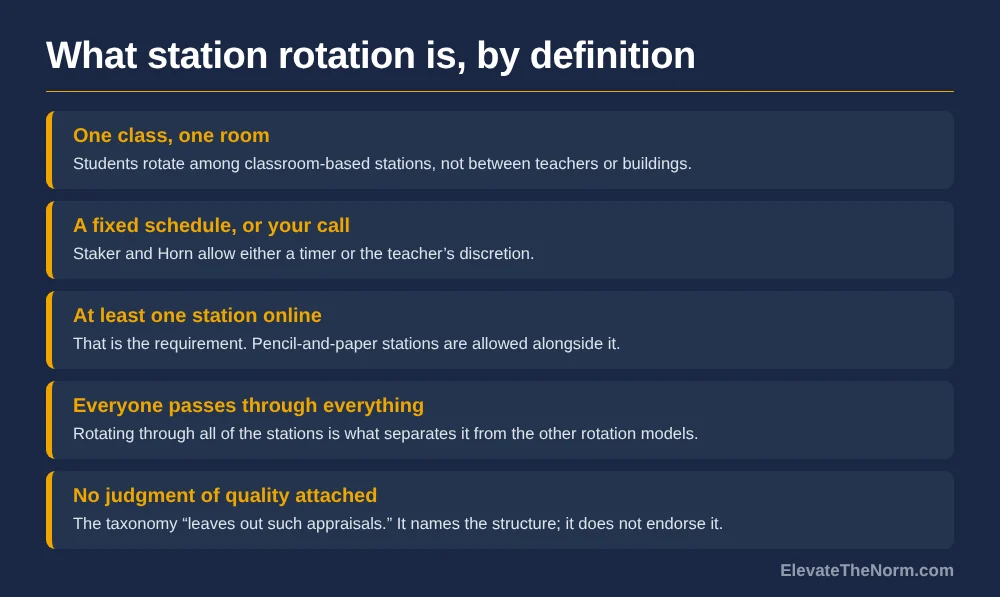
Two things in that document deserve more attention than they get. The first is the authors’ stated purpose: definitions that “create a shared language that enables people to talk about the new phenomena.” A classification, in other words. The second is their refusal to grade it. The taxonomy “leaves out such appraisals,” and the paper says blended learning “can be both good and bad.”
Worth noticing where the canonical example comes from. The illustration Staker and Horn use for station rotation is a kindergarten classroom, with fifteen computers, rotating among online learning, small-group instruction and individual assignments. The model’s defining picture is five-year-olds. That is not a reason to dismiss it in grades 6–12, but it is a reason to stop treating it as a secondary practice with a secondary track record.
Does station rotation actually work?
Nobody knows. The American Institutes for Research looked for empirical research on station rotation in 2020 and reports that its search “did not yield any empirical research articles on station rotation.” It describes the wider personalized-learning research base as “thin.”
That is the whole answer to the question most teachers are asking, and it is worth sitting with: the one serious attempt to find evidence for this model came back empty-handed before it had even started looking at students.
So AIR ran its own descriptive study across five sites, and found that “station rotation was not associated with significantly higher student achievement on standardized assessments.” Attendance showed no significant difference either. Students did generally report positive views of their learning — self-reported, affective, and not the same thing as learning more.
Read that result with the authors’ own limits attached. Their design “does not allow for strong causal inference”: it is a convenience sample, reporting associations rather than effects. A null association is not proof the model fails. It is the absence of the evidence most people assume is already there.
And even that study is not about your students. Its surveys went to all grade 4–8 teachers, and it reports station rotation was “more common in elementary grades than in middle grades.” There is no grades 9–12 study of this model at all.
Why do people think station rotation has evidence behind it?
Because one federal number gets borrowed constantly. The US Department of Education’s meta-analysis of online learning reported that “the mean effect size in studies comparing blended with face-to-face instruction was +0.35, p < .001.” That figure is real, and it is not about secondary students.
The report’s authors say so themselves, twice. “The great majority of estimated effect sizes in the meta-analysis are for undergraduate and older students,” and “caution is required in generalizing to the K–12 population.” Then the sentence that undoes the marketing version entirely: “the positive effects associated with blended learning should not be attributed to the media, per se” — because the blended conditions usually added learning time and extra instructional elements on top.
Purely online against face-to-face, in the same analysis, produced an average effect of +0.05 and was not statistically significant. The blended advantage came from adding things, not from moving things online.
How thin is the K–12 base underneath all this? A federal regional lab review puts a number on it: of the prior meta-analytic literature, “only 5 of 176 studies that met the authors’ eligibility criteria focused on K–12 schooling.” Of its own 17 studies, “only 7 used a rigorous group research design,” and it concludes that its findings “do not allow for conclusions to be drawn about the effectiveness of these programs as a whole.”
What does the one secondary study show?
It contradicts itself, which is more useful than it sounds. Minaz Fazal and Melanie Bryant compared station-rotation blended learning against face-to-face instruction with 413 sixth graders in middle school math, and got opposite answers from two different tests.
On the MAP growth measure, the blended group came out ahead: t(411) = 3.02, p = .003, d = 0.30. On the STAAR state achievement test, the face-to-face group came out ahead, d = −0.28, p = .005. Same students, same study, two outcome measures, two signs.
The design limits it further. Students were not randomly assigned; the authors call the work non-experimental, with four teachers and intact classes. Take one number from that study and you can prove whatever you came to prove, which is roughly what has happened to this model in general.
Where is the real evidence in this model?
In the teacher station. Small-group instruction from a teacher is one of the better-evidenced things in education, and in a station rotation it is the only part of the structure carrying a track record.
Andre Nickow, Philip Oreopoulos and Vincent Quan’s meta-analysis of experimental tutoring studies reports “an overall pooled effect size estimate of 0.37 SD” across PreK–12. Two qualifications travel with it. Effects “tend to be strongest among the earlier grades,” a decline the authors attribute entirely to literacy programs — in mathematics they report a reverse trend, which is good news if you teach secondary math. And effects are “stronger, on average, for teacher and paraprofessional tutoring programs” than for volunteers or parents, though that teacher advantage is driven largely by first-grade Reading Recovery studies. The authors call these moderator findings descriptive, not causal.
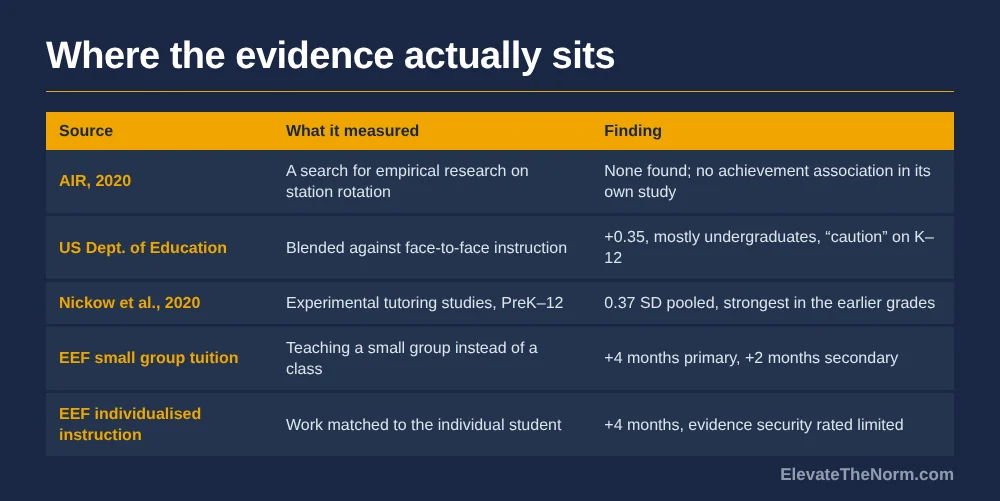
The EEF’s toolkit entry gives the same shape in school-friendly units: small group tuition averages “four months’ additional progress over the course of a year,” but “impact tends to be greater in primary schools (+4 months) than secondary schools, which has fewer studies overall and a lower impact (+2 months).” Evidence security is rated moderate, and it “lost an additional padlock because a large percentage of the studies were not independently evaluated.”
The actionable number is group size. “As a rule of thumb, the smaller the group the better,” and “once group size increases above six or seven there is a noticeable reduction in effectiveness.” That single sentence should decide your station design before anything else does. Three stations in a class of thirty puts ten students at the teacher table, which is past the point where the evidence says the thing stops working.
Does the online practice station do anything?
Modestly, on limited evidence, and not because it is digital. The EEF rates individualised instruction at “+4 months” of additional progress for very low cost — with evidence security rated “limited.”
Two findings on that page cut against the usual pitch. Secondary does better than primary here, +4 months against +3 — the opposite of the small-group pattern. And on the technology itself: “approaches using digital technology to individualise instruction show that they are as effective as those without technology.” The software is not the ingredient.
There is a detail buried in that entry that describes station rotation without naming it. The EEF notes that many technology studies pair the software with small group tuition, “where teachers provide targeted instruction to the pupils that are not engaging with the technology.” That is the model, and the EEF attributes the result to the pairing rather than to the program. Its blunt guidance: individualised instruction “may be better used as a supplement to usual class teaching, rather than a replacement.”
If you want named programs with rigorous K–12 findings behind them, the federal review above identifies four: Cognitive Tutor Algebra I, LeapTrack, READ 180 and Time To Know. The underlying studies were not read for this article, so no effect sizes are quoted for any of them. That list is also notable for how short it is.
What does station rotation cost you in time?
Three transitions in a period you did not previously spend, against a time budget that is already tighter in high school than in elementary school. That trade is the main practical argument against the model, and it gets stronger as students get older.
Matthew Kraft and Sarah Novicoff’s analysis of one district’s instructional time found that “the average elementary school student in PPSD loses 16 percent of instructional time,” while “the typical middle school student loses 21 percent” and “high school students lose a total of 25 percent.”
The same paper is the source of a figure that gets misquoted everywhere, so here it is in full: “estimates of off-task behavior, transitions, and wait-time suggest these activities occupy between 17 and 29 percent of instructional time.” That is a range assembled from four other studies, and it bundles off-task behaviour, transitions and wait time together. It is not a measurement of transitions, and anyone telling you transitions eat a quarter of your class has not read the sentence.
What the figures do support is this: the move costs real minutes, and a 45- or 50-minute secondary period cannot absorb five stations. Keep the count low and the transitions boring.
How many stations should you have, and how long should they be?
Two or three stations, sixteen to thirty minutes each, is what teachers running the model actually do. That is prevailing practice reported by AIR, not an outcome study, and it should be read as what works logistically rather than what produces learning.
AIR found teachers most often used two or three stations rather than four or five, that “about 55% of station rotation teachers reported 16 to 30 minutes at each station, and about 32% reported 10 to 15 minutes,” that most grouped students by similar learning needs, and that about a third regrouped weekly.
Catlin Tucker, who has written more practical material on this model than anyone, recommends designing three or four distinct stations and running mirrored copies so each half of the room meets the same tasks, at roughly six students per station, with a rotation allowed to run across several days rather than cramming into one period. That is practitioner advice rather than evidence — but six per station is the same number the EEF arrives at from the research, which is a convergence worth taking seriously.
| Station | What happens there | What the evidence says | The number that governs it |
|---|---|---|---|
| Teacher-led small group | Direct teaching to a handful of students | The only component of the model with a replicated track record | Six or seven students, maximum |
| Independent or online practice | Practice on content already taught | Modest, on limited evidence, and digital is no better than paper | +4 months, evidence security rated limited |
| Collaborative task | Students work a task together without you | Depends on the task and the roles, not on the rotation | No station-rotation evidence exists |
| The rotation itself | Moving students between stations on a timer | A search for empirical research on it returned nothing | Three transitions you did not previously spend |


How do you build a station rotation in a 50-minute period?
Work backwards from the teacher table. Decide how many minutes you need with how many students, and let that decide everything else — the station count, the timing, and whether the rotation finishes today at all.
- Name the one thing you need to teach a small group. If you cannot say what you will do at that table that you cannot do from the front, you do not need stations. You need a better lesson.
- Divide the class so the teacher table holds six or seven, not ten. In a class of thirty that means four groups, which means the rotation runs over two days. Let it. A group of ten at the teacher table is past the size where the evidence says small-group teaching works.
- Build two stations, not four. One teacher-led, one that runs without you. A third only if it genuinely runs without you too. Every station you add is a transition you pay for and a set of instructions you have to write.
- Make the independent station practice, not new instruction. The EEF is explicit that individualised instruction works better as a supplement than a replacement, and students teaching themselves new content on a screen while you are busy is the version of this model that fails quietly.
- Write the stuck procedure before the lesson. Students at the independent station will get stuck while you are unavailable, and “ask three before me” reads to a teenager as “do not ask.” Give them a written answer key, a worked example, or a named classmate — something that is not a closed door.
- Time the transition and make it dull. Same signal, same route, same thirty seconds. The only interesting thing in the room should be the work.
A note on grouping, because it is the part students notice first. AIR found most teachers group by similar learning needs and only about a third regroup weekly. A group that never changes is read correctly by teenagers as a ranking, and a student who has been in the same group since September has been told something about themselves every week since. Group by the specific skill you are teaching that week, regroup when the skill changes, and say out loud why the groups look different today. Flexible grouping that actually changes is the version of this that does not become tracking inside one classroom.
What about students without reliable internet or devices?
Keep the online station inside the room and inside the period. A rotation that works in class and then sends unfinished digital work home turns a device gap into a grade gap, and the gap is well documented.
In a 2018 Pew Research Center survey of 743 US teens aged 13 to 17, 17 percent said they are often or sometimes unable to complete homework assignments because they do not have reliable internet or a computer. Among teens in households earning under $30,000 a year it was 24 percent, against 9 percent in households above $75,000. A quarter of Black teens said they were at least sometimes unable to finish homework for that reason. Those figures are from 2018 and should be read as dated rather than current.
The design implication is small and non-negotiable. Whatever happens at the online station finishes at the online station, there is a paper version for the day the network is down, and nothing at that station is the only route to the content. Staker and Horn’s own definition allows pencil-and-paper stations alongside the online one; the model does not require a device per child.
What goes wrong with station rotation?
Four things, and three of them are a teacher dropping a step rather than the model failing. The fourth is a question nobody has a good answer to.
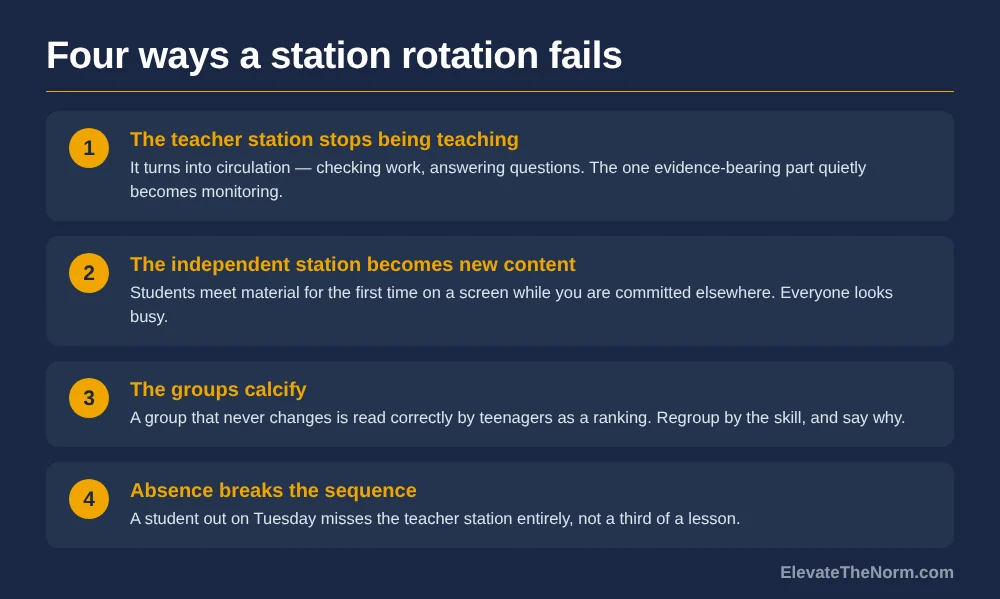
The teacher station stops being teaching. It becomes circulation — checking work, answering questions, putting out fires. The only evidence-bearing component of the structure quietly turns into monitoring, and the rotation keeps running as though nothing changed.
The independent station becomes unsupervised new content. Students meet material for the first time on a screen while the teacher is committed elsewhere. That is the arrangement the EEF warns against, and it is invisible from the front of the room because everyone looks busy.
The groups calcify. Covered above, and it is the failure students feel rather than the one that shows up on a test.
Absence breaks the sequence. A student out on Tuesday misses the teacher station entirely, not a third of the lesson, and no published guidance addresses it. The workable answer is to make the teacher station the one piece you will re-run, in two minutes, one-to-one, rather than the one piece that cannot be repeated. Noise and grading sit in the same category: real problems, no research, and worth deciding before the first rotation rather than during it.
Clay’s take: the rotation is the furniture, the small group is the instruction
The structure’s entire job is to buy a teacher twenty minutes with six students. If a design does not deliver that, there is nothing left in it that any evidence supports.
I am wary of how this model gets sold, because the part being sold is the part with no track record. The pitch leads with the software and the personalization, and the research leads with a teacher at a table with a handful of kids — a practice that predates every piece of technology in the room. A school that buys the platform and leaves the teacher station at ten students has bought the packaging.
That said, a null result from one descriptive study is not a reason to walk away. Plenty of sensible teaching has less behind it than this, and “no evidence” means nobody has measured it rather than that it has failed. What the thin evidence should change is the claim, not the practice. Run it because you want twenty minutes with six students and cannot get them any other way. Do not run it because a slide said blended learning is worth +0.35, and do not let anyone tell a school board that it is.
What to do next week
Try one rotation in one class, with two stations, on content you have already taught. Not new material, not four stations, not a model class period for anyone to watch.
Put six or seven students at your table and teach them the thing you have never had time to teach a whole class. Give everyone else practice they can genuinely do alone, with a written way out when they get stuck. Then ask yourself one question at the end: was the small group better than what you would have done from the front? That is the whole test, and it has nothing to do with technology.
If the answer is no, the fix is usually upstream. The flipped classroom buys class time a different way, group work roles cover what happens at the station you are not sitting at, numbered heads together is a smaller structure that needs no rotation at all, and activities for student centered learning covers what to put at a station once you have built one.
Frequently Asked Questions
What is the station rotation model?
Station rotation is a blended-learning model in which students in one class rotate on a fixed schedule, or at the teacher’s discretion, among stations inside the same room, with at least one station online. Staker and Horn’s taxonomy distinguishes it from other rotation models by the fact that students rotate through all of the stations rather than only some.
Does station rotation improve student achievement?
There is no evidence that it does. A 2020 American Institutes for Research study reports that its literature search found no empirical research articles on station rotation, and its own descriptive study found the model was not associated with significantly higher achievement on standardized assessments. That is an absence of evidence rather than proof of failure, and the study covered grades 4 to 8.
How many stations should a station rotation have?
Two or three, with the teacher-led group kept to six or seven students. AIR found teachers most often run two or three stations, with about 55 percent spending 16 to 30 minutes at each. The limiting number comes from the EEF: above six or seven students in a group there is a noticeable reduction in the effectiveness of small-group teaching.
What is the difference between station rotation and a flipped classroom?
A flipped classroom moves first-exposure instruction out of the period, usually to video at home, so class time can be spent on practice. Station rotation keeps everything inside the period and moves the students instead, cycling them between a teacher-led group and work they do without you. One changes when instruction happens; the other changes where students are standing.
Can you do station rotation in a 45-minute class period?
Yes, with two stations rather than four, and often by letting one rotation run across two days. Three transitions cost real minutes in a period that is already losing time, and secondary students lose more instructional time than elementary students do. Keep the station count low, keep transitions dull and identical, and do not try to finish everything in one sitting.
Does station rotation require a device for every student?
No. The model’s own definition requires at least one online station, not one device per child, and it explicitly allows pencil-and-paper stations alongside it. Keeping the online work inside the room and inside the period also avoids pushing it home, which matters because 17 percent of US teens told Pew in 2018 they sometimes cannot finish homework for lack of reliable internet or a computer.
Is my child only getting a third of the teacher’s attention?
Less teacher time overall, but more of it directed at them. In a whole-class lesson a student may not be spoken to at all; at a teacher-led station of six, being spoken to is unavoidable. The trade only pays if the small group is genuine teaching rather than the teacher circulating and checking work, which is the most common way this model goes wrong.
What happens when a student is absent during a station rotation?
They miss the teacher station entirely, not a third of a lesson, and no published guidance addresses this. The practical fix is to treat the teacher-led portion as the piece you will re-run in two minutes one-to-one, rather than the piece that cannot be repeated. Decide that before the first rotation, not after a student has missed one.
Sources
- Staker, H., & Horn, M. B. Classifying K–12 Blended Learning. Innosight Institute (now the Clayton Christensen Institute), May 2012. Full text. Source of the Station-Rotation definition quoted here, the rotation-through-all-stations distinction, the stated purpose of creating a shared language, the statement that the taxonomy leaves out appraisals of quality, and the kindergarten illustration of the model.
- Fulbeck, E., Atchison, D., Giffin, J., Seidel, D., & Eccleston, M. Personalizing Student Learning With Station Rotation: A Descriptive Study. American Institutes for Research, commissioned by the Overdeck Family Foundation, July 2020. Full text. Source of the finding that the literature search yielded no empirical research articles on station rotation, the thin description of the research base, the null achievement and attendance associations, the authors’ statement that the design does not allow strong causal inference, the two-to-three station and 16-to-30-minute practice figures, the grouping and regrouping findings, and the grade 4–8 scope.
- Means, B., Toyama, Y., Murphy, R., Bakia, M., & Jones, K. Evaluation of Evidence-Based Practices in Online Learning: A Meta-Analysis and Review of Online Learning Studies. U.S. Department of Education, Office of Planning, Evaluation and Policy Development, revised September 2010. Full text. Source of the +0.35 blended-versus-face-to-face effect, the +0.05 purely-online result, the authors’ statement that most effect sizes are for undergraduate and older students, the caution about generalizing to K–12, and the warning that the effects should not be attributed to the media per se. The copy read for this article was the Boston University mirror.
- Brodersen, R. M., & Melluzzo, D. Summary of research on online and blended learning programs that offer differentiated learning options (REL 2017–228). Institute of Education Sciences, National Center for Education Evaluation, REL Central, February 2017. Full text. Source of the five-of-176 figure, the seven-of-17 rigorous-design count, the statement that no conclusions can be drawn about effectiveness as a whole, and the four named programs with rigorous positive findings.
- Fazal, M., & Bryant, M. “Blended Learning in Middle School Math: The Question of Effectiveness.” Journal of Online Learning Research, 5(1), 49–64 (2019). Full text. Source of the 413 sixth-grade sample, the station-rotation framing, the MAP result (d = 0.30) and the opposing STAAR result (d = −0.28), and the authors’ statement that students were not randomly assigned. The study’s reported means were not reproduced here because the published tables and narrative disagree.
- Nickow, A., Oreopoulos, P., & Quan, V. The Impressive Effects of Tutoring on PreK-12 Learning: A Systematic Review and Meta-Analysis of the Experimental Evidence. NBER Working Paper No. 27476, July 2020. Full text. Source of the 0.37 SD pooled effect, the finding that effects are strongest in earlier grades with a reverse trend in mathematics, the comparison of teacher and paraprofessional tutors against volunteers and parents, and the authors’ description of their moderator analyses as descriptive rather than causal.
- Education Endowment Foundation. Small group tuition, Teaching and Learning Toolkit, accessed November 2026. Toolkit entry. Source of the four-months average, the primary (+4) against secondary (+2) split, the smaller-the-group rule of thumb, the six-or-seven threshold, the moderate evidence rating, and the note that a padlock was lost because many studies were not independently evaluated.
- Education Endowment Foundation. Individualised instruction, Teaching and Learning Toolkit, accessed November 2026. Toolkit entry. Source of the +4 months figure and limited evidence security, the secondary (+4) against primary (+3) comparison, the finding that digital approaches are as effective as those without technology, the description of pairing software with small group tuition, and the supplement-rather-than-replacement guidance.
- Kraft, M. A., & Novicoff, S. Time in School: A Conceptual Framework, Synthesis of the Causal Research, and Empirical Exploration. Annenberg EdWorkingPaper No. 22-653, February 2024. Full text. Source of the Providence figures of 16, 21 and 25 percent of instructional time lost by level, and of the 17-to-29 percent range, which is synthesised from four prior studies and covers off-task behaviour, transitions and wait time together rather than transitions alone.
- Anderson, M., & Perrin, A. “Nearly one-in-five teens can’t always finish their homework because of the digital divide.” Pew Research Center, 26 October 2018. Report. Source of the 17 percent overall figure, the 24 percent and 9 percent income comparison, the figure for Black teens, and the sample of 743 teens aged 13 to 17 surveyed in spring 2018.
- Tucker, C. “FAQ: Station Rotation Model” and “Addressing Station Rotation Challenges.” catlintucker.com, December 2022 and April 2018. FAQ post. Source of the mirrored-station design, the three-to-four station recommendation, roughly six students per station, and rotations running across several days. This is practitioner advice from a teacher and author, not research, and is labelled as such in the text.