By Clay Shumate
Spiral review means deliberately revisiting material you already taught, spread out across weeks rather than crammed before a test. The spacing research behind it is strong. The research on spiral review itself, as a packaged classroom routine in grades 6–12, barely exists.
Key Takeaways
- Spacing is one of the best-evidenced findings in learning science. Cepeda and colleagues (2006) synthesised 839 assessments across 317 experiments in 184 articles. Only 12 of 271 massed-versus-spaced comparisons showed no effect.
- Almost none of that evidence was collected over the timescales a teacher cares about. In the same meta-analysis, 80 percent of the performance differences used a retention interval of less than one day, and only 4 percent went past a month.
- There is a rule of thumb for the gap, and it is not “longer is better.” Carpenter and colleagues (2012) report that “the optimal spacing gap equaled 10–20 % of the test delay.” They also write plainly: “a longer spacing gap is not always better.”
- No high school study sits underneath any of this. The 2012 review describes school spacing studies at grade 1, grade 5 and grade 8. It describes none with high school students.
- Spiral review and the spiral curriculum are different things, and only one of them gets criticised. Schmidt, Houang and Cogan called US maths standards “a mile wide and an inch deep” because topics are introduced early and repeated for years. That is a curriculum-design problem, not an argument against Friday warm-ups on last month’s material.
What is spiral review?
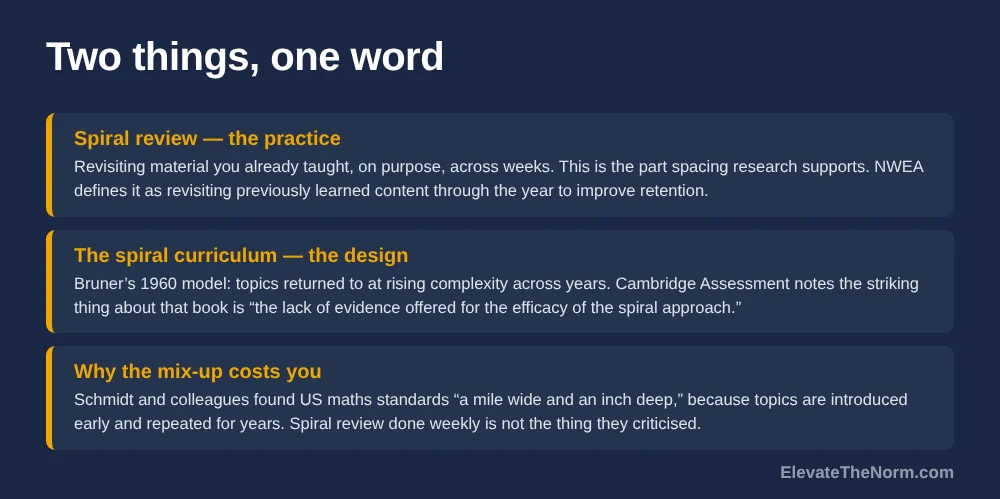
Spiral review is the deliberate practice of returning to material you have already taught, on a schedule, across the year. NWEA puts it simply: with spiral review, teachers revisit previously learned content throughout the school year to improve retention. In practice it usually looks like a short warm-up, a few questions on old units mixed into a homework set, or a cumulative quiz.
It is a delivery routine, not a theory. What sits underneath it are two findings from cognitive psychology: the spacing effect, and — when the questions are mixed rather than blocked — interleaving. The useful question is not whether spacing works. It is whether the version of spacing you can actually run in a 50-minute period, with 150 students and a pacing guide, does anything.
Is spiral review the same as a spiral curriculum?
No, and conflating them is how a perfectly sensible classroom routine ends up tarred with a curriculum criticism it never earned. A spiral curriculum is a design model: topics are revisited at rising complexity across years. Ireland and Mouthaan (2020) trace it to Bruner’s The Process of Education (1960), and note something worth sitting with — “the lack of evidence offered for the efficacy of the spiral approach” in that book. They add that the model was “implicitly accepted as a key model” with limited critical reflection.
Spiral review is what you do on a Tuesday. It operates on weeks, not years, with material the same teacher taught the same students. Nothing Bruner wrote is load-bearing for it.
The criticisms of the curriculum model are real, and they are not criticisms of the practice. Ireland and Mouthaan report Snider’s (2004) argument that the intent was depth at each pass but the “functional result is that students acquire a superficial understanding of math concepts,” and that students who have mastered a concept are “subjected to unnecessary repetition of the content which can be demotivating.” Snider also names “insufficient cumulative review” as a shortcoming — which is to say that one of the complaints about the spiral curriculum is that it does not do enough of what spiral review does.
Schmidt, Houang and Cogan (2002) made the structural case from the TIMSS curriculum data. “We introduce topics early and then repeat them year after year,” they wrote, and “very little depth is added each time the topic is addressed because each year we devote much of the time to reviewing the topic.” Their summary line is the one everybody quotes: US standards are “a mile wide and an inch deep.” For scale, they report that eighth-grade maths textbooks in Japan have around 10 topics while US eighth-grade textbooks have over 30.
| Spiral review (the practice) | Spiral curriculum (the design) | |
|---|---|---|
| Timescale | Days to weeks | Years, across grade levels |
| Who controls it | The classroom teacher | The state, the district or the textbook publisher |
| Material | Content you taught this group | Topics reintroduced to new students each year |
| Evidence behind it | The spacing literature — large, robust, mostly short-interval and mostly adult | Bruner offered none; Cambridge Assessment says so outright |
| Main criticism | Eats warm-up minutes; feels worse to students than blocked practice | Superficial coverage, unnecessary repetition, a mile wide and an inch deep |
Does spiral review actually work?
The honest answer has two halves. The ingredients are extremely well evidenced. The packaged routine is not, and nobody should pretend otherwise.
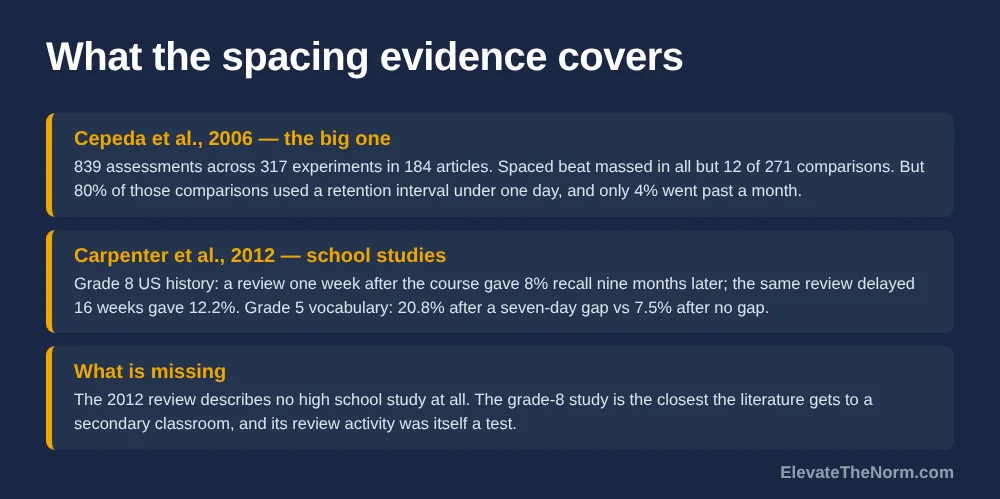
On the ingredients: Cepeda, Pashler, Vul, Wixted and Rohrer (2006) is about as solid as educational psychology gets. They located 839 assessments of distributed practice across 317 experiments in 184 articles, and reported that “spaced presentations led to markedly better final-test performance, compared with massed presentations.” Only 12 of 271 massed-versus-spaced comparisons showed no effect. For retention intervals under a minute the spaced advantage was 9 percentage points, and their accuracy table shows the gap widening at longer delays — 31.1 percent versus 45.4 percent at two to seven days.
On the packaging: NWEA’s own review of the maths research is refreshingly candid about what is missing. It treats spiral review as a combination of two well-studied practices rather than as something that has been tested in its own right, names no study of spiral review in maths specifically, and concedes that “developing a universal model for spiral review in mathematics continues to be challenging.” If you have been shown an effect size for “spiral review,” ask where it came from. It is almost certainly an effect size for spacing or interleaving with a different label on it.
What are the honest limits of the spacing research?
Three, and the papers name all three themselves.
The intervals are short. Cepeda and colleagues state that “the vast majority of mean performance differences (80%) used a retention interval of less than 1 day, and only a few differences (4%) used a retention interval longer than 1 month.” A teacher wanting material to survive from September to a May exam is asking a question that four percent of the literature addresses.
There is a relearning confound. Many of the studies trained participants to a criterion, which means longer gaps forced more relearning. The authors say this makes it “impossible to know whether differences in final-test performance reflect distributed practice effects per se.” That is the paper’s own caution, not a critic’s.
The materials and the people are not yours. Cepeda’s review covers verbal recall tasks — word lists, paired associates, paragraphs. Carpenter and colleagues acknowledge that “the vast majority of studies on the spacing effect have been conducted in the laboratory,” and that spacing “has yet to be systematically implemented in educational curricula.” They offer their classroom recommendations as practical suggestions, not as proven protocols.
What do the school studies actually show?
Carpenter and colleagues describe three, and it is worth knowing exactly how thin the ground is.
- Grade 8, US history. After the course ended, students reviewed questions from the last unit either one week later or 16 weeks later, across the summer. On a final test nine months after the review, the delayed-review group recalled 12.2 percent and the immediate-review group 8 percent. Most answers were forgotten by then either way. The review was itself a testing activity, so the study does not isolate spacing cleanly.
- Grade 5, vocabulary. Students learned uncommon words in two tutorials, separated either by nothing or by a week. Tested five weeks after the second tutorial, the seven-day-gap group recalled 20.8 percent of definitions against 7.5 percent for the no-gap group.
- Grade 1, reading. Six minutes of instruction a day for two weeks, delivered either in one block or as three two-minute sessions. The spaced group gained 8.3 points against 1.3.
None of these is a high school study. The 2012 review describes no study with high school students at all. That is not a reason to ignore spacing — the mechanism is about memory, and there is no particular reason to think 16-year-olds are exempt. It is a reason to stop quoting numbers as though they were measured on your students.
How long should the gap between reviews be?
Set the gap at roughly 10 to 20 percent of how long you need the material to last. That is the single most useful number in this literature. Carpenter and colleagues state it directly: “In general, the optimal spacing gap equaled 10–20 % of the test delay.”
The underlying study had adults learn facts in two sessions with gaps from 0 to 105 days and test delays of 7, 35, 70 or 350 days. A 7-day test favoured a 1-day gap; a 35-day test favoured an 11-day gap; a 70-day test favoured a 21-day gap. Translate that into school terms and the arithmetic is unglamorous but usable:
| You need it to last | Gap the 10–20% rule suggests | What that looks like |
|---|---|---|
| To a unit test in 4–6 weeks | About 3–8 days | One warm-up a week on the current unit’s earlier content |
| To a semester exam in about 18 weeks | About 2–4 weeks | A cumulative item set roughly monthly |
| To a state test in about 30 weeks | About 3–6 weeks | Reach back a unit or two every few weeks, not every Friday |
Two cautions on that table. The percentages come from adult laboratory work with two sessions, and Carpenter and colleagues say explicitly that whether the same optima hold for three or more sessions “remains an open question.” And longer is not automatically better: the paper notes diminishing returns, and that “an increase in the duration of the spacing gap does not always produce superior memory retention.”
How do you build a spiral review that fits a real class period?
Five or six questions at the start of the period, pulled from material you taught more than a unit ago, answered and corrected before the bell. That is the whole thing. The steps below are drawn from what the sources above support rather than from a template anybody is selling.
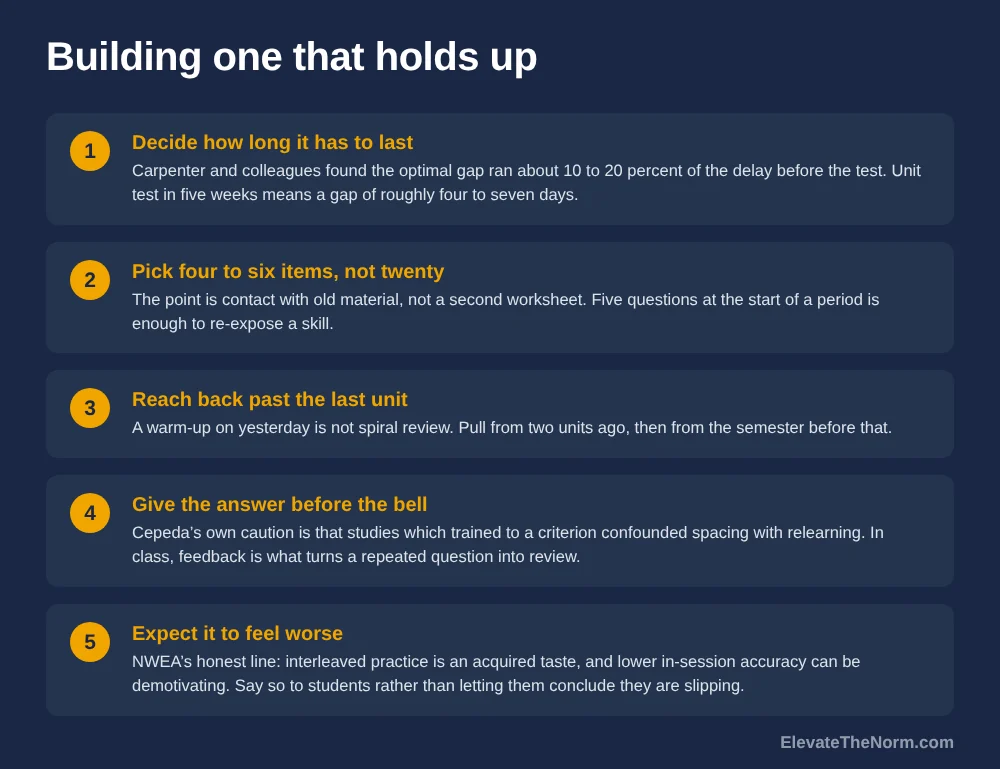
- Decide how long the material has to last, then set the gap from it. Ten to twenty percent of that delay. A unit test five weeks out means a gap of roughly four to seven days.
- Cap it at four to six items. The aim is contact with old material, not a second worksheet. If it eats fifteen minutes, it has stopped being a warm-up and started being a lesson you did not plan.
- Reach back past the last unit. A warm-up on yesterday is not spiral review, it is a recap. Pull from two units ago, and from last semester once you have one.
- Give the answers before the bell. Cepeda’s relearning confound is a warning about research design, but it points at something real for teaching: a question you got wrong and never had corrected is not review, it is rehearsal of the error.
- Tell students it will feel worse. NWEA is honest that interleaved practice is an acquired taste and that lower in-session accuracy “can be demotivating.” If you do not say this out loud, a class that gets four of six wrong concludes it is getting dumber.
- Do not grade it for accuracy. It is deliberately hard and deliberately about material from weeks ago. Grading it for correctness punishes students for the design of the activity.
Where the questions come from, because that is the real cost. Writing five fresh items a week for five preps is not happening, and any version of this that depends on it will die by October. Pull them from assessments you already gave. The questions students missed on the unit test three weeks ago are, by definition, the content worth revisiting, and they are already written. That turns the weekly prep from thirty minutes into about five.
What a coach or administrator should look for is not whether a warm-up is on the board. It is three things: whether the items reach back further than the current unit, whether students get the answers before the period moves on, and whether the gradebook is empty of them. A building that mandates a daily cumulative warm-up and audits completion will get daily recaps of yesterday, graded, which is the one version of this with no evidence behind it at all.
Does cumulative review hold up over a whole year?
The best secondary evidence on this comes from a quizzing study rather than a spacing one. McDaniel, Agarwal, Huelser, McDermott and Roediger (2011) ran quizzes in 8th grade science and reported, in the published abstract, “between 13% and 25% gains in performance on summative unit examinations” — and, importantly here, that “the benefits of quizzing (relative to not quizzing) persisted on cumulative semester and end-of-year exams.”
That is the closest thing to a direct answer a grades 6–12 teacher has: repeated low-stakes contact with content, in a real middle school, still showing up on the end-of-year exam. Two caveats, both mine rather than the authors’. Only the abstract could be retrieved for this article, so the sample size and the stated limitations are not reported here. And a quiz is not the same intervention as a warm-up, though in a classroom they look almost identical.
The same study is the reason the companion article on pre-assessment lands where it does: when those researchers varied when the quiz happened, the review slot before the exam beat the slot before the lecture.
When is spiral review the wrong move?
- When students never learned it the first time. Spacing is a retention tool. Reviewing a skill a student never had is not spiral review, it is a four-minute reteach with no time to do it properly. A difficulty is only desirable when the learner has what they need to overcome it.
- When it is really a fifth worksheet. If the warm-up has grown to fifteen items and gets graded, the cost has outgrown the mechanism. Everything above assumes small and frequent.
- When the questions are all from last week. That is massed practice with extra steps, and massed practice is the condition that lost in all those comparisons.
- When nobody corrects it. A stack of unmarked warm-ups is not distributed practice. It is distributed guessing.
Clay’s take
I think spiral review is one of the few things in this field where the cheap version is most of the benefit. Five questions, old material, answered out loud, four minutes. You do not need a product, a platform or a pacing overhaul, and the mechanism underneath it is about as well established as anything we have.
What I would not do is let anybody sell it to me as a program with a number attached. The number does not exist for spiral review as such. It exists for spacing, measured mostly on adults recalling word lists over intervals shorter than a day, and the three school studies in the literature are grades 1, 5 and 8. That is a thin plank to build a department-wide mandate on, and a perfectly good plank to build a Tuesday warm-up on.
The part I would actually spend effort on is the honesty with students. Spiral review feels bad. They will miss questions they would have aced three weeks ago, and if you do not explain why that is the point, a 14-year-old reads it as evidence they are falling behind. Treating them as young adults here means telling them the design on purpose: this is supposed to be hard, forgetting is normal, and pulling it back is the work.
What to do next
- Pick one class and one day a week. Write five questions from a unit you finished at least three weeks ago.
- Run it for four minutes at the start of the period and give the answers before you move on. Do not put a grade on it.
- Check the gap against the 10 to 20 percent rule: how long do you need this to last, and are you coming back often enough?
- Mix the question types rather than blocking them — that is where interleaving does its work, and it is free.
- If students ask why it feels harder than their usual homework, the study-skills evidence and what cognitive load theory does and does not claim are both reasonable things to point them at.
Frequently Asked Questions
What is spiral review in the classroom?
Spiral review is the deliberate practice of returning to content you already taught, spread across weeks instead of massed before a test. NWEA describes it as revisiting previously learned content throughout the school year to improve retention. In a grades 6-12 classroom it usually looks like a short warm-up, mixed homework items, or a cumulative quiz.
Is spiral review backed by research?
The spacing it relies on is very well evidenced. Cepeda and colleagues (2006) synthesised 839 assessments across 317 experiments, and only 12 of 271 massed-versus-spaced comparisons showed no effect. Spiral review as a packaged routine has not been tested in its own right, and no study of spiral review in mathematics specifically is named in the practitioner reviews.
What is the difference between spiral review and a spiral curriculum?
Spiral review is a classroom practice operating over days and weeks, controlled by the teacher, using content that teacher already taught. A spiral curriculum is a design model from Bruner’s 1960 book in which topics are revisited at rising complexity across years, controlled by states and publishers. Criticisms of the curriculum model are not criticisms of the practice.
How often should spiral review happen?
Set the gap at roughly 10 to 20 percent of how long you need the material to last, which is the rule Carpenter and colleagues report from the spacing literature. A unit test four to six weeks out suggests a gap of about three to eight days. A semester exam suggests something closer to monthly. Longer gaps are not automatically better.
Should spiral review be graded?
No. The activity is deliberately hard and deliberately pulls from material students last saw weeks ago, so accuracy will be low by design. Grading it for correctness penalises students for the structure of the task. Completion credit or no credit at all keeps the incentive pointed at the retrieval rather than at the score.
Why do students do worse on spiral review than on regular practice?
Because mixing and spacing make performance during practice drop even while retention improves. NWEA calls interleaved practice an acquired taste and notes that lower in-session accuracy can be demotivating. Tell students this before you start. Otherwise a class that misses four of six concludes it is getting worse, when the difficulty is the mechanism working.
My child keeps getting the warm-up questions wrong. Should I be worried?
Usually not. Spiral review pulls from material last taught weeks earlier, so low accuracy is built into the design rather than a sign of slipping. Forgetting and then pulling the information back is the mechanism that makes it stick. The fair question for the teacher is whether these are graded for correctness, because they should not be, and whether students get the answers the same day.
Does spiral review work in high school?
Probably, but nobody has shown it directly. The 2012 review of classroom spacing research describes studies at grade 1, grade 5 and grade 8 and none at high school. The closest secondary evidence is a grade 8 science quizzing study whose benefits persisted on cumulative semester and end-of-year exams. Treat the practice as well-reasoned rather than as proven for teenagers.
Sources
- Cepeda, N. J., Pashler, H., Vul, E., Wixted, J. T., & Rohrer, D. (2006). Distributed practice in verbal recall tasks: A review and quantitative synthesis. Psychological Bulletin, 132(3), 354–380. Full text. Source of the 839 assessments / 317 experiments / 184 articles counts, the 12-of-271 figure, the 9 percentage-point short-interval difference, the accuracy table, the 80 percent / 4 percent retention-interval limitation and the relearning confound. Scope caveat: this is a review of verbal recall tasks such as word lists and paired associates, not of classroom content, and the paper reports accuracy differences rather than Cohen’s d for the massed-versus-spaced comparison because effect-size data were insufficient.
- Carpenter, S. K., Cepeda, N. J., Rohrer, D., Kang, S. H. K., & Pashler, H. (2012). Using spacing to enhance diverse forms of learning: Review of recent research and implications for instruction. Educational Psychology Review, 24, 369–378. Full text. Source of the 10–20 percent rule, the Cepeda et al. (2008) gap optima, the grade 8 / grade 5 / grade 1 school studies and their figures, the laboratory caveat, and the open question about three or more sessions. The review describes no high school study. The grade 8 and grade 5 results originate in Carpenter, Pashler & Cepeda (2009) and Sobel, Cepeda & Kapler (2011) respectively.
- Schmidt, W., Houang, R., & Cogan, L. (2002). A Coherent Curriculum: The Case of Mathematics. American Educator, Summer 2002. Full text. Source of “a mile wide and an inch deep,” the repeat-every-year description, and the Japan-versus-US eighth-grade textbook topic counts. Note that the article never uses the word “spiral” — it is cited here for the structural criticism of repeated shallow coverage, which is commonly attached to spiral designs.
- Ireland, J., & Mouthaan, M. (2020). Perspectives on curriculum design: comparing the spiral and the network models. Research Matters, Issue 30, 7–11. Cambridge Assessment. Full text. Source of the Bruner (1960) provenance, the observation about the lack of evidence offered in that book, and the Snider (2004) criticisms of superficial treatment, unnecessary repetition and insufficient cumulative review. This is a literature review, not new empirical work, and the Snider criticisms are reported by it rather than tested by it.
- Kugler, A. (2025, November 13). What does research say about spiral review in mathematics? Teach. Learn. Grow., NWEA. Article. Source of the spiral-review definition, the acquired-taste and demotivation cautions, and the admission that a universal model remains challenging. This is a practitioner synthesis, not a study; it names no study of spiral review in maths specifically and does not state the grade levels of the work it cites.
- McDaniel, M. A., Agarwal, P. K., Huelser, B. J., McDermott, K. B., & Roediger, H. L. (2011). Test-Enhanced Learning in a Middle School Science Classroom: The Effects of Quiz Frequency and Placement. Journal of Educational Psychology, 103(2), 399–414. Abstract. Only the abstract could be retrieved, so the sample size and stated limitations are not reported here. Source of the 13–25 percent range and the persistence on cumulative semester and end-of-year exams.
- What is not cited, and why. The IES practice guide Organizing Instruction and Study to Improve Student Learning could not be opened from this session and is therefore not cited, despite being the obvious federal source on this topic. Several figures circulating in the practitioner literature were traced to blog posts citing other blog posts and were dropped. No number in this article comes from a source that was not opened and read, and no effect size is quoted for spiral review itself because none exists.